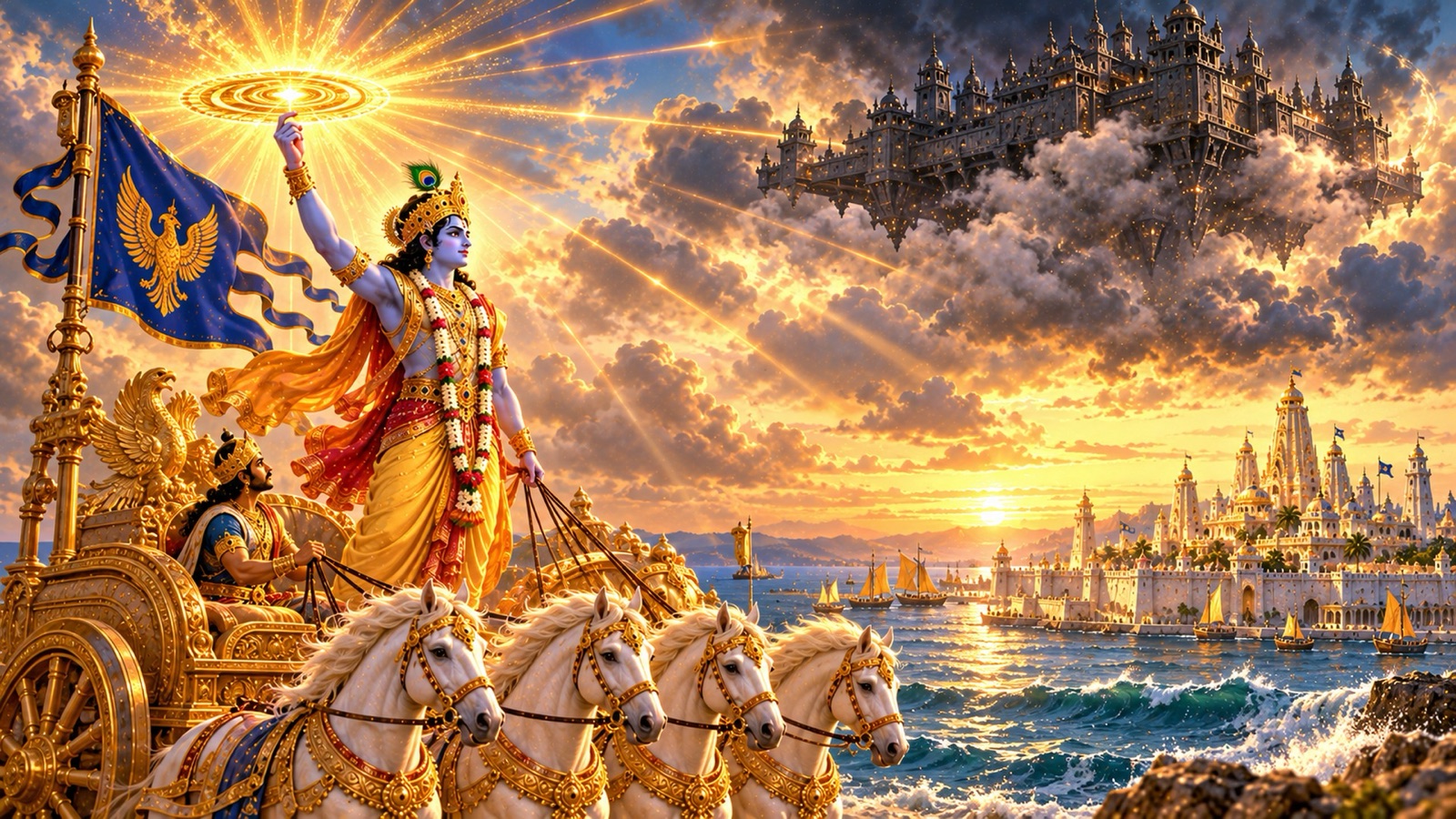
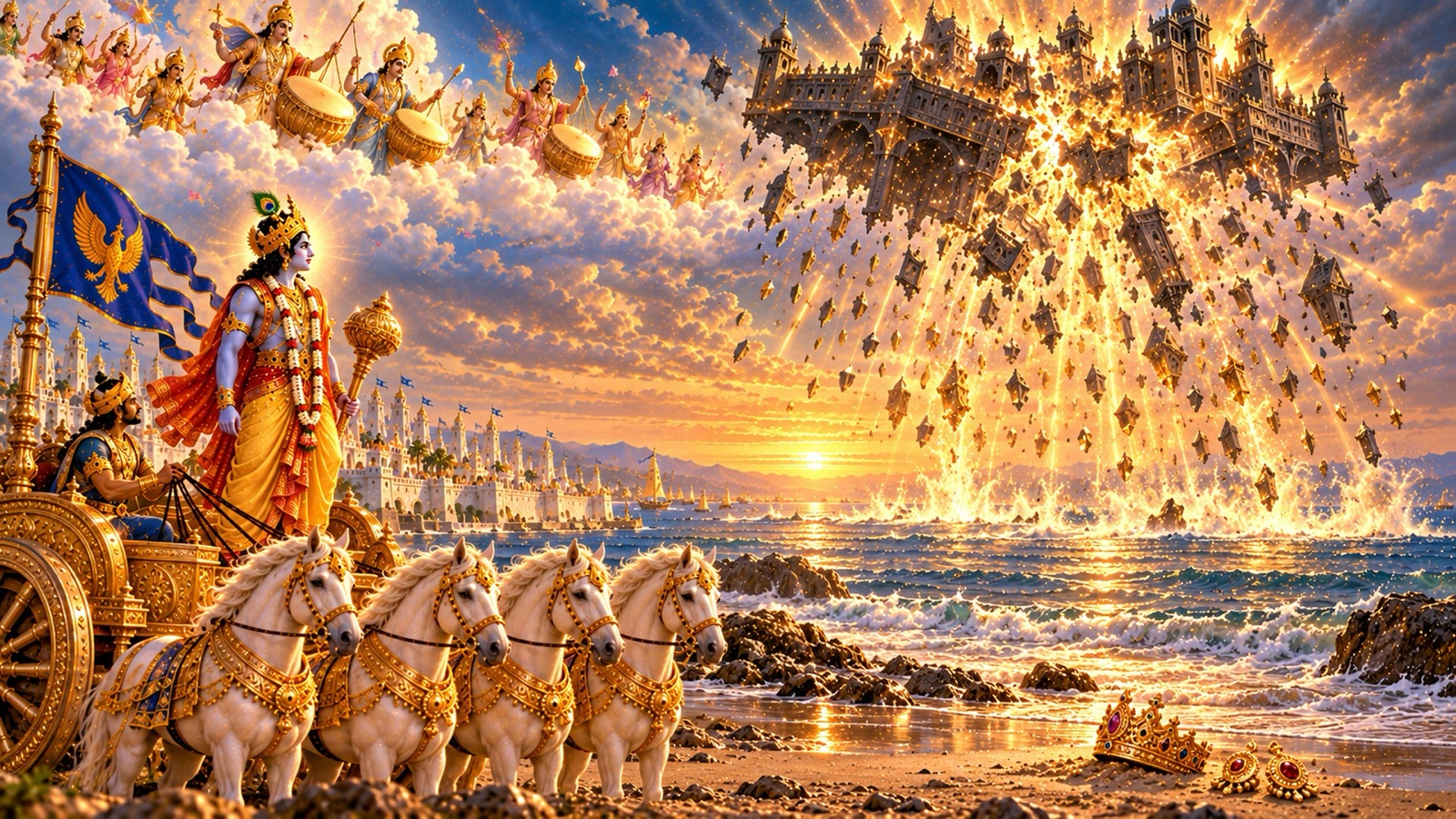
Standing in His chariot beneath the Garuda banner, the Lord lifts His discus, blazing like the sun of the final dissolution, and the sorcerer-king Shalva’s long reign of illusion ends above the waters of Dvaraka.
Om Namo Bhagavate Vasudevaya.
Om Namo Bhagavate Vasudevaya.
Om Namo Bhagavate Vasudevaya.
Welcome back to Srimad Bhagavatam Wisdom, our devotional journey through the sacred histories and teachings of the Srimad Bhagavat Mahapurana. In this seventy-seventh chapter of the Tenth Canto, Pradyumna rides back into battle, Krishna hurries home from Indraprastha to find Dvaraka besieged, and Shalva, the magician who rules the flying city Saubha, meets the Lord face to face — with weapons first, and then with a conjured Vasudeva. Sukadeva pauses to tell King Parikshit plainly who Krishna is, before the Sudarshana discus rises like the sun.
Chapter Information
- Scripture: Śrīmad Bhāgavata Mahāpurāṇa
- Canto: 10 (Book Ten, Latter Half)
- Chapter: 77 (Discourse 77)
- Chapter title: Lord Krishna Slays the Demon Shalva
- Principal speaker: Sukadeva Gosvami (narrating to King Parikshit)
- Principal listener: King Parikshit
- Main setting: The shore and sea of Dvārakā, beneath Shalva’s aerial city Saubha
- Central subject: Pradyumna’s victory over Dyuman; Krishna’s return from Indraprastha; His duel with Shalva; the illusion of Vasudeva’s death; Sukadeva’s teaching that delusion can never touch the Lord; the destruction of Saubha and the slaying of Shalva
- Principal verse range: Canto 10, Chapter 77, verses 1–37
- Primary edition: Gita Press Śrīmad Bhāgavata Mahāpurāṇa (English, Part II)
Context From the Previous Chapter
In Chapter 76 Shalva, who had vowed to rid the earth of the Yadus, descended on Dvaraka in the aerial city Saubha he had won from Lord Shiva. Pradyumna led the defence, but Shalva’s minister Dyuman felled him with a mace, and his charioteer, following the code of battle, bore him from the field — to Pradyumna’s bitter shame when he awoke.
Pradyumna Rides Back to Dyuman
Pradyumna did not argue long with his charioteer. He sipped water to purify himself, fastened his armour, took up his bow and said simply, “Drive me to the side of the warrior Dyuman.” Dyuman was at that moment scattering the Yadava ranks. Pradyumna checked his onslaught and, smiling, loosed eight iron shafts: four for the horses, one for the driver, one each for the bow and the banner, and the last for Dyuman’s head. Meanwhile Gada, Satyaki, Samba and the other heroes mowed down Shalva’s host, and the soldiers of Saubha fell one after another into the sea. So the two armies struck at each other, and the terrible battle raged without pause for twenty-seven days and nights.
Krishna Hurries Home From Indraprastha
All this while Krishna was at Indraprastha, where Yudhishthira had invited Him to the Rajasuya sacrifice. When the sacrifice was complete and Shishupala had been slain, the Lord took leave of the Kuru elders, the sages, Kunti and the Pandavas and set out for Dvaraka; and on the road He saw omens of the most frightening kind. He said to Himself: “I came away here together with My elder brother. Surely the kings of Shishupala’s party are attacking My city.” Reaching Dvaraka, He saw the havoc wrought on His people. He placed the defence of the city in Balarama’s hands and, marking Shalva and his floating fortress, turned to His charioteer Daruka.
रथं प्रापय मे सूत शाल्वस्यान्तिकमाशु वै ।
सम्भ्रमस्ते न कर्तव्यो मायावी सौभराडयम् ॥ १० ॥
rathaṁ prāpaya me sūta śālvasyāntikam āśu vai sambhramas te na kartavyo māyāvī saubha-rāḍ ayam
Meaning: “Charioteer, bring My chariot quickly to Shalva. You must not be alarmed — this lord of Saubha is a master of magic.” (Canto 10, Chapter 77, verse 10)
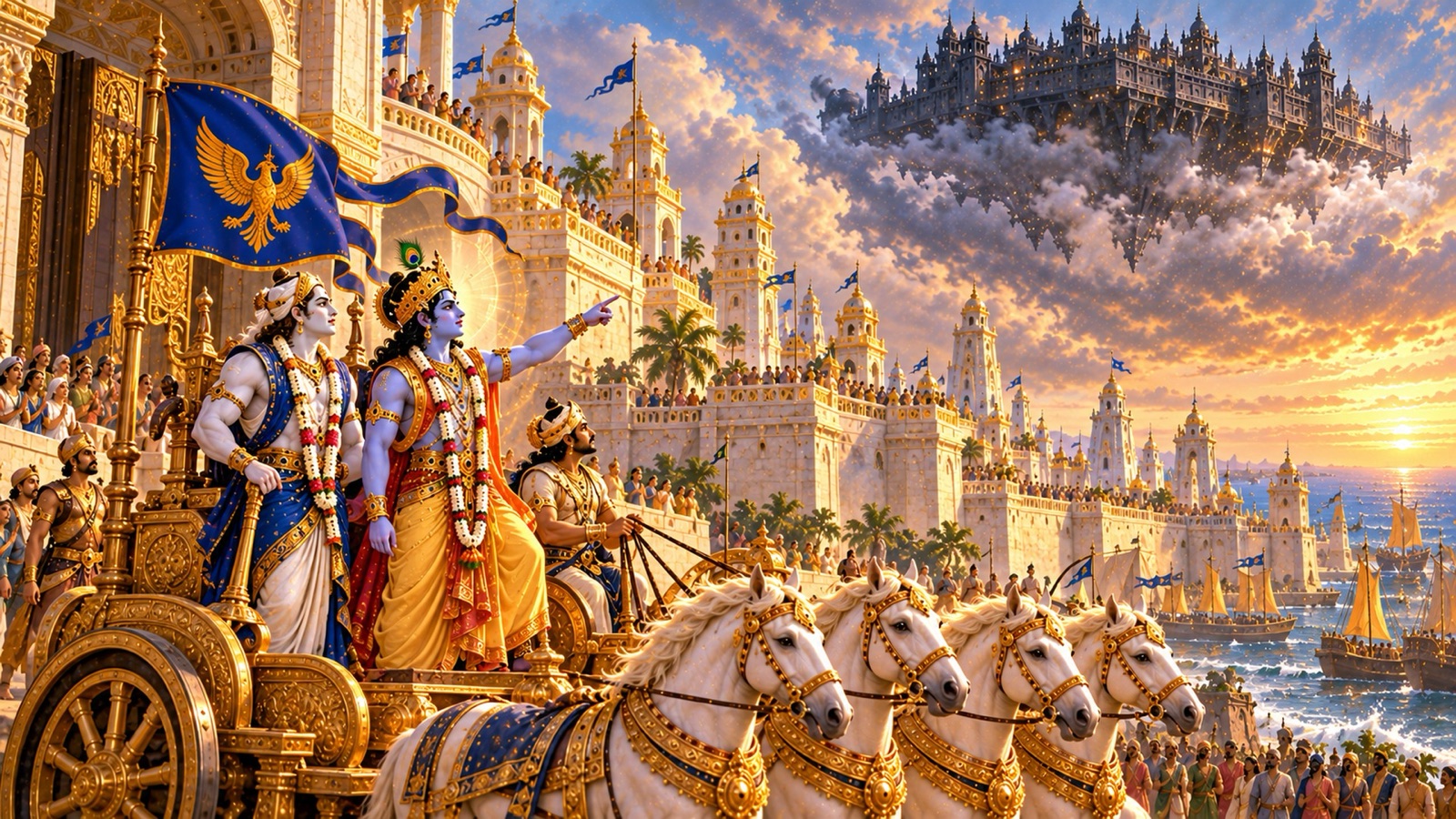
Daruka mounted and drove, and as the chariot entered the field, friend and foe alike knew the Lord by the emblem of Garuda flying on His banner.
The Duel With Shalva
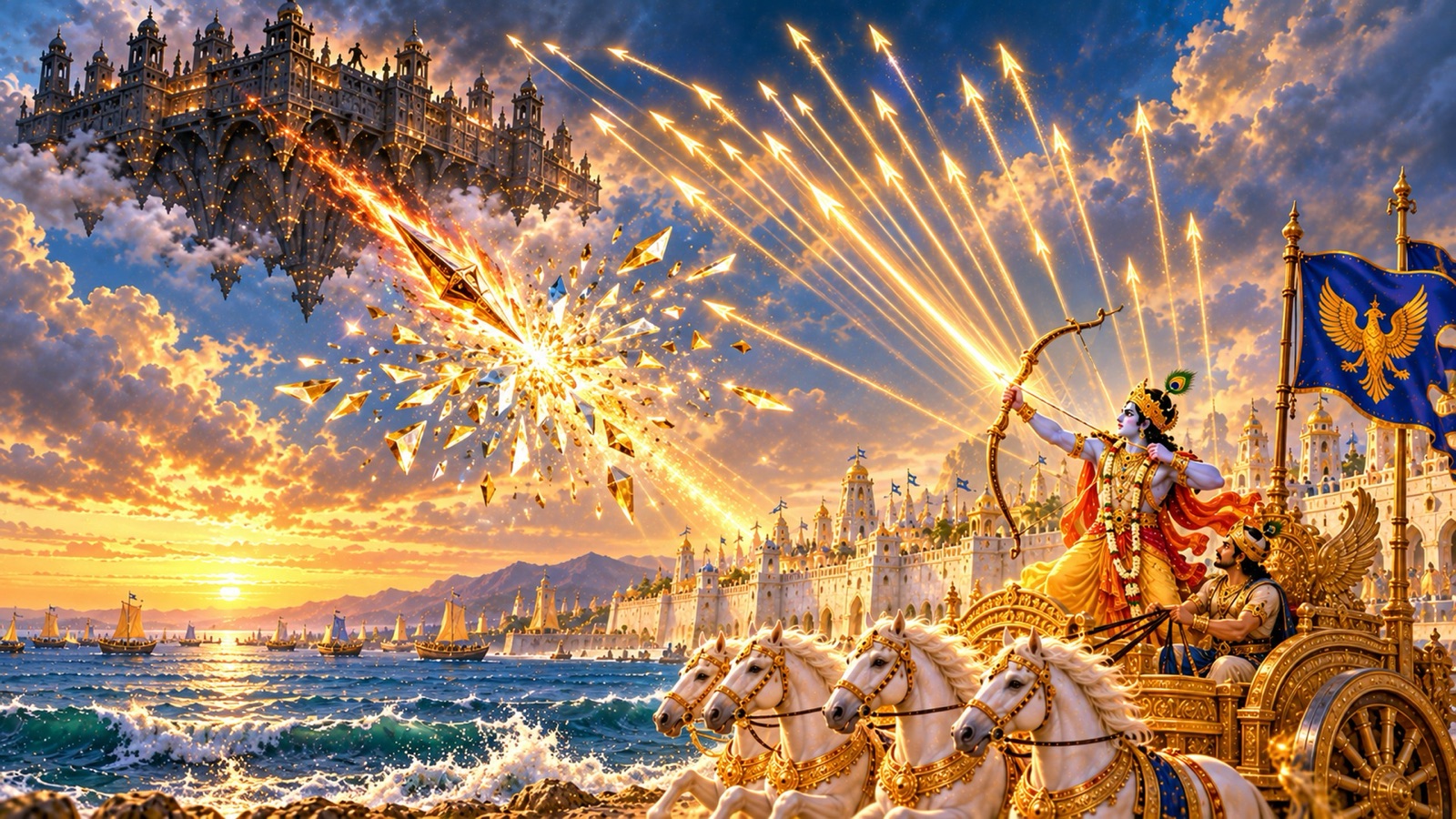
Shalva’s army was by now almost destroyed. Seeing Krishna, he hurled a dreadful, roaring lance at Daruka; it tore through the sky like a great meteor, lighting the quarters as it fell. The Lord split it into a hundred pieces with His arrows, then pierced Shalva with sixteen shafts and filled the wheeling Saubha with torrents of arrows, as the sun fills the heavens with its rays. Then Shalva struck the Lord’s left arm, and the Sharnga bow slipped from His hand. All who watched, in the sky and on the earth, cried out in wonder and dread at that astonishing feat.
Emboldened, the lord of Saubha roared his taunt. “Fool! Before our very eyes you carried off the bride of our friend and brother Shishupala, and then you killed him in the midst of the assembly when he was off his guard. You think yourself unconquerable. Stand before me today, and with my sharp arrows I will send you to the place from which none return.”
श्रीभगवानुवाच
वृथा त्वं कत्थसे मन्द न पश्यस्यन्तिकेऽन्तकम् ।
पौरुषं दर्शयन्ति स्म शूरा न बहुभाषिणः ॥ १९ ॥
śrī-bhagavān uvāca vṛthā tvaṁ katthase manda na paśyasy antike ‘ntakam pauruṣaṁ darśayanti sma śūrā na bahu-bhāṣiṇaḥ
Meaning: The Lord said: “Dull-witted one, you boast in vain, not seeing Death standing beside you. Heroes show their valour; they are not men of many words.” (Canto 10, Chapter 77, verse 19)
With that the Lord, roused to anger, swung His mace with terrible force upon Shalva’s collar-bone. The sorcerer shuddered and vomited blood, and as the mace returned to the Lord’s hand he vanished from sight.
The Cruellest Illusion
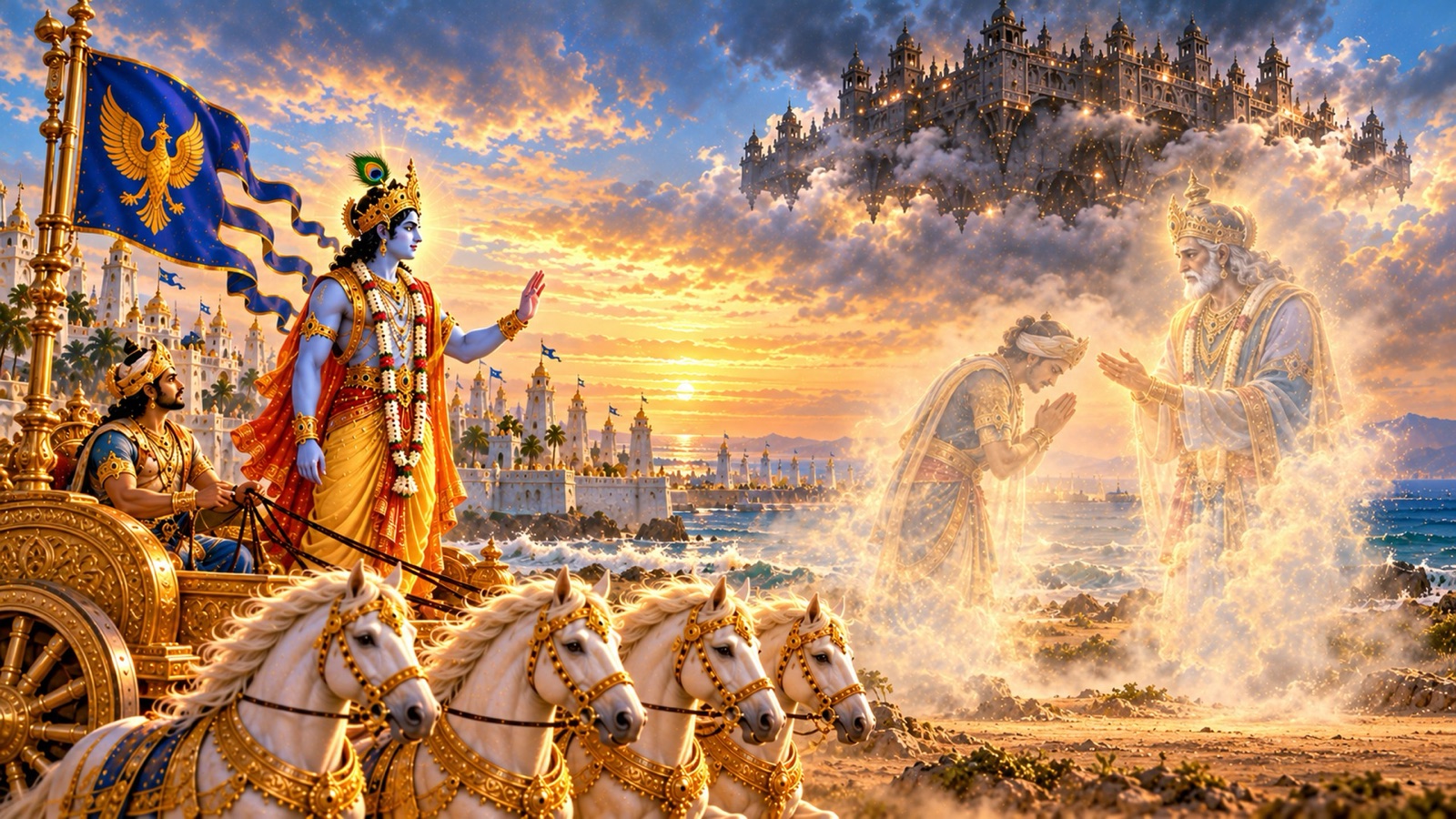
A moment later a man came walking across the field. He bowed his head to Krishna and, weeping, said he had been sent by Devaki: “Krishna, Krishna, mighty-armed, so devoted to Your parents — Shalva has bound Your father and dragged him away, as a butcher drags a beast to the slaughter.” Hearing this unwelcome news the Lord, who had assumed human nature, grew troubled at heart; out of tenderness and affection He spoke as an ordinary man might speak.
कथं राममसम्भ्रान्तं जित्वाजेयं सुरासुरैः ।
शाल्वेनाल्पीयसा नीतः पिता मे बलवान् विधिः ॥ २४ ॥
kathaṁ rāmam asambhrāntaṁ jitvājeyaṁ surāsuraiḥ śālvenālpīyasā nītaḥ pitā me balavān vidhiḥ
Meaning: “How could the puny Shalva overcome Balarama — never flustered, unconquerable even by gods and demons — and carry off My father? Truly, fate is strong.” (Canto 10, Chapter 77, verse 24)
Even as Govinda spoke, Shalva appeared before Him leading one who looked like Vasudeva, and jeered: “Here is the father who begot you, for whose sake you live! I will kill him while you watch. Save him if you can, you fool.” With this threat the magician seemed to sever that figure’s head with his sword and, carrying it off, rose into the Saubha, which hung close by in the air.
For one moment the great-souled Lord, whose knowledge is rooted in His own being, appeared overcome by natural feeling through His attachment to His kin. Then He recognised the demonic magic for what it was — the art that the asura Maya had taught, now spread before Him by Shalva.
न तत्र दूतं न पितुः कलेवरं
प्रबुद्ध आजौ समपश्यदच्युतः ।
स्वाप्नं यथा चाम्बरचारिणं रिपुं
सौभस्थमालोक्य निहन्तुमुद्यतः ॥ २९ ॥
na tatra dūtaṁ na pituḥ kalevaraṁ prabuddha ājau samapaśyad acyutaḥ svāpnaṁ yathā cāmbara-cāriṇaṁ ripuṁ saubha-stham ālokya nihantum udyataḥ
Meaning: Fully awake, Acyuta found on the battlefield neither the messenger nor His father’s body — they had been like figures in a dream; and beholding His enemy riding the sky in Saubha, He prepared to kill him. (Canto 10, Chapter 77, verse 29)
Sukadeva Speaks Plainly About the Lord
Here Sukadeva turns from the battle to Parikshit with words that steady the whole account. Some sages, he says, tell the story in this way — that Krishna grieved — but they do not reflect carefully; they forget that such a claim contradicts what they themselves have said of Him elsewhere.
क्व शोकमोहौ स्नेहो वा भयं वा येऽज्ञसम्भवाः ।
क्व चाखण्डितविज्ञानज्ञानैश्वर्यस्त्वखण्डितः ॥ ३१ ॥
kva śoka-mohau sneho vā bhayaṁ vā ye ‘jña-sambhavāḥ kva cākhaṇḍita-vijñāna- jñānaiśvaryas tv akhaṇḍitaḥ
Meaning: Where are grief, delusion, attachment or fear, which are born of ignorance — and where is He, the undivided One, whose realisation, knowledge and sovereignty are never divided? (Canto 10, Chapter 77, verse 31)
यत्पादसेवोर्जितयात्मविद्यया
हिन्वन्त्यनाद्यात्मविपर्ययग्रहम् ।
लभन्त आत्मीयमनन्तमैश्वरं
कुतो नु मोहः परमस्य सद्गतेः ॥ ३२ ॥
yat-pāda-sevorjitayātma-vidyayā hinvanty anādyātma-viparyaya-graham labhanta ātmīyam anantam aiśvaraṁ kuto nu mohaḥ paramasya sad-gateḥ
Meaning: Through the self-knowledge that grows strong by serving His feet, the sages cast off the beginningless misconception that the body is the self and attain their own infinite divine glory. How, then, could delusion touch Him, the Supreme, the refuge of the saintly? (Canto 10, Chapter 77, verse 32)
This is the heart of the chapter, and a Vaishnava teacher would linger here. Why did the Lord let Himself appear stricken at all? Because He had taken on human nature for the sake of His pastimes, and in that nature He shows the world exactly what a loving son feels — yet Sukadeva will not let us mistake the play for the player. Shalva’s magic conjured a father’s body and its death; the Lord’s awakening showed it to be a dream. That is the whole of maya in a single scene: it presents us with loss where nothing has been lost, and it is dispelled the instant we look with awakened eyes. The sages gain those eyes by serving His feet; the One whose feet are served cannot Himself be in the dark. Our grief, our fear and our clinging are the measure of our ignorance, and the same service that frees the sages frees us.
The Fall of Saubha and of Shalva
Shalva now assailed the Lord with a storm of weapons, but Krishna, whose prowess never fails, pierced him with arrows, broke his armour, bow and crest-jewel, and smashed the Saubha with His mace. Shattered by that blow, the aerial city broke into a thousand fragments and sank into the sea. Shalva leapt from it, stood upon the ground, and rushed at Krishna with his mace raised; the Lord cut off that mace-bearing arm with a broad-headed arrow. Then, to finish Shalva, He took up His wondrous discus, radiant as the sun at the dissolution of the worlds, and holding it aloft He shone like the eastern mountain crowned with the rising sun. With that discus Hari struck off the head of the great magician, crown and earrings and all, as Indra once struck Vritra with the thunderbolt; and a cry of anguish rose from Shalva’s men.
तस्मिन् निपतिते पापे सौभे च गदया हते ।
नेदुर्दुन्दुभयो राजन् दिवि देवगणेरिताः ।
सखीनामपचितिं कुर्वन् दन्तवक्रो रुषाभ्यगात् ॥ ३७ ॥
tasmin nipatite pāpe saubhe ca gadayā hate nedur dundubhayo rājan divi deva-gaṇeritāḥ sakhīnām apacitiṁ kurvan dantavakro ruṣābhyagāt
Meaning: When that sinner had fallen and Saubha lay broken by the mace, O King, the gods sounded their kettledrums in heaven. Then Dantavaktra, seeking to avenge his friends, rushed up in fury. (Canto 10, Chapter 77, verse 37)
Principal Teachings of This Chapter
1. A hero returns to his duty without delay. Pradyumna, ashamed of leaving the field, does not brood; he purifies himself, arms himself and goes straight back to Dyuman. Devotion, too, is proven by how quickly we return after a fall.
2. There is no room for panic in the Lord’s service. Krishna’s first word to Daruka (verse 10) is that he must not be alarmed, though their enemy is a master of magic. The servant who rides with the Lord has nothing to fear from any illusion.
3. Valour speaks through deeds. The Lord’s reply to Shalva (verse 19) is a rule for every spiritual life: the truly strong do not advertise their strength; they act.
4. The Lord’s sorrow is His play, not His bondage. Krishna’s lament for His father (verse 24) is spoken, as Sukadeva says, in the human nature He had assumed. He shares our tears so that we may share His freedom.
5. Ignorance alone breeds grief, delusion, attachment and fear. Verse 31 names the four exactly and places them where they belong — in the unawakened — never in the One whose knowledge and power are whole.
6. Service to His feet is the cure for beginningless delusion. Verse 32 is both a doctrine and a promise: those who serve His feet shed the age-old error of mistaking the body for the self, and gain a glory that is their own.
A Devotional Reflection
Of all Shalva’s weapons, the one that reached closest to the Lord was not the lance or the mace but a lie — a weeping messenger, a familiar face, a death that never happened. It is sobering to recognise our own lives in that moment. How often are we undone not by what is real but by what we are shown: a fear dressed as news, a loss imagined in detail, a separation that exists only in the mind’s theatre? Krishna lets the illusion play for a heartbeat, and then He simply looks, and there is nothing there. Sukadeva insists that this looking is not a feat the Lord performs; it is what He is. For us it is a practice. Each time grief, confusion, clinging or dread rises, we can ask whose magic has conjured it, and turn our eyes to the feet of the One who was never deceived. We need not be sages to begin. We need only to look, as He looked, and to find that the messenger has gone.
A Daily Devotional Practice
Today, when a fear or a sorrow presents itself with the full conviction of a messenger from home, pause before you believe it. Breathe, and silently place the matter at Krishna’s feet with the words of the sages: “Where are grief and fear, born of ignorance — and where is He?” Then recall the chapter’s thirty-first and thirty-second verses and rest in their steadiness for a few minutes. Close by chanting gently: Om Namo Bhagavate Vasudevaya.
Conclusion
The seventy-seventh chapter of the Tenth Canto brings the war of Saubha to its end. Pradyumna redeems his retreat, the Lord returns to defend His city, and Shalva’s every weapon — lance, arrow, mace and finally sorcery — breaks against Him, until the Sudarshana discus finishes the magician and the gods beat their drums in heaven. Yet the chapter’s lasting gift is Sukadeva’s calm correction: the Lord who seemed to weep was never bound, and the service of His feet that frees the sages from beginningless delusion is open to us all. May we hold that truth whenever illusion comes bearing bad news.
May the divine wisdom of Srimad Bhagavatam awaken pure devotion within our hearts.
Om Namo Bhagavate Vasudevaya.
Jay Shree Madhav.
References and Attribution
- Primary edition: Gita Press, Śrīmad Bhāgavata Mahāpurāṇa (English, Part II), Book Ten (Latter Half), Discourse 77.
- Series: Srimad Bhagavatam Wisdom · Biswa Sanatan Dharma Seva Trust.
- Presented following the spiritual guidance and recommendation of Pandit Dr. Shri Kashinath Mishra.
This is an original, faithful retelling in the writer’s own words, with brief quoted verses shown in Devanāgarī and transliteration and their meanings given as summaries. It is not a reproduction of any single publisher’s continuous translation or commentary. No affiliation with or endorsement by any publisher is implied.
Jay Shree Madhav