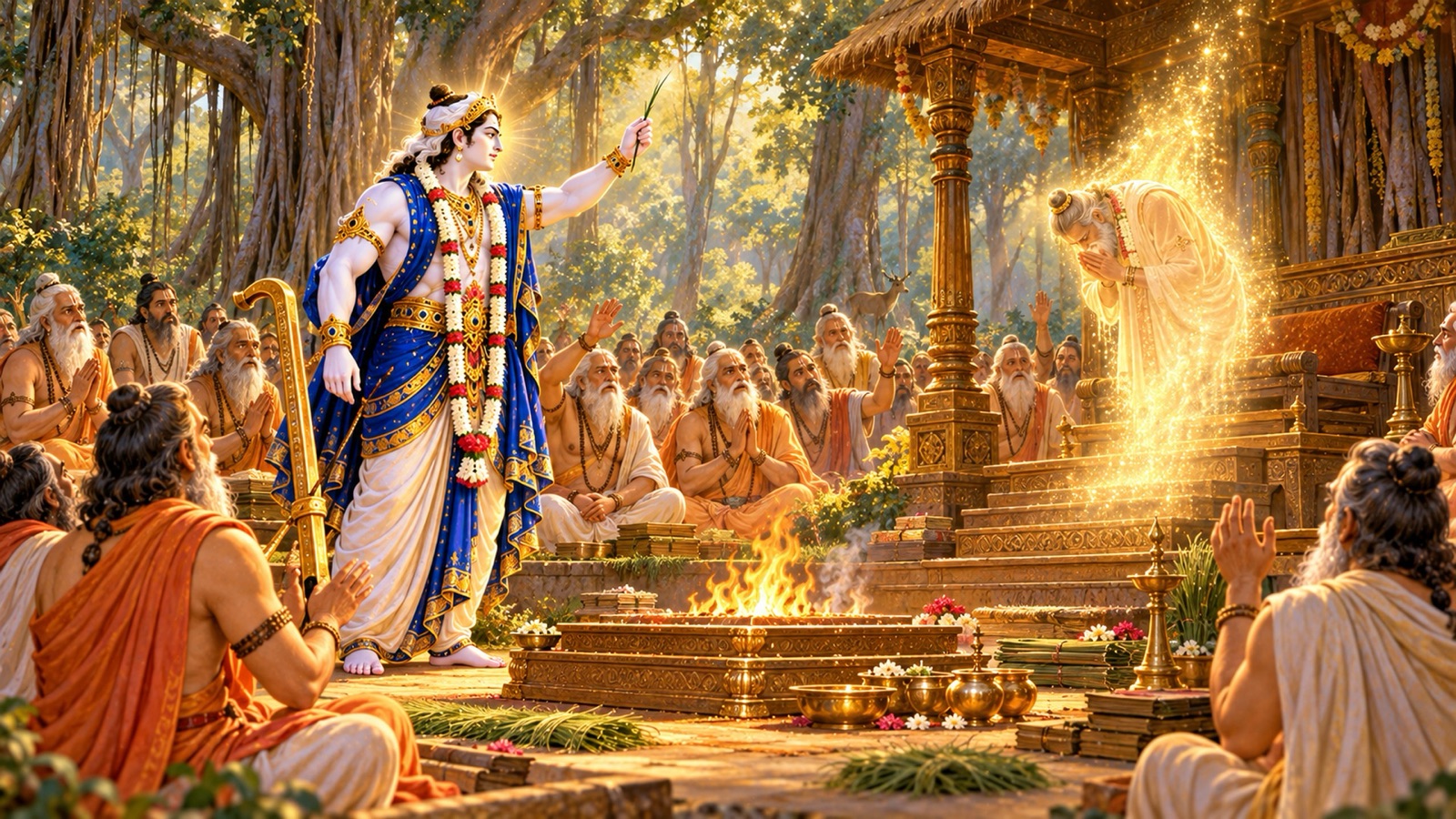
A proud warrior falls before Krishna’s mace, and at Naimisaranya a single blade of kusa grass in Balarama’s hand teaches the sages that scholarship without humility is only a role played on a stage.
Om Namo Bhagavate Vasudevaya.
Om Namo Bhagavate Vasudevaya.
Om Namo Bhagavate Vasudevaya.
Welcome back to Srimad Bhagavatam Wisdom, our devotional journey through the sacred histories and teachings of the Srimad Bhagavat Mahapurana. In this seventy-eighth chapter of the Tenth Canto, Sukadeva first completes the account of Krishna’s enemies, Dantavakra and his brother Viduratha, and then follows Balarama on pilgrimage to the great sacrifice of the sages at Naimisaranya, where pride on the speaker’s seat becomes a lesson for the world.
Chapter Information
- Scripture: Śrīmad Bhāgavata Mahāpurāṇa
- Canto: 10 (Book Ten, Latter Half)
- Chapter: 78 (Discourse 78)
- Chapter title: The Killing of Dantavakra, Viduratha and Romaharshana
- Principal speaker: Sukadeva Gosvami (narrating to King Parikshit)
- Principal listener: King Parikshit
- Main setting: The battlefield and city of Dvaraka; the holy places along the Sarasvati; the forest of Naimiṣāraṇya
- Central subject: The deliverance of Dantavakra and Viduratha; Balarama’s pilgrimage; the fall of Romaharshana Suta and the sages’ prescription of atonement
- Principal verse range: Canto 10, Chapter 78, verses 1–40
- Primary edition: Gita Press Śrīmad Bhāgavata Mahāpurāṇa (English, Book Ten, Latter Half)
Context From the Previous Chapter
In Chapter 77, Shalva deceived Krishna with an illusion of Vasudeva’s capture, but the Lord saw through the magic, shattered the aerial city Saubha and cut off Shalva’s head with the Sudarshana discus. As that chapter closed, Dantavakra marched out in rage to avenge his fallen friends.
Dantavakra Comes Alone to the Field
Sukadeva continued: Dantavakra, the dull-witted king of Karusha, was a dear friend of Shishupala, Shalva and Paundraka, all of whom had departed this world at Krishna’s hands. Wishing to repay his friendship to the dead, he came to fight the Lord entirely alone — no army, no chariot, nothing in his hand but a mace. Yet so vast was his strength that the earth trembled beneath his feet as he strode forward.
Seeing him approach in that manner, Krishna at once seized His own mace, sprang down from His chariot and checked Dantavakra’s advance, just as the shore holds back the surging sea.
तं तथायान्तमालोक्य गदामादाय सत्वर: ।
अवप्लुत्य रथात् कृष्ण: सिन्धुं वेलेव प्रत्यधात् ॥ ३ ॥
taṁ tathāyāntam ālokya gadām ādāya satvaraḥ avaplutya rathāt kṛṣṇaḥ sindhuṁ veleva pratyadhāt
Meaning: Observing him coming in that way, Krishna quickly took up His mace, leaped from His chariot and stood in his path, as a shoreline resists the ocean. (Canto 10, Chapter 78, verse 3)
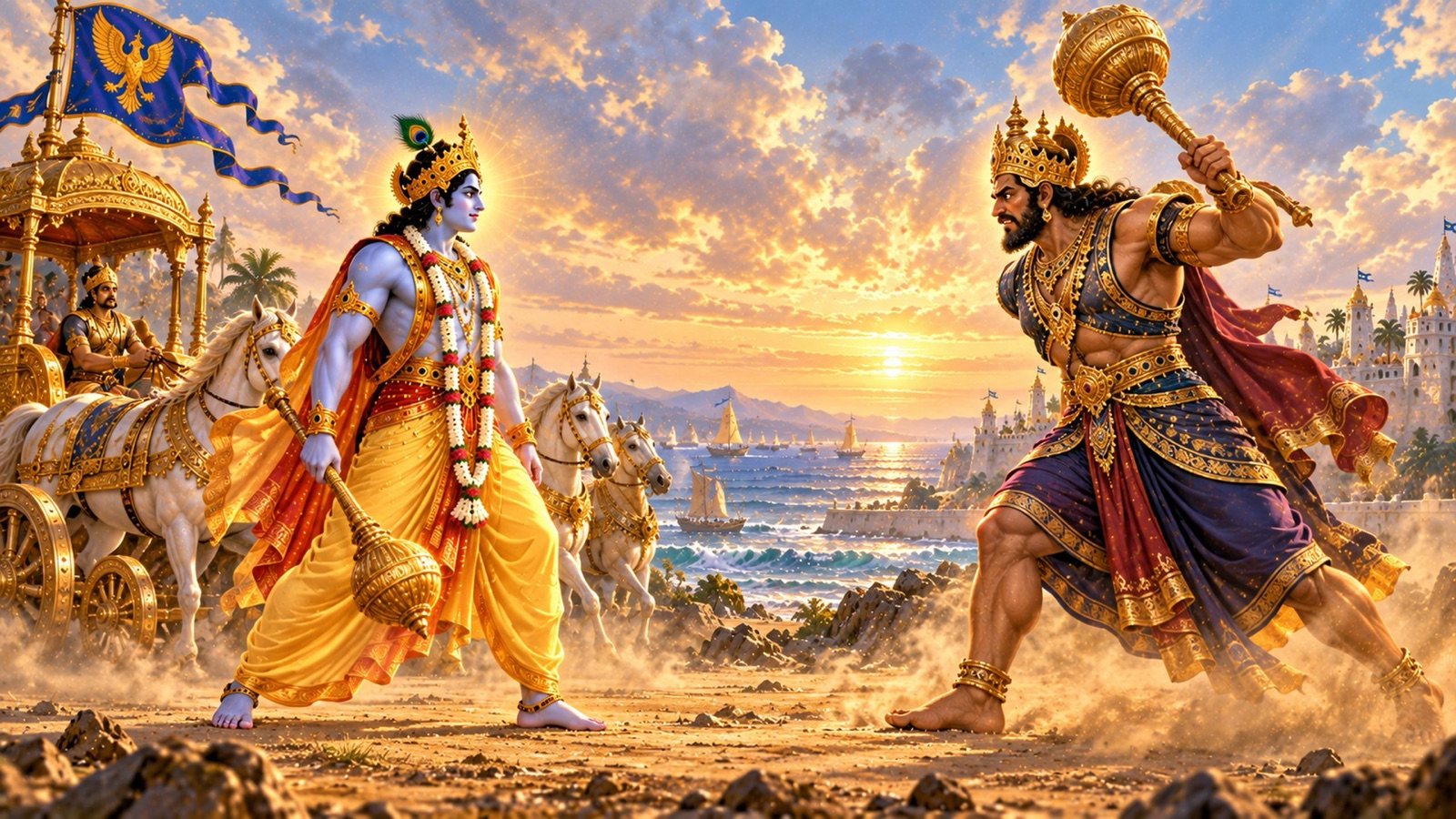
Lifting his mace, the arrogant king spoke to Mukunda with mocking delight: ‘How fortunate, O Krishna, that today you have come within my sight! You are my cousin, yet you have slain my friends and now seek my life too. So, fool, I shall destroy you with this mace, hard as the thunderbolt. Only by killing you — an enemy wearing the face of a kinsman, like a disease lodged in the body — can I repay my debt to my friends.’
Having pricked the Lord with these harsh words as a driver goads an elephant, Dantavakra brought his mace down upon Krishna’s head and roared like a lion. But the jewel of the Yadus did not move even a step. With His own heavy mace, the Kaumodaki, Krishna struck him on the chest; his heart torn open, Dantavakra lost his life and sank to the earth, his hair, arms and legs flung outward.
Then, O King, exactly as when Shishupala was slain, a very subtle light rose from Dantavakra and, while all looked on in wonder, entered into Krishna.
तत: सूक्ष्मतरं ज्योति: कृष्णमाविशदद्भुतम् ।
पश्यतां सर्वभूतानां यथा चैद्यवधे नृप ॥ १० ॥
tataḥ sūkṣmataraṁ jyotiḥ kṛṣṇam āviśad adbhutam paśyatāṁ sarva-bhūtānāṁ yathā caidya-vadhe nṛpa
Meaning: Thereupon a most subtle and wonderful effulgence passed into Krishna before the eyes of every creature present, just as at the killing of the king of Chedi, O ruler of men. (Canto 10, Chapter 78, verse 10)
Viduratha’s Fall and the Lord’s Return to Dvaraka
Dantavakra’s brother Viduratha, drowning in grief for his brother, now came panting onto the field with sword and shield, bent on killing Krishna. As he charged, the Lord took off his head, crown and earrings and all, with the razor-rimmed Sudarshana discus.
Thus, having destroyed Saubha, Shalva, Dantavakra and his younger brother — foes no one else could have withstood — Krishna was praised by gods and men. Sages, Siddhas, Gandharvas, Vidyadharas, great serpents, Apsaras, the forefathers, Yakshas, Kinnaras and Charanas sang of His victory and rained flowers upon Him, and surrounded by the foremost Vrishnis He entered His decorated city.
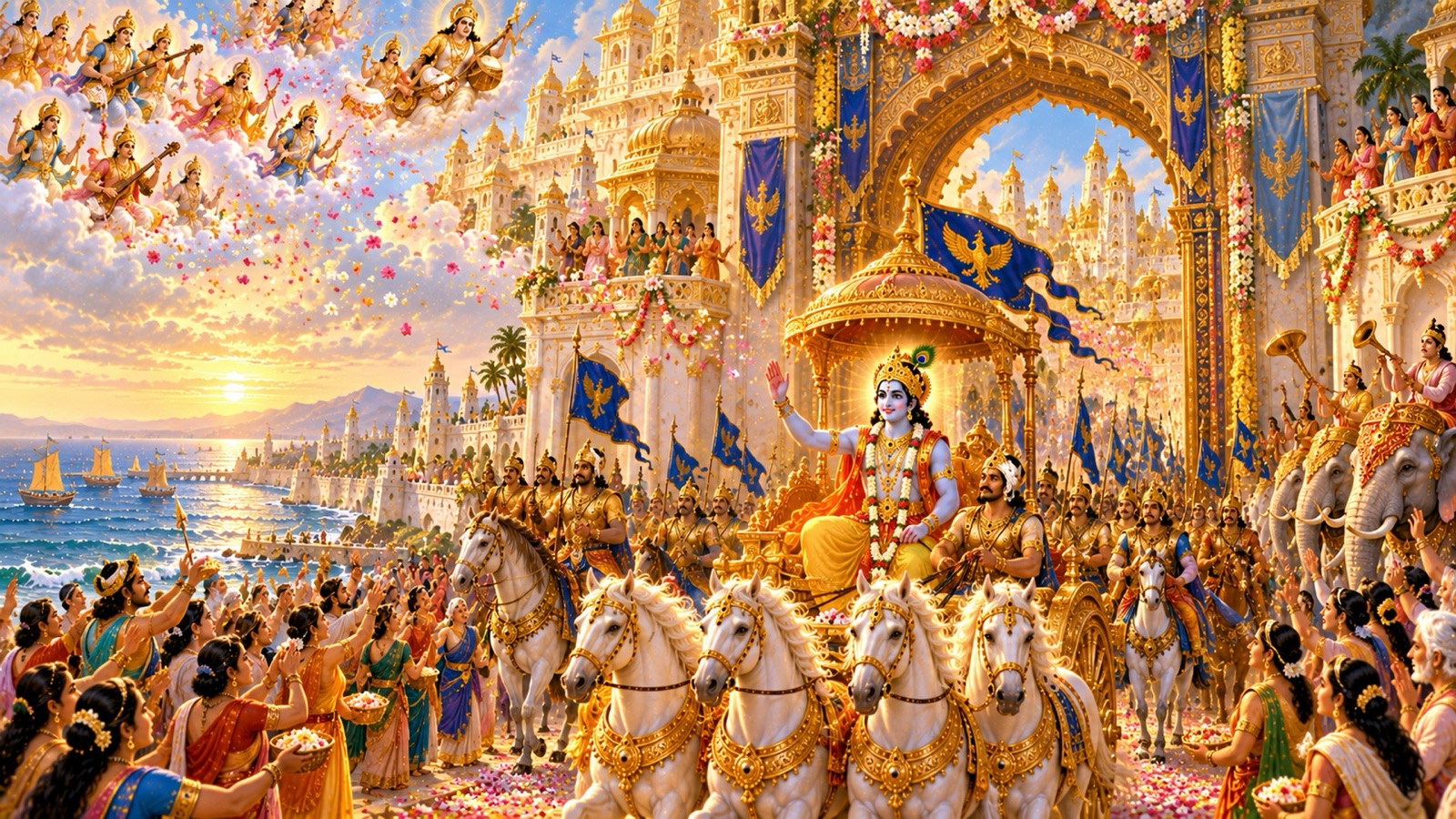
Here Sukadeva pauses on a truth that lies beneath every battle of the Lord: though Krishna, the master of yoga, may at times look defeated to those of animal vision, He is forever victorious.
एवं योगेश्वर: कृष्णो भगवान् जगदीश्वर: ।
ईयते पशुदृष्टीनां निर्जितो जयतीति स: ॥ १६ ॥
evaṁ yogeśvaraḥ kṛṣṇo bhagavān jagad-īśvaraḥ īyate paśu-dṛṣṭīnāṁ nirjito jayatīti saḥ
Meaning: In this way the Supreme Lord Krishna, master of yoga and controller of the worlds, appears to people whose sight is like that of beasts to be sometimes conquered; yet it is He who always conquers. (Canto 10, Chapter 78, verse 16)
Balarama Sets Out on Pilgrimage
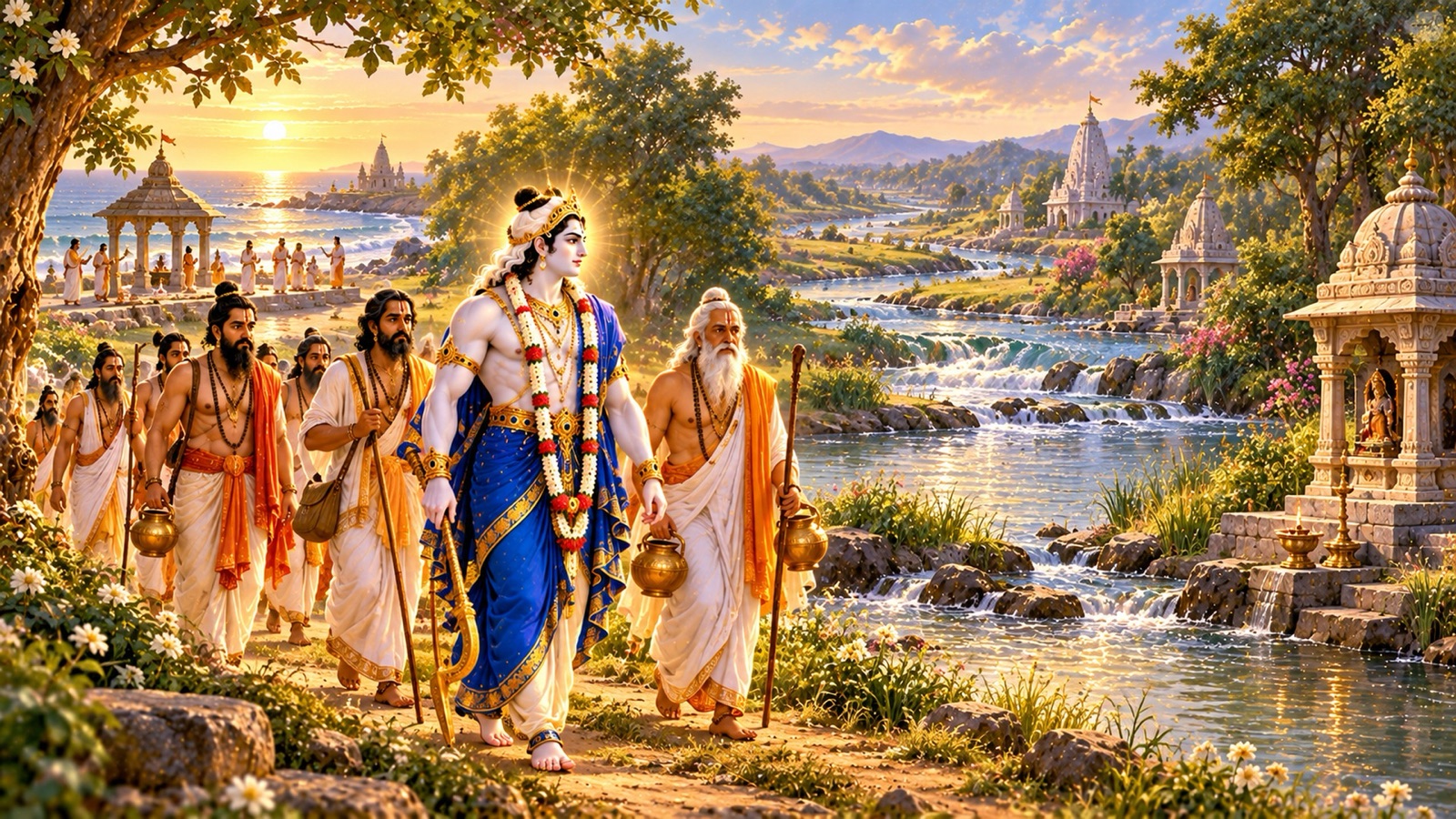
Now the narration turns to Balarama. Hearing that the Kurus were preparing for war with the Pandavas, He wished to remain neutral, and so, on the pretext of bathing in holy waters, He departed from Dvaraka. At Prabhasa He bathed in the sea and satisfied the gods, sages and forefathers with offerings of water, and human beings with food. Then, accompanied by brahmanas, He travelled upstream along the Sarasvati, visiting Prithudaka, Bindusara, Tritakupa, Sudarshana, Vishala, Brahmatirtha, Chakratirtha and the place where the Sarasvati turns toward the east. Passing the holy sites along the Yamuna and the Ganga, He came at last to Naimisaranya, where the sages were holding a long sacrifice.
Romaharshana on the Speaker’s Seat
Recognising who had come among them, the sages of that long sacrifice rose, welcomed and bowed to Balarama, and worshipped Him, each according to his standing. When He had taken His seat with His companions, Balarama noticed Romaharshana, the disciple of the great sage Vyasa, seated upon the elevated seat of the speaker.
A Suta by birth, he sat higher than the brahmanas, and he had neither risen when the Lord entered nor bowed with folded palms. Seeing this, Madhava grew angry.
अप्रत्युत्थायिनं सूतमकृतप्रह्वणाञ्जलिम् ।
अध्यासीनं च तान् विप्रांश्चुकोपोद्वीक्ष्य माधव: ॥ २३ ॥
apratyutthāyinaṁ sūtam akṛta-prahvaṇāñjalim adhyāsīnaṁ ca tān viprāṁś cukopodvīkṣya mādhavaḥ
Meaning: Beholding that Suta, who had not stood up, had made no bow with joined hands, and was seated above those brahmanas, Madhava became angry. (Canto 10, Chapter 78, verse 23)
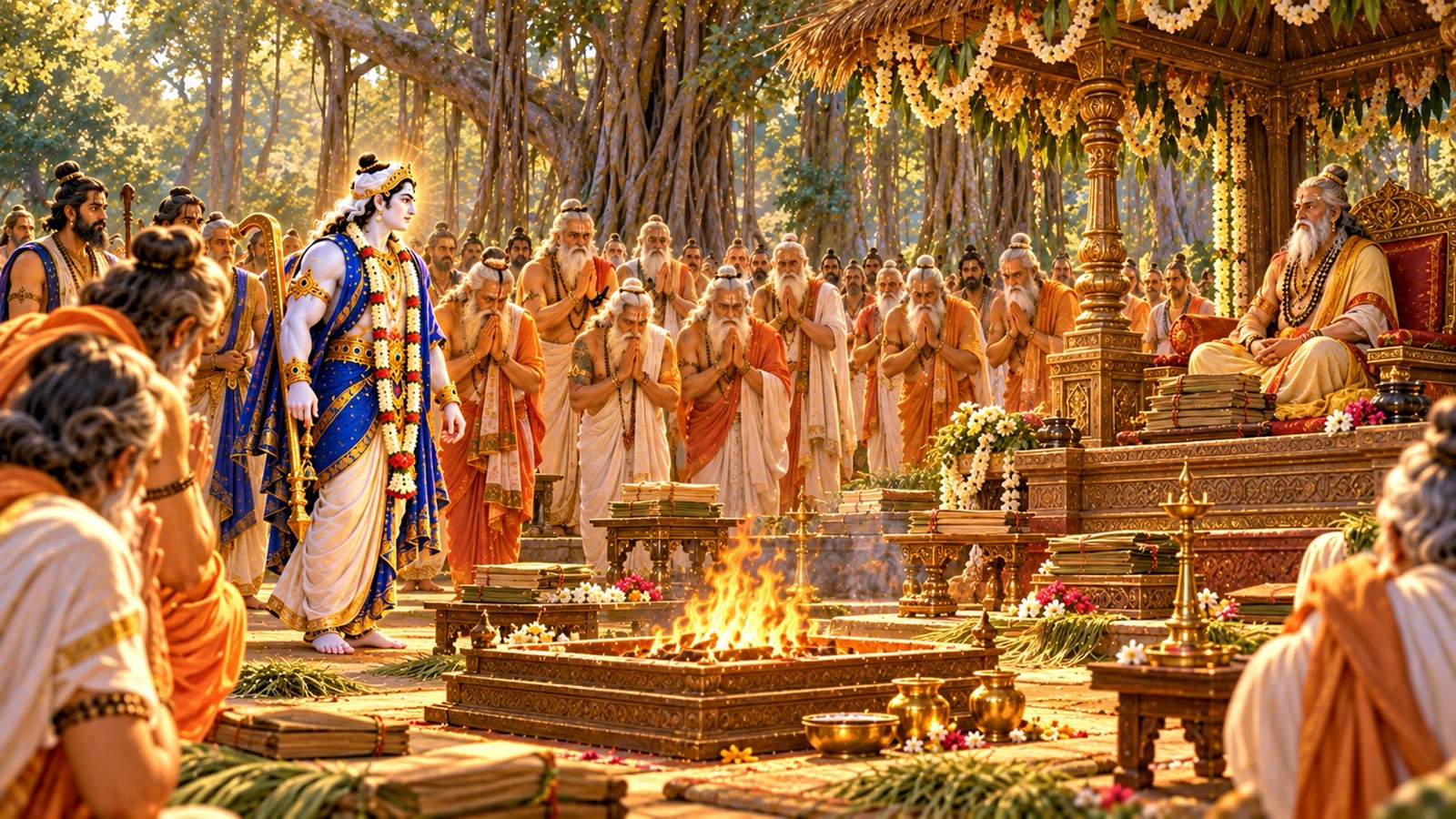
Balarama said to the brahmanas: ‘Because this man, born of a mixed union, sits above these brahmanas and above us who guard dharma, this fool deserves to die. He became the disciple of the venerable sage and studied under him all the histories, the Puranas and every scripture of dharma — yet in one who is unrestrained and unhumbled, who vainly thinks himself learned and has not conquered his own self, such study bears no fruit, any more than an actor’s lines make him what he pretends to be. For this very purpose I have descended into this world: those who carry the flag of dharma without living it are worse than the openly sinful, and they are to be slain by Me.’
एतदर्थो हि लोकेऽस्मिन्नवतारो मया कृत: ।
वध्या मे धर्मध्वजिनस्ते हि पातकिनोऽधिका: ॥ २७ ॥
etad-artho hi loke ’sminn avatāro mayā kṛtaḥ vadhyā me dharma-dhvajinas te hi pātakino ’dhikāḥ
Meaning: For this end have I made My descent into this world: those who make a false display of religion are the worst of sinners, and they are fit to be killed by Me. (Canto 10, Chapter 78, verse 27)
The Blade of Kusa Grass
Though on pilgrimage He had turned away even from slaying the wicked, the Lord, having spoken thus, touched the Suta with the tip of a blade of kusa grass in His hand — and Romaharshana died on the spot. What was destined could not be turned aside.
एतावदुक्त्वा भगवान् निवृत्तोऽसद्वधादपि ।
भावित्वात् तं कुशाग्रेण करस्थेनाहनत् प्रभु: ॥ २८ ॥
etāvad uktvā bhagavān nivṛtto ’sad-vadhād api bhāvitvāt taṁ kuśāgreṇa kara-sthenāhanat prabhuḥ
Meaning: Having said this much, the almighty Lord, though He had refrained even from killing the wicked, struck him with the point of the kusa grass in His hand, because it was fated so. (Canto 10, Chapter 78, verse 28)
The Sages’ Plea and the Lord’s Promise
All the sages cried out ‘Alas! Alas!’ and, grieved at heart, said to Lord Sankarshana: ‘O Lord, You have done an unrighteous deed. O joy of the Yadus, it was we who gave him the seat of a brahmana, and with it long life and freedom from fatigue for as long as this sacrifice should last. Unknowingly You have committed what amounts to killing a brahmana. You are the master of yoga, and even the Vedas do not bind You; yet You have descended to purify the world. If You, prompted by no one, perform of Your own accord the purification prescribed for this sin, You will set an example for all people.’
The Lord replied: ‘Out of compassion for the world I shall certainly perform atonement for this killing; prescribe for Me whatever the foremost rule of expiation requires. And whatever you wished for this man — long life, strength and full command of his senses — tell Me, and I shall accomplish it by My yogamaya.’
The sages answered: ‘O Rama, arrange matters so that the power of Your weapon and Your prowess remain true, that his death remains a fact, and that our word of blessing to him is also fulfilled.’
The Lord said: ‘The Vedas teach that one’s own self is born again as the son. Therefore his son shall be the speaker of the Puranas to you, endowed with long life, strong senses and vigour.’
आत्मा वै पुत्र उत्पन्न इति वेदानुशासनम् ।
तस्मादस्य भवेद्वक्ता आयुरिन्द्रियसत्त्ववान् ॥ ३६ ॥
ātmā vai putra utpanna iti vedānuśāsanam tasmād asya bhaved vaktā āyur-indriya-sattva-vān
Meaning: The injunction of the Vedas is that the self takes birth as one’s son. Hence this man’s son shall be your reciter, possessed of long life, sound senses and strength. (Canto 10, Chapter 78, verse 36)
‘What else do you desire, best of sages?’ He continued. ‘Tell Me, and I shall do it; and consider, O wise ones, what atonement is right for Me, who acted unknowingly.’
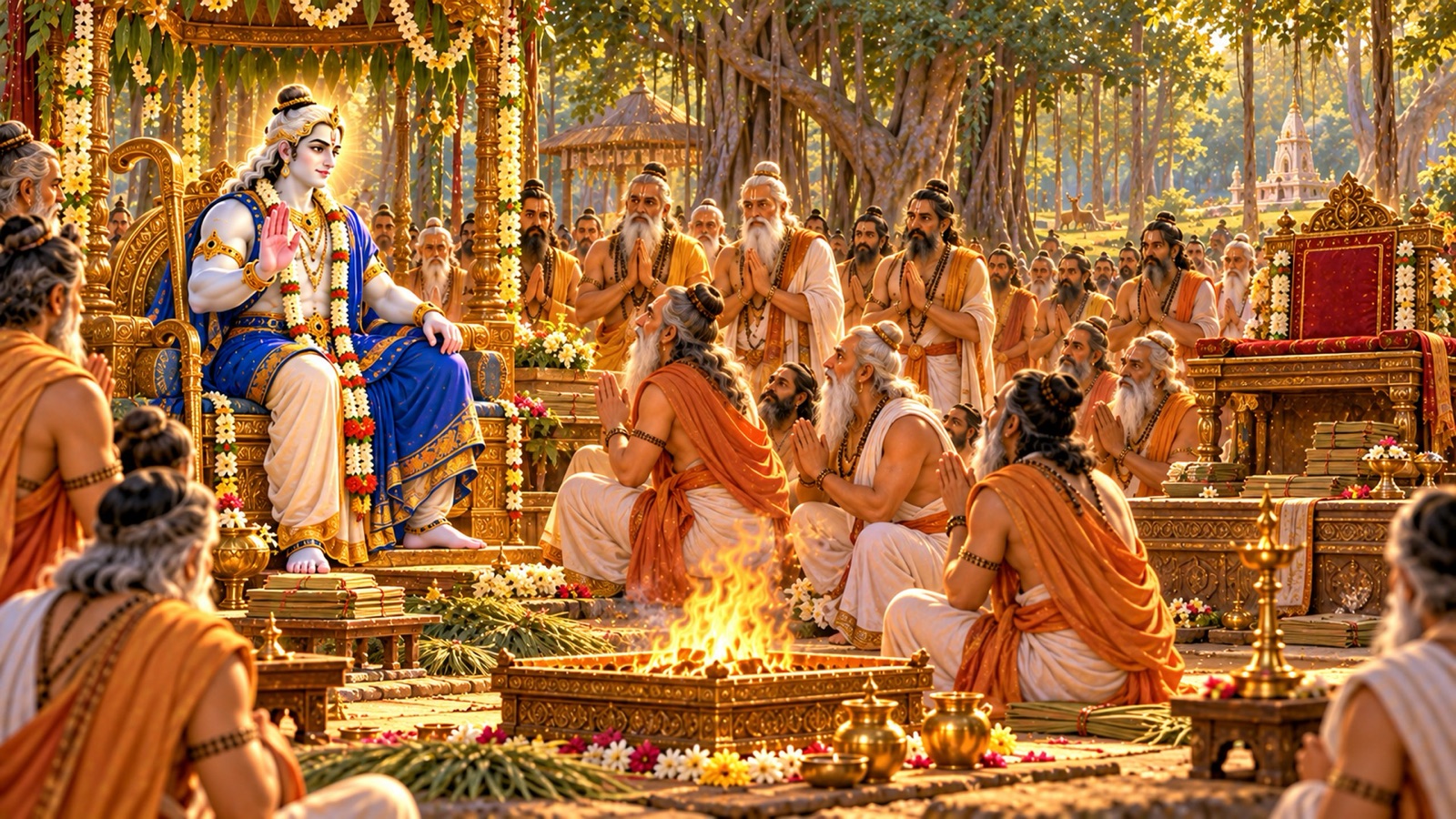
The sages said: ‘There is a dreadful demon named Balvala, son of Ilvala, who comes here on every new-moon and full-moon day and defiles our sacrifice, showering upon us pus, blood, excrement, urine, wine and flesh. O descendant of Dasharha, slay that sinner — that will be the greatest service You can render us. Then, with a composed mind, circle the land of Bharata for twelve months, bathing at its holy places; by this You will be purified.’
ततश्च भारतं वर्षं परीत्य सुसमाहित: ।
चरित्वा द्वादश मासांस्तीर्थस्नायी विशुध्यसि ॥ ४० ॥
tataś ca bhārataṁ varṣaṁ parītya su-samāhitaḥ caritvā dvādaśa-māsāṁs tīrtha-snāyī viśudhyasi
Meaning: Afterwards, travelling around Bharatavarsha with a well-collected mind for twelve months and bathing at the sacred waters, You will become pure. (Canto 10, Chapter 78, verse 40)
Principal Teachings of This Chapter
1. The Lord cannot truly be defeated. The verse on Krishna as Yogeshvara (verse 16) is the key to all His battles: when He seems struck or outmatched, that is only the vision of those who see like beasts.
2. Even hostility fixed on Krishna ends in Him. The light that passes from Dantavakra into the Lord (verse 10) reveals His mercy: one whose mind clung to Him even in enmity returns to Him at the end.
3. Learning without humility is only a performance. Romaharshana knew every Purana yet did not rise for the Lord (verse 23). Knowledge that breeds pride instead of reverence has not been truly received.
4. The hypocrite is judged more severely than the open sinner. Those who wave the banner of dharma without living it are the greater sinners, and Balarama descends to deal with them (verse 27). Sincerity in devotion matters more than its display.
5. Destiny unfolds even through the Lord’s gentlest touch. A blade of kusa grass (verse 28) accomplished what was fated; the Lord’s instruments never measure His power.
6. Those who set the example must accept correction. Though beyond the Vedas, Balarama accepts the sages’ prescription (verse 40) so that the world may learn from Him. Greatness in dharma is shown by willingness to be corrected.
A Devotional Reflection
Two very different scenes share this chapter. On the battlefield, Dantavakra’s pride is loud: he mocks the Lord, boasts of his mace, strikes the first blow. In the sacred grove, Romaharshana’s pride is silent: he simply stays seated. Yet the quiet pride proves the more dangerous. The warrior at least knew whom he opposed; the scholar, surrounded by scripture, forgot that the Lord had entered the room. How often do we, too, sit comfortably on the seat of what we know and fail to stand when the Lord comes before us as a guest, an elder, a chance to serve? Balarama’s kusa blade is a mercy that keeps the speaker’s seat honest, so that the Puranas may be spoken by one who has learned to bow. And the Lord Himself, needing no atonement, humbly asks the sages what He should do. If even He bends for the sake of the world, what seat of ours is too high to leave?
A Daily Devotional Practice
Today, whenever a sacred name, a scripture, a teacher or an elder comes before you, let your body answer first: rise if you are seated, fold your hands or bow your head. Make reverence a habit of the limbs, not only of the mind, remembering how much was lost when a learned man would not stand. Begin by chanting gently: Om Namo Bhagavate Vasudevaya.
Conclusion
Chapter 78 closes the chain of enemies who rose against Krishna after Shishupala’s death and opens Balarama’s sacred wanderings. It leaves us with a single luminous point: the Lord of the universe, who can never be conquered, is pleased not by learning or strength but by humility before Him. May we, remembering the kusa blade at Naimisaranya, learn to rise when the Lord enters our lives.
May the divine wisdom of Srimad Bhagavatam awaken pure devotion within our hearts.
Om Namo Bhagavate Vasudevaya.
Jay Shree Madhav.
References and Attribution
- Primary edition: Gita Press, Śrīmad Bhāgavata Mahāpurāṇa (English), Book Ten (Latter Half), Discourse 78.
- Series: Srimad Bhagavatam Wisdom · Biswa Sanatan Dharma Seva Trust.
- Presented following the spiritual guidance and recommendation of Pandit Dr. Shri Kashinath Mishra.
This is an original, faithful retelling in the writer’s own words, with brief quoted verses shown in Devanāgarī and transliteration and their meanings given as summaries. It is not a reproduction of any single publisher’s continuous translation or commentary. No affiliation with or endorsement by any publisher is implied.
Jay Shree Madhav