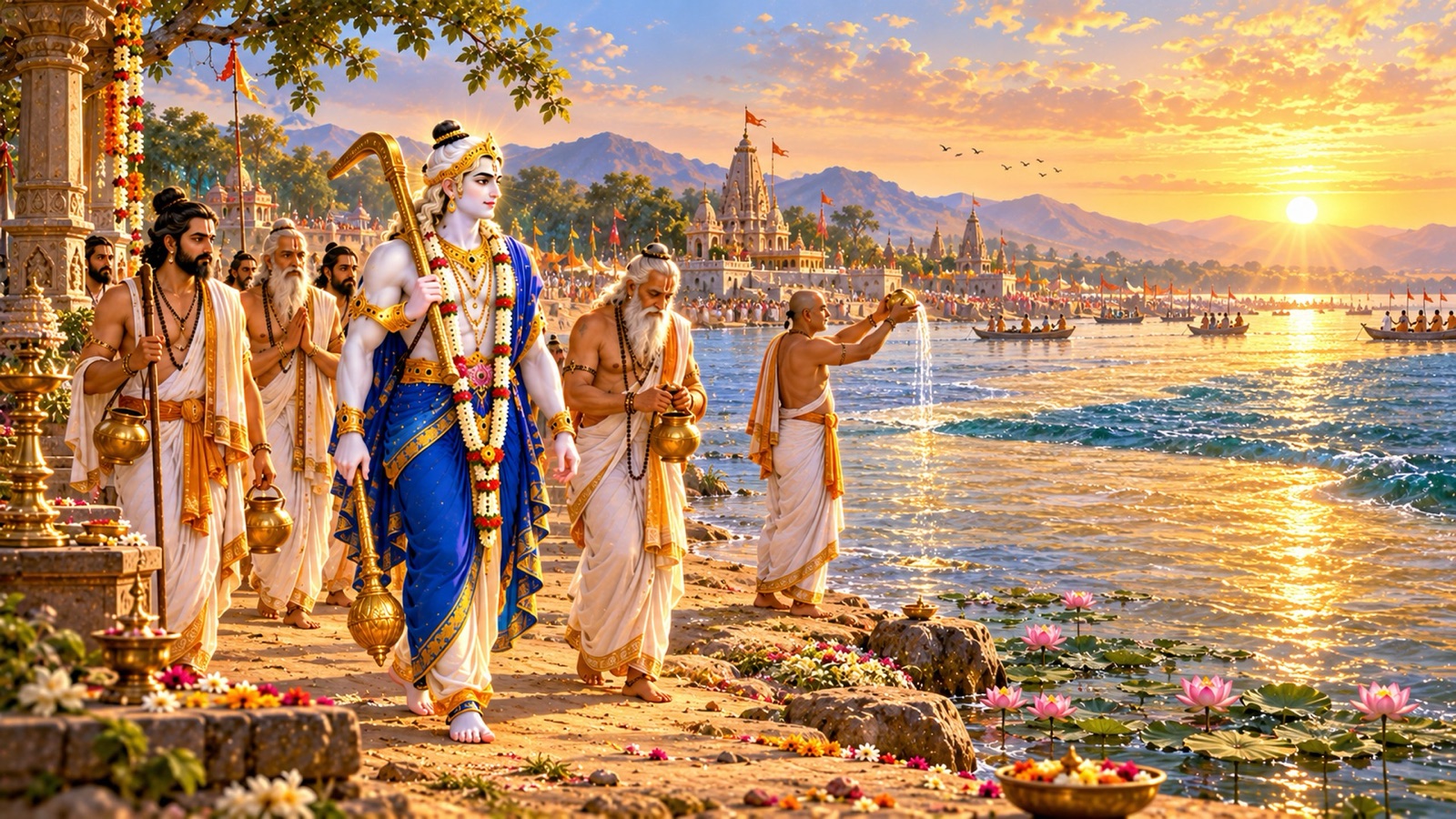
Having freed the sages of Naimisaranya from the demon Balvala, Lord Balarama walks the sacred rivers and shrines of Bharatavarsha for a full year, and at Kurukshetra counsels peace to two warriors whom destiny will not let listen.
Om Namo Bhagavate Vasudevaya.
Om Namo Bhagavate Vasudevaya.
Om Namo Bhagavate Vasudevaya.
Welcome back to Srimad Bhagavatam Wisdom, our devotional journey through the sacred histories and teachings of the Srimad Bhagavat Mahapurana. In this seventy-ninth chapter of the Tenth Canto, Sukadeva Gosvami tells King Parikshit how Lord Balarama fulfilled the twofold vow He had accepted from the sages — destroying the demon who defiled their sacrifice, then circling the holy land for twelve months before returning to Naimisaranya to complete His sacrifices in peace.
Chapter Information
- Scripture: Śrīmad Bhāgavata Mahāpurāṇa
- Canto: 10 (Book Ten, Latter Half)
- Chapter: 79 (Discourse 79)
- Chapter title: Lord Balarama Goes on Pilgrimage
- Principal speaker: Sukadeva Gosvami (narrating to King Parikshit)
- Principal listener: King Parikshit
- Main setting: The sacrificial ground of Naimiṣāraṇya; the holy places of Bharatavarsha from the Sarayu to Setubandha; Kurukshetra; Dvaraka
- Central subject: The slaying of Balvala; Balarama’s year-long pilgrimage; His attempt to stop the mace duel between Bhima and Duryodhana; the completion of His sacrifices and the gift of pure wisdom to the sages
- Principal verse range: Canto 10, Chapter 79, verses 1–34
- Primary edition: Gita Press Śrīmad Bhāgavata Mahāpurāṇa (English, Book Ten, Discourse 79)
Context From the Previous Chapter
In Chapter 78, Lord Balarama, arriving at Naimisaranya during the sages’ long sacrifice, slew the reciter Romaharshana for failing to rise and honour Him. When the sages pointed out that this amounted to killing a brahmana, He asked them to prescribe an expiation. They requested two things: that He destroy the demon Balvala, who fouled their sacrifice on every new-moon and full-moon day, and that He then wander the holy places of Bharatavarsha for twelve months.
The Demon Descends on the Sacrifice
Sukadeva continued his narration. On the very next full-moon day, a terrible wind rose over the sacrificial ground, hurling dust everywhere and carrying from every side the stench of pus. Then a shower of filth, conjured by Balvala, fell upon the sacred enclosure, and after it the demon himself appeared, trident in hand. His huge body was dark as a heap of soot; his hair, moustache and beard glowed like heated copper; and his face, with its jutting fangs and knotted brows, was dreadful to behold.
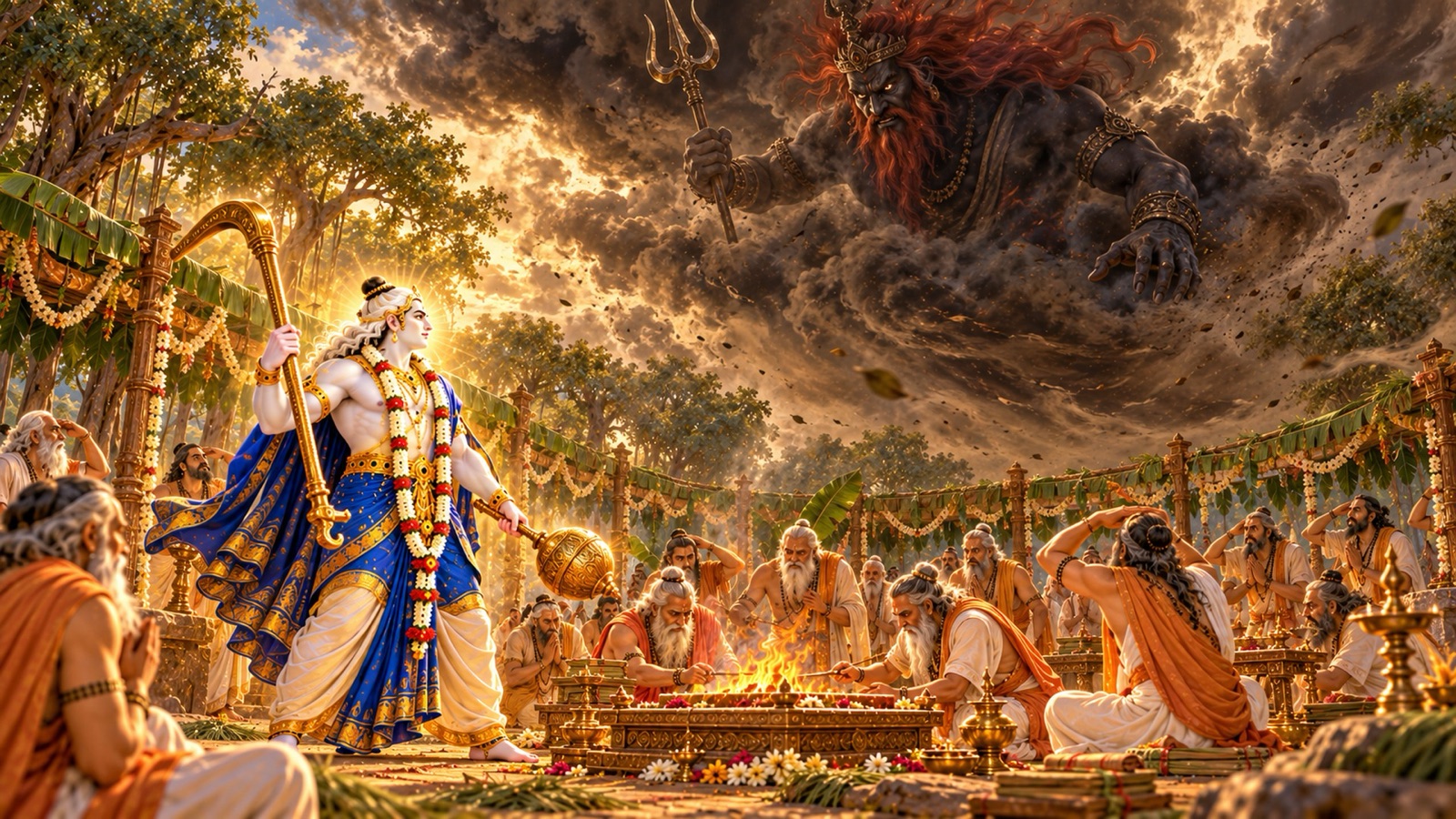
Seeing him, Balarama remembered His two famous weapons — the club that shatters the ranks of hostile armies, and the plough that subdues the demons — and in that instant both presented themselves before Him.
The Plough and the Club
Balvala was coursing through the sky. With the tip of His plough Balarama hooked him and dragged him down, and then, blazing with anger against this tormentor of the brahmanas, He struck him on the head with His club.
तमाकृष्य हलाग्रेण बल्वलं गगनेचरम् ।
मूषलेनाहनत्क्रुद्धो मूर्ध्नि ब्रह्मद्रुहं बल: ॥ ५ ॥
tam ākṛṣya halāgreṇa balvalaṁ gagane-caram mūṣalenāhanat kruddho mūrdhni brahma-druhaṁ balaḥ
Meaning: Pulling down Balvala, who was moving through the sky, with the end of His plough, the enraged Balarama struck that enemy of the brahmanas upon the head with His club. (Canto 10, Chapter 79, verse 5)
His forehead split, the demon fell to the earth with a cry of anguish, like a reddish mountain peak shattered by a thunderbolt. The holy sages praised Balarama, pronounced blessings on Him that could never fail, and consecrated Him with sacred water, just as the gods once bathed Indra after he had slain Vritra.
संस्तुत्य मुनयो रामं प्रयुज्यावितथाशिष: ।
अभ्यषिञ्चन् महाभागा वृत्रघ्नं विबुधा यथा ॥ ७ ॥
saṁstutya munayo rāmaṁ prayujyāvitathāśiṣaḥ abhyaṣiñcan mahā-bhāgā vṛtra-ghnaṁ vibudhā yathā
Meaning: The greatly fortunate sages glorified Balarama, bestowed on Him their infallible benedictions, and anointed Him, even as the gods had anointed the slayer of Vritra. (Canto 10, Chapter 79, verse 7)
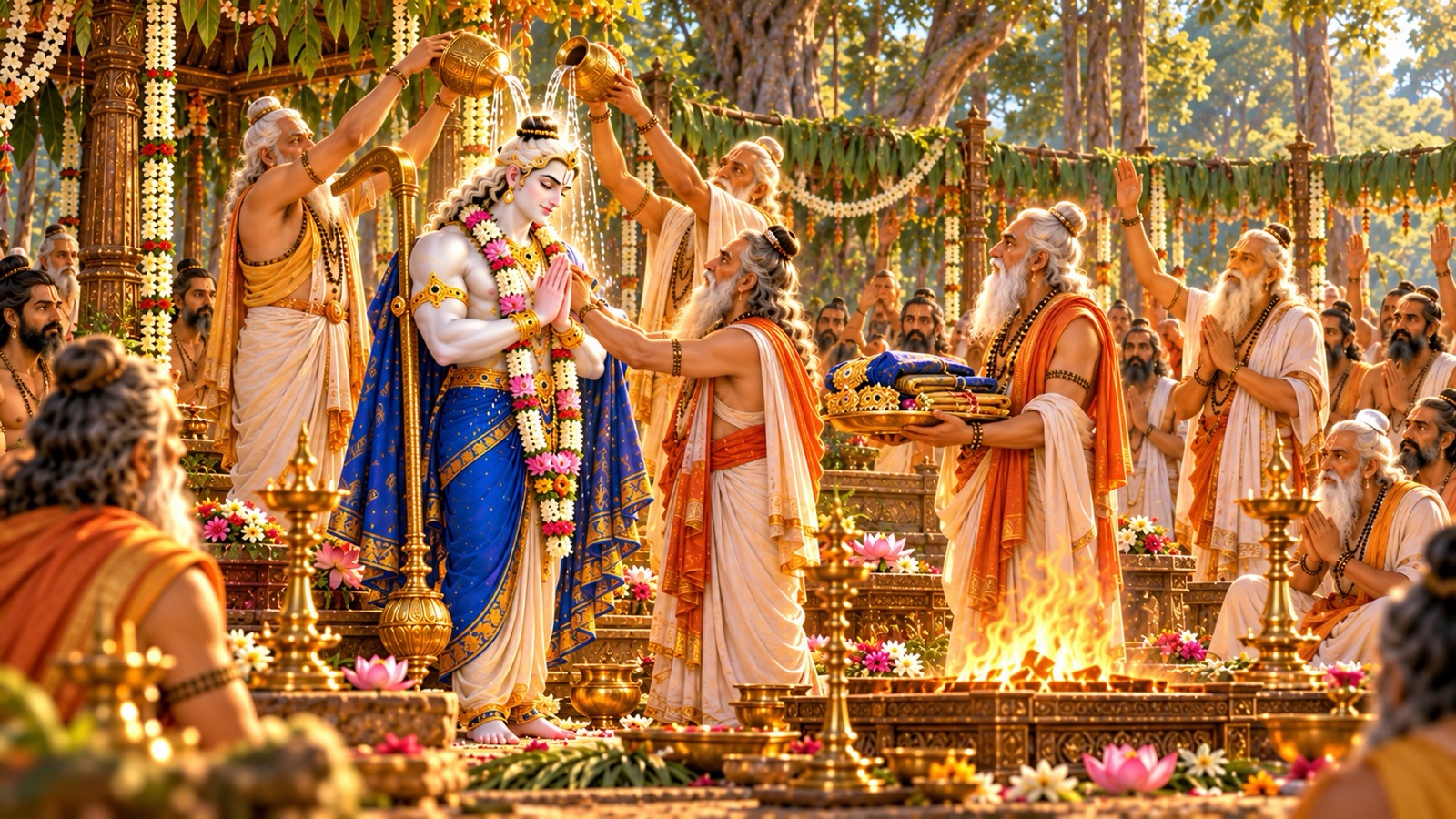
They then offered Him a Vaijayanti garland of unfading lotuses, the abode of the goddess of fortune, together with a pair of divine garments and celestial ornaments.
The Pilgrimage Begins
With the sages’ leave, Balarama set out accompanied by brahmanas. He went first to the river Kaushiki and bathed there, and then to the lake from which the Sarayu flows. Following the Sarayu downstream He reached Prayaga, where He bathed and offered libations to the gods, the sages and the forefathers, and from there He went on to the hermitage of Pulaha.
He bathed in the Gomati, the Gandaki and the Vipasha, and immersed Himself in the Shona. At Gaya He worshipped the forefathers, and at the confluence of the Ganga with the sea He performed His ablutions. On Mount Mahendra He met Parashurama, the Lord’s own earlier descent, and offered Him respectful greetings. He bathed in the seven streams of the Godavari, in the Vena and the Bhimarathi, and in the lake Pampa; He visited Skanda, the commander of the gods, and then climbed Shrishaila, the abode of Lord Shiva. In the Dravida country He beheld the most holy hill of Venkata, passed through Kamakoshni and the city of Kanchi, bathed in the Kaveri, best of rivers, and arrived at Shriranga, where Lord Hari is ever present. He went on to the Rishabha hill, sacred to Hari, to the southern Mathura, and at last to Setubandha, the bridge across the sea, which destroys the gravest sins.
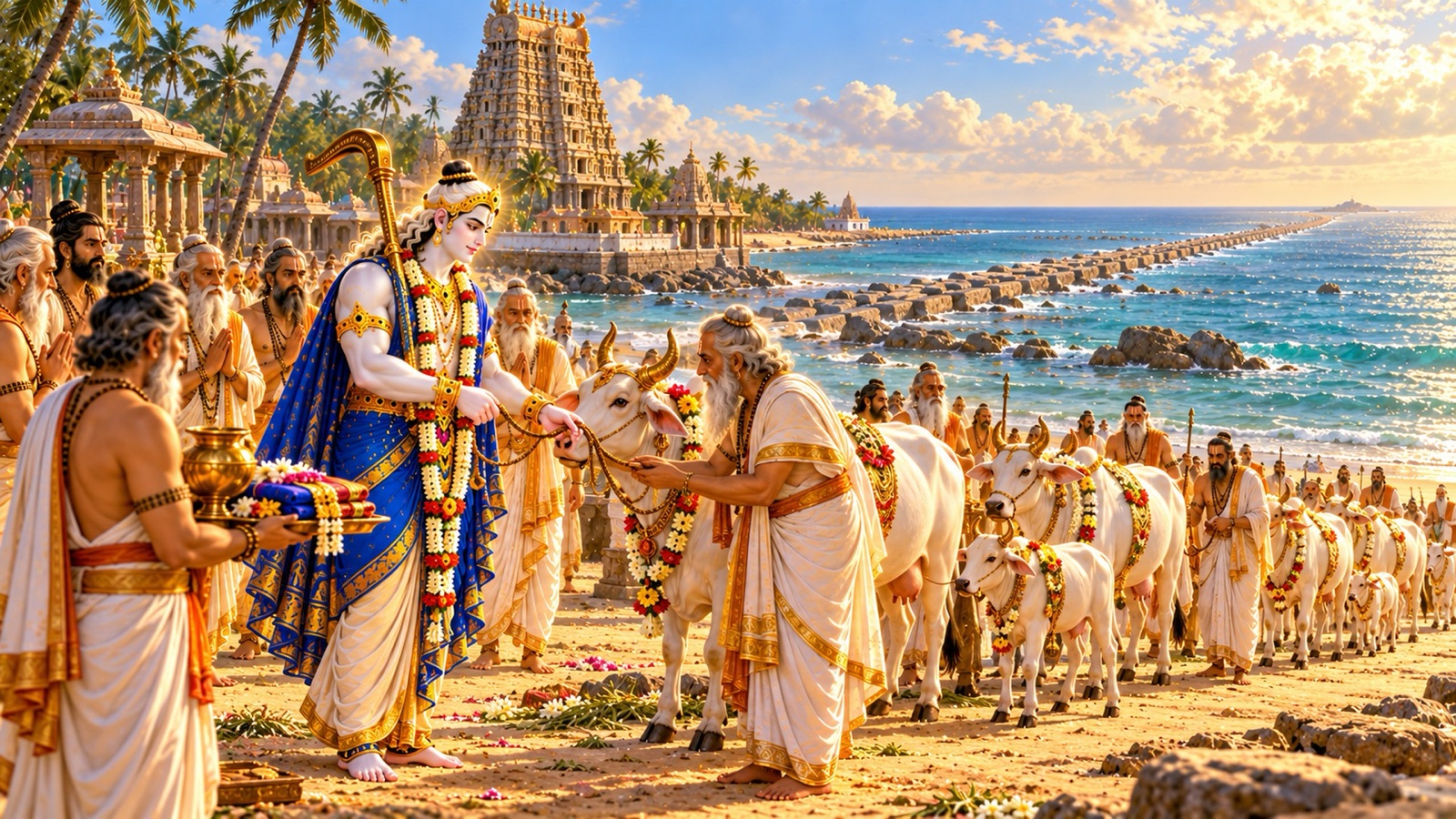
There the wielder of the plough gave ten thousand cows to the brahmanas. He bathed in the Kritamala and the Tamraparni and came to the Malaya range, where the sage Agastya sat in meditation. Balarama bowed to him, received his blessings and permission, and proceeded to the southern ocean, where He had darshan of the goddess Durga known as Kanya. Next He reached the sacred Phalguna tirtha and the excellent lake Panchapsaras, where Lord Vishnu is ever present; bathing there, He again gave away ten thousand cows.
Travelling on, He passed through the lands of Kerala and Trigarta to Gokarna, the holy place of Shiva where Lord Dhurjati dwells. He saw the goddess Arya on her island, visited Shurparaka, and bathed in the Tapi, the Payoshni and the Nirvindhya. He entered the Dandaka forest and came to the Reva, on whose bank stands the city of Mahishmati; and after bathing in the Manu tirtha, He returned at last to Prabhasa.
News of the War and the Journey to Kurukshetra
At Prabhasa Balarama heard from the brahmanas that in the war between the Kurus and the Pandavas nearly all the kshatriyas had perished. He understood that the earth’s burden had been lifted.
श्रुत्वा द्विजै: कथ्यमानं कुरुपाण्डवसंयुगे ।
सर्वराजन्यनिधनं भारं मेने हृतं भुव: ॥ २२ ॥
śrutvā dvijaiḥ kathyamānaṁ kuru-pāṇḍava-saṁyuge sarva-rājanya-nidhanaṁ bhāraṁ mene hṛtaṁ bhuvaḥ
Meaning: Hearing from the brahmanas that in the battle of the Kurus and Pandavas all the royal warriors had been destroyed, He considered that the burden of the earth had been removed. (Canto 10, Chapter 79, verse 22)
Learning that Bhima and Duryodhana were at that moment fighting with maces on the battlefield, the beloved son of the Yadus went to Kurukshetra, wishing to prevent their mutual destruction. When Yudhishthira, the twins Nakula and Sahadeva, Lord Krishna and Arjuna saw Him, they bowed to Him and stood silent, wondering what He had come to say.
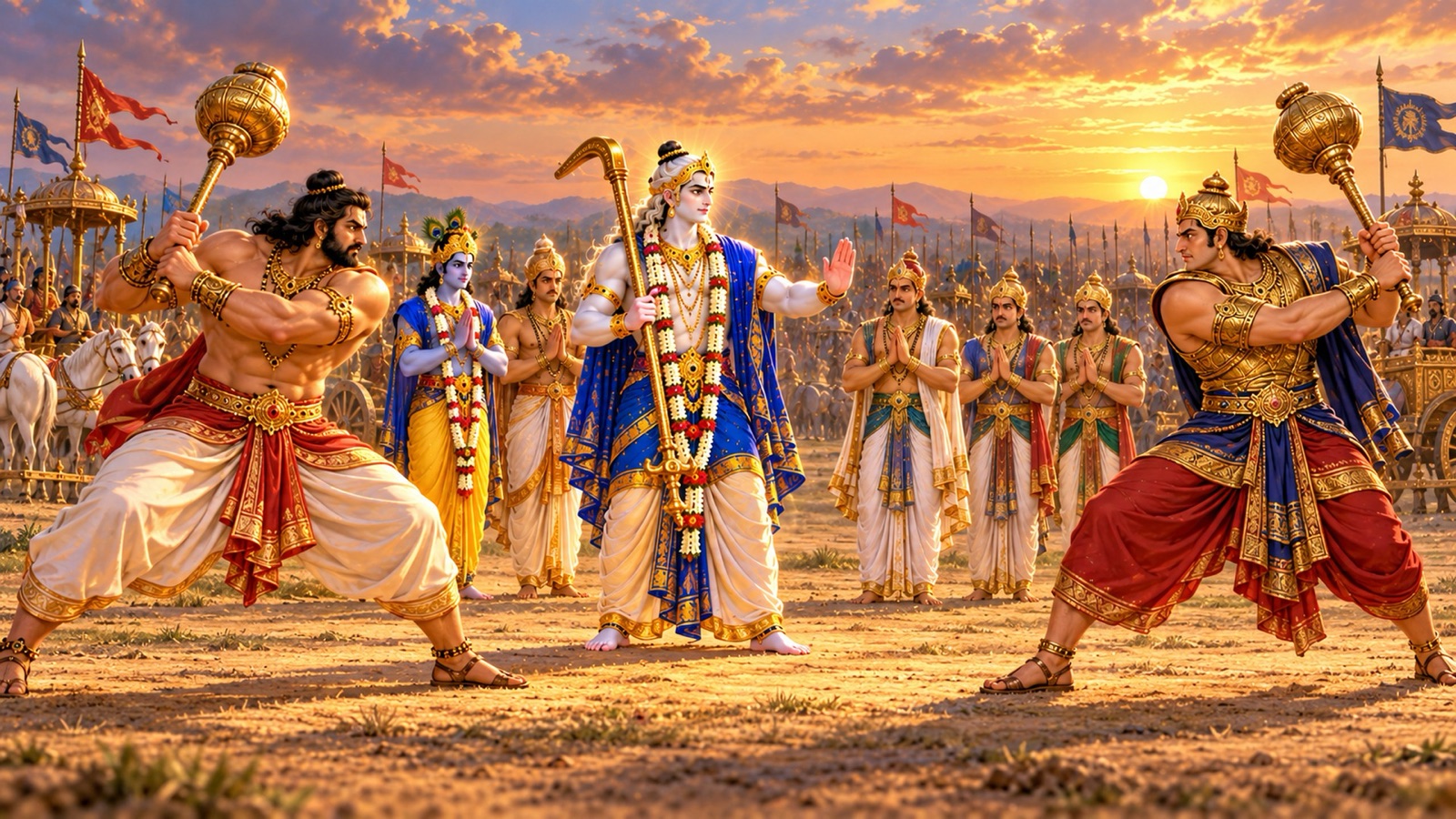
Balarama found the two warriors, maces in hand, inflamed with rage and each bent on victory, wheeling in intricate circles around one another. He addressed them: “O King, O Vrikodara, you two heroes are equal in strength. One of you, I think, has the greater power; the other, the greater skill.”
तस्मादेकतरस्येह युवयो: समवीर्ययो: ।
न लक्ष्यते जयोऽन्यो वा विरमत्वफलो रण: ॥ २७ ॥
tasmād ekatarasyeha yuvayoḥ sama-vīryayoḥ na lakṣyate jayo ’nyo vā viramatv aphalo raṇaḥ
Meaning: Therefore, since the two of you are matched in prowess, I see neither victory nor defeat for either; let this fruitless fight cease. (Canto 10, Chapter 79, verse 27)
Though His words were wholesome and offered for their good, the two did not accept them. Their enmity was too deeply rooted; each kept recalling the harsh words and wicked deeds of the other. Balarama recognised in this the hand of destiny. Without pressing further, He went back to Dvaraka, where Ugrasena and His other kinsmen welcomed Him with joy.
The Second Visit to Naimisaranya
From Dvaraka Balarama went once more to the Naimisha forest. There the sages, glad at heart, had Him perform every kind of sacrifice — He who had withdrawn from all strife, and of whom, in truth, every sacrifice is a limb. Then the almighty Lord bestowed on those sages a pure, transcendental knowledge.
तेभ्यो विशुद्धं विज्ञानं भगवान् व्यतरद् विभु: ।
येनैवात्मन्यदो विश्वमात्मानं विश्वगं विदु: ॥ ३१ ॥
tebhyo viśuddhaṁ vijñānaṁ bhagavān vyatarad vibhuḥ yenaivātmany ado viśvam ātmānaṁ viśva-gaṁ viduḥ
Meaning: The all-powerful Lord imparted to them pure spiritual knowledge, by which they perceived this universe within the Self and the Self as pervading the universe. (Canto 10, Chapter 79, verse 31)
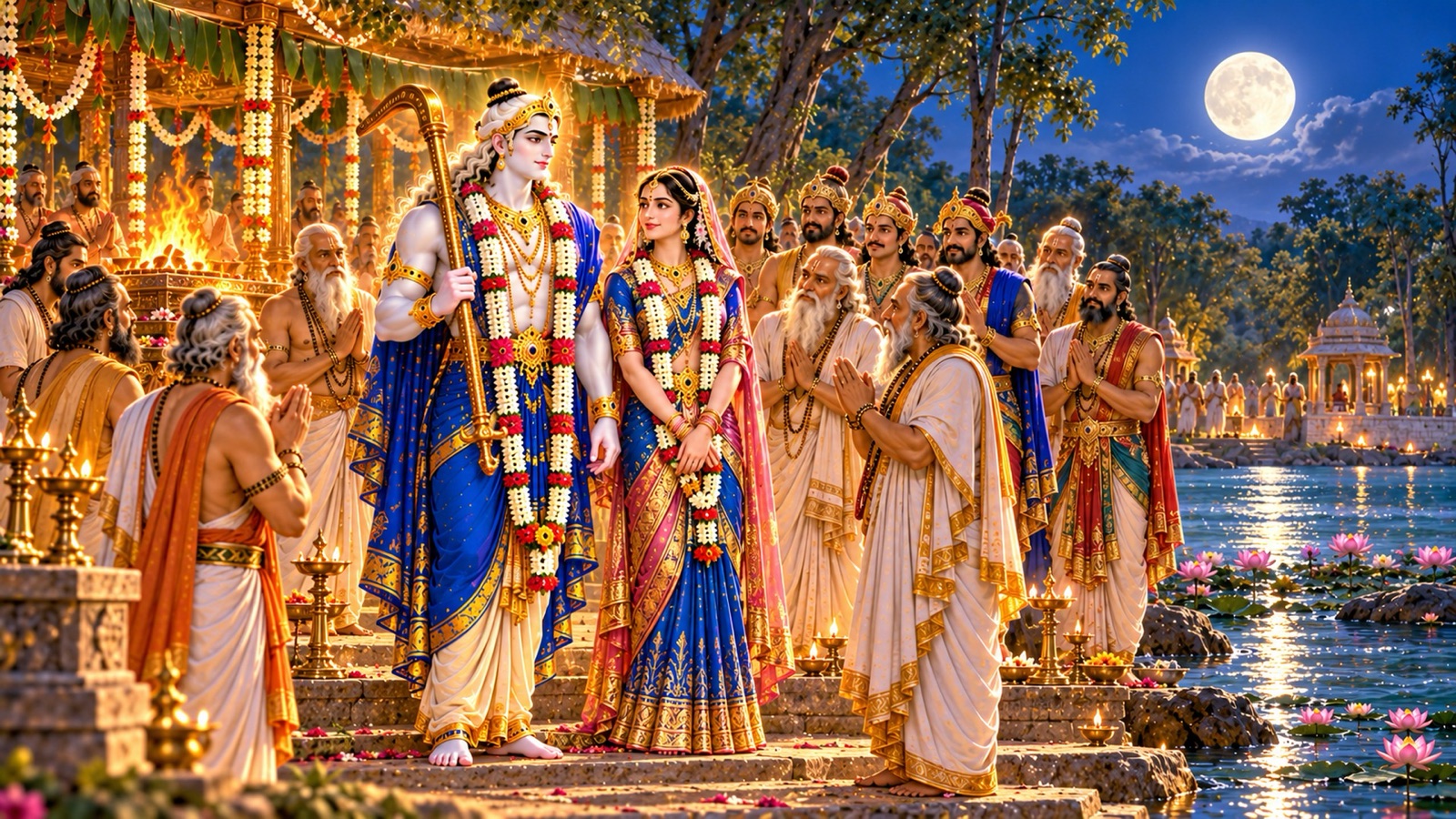
Having taken the concluding avabhritha bath together with His consort Revati, Balarama stood among His kinsmen, friends and well-wishers in fine garments and beautiful ornaments, shining like the moon amid its own moonlight.
The Glory of Balarama
Sukadeva closed the chapter by reminding Parikshit of who this pilgrim truly is. Balarama is Ananta, the infinite and immeasurable Lord, who appears as a mortal only by His own Maya; His exploits are beyond counting.
ईदृग्विधान्यसंख्यानि बलस्य बलशालिन: ।
अनन्तस्याप्रमेयस्य मायामर्त्यस्य सन्ति हि ॥ ३३ ॥
īdṛg-vidhāny asaṁkhyāni balasya bala-śālinaḥ anantasyāprameyasya māyā-martyasya santi hi
Meaning: Countless indeed are such deeds of the mighty Balarama — the unlimited and immeasurable Lord who appears as a human being by His own illusory potency. (Canto 10, Chapter 79, verse 33)
योऽनुस्मरेत रामस्य कर्माण्यद्भुतकर्मण: ।
सायं प्रातरनन्तस्य विष्णो: स दयितो भवेत् ॥ ३४ ॥
yo ’nusmareta rāmasya karmāṇy adbhuta-karmaṇaḥ sāyaṁ prātar anantasya viṣṇoḥ sa dayito bhavet
Meaning: Whoever remembers, at dusk and at dawn, the activities of Balarama, the performer of wonderful deeds, becomes dear to the infinite Lord Vishnu. (Canto 10, Chapter 79, verse 34)
Principal Teachings of This Chapter
1. The Lord guards those who guard the sacred fire. Balvala’s attack fell on sages who had harmed no one, and the Lord Himself rose to end it (verse 5). Whoever lives for the service of the Divine is never left without a protector.
2. Humility is the ornament of greatness. Though honoured by the sages like Indra after Vritra (verse 7), Balarama still bowed to Parashurama, to Agastya and to the shrines of Shiva and Durga along His way. The pilgrim’s road is walked with a lowered head.
3. The holy land is itself a teacher. Rivers, confluences, mountains and the seats of saints fill this chapter. Bathing in them, offering to the forefathers, and giving in charity are shown as acts that purify and reorder the heart.
4. Even the Lord’s counsel cannot override chosen hatred. Balarama’s plea for peace (verse 27) was perfect, yet Bhima and Duryodhana rejected it because they would not stop feeding their grievances. Grace knocks; the door must be opened from within.
5. Sacrifice finds its goal in self-knowledge. The chapter does not end with ritual but with realisation: the sages come to see the universe within the Self and the Self within all (verse 31). Outer worship ripens into inner vision.
6. Remembering His deeds makes one dear to Him. The closing promise (verse 34) is the simplest teaching of all — recall Balarama’s acts at dawn and dusk, and the infinite Lord counts you as His own.
The deeper truth a devotee will draw from this chapter lies in the words “every sacrifice is a limb of Him.” Balarama needed no expiation; He is the Self of every rite. Yet He walked the dusty roads of Bharatavarsha for a year because His followers needed to see what reverence for the brahmanas, the tirthas and the forefathers looks like. His neutrality at Kurukshetra belongs to the same design: He had already discerned, at Prabhasa, that the earth’s burden was being removed as the Lord intended, so He offered good counsel and then deferred to the course the Supreme had set. The Lord teaches dharma by living it, and when destiny is already His own will, He does not force even a brother to obey.
A Devotional Reflection
What moves the heart in this chapter is the picture of the strongest being in creation choosing the humblest path. Balarama could have dissolved a demon with a glance, yet He took up His plough; He could have decreed His own innocence, yet He accepted the sages’ penance and set out on foot. At each shrine He did exactly what an ordinary pilgrim does — bathed, offered water, bowed, gave cows — and so He sanctified the very idea of pilgrimage for all who would follow. When He reached Kurukshetra and found two men too consumed with old wounds to hear Him, He did not rage or compel. He saw destiny at work and let it be. We too are called to speak the truth with love, do our part, and leave the outcome to the Lord. And the chapter’s last word reassures us that none of this is beyond our reach. We may never bathe in the seven Godavaris, but we can remember Him each morning and evening, and that remembrance alone, Sukadeva promises, makes us His beloved.
A Daily Devotional Practice
Twice today — once at sunrise and once at dusk — pause for a few minutes and recall one deed of Lord Balarama from this chapter: the plough drawing down Balvala, the bow before Agastya, or the gentle words at Kurukshetra. Offer that memory to Him as the sages offered water, and ask that your own anger be as patient as His and your own strength as humble. Begin by chanting gently: Om Namo Bhagavate Vasudevaya.
Conclusion
This chapter carries Lord Balarama from the defiled sacrificial ground of Naimisaranya, across the whole sacred map of Bharatavarsha, to the battlefield of Kurukshetra and home again. Its single thread is the Lord’s willingness to live the dharma He teaches — to purify where He needs no purification, to counsel where He knows He will not be heard, and to crown it all by giving the sages the knowledge that sees the Self in everything. May the memory of the Lord who walked as a pilgrim make us pilgrims too, at dawn and at dusk, until His remembrance becomes the very breath of our devotion.
May the divine wisdom of Srimad Bhagavatam awaken pure devotion within our hearts.
Om Namo Bhagavate Vasudevaya.
Jay Shree Madhav.
References and Attribution
- Primary edition: Gita Press, Śrīmad Bhāgavata Mahāpurāṇa (English), Book Ten (Latter Half), Discourse 79, pages 449–452.
- Series: Srimad Bhagavatam Wisdom · Biswa Sanatan Dharma Seva Trust.
- Presented following the spiritual guidance and recommendation of Pandit Dr. Shri Kashinath Mishra.
This is an original, faithful retelling in the writer’s own words, with brief quoted verses shown in Devanāgarī and transliteration and their meanings given as summaries. It is not a reproduction of any single publisher’s continuous translation or commentary. No affiliation with or endorsement by any publisher is implied.
Jay Shree Madhav