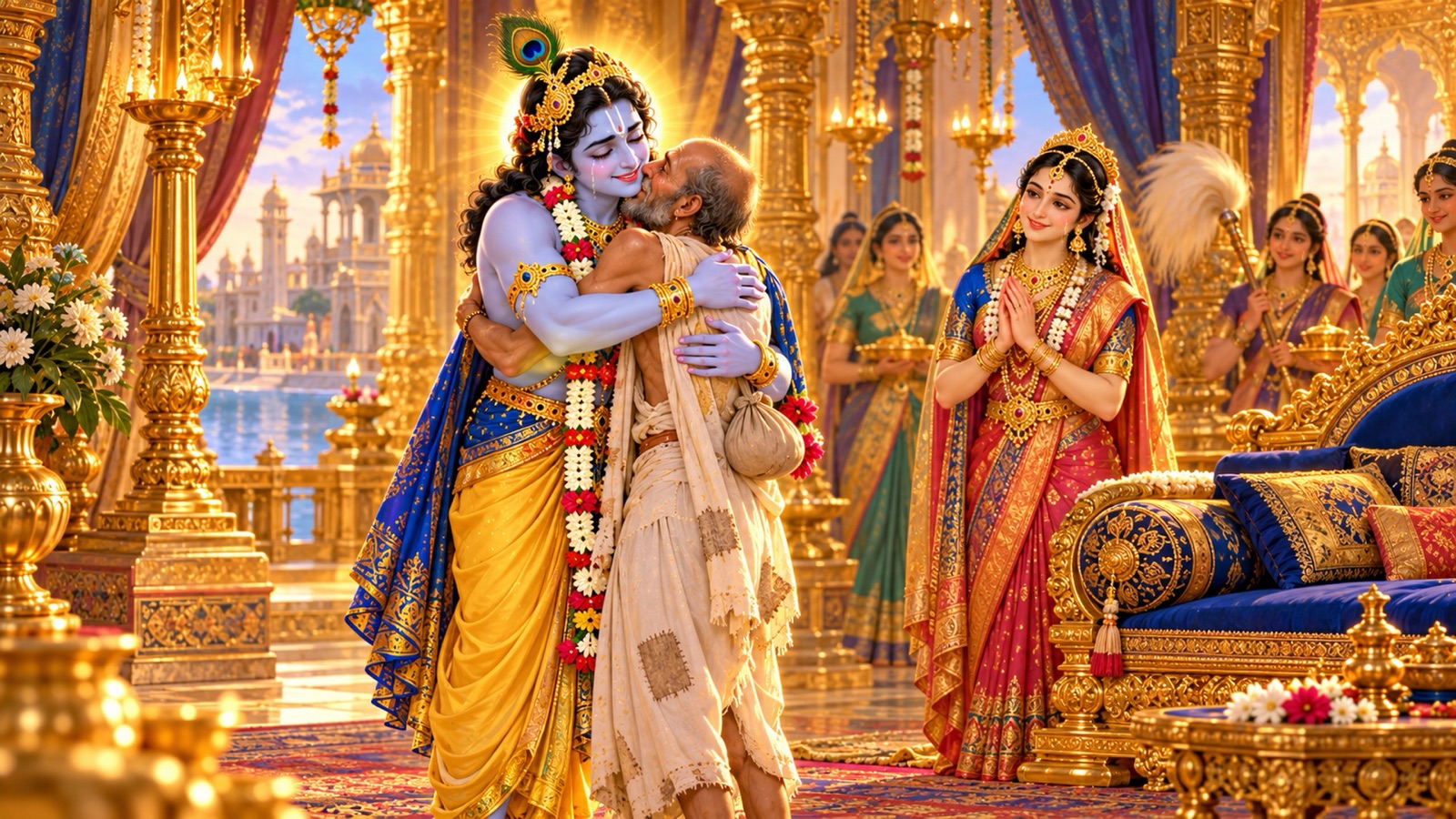
A brahmana worn thin by poverty walks to Dvaraka with a knotted rag of flattened rice, and the Lord of the three worlds leaves His queen’s side, weeps at his touch, and bathes his feet with His own hands.
Om Namo Bhagavate Vasudevaya.
Om Namo Bhagavate Vasudevaya.
Om Namo Bhagavate Vasudevaya.
Welcome back to Srimad Bhagavatam Wisdom, our devotional journey through the sacred histories and teachings of the Srimad Bhagavat Mahapurana. This eightieth chapter of the Tenth Canto opens the beloved story of Sudama: a destitute brahmana, Krishna’s boyhood friend, is sent by his devoted wife to the Lord with a few handfuls of borrowed rice, and in Dvaraka is received with a love that astonishes the whole palace.
Chapter Information
- Scripture: Śrīmad Bhāgavata Mahāpurāṇa
- Canto: 10 (Book Ten, Latter Half)
- Chapter: 80 (Discourse 80)
- Chapter title: The Brahmana Sudama Visits Lord Krishna in Dvaraka
- Principal speaker: Sukadeva Gosvami (narrating to King Parikshit)
- Principal listener: King Parikshit
- Main setting: The brahmana’s humble home, and the palace of Lord Krishna in Dvārakā
- Central subject: Sudama’s poverty and his wife’s plea; the gift of flattened rice; Krishna’s loving reception of His friend; their remembrance of Sandipani’s ashram and the greatness of service to the guru
- Principal verse range: Canto 10, Chapter 80, verses 1–45
- Primary edition: Gita Press Śrīmad Bhāgavata Mahāpurāṇa (English, Book Ten, Latter Half)
Parikshit’s Thirst for the Lord’s Glories
King Parikshit turned to the sage with fresh eagerness: the deeds of Mukunda, whose might has no limit, must themselves be limitless, so let him hear still more. What person of discernment, pierced again and again by the arrows of desire, could ever tire of the holy stories of the Lord of excellent fame? Then the king spoke of what makes our faculties worthy of their names.
सा वाग् यया तस्य गुणान् गृणीते करौ च तत्कर्मकरौ मनश्च ।
स्मरेद् वसन्तं स्थिरजङ्गमेषु शृणोति तत्पुण्यकथा: स कर्ण: ॥ ३ ॥
sā vāg yayā tasya guṇān gṛṇīte karau ca tat-karma-karau manaś ca smared vasantaṁ sthira-jaṅgameṣu śṛṇoti tat-puṇya-kathāḥ sa karṇaḥ
Meaning: True speech is that which sings His qualities; true hands are those that labour in His work; the true mind is that which remembers Him dwelling in all moving and unmoving beings; and the true ear is that which hears His sacred stories. (Canto 10, Chapter 80, verse 3)
So too, the king continued, that head is a head which bows to all creatures as the Lord’s forms, that eye is an eye which sees Him everywhere, and those limbs are limbs daily sprinkled with the water that has washed the feet of the Lord and His devotees. Suta tells the sages of Naimiṣāraṇya that Sukadeva, his heart wholly immersed in Vasudeva, then began to answer.
The Brahmana Friend of Krishna
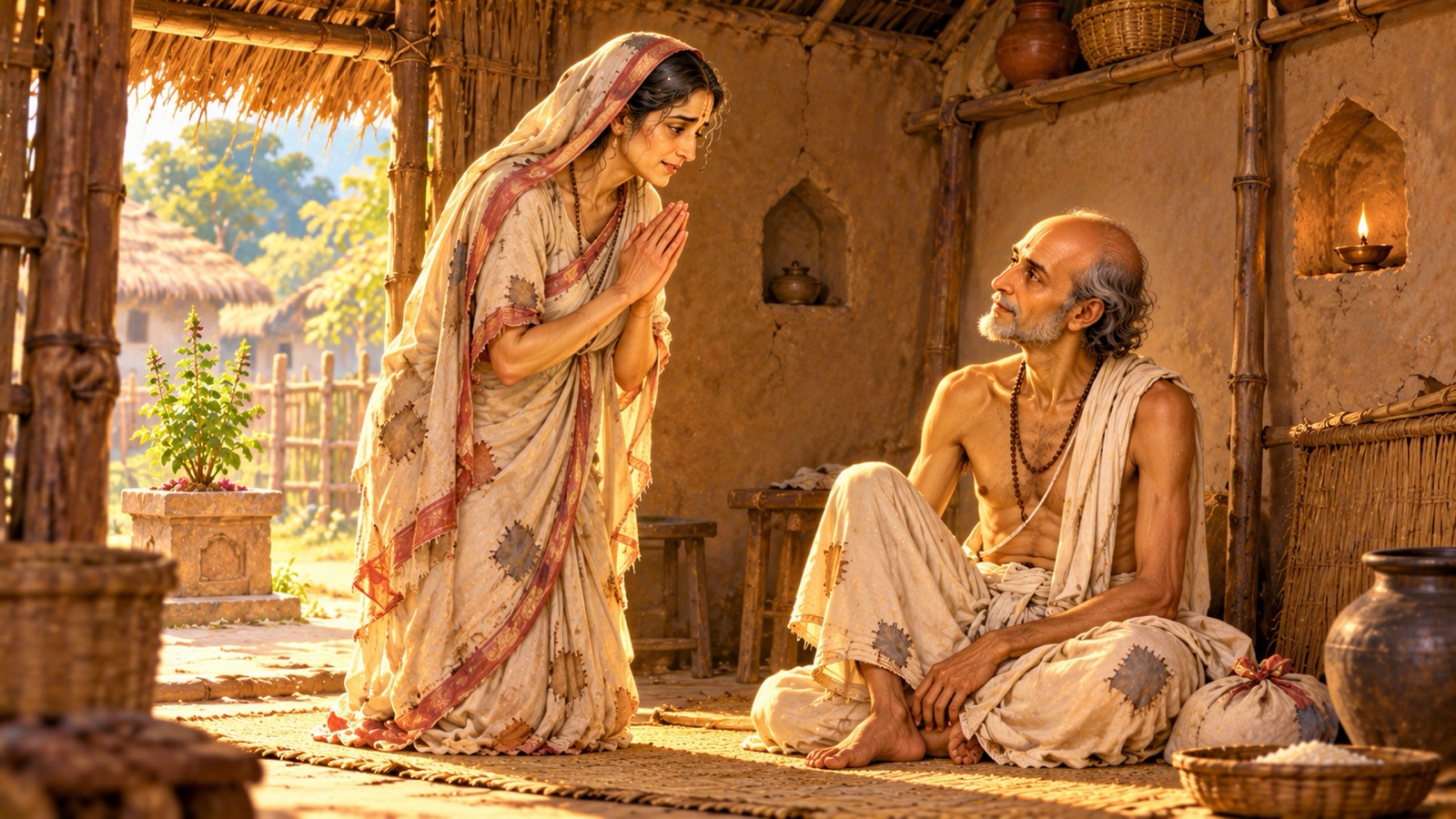
There was a certain brahmana, Sukadeva said, who was a dear friend of Krishna: a knower of Brahman, detached from sense-objects, peaceful and self-controlled. Though a householder, he lived content with whatever came unsought. His clothes were tattered, and his wife, equally ill-clad, had grown gaunt from hunger. One day that chaste woman came before her husband with a withered face and trembling body, and spoke with great gentleness.
The Wife’s Gentle Plea
“Blessed one,” she said, “Krishna, the Lord of the goddess of fortune Himself, the protector of brahmanas and the shelter of all, the best of the Satvatas, is your own friend. Go to Him, the refuge of the saintly; seeing you a householder in distress, He will surely give you abundant wealth.”
आस्तेऽधुना द्वारवत्यां भोजवृष्ण्यन्धकेश्वर: ।
स्मरत: पादकमलमात्मानमपि यच्छति ।
किं न्वर्थकामान् भजतो नात्यभीष्टाञ्जगद्गुरु: ॥ ११ ॥
āste ‘dhunā dvāravatyāṁ bhoja-vṛṣṇy-andhakeśvaraḥ smarataḥ pāda-kamalam ātmānam api yacchati kiṁ nv artha-kāmān bhajato nāty-abhīṣṭāñ jagad-guruḥ
Meaning: He now dwells in Dvaraka as Lord of the Bhojas, Vrishnis and Andhakas. To one who simply remembers His lotus feet He gives even His own Self; what wonder, then, that the Teacher of the universe should grant wealth and enjoyment, which are not really so desirable, to one who worships Him? (Canto 10, Chapter 80, verse 11)
Four Handfuls of Flattened Rice
Entreated again and again, the brahmana at last consented, yet not for the sake of riches. “The sight of the Lord of excellent fame,” he thought, “is itself the highest gain.” Resolving to go, he asked her gently whether anything in the house might serve as a present.
याचित्वा चतुरो मुष्टीन् विप्रान् पृथुकतण्डुलान् ।
चैलखण्डेन तान् बद्ध्वा भर्त्रे प्रादादुपायनम् ॥ १४ ॥
yācitvā caturo muṣṭīn viprān pṛthuka-taṇḍulān caila-khaṇḍena tān baddhvā bhartre prādād upāyanam
Meaning: Begging four handfuls of flattened rice from brahmanas, she tied them in a piece of cloth and gave them to her husband as a gift for the Lord. (Canto 10, Chapter 80, verse 14)
With that small bundle the foremost of brahmanas set out for Dvaraka, and the one thought that walked with him was this: how shall I obtain the sight of Krishna?

Into the Golden City
Reaching Dvaraka with other brahmanas, he passed three guard-posts and three gated enclosures and came to the mansions of the Andhakas and Vrishnis, followers of the Lord’s own dharma, where ordinary people could never enter. There stood Krishna’s palace with its homes for sixteen thousand queens, and the brahmana stepped into one richly adorned dwelling as a man who has entered the bliss of Brahman.
The Lord Rises to Embrace His Friend
Krishna was seated on a couch beside His beloved Rukmini. Seeing the brahmana while he was still far off, the infallible Lord sprang up at once, went forward, and gathered him joyfully into both His arms.
तं विलोक्याच्युतो दूरात् प्रियापर्यङ्कमास्थित: ।
सहसोत्थाय चाभ्येत्य दोर्भ्यां पर्यग्रहीन्मुदा ॥ १८ ॥
taṁ vilokyācyuto dūrāt priyā-paryaṅkam āsthitaḥ sahasotthāya cābhyetya dorbhyāṁ paryagrahīn mudā
Meaning: Seeing him from a distance, Acyuta, who was seated on His beloved’s couch, rose suddenly, came forward and embraced him with both arms in delight. (Canto 10, Chapter 80, verse 18)
The lotus-eyed Lord, who is bliss itself, was so moved at the touch of His dear friend, the brahmana sage, that tears fell from His eyes.
The Worship of a Ragged Guest
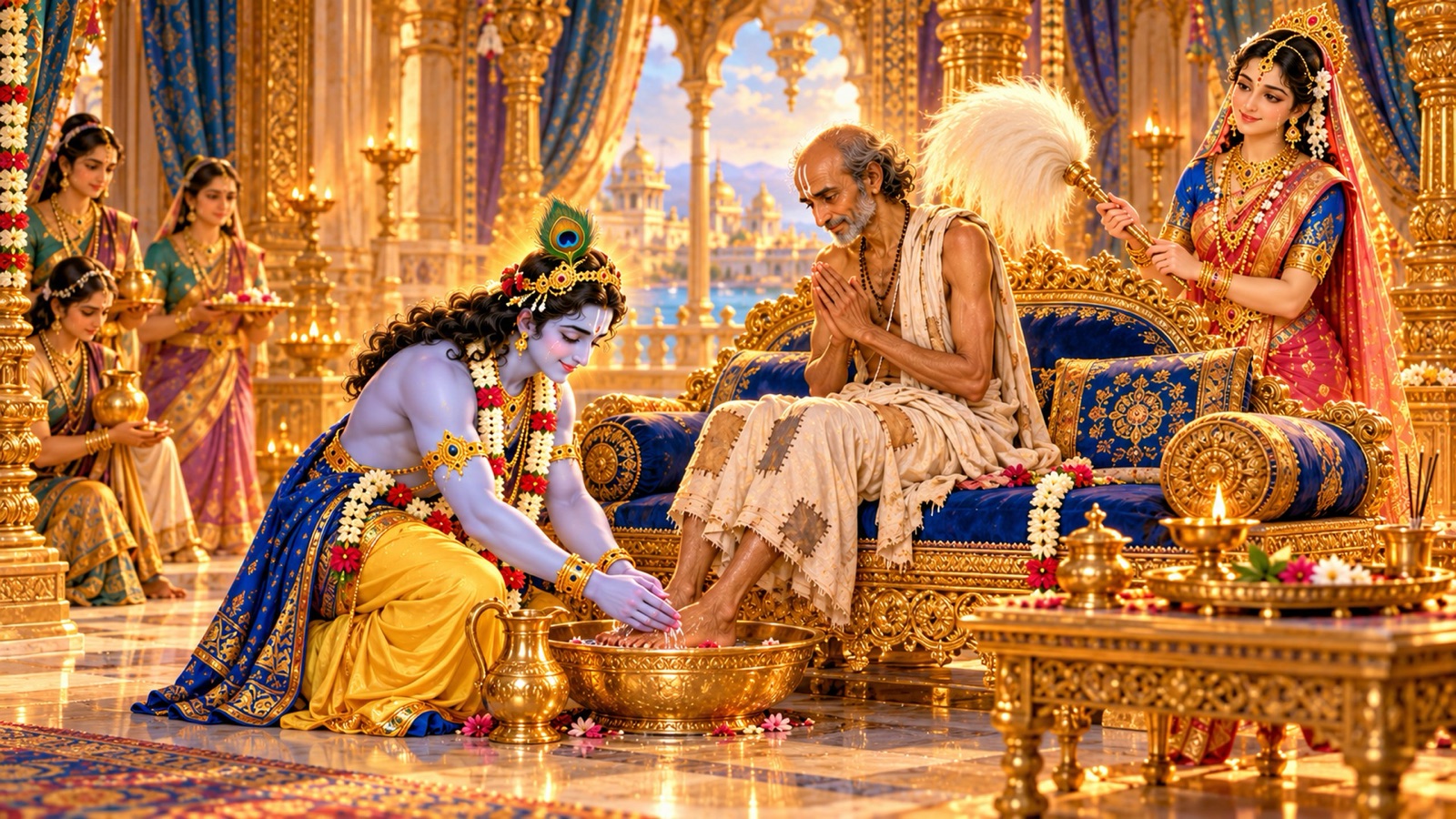
Then the purifier of the worlds seated His friend on His own couch and with His own hands brought the articles of worship. He washed the brahmana’s feet and took the water upon His head, anointed him with divine fragrance and with sandal, aloe and saffron paste, worshipped him with incense and rows of lamps, offered him betel and the gift of a cow, and welcomed him with loving words. And Rukmini herself stood fanning this emaciated visitor whose clothes hung in rags.
कुचैलं मलिनं क्षामं द्विजं धमनिसन्ततम् ।
देवी पर्यचरत् साक्षाच्चामरव्यजनेन वै ॥ २३ ॥
ku-cailaṁ malinaṁ kṣāmaṁ dvijaṁ dhamani-santatam devī paryacarat sākṣāc cāmara-vyajanena vai
Meaning: The goddess Rukmini herself served that brahmana, poorly dressed, unwashed and thin, his veins standing out upon his body, by fanning him with a chowry. (Canto 10, Chapter 80, verse 23)
The Wonder of the Palace Women
The women of the inner palace watched in amazement as Krishna, whose fame is spotless, honoured this wandering mendicant so lovingly. “What merit has this penniless beggar earned,” they whispered, “scorned and lowly in the world’s eyes, that the Teacher of the three worlds should leave the goddess of fortune seated on His couch and embrace him as though he were His elder brother?” Meanwhile the two friends clasped hands and spoke of the sweet days they had shared in the house of their guru.
Krishna Asks His Friend to Remember
The Lord asked first whether, returning from the guru’s house with the teacher’s leave, His friend had married a wife suited to him. “I know,” He said, “that your heart is not bound to household life, and that you care little for wealth. Rare are those who, shaking off the desires born of Maya, still perform their duties with a mind untouched by craving, as I do to set an example for the world.” Then He asked whether the brahmana remembered their stay in the gurukula, where the twice-born learns what must be known and crosses the darkness of ignorance.
He spoke of the three gurus of a man’s life: the father who gives the body; the teacher who gives the sacred thread and instructs in duty, to be honoured like Krishna Himself; and the teacher who bestows knowledge of the Self, who is Krishna in person. Those who cross the ocean of birth and death by the guru’s word alone truly understand their own good. And He crowned these words with a declaration that is the heart of this chapter.
नाहमिज्याप्रजातिभ्यां तपसोपशमेन वा ।
तुष्येयं सर्वभूतात्मा गुरुशुश्रूषया यथा ॥ ३४ ॥
nāham ijyā-prajātibhyāṁ tapasopaśamena vā tuṣyeyaṁ sarva-bhūtātmā guru-śuśrūṣayā yathā
Meaning: I, the Self of all beings, am not as satisfied by sacrifice, by the second birth of initiation, by austerity or by inner quietude as I am by faithful service rendered to the guru. (Canto 10, Chapter 80, verse 34)
The Night of the Storm
“Do you recall,” Krishna said, “the day our guru’s wife sent us to gather firewood? We had entered the great forest when, out of season, fierce wind and rain broke upon us and the thunder roared without pity. The sun set, darkness swallowed every direction, and with water everywhere we could not tell high ground from low. Beaten by wind and flood, lost and bewildered, we wandered holding each other by the hand. At sunrise our teacher Sandipani, learning what had happened, came searching and found us, his disciples, in that wretched state.”

Sandipani’s Blessing
“‘My dear children,’ he said, ‘you have suffered so much for my sake! One’s own body is dearest of all to every creature, yet you disregarded even that out of devotion to me. This indeed is the duty of a true disciple, by which he repays the guru.’”
एतदेव हि सच्छिष्यै: कर्तव्यं गुरुनिष्कृतम् ।
यद् वै विशुद्धभावेन सर्वार्थात्मार्पणं गुरौ ॥ ४१ ॥
etad eva hi sac-chiṣyaiḥ kartavyaṁ guru-niṣkṛtam yad vai viśuddha-bhāvena sarvārthātmārpaṇaṁ gurau
Meaning: This alone is what good disciples must do to repay the debt to the guru: with a wholly pure heart, to offer him everything they possess and their very self. (Canto 10, Chapter 80, verse 41)
“‘I am pleased with you, best of brahmanas,’ he blessed us. ‘May all your wishes come true, and may the Vedic knowledge you learned from me never fade, here or hereafter.’” Many such things befell us in our guru’s house, Krishna concluded; by the guru’s grace alone does a person become fulfilled and attain perfect peace.
The Brahmana’s Reply
The brahmana answered: “O God of gods, Teacher of the universe, what remains for us to accomplish, when we lived in the guru’s house together with You, whose every wish is truth itself? Your body, O almighty one, is the Vedas, the field in which every blessing is sown. That You should dwell in a teacher’s house to study them is nothing but a most wonderful imitation of human ways.”
यस्यच्छन्दोमयं ब्रह्म देह आवपनं विभो ।
श्रेयसां तस्य गुरुषु वासोऽत्यन्तविडम्बनम् ॥ ४५ ॥
yasya cchando-mayaṁ brahma deha āvapanaṁ vibho śreyasāṁ tasya guruṣu vāso ‘tyanta-viḍambanam
Meaning: O all-pervading Lord, Your body is the Veda itself, the seedbed of all that is auspicious; Your residence in the homes of teachers is therefore the greatest play-acting. (Canto 10, Chapter 80, verse 45)
Principal Teachings of This Chapter
1. Every faculty finds its purpose in the Lord. Parikshit’s words (verse 3) measure speech, hands, mind and ears by whether they glorify, serve, remember and hear of Krishna. Devotion is the native use of every limb.
2. Seeing the Lord is itself the supreme gain. The brahmana goes to Dvaraka not for wealth but because darshan of the Lord is the highest attainment. The wife’s own words (verse 11) place the gift of the Lord’s Self far above riches, which He grants almost as an afterthought.
3. Love, not status, moves the Lord. Krishna leaves the goddess of fortune’s side to embrace a ragged beggar (verse 18) and washes his feet. The palace women’s astonishment tells us that the Lord is won by the heart’s devotion alone.
4. Service to the guru pleases the Lord most of all. Krishna’s declaration (verse 34), with Sandipani’s words on offering one’s very self (verse 41), is the chapter’s doctrinal core: more than ritual, initiation, austerity or quietude, humble service to the teacher wins the Self of all beings.
5. The Lord’s human pastimes teach by example. Krishna studied in a guru’s house though the Vedas are His own body (verse 45), performing duties without desire so that the world may learn to follow.
A Devotional Reflection
Why does the Lord arrange this meeting at all, when He knows His friend’s need and could fill his house with wealth from afar? Krishna wished the whole world to witness that He is bound not by gifts but by love. The brahmana’s bundle is worth almost nothing; his heart, which seeks only the sight of Krishna, is worth everything. By rising from Rukmini’s side, weeping, and bathing a beggar’s feet, the Lord of Sri publicly reverses every scale of the world. And by turning the talk to Sandipani He reveals the hidden thread: the self-forgetting devotion two boys once showed their teacher in a storm-dark forest is exactly what He treasures now. We who come with our own small bundles may take heart. He does not weigh what we bring; He looks at who we have become in loving Him.
A Daily Devotional Practice
Today, remember with gratitude one teacher through whom sacred knowledge reached you — a parent, a guru, a saintly guide — and offer that person a silent prayer, a word of thanks, or a small act of service, recalling that such service pleases Krishna more than any ritual. Then read or hear a passage of the Bhagavatam, so that your ears may be true ears today. Begin by chanting gently: Om Namo Bhagavate Vasudevaya.
Conclusion
Here Sukadeva begins the story of Sudama. A destitute brahmana carries a poor man’s gift to Dvaraka, and the Lord of all opulence greets him as the dearest of guests, then leads him back in memory to Sandipani’s ashram and the forest storm, crowning that memory with His teaching that service to the guru pleases Him beyond all else. May we learn from Sudama to seek the Lord for His own sake, and from the two young disciples to hold our teachers dearer than ourselves.
May the divine wisdom of Srimad Bhagavatam awaken pure devotion within our hearts.
Om Namo Bhagavate Vasudevaya.
Jay Shree Madhav.
References and Attribution
- Primary edition: Gita Press, Śrīmad Bhāgavata Mahāpurāṇa (English), Book Ten (Latter Half), Discourse 80.
- Series: Srimad Bhagavatam Wisdom · Biswa Sanatan Dharma Seva Trust.
- Presented following the spiritual guidance and recommendation of Pandit Dr. Shri Kashinath Mishra.
This is an original, faithful retelling in the writer’s own words, with brief quoted verses shown in Devanāgarī and transliteration and their meanings given as summaries. It is not a reproduction of any single publisher’s continuous translation or commentary. No affiliation with or endorsement by any publisher is implied.
Jay Shree Madhav