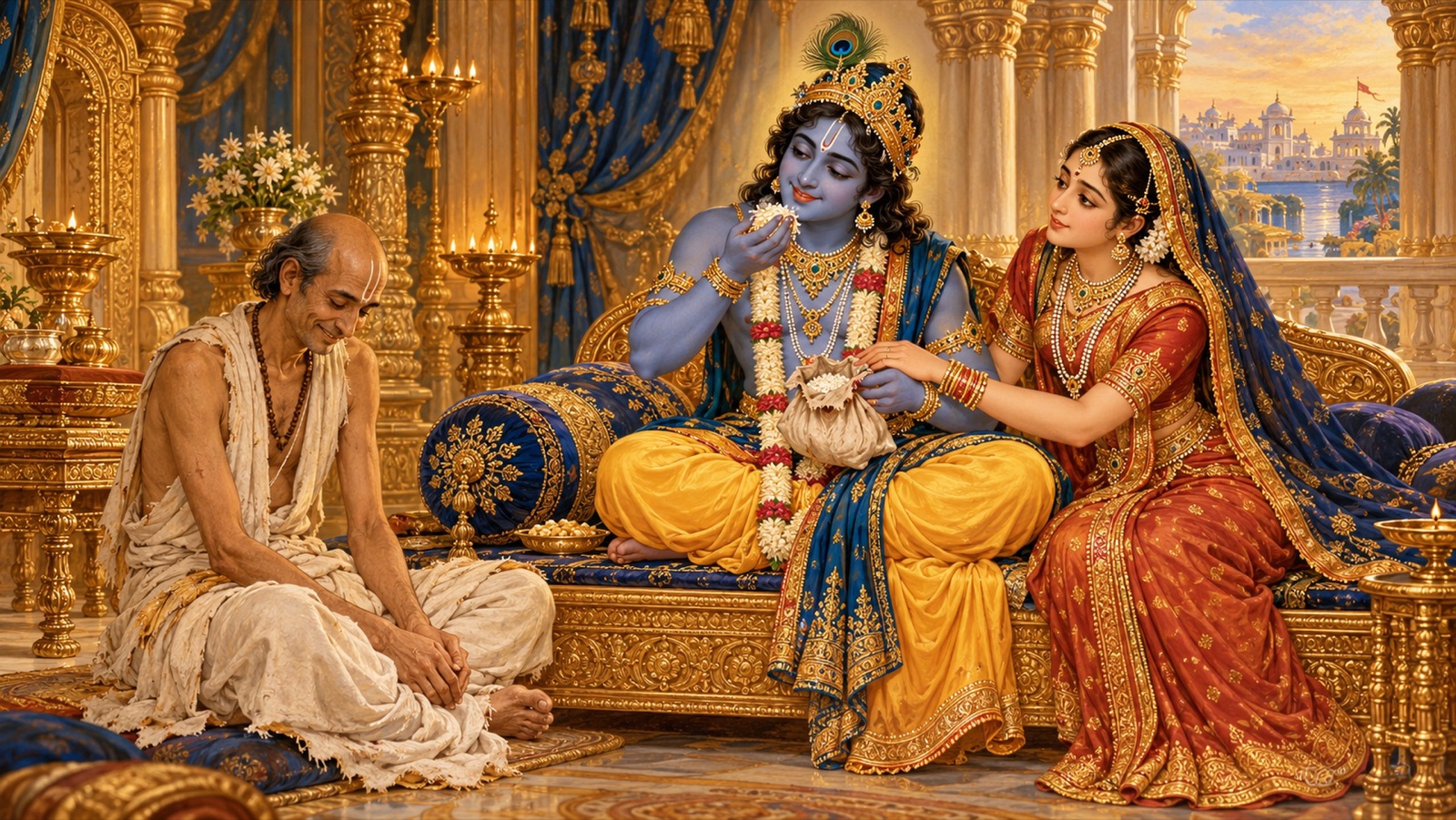
A fistful of chipped rice tied in a rag, a Lord who eats it as the wealth of three worlds, and a poor friend sent home without a coin — only to find that grace had reached his doorstep before he did.
Om Namo Bhagavate Vasudevaya.
Om Namo Bhagavate Vasudevaya.
Om Namo Bhagavate Vasudevaya.
Welcome back to Srimad Bhagavatam Wisdom, our devotional journey through the sacred histories and teachings of the Srimad Bhagavat Mahapurana. In this eighty-first chapter of the Tenth Canto, Sukadeva completes the beloved story of Sudama, the poor brahmana friend of Krishna. The Lord draws the hidden bundle of chipped rice from His guest’s torn cloth and eats it with delight; Rukmini herself must stay His hand. Sudama leaves with nothing in his hands and everything in his heart, and returns to find his hut become a palace — yet his love for Krishna, not his fortune, remains his treasure.
Chapter Information
- Scripture: Śrīmad Bhāgavata Mahāpurāṇa
- Canto: 10 (Book Ten, Latter Half)
- Chapter: 81 (Discourse 81)
- Chapter title: The Lord Blesses Sudama Brahmana
- Principal speaker: Sukadeva Gosvami (narrating to King Parikshit)
- Principal listener: King Parikshit
- Main setting: Krishna’s palace in Dvārakā, and then the home of Sudama
- Central subject: Krishna’s acceptance of Sudama’s chipped rice; his departure without asking for wealth; the transformation of his home; his unchanged devotion
- Principal verse range: Canto 10, Chapter 81, verses 1–41
- Primary edition: Gita Press Śrīmad Bhāgavata Mahāpurāṇa (English, Part II)
Context From the Previous Chapter
In Chapter 80, the poor brahmana Sudama, urged by his devoted wife, set out for Dvārakā with a small bundle of chipped rice for his boyhood friend. Krishna received him with overflowing honour, washed his feet, seated him on His own bed, and the friends recalled their days in the home of their preceptor Sāndīpani.
“What Have You Brought for Me?”
Sukadeva continued. Krishna, who knows the minds of all beings, who is devoted to the brahmanas and the refuge of the saintly, had been speaking warmly with His dear friend. Now, looking at him with eyes full of love and smiling playfully, He asked a teasing question.
श्रीभगवानुवाच
किमुपायनमानीतं ब्रह्मन् मे भवता गृहात् ।
अण्वप्युपाहृतं भक्तै: प्रेम्णा भूर्येव मे भवेत् ।
भूर्यप्यभक्तोपहृतं न मे तोषाय कल्पते ॥ ३ ॥
kim upāyanam ānītaṁ brahman me bhavatā gṛhāt aṇv apy upāhṛtaṁ bhaktaiḥ premṇā bhury eva me bhavet bhūry apy abhaktopahṛtaṁ na me toṣāya kalpate
Meaning: The glorious Lord said: O brahmana, what gift have you brought Me from your home? Even the tiniest thing My devotees offer with love becomes immense to Me; but a great heap given without devotion cannot bring Me satisfaction. (Canto 10, Chapter 81, verse 3)
Then He spoke words devotees have treasured ever since.
पत्रं पुष्पं फलं तोयं यो मे भक्त्या प्रयच्छति ।
तदहं भक्त्युपहृतमश्नामि प्रयतात्मन: ॥ ४ ॥
patraṁ puṣpaṁ phalaṁ toyaṁ yo me bhaktyā prayacchati tad ahaṁ bhakty-upahṛtam aśnāmi prayatātmanaḥ
Meaning: Whoever offers Me with devotion a leaf, a flower, a fruit or water — that offering of love, brought by one of purified heart, I accept and eat. (Canto 10, Chapter 81, verse 4)
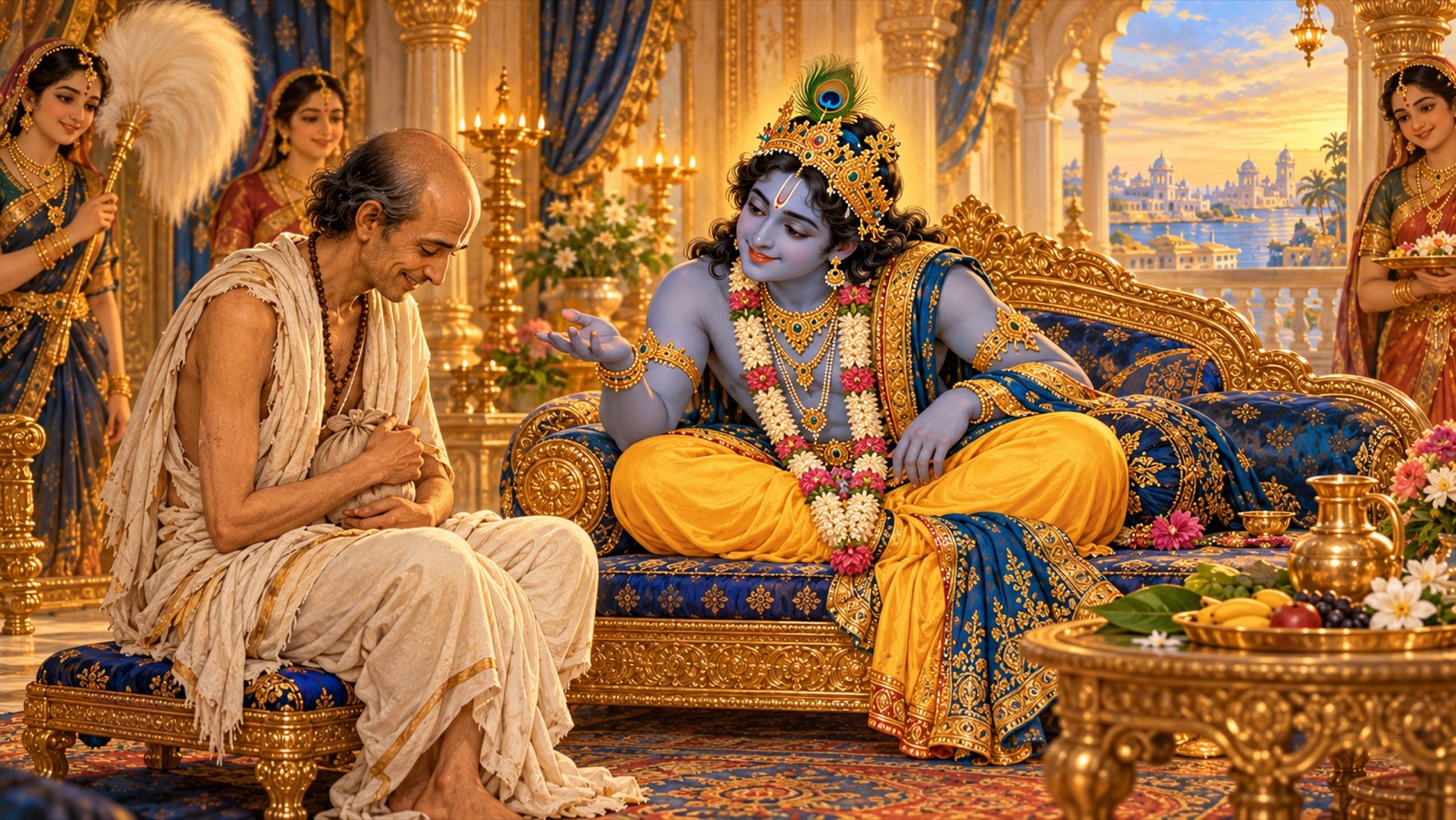
Even so encouraged, the brahmana could not bring himself to hold out his handful of beaten rice before the Lord of Lakshmi Herself. Shy, he simply hung his head.
The Lord Takes the Hidden Gift
But Krishna, who sees into every heart, understood why His friend had come. He thought to Himself: this brahmana has never once sought wealth from Me. He has come now only at the entreaty of his devoted wife, whom he wishes to please. I shall grant him riches that even the immortals find hard to obtain.
Having resolved this, the Lord Himself reached under the brahmana’s covering cloth, drew out the chipped rice tied in a rag, and exclaimed with joy: “What is this, My friend? You have brought Me what I love most! These grains will satisfy not only Me but the whole universe.” Saying so, He ate one handful, and was raising a second to His mouth when Rukmini — the goddess of fortune Herself, wholly devoted to Him — caught hold of His hand.
इति मुष्टिं सकृज्जग्ध्वा द्वितीयां जग्धुमाददे ।
तावच्छ्रीर्जगृहे हस्तं तत्परा परमेष्ठिन: ॥ १० ॥
iti muṣṭiṁ sakṛj jagdhvā dvitīyāṁ jagdhum ādade tāvac chrīr jagṛhe hastaṁ tat-parā parameṣṭhinaḥ
Meaning: Having thus eaten a single fistful, He took up a second to eat — whereupon Śrī, the goddess of fortune, devoted to Him, grasped the hand of the Supreme Lord. (Canto 10, Chapter 81, verse 10)
“This is enough, O Soul of the universe,” She said. “One handful alone suffices to please You, and to give a man every kind of prosperity in this world and the next.” Beneath Her words lay a tender plea: with a second handful, She Herself would have had to follow the gift.
Sudama Departs With Empty Hands and a Full Heart
The brahmana spent that night in Krishna’s palace, dined to his heart’s content, and felt as though he were already in the Lord’s own abode. The next morning he set out for home. Krishna, the life of the universe, complete in His own bliss, walked some distance with him, delighted him with sweet words, and bowed to him in farewell.
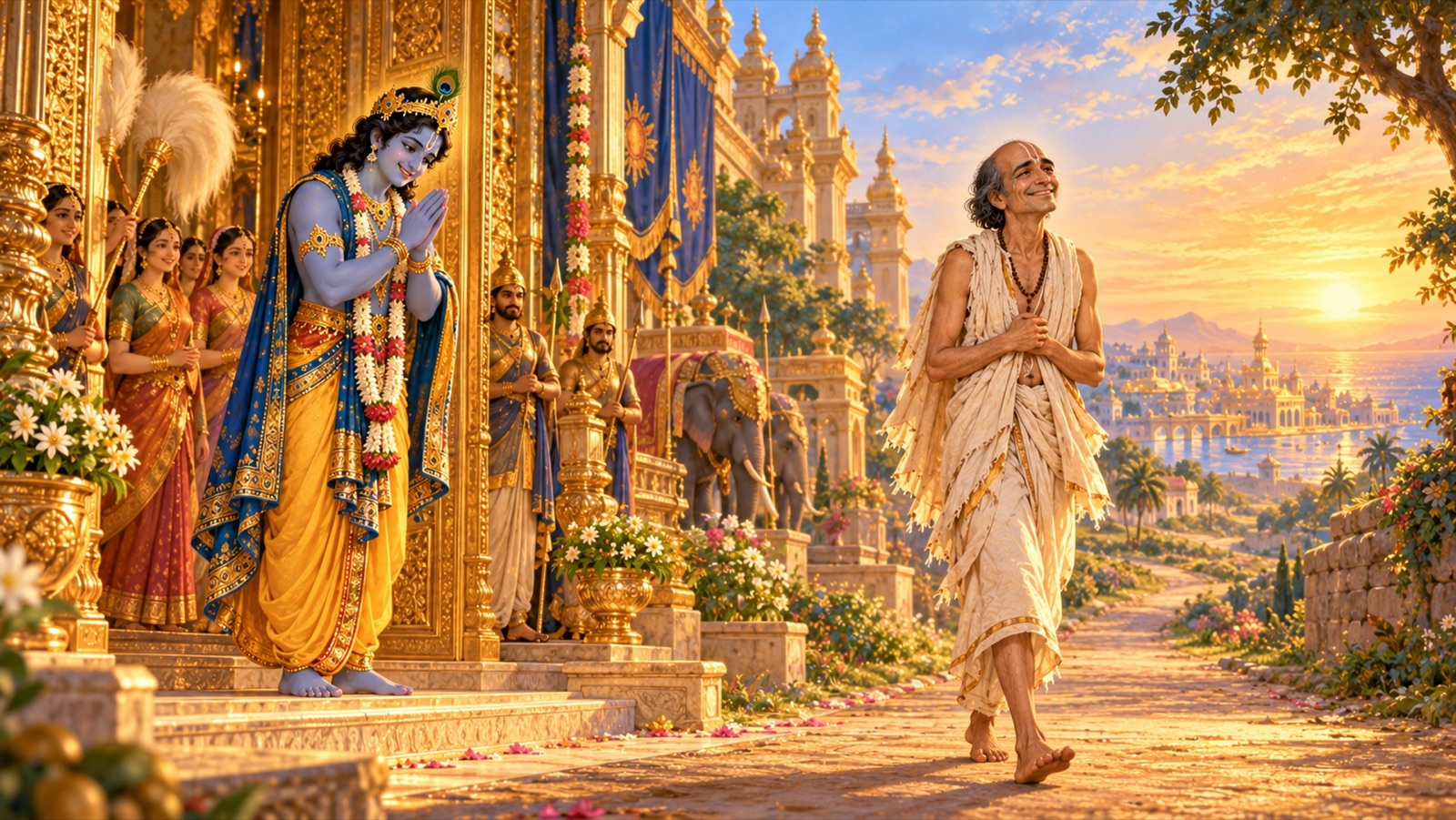
Sudama had received no wealth from Krishna, and he had asked for none. A little abashed at his own smallness of heart, he nevertheless walked home overflowing with happiness, for he had beheld the Lord. Along the way his thoughts poured out in wonder. How devoted to the brahmanas the Lord is! He clasped a destitute like me to the very chest where Lakshmi dwells. What am I — a poor sinner — beside Krishna, the abode of fortune? Yet because I was born in a brahmana family, He embraced me, seated me on the bed of His beloved Rukmini as though I were His brother, and the queen herself fanned me when she saw I was tired. The God of gods pressed my feet and served me like a divinity. Heaven, liberation, every treasure of earth and the nether regions, every mystic perfection flow from the worship of His feet. And yet He gave me not a little wealth — surely because riches would intoxicate a poor man like me and make me forget Him.
अधनोऽयं धनं प्राप्य माद्यन्नुच्चैर्न मां स्मरेत् ।
इति कारुणिको नूनं धनं मेऽभूरि नाददात् ॥ २० ॥
adhano ’yaṁ dhanaṁ prāpya mādyann uccair na māṁ smaret iti kāruṇiko nūnaṁ dhanaṁ me ’bhūri nādadāt
Meaning: “This penniless man, on obtaining wealth, would grow proud and no longer remember Me” — thinking thus, the compassionate Lord surely refrained from giving me even a small fortune. (Canto 10, Chapter 81, verse 20)
Sudama reads the Lord’s silence as mercy, not neglect — the very heart of his devotion.
The Hut That Had Become a Palace
Musing in this way, the brahmana came near his home — and could not recognise it. On every side rose mansions of seven storeys, shining like the sun, the fire and the moon. Gardens and groves resounded with birdsong; ponds were covered with blossoming lilies and lotuses. Handsomely dressed men and lovely women moved about everywhere. Bewildered, he wondered: What is this? Whose house is this? If this is where I lived, what wonder has turned it into so many palaces?
As he stood puzzling, men and women radiant as gods came out to welcome the blessed brahmana with songs and music. His wife, hearing that her husband had returned, hurried out of the mansion in joyous haste, looking like the goddess Lakshmi stepping forth from Her own abode. At the sight of him her eyes filled with tears of love; closing them in modesty, she bowed to him and embraced him in her heart.
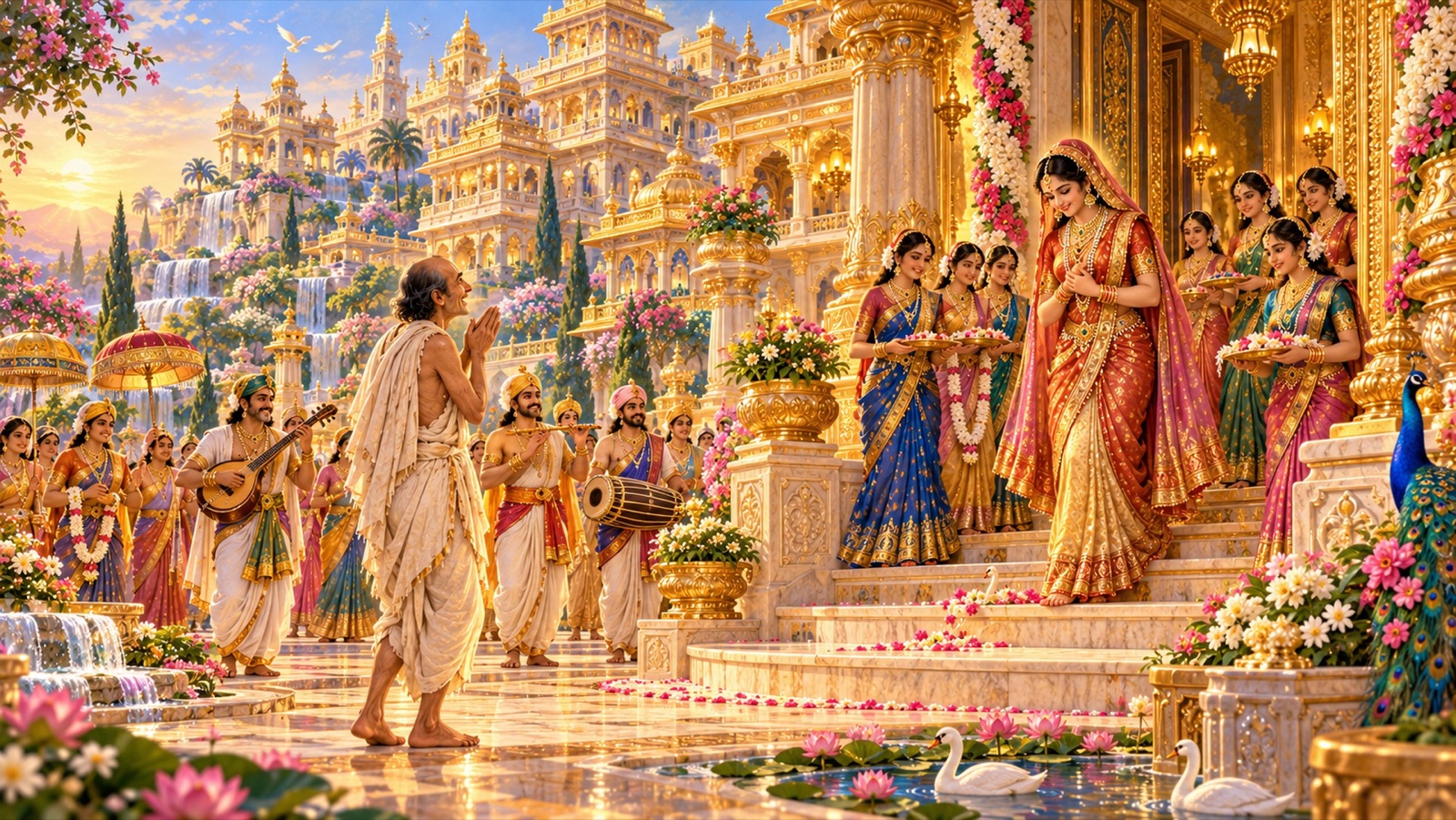
The brahmana marvelled to see her shining like a celestial lady among maidservants adorned with golden necklaces. Following her, he entered his own house, now upheld by hundreds of jewelled pillars and splendid as the palace of Indra: couches of ivory inlaid with gold, bedding white and soft as the foam of milk, golden-handled whisks, cushioned seats of gold, canopies hung with pearls, and crystal walls set with emeralds where figures of precious stone held blazing jewels to light the halls.
Sudama’s Unchanged Heart
Seeing such abundance arrive without any visible cause, the brahmana did not lose himself in it. With a calm mind he reflected. I have always been poor and unfortunate, he thought; from where could such prosperity come, if not from the gracious glance of Krishna, the crest-jewel of the Yadus, the Lord of all opulence? He gives abundantly to the devotee who approaches Him, yet counts His gift as nothing and never speaks of it — like a rain-cloud, my friend, the best of the Dāśārhas, gives silently. Though He makes light of what He bestows, He makes much of the smallest thing His devotee brings; with such delight did the great-souled Lord accept my single handful of chipped rice.
And then, in the midst of all his new wealth, Sudama prayed for the only thing he had ever wanted.
तस्यैव मे सौहृदसख्यमैत्री
दास्यं पुनर्जन्मनि जन्मनि स्यात् ।
महानुभावेन गुणालयेन
विषज्जतस्तत्पुरुषप्रसङ्ग: ॥ ३६ ॥
tasyaiva me sauhṛda-sakhya-maitrī- dāsyaṁ punar janmani janmani syāt mahānubhāvena guṇālayena viṣajjatas tat-puruṣa-prasaṅgaḥ
Meaning: Birth after birth, may I have His affection, His friendship, His companionship and His service; and may I, attached to that great-souled Lord who is the abode of all virtues, enjoy the company of His devotees. (Canto 10, Chapter 81, verse 36)
He understood, too, why the Lord so often says no. Krishna, the unborn, who sees far, knows how wealth and power lead to the downfall of those who grow drunk on them.
भक्ताय चित्रा भगवान् हि सम्पदो
राज्यं विभूतीर्न समर्थयत्यज: ।
अदीर्घबोधाय विचक्षण: स्वयं
पश्यन् निपातं धनिनां मदोद्भवम् ॥ ३७ ॥
bhaktāya citrā bhagavān hi sampado rājyaṁ vibhūtīr na samarthayaty ajaḥ adīrgha-bodhāya vicakṣaṇaḥ svayaṁ paśyan nipātaṁ dhanināṁ madodbhavam
Meaning: The unborn Lord, who is wise and Himself sees how the wealthy fall through the pride that riches breed, does not bestow dazzling fortunes, kingdoms and opulences upon a devotee whose understanding is short. (Canto 10, Chapter 81, verse 37)
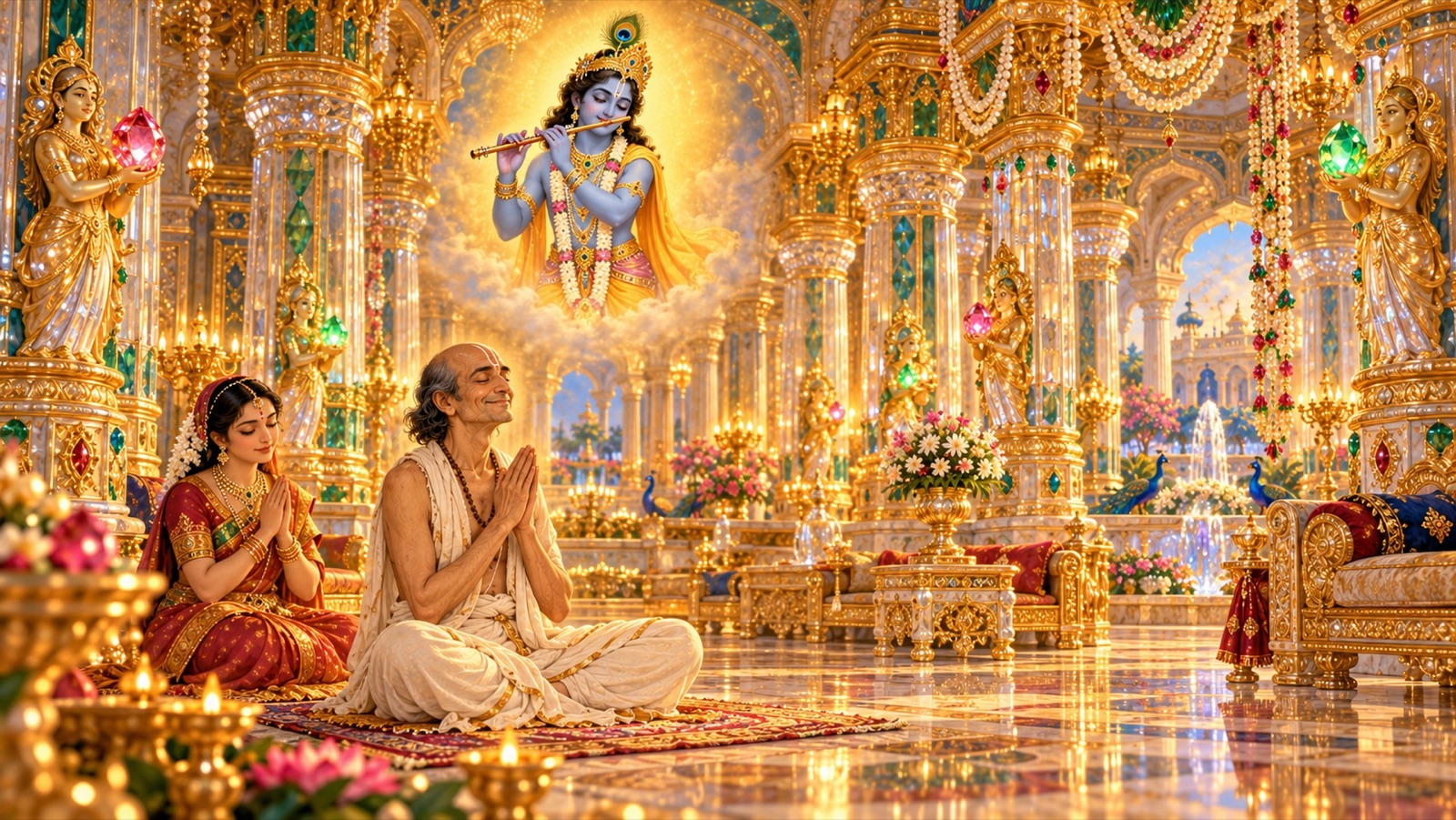
Settled in this conviction, the brahmana, an intense devotee of Janārdana, enjoyed with his wife the pleasures that had come only sparingly and without greed, ready to let them go — and his devotion to Krishna grew ever greater.
Sukadeva’s Closing Words
Sukadeva then gave Parikshit the lesson of the whole episode. The God of gods, the Lord of sacrifice, Hari Himself regards the brahmanas as His masters and worshipful deity; no being is higher than they. And this brahmana, the Lord’s friend, having seen how the Unconquerable is conquered by His own servants, became absorbed in meditation upon Him. By its force the knots binding his soul were cut, and before long he attained the Lord’s abode, the goal of the saintly.
एतद् ब्रह्मण्यदेवस्य श्रुत्वा ब्रह्मण्यतां नर: ।
लब्धभावो भगवति कर्मबन्धाद् विमुच्यते ॥ ४१ ॥
etad brahmaṇya-devasya śrutvā brahmaṇyatāṁ naraḥ labdha-bhāvo bhagavati karma-bandhād vimucyate
Meaning: A person who hears this account of the Lord’s loving regard for the brahmanas — He who holds the brahmanas as His deity — gains devotion to the Lord and is released from the bondage of karma. (Canto 10, Chapter 81, verse 41)
Principal Teachings of This Chapter
1. Love, not quantity, is what the Lord accepts. A tiny offering brought with love outweighs a mountain given without it; He eats whatever leaf, flower, fruit or water is placed before Him with devotion (verses 3–4). The gate to His heart is bhakti alone.
2. The Lord withholds as an act of mercy. Sudama’s insight (verse 20) is confirmed later: the all-seeing Lord does not hand dazzling fortune to one whom pride would destroy (verse 37). When a prayer for worldly gain goes unanswered, the devotee may trust a compassion wiser than his wish.
3. He gives like a cloud — silently and beyond measure. Krishna poured out riches without a word, counting even that abundance as nothing. His generosity is not announced; it is discovered.
4. True wealth is His friendship. Standing in a palace of jewels, Sudama asks only for the Lord’s affection, service and the company of His devotees in every birth (verse 36). One who has tasted Krishna’s love has nothing higher left to want.
5. The Lord is conquered by His servants. The Unconquerable submits to the will of His devotee, who thereby attains His abode. Merely hearing of such love awakens devotion and loosens the bonds of karma (verse 41).
A Devotional Reflection
What moves the heart most in this story is not the palace at the end but the walk home before it. Sudama leaves Dvārakā with nothing, and he is happy, because he has seen his friend. He even thanks the Lord for refusing him. Only a heart already full could read emptiness as kindness; and into that heart, which wanted nothing, Krishna poured everything.
Here, too, is the lesson of Rukmini’s hand upon the Lord’s. The gift was small; the love inside it set the goddess of fortune herself in motion. A sincere word, a moment of remembrance, a small act done for His pleasure — these are our chipped rice, and He receives them as the wealth of worlds.
May we learn from Sudama both halves of his faith: to be content when the Lord gives nothing, and to remain unchanged when He gives all. Fortune came and went around him; his devotion alone kept growing. That is the wealth the Lord wished for His friend, and wishes for us.
A Daily Devotional Practice
Today, offer the Lord something small with your whole heart — a tulasī leaf, a flower, a fruit, a cup of water, or a few minutes of undistracted remembrance — asking nothing in return. If a wish of yours has gone unanswered, thank Him as Sudama did, trusting that He sees further than you can. Begin by chanting gently: Om Namo Bhagavate Vasudevaya.
Conclusion
The eighty-first chapter of the Tenth Canto brings the story of Sudama to its tender close. The brahmana goes home empty-handed yet blessed, and finds a jewelled palace where his hut once stood. Through it all shines one truth: the Lord weighs the love in an offering, not its size, and He gives or withholds wealth solely for the good of the devotee’s heart. Sudama, enriched beyond measure, asks only for Krishna’s friendship birth after birth — and attains Him. May we offer our little with the same love, and hold our much with the same detachment.
May the divine wisdom of Srimad Bhagavatam awaken pure devotion within our hearts.
Om Namo Bhagavate Vasudevaya.
Jay Shree Madhav.
References and Attribution
- Primary edition: Gita Press, Śrīmad Bhāgavata Mahāpurāṇa (English, Part II), Book Ten (Latter Half), Discourse 81.
- Series: Srimad Bhagavatam Wisdom · Biswa Sanatan Dharma Seva Trust.
- Presented following the spiritual guidance and recommendation of Pandit Dr. Shri Kashinath Mishra.
This is an original, faithful retelling in the writer’s own words, with brief quoted verses shown in Devanāgarī and transliteration and their meanings given as summaries. It is not a reproduction of any single publisher’s continuous translation or commentary. No affiliation with or endorsement by any publisher is implied.
Jay Shree Madhav