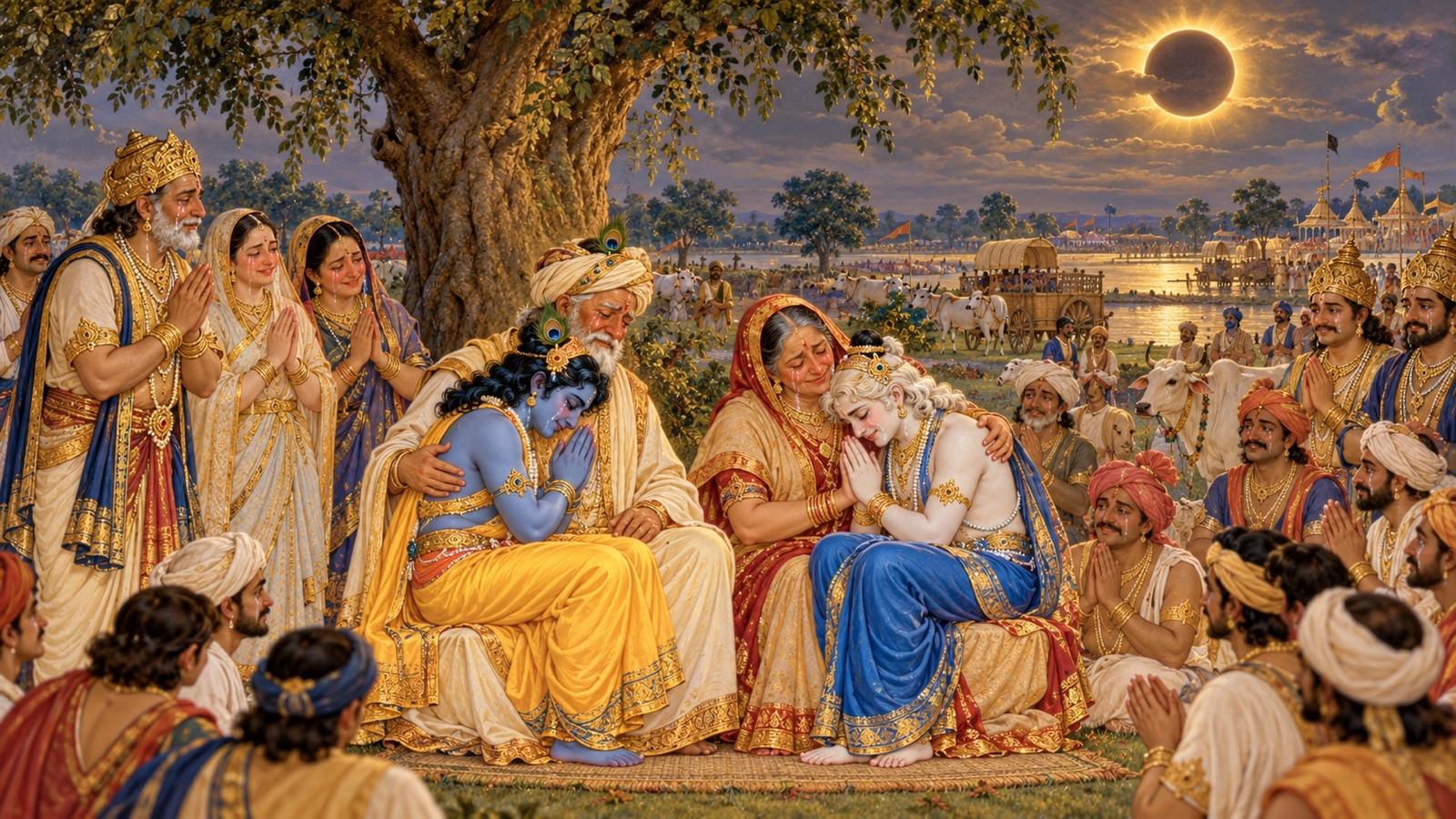
Under the darkened sun of a great eclipse, Kurukshetra becomes the meeting place of Dwaraka and Vraja — and Krishna, long parted from those who love Him most, sits once more on the laps of Nanda and Yashoda and fills the eyes of the gopis.
Om Namo Bhagavate Vasudevaya.
Om Namo Bhagavate Vasudevaya.
Om Namo Bhagavate Vasudevaya.
Welcome back to Srimad Bhagavatam Wisdom, our devotional journey through the Srimad Bhagavat Mahapurana. In this eighty-second chapter of the Tenth Canto, Sukadeva Gosvami takes us to the eclipse pilgrimage at Samanta-pañcaka, where the Yadus meet the kings of Bharata and the cowherds of Vraja, and Krishna teaches the gopis that devotion to Him bestows immortality.
Chapter Information
- Scripture: Śrīmad Bhāgavata Mahāpurāṇa
- Canto: 10 (Book Ten, Latter Half)
- Chapter: 82 (Discourse 82)
- Chapter title: Krishna and Balarama Meet the Inhabitants of Vrindavana
- Principal speaker: Sukadeva Gosvami, with the words of Kunti, Vasudeva, the kings, Rohini and Devaki, Krishna and the gopis
- Principal listener: King Parikshit
- Main setting: Samanta-pañcaka at Kurukṣetra, during a total solar eclipse
- Central subject: The eclipse pilgrimage; the meeting of kings and kinsmen; the reunion with Nanda, Yashoda and the gopis; Krishna’s teaching and the gopis’ prayer
- Principal verse range: Canto 10, Chapter 82, verses 1–48
- Primary edition: Gita Press Śrīmad Bhāgavata Mahāpurāṇa (English)
Context From the Previous Chapter
In Chapter 81, the poor brahmana Sudama offered Krishna a handful of beaten rice and came home to find a palace where his hut had stood; seeing that the Lord often withholds wealth out of compassion, he lived without attachment and reached the Lord’s abode. Sukadeva now turns to a pilgrimage that drew all of Bharata beneath a darkened sun.
The Great Eclipse and the Pilgrimage to Samanta-pañcaka
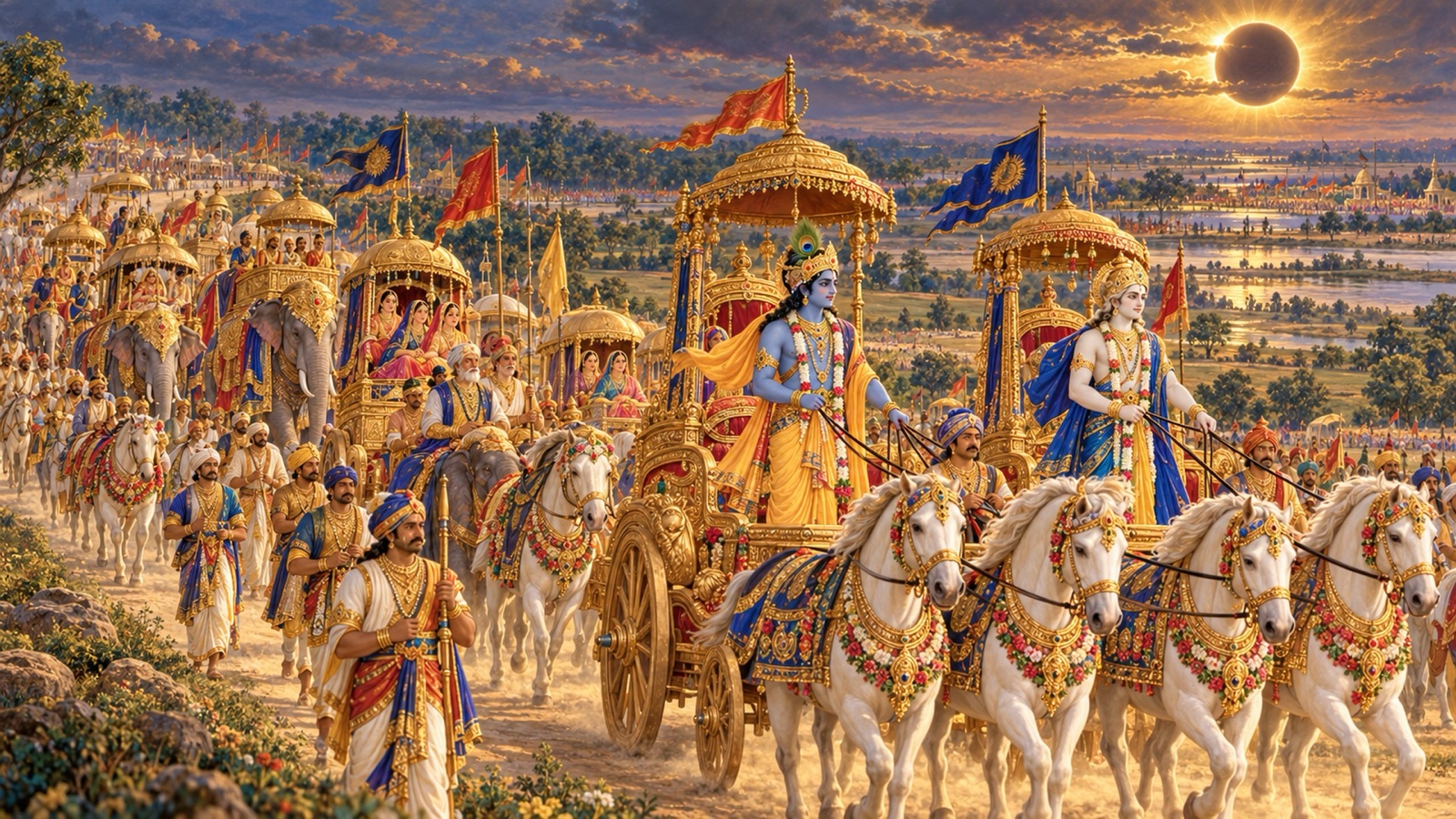
Sukadeva told Parikshit that once, while Krishna and Balarama were living in Dwaraka, there occurred a total eclipse of the sun, like the darkness that falls at the end of a kalpa. Knowing of it beforehand, people from every direction set out for the sacred field of Samanta-pañcaka to earn merit and blessedness. Here Parashurama, foremost of warriors, had rid the earth of its kshatriyas and filled five great lakes with the blood of kings; and here, though untouched by karma, that almighty Lord had performed sacrifice for the cleansing of sin, acting like an ordinary man to teach the world. To this field came the people of Bharata, intent on washing away their sins, and with them the Vrishnis — Akrura, Vasudeva, Ugrasena and the elders; Gada, Pradyumna, Samba and the younger princes — while Aniruddha and the general Kritavarma, with Sucandra, Suka and Sarana, stayed behind to guard Dwaraka.
Garlanded with gold and celestial flowers, clad in fine garments and armour, the Yadus rode with their wives in chariots shining like celestial mansions, on horses that moved like waves and on trumpeting elephants like thunderclouds, with footmen bright as Vidyadharas, so that on the road they looked like gods passing through the sky.
Bathing, Fasting and Charity at the Holy Field
Reaching Kurukshetra, those greatly fortunate Yadus bathed in the sacred waters, kept the fast of the eclipse with concentrated minds, and gave the brahmanas cows adorned with cloth, garlands and gold. When the eclipse had passed they bathed again in the lakes that bear Parashurama’s name and fed the best of brahmanas with excellent food, all with one prayer: “May our devotion rest in Krishna.” Then, with the brahmanas’ leave, they broke their fast and rested in the cool shade of the trees.
Friends and Kinsmen Meet Again
Rested, the Yadus looked upon the friends and kinsmen gathered there: the kings of Matsya, Ushinara, Kosala, Vidarbha, Kuru, Srinjaya, Kamboja, Kekaya, Madra, Kunti, Anarta and Kerala, with hundreds of others, allies and rivals alike; and among them Nanda and the cowherds, their dear friends, and the gopis who had yearned so long to see Krishna.
Joy at the sight of one another made the lotuses of their hearts and faces bloom; they clasped each other close, tears streaming, hair standing on end, voices failing. The women too greeted one another with smiles and loving glances and embraced with tears of affection. The younger bowed to the elders and were bowed to by those younger still, and having asked after one another’s welfare, all fell to speaking of Krishna, for no other topic could hold them.
Kunti’s Lament and Vasudeva’s Reply
Kunti, seeing her brothers and sisters with their children, her parents, her brothers’ wives, and Krishna Himself, found the grief of long years eased in their company. Yet she turned to her brother Vasudeva with a heart still tender from old wounds. “Noble brother,” she said, “I think of myself as one whose hopes were never fulfilled, for even the best of you did not remember me in my calamities. Friends, relatives, sons, brothers and even parents forget the one whom fortune does not favour.”
श्रीवसुदेव उवाच
अम्ब मास्मानसूयेथा दैवक्रीडनकान् नरान् ।
ईशस्य हि वशे लोक: कुरुते कार्यतेऽथ वा ॥ २० ॥
śrī-vasudeva uvāca amba māsmān asūyethā daiva-krīḍanakān narān īśasya hi vaśe lokaḥ kurute kāryate ’tha vā
Meaning: Sri Vasudeva said: Dear sister, do not blame us — we men are mere playthings of destiny. The world is under the Lord’s control; whatever a person does, he is made to do by Him. (Canto 10, Chapter 82, verse 20)
Vasudeva reminded her how the Yadus, harassed by Kamsa, had been scattered in every direction, and only now had been restored by Providence to a place of their own.
The Kings Behold Krishna and Praise the Yadus
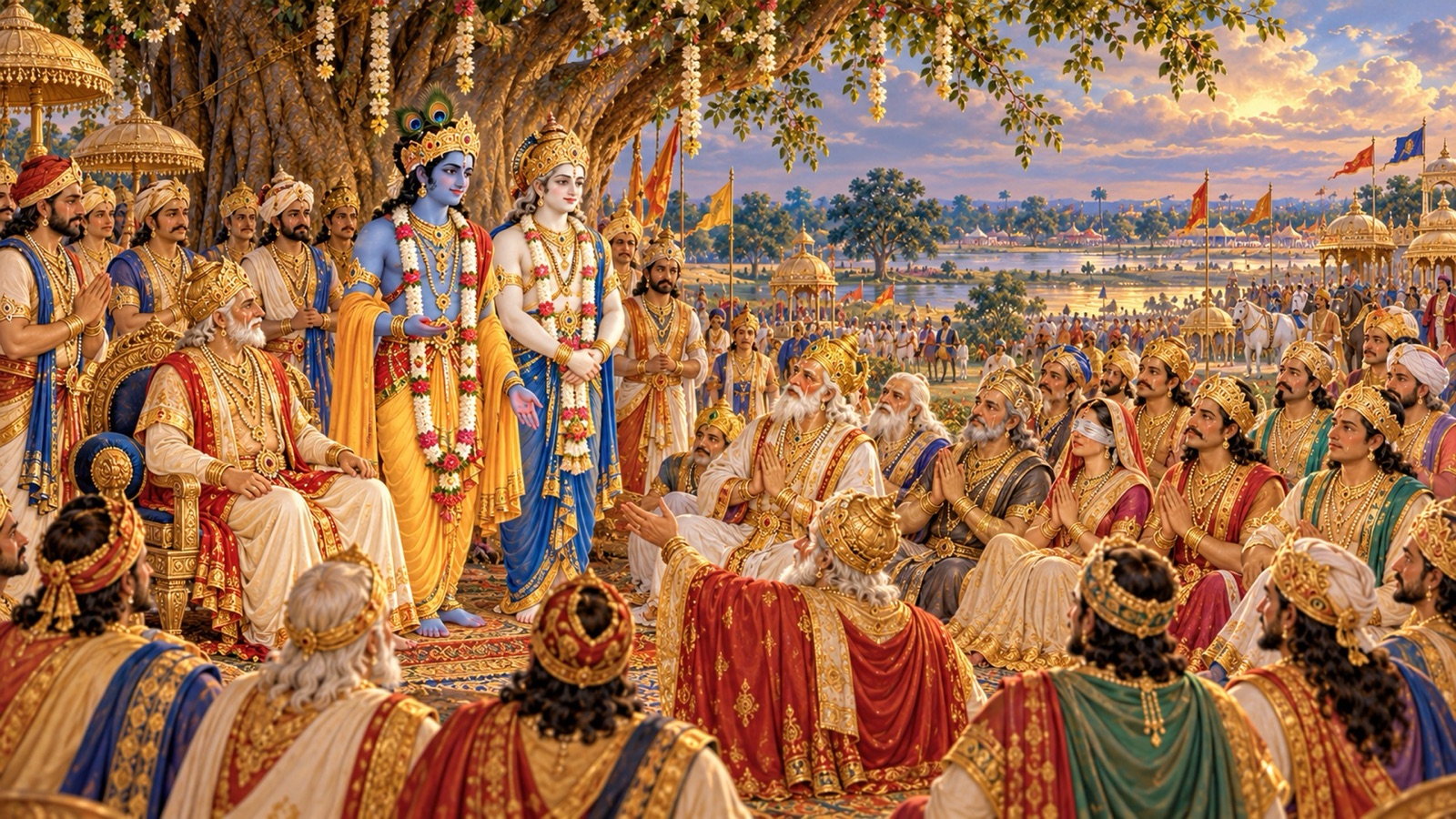
Honoured by Vasudeva, Ugrasena and the other Yadus, the kings were filled with the highest bliss at the sight of the infallible Lord. Bhishma, Drona, Dhritarashtra, Gandhari with her sons, the Pandavas with their wives, Kunti, Srinjaya, Vidura, Kripa, Kuntibhoja, Virata, Bhishmaka, the great Nagnajit, Purujit, Drupada, Shalya, Dhrishtaketu, the king of Kashi, Damaghosha, Vishalaksha, the king of Mithila, the kings of Madra and Kekaya, Yudhamanyu, Susharma, Bahlika and their sons, and all the kings who followed Yudhishthira gazed in wonder at the form of Krishna, the abode of all beauty, with His consorts. Honoured in turn by Balarama and Krishna, they joyfully praised the Vrishnis, who lived under Krishna’s protection, addressing Ugrasena, king of the Bhojas:
अहो भोजपते यूयं जन्मभाजो नृणामिह ।
यत् पश्यथासकृत् कृष्णं दुर्दर्शमपि योगिनाम् ॥ २८ ॥
aho bhoja-pate yūyaṁ janma-bhājo nṛṇām iha yat paśyathāsakṛt kṛṣṇaṁ durdarśam api yoginām
Meaning: O lord of the Bhojas! Among men in this world you alone have reaped the fruit of birth, for you see again and again Krishna, who is rarely seen even by the yogis. (Canto 10, Chapter 82, verse 28)
His fame sung by the Vedas, they said, the water that washes His feet and the scripture that is His word purify the whole world; and the earth, her fortune scorched by time, had regained her strength at the touch of His lotus feet and once more yields all that we desire. “You are joined to Him by marriage and by blood; you see Him, touch Him, walk, converse, sit, eat and sleep beside Him. Though you walk the householder’s path, which leads toward hell, Vishnu Himself dwells in your homes — He whose very sight ends all craving for heaven and even for liberation.”
Nanda Arrives: The Reunion with Vraja
When Nanda learned that the Yadus, led by Krishna, had come to Kurukshetra, he too set out with the cowherds, their carts laden with provisions. At the sight of him the Vrishnis rose up in delight, like bodies into which life has returned, and embraced him tightly after their long separation. Vasudeva held Nanda in overwhelming love, remembering one by one the torments Kamsa had inflicted and how he had been forced to leave his sons in Nanda’s keeping at Gokula. Krishna and Balarama embraced their foster-parents and bowed to them, and for love could not speak, their throats choked with tears. Nanda and the blessed Yashoda took their two sons onto their laps and held them in their arms, and the agony of years of separation left their hearts.
Rohini and Devaki Speak to Yashoda
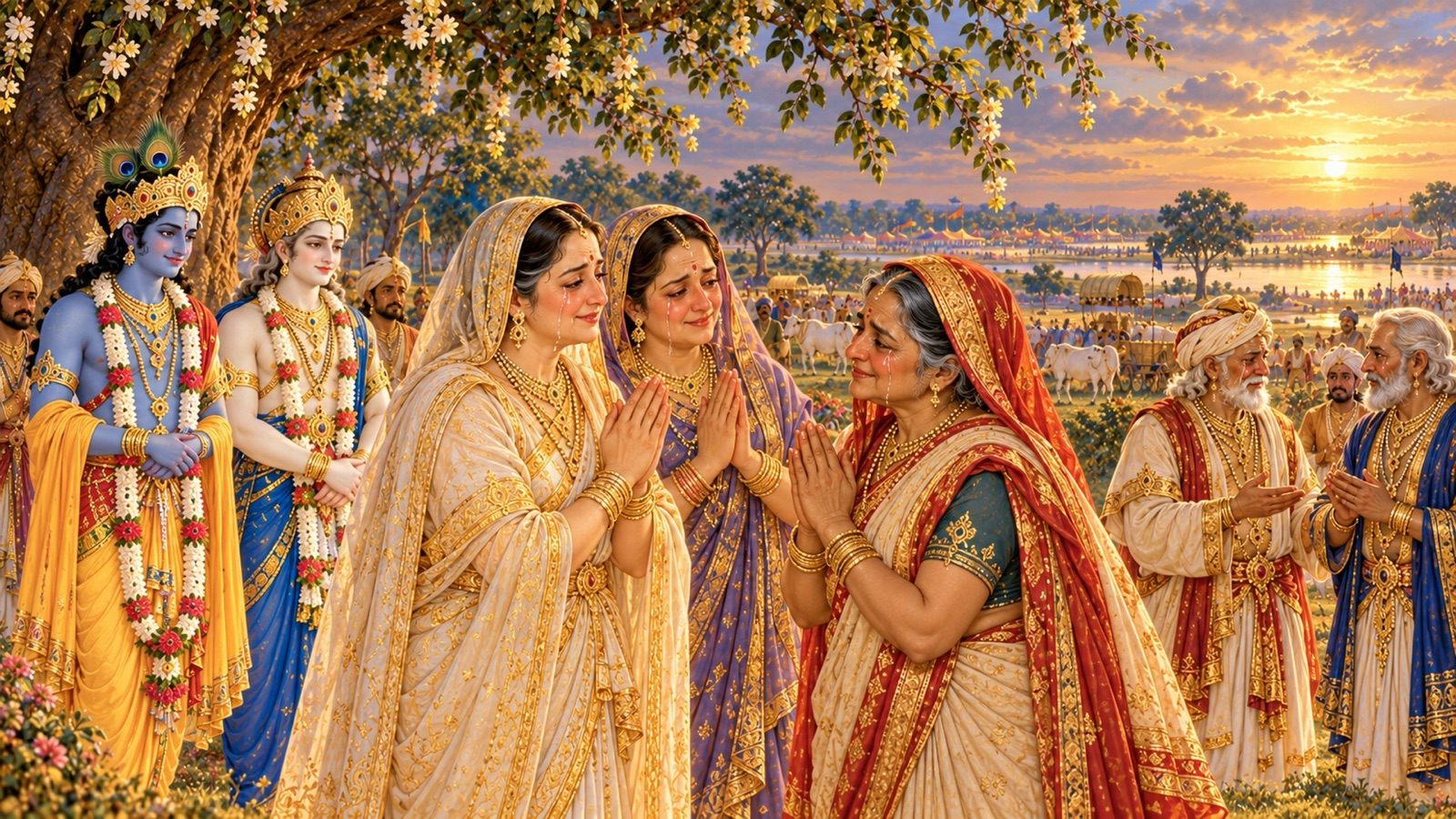
Then Rohini and Devaki embraced the queen of Vraja and, remembering her friendship, spoke with tear-choked voices. “Who could ever forget the unbroken friendship you have both shown us? Even the wealth of Indra could not repay it. These two had not yet seen their parents when they were left in your keeping, and from you they received cherishing, nurture, protection and every blessing for their growth; under your care they knew no fear, for you guarded them as the eyelids guard the eyes. Truly, for the saintly there is no distinction between one’s own and another’s.”
The Gopis Behold Their Beloved
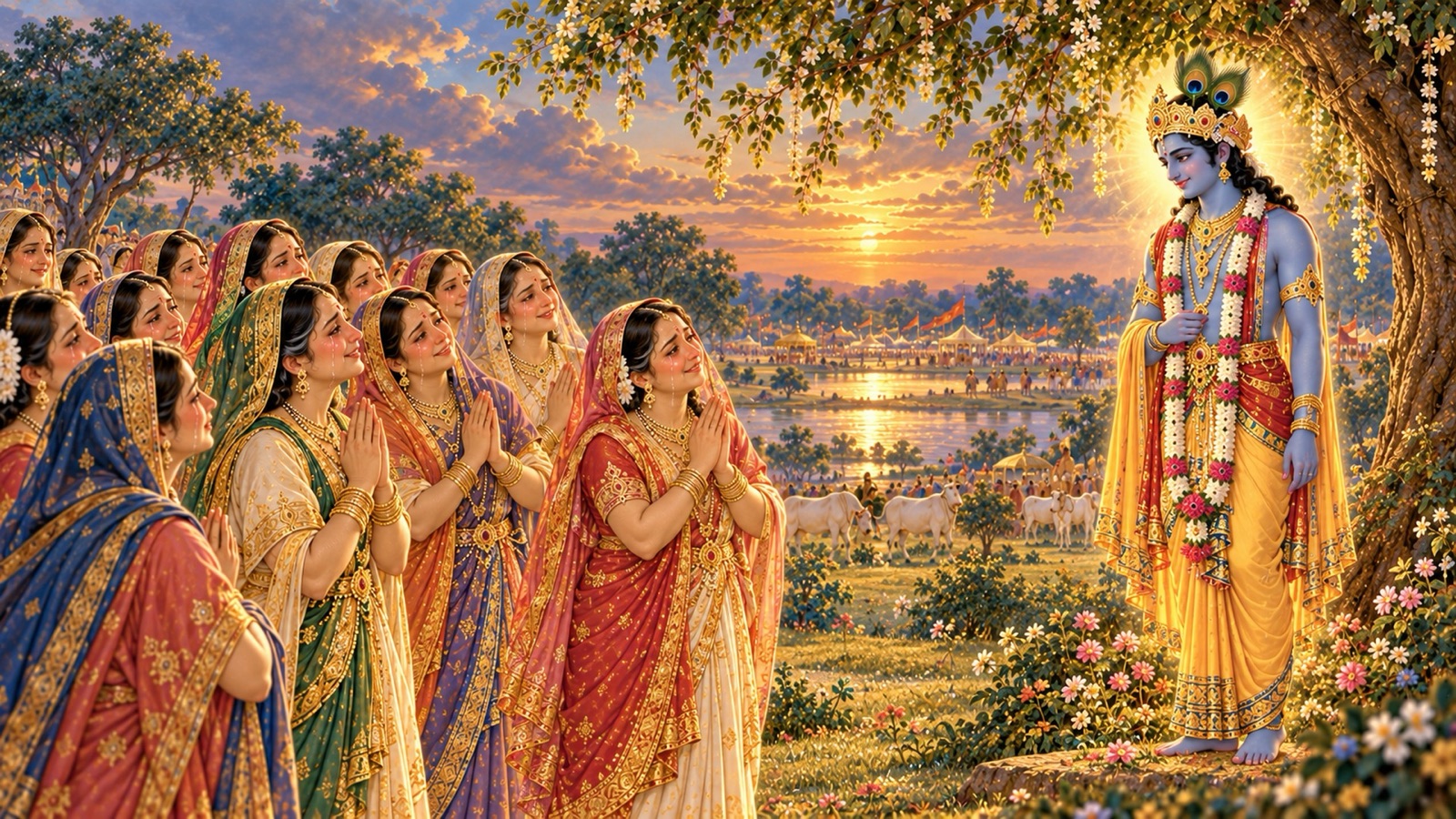
Sukadeva then spoke of the gopis, whose love for Krishna surpassed every other love. In Vraja, gazing upon Him, they used to curse the Creator for giving their eyes lids that blinked and broke their vision. Now, meeting Him after so many years, they drew Him in through their eyes and were lost in Him.
श्रीशुक उवाच
गोप्यश्च कृष्णमुपलभ्य चिरादभीष्टं
यत्प्रेक्षणे दृशिषु पक्ष्मकृतं शपन्ति ।
दृग्भिर्हृदीकृतमलं परिरभ्य सर्वा-
स्तद्भावमापुरपि नित्ययुजां दुरापम् ॥ ३९ ॥
śrī-śuka uvāca gopyaś ca kṛṣṇam upalabhya cirād abhīṣṭaṁ yat-prekṣaṇe dṛśiṣu pakṣma-kṛtaṁ śapanti dṛgbhir hṛdī-kṛtam alaṁ parirabhya sarvās tad-bhāvam āpur api nitya-yujāṁ durāpam
Meaning: Sri Suka said: And the gopis, obtaining after so long the Krishna they desired — at whose sight they would curse the maker of the eyelids — took Him through their eyes into their hearts, embraced Him there to their fill, and all attained that absorption in Him which is hard even for those ever united with Him in yoga. (Canto 10, Chapter 82, verse 39)
Krishna’s Words to the Gopis in Private
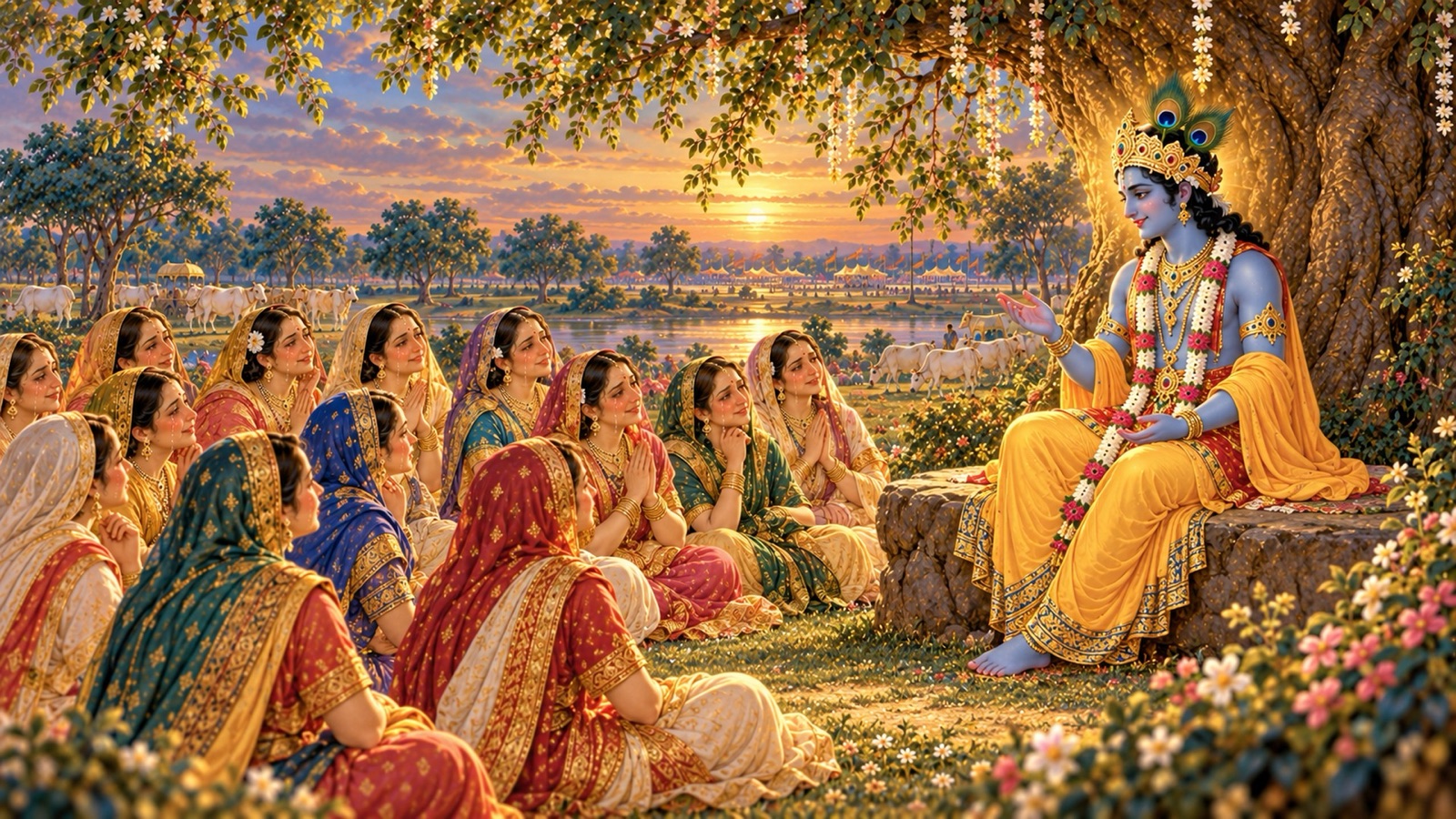
Seeing them in this condition, the Lord met the gopis in a secluded place, embraced them, asked after their health, and with a smile began to speak. “Dear friends, do you still remember us? For the sake of our kinsmen we went away, our minds set on destroying the enemies’ side, and we have been long absent. Do you think ill of us, suspecting us of ingratitude? Surely it is the Lord alone who joins beings together and parts them again. Just as the wind gathers clouds, blades of grass, tufts of cotton and particles of dust and then scatters them, so does the Maker of beings unite and separate His creatures.”
मयि भक्तिर्हि भूतानाममृतत्वाय कल्पते ।
दिष्ट्या यदासीन्मत्स्नेहो भवतीनां मदापन: ॥ ४४ ॥
mayi bhaktir hi bhūtānām amṛtatvāya kalpate diṣṭyā yad āsīn mat-sneho bhavatīnāṁ mad-āpanaḥ
Meaning: Devotion to Me leads living beings to immortality. By good fortune you have that love for Me which brings one to Me. (Canto 10, Chapter 82, verse 44)
Then the Lord revealed who He is in truth. “O ladies, I am the beginning and the end of all beings, and I am within them and without — just as ether, water, earth, air and fire are the beginning and end of every material thing and pervade it inside and out. These elements enter created things as their material cause, and the self abides in them as the experiencer; but both rest in Me, the imperishable Supreme, who am beyond them both.”
The Gopis’ Prayer
Instructed by Krishna in this knowledge of the Self, the gopis reflected on it again and again, and by that constant remembrance the covering of the individual self fell away and they attained Him. Then they prayed:
आहुश्च ते नलिननाभ पदारविन्दं
योगेश्वरैर्हृदि विचिन्त्यमगाधबोधै: ।
संसारकूपपतितोत्तरणावलम्बं
गेहं जुषामपि मनस्युदियात् सदा न: ॥ ४८ ॥
āhuś ca te nalina-nābha padāravindaṁ yogeśvarair hṛdi vicintyam agādha-bodhaiḥ saṁsāra-kūpa-patitottaraṇāvalambaṁ gehaṁ juṣām api manasy udiyāt sadā naḥ
Meaning: And they said: O lotus-naveled Lord, Your lotus feet, meditated upon in the heart by the masters of yoga of fathomless wisdom, are the support by which those fallen into the well of worldly existence climb out. May those feet rise always in our minds, even though we are occupied with household life. (Canto 10, Chapter 82, verse 48)
So the chapter closes: the gopis, just raised to oneness with the Supreme Self, ask only that His feet never leave their minds amid their duties at home.
Principal Teachings of This Chapter
1. Sacred observance is for the sake of devotion. Parashurama, untouched by karma, performed sacrifice to show the world the way, and the Yadus bathed, fasted and gave with one aim: “May our devotion rest in Krishna.” Rites bear their true fruit when they deepen bhakti.
2. Both union and separation are the Lord’s will. Vasudeva calls men playthings of destiny; Krishna tells the gopis that the Lord joins and parts His creatures as the wind gathers and scatters clouds. One divine hand lies behind every meeting and every farewell.
3. To see Krishna is the fruit of human birth. The kings count the Yadus alone as fulfilled, because they live beside One whom even yogis rarely behold; where Vishnu dwells, craving for heaven and liberation ends.
4. For the saintly there is no “mine” and “another’s.” Yashoda raised sons not born to her as tenderly as the eyelids guard the eye; love that makes no such distinction is the mark of a holy heart.
5. Love attains what yoga labours for — and asks only for remembrance. This is the chapter’s heart. Why does the Lord give the knowledge of His all-pervading nature to those who already love Him most? Not to replace their love with philosophy, but to show them that the One they long for was never truly absent — He is within them and around them as the elements pervade every form, and it is He who parted them and now reunites them. Having become one with Him, the gopis do not ask for liberation but that His lotus feet rise always in their minds amid household life. The Bhagavatam sets loving remembrance of the Lord above every other attainment.
A Devotional Reflection
There is a tenderness in this chapter that stays with us long after the reading. Kings and cowherds converge on one field, yet the Bhagavatam pauses for the smallest scenes: Vasudeva weeping on Nanda’s shoulder, two mothers unable to speak as their sons climb onto their laps, Devaki thanking the woman who raised her child. The grandeur of Dwaraka does not erase the debt to Gokula, and the Lord’s divinity does not erase His gratitude; He bows to Nanda and Yashoda and asks the gopis, almost shyly, whether they still remember Him. Each of us carries some long separation. The gopis show that the way back to Him begins with eyes that receive Him and a mind that will not let His feet go.
A Daily Devotional Practice
Today, choose one ordinary household task — cooking, cleaning, walking to work — and offer it with the gopis’ prayer: “May Your lotus feet rise always in my mind, even amid my duties at home.” Whenever the task resumes, let the remembrance resume with it; let the busy hour itself become the place of meeting. Begin by chanting gently: Om Namo Bhagavate Vasudevaya.
Conclusion
The eighty-second chapter of the Tenth Canto turns an eclipse into a festival of reunion. On the field made holy by Parashurama, Dwaraka and Vraja meet again, kings envy those who live beside Krishna, and the mothers who bore Him and the mothers who nursed Him weep together. Then the Lord, alone with the gopis, teaches that He joins and parts all beings, pervades everything within and without, and bestows immortality through devotion — and they ask only that His feet remain forever in their minds. May we too seek not His gifts but His remembrance.
May the divine wisdom of Srimad Bhagavatam awaken pure devotion within our hearts.
Om Namo Bhagavate Vasudevaya.
Jay Shree Madhav.
References and Attribution
- Primary edition: Gita Press, Śrīmad Bhāgavata Mahāpurāṇa (English), Book Ten (Latter Half), Discourse 82.
- Series: Srimad Bhagavatam Wisdom · Biswa Sanatan Dharma Seva Trust.
- Presented following the spiritual guidance and recommendation of Pandit Dr. Shri Kashinath Mishra.
This is an original, faithful retelling in the writer’s own words, with brief quoted verses shown in Devanāgarī and transliteration and their meanings given as summaries. It is not a reproduction of any single publisher’s continuous translation or commentary. No affiliation with or endorsement by any publisher is implied.
Jay Shree Madhav