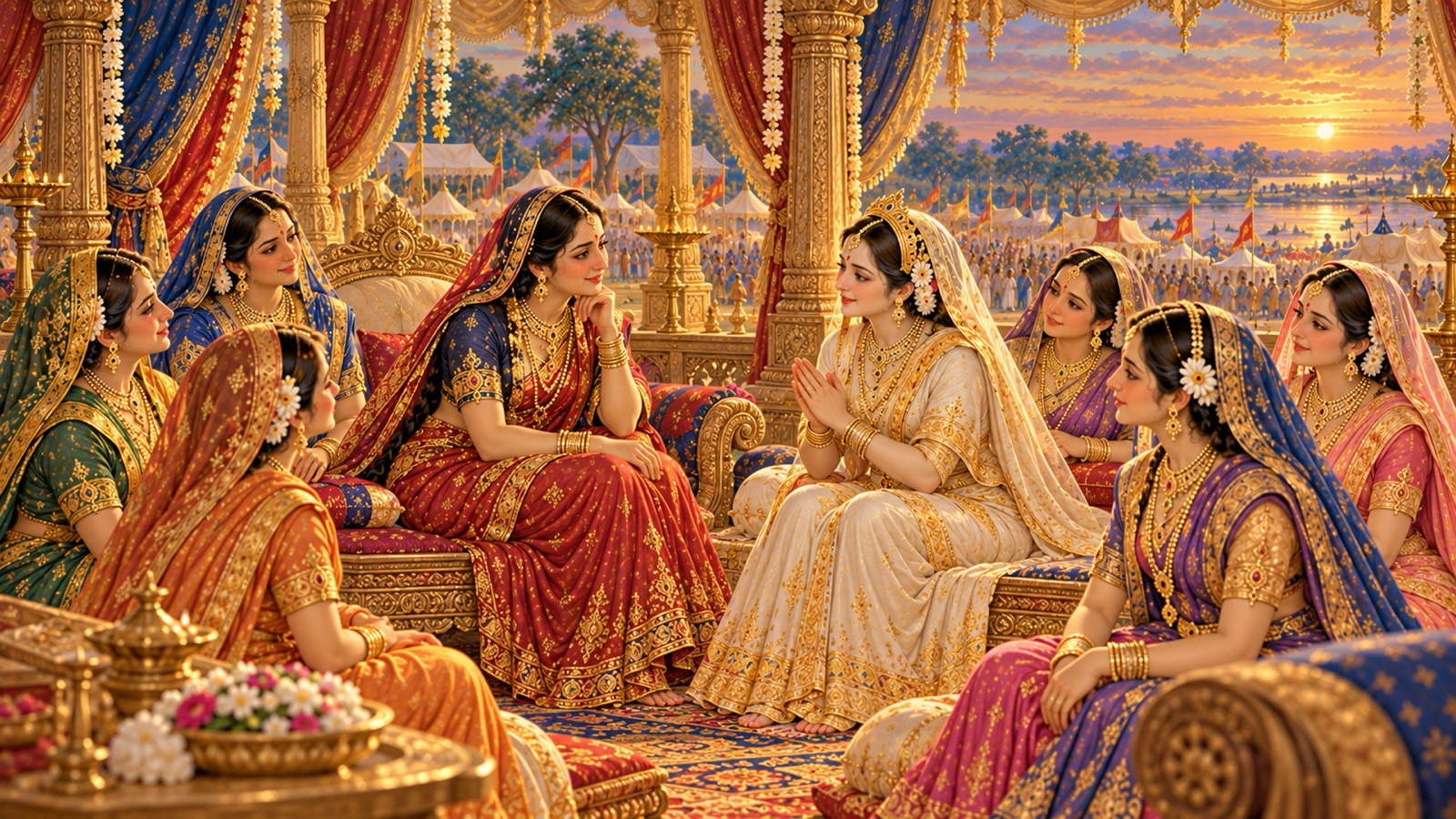
In the women’s quarters at Kurukshetra, Draupadi asks the consorts of Krishna how the Lord came to wed each of them — and queen after queen answers with the same longing: not kingdoms, not heaven, only the dust of His lotus feet.
Om Namo Bhagavate Vasudevaya.
Om Namo Bhagavate Vasudevaya.
Om Namo Bhagavate Vasudevaya.
Welcome back to Srimad Bhagavatam Wisdom, our devotional journey through the sacred histories and teachings of the Srimad Bhagavat Mahapurana. In this eighty-third chapter of the Tenth Canto, after Yudhishthira and his companions praise Krishna at Kurukshetra, Draupadi asks the queens of Krishna how the Lord married them, and their replies close in the single voice of the sixteen thousand freed from Bhauma’s palace.
Chapter Information
- Scripture: Śrīmad Bhāgavata Mahāpurāṇa
- Canto: 10 (Book Ten, Latter Half)
- Chapter: 83 (Discourse 83)
- Chapter title: Draupadi Meets the Queens of Krishna
- Principal speaker: Sukadeva Gosvami; within the chapter, the queens of Krishna
- Principal listener: King Parikshit; within the chapter, Draupadi
- Main setting: The holy field of Kurukshetra, during the gathering at the solar eclipse
- Central subject: Draupadi’s question and each queen’s account of her marriage, ending in the prayer for the dust of the Lord’s feet
- Principal verse range: Canto 10, Chapter 83, verses 1–43
- Primary edition: Gita Press Śrīmad Bhāgavata Mahāpurāṇa
Context From the Previous Chapter
In Chapter 82 the Yadus came to Kurukshetra for the solar eclipse and were reunited with the Pandavas, with Nanda and the people of Vraja, and with the gopis, whom Krishna instructed and blessed with lasting remembrance of His feet. This chapter continues in that holy gathering.
The Lord Greets Yudhishthira and His Friends
Sukadeva continued. The Lord, who was both the teacher of the gopis and the goal they reached through His teaching, having shown them such grace, now asked Yudhishthira and His other well-wishers about their welfare. The sight of His feet had washed away their sins; honoured by the Lord of the worlds, they answered Him with joy.
How, they said, could any misfortune touch those who drink, through the cups of their ears, the nectar of His lotus feet that flows from the lips of great souls and cuts away the soul’s forgetfulness of its Maker?
कुतोऽशिवं त्वच्चरणाम्बुजासवं महन्मनस्तो मुखनिःसृतं क्वचित् ।
पिबन्ति ये कर्णपुटैरलं प्रभो देहंभृतां देहकृदस्मृतिच्छिदम् ॥ ३ ॥
kuto ‘śivaṁ tvac-caraṇāmbujāsavaṁ mahan-manasto mukha-niḥsṛtaṁ kvacit pibanti ye karṇa-puṭair alaṁ prabho dehaṁ-bhṛtāṁ deha-kṛd-asmṛti-cchidam
Meaning: O Lord, what evil can befall those who, with the cups of their ears, fully drink the wine of Your lotus feet — which issues at times from the mouths of the great-hearted, and which severs the embodied soul’s forgetfulness of the Creator of its body? (Canto 10, Chapter 83, verse 3)
They bowed to Him as unbroken wisdom and a flood of bliss untouched by waking, dream and sleep, the refuge of the paramahamsas, who had taken a form by His own Yogamaya to protect the Vedas when time had worn them thin.
The Women Meet, and Draupadi Asks Her Question
While they were praising the Lord in this way, the ladies of the Yadu and Kuru families came together and began telling one another the stories of Krishna sung throughout the three worlds; Sukadeva now relates what they said.
Draupadi called the queens by name — the princess of Vidarbha, Bhadra, Jambavati, the princess of Kosala, Satyabhama, Kalindi, Saibya, Rohini, Lakshmana and the other consorts of Krishna — and asked them to tell her how the Lord, who is God Himself yet imitates the ways of the world through His own Maya, had taken each of them as His bride.
Rukmini: Carried Away Like a Lion’s Share
Rukmini answered first. Jarasandha and the other kings had gathered with bows raised to see her given to Sisupala of Cedi; but the Lord, whose foot-dust rests on the crowns of warriors no one else can defeat, carried her out of their midst as a lion carries off its portion from a herd of goats and sheep. May those feet, the abode of the goddess of fortune, she prayed, be hers to worship always.
चैद्याय मार्पयितुमुद्यतकार्मुकेषु राजस्वजेयभटशेखरिताङ्घ्रिरेणुः ।
निन्ये मृगेन्द्र इव भागमजावियूथात् तच्छ्रीनिकेतचरणोऽस्तु ममार्चनाय ॥ ८ ॥
caidyāya mārpayitum udyata-kārmukeṣu rājasv ajeya-bhaṭa-śekharitāṅghri-reṇuḥ ninye mṛgendra iva bhāgam ajāvi-yūthāt tac-chrī-niketa-caraṇo ‘stu mamārcanāya
Meaning: When the kings stood with bows ready to give me to the king of Cedi, He whose foot-dust crowns the heads of invincible heroes bore me away, as a lion takes its share from a flock of goats and sheep; may those feet, the home of Sri, be the object of my worship. (Canto 10, Chapter 83, verse 8)
Satyabhama and Jambavati: The Jewel and the Cave
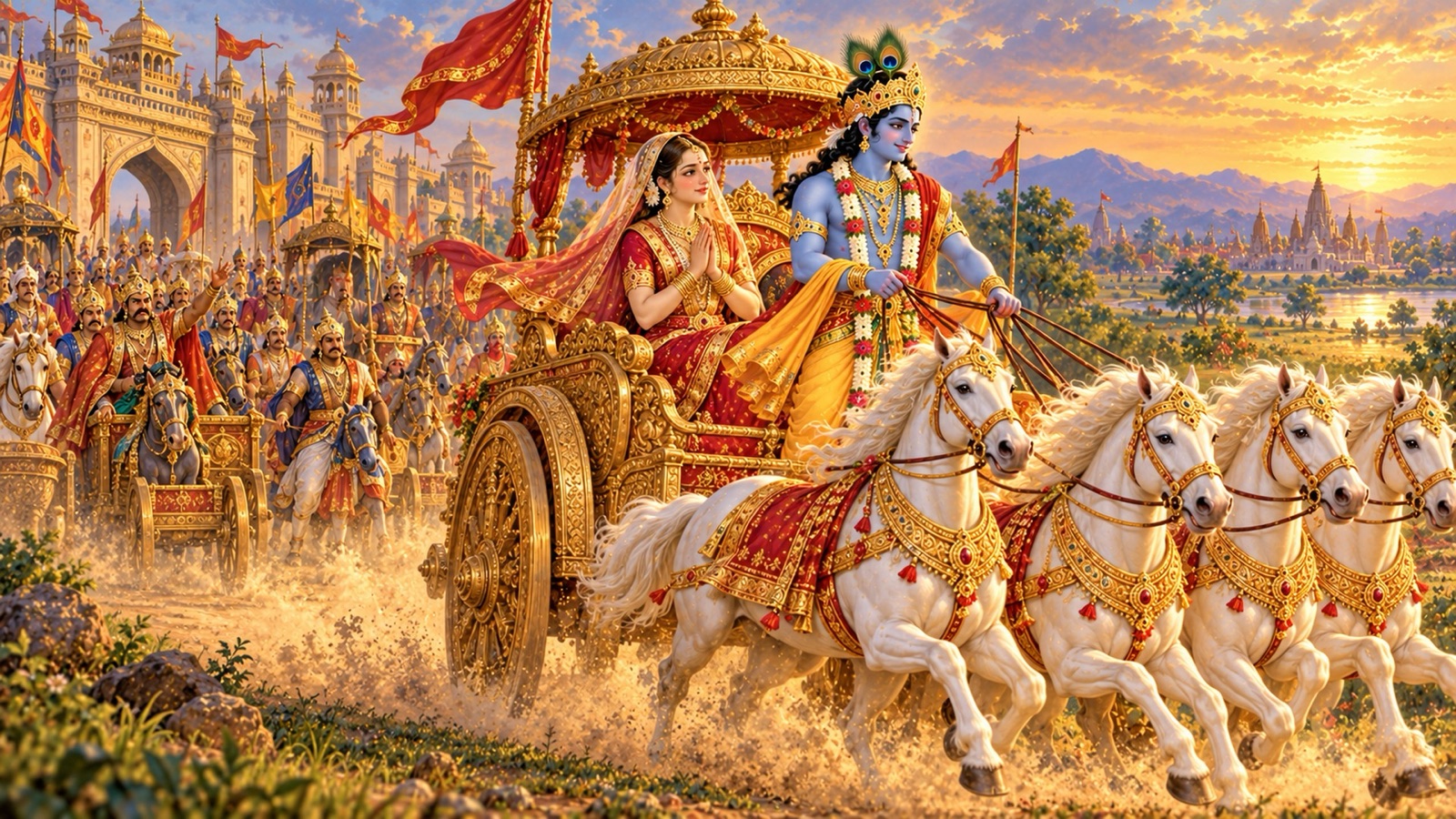
Satyabhama spoke next. Her father, grieving for his brother Prasena, had accused the Lord of murdering him; to wipe away that stain Krishna defeated the king of the bears and restored the jewel, and her father, frightened by his false charge, gave the Lord the jewel together with his daughter, though he had promised her to another.
Jambavati followed. Her father Jambavan did not know that the Lord before him was his own worshipful master, the husband of Sita, and so he fought Him for twenty-seven days. Only when he had tested Him and recognised Him did he clasp His feet and offer her, with the jewel, as his gift of honour. “I am His maidservant,” she said simply.
Kalindi, Mitravinda and Satya
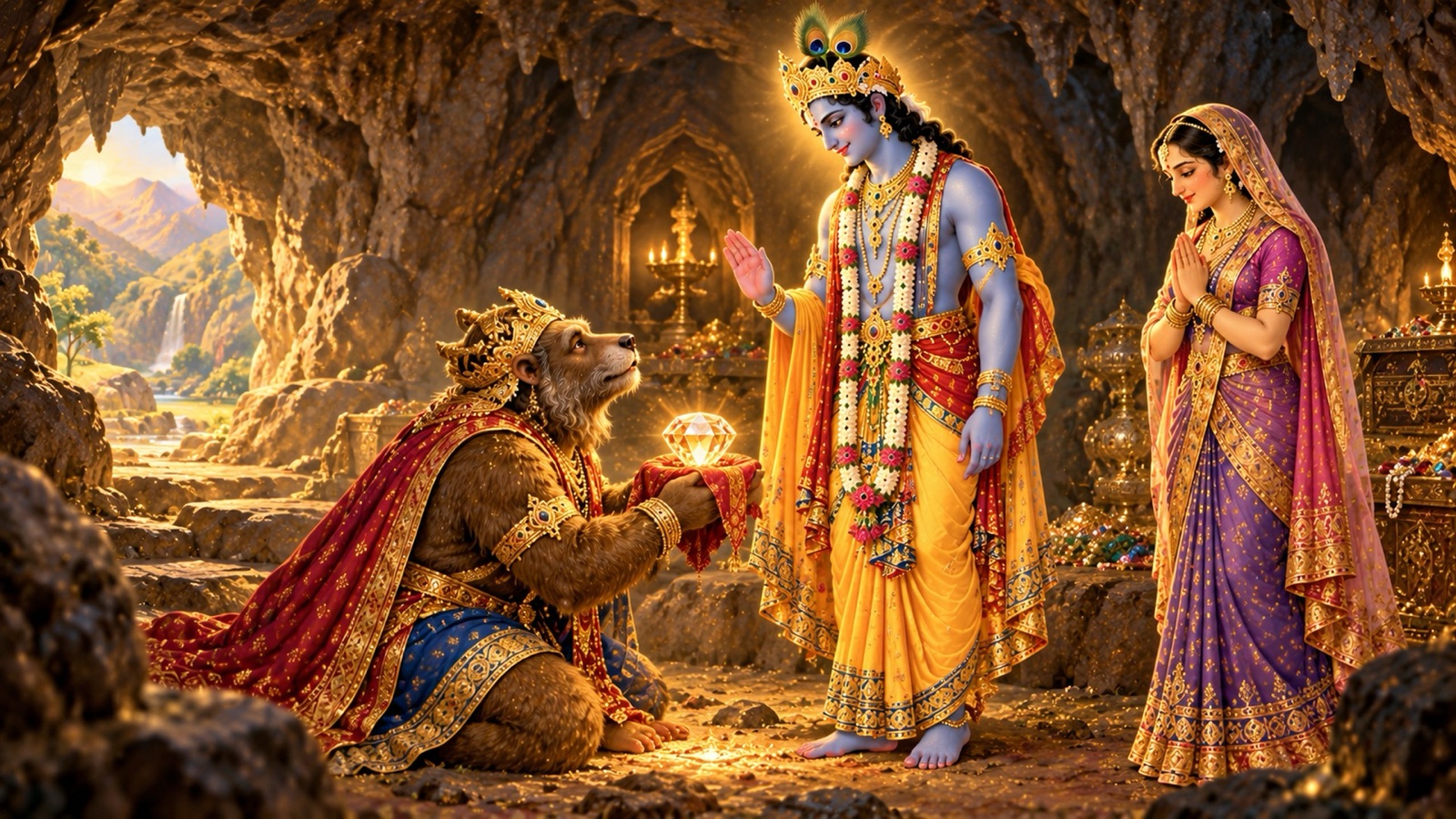
Kalindi’s account was the briefest. Knowing that she was performing austerities in the hope of touching His feet, the Lord came with His friend Arjuna and accepted her hand; and now, she said, she sweeps His house.
Mitravinda recalled her svayamvara: the Lord came, overcame the assembled kings, and took her to Dwaraka, the dwelling of all splendour, as a lion snatches its prey from a pack of dogs, defeating also her own brothers, who tried to wrong her by stopping Him. In every life, she prayed, let her wash His feet.
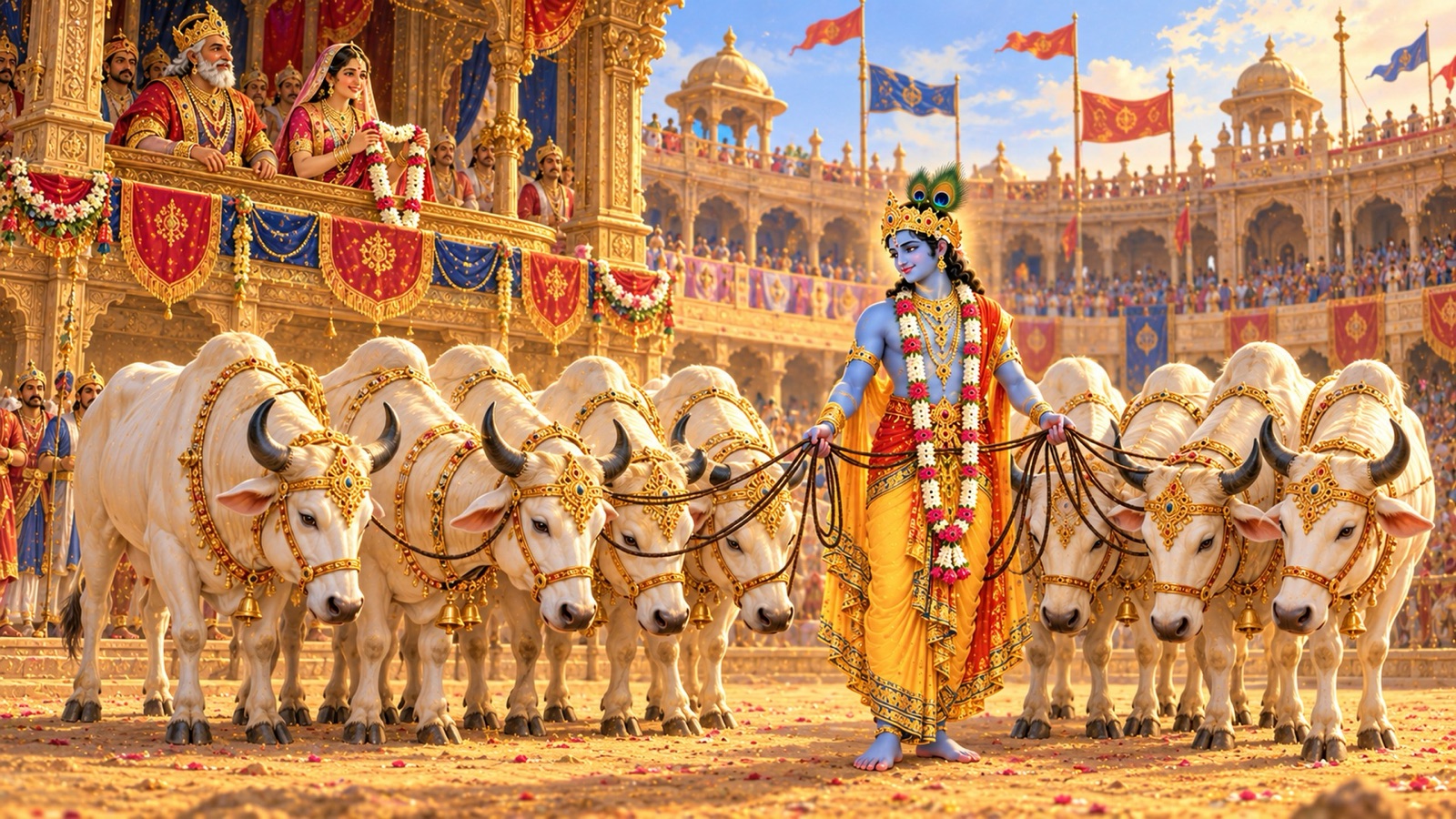
Satya, the princess of Kosala, told how her father had kept seven bulls of tremendous strength and razor-sharp horns, which had broken the pride of many a hero, to test her suitors. The Lord seized them in play and bound them in a moment, as children bind the kids of goats. Having won her as the prize of His prowess, He took her to Dwaraka with her maids and a fourfold army, defeating on the way the kings who tried to stop Him. Her one wish was to go on serving Him.
Bhadra, Daughter of the Lord’s Aunt
Bhadra explained that Krishna was the son of her maternal uncle; knowing her heart was given to Him, her father summoned the Lord himself and bestowed her on Him with an aksauhini of troops and many companions. Wherever her karma might carry her in future births, she asked that her highest good be the touch of His feet.
Lakshmana: The Fish Hidden Behind the Veil
Lakshmana, daughter of King Brhatsena, spoke at greatest length. Hearing Narada sing of the Lord’s descent and deeds, and reflecting that Lakshmi herself had passed over the guardians of the worlds to choose Him, she fixed her mind on Mukunda. Her loving father, learning her resolve, devised a means: like the fish by which Draupadi’s father had won Arjuna for her, he set up a fish as the target — but wholly hidden, with only its reflection visible in the water below.
Kings skilled in archery came in their thousands and were duly honoured. Some could not lift the bow; others were thrown down by its recoil. Jarasandha, Sisupala, the king of Ambastha, Bhima, Duryodhana and Karna strung it but could not find the fish. Arjuna located it by its reflection and shot with care, yet his arrow only grazed the mark.
When the humbled princes had returned to their seats, the Lord took up the bow, strung it in play, glanced once at the water, and brought the fish down with a single shaft as the sun stood at the meridian in Abhijit. Cries of victory rose on earth, drums sounded in heaven, and the gods rained flowers.
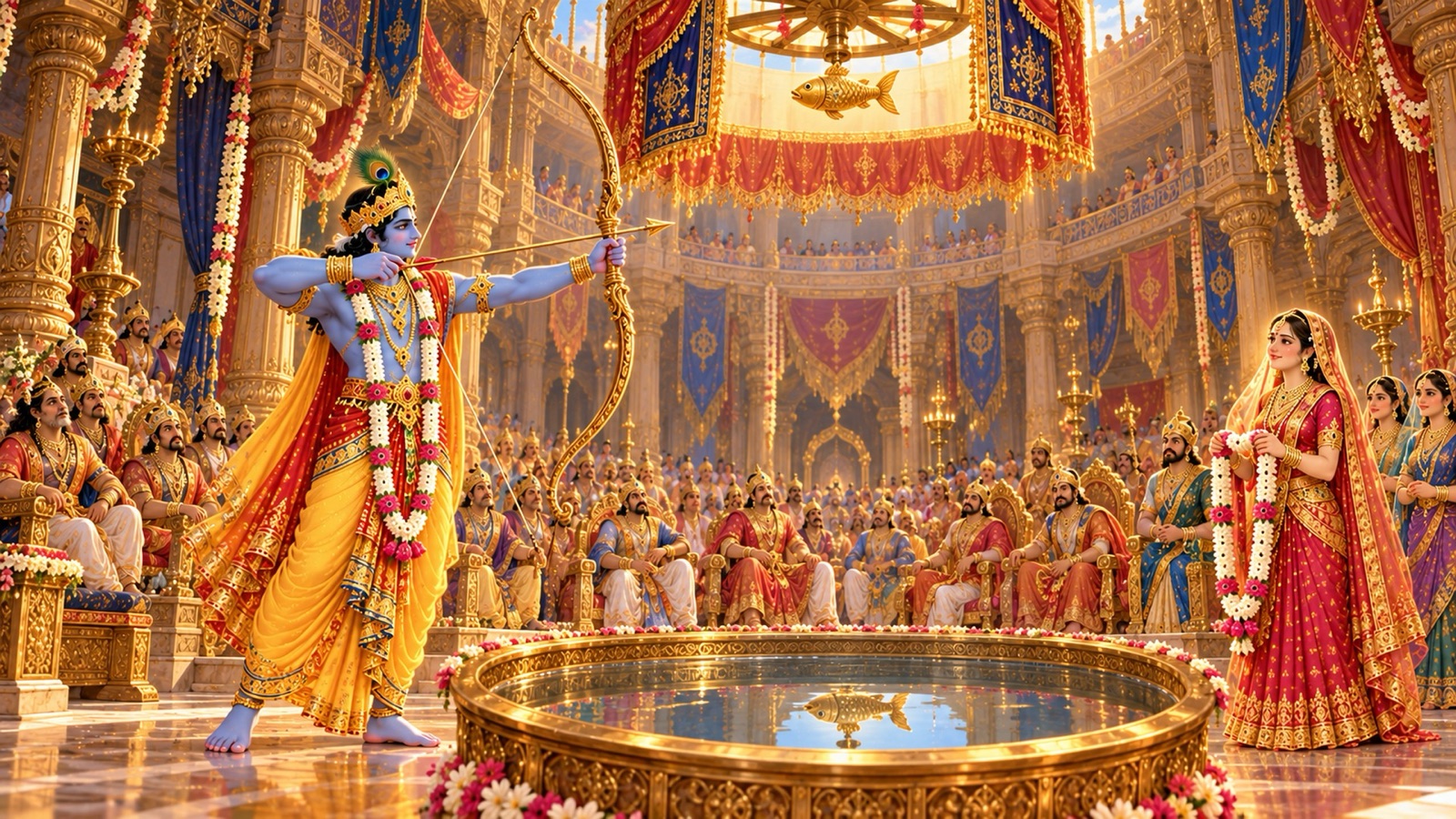
Then Lakshmana entered the arena, anklets ringing, in fresh silks with flowers in her braid, a shy smile and a golden necklace of gems in her hands, and with a heart overflowing with love placed it around the Lord’s neck; drums and conches resounded, dancers danced and singers sang, while the smitten monarchs seethed.
The Lord, four-armed, set her on His chariot, took up bow and armour, and with Daruka at the reins drove out through the watching kings as a lion walks through a herd of deer. Those who pursued Him fared no better than dogs chasing a lion: some fell to the arrows of His Sarnga bow, and the rest fled.
Like the sun entering his own sky, the Lord of the Yadus entered Dwaraka, decked with arches and banners. Her father honoured his kinsmen with gifts and out of love presented to the Lord — who lacks nothing and delights only in Himself — maidservants, wealth, soldiers, elephants, chariots, horses and weapons. To have become the household maids of the self-satisfied Lord, Lakshmana reflected, they must have given up every attachment and practised hard austerities in lives gone by.
आत्मारामस्य तस्येमा वयं वै गृहदासिकाः ।
सर्वसङ्गनिवृत्त्याद्धा तपसा च बभूविम ॥ ३९ ॥
ātmārāmasya tasyemā vayaṁ vai gṛha-dāsikāḥ sarva-saṅga-nivṛttyāddhā tapasā ca babhūvima
Meaning: We have indeed become the maidservants in the home of Him who is satisfied in His own Self — surely through complete renunciation of all attachment and through austerity. (Canto 10, Chapter 83, verse 39)
The Sixteen Thousand Queens Speak With One Voice
Last of all the sixteen thousand queens answered, Rohini speaking for them. Bhaumasura, conquering the earth, had defeated many kings and imprisoned their daughters in his palace. When the Lord had slain Bhauma and his hosts and learned of them, He freed them; and though complete in Himself, He married them all, knowing they constantly remembered His lotus feet, which release the soul from birth and death.
Then came their prayer, the heart of the whole chapter. They wanted neither sovereignty over the earth nor the throne of Indra, neither mystic powers nor the seat of Brahma, neither liberation nor even the eternal realm of Hari — only to carry on their heads the dust of the Lord’s feet, fragrant with the saffron from the breast of the goddess of fortune.
न वयं साध्वि साम्राज्यं स्वाराज्यं भौज्यमप्युत ।
वैराज्यं पारमेष्ठ्यं च आनन्त्यं वा हरेः पदम् ॥ ४१ ॥
कामयामह एतस्य श्रीमत्पादरजः श्रियः ।
कुचकुङ्कुमगन्धाढ्यं मूर्ध्ना वोढुं गदाभृतः ॥ ४२ ॥
na vayaṁ sādhvi sāmrājyaṁ svārājyaṁ bhaujyam apy uta vairājyaṁ pārameṣṭhyaṁ ca ānantyaṁ vā hareḥ padam kāmayāmaha etasya śrīmat-pāda-rajaḥ śriyaḥ kuca-kuṅkuma-gandhāḍhyaṁ mūrdhnā voḍhuṁ gadā-bhṛtaḥ
Meaning: O virtuous lady, we do not desire imperial rule, nor the kingdom of heaven, nor its pleasures, nor supreme power, nor the post of Brahma, nor immortality, nor even the abode of Hari; we desire only to bear upon our heads the glorious dust of the feet of the wielder of the mace, rich with the scent of the kunkuma from the bosom of Sri. (Canto 10, Chapter 83, verses 41–42)
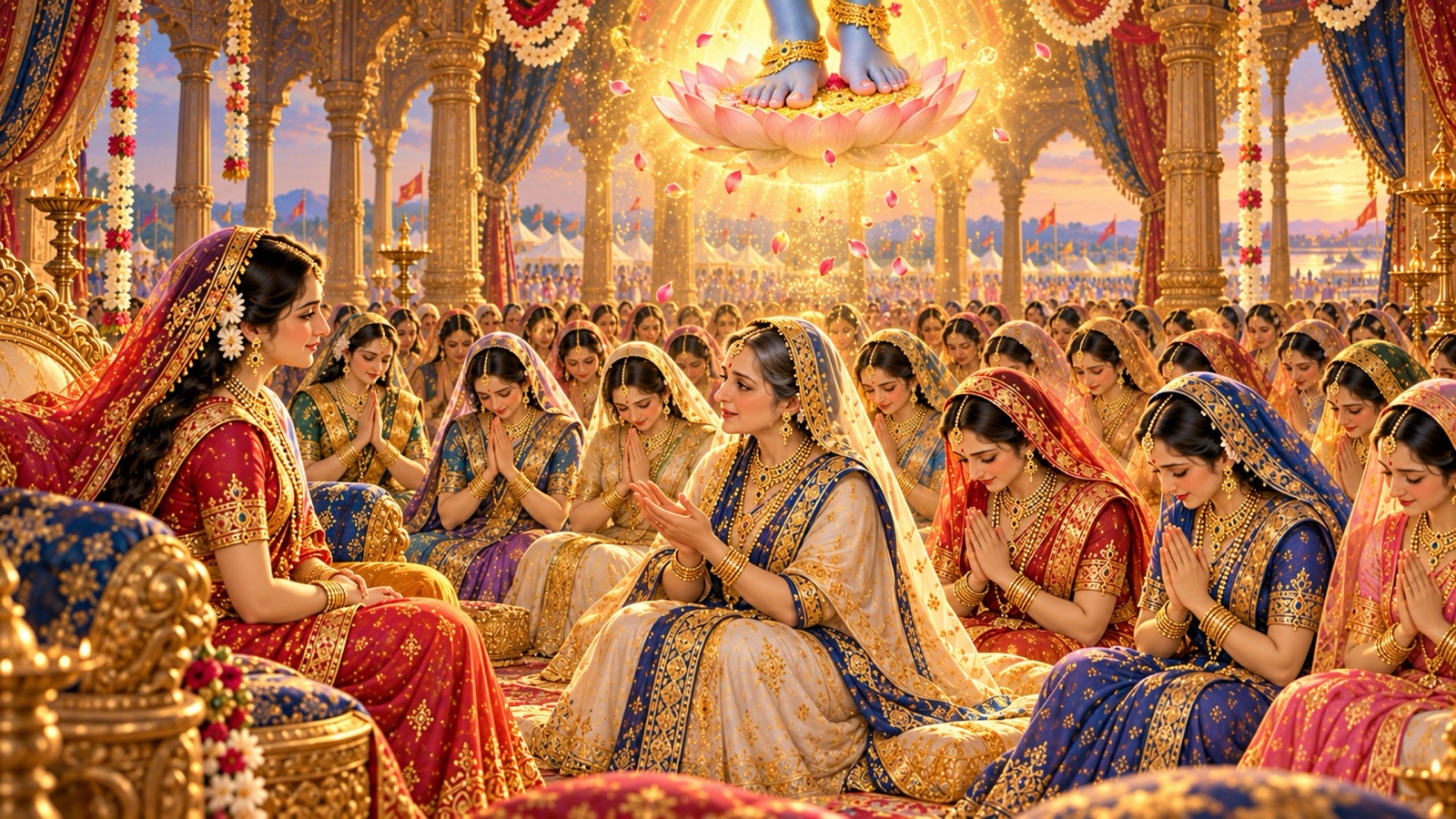
And they named the company they wished to join: the women of Vraja, the Pulinda women of the forest, the grasses and creepers, and the cowherds who grazed the cows beside the great-souled Lord, all of whom yearned for the touch of His feet.
व्रजस्त्रियो यद् वाञ्छन्ति पुलिन्द्यस्तृणवीरुधः ।
गावश्चारयतो गोपाः पादस्पर्शं महात्मनः ॥ ४३ ॥
vraja-striyo yad vāñchanti pulindyas tṛṇa-vīrudhaḥ gāvaś cārayato gopāḥ pāda-sparśaṁ mahātmanaḥ
Meaning: We long for that which the women of Vraja, the Pulinda women, the grasses and creepers, and the cowherds grazing the cows all desire — the touch of the feet of the great Soul. (Canto 10, Chapter 83, verse 43)
Principal Teachings of This Chapter
1. Hearing of the Lord removes forgetfulness. In verse 3 the nectar of Krishna’s feet, received through the ears from great souls, is said to cut away the soul’s forgetfulness of God. Devotional hearing is the cure for the root disease of embodied life.
2. God acts in the world without ceasing to be God. Draupadi notes that the Lord, though God Himself, follows human ways through His own Maya. His marriages are His play, not His need.
3. The fruit of austerity is service. In verse 39 the queens’ renunciation and austerity bear fruit as the chance to serve the self-satisfied Lord in His household. Every queen names a humble service — sweeping, washing His feet, being His maid — as her treasure.
4. The dust of His feet outranks liberation itself. In verses 41 and 42 the queens set aside empire, heaven, the post of Brahma, liberation and even the Lord’s own abode. Here is the single point a Vaishnava draws from the chapter: the Lord, atmarama and complete in Himself, arranged these marriages not to gain companions but to give the most fortunate women on earth the lowest place at His feet, because that place, and not any throne, is the highest fruit of devotion. This preference for service over reward is what makes their love pure.
5. The queens look to Vraja. In verse 43 the consorts of the Lord of Dwaraka envy the gopis, the forest women, the cowherds, even the grass of Vrindavana. Nearness to Krishna is measured by longing, not by rank.
A Devotional Reflection
Each queen was asked the same simple thing — how did He marry you? — and each answered with a story that ended in a prayer. The circumstances could hardly differ more, yet every voice arrives at the Lord’s feet and asks only to stay there. What moves us most is who is speaking: the most fortunate women in creation, wives of the Supreme Person Himself. If anyone could rest content in what they possessed, it was they. Instead they call themselves sweepers and maidservants, and envy the blades of grass of Vraja. Devotion does not shrink as fortune grows; it only becomes humbler. The surest sign of having received the Lord’s grace is not satisfaction but an ever-deepening wish to serve.
A Daily Devotional Practice
Today, choose one small act of service — tidying the place where you pray, or quietly helping someone in your home — and do it in the spirit of Kalindi sweeping the Lord’s house, remembering that the queens of Dwaraka counted such service above every kingdom. Pray that His foot-dust may rest upon your head, and chant gently: Om Namo Bhagavate Vasudevaya.
Conclusion
Draupadi’s question opens the door to the most intimate testimony in the Bhagavata: the queens of Krishna telling how He came for them and what they now ask of Him. Through rescue, contest, penance and release from Bhauma’s prison the Lord gathered His brides, and all of them, from Rukmini to the sixteen thousand, place the dust of His feet above every reward, even liberation. May their humility become ours, and may we too seek no higher fortune than serving Him.
May the divine wisdom of Srimad Bhagavatam awaken pure devotion within our hearts.
Om Namo Bhagavate Vasudevaya.
Jay Shree Madhav.
References and Attribution
- Primary edition: Gita Press, Śrīmad Bhāgavata Mahāpurāṇa (English), Book Ten (Latter Half), Discourse 83, pages 465–470.
- Series: Srimad Bhagavatam Wisdom · Biswa Sanatan Dharma Seva Trust.
- Presented following the spiritual guidance and recommendation of Pandit Dr. Shri Kashinath Mishra.
This is an original, faithful retelling in the writer’s own words, with brief quoted verses shown in Devanāgarī and transliteration and their meanings given as summaries. It is not a reproduction of any single publisher’s continuous translation or commentary. No affiliation with or endorsement by any publisher is implied.
Jay Shree Madhav