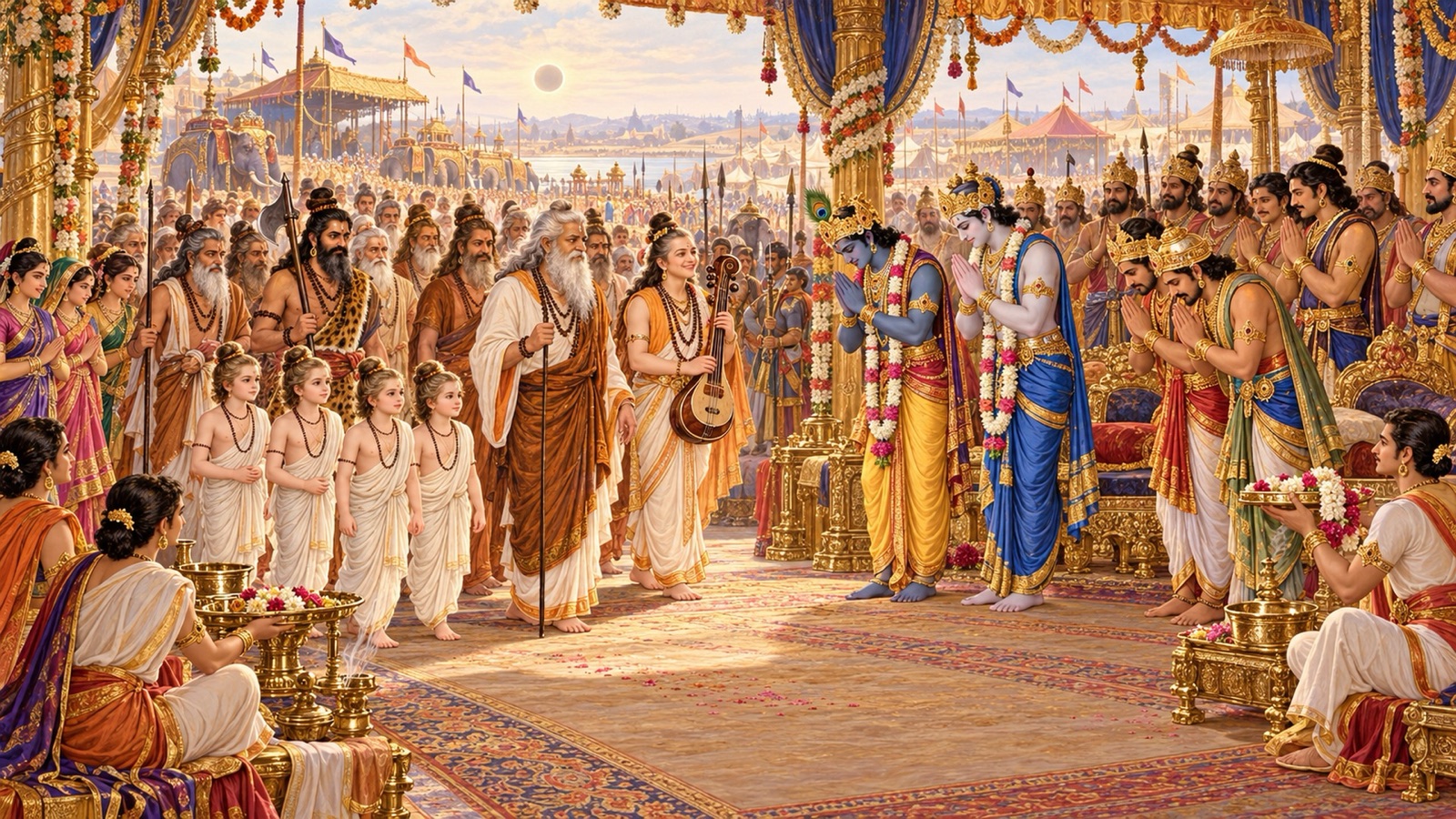
At holy Kurukshetra the greatest sages gather before Krishna and Balarama, the Lord teaches that a saint’s very sight purifies, and Vasudeva learns how karma is undone through sacrifice to Vishnu.
Om Namo Bhagavate Vasudevaya.
Om Namo Bhagavate Vasudevaya.
Om Namo Bhagavate Vasudevaya.
Welcome back to Srimad Bhagavatam Wisdom, our devotional journey through the Srimad Bhagavat Mahapurana. In this eighty-fourth chapter of the Tenth Canto, the great rishis come to Kurukshetra, the Lord honours them with words that overturn our easy ideas of holiness, and Vasudeva’s question leads to a grand sacrifice and a tender parting from Nanda.
Chapter Information
- Scripture: Śrīmad Bhāgavata Mahāpurāṇa
- Canto: 10 (Book Ten, Latter Half)
- Chapter: 84 (Discourse 84)
- Chapter title: The Sages’ Teachings at Kurukshetra
- Principal speaker: Sukadeva Gosvami (narrating to King Parikshit)
- Principal listener: King Parikshit
- Main setting: Kurukshetra
- Central subject: The sages’ arrival; Krishna’s teaching on saints; the sages’ hymn; Vasudeva’s question, the sages’ answer and his sacrifice; the farewell to Nanda
- Principal verse range: Canto 10, Chapter 84, verses 1–71
- Primary edition: Gita Press Śrīmad Bhāgavata Mahāpurāṇa (English, Part II)
The Great Sages Arrive at Kurukshetra
When the queens had spoken, Kunti, Gandhari, Draupadi, Subhadra, the other kings’ wives and the gopis marvelled at such love for Krishna, the Soul of all, and wept for joy. While women spoke with women and men with men, great sages appeared, longing to see Krishna and Balarama: Krishna-dvaipayana Vyasa, Devarshi Narada, Cyavana, Devala, Asita, Vishvamitra, Shatananda, Bharadvaja, Gautama, Parashurama with his disciples, Vasishtha, Galava, Bhrigu, Pulastya, Kashyapa, Atri, Markandeya, Brihaspati, Dvita, Trita and Ekata, the four Kumaras, Angira, Agastya, Yajnavalkya and Vamadeva.
Seeing these rishis whom the whole world reveres, the kings, the Pandavas, and Krishna and Balarama Themselves rose and bowed, welcoming them with sweet words, seats, water for their feet, garlands, incense and sandal paste. When they were settled, the Lord who had descended to protect dharma spoke, and the whole assembly fell silent.
The Lord Speaks: Saints Purify by Their Very Sight
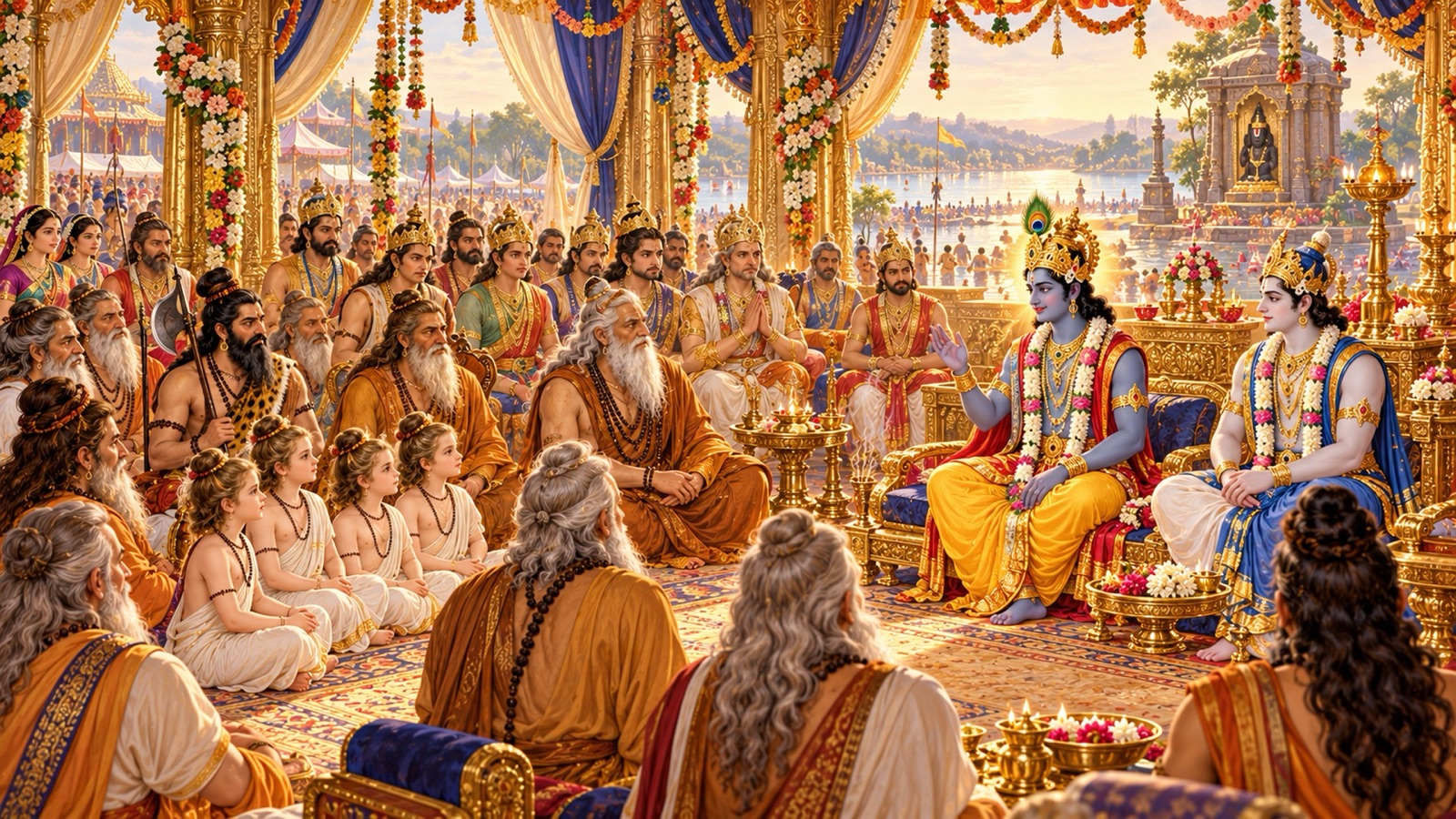
“Today our birth has borne its full fruit,” Krishna said, “for we have been blessed with the sight of the masters of yoga, which even the gods rarely obtain.” How, He asked, could people of meagre austerity, who see God confined to an image, ever gain the privilege of seeing, touching and worshipping you? Then He gave the teaching on which the whole chapter turns.
न ह्यम्मयानि तीर्थानि न देवा मृच्छिलामया: ।
ते पुनन्त्युरुकालेन दर्शनादेव साधव: ॥ ११ ॥
na hy am-mayāni tīrthāni na devā mṛc-chilā-mayāḥ te punanty uru-kālena darśanād eva sādhavaḥ
Meaning: Holy places are not made of water alone, nor are the gods mere images of clay and stone; these purify a person only after long worship, but saintly men purify by their very sight. (Canto 10, Chapter 84, verse 11)
The deities of fire, sun, moon, earth, water, sky, air, speech and mind, He continued, cannot wholly wash away sin, for their worship keeps alive the sense of difference, whereas the wise destroy our sins when served for a single muhurta. And whoever takes this perishable body for the self, clings to family as his own, and finds worship only in images and holiness only in water, never in the knowers of truth, is nothing but an ass among cows.
The Sages Understand and Offer Their Hymn
Hearing these words from the Lord of unfailing wisdom, the sages sat silent and perplexed. At length they understood: He was behaving like a man bound by karma so that the world might learn from His example. Smiling, they addressed the Teacher of all the worlds.
श्रीमुनय ऊचु:
यन्मायया तत्त्वविदुत्तमा वयं
विमोहिता विश्वसृजामधीश्वरा: ।
यदीशितव्यायति गूढ ईहया
अहो विचित्रं भगवद्विचेष्टितम् ॥ १६ ॥
śrī-munaya ūcuḥ yan-māyayā tattva-vid-uttamā vayaṁ vimohitā viśva-sṛjām adhīśvarāḥ yad īśitavyāyati gūḍha īhayā aho vicitraṁ bhagavad-viceṣṭitam
Meaning: The sages said: Even we, the foremost knowers of truth and the lords of the world’s creators, are bewildered by Your Maya, for You, the Lord, move hidden behind human endeavour as though You were one to be ruled. Oh, how wonderful are the doings of the Supreme Lord! (Canto 10, Chapter 84, verse 16)
As the one earth takes many forms yet remains earth, they sang, so the Lord creates, sustains and withdraws the universe and is never bound — all of it play. Though beyond Prakriti, He assumes from age to age a form of pure sattva to protect His devotees, subdue the wicked and uphold the eternal Vedic path; the Vedas are His heart, and He honours the brahmanas who carry them. “Meeting You today, our birth, learning and austerity have found their goal,” they continued, bowing to Krishna, whose Yogamaya hides His greatness even from the Yadus beside Him. Their hymn rose to its prayer: today we have seen Your feet, the source of the Ganga that washes away floods of sin, which ripened yogis hold in their hearts; those whose coverings are dissolved by surging devotion attain Your abode — be gracious to Your devotees.
Vasudeva’s Question and Narada’s Smile
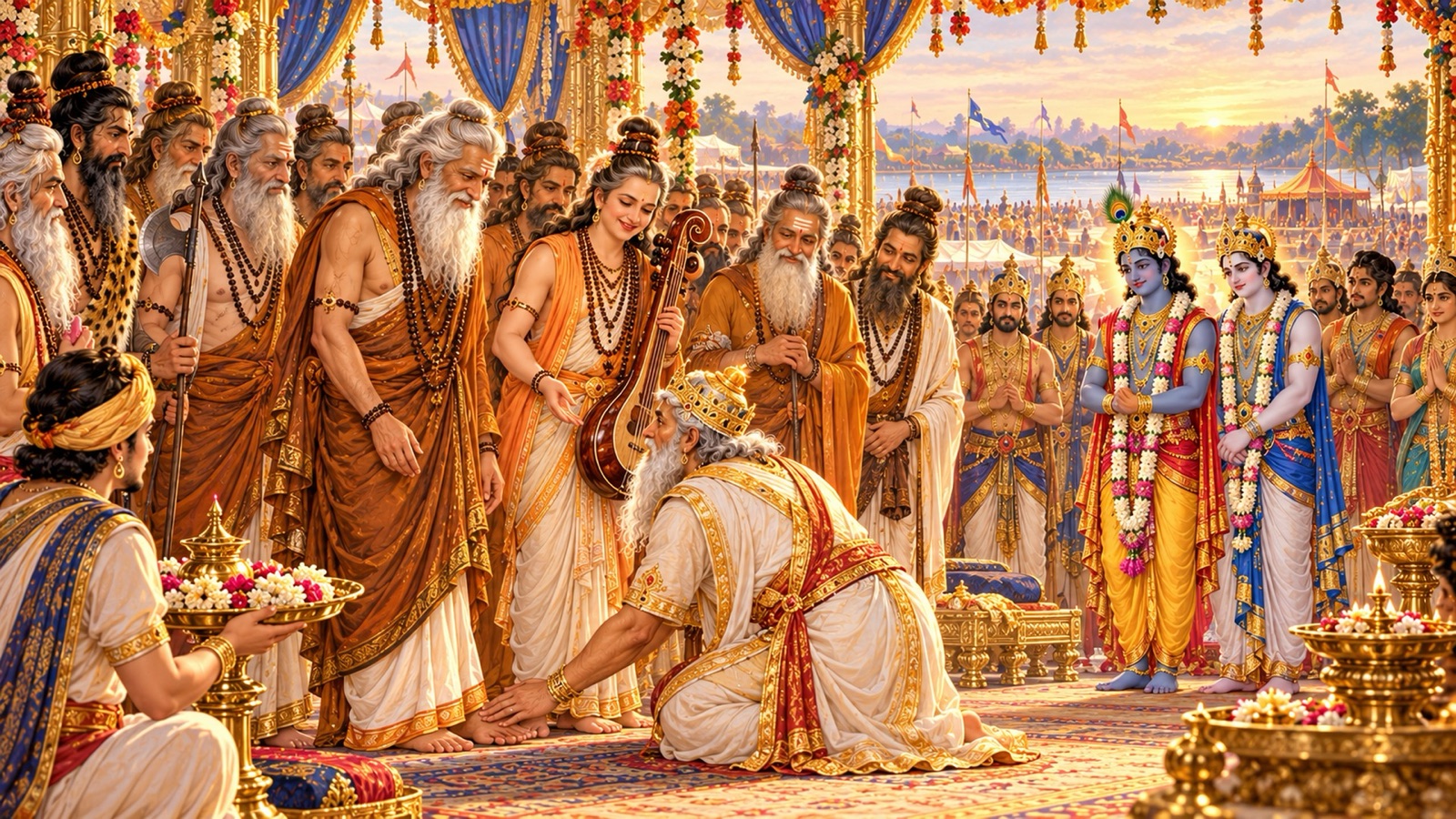
Having praised the Lord, the sages took leave of Him, of Dhritarashtra and of Yudhishthira, and prepared to return to their hermitages. Seeing this, Vasudeva came forward, bowed, clasped their feet and asked with great humility: “Salutations to you, sages, in whom all the gods reside. Tell us by what action one may be released from all action.”
Narada smiled. It is no wonder, he told the others, that Vasudeva, who looks upon Krishna as his child, should ask us the road to his own good; among mortals nearness breeds neglect, and a man living beside the Ganga leaves her water to seek purity elsewhere. Krishna’s awareness, he declared, is never dimmed by Time, by the gunas, by afflictions or by karma; He is the one Lord without a second, and only when He veils Himself in His own energies does the ignorant think Him covered, as men imagine the sun hidden by clouds or eclipse.
The Sages Teach the Way of Sacrifice
Then, within the hearing of Krishna, Balarama and the kings, the sages gave Vasudeva their answer.
कर्मणा कर्मनिर्हार एष साधु निरूपित: ।
यच्छ्रद्धया यजेद् विष्णुं सर्वयज्ञेश्वरं मखै: ॥ ३५ ॥
karmaṇā karma-nirhāra eṣa sādhu-nirūpitaḥ yac chraddhayā yajed viṣṇuṁ sarva-yajñeśvaraṁ makhaiḥ
Meaning: This has been rightly established as the way by which action itself destroys the bondage of action: to worship Vishnu, the Lord of all sacrifices, with faith, through sacrifices. (Canto 10, Chapter 84, verse 35)
This, they explained, the wise call the easiest path to peace of mind; for the householder nothing is more auspicious than worshipping the Supreme Person with honestly earned wealth. Let a man exhaust his thirst for riches through sacrifice and charity, his longing for family through household life, and his craving for higher worlds by remembering that Time sweeps even them away; then let him go to the forest. The twice-born owe three debts — to the gods, the rishis and the ancestors — cleared by sacrifice, Vedic study and a son; whoever leaves home without clearing them falls. “You are free of your debts to the rishis and the ancestors, Vasudeva,” they said. “Pay your debt to the gods by sacrifice, and then you may leave home.” They ended with the truth he had been too close to see.
वसुदेव भवान् नूनं भक्त्या परमया हरिम् ।
जगतामीश्वरं प्रार्च: स यद् वां पुत्रतां गत: ॥ ४१ ॥
vasudeva bhavān nūnaṁ bhaktyā paramayā harim jagatām īśvaraṁ prārcaḥ sa yad vāṁ putratāṁ gataḥ
Meaning: O Vasudeva, you surely worshipped Hari, the Lord of the worlds, with supreme devotion; that is why He has become a son to you both. (Canto 10, Chapter 84, verse 41)
Here the chapter’s two movements meet. Krishna had told the assembly that neither tirtha nor image can do what a saint does; now the saints tell His own father that the Lord of all sacrifices has been living in his house as his boy. Vasudeva’s bewilderment is no flaw in his devotion but its proof: the Lord hides His majesty most completely from those He loves most intimately, so that their love stays free of awe. The sages prescribe sacrifice so that the Lord’s father may worship in the fire the Son he embraces at home, and so the world may learn that every act finds release only when offered to Hari.
Vasudeva’s Great Sacrifice at Kurukshetra
Bowing his head low, the noble Vasudeva won the sages’ favour and appointed them his priests, and in that holy field they made him perform many sacrifices of the highest order. The Yadus and the kings bathed and put on fine garments and lotus garlands; Vasudeva’s wives, adorned with golden necklaces and sandal paste, entered the sacrificial hall in joy, carrying the articles of worship. Drums and conchs resounded, dancers danced, bards sang, and Gandharva women sang with their husbands. Anointed with collyrium and fresh butter, Vasudeva was consecrated with his eighteen wives, as the moon among the stars; clad in deerskin he shone beside his jewelled queens, the priests gleamed as at Indra’s own sacrifice, and Krishna and Balarama shone with Their wives, sons and kinsmen, who are expansions of Themselves.
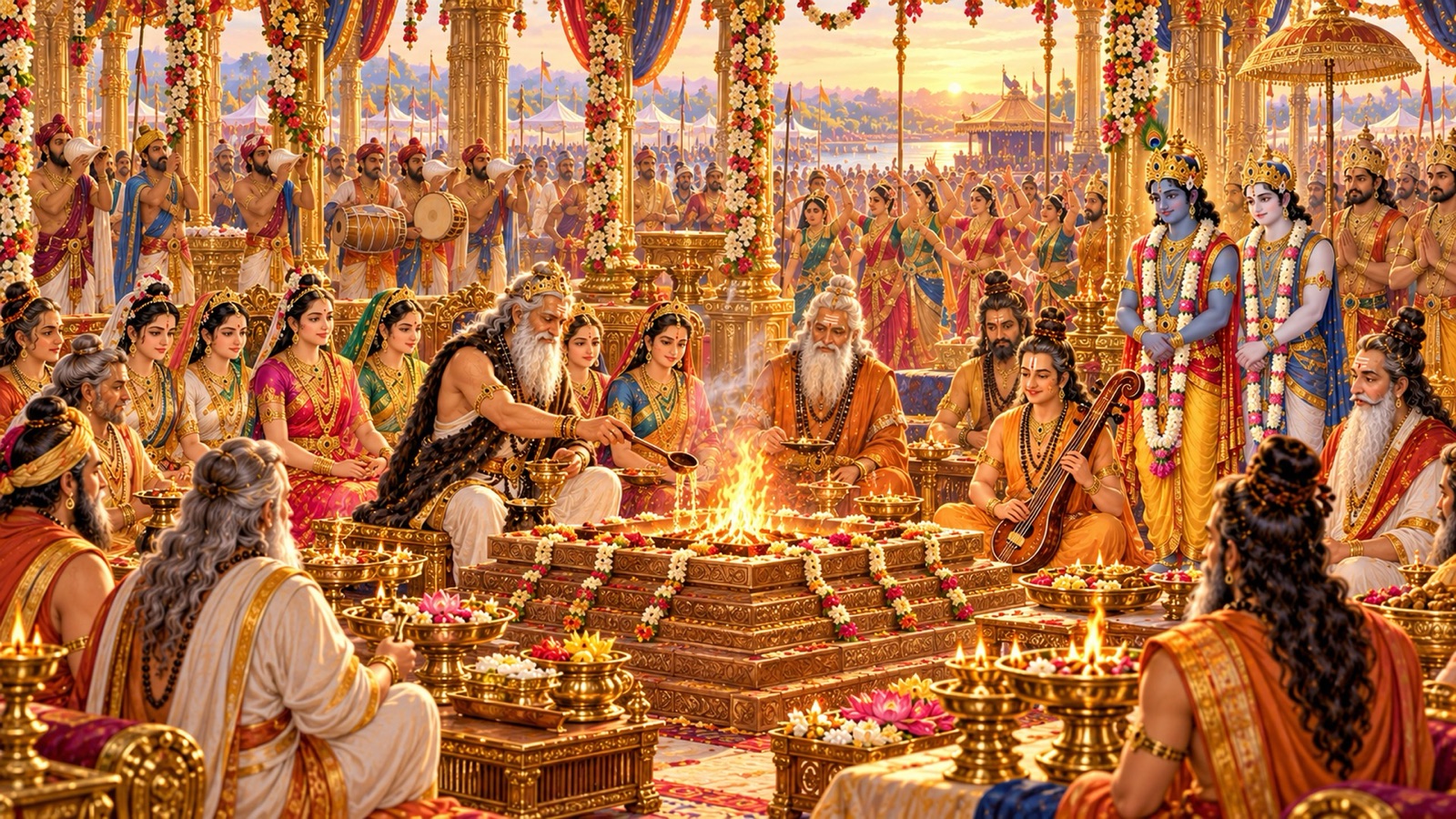
At the close of each sacrifice Vasudeva performed the Agnihotra and the other prescribed rites, worshipping Vishnu, the Lord of all ritual substances and mantras. He gave the priests garments, ornaments and fees, with adorned cows, maidens, lands and wealth as the scriptures ordain, and after the Patni-samyaja and the concluding bath followed the sages to Rama-hrada, the lake named after Parashurama. There he and his wives gave their ornaments to the bards, dressed anew and fed every class of people and even the animals, down to the dogs; he honoured his kinsmen, the visiting princes, the priests, gods, men, spirits, ancestors and Charanas, and all took leave of Krishna and departed praising the sacrifice.
Partings, and Vasudeva’s Words to Nanda
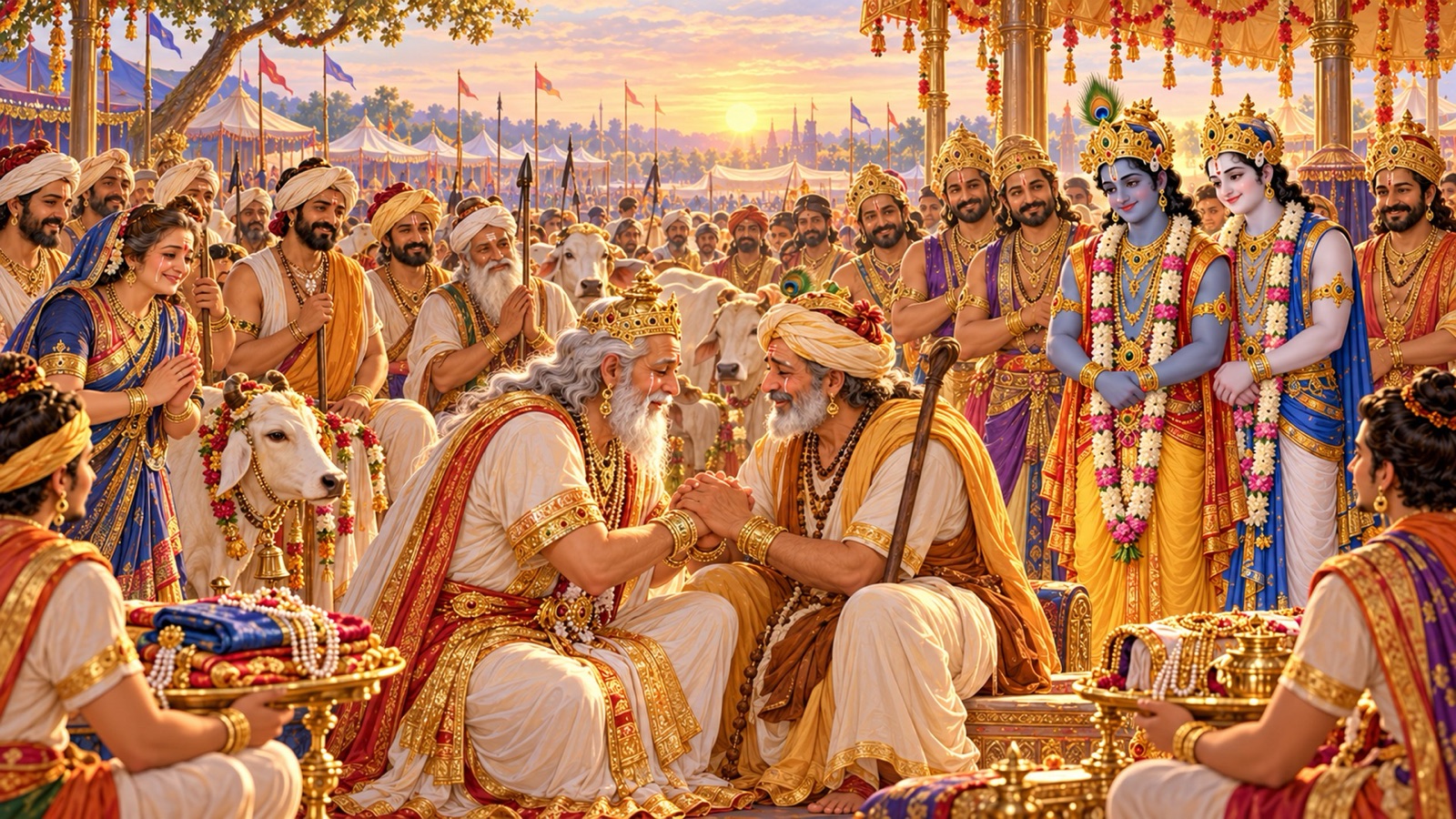
Dhritarashtra, Vidura, the Pandavas with Kunti, Bhishma, Drona, Narada, Vyasa and the other kinsmen felt the pain of separation as they left the Yadus, embracing them and departing only with difficulty. Nanda alone, honoured with rich gifts by Krishna, Balarama and Ugrasena, stayed on out of love. Vasudeva, his great wish fulfilled as easily as if he had crossed an ocean without effort, took Nanda by the hand and spoke.
श्रीवसुदेव उवाच
भ्रातरीशकृत: पाशो नृणां य: स्नेहसंज्ञित: ।
तं दुस्त्यजमहं मन्ये शूराणामपि योगिनाम् ॥ ६१ ॥
śrī-vasudeva uvāca bhrātar īśa-kṛtaḥ pāśo nṛṇāṁ yaḥ sneha-saṁjñitaḥ taṁ dustyajam ahaṁ manye śūrāṇām api yoginām
Meaning: Vasudeva said: Brother, the Lord has fashioned for men a noose that goes by the name of affection; I think it hard to cast off even for heroes and yogis. (Canto 10, Chapter 84, verse 61)
“The friendship you have shown to us ungrateful ones has no equal and can never be repaid,” he went on, “yet it will never end. Once we were helpless and could do nothing for you; now, drunk with wealth and power, we fail to see you even before us. May royal fortune never come to one who seeks his true good, for it blinds a man even to his own kin.” Remembering Nanda’s love, Vasudeva wept.
Nanda’s Three Months and the Return to Dvaraka
To please his friend, and bound by love for Krishna and Balarama, Nanda put off his departure day after day and stayed three months, honoured by the Yadus with enjoyments, ornaments, silks and priceless gifts for him and all of Vraja. Vasudeva, Ugrasena, Krishna, Balarama and Uddhava each gave him presents, and with the Yadus’ leave he set out; yet Nanda, the gopas and the gopis had placed their hearts at Govinda’s lotus feet and could not take them back, and so they went towards Mathura leaving their hearts behind.
When their kinsmen had gone and the monsoon was near, the Vrishnis, who held Krishna as their deity, returned to Dvaraka and told the people of Vasudeva’s great festival, their meeting with friends, and all that had happened on the pilgrimage.
Principal Teachings of This Chapter
1. The saint purifies more swiftly than the tirtha or the image. Sacred waters and consecrated forms cleanse after long service; a holy person cleanses by being seen.
2. The Lord teaches by His own conduct. Krishna speaks as a karma-bound man only to instruct the world, and His humility before the rishis shows how the strong should honour the wise.
3. Nearness can breed neglect. Narada’s man who leaves the Ganga at his door for another tirtha warns us not to overlook the grace already near us.
4. Action is dissolved by action offered to Vishnu. The sages do not tell Vasudeva to abandon work but to make every work a sacrifice to the Lord of all sacrifices.
5. Affection is the Lord’s own noose. Even heroes and yogis cannot shake it off, Vasudeva confesses, and fortune blinds men to their own kin.
A Devotional Reflection
What moves me most in this chapter is the Lord of the universe rising from His seat to honour sages who have come to see Him. Holy rivers, temple images, austerities — all that we were taught to prize, Krishna gently sets second to the living saint, and He does it while the greatest saints sit before Him. Then the scene turns inward: Vasudeva, who has held God on his lap, still does not know the way out of karma, and Narada names the ache we all share — that what is nearest is hardest to see. The remedy is practical: do your duties, but hand their fruit to Vishnu. And at the end two fathers stand weeping, hand in hand, bound by a love the Lord Himself has tied. Devotion is not an escape from affection but its purification.
A Daily Devotional Practice
Today, honour one person of genuine devotion in your life with a sincere word or a small act of service, remembering that the sight of a sadhu purifies at once. Then offer one ordinary duty of the day inwardly to Vishnu before beginning it. Begin by chanting gently: Om Namo Bhagavate Vasudevaya.
Conclusion
This chapter gathers the purpose of the Kurukshetra pilgrimage into one truth: the Lord veiled by His own Maya even from His parents is reached through reverence for His devotees and through work offered to Him as sacrifice. Krishna places the saint above every tirtha; the rishis bow to the Lord hidden in human form; Vasudeva worships in the fire the Son who lives in his house; and Nanda carries home a heart no longer his own. May we learn to see the Lord in His saints and to offer Him all that we do.
May the divine wisdom of Srimad Bhagavatam awaken pure devotion within our hearts.
Om Namo Bhagavate Vasudevaya.
Jay Shree Madhav.
References and Attribution
- Primary edition: Gita Press, Śrīmad Bhāgavata Mahāpurāṇa (English, Part II), Book Ten (Latter Half), Discourse 84.
- Series: Srimad Bhagavatam Wisdom · Biswa Sanatan Dharma Seva Trust.
- Presented following the spiritual guidance and recommendation of Pandit Dr. Shri Kashinath Mishra.
This is an original, faithful retelling in the writer’s own words, with brief quoted verses shown in Devanāgarī and transliteration and their meanings given as summaries. It is not a reproduction of any single publisher’s continuous translation or commentary. No affiliation with or endorsement by any publisher is implied.
Jay Shree Madhav