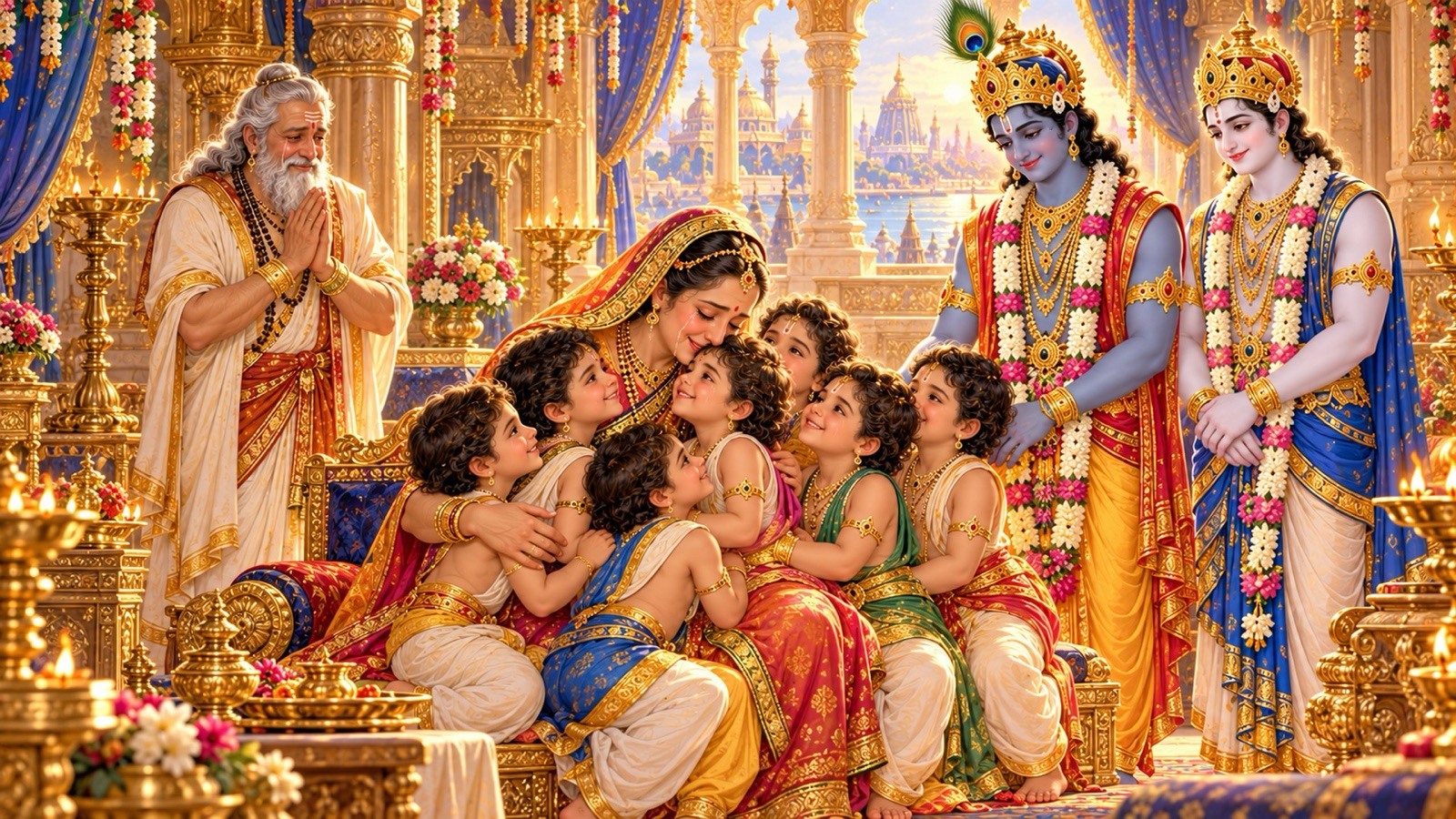
Vasudeva sees his Sons as the Lords of all creation, Krishna teaches him to see Brahman everywhere, and the two Brothers descend to Sutala to bring Devaki’s six slain sons home.
Om Namo Bhagavate Vasudevaya.
Om Namo Bhagavate Vasudevaya.
Om Namo Bhagavate Vasudevaya.
Welcome back to Srimad Bhagavatam Wisdom, our devotional journey through the sacred histories and teachings of the Srimad Bhagavat Mahapurana. In this eighty-fifth chapter of the Tenth Canto, Vasudeva addresses Krishna and Balarama as the Supreme, Krishna answers with a teaching on the one Self in all, and Devaki’s plea for her six slain sons carries the Brothers to King Bali’s realm.
Chapter Information
- Scripture: Śrīmad Bhāgavata Mahāpurāṇa
- Canto: 10 (Book Ten, Latter Half)
- Chapter: 85 (Discourse 85)
- Chapter title: Lord Krishna Instructs Vasudeva and Retrieves Devaki’s Sons
- Principal speaker: Sukadeva Gosvami (to King Parikshit); Suta Gosvami speaks the closing verse
- Principal listener: King Parikshit
- Main setting: Dvaraka; Sutala, the realm of King Bali
- Central subject: Vasudeva’s prayer; all is Brahman; Devaki’s request; Bali’s worship; the six sons released
- Principal verse range: Canto 10, Chapter 85, verses 1–59
- Primary edition: Gita Press Śrīmad Bhāgavata Mahāpurāṇa (English, Part II)
Context From the Previous Chapter
In Chapter 84, after the sages guided Vasudeva’s great sacrifice at Kurukshetra, the Yadus honoured Nanda and the people of Vraja for three months and returned to Dvaraka before the monsoon.
The Sons Bow to Their Father
Sukadeva continued. One day Krishna and Balarama came to Their parents and bowed at Vasudeva’s feet. He welcomed Them with love; yet he had heard from the sages who his Sons truly were and had seen deeds no mortal child could do; convinced of Their divinity, he addressed Them with deep affection.
Vasudeva’s Prayer: The Rulers of Matter and Spirit
He hailed Krishna as the embodiment of truth and consciousness and Sankarshana, Balarama, as the master of great yogis, declaring that he knew Them to be eternal, sovereigns even of Prakriti and Purusha, the two causes of the world.
कृष्ण कृष्ण महायोगिन् सङ्कर्षण सनातन ।
जाने वामस्य यत् साक्षात् प्रधानपुरुषौ परौ ॥ ३ ॥
kṛṣṇa kṛṣṇa mahā-yogin saṅkarṣaṇa sanātana jāne vām asya yat sākṣāt pradhāna-puruṣau parau
Meaning: O Krishna, O Krishna, great master of yoga! O Sankarshana, eternal one! I know that You two are directly the supreme Pradhana and Purusha of this universe, the primal matter and the primal spirit that lie beyond it. (Canto 10, Chapter 85, verse 3)
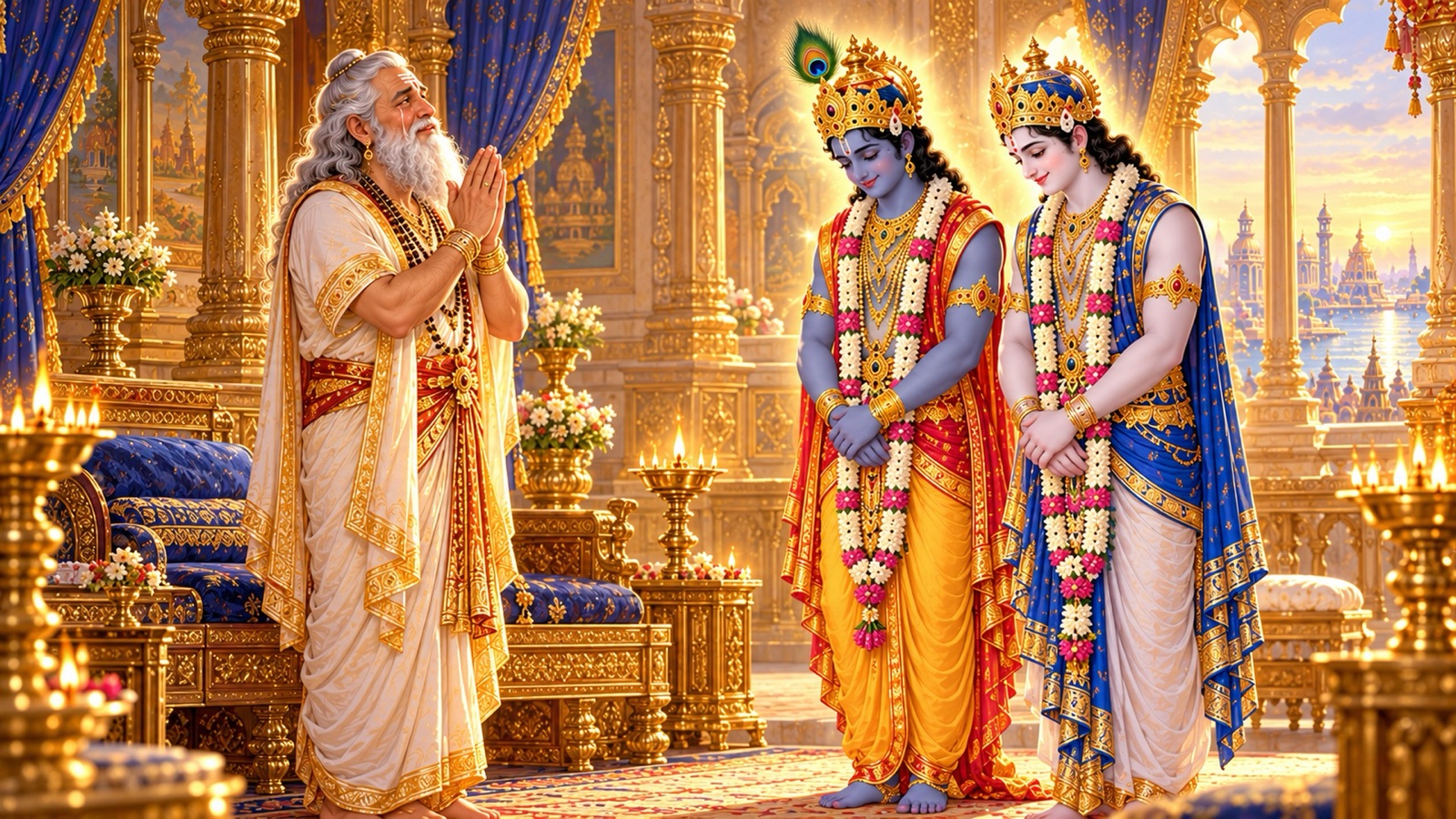
Whatever exists, he went on, in any place, time or form, is nothing but Them: the ground and cause of the universe, its only Lords, made for Their play. They entered Their own creation as its Inner Controller and sustain it as life and soul; the agents of creation act only by Their power. Then he named the world as the Lord: the lustre of the moon, the glow of fire, the brilliance of sun, stars and lightning; the firmness of mountains and the fragrance of the earth; the purity and taste of water; the vigour of the senses and the body’s strength; the directions, the sky, sound and speech; the gods of the senses, the resolve of the intellect and the memory that binds experience. He is the threefold ego from which elements, senses and mind arise, and the Maya that returns bound souls to birth. As a substance abides beneath its changing shapes, He is the imperishable truth behind all that perishes; the gunas rest in Him yet never touch Him, and those who miss His subtle presence in their flow wander through birth and death.
“I Have Had Enough”: The Father Takes Shelter
By good fortune, Vasudeva said, he had received a human body in this land, yet, bewildered by the Lord’s Maya, he had let his life pass in neglect of its purpose. The Lord binds the world with the ropes of “I” and “mine”. “You are not our sons but the Lords of nature and of every soul, come to relieve the earth’s burden of kings, as You told me when You appeared.”
तत्ते गतोऽस्म्यरणमद्य पदारविन्द-
मापन्नसंसृतिभयापहमार्तबन्धो ।
एतावतालमलमिन्द्रियलालसेन
मर्त्यात्मदृक् त्वयि परे यदपत्यबुद्धि: ॥ १९ ॥
tat te gato ’smy araṇam adya padāravindam āpanna-saṁsṛti-bhayāpaham ārta-bandho etāvatālam alam indriya-lālasena martyātma-dṛk tvayi pare yad apatya-buddhiḥ
Meaning: Therefore, O friend of the distressed, today I have come for shelter to Your lotus feet, which take away the fear of worldly existence from those who approach them. Enough, enough of this hankering of the senses, under whose sway I took this mortal body for myself and looked upon You, the Supreme, as my child. (Canto 10, Chapter 85, verse 19)
He recalled the Lord’s words in the maternity chamber: though unborn, He had appeared through the two of them age after age to protect His dharma. Like the sky You take on and cast off countless forms yet remain one and infinite; who can fathom Your Yogamaya? The whole world sings Your glories.
The Lord’s Answer: See Everything as Brahman
Hearing this, Krishna, the jewel of the Yadus, smiled, bowed humbly and answered gently: “Father, We are your sons, and you have spoken the highest truth to Us; We accept all you have said.” Then came the teaching at the heart of the chapter.
अहं यूयमसावार्य इमे च द्वारकौकस: ।
सर्वेऽप्येवं यदुश्रेष्ठ विमृग्या: सचराचरम् ॥ २३ ॥
ahaṁ yūyam asāv ārya ime ca dvārakaukasaḥ sarve ’py evaṁ yadu-śreṣṭha vimṛgyāḥ sa-carācaram
Meaning: I Myself, you, My elder brother here, these residents of Dvaraka, and indeed all beings, moving and unmoving, O best of the Yadus, should be regarded in just this way, as Brahman. (Canto 10, Chapter 85, verse 23)
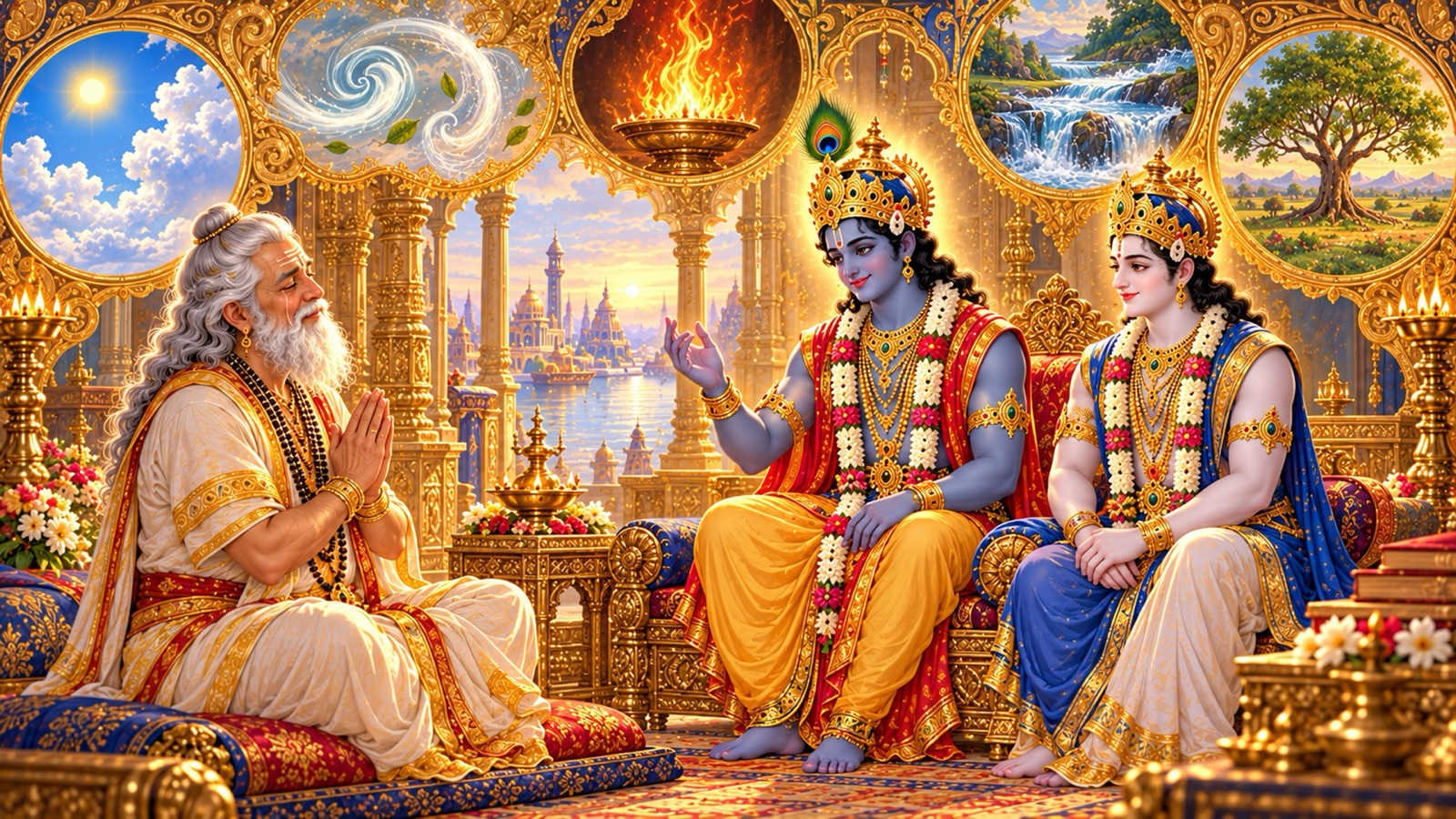
The Self, He explained, is one, self-luminous, eternal and beyond the gunas; yet it brings forth the gunas from itself, and in the bodies made of them it seems manifold, perceptible, passing and qualified, just as each of the five elements, one in essence, appears manifest or hidden, scanty or abundant in its products.
Why add this to His father’s prayer? Vasudeva had seen that his Sons were God, yet a gap remained between the God he beheld and the soul he was. Krishna closes it: the Brahman recognized in Krishna and Balarama is to be recognized in Vasudeva, in Dvaraka’s citizens, in every being; true knowledge is to find Him everywhere, with no second thing. Hearing the almighty Lord, Vasudeva was freed from the sense of difference and in silent joy stilled his mind.
Devaki’s Plea for Her Six Sons
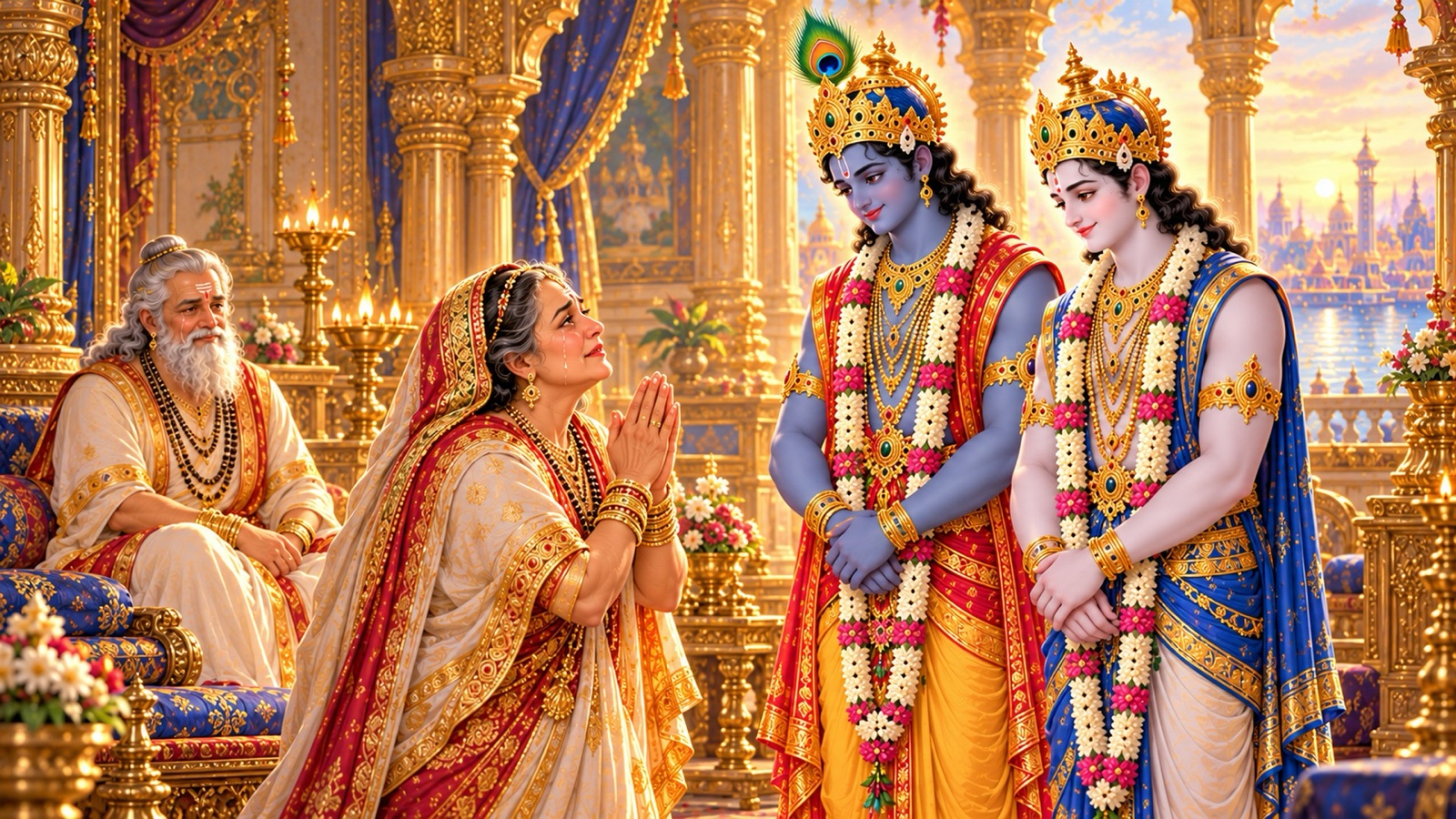
Devaki, in whom all the goddesses dwelt, had heard with astonishment that her Sons had brought Their teacher’s long-dead son back from Yama. Remembering her own children, killed by Kamsa at birth, she spoke to Krishna and Balarama with tears. “O Rama of immeasurable Self, O Krishna, Lord of the masters of yoga, You rule the Prajapatis themselves and are the original Person made manifest. You have descended through me to remove the kings who burden the earth. From a portion of You comes Maya, from Maya the gunas, and from these the world’s creation, maintenance and dissolution. Today I take refuge in You. As You brought back Your guru’s son, so grant my wish: let me see the sons the king of the Bhojas slew.”
In Sutala: King Bali Receives the Lord
Thus urged by Their mother, Krishna and Balarama entered the subterranean realm of Sutala by Yogamaya. When Bali, lord of the Daityas, saw the Soul of the universe arrive in that twofold form, he sprang from his seat, his heart flooding with joy, and bowed with all his household. He seated Them, washed Their feet and sprinkled on his own head and his family’s the water that purifies the universe up to Brahma. He worshipped Them with garments, ornaments, sandalwood, betel, lamps and food sweet as nectar, offered Them his family, wealth and self, and, pressing the Lord’s feet again and again to his heart and head, eyes dim with tears and hair on end, prayed in a choked voice.
Bali’s Prayer: Rescue Me From the Dark Well
“Obeisance to You, Rama, boundless and great; obeisance to You, Krishna, creator of all, source of the paths of knowledge and devotion, the Absolute, the Supreme Self.” Your sight, he said, is hard for ordinary beings to win, yet You have granted it unasked to us whose nature is passion and darkness. Daityas, Danavas, Gandharvas, Siddhas, Vidyadharas, Caranas, Yakshas, Rakshasas, Pisacas, Bhutas and the Pramatha chiefs nurse enmity against You whose body is the Vedas, yet through hatred or self-interested devotion some of us have come nearer to You than the sattvika gods. Even great yogis cannot grasp Your Yogamaya; how could we?
तन्न: प्रसीद निरपेक्षविमृग्ययुष्मत्-
पादारविन्दधिषणान्यगृहान्धकूपात् ।
निष्क्रम्य विश्वशरणाङ्घ्र्युपलब्धवृत्ति:
शान्तो यथैक उत सर्वसखैश्चरामि ॥ ४५ ॥
tan naḥ prasīda nirapekṣa-vimṛgya-yuṣmat- pādāravinda-dhiṣaṇānya-gṛhāndha-kūpāt niṣkramya viśva-śaraṇāṅghry-upalabdha-vṛttiḥ śānto yathaika uta sarva-sakhaiś carāmi
Meaning: So be gracious to us: let my mind rest on Your lotus feet, which the desireless seek, so that I may climb out of this blind well of household life and, living by the shelter of Your feet that are the refuge of the world, wander in peace alone, or else in the company of those who are friends to all. (Canto 10, Chapter 85, verse 45)
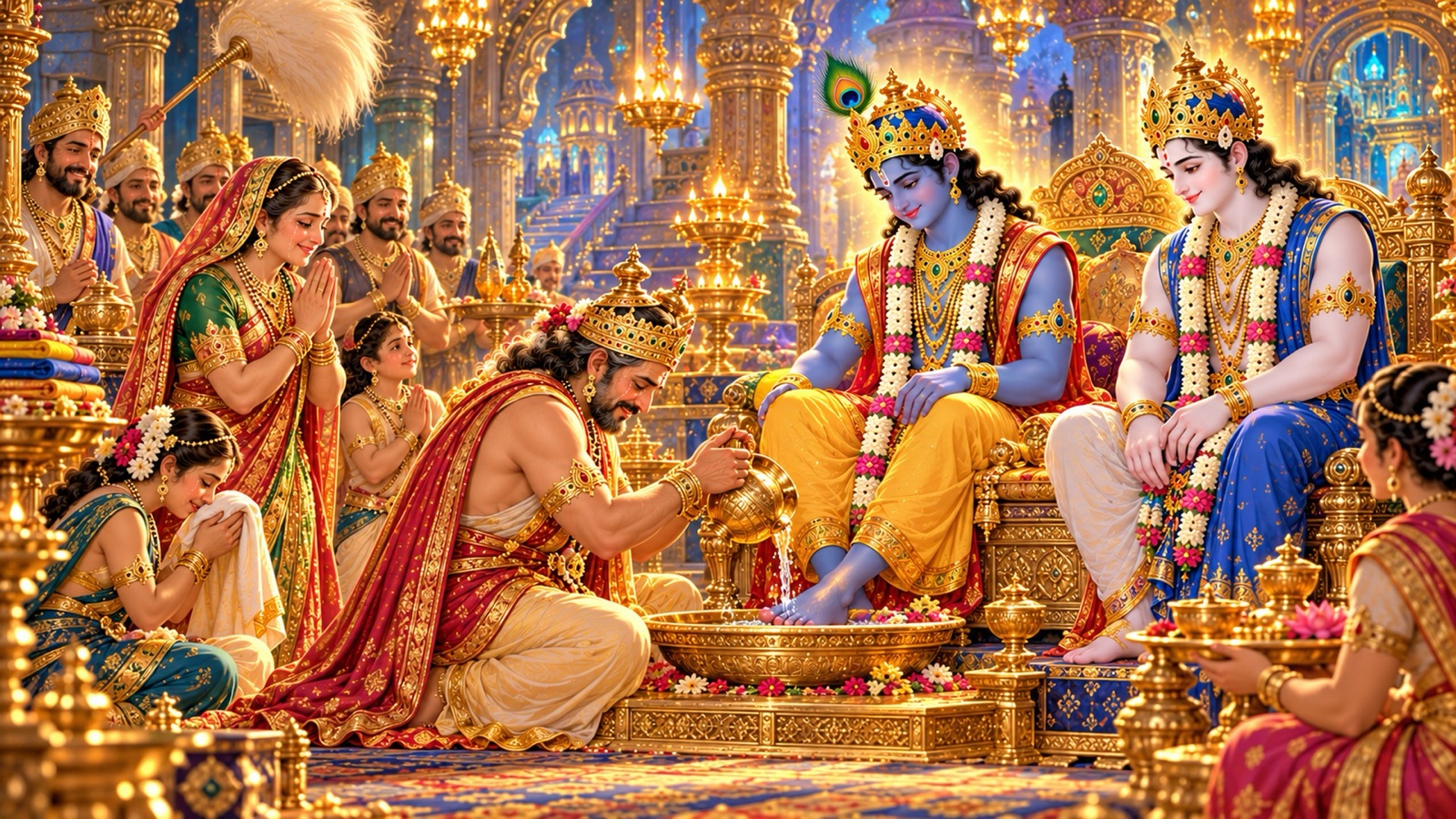
He ended by asking the ruler of all beings to make them sinless and to teach the path by which a man of faith rises beyond injunction and prohibition.
The History of the Six Brothers
The Lord then told Bali who the children were. In the first Manvantara, Marichi had six sons by his wife Urna, all of them gods. Seeing Brahma overcome by an improper desire for his own daughter, they laughed, and for that fault were born among the asuras as sons of Hiranyakasipu; Yogamaya carried them from there into Devaki’s womb, and Kamsa killed them at birth. “Our mother grieves for these children, who now live with you. We will take them to end her sorrow; freed from the curse, they will return to their own abode in peace.” He named them Smara, Udgitha, Parishvanga, Patanga, Kshudrabhrit and Ghrini, promising that by His grace all six would regain their blessed state. Taking the children, and honoured once more by Bali, the Brothers returned to Dvaraka and gave the boys to Their mother.
Devaki Nurses Her Children; Their Ascent
At the sight of those children, milk flowed from Devaki’s breasts out of love. She gathered them onto her lap, embraced them and smelt the crowns of their heads again and again, and, bewildered by the Lord’s Maya that keeps creation turning, she joyfully suckled them.
पीत्वामृतं पयस्तस्या: पीतशेषं गदाभृत: ।
नारायणाङ्गसंस्पर्शप्रतिलब्धात्मदर्शना: ॥ ५५ ॥
pītvāmṛtaṁ payas tasyāḥ pīta-śeṣaṁ gadā-bhṛtaḥ nārāyaṇāṅga-saṁsparśa- pratilabdhātma-darśanāḥ
Meaning: Having drunk her nectar-like milk, the remnant of what the mace-bearing Lord Himself had drunk, and having regained the vision of the Self through the touch of Narayana’s limbs, the six were transformed. (Canto 10, Chapter 85, verse 55)
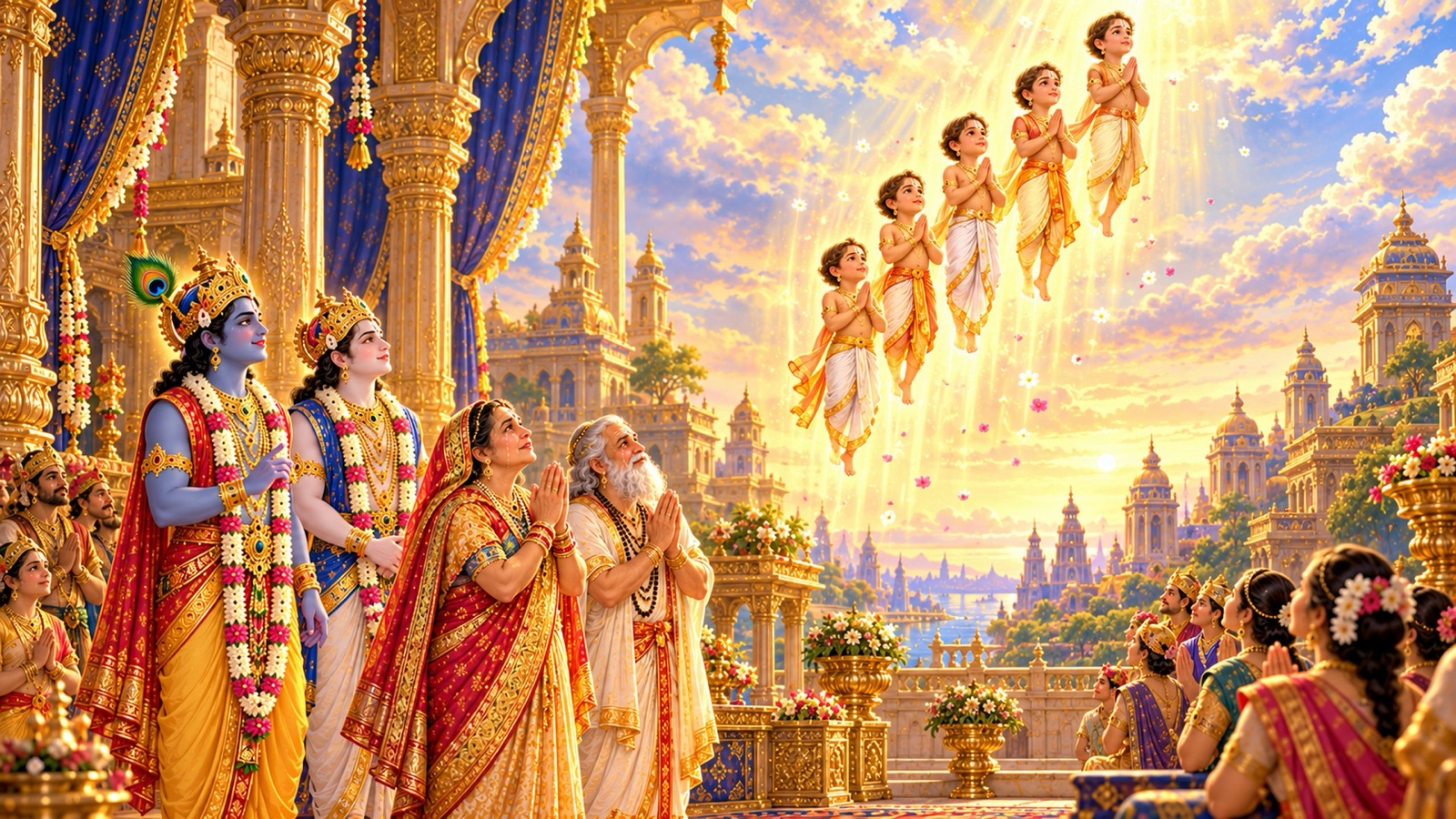
They bowed to Govinda, to Devaki, to their father and to Balarama, and before the eyes of all rose to the abode of the gods. Devaki, watching her dead sons come and go, understood in wonder that this was Krishna’s Maya at play; such deeds of the Lord of unlimited power, Sukadeva said, are endless.
Suta’s Closing Words
Here Suta Gosvami, speaking to the sages of Naimisharanya, blessed the hearer.
य इदमनुशृणोति श्रावयेद् वा मुरारे-
श्चरितममृतकीर्तेर्वर्णितं व्यासपुत्रै: ।
जगदघभिदलं तद्भक्तसत्कर्णपूरं
भगवति कृतचित्तो याति तत्क्षेमधाम ॥ ५९ ॥
ya idam anuśṛṇoti śrāvayed vā murāreś caritam amṛta-kīrter varṇitaṁ vyāsa-putraiḥ jagad-agha-bhid alaṁ tad-bhakta-sat-karṇa-pūraṁ bhagavati kṛta-citto yāti tat-kṣema-dhāma
Meaning: Whoever regularly hears or recites this history of Murari of immortal fame, as told by the son of Vyasa, a history that destroys the sins of the world and adorns the ears of His devotees, fixes his mind on the Lord and goes to His abode of perfect peace. (Canto 10, Chapter 85, verse 59)
Principal Teachings of This Chapter
1. Everything that shines, shines by Him. Vasudeva finds the Lord in moonlight and fire, in the earth’s fragrance and the water’s taste, in speech, memory and the senses; the devotee learns to read the world as one Name.
2. Affection is a rope the Lord has tied. Even love for Krishna as a child was a form of “I” and “mine”; the remedy is not to love less but to recognize whom we have always loved.
3. The knower too is Brahman. Krishna’s instruction that He, Balarama, Vasudeva and all beings be seen as Brahman makes realization the end of difference, not admiration of a distant God.
4. The right prayer is for His feet. Granted a sight the gods rarely win, Bali asks only to leave the blind well of worldly life for the shelter of the Lord’s feet.
5. His mercy completes what the curse began. Fallen for mocking Brahma, born among asuras and slain by Kamsa, the six sons are restored by Krishna’s touch to self-knowledge and their home.
A Devotional Reflection
This is one of the quietest and most intimate chapters of the Tenth Canto. A father prays, a mother weeps, a king in the underworld washes two pairs of feet, and six children drink milk and go home. Yet it holds a whole path of devotion. Vasudeva shows the moment when familiarity falls away and the One we treated casually is seen as the Lord of matter and spirit. Krishna shows that this seeing must widen to include ourselves and every creature. Devaki shows that the Lord answers an old wound rather than dismissing it. And the six brothers remind us that no fall is final: His touch can still awaken us and send us home.
A Daily Devotional Practice
Today, take one ordinary thing, sunlight, the taste of water, a voice, and quietly acknowledge it as the Lord’s presence, as Vasudeva did. Then extend it, as Krishna asked, to those around you and to yourself. Close the day with Bali’s prayer that your mind rest at His lotus feet. Begin and end by chanting gently: Om Namo Bhagavate Vasudevaya.
Conclusion
In this chapter knowledge and love meet in a single household. Vasudeva’s realization ends in surrender at his Sons’ feet; Krishna’s reply widens it until nothing is left outside Brahman; Devaki’s grief is honoured by a journey to Sutala and Bali’s worship there; and the six brothers, freed at last, ascend before all eyes. Suta’s blessing tells us why we hear it: the deeds of Murari fix the mind on Him and carry us to His shelter. May we see Him in all and trust Him to bring every lost child home.
May the divine wisdom of Srimad Bhagavatam awaken pure devotion within our hearts.
Om Namo Bhagavate Vasudevaya.
Jay Shree Madhav.
References and Attribution
- Primary edition: Gita Press, Śrīmad Bhāgavata Mahāpurāṇa (English, Part II), Book Ten (Latter Half), Discourse 85, printed pages 478–484.
- Series: Srimad Bhagavatam Wisdom · Biswa Sanatan Dharma Seva Trust.
- Presented following the spiritual guidance and recommendation of Pandit Dr. Shri Kashinath Mishra.
This is an original, faithful retelling in the writer’s own words, with brief quoted verses shown in Devanāgarī and transliteration and their meanings given as summaries. It is not a reproduction of any single publisher’s continuous translation or commentary. No affiliation with or endorsement by any publisher is implied.
Jay Shree Madhav