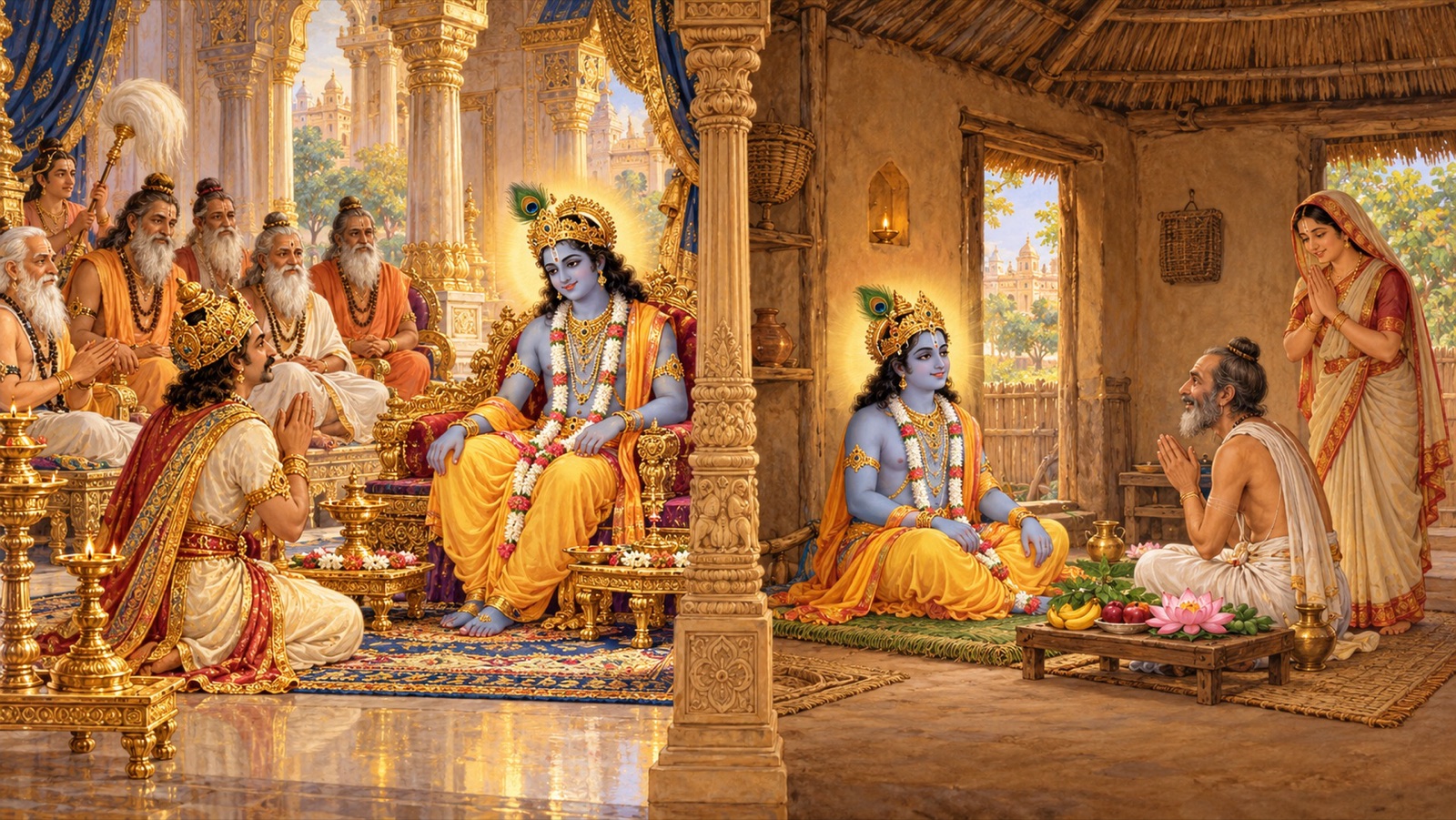
Invited at the same moment by a king and by a poor brahmana, Krishna enters both their homes at once, and in each He proves that no one is dearer to Him than His devotee.
Om Namo Bhagavate Vasudevaya.
Om Namo Bhagavate Vasudevaya.
Om Namo Bhagavate Vasudevaya.
Welcome back to Srimad Bhagavatam Wisdom, our devotional journey through the sacred histories and teachings of the Srimad Bhagavat Mahapurana. This eighty-sixth chapter of the Tenth Canto tells how Arjuna, disguised as a renunciant, won Subhadra, and then follows Krishna to Mithila, where He graces the brahmana Shrutadeva and King Bahulashva and reveals how He wishes to be worshipped.
Chapter Information
- Scripture: Śrīmad Bhāgavata Mahāpurāṇa
- Canto: 10 (Book Ten, Latter Half)
- Chapter: 86 (Discourse 86)
- Chapter title: Arjuna Kidnaps Subhadra, and Krishna Blesses His Devotees
- Principal speaker: Sukadeva Gosvami (with the prayers of Bahulashva and Shrutadeva and the words of Lord Krishna)
- Principal listener: King Parikshit
- Main setting: Dvārakā, and Mithilā, the capital of Videha
- Central subject: Subhadra’s marriage to Arjuna; Krishna’s visit to two devotees of Mithila; His teaching that the saintly brahmana is His own self
- Principal verse range: Canto 10, Chapter 86, verses 1–59
- Primary edition: Gita Press Śrīmad Bhāgavata Mahāpurāṇa (English, Book Ten)
Context From the Previous Chapter
In Chapter 85, Krishna and Balarama brought back from Bali’s realm the six sons of Devaki slain by Kamsa, who, freed from their curse, rose to the heavens. Parikshit now asks about a pastime touching his own family.
Parikshit’s Question
The king asked Sukadeva how Arjuna came to marry Subhadra, the sister of Balarama and Krishna, the lady who was his own grandmother.
Arjuna in the Guise of a Renunciant
Wandering the earth on pilgrimage, Sukadeva said, the mighty Arjuna came to Prabhasa and heard of Subhadra, the daughter of his maternal uncle Vasudeva. He learnt too that Balarama meant to give her to Duryodhana and no one else. Longing to win her, he took the dress of a renunciant with the triple staff and entered Dvaraka.
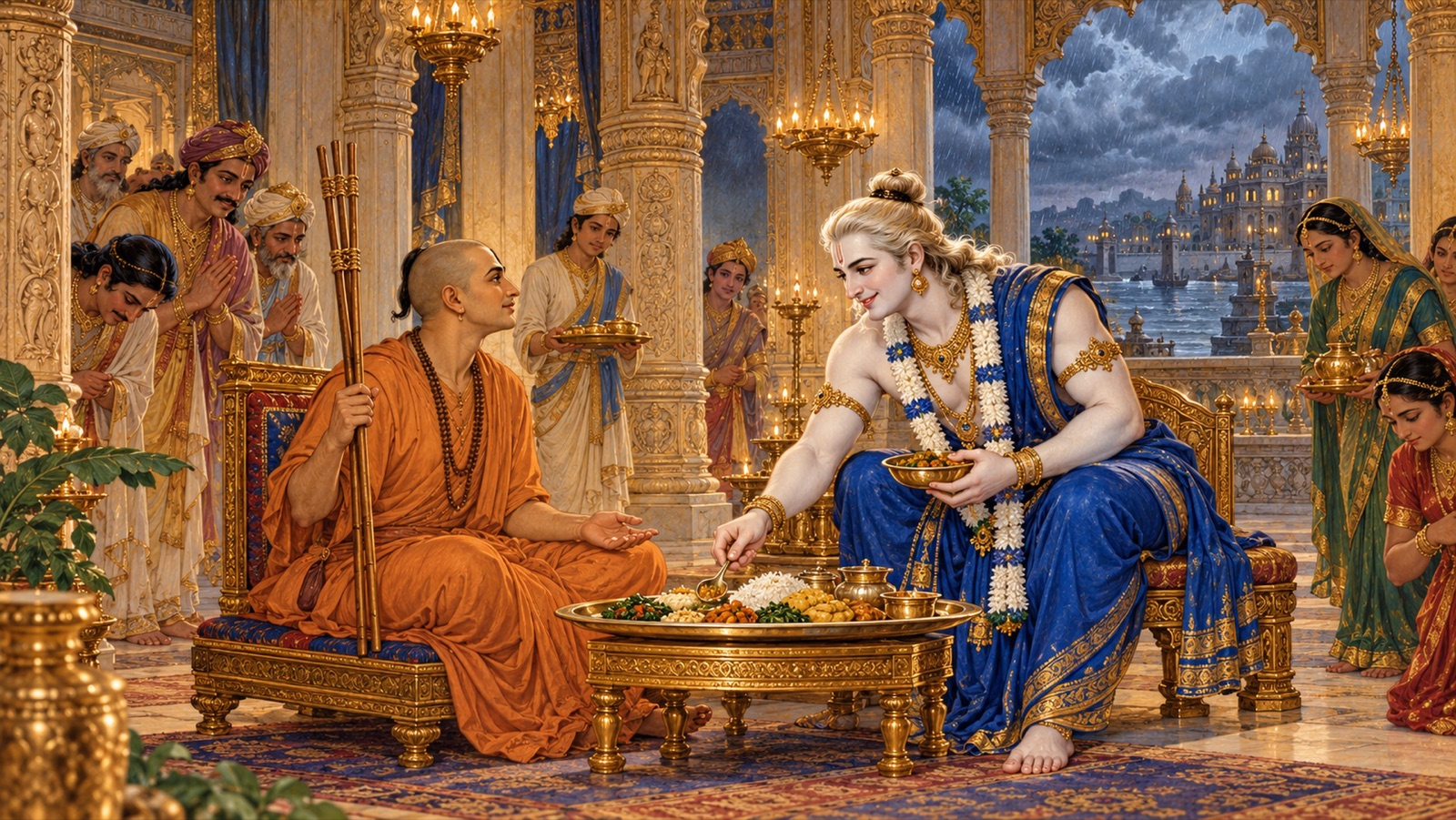
He passed the four months of the monsoon there, honoured by the citizens and by Balarama Himself, who did not recognise him. One day Balarama brought the supposed ascetic home as a guest and fed him with reverence. There Arjuna saw the young Subhadra, whose beauty captivated the heart of heroes, and his heart turned toward her. Subhadra too fell in love at the sight of him, and with shy, smiling, sidelong glances she fixed her heart and eyes upon him. From then on Arjuna thought of her alone and watched for his opportunity, finding no peace of mind.
Subhadra’s Departure From Dvaraka
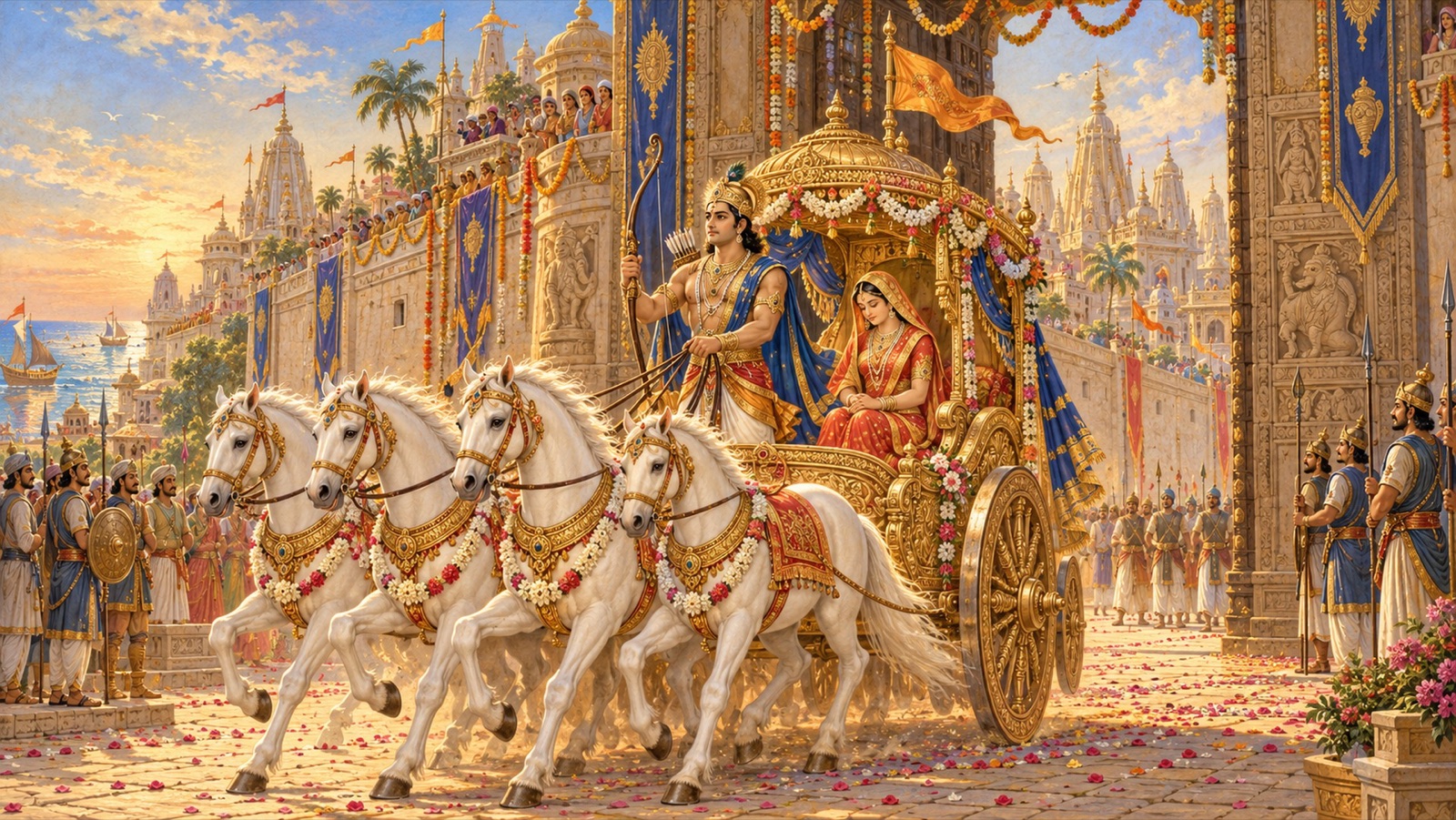
The moment came on a great festival of the gods, when Subhadra rode out of the fort in a chariot to visit the temple. Arjuna took her away, and he did so with the approval of her parents, Devaki and Vasudeva, and of Krishna Himself.
महत्यां देवयात्रायां रथस्थां दुर्गनिर्गताम् ।
जहारानुमतः पित्रोः कृष्णस्य च महारथः ॥ ९ ॥
mahatyāṁ deva-yātrāyāṁ ratha-sthāṁ durga-nirgatām jahārānumataḥ pitroḥ kṛṣṇasya ca mahā-rathaḥ
Meaning: During a great festival of the gods, as Subhadra came out of the fort seated in her chariot, the mighty chariot-warrior Arjuna carried her away with the consent of her parents and of Krishna. (Canto 10, Chapter 86, verse 9)
Standing in her chariot with bow in hand, Arjuna drove off the guards who tried to stop him, and while her kinsmen cried out he bore away his bride as a lion bears away his share.
Balarama’s Anger and His Blessing
When the news reached Balarama, He was shaken like the ocean at the full moon, until Krishna and the other kinsmen clasped His feet and soothed Him. Then, glad at heart, Balarama sent the bride and bridegroom a dowry of great wealth, household treasures, elephants, chariots, horses, and men and women attendants.
Two Devotees of Mithila
Sukadeva then began a new history. In Mithila, the capital of Videha, lived a jewel among brahmanas named Shrutadeva. Through single-minded devotion to Krishna all his purposes were fulfilled; he was peaceful, wise and free of craving. Though a householder, he lived content on whatever came unsought, receiving each day just enough and never more, and performed his duties well. The ruler of that land, Bahulashva, was devoted in the same way and free of all false pride. Both were dear to the infallible Lord.
Krishna’s Journey to Videha
Pleased with them both, the Lord mounted the chariot brought by Daruka and set out for Videha with a company of sages: Narada, Vamadeva, Atri, Krishna Dvaipayana Vyasa, Parashurama, Asita, Aruni, Sukadeva himself, Brihaspati, Kanva, Maitreya, Chyavana and others. Along the way townspeople and villagers waited upon Him with offerings, and among the sages He shone like the risen sun among the planets.
The men and women of Anarta, Dhanva, Kurujangala, Kanka, Matsya, Panchala, Kunti, Madhu, Kekaya, Kosala, Arna and other lands drank with their eyes the lotus of His smiling face. To those whose darkness His sight dispelled, the Teacher of the three worlds granted true vision and the highest good, and so, hearing His glories sung, He slowly reached Videha.
The Lord Enters Two Homes at Once
Hearing that the Lord had come, the people of Mithila came out joyfully with gifts and bowed with joined palms to Him and to the sages they had only heard of. Knowing that the Teacher of the world had come for their blessing, the king and Shrutadeva both fell at His feet, and at one and the same moment each invited Krishna and the brahmanas to accept his hospitality.
भगवांस्तदभिप्रेत्य द्वयोः प्रियचिकीर्षया ।
उभयोराविशद् गेहमुभाभ्यां तदलक्षितः ॥ २६ ॥
bhagavāṁs tad abhipretya dvayoḥ priya-cikīrṣayā ubhayor āviśad geham ubhābhyāṁ tad-alakṣitaḥ
Meaning: Understanding their wish and desiring to please them both, the Lord entered the homes of both men, and neither of them perceived that He had gone to the other. (Canto 10, Chapter 86, verse 26)
Bahulashva’s Worship
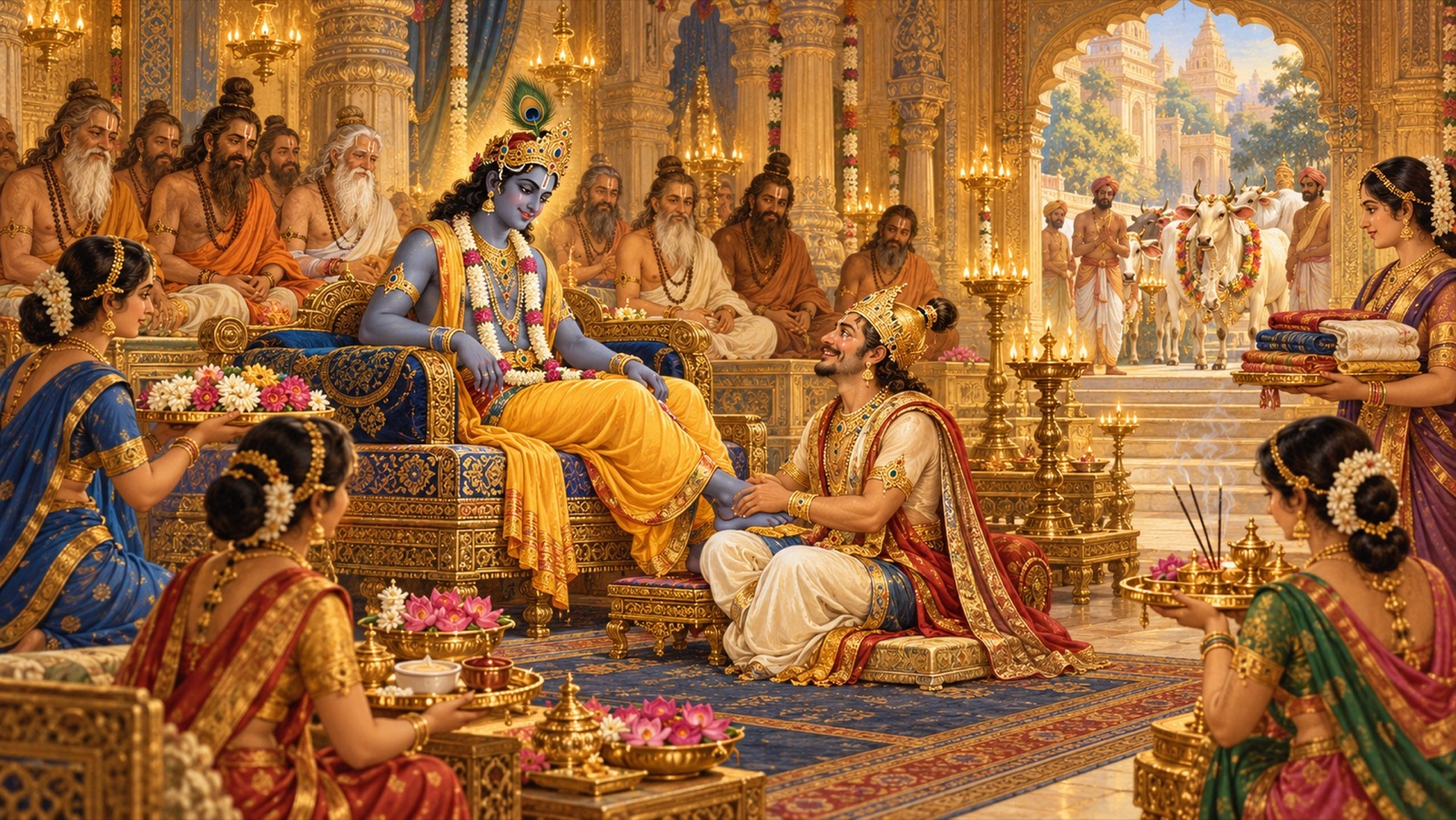
The high-minded Janaka, Bahulashva, seated Krishna and the road-weary sages on the finest seats. His eyes dimmed by tears of devotion, he bowed, washed their feet, and sprinkled that purifying water on his head and his family. He worshipped them with sandal paste, garlands, garments, ornaments, incense, lamps, water of welcome, and cows and bulls. When they had been satisfied with food, he took the feet of Vishnu upon his lap, gently pressed them, and prayed in sweet words.
The Prayer of King Bahulashva
“You are the Self of all beings,” the king said, “the witness within them, self-luminous and almighty; and now You have come before the eyes of us who remember Your lotus feet. You have shown Yourself to make true Your own declaration.”
स्ववचस्तदृतं कर्तुमस्मद्दृग्गोचरो भवान् ।
यदात्थैकान्तभक्तान् मे नानन्तः श्रीरजः प्रियः ॥ ३२ ॥
sva-vacas tad ṛtaṁ kartum asmad-dṛg-gocaro bhavān yad ātthaikānta-bhaktān me nānantaḥ śrīr ajaḥ priyaḥ
Meaning: You have become visible to our eyes in order to fulfil Your own words, for You have declared that neither Ananta, nor the goddess Shri, nor the unborn Brahma is as dear to You as Your exclusively devoted servants. (Canto 10, Chapter 86, verse 32)
Who, the king asked, knowing that You give Your very self to the peaceful sages who own nothing, could abandon Your lotus feet? Descending among the Yadus, You have spread a fame that removes the sins of the three worlds, for the peace of those caught in birth and death. Bowing to Krishna of unfailing wisdom, who as the sage Narayana practises serene austerity, he begged Him to stay some days and purify the dynasty of Nimi with the dust of His feet. So invited, the Lord stayed on, blessing the men and women of Mithila.
Shrutadeva’s Welcome
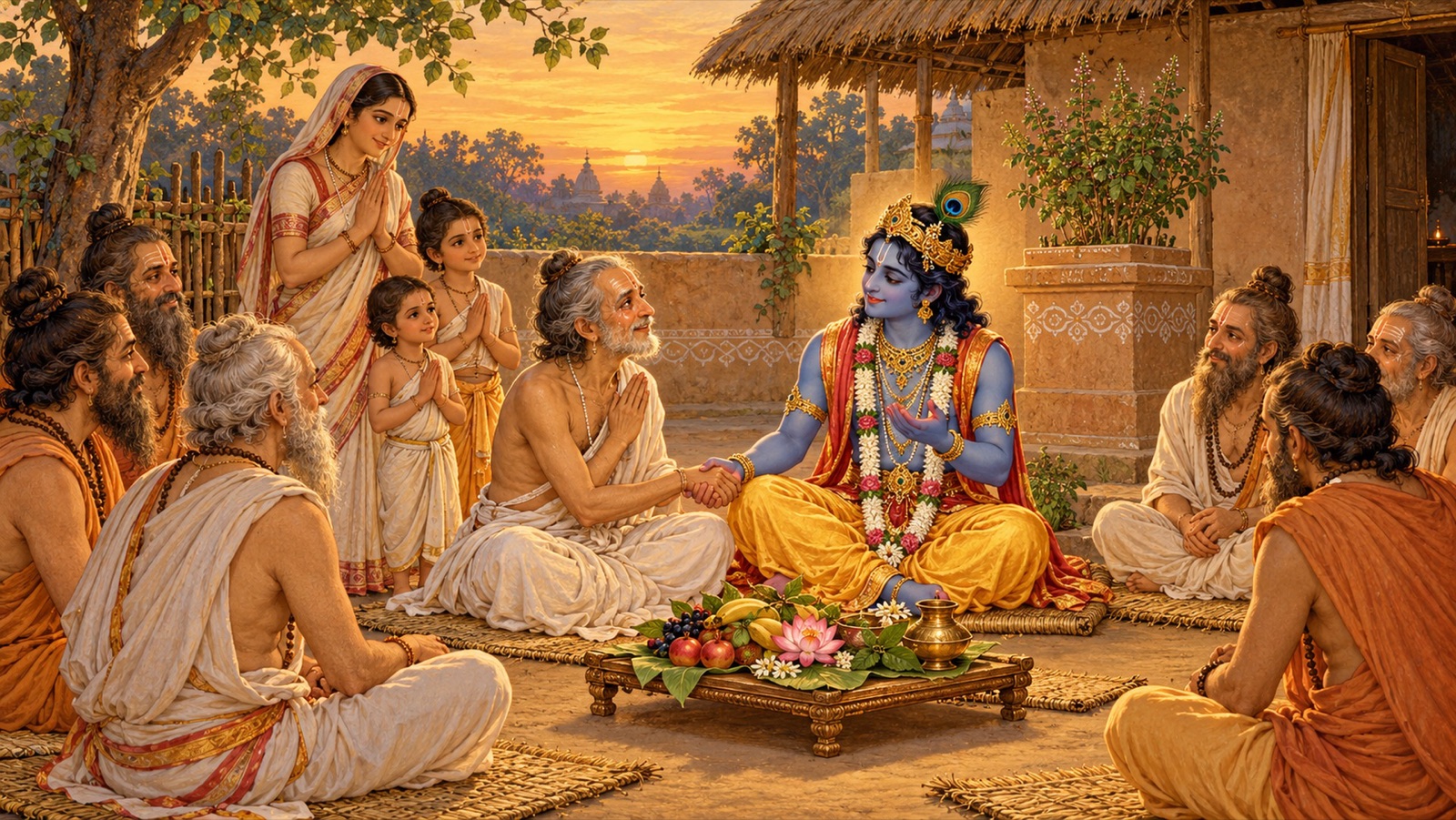
Shrutadeva, like Janaka, was overjoyed to find the Lord at his door, and bowing to the sages he danced, waving his cloth. He seated his guests on mats of straw and kusha grass, welcomed them with kind words, and with his wife gladly washed their feet, sprinkling that water on himself, his house and his family. He honoured them with whatever lay to hand: fruits, fragrant ushira root, pure sweet water, scented clay, tulasi leaves, kusha grass and lotuses, and food that nourishes goodness, wondering all the while how he, fallen into the dark well of household life, had earned the company of Krishna and of sages whose foot-dust sanctifies every holy place. When the guests had eaten, Shrutadeva, with his wife and children, touched Krishna’s feet and spoke.
The Prayer of Shrutadeva
“It is not only today that we have gained Your sight, O Supreme Person,” he said, “for You have been present ever since You created this world by Your energies and entered it, as a sleeping man creates a dream world and appears within it. You reveal Yourself in the hearts of the pure who constantly hear of You, speak of You, worship You and bow to You.”
हृदिस्थोऽप्यतिदूरस्थः कर्मविक्षिप्तचेतसाम् ।
आत्मशक्तिभिरग्राह्योऽप्यन्त्युपेतगुणात्मनाम् ॥ ४७ ॥
hṛdi-stho ‘py ati-dūra-sthaḥ karma-vikṣipta-cetasām ātma-śaktibhir agrāhyo ‘py anty upeta-guṇātmanām
Meaning: Though seated in the heart, You remain very far from those whose minds are scattered by worldly activity; and though no one can grasp You by his own powers, You stand close to those whose hearts have gained devotional qualities. (Canto 10, Chapter 86, verse 47)
He bowed to the Lord who is the Supreme Self for the knowers of the Self and death for those who take the body for the self, whose vision Maya can never veil, and asked, “Command us, Your servants: what may we do for You? The suffering of men ends the moment You come within their sight.”
Krishna Takes the Brahmana’s Hand
Hearing this, the Lord who removes the distress of the surrendered took Shrutadeva’s hand in His own and, smiling, began to speak.
The Lord’s Teaching on the Saintly Brahmana
“O brahmana,” Krishna said, “know that these sages have come only to bless you. They travel with Me through the worlds, purifying them with the dust of their feet. The deities, holy places and sacred waters purify slowly, through sight, touch and worship over a long time; but the saints purify at once by their glance, and the holy places draw their power from such souls. The brahmana is by birth the best of beings, and how much more so when endowed with austerity, learning, contentment and devotion to Me.”
न ब्राह्मणान्मे दयितं रूपमेतच्चतुर्भुजम् ।
सर्ववेदमयो विप्रः सर्वदेवमयो ह्यहम् ॥ ५४ ॥
na brāhmaṇān me dayitaṁ rūpam etac catur-bhujam sarva-veda-mayo vipraḥ sarva-deva-mayo hy aham
Meaning: Even this four-armed form of Mine is not dearer to Me than the brahmana, for the brahmana embodies all the Vedas, while I embody all the gods. (Canto 10, Chapter 86, verse 54)
“People of poor understanding do not know this,” the Lord continued. “Envious, they see an object of worship only in the temple image and slight the brahmana, the guru of the world, who is Myself and their own self. Seeing Me everywhere, the brahmana knows this universe, with its causes, to be nothing but My forms. Therefore, Shrutadeva, worship these sages with the faith you have in Me. So I am worshipped directly, and by no other means, not even by lavish wealth.”
Here the purpose of the whole journey shines out. Krishna came to Mithila to make His own word true, that the exclusive devotee is dearer to Him than Balarama, Lakshmi or Brahma; and having proved it by entering two homes at once, He showed where that love is to be returned: in honouring His devotees as Himself.
The Close of the Chapter
Instructed in this way, Shrutadeva worshipped Krishna and the sages as one Self and attained the supreme destination, as did Bahulashva. Thus the Lord, who is Himself devoted to His devotees, stayed on with these two, taught them the path of the righteous, and returned to Dvaraka.
Principal Teachings of This Chapter
1. The devotee is dearer to the Lord than anyone. Bahulashva recalls Krishna’s promise that not even Balarama, Lakshmi or Brahma are as dear to Him as His exclusive devotee; the twofold appearance in Mithila proves it.
2. The Lord is near to the pure heart and far from the distracted mind. Dwelling in every heart, He is remote to those scattered by worldly work and close to those who hear and chant of Him.
3. Saints purify at once what holy places purify slowly. Krishna ranks the glance of a great soul above pilgrimage and temple worship, for the holy places owe their sanctity to the saints.
4. The saintly brahmana is the Lord’s own body. Not even His four-armed form is dearer to Krishna than the devotee-brahmana; to slight him while worshipping only the deity is a crooked mind’s mark.
5. God is worshipped directly through His servants. Honouring the Lord’s devotees with faith is direct worship of the Lord, which no outpouring of wealth can equal.
A Devotional Reflection
What moves the heart most here is not the wonder of Krishna’s two simultaneous forms but the two very different houses He chose. One was a palace with fine seats and cattle to give away; the other had straw mats, fruit, clay and tulasi. Krishna sat in both with the same delight, and both hosts reached the same perfection. The Lord measures a welcome not by its price but by the heart behind it. When Shrutadeva asked what service he could render, Krishna pointed to the sages at the door: serve them, and you have served Me. Perhaps the Lord stands at our doors in the same way, in the devotees we overlook while we look for Him elsewhere.
A Daily Devotional Practice
Today, honour one devotee of the Lord as you would the Lord Himself, with a sincere word of respect, a small service, or a gift given with faith, remembering Krishna’s promise that such service reaches Him directly. Begin by chanting gently: Om Namo Bhagavate Vasudevaya.
Conclusion
This chapter joins Subhadra’s marriage, blessed at last by Balarama, to Krishna’s visit to Mithila, where a king and a poor brahmana received Him at the same moment. Its heart is the Lord’s own declaration that the devotee is dearer to Him than His divine form and that He is worshipped most directly when His servants are served with faith. May we learn from Bahulashva and Shrutadeva to receive the Lord’s devotees with love, and so find the Lord Himself present in our homes.
May the divine wisdom of Srimad Bhagavatam awaken pure devotion within our hearts.
Om Namo Bhagavate Vasudevaya.
Jay Shree Madhav.
References and Attribution
- Primary edition: Gita Press, Śrīmad Bhāgavata Mahāpurāṇa (English), Book Ten (Latter Half), Discourse 86.
- Series: Srimad Bhagavatam Wisdom · Biswa Sanatan Dharma Seva Trust.
- Presented following the spiritual guidance and recommendation of Pandit Dr. Shri Kashinath Mishra.
This is an original, faithful retelling in the writer’s own words, with brief quoted verses shown in Devanāgarī and transliteration and their meanings given as summaries. It is not a reproduction of any single publisher’s continuous translation or commentary. No affiliation with or endorsement by any publisher is implied.
Jay Shree Madhav