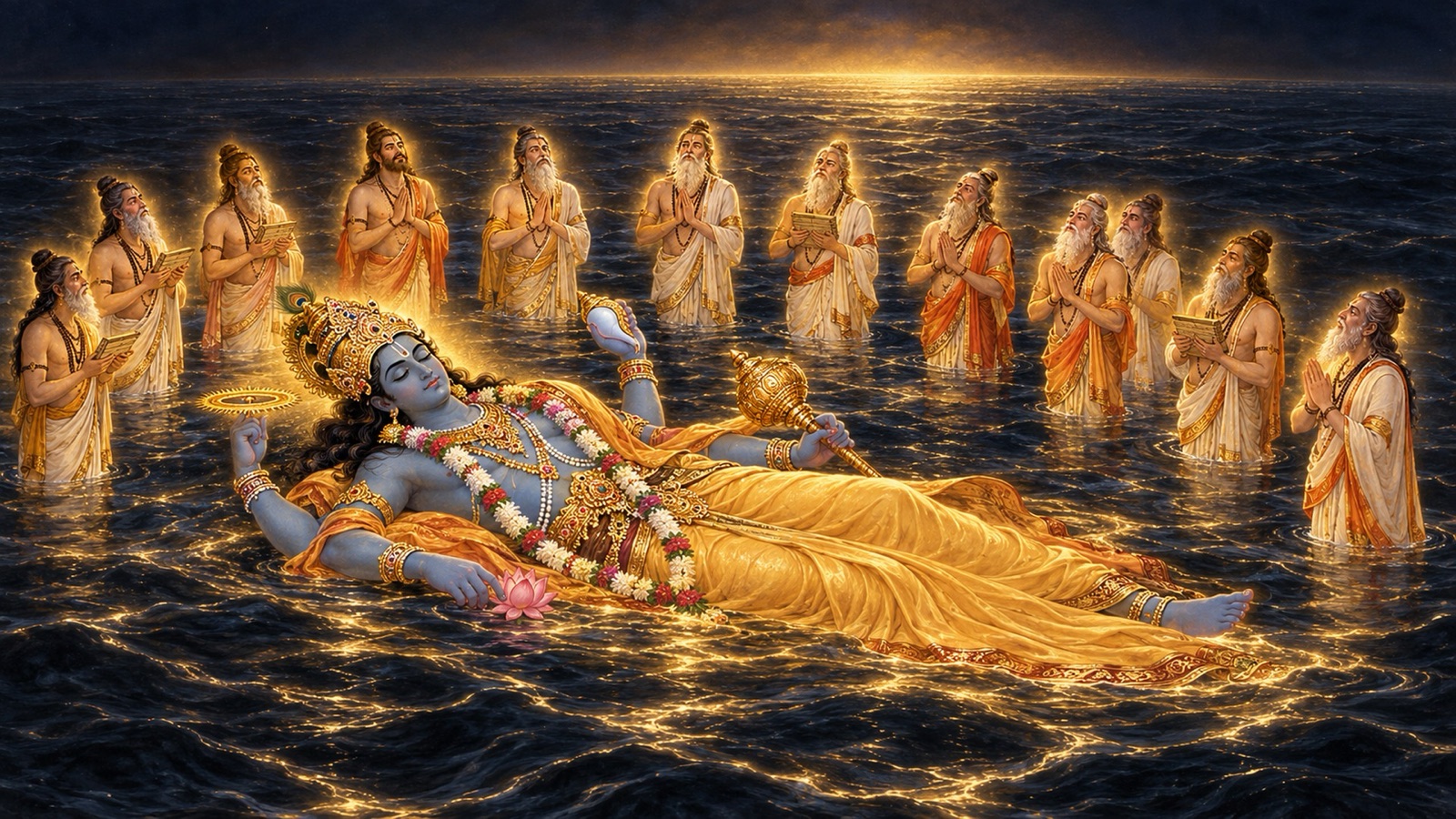
At the end of the great dissolution, the Vedas in their living form awaken the sleeping Lord with a hymn — and confess in it that every word they utter finds its goal in Him alone.
Om Namo Bhagavate Vasudevaya.
Om Namo Bhagavate Vasudevaya.
Om Namo Bhagavate Vasudevaya.
Welcome back to Srimad Bhagavatam Wisdom, our devotional journey through the sacred histories and teachings of the Srimad Bhagavat Mahapurana. In this eighty-seventh chapter of the Tenth Canto, King Parikshit asks how the Vedas, whose words belong to the gunas, can speak of the Absolute beyond them — and Sukadeva answers with the hymn the Śrutis themselves once sang.
Chapter Information
- Scripture: Śrīmad Bhāgavata Mahāpurāṇa
- Canto: 10 (Book Ten, Latter Half)
- Chapter: 87 (Discourse 87)
- Chapter title: The Prayers of the Personified Vedas (Śruti-stuti)
- Principal speaker: Sukadeva Gosvami; within his narration, Narayana Rishi and the sage Sanandana
- Principal listener: King Parikshit
- Main setting: Badarikāśrama, the hermitage of Nārāyaṇa Ṛṣi among the sages of Kalāpa
- Central subject: How the Vedas can describe Brahman; the hymn of the personified Vedas that awakened the Lord after dissolution; the supremacy of devotion
- Principal verse range: Canto 10, Chapter 87, verses 1–50
- Primary edition: Gita Press Śrīmad Bhāgavata Mahāpurāṇa (English)
Context From the Previous Chapter
In Chapter 86, Sri Krishna went to Mithila and stayed at once with King Bahulashva and the poor brahmana Srutadeva, accepting the loving worship of both; having taught these two devotees the way of the righteous, He returned to Dvaraka.
Parikshit’s Question and Sukadeva’s Answer
King Parikshit asked: the Śruti texts deal with the gunas; how can they refer directly to Brahman, which cannot be pointed out, is beyond the gunas, and transcends both cause and effect?
Sukadeva replied that the Lord evolved the intellect, senses, mind and vital airs of embodied souls for their enjoyment, their births and their final liberation — and through these faculties the import of the Vedas, which speak of Brahman alone, is grasped. This ancient secret, cherished by Sanaka and his brothers, frees whoever holds it with faith from identification with the body. To explain it, Sukadeva recounted a dialogue between Narada and the divine sage Narayana.
Narada at the Hermitage of Narayana Rishi
Once, wandering the worlds, Narada came to the hermitage of Narayana Rishi, the immortal seer who since the beginning of the kalpa has practised austerity in Bharatavarsha for the welfare of mankind. Bowing low before the divine sage, seated among the sages of Kalapa village — Badarikashrama — Narada asked the very question Parikshit had put.
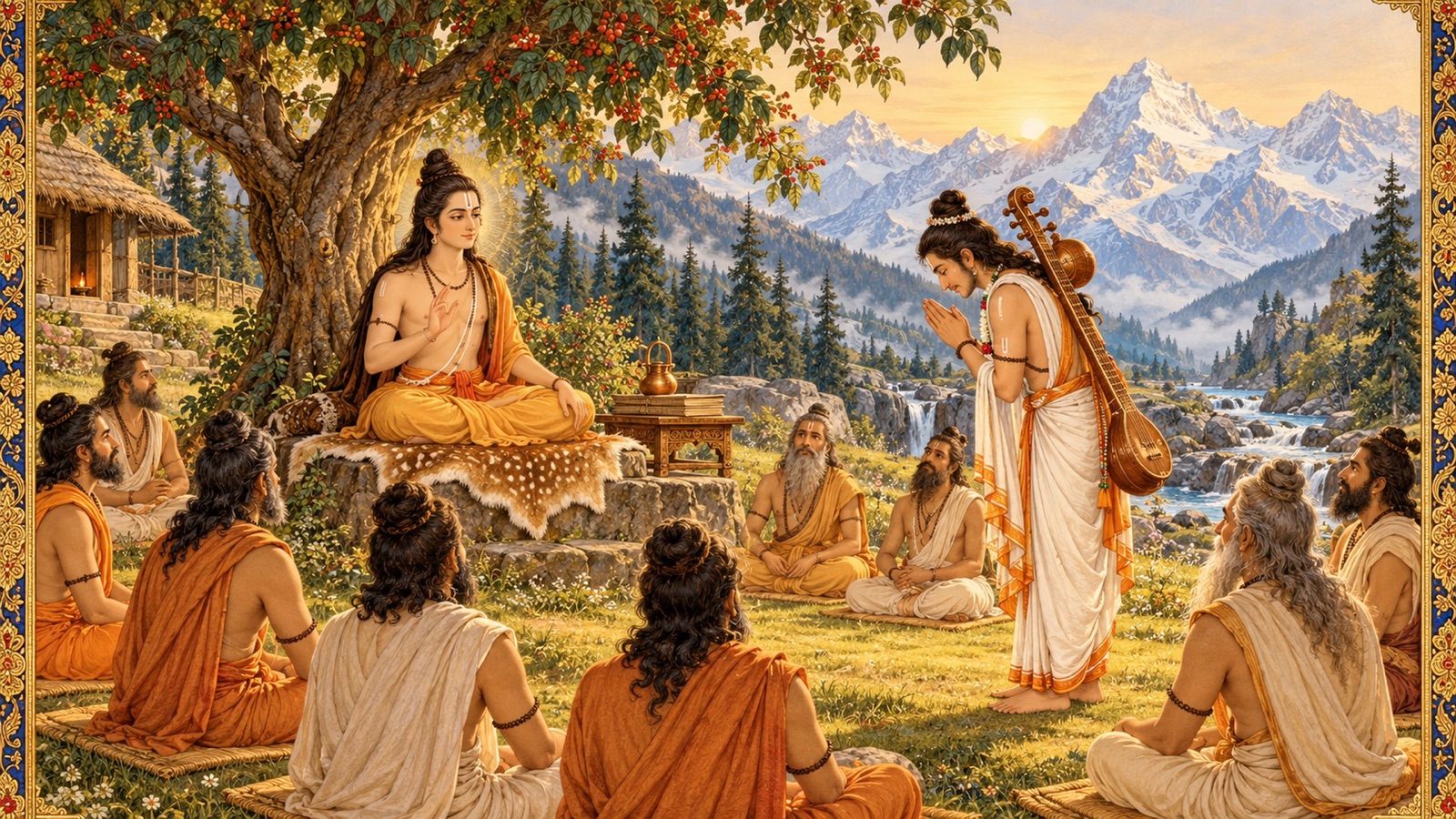
Before those listening rishis, Narayana Rishi answered by recalling a discussion once held among the ancient sages of Janaloka.
The Assembly of the Sages in Janaloka
Long ago, He said, the mind-born sons of Brahma — lifelong celibates — gathered in Janaloka to discuss Brahman, while Narada himself was away in Shvetadvipa seeing Lord Aniruddha. Though equal in learning, austerity and virtue, they chose Sanandana to expound while the rest listened.
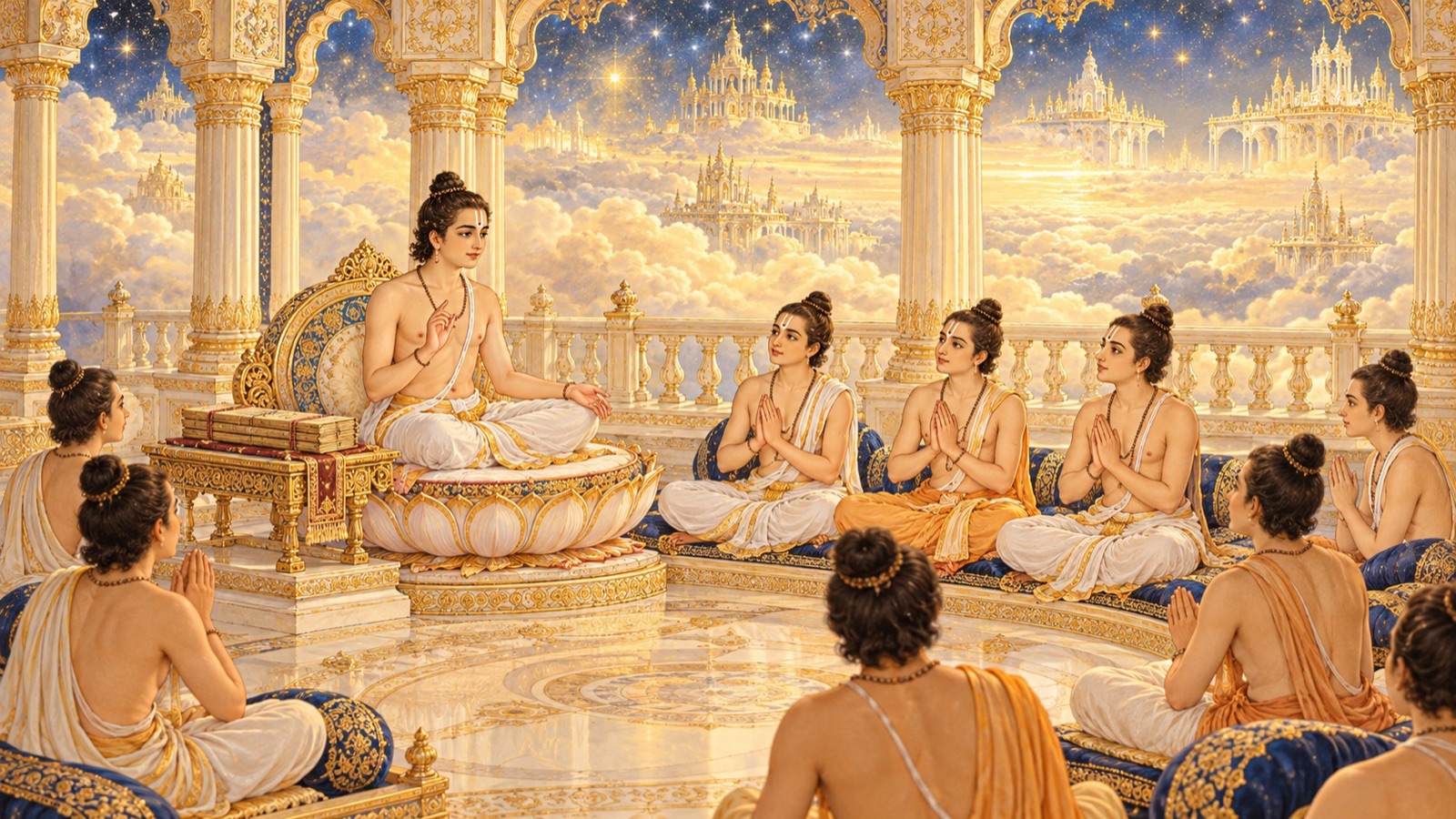
Sanandana told them how, at the end of pralaya, the deities presiding over the Śruti texts awakened the Supreme Lord, who had swallowed the universe He Himself had evolved and lay sleeping with all His potencies — as bards at daybreak wake a sleeping emperor with songs of his deeds.
The Hymn of the Śrutis Begins
The Vedas opened with a cry of victory, begging the unconquered Lord to root out the beginningless nescience that binds every creature.
जय जय जह्यजामजित दोषगृभीतगुणां त्वमसि यदात्मना समवरुद्धसमस्तभगः ।
अगजगदोकसामखिलशक्त्यवबोधक ते क्वचिदजयात्मना च चरतोऽनुचरेन्निगमः ॥ १४ ॥
jaya jaya jahy ajām ajita doṣa-gṛbhīta-guṇāṁ tvam asi yad ātmanā samavaruddha-samasta-bhagaḥ aga-jagad-okasām akhila-śakty-avabodhaka te kvacid ajayātmanā ca carato ’nucaren nigamaḥ
Meaning: Victory, victory to You, O Unconquered One! Destroy the beginningless ignorance that has seized the gunas for an evil end, for by Your own nature You hold all divine excellences. O Awakener of every power in moving and unmoving beings, the Veda can describe You only when You sport with Your Maya or stand in Your own absolute nature. (Canto 10, Chapter 87, verse 14)
The wise, the Śrutis continued, know this whole universe to be Brahman alone, for the world comes from Him and returns to Him as pots to clay.
The Ocean of Nectar of His Stories
Then the Vedas turned to the surest path for the embodied soul. The wise, they sang, have plunged into the nectar-ocean of Your stories, which wash away the impurities of all the worlds, and have shed their threefold afflictions; those who obey You truly live, while others merely breathe like bellows. Some seers contemplate the Lord in the abdomen, the sons of Aruna in the heart, from which the Sushumna rises to the crown, and those who reach that path do not fall again into the jaws of death. Entering the forms You evolve, You shine through them as one fire takes the shape of its fuel.
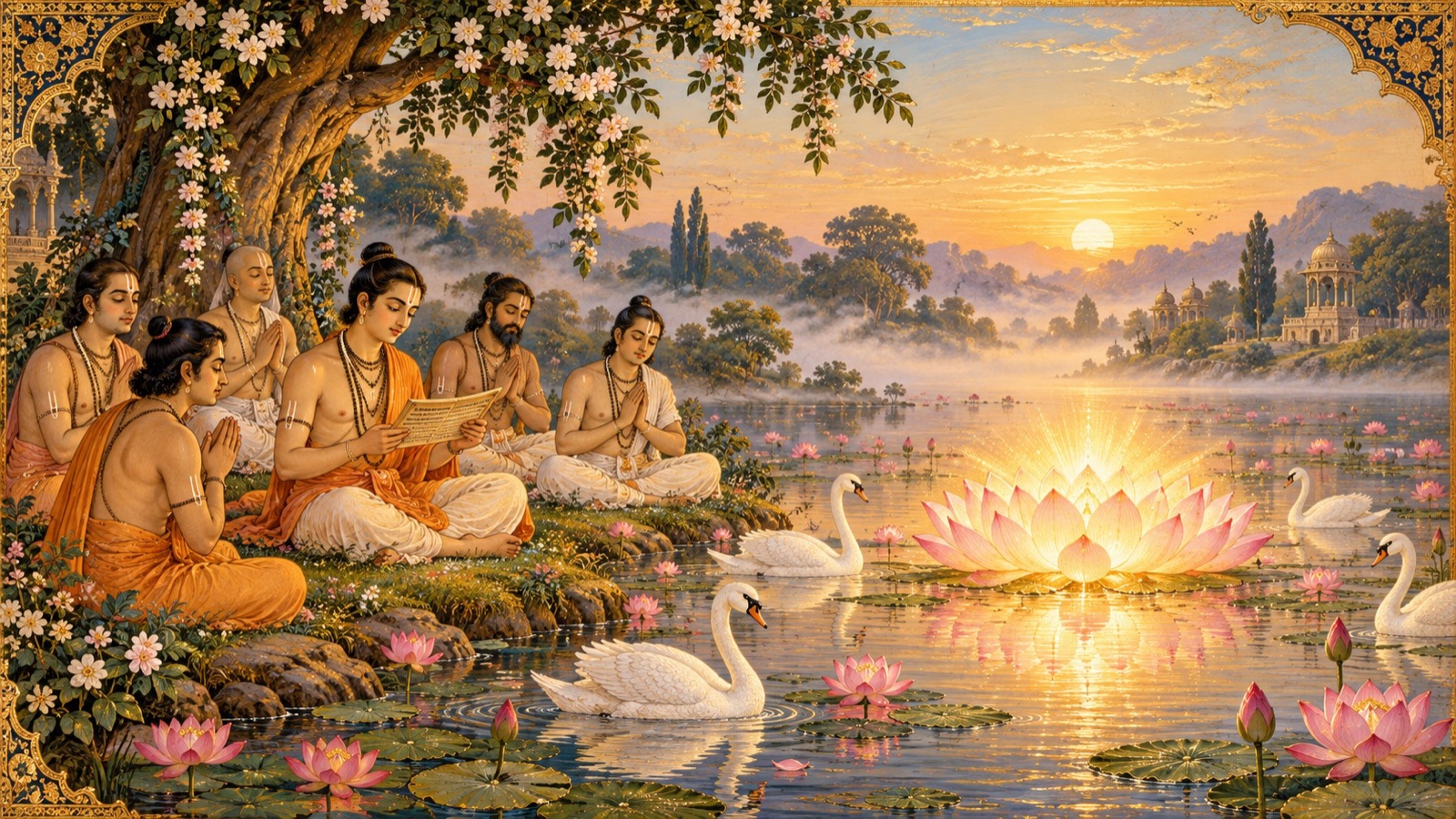
Some, their weariness of birth and death washed away in the ocean of Your deeds, have left home for the company of devotees who sport like swans at the lotus of Your feet, and these no longer desire even liberation; yet most people take no delight in You, their own Self, and ruin themselves by pampering the body. Then came the Vedas’ most tender confession:
निभृतमरुन्मनोऽक्षदृढयोगयुजो हृदि यन्मुनय उपासते तदरयोऽपि ययुः स्मरणात् ।
स्त्रिय उरगेन्द्रभोगभुजदण्डविषक्तधियो वयमपि ते समाः समदृशोऽङ्घ्रिसरोजसुधाः ॥ २३ ॥
nibhṛta-marun-mano-’kṣa-dṛḍha-yoga-yujo hṛdi yan munaya upāsate tad arayo ’pi yayuḥ smaraṇāt striya uragendra-bhoga-bhuja-daṇḍa-viṣakta-dhiyo vayam api te samāḥ sama-dṛśo ’ṅghri-saroja-sudhāḥ
Meaning: The truth that sages worship in the heart with breath, mind and senses stilled by firm yoga, even Your enemies reached by remembering You. The women of Vraja, whose minds clung to Your arms resembling the serpent-king’s body, and we who see You everywhere and drink the nectar of Your lotus feet — all are equal in Your sight. (Canto 10, Chapter 87, verse 23)
Who Can Know Him?
Who born later can know You who are before all, from whom Brahma and the gods arose? When You withdraw everything and repose as now, neither gross nor subtle exists, neither Time nor the scriptures by which You might be known. This universe appears real only by resting upon You, as an ornament is nothing but gold. Those who worship You as the Indweller of all beings set their foot on the head of Death; Brahma and the gods bear tribute to You as vassal kings to an emperor; and to You, pure as the sky, none is kin and none alien. Beings arise where Prakriti and Purusha meet, as bubbles where wind meets water, and merge in You again as rivers enter the sea.
Devotion, the Guru and the Restless Mind
Seeing the delusion Maya plants in men, the wise cultivate a devotion that grows every moment, and Your frown — the wheel of Time — terrifies only those who have not taken refuge in You. Then the Vedas named the one safeguard on the whole path:
विजितहृषीकवायुभिरदान्तमनस्तुरगं य इह यतन्ति यन्तुमतिलोलमुपायखिदः ।
व्यसनशतान्विताः समवहाय गुरोश्चरणं वणिज इवाज सन्त्यकृतकर्णधरा जलधौ ॥ ३३ ॥
vijita-hṛṣīka-vāyubhir adānta-manas turagaṁ ya iha yatanti yantum ati-lolam upāya-khidaḥ vyasana-śatānvitāḥ samavahāya guroś caraṇaṁ vaṇija ivāja santy akṛta-karṇa-dharā jaladhau
Meaning: O Unborn Lord, those who strive by wearying devices to subdue the wild horse of the mind — untamed even by masters of breath and senses — while neglecting the feet of the guru, are beset by a hundred calamities, like merchants who have put to sea without a helmsman. (Canto 10, Chapter 87, verse 33)
What can kinsmen, wealth or life itself give a man when You, his very Self, are at his side? Sages still visit the holy rivers for the company of saints, and whoever fixes his mind even once on You no longer clings to the household.
The World’s Unreality and the Forgotten Gem
The world is not real merely because it comes from the Real, the Vedas said — the snake seen in a rope is false though the rope is real; since the world existed neither before creation nor after dissolution, it only seems to exist in You between the two.
Under Maya the soul takes the body to be itself and transmigrates, while You cast ignorance away as a serpent sheds its skin. For those who restrain the senses outwardly yet never uproot passion, You remain hard to reach even while seated in their heart, like a gem worn forgotten about the neck; but he who truly knows You is shaken by no joy or sorrow, for You, entering the heart through the ear, are attained as the highest bliss.
The Vedas Find Their End in Him
The hymn rose to its summit in a verse that answers Parikshit’s question from within the Vedas’ own mouth.
द्युपतय एव ते न ययुरन्तमनन्ततया त्वमपि यदन्तराण्डनिचया ननु सावरणाः ।
ख इव रजांसि वान्ति वयसा सह यच्छ्रुतयस्त्वयि हि फलन्त्यतन्निरसनेन भवन्निधनाः ॥ ४१ ॥
dyu-pataya eva te na yayur antam anantatayā tvam api yad-antarāṇḍa-nicayā nanu sāvaraṇāḥ kha iva rajāṁsi vānti vayasā saha yac chrutayas tvayi hi phalanty atan-nirasanena bhavan-nidhanāḥ
Meaning: Neither the rulers of heaven nor even You Yourself can reach Your limit, for You are limitless — You within whom multitudes of universes with their coverings drift, driven by Time, like dust in the sky. That is why we, the Śrutis, whose final goal is You, bear fruit in You by setting aside all that is not You. (Canto 10, Chapter 87, verse 41)
Here lies the heart of the chapter. The Vedas are made of words, and words are children of the gunas; yet they are not helpless before the Absolute, because nothing they name exists apart from Him, and every account of His play with Maya is finally an account of the One who plays. Their method is to deny all that is not He until only the Lord remains. The scriptures are not a wall between the devotee and God; they are living servants who wake Him at dawn and fall silent at His feet — and their silence is their fruit.
Narada Receives the Teaching and Carries It to Vyasa
Narayana Rishi concluded: having heard this, Sanaka and his brothers paid homage to Sanandana; thus those first-born sages churned out the essence of the Vedas, the Puranas and the Upanishads. “Cherish this teaching with faith, O son of Brahma,” He told Narada, “for it burns away desire; and wander the earth as you please.”
Narada received it with reverence and prayed: “Hail to Lord Sri Krishna of stainless glory, who assumes charming forms to end the repeated births of all beings.” Bowing to the ancient seer and His disciples, he went to the hermitage of Dvaipayana Vyasa — Sukadeva’s own father — and recited to him the whole hymn.
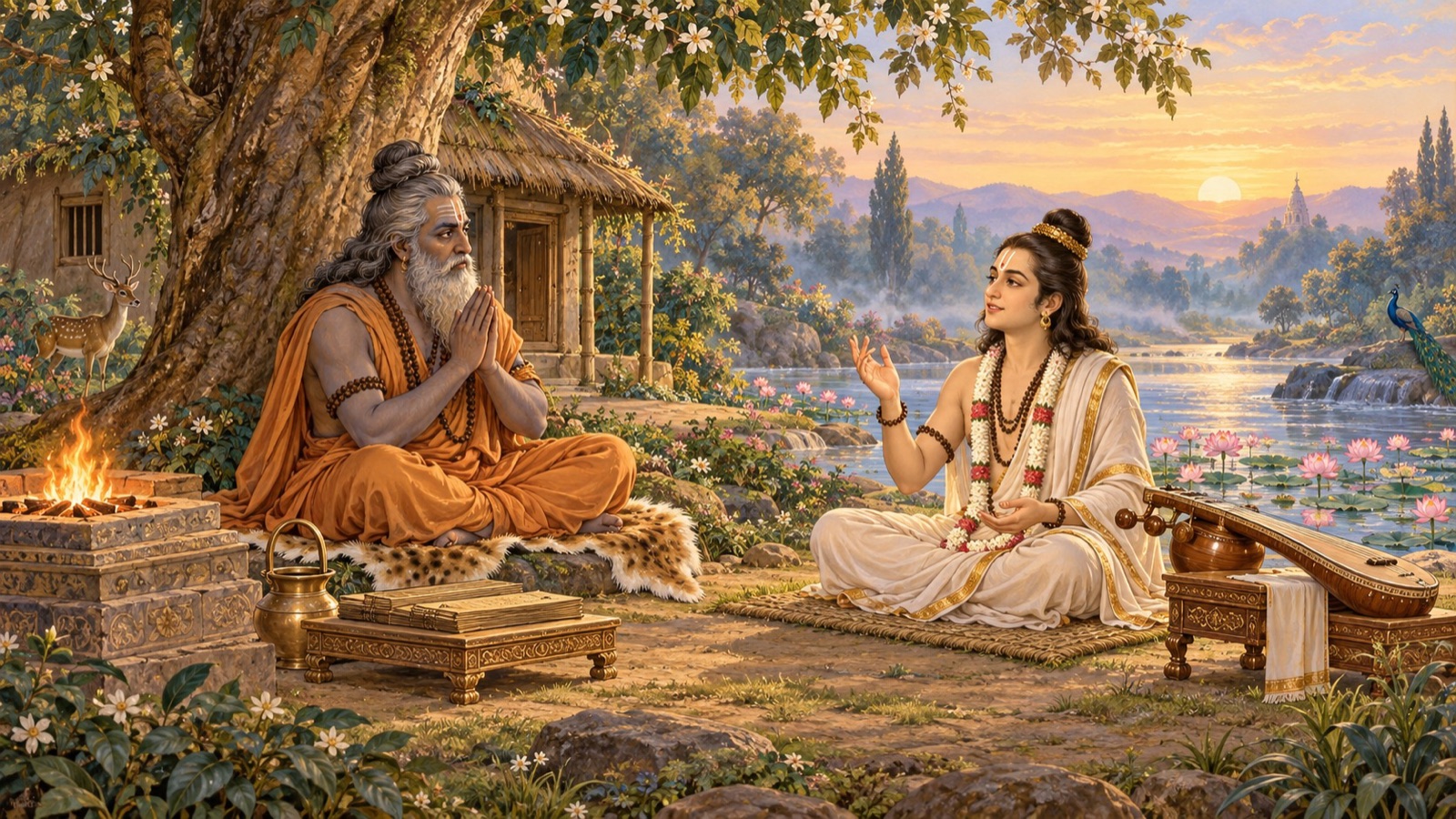
“Thus, O Parikshit,” said Sukadeva, “I have told you how the mind and the Veda may enter Brahman, though It is beyond description and untouched by the gunas.” He closed with a meditation for the heart to hold always.
योऽस्योत्प्रेक्षक आदिमध्यनिधने योऽव्यक्तजीवेश्वरो यः सृष्ट्वेदमनुप्रविश्य ऋषिणा चक्रे पुरः शास्ति ताः ।
यं सम्पद्य जहात्यजामनुशयी सुप्तः कुलायं यथा तं कैवल्यनिरस्तयोनिमभयं ध्यायेदजस्रं हरिम् ॥ ५० ॥
yo ’syotprekṣaka ādi-madhya-nidhane yo ’vyakta-jīveśvaro yaḥ sṛṣṭvedam anupraviśya ṛṣiṇā cakre puraḥ śāsti tāḥ yaṁ sampadya jahāty ajām anuśayī suptaḥ kulāyaṁ yathā taṁ kaivalya-nirasta-yonim abhayaṁ dhyāyed ajasraṁ harim
Meaning: One should meditate without ceasing on Sri Hari, the giver of fearlessness, who in His pure state keeps Maya far away: He who conceives this universe and abides at its beginning, middle and end; who is Lord of both the Unmanifest and the soul; who created the world, entered it with the soul, fashioned bodies and governs them; and on reaching whom the embodied being sheds beginningless ignorance, as a sleeping man forgets his body. (Canto 10, Chapter 87, verse 50)
Principal Teachings of This Chapter
1. The Vedas reach the Absolute by His play and by negation. They can follow the Lord only when He sports with Maya or rests in His own nature, and bear fruit by denying all He is not.
2. Hearing of Him is itself the cure. The wise shed their afflictions by bathing in the ocean of His kathā, and devotees in holy company no longer crave even liberation.
3. Absorption in Him saves, whatever its mood. Sages by yoga, enemies by hostile remembrance, the women of Vraja by love — all reached Him.
4. Without the guru, self-effort founders. Those who neglect the guru’s feet and trust their own devices are like merchants at sea without a helmsman.
5. He is already in the heart, like a forgotten gem. The Lord within remains unreached until passion is uprooted; fearlessness belongs to those who meditate on Him without ceasing.
A Devotional Reflection
There is something humbling in hearing the Vedas pray. We think of scripture as the voice that commands and explains; here the Śrutis stand like bards at the door of a sleeping king, confessing that they can speak of Him only when He chooses to play. If the Vedas bow so low, how much lower should our clever reasoning bow? Yet the same hymn encourages the simplest heart: it points to the Lord’s stories and says the wise were healed merely by bathing there, and it reminds us that the gopis stand equal with the greatest yogis. We are left not intimidated but invited — hear of Him, hold the guru’s feet, and let the One whom even the Vedas cannot exhaust make Himself known in a heart that simply wants Him.
A Daily Devotional Practice
Today, choose one short pastime of the Lord that you love and read or hear it slowly — not to study, but to bathe in it. Bow inwardly to your guru before you begin, and afterwards rest a few breaths in the thought that the Lord who made this world has also entered your heart. Begin by chanting gently: Om Namo Bhagavate Vasudevaya.
Conclusion
The eighty-seventh chapter of the Tenth Canto carries one of the most profound hymns in the Bhagavata, passed from the personified Vedas through Sanandana, Narayana Rishi and Narada to Vyasa, and through Sukadeva to Parikshit. Its single point is that the Absolute beyond the gunas is not a void but Sri Hari Himself, whom the devotee reaches by hearing, by the guru’s grace and by fearless remembrance. May the song that awakened the Lord at the dawn of creation awaken Him in us.
May the divine wisdom of Srimad Bhagavatam awaken pure devotion within our hearts.
Om Namo Bhagavate Vasudevaya.
Jay Shree Madhav.
References and Attribution
- Primary edition: Gita Press, Śrīmad Bhāgavata Mahāpurāṇa (English), Book Ten (Latter Half), Discourse 87, pages 488–498 of Book Ten.
- Series: Srimad Bhagavatam Wisdom · Biswa Sanatan Dharma Seva Trust.
- Presented following the spiritual guidance and recommendation of Pandit Dr. Shri Kashinath Mishra.
This is an original, faithful retelling in the writer’s own words, with brief quoted verses shown in Devanāgarī and transliteration and their meanings given as summaries. It is not a reproduction of any single publisher’s continuous translation or commentary. No affiliation with or endorsement by any publisher is implied.
Jay Shree Madhav