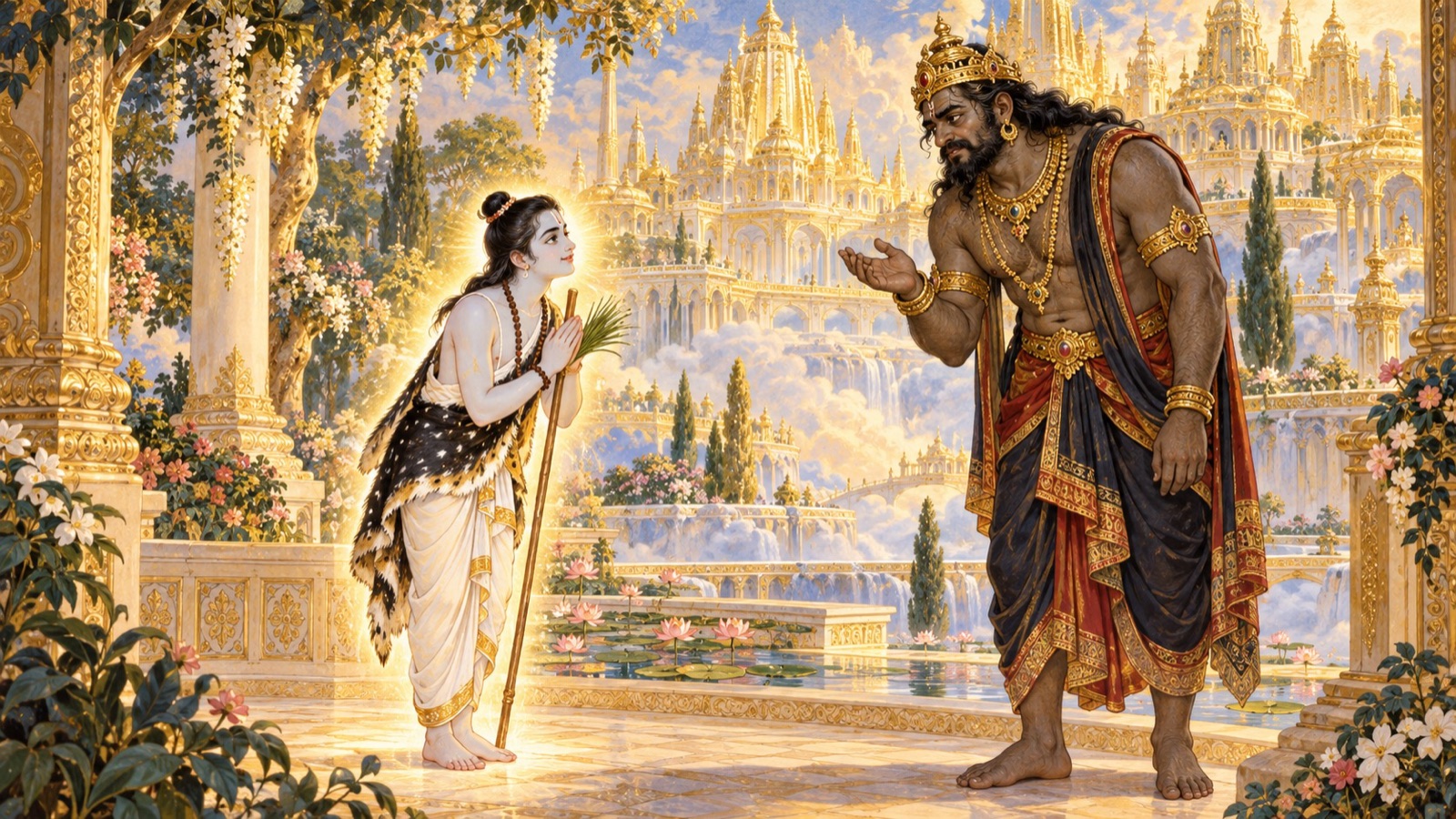
A demon wins from Lord Shiva the power to kill with a touch and turns it on the giver Himself — until Lord Narayana, disguised as a young student with kusha grass in His hand, undoes the terror with nothing but sweet words.
Om Namo Bhagavate Vasudevaya.
Om Namo Bhagavate Vasudevaya.
Om Namo Bhagavate Vasudevaya.
Welcome back to Srimad Bhagavatam Wisdom, our devotional journey through the sacred histories and teachings of the Srimad Bhagavat Mahapurana. In this eighty-eighth chapter of the Tenth Canto, King Parikshit asks why the worshippers of Lord Shiva so often prosper while the worshippers of Lord Vishnu, the Lord of Lakshmi Herself, so often live in want. Sukadeva’s reply opens into Sri Krishna’s own teaching on His grace, and then into the ancient history of the demon Vrika, who aimed Shiva’s boon at Shiva Himself.
Chapter Information
- Scripture: Śrīmad Bhāgavata Mahāpurāṇa
- Canto: 10 (Book Ten, Latter Half)
- Chapter: 88 (Discourse 88)
- Chapter title: Lord Shiva Saved from Vrikasura
- Principal speaker: Sukadeva Gosvami (narrating to King Parikshit)
- Principal listener: King Parikshit
- Main setting: Kedāra in the Himalayas, and the realm of Vaikuṇṭha
- Central subject: Why Shiva’s worshippers prosper while Vishnu’s devotees lose wealth; Vrika’s boon; the Lord’s rescue of Shiva
- Principal verse range: Canto 10, Chapter 88, verses 1–40
- Primary edition: Gita Press Śrīmad Bhāgavata Mahāpurāṇa (English, Part II)
Context From the Previous Chapter
In Chapter 87, Sukadeva recounted the hymn of the personified Vedas as Narada heard it from the sage Narayana, and closed by urging constant meditation on Sri Hari, who stands beyond the three gunas.
Parikshit’s Question
Among gods, demons and men alike, King Parikshit observed, those who serve Lord Shiva — who has Himself spurned every enjoyment — are mostly rich and surrounded by pleasures, while those devoted to Lord Hari, the master of Lakshmi and of all opulence, are generally not. The two Lords are opposite in nature, yet their worshippers’ fortunes run contrary to all expectation. “Great indeed is our doubt here,” said the king; “we wish to understand it.”
Shiva Within the Gunas, Hari Beyond Them
Sukadeva answered first with the principle beneath the puzzle. Lord Shiva is ever united with His Shakti and clothed in the three gunas; He presides over the threefold cosmic ego — sattvika, rajasika and tamasika — from which arise the sixteen evolutes: the mind, the ten senses and the five gross elements. Whoever worships the deity presiding over these gains every form of material prosperity, for he approaches the lord of the world’s very substance. Lord Hari is different in kind: the Supreme Person beyond Prakriti, untouched by the gunas, the all-seeing witness in every heart; and His worshipper becomes, like Him, free of the gunas.
हरिर्हि निर्गुण: साक्षात् पुरुष: प्रकृते: पर: ।
स सर्वदृगुपद्रष्टा तं भजन् निर्गुणो भवेत् ॥ ५ ॥
harir hi nirguṇaḥ sākṣāt puruṣaḥ prakṛteḥ paraḥ sa sarva-dṛg upadraṣṭā taṁ bhajan nirguṇo bhavet
Meaning: Hari is directly the Supreme Person, beyond material nature and devoid of the gunas; He sees everything and is the witness of all. One who worships Him likewise becomes free from the gunas. (Canto 10, Chapter 88, verse 5)
Sukadeva then reminded the king that his own grandfather had once asked this very question. When the Ashvamedha sacrifices were complete and Yudhishthira was hearing sacred duties from Sri Krishna, he put this doubt to Him; and the Lord, descended in the Yadu line for mankind’s highest good, was pleased and spoke.
Krishna’s Own Answer to Yudhishthira
“When I wish to favour someone,” the Lord said, “I gradually take away his wealth. Then, poor and sunk in sorrow upon sorrow, he finds that even his own people abandon him.”
यस्याहमनुगृह्णामि हरिष्ये तद्धनं शनै: ।
ततोऽधनं त्यजन्त्यस्य स्वजना दु:खदु:खितम् ॥ ८ ॥
yasyāham anugṛhṇāmi hariṣye tad-dhanaṁ śanaiḥ tato ’dhanaṁ tyajanty asya svajanā duḥkha-duḥkhitam
Meaning: The Lord said: From the one on whom I bestow My grace I slowly remove his riches; thereupon his own kinsmen forsake him, destitute and afflicted with misery after misery. (Canto 10, Chapter 88, verse 8)
When such a man strives once more for wealth and fails at every turn, the Lord continued, and in his disappointment befriends My devotees, then I pour My grace upon him; he realizes the supreme Brahman — subtle, infinite, pure consciousness and truth — as his very self, and is released from the round of birth and death. “That is why,” said Krishna, “people give Me up as too hard to please and worship other gods. From those easily satisfied deities they win royal fortune, grow proud and intoxicated, and in their madness come to despise the very gods who granted them boons.”
The poverty of the Vaishnava is not the Lord’s neglect but His surgery. Wealth, and the kinsmen who gather around it, are the hooks by which the world holds the soul; by drawing them out the Lord frees His devotee and leads him, through the company of devotees, to the one treasure that cannot be lost. The quick-giving gods pour out riches that inflate the ego until prosperity itself becomes the worshipper’s undoing. What looks like misfortune in the Lord’s devotee is the most careful form of His love.
Quick to Bless, Quick to Curse
Returning to his own voice, Sukadeva added a second truth: Brahma, Vishnu, Shiva and the other gods can all curse and bless, but Shiva and Brahma are swiftly moved to both, while Achyuta is not. The wise illustrate this with an ancient history of how Girisha, the Lord of Kailasa, fell into grave trouble by granting a boon to the demon Vrika.
Vrika, the evil-minded son of Shakuni, once met the sage Narada on the road and asked which of the three great gods was quickest to please. Narada sent him to Lord Shiva, who is satisfied by a small merit and angered by a small fault. He had been pleased with Ravana and Bana merely because they praised Him like court bards, and gave them unequalled power — only to reap trouble, for Ravana went on to shake His own Mount Kailasa and Bana bound Him to guard a demon’s city.
Vrika’s Terrible Austerity at Kedara
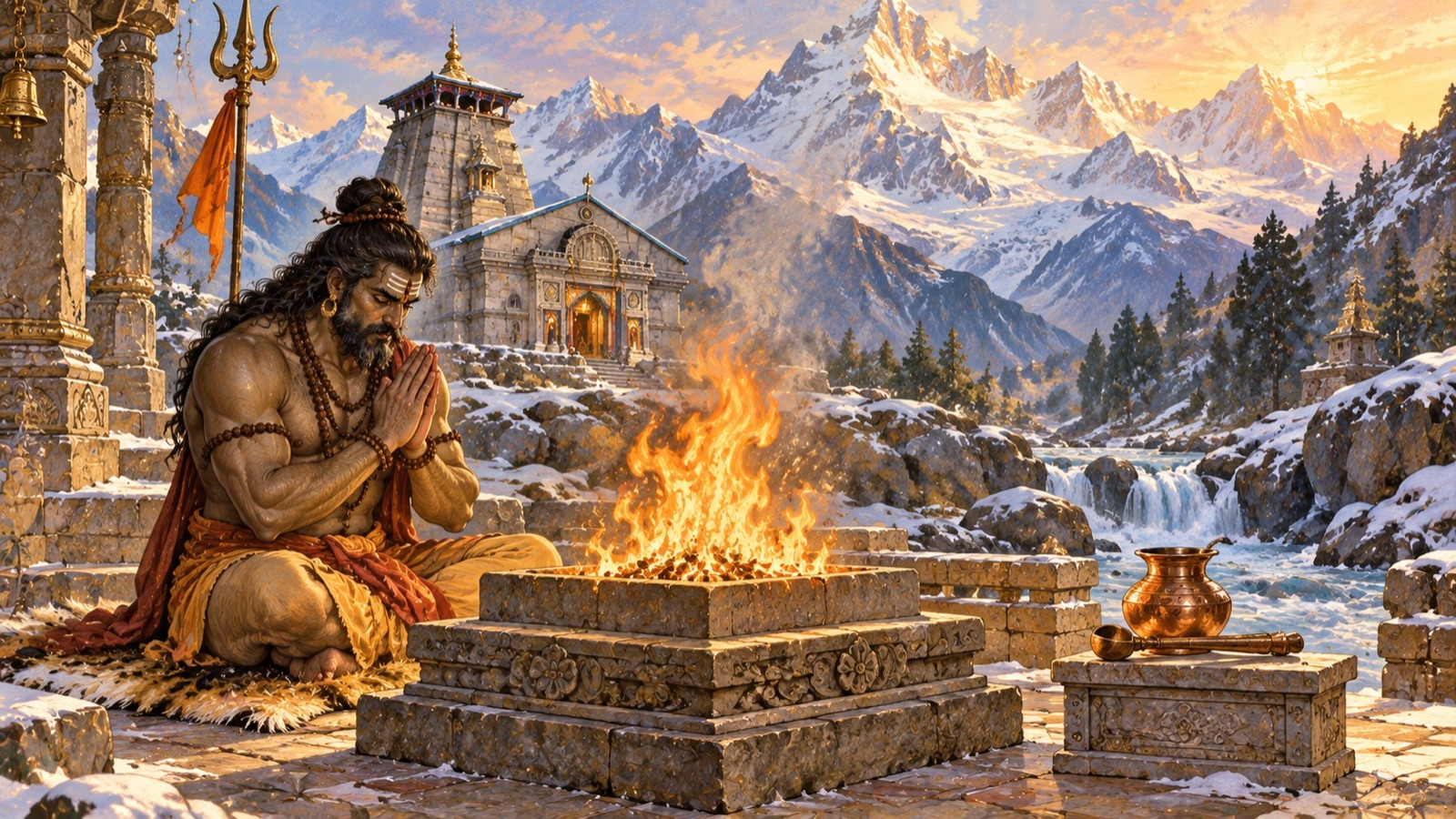
So instructed, the demon went to Kedara in the Himalayas and worshipped Lord Hara in the most dreadful way, cutting flesh from his own limbs and offering it into the fire, the Lord’s mouth. Six days passed without a vision of the god. On the seventh, in despair, he bathed in the holy waters there and, his hair still wet, raised his sword to sever his own head as the final oblation.
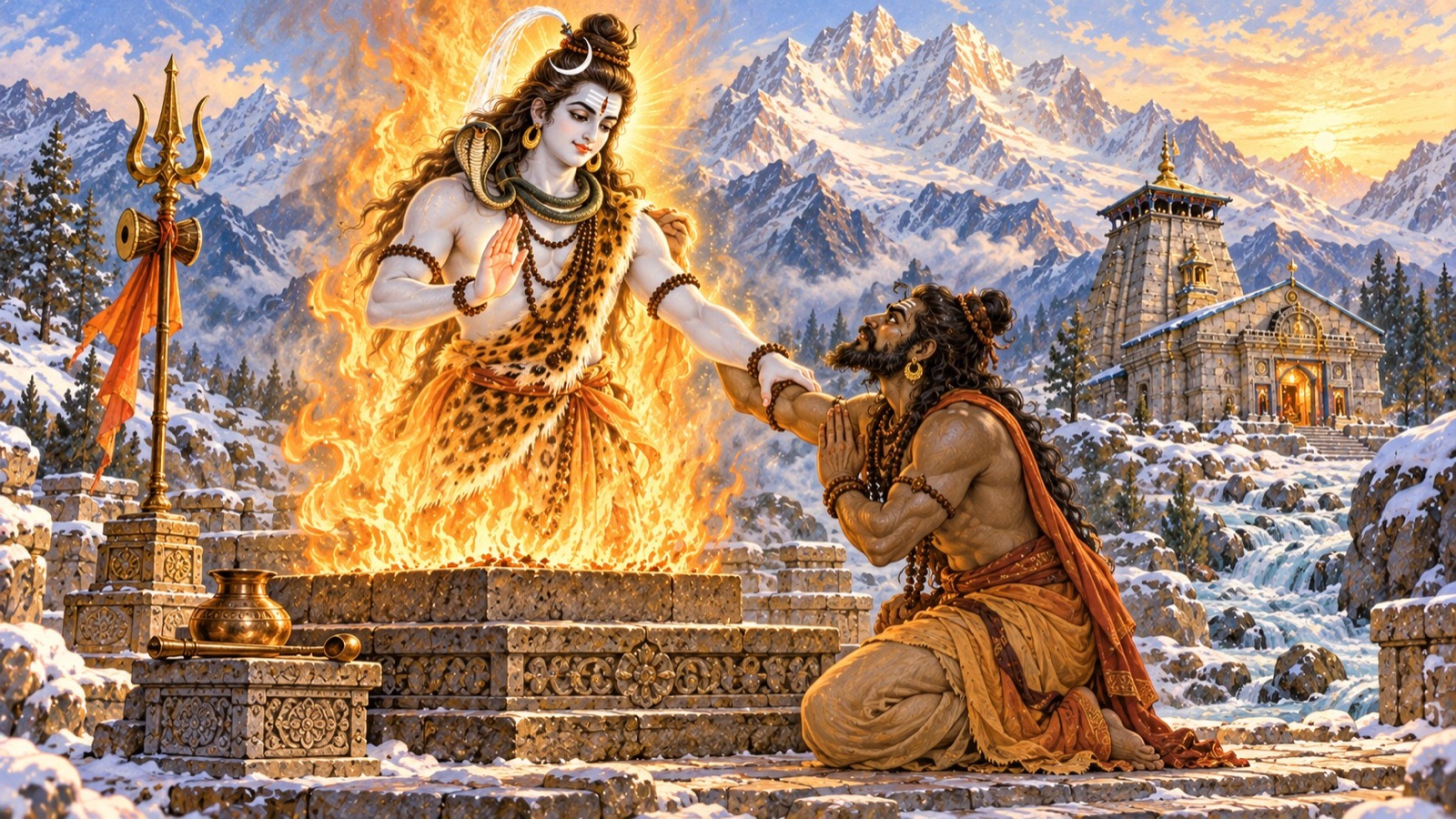
At that instant Lord Shiva — Dhurjati of the matted locks, supremely compassionate — rose out of the flames like fire itself, seized the demon’s arms and held him back, as a friend restrains a friend from destroying himself. At that blessed touch Vrika’s torn body was made whole.
A Boon Like Nectar Fed to a Serpent
Then the Lord spoke: “Enough, dear one, enough! Ask of Me whatever boon you wish and I will give it. A mere offering of water pleases Me from those who come to Me. Alas, you have tormented this body cruelly and for nothing.”
तमाह चाङ्गालमलं वृणीष्व मे यथाभिकामं वितरामि ते वरम् ।
प्रीयेय तोयेन नृणां प्रपद्यतामहो त्वयात्मा भृशमर्द्यते वृथा ॥ २० ॥
tam āha cāṅgālam alaṁ vṛṇīṣva me yathābhikāmaṁ vitarāmi te varam prīyeya toyena nṛṇāṁ prapadyatām aho tvayātmā bhṛśam ardyate vṛthā
Meaning: He said to him: Dear one, enough, enough! Choose from Me the boon you desire and I shall grant it. I am satisfied with a little water from men who take refuge in Me; alas, you have grievously afflicted your body in vain. (Canto 10, Chapter 88, verse 20)
The wicked demon asked for a boon terrifying to every creature: “Whosoever’s head I touch with my hand, let him die.” Lord Rudra was troubled for a moment, O descendant of Bharata; then, laughing, He said “Om” — so be it — and granted it, like feeding nectar to a snake.
The Pursued Lord of Kailasa
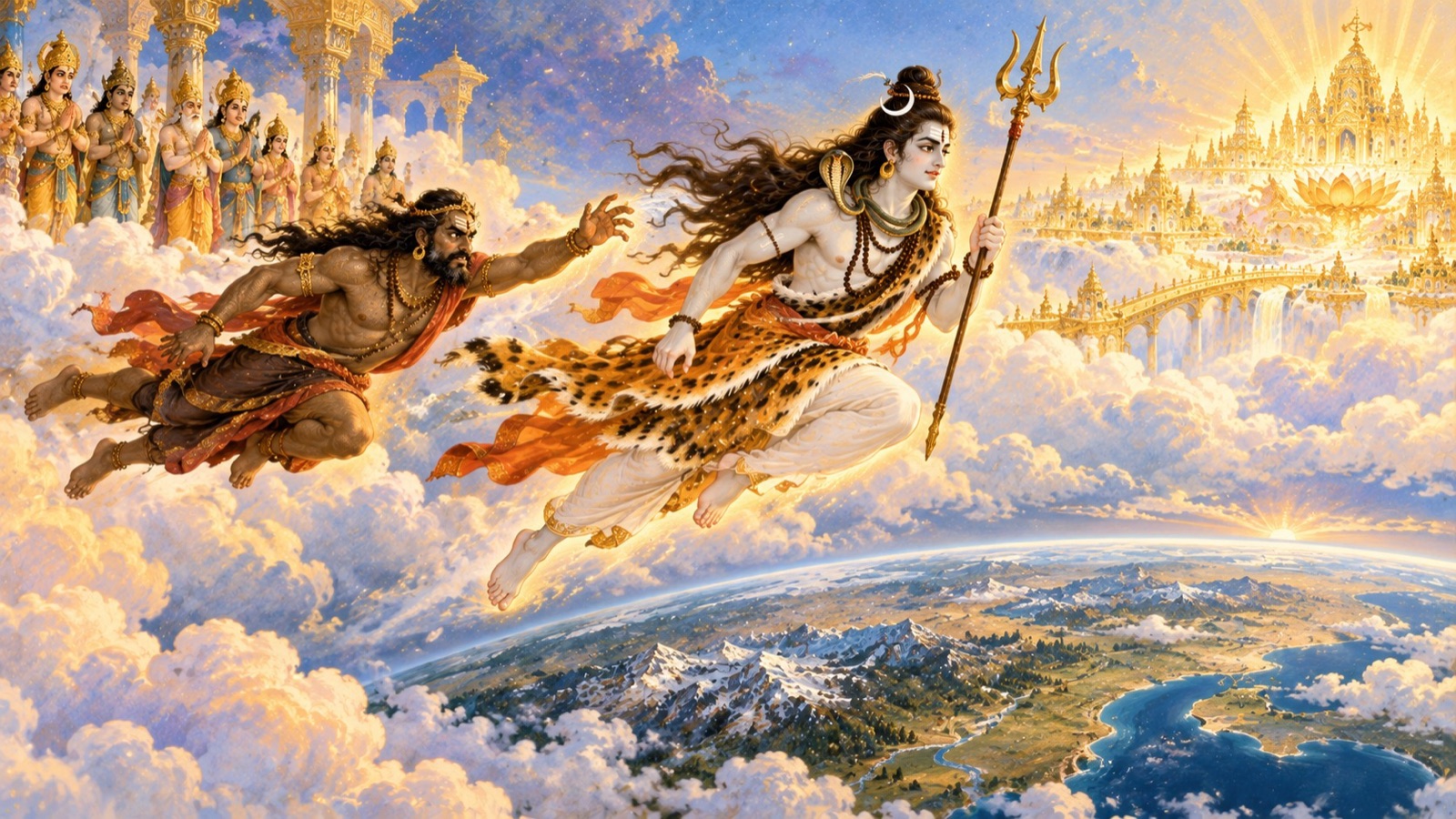
Vrika did not wait. His sinful desire had settled on Goddess Parvati, and to test the boon he moved to set his hand upon Sankara’s own head. Now the all-auspicious Lord was afraid of what His own hands had done. Trembling, with the demon close behind, He fled across the whole earth, to the limits of heaven and the ends of the directions, and then northward. The great gods saw no remedy and stood silent. At last Sankara reached shining Vaikuntha, beyond the darkness of material nature — the abode of Narayana Himself, the supreme goal of peaceful renunciants, from which no one returns.
The Lord Becomes a Young Student
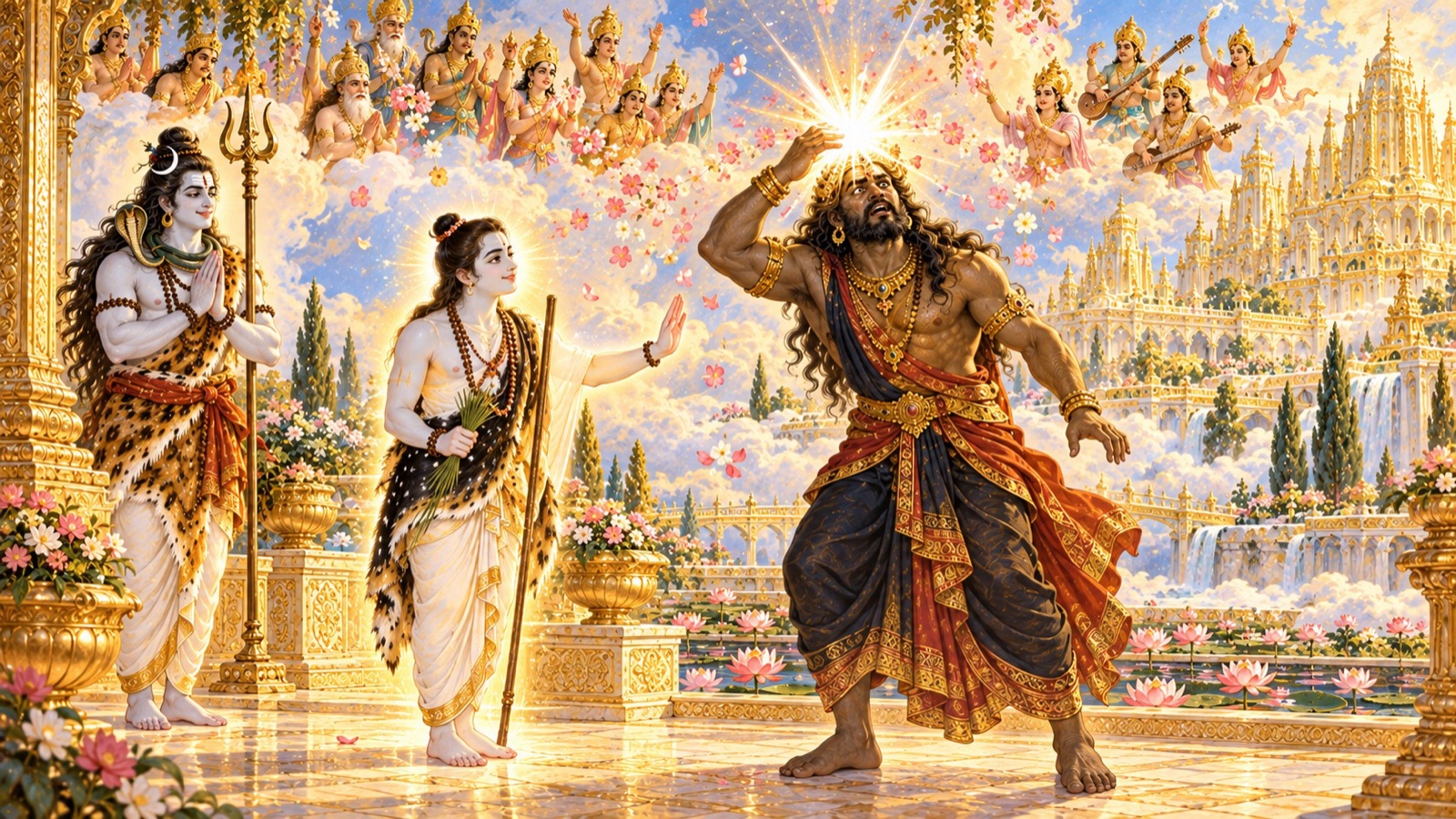
Seeing Shiva’s plight from afar, the Lord who destroys His devotees’ distress became, by His Yogamaya, a young brahmachari and came forward to meet the demon. Girdled with munja grass, wearing a black deerskin, carrying staff and rudraksha beads, blazing like fire with His own splendour and holding kusha grass, He greeted the asura with a student’s humility. “Son of Shakuni,” He said, “you are plainly weary. Have you come from far? Rest a moment — this body yields a man all his desires. Mighty one, if it is fit for our ears, tell us what you intend; people generally gain their ends through others’ help.” Questioned in words that rained nectar, the demon forgot his fatigue and told the youth all he had done.
“Place Your Hand on Your Own Head”
The Lord listened, then answered with feigned disbelief. “If that is so, we cannot believe a word Shiva says. Do you not know that under Daksha’s curse He has taken up the ways of the pishachas and now rules over ghosts and goblins? But if you still trust Him as the guru of the universe, O lord of the Danavas, test it this very moment: place your hand on your own head. And if Sankara’s word proves false in any way, kill this liar, so that he never utters a falsehood again.”
यदि वस्तत्र विश्रम्भो दानवेन्द्र जगद्गुरौ ।
तर्ह्यङ्गाशु स्वशिरसि हस्तं न्यस्य प्रतीयताम् ॥ ३३ ॥
yadi vas tatra viśrambho dānavendra jagad-gurau tarhy aṅgāśu sva-śirasi hastaṁ nyasya pratīyatām
Meaning: O lord of the Danavas, if you have faith in that guru of the universe, then, dear friend, put your hand upon your own head at once and see for yourself. (Canto 10, Chapter 88, verse 33)
Bewildered by the Lord’s clever, charming words, his judgment broken, the foolish demon forgot himself and set his hand on his own head. In an instant he fell, his head split as if by a thunderbolt, and the heavens rang with cries of “Jaya!”, “Namah!” and “Sadhu!” Gods, sages, forefathers and Gandharvas showered flowers on the fallen sinner Vrikasura, and Lord Shiva was delivered from his peril.
The Lord’s Words to the Freed Shiva
Then the Supreme Person spoke to the liberated Girisha: “O Deva, O Mahadeva, this sinner has been slain by his own sin. What creature who offends against great souls can prosper — how much less one who wrongs You, the Lord and teacher of the universe?”
Sukadeva closed with the fruit of hearing this history.
य एवमव्याकृतशक्त्युदन्वत: परस्य साक्षात् परमात्मनो हरे: ।
गिरित्रमोक्षं कथयेच्छृणोति वा विमुच्यते संसृतिभिस्तथारिभि: ॥ ४० ॥
ya evam avyākṛta-śakty-udanvataḥ parasya sākṣāt paramātmano hareḥ giritra-mokṣaṁ kathayec chṛṇoti vā vimucyate saṁsṛtibhis tathāribhiḥ
Meaning: One who thus narrates or listens to this deliverance of Lord Shiva by Hari — the ocean of inconceivable energies, the Supreme, the Paramatma Himself — is released from repeated birth and death and from his enemies as well. (Canto 10, Chapter 88, verse 40)
Principal Teachings of This Chapter
1. The Lord’s grace may arrive as loss. Krishna strips the one He favours of wealth so that, forsaken by the world, he befriends devotees and finds Brahman. Reversals are the Lord’s hand, not His absence.
2. Worship shapes the worshipper. Shiva presides over the gunas, so his worshippers gain the things of the gunas; Hari is nirguna, so His worshipper becomes nirguna. We grow like what we adore.
3. Boons quickly given carry their own danger. Ravana, Bana and Vrika all turned swift boons against their giver. Fortune won without purification intoxicates.
4. The Lord protects even the protector. When the gods stood silent, Narayana rescued Mahadeva with no weapon but a few sweet words.
5. Offence against the great destroys the offender. Vrika died by his own hand and his own sin; no one who wrongs great souls can find welfare.
A Devotional Reflection
How tenderly the Lord treats both of His troubled servants in this history. To Shiva, who in boundless mercy gave a dangerous boon, He gives rescue without a word of reproach; to Yudhishthira, and through him to every anxious devotee, He gives the hardest comfort in the Bhagavatam — that when He takes something from us, it is because He wants to give us Himself. The Lord’s own grace is slower and deeper than the quick boons Narada described. It empties the hands so that they can finally fold in surrender; it lets kinsmen drift away so that the company of devotees becomes our family. Vrika offered his own flesh and received a boon that killed him; a devotee offers a little water with a true heart and receives the Lord. May we want only Him.
A Daily Devotional Practice
Today, when some small loss touches you — a failed plan, money slipping away, a friend turning cold — pause before complaining and recall the Lord’s words to Yudhishthira. Offer that loss to Him as His own doing, and spend a few minutes with a devotee, a page of the Bhagavatam or the holy name. Begin by chanting gently: Om Namo Bhagavate Vasudevaya.
Conclusion
The eighty-eighth chapter of the Tenth Canto turns a devotee’s oldest complaint — why the worldly prosper and the faithful go without — into a window onto the Lord’s heart. Sri Krishna impoverishes those He loves to lead them to Brahman, while easily pleased gods shower a wealth that ends in pride; and Vrikasura’s history shows what a hasty boon can cost even its divine giver, until the Lord saves Shiva with a smile and a question. May we trust His slow and perfect grace more than every quick reward.
May the divine wisdom of Srimad Bhagavatam awaken pure devotion within our hearts.
Om Namo Bhagavate Vasudevaya.
Jay Shree Madhav.
References and Attribution
- Primary edition: Gita Press, Śrīmad Bhāgavata Mahāpurāṇa (English, Part II), Book Ten (Latter Half), Discourse 88.
- Series: Srimad Bhagavatam Wisdom · Biswa Sanatan Dharma Seva Trust.
- Presented following the spiritual guidance and recommendation of Pandit Dr. Shri Kashinath Mishra.
This is an original, faithful retelling in the writer’s own words, with brief quoted verses shown in Devanāgarī and transliteration and their meanings given as summaries. It is not a reproduction of any single publisher’s continuous translation or commentary. No affiliation with or endorsement by any publisher is implied.
Jay Shree Madhav