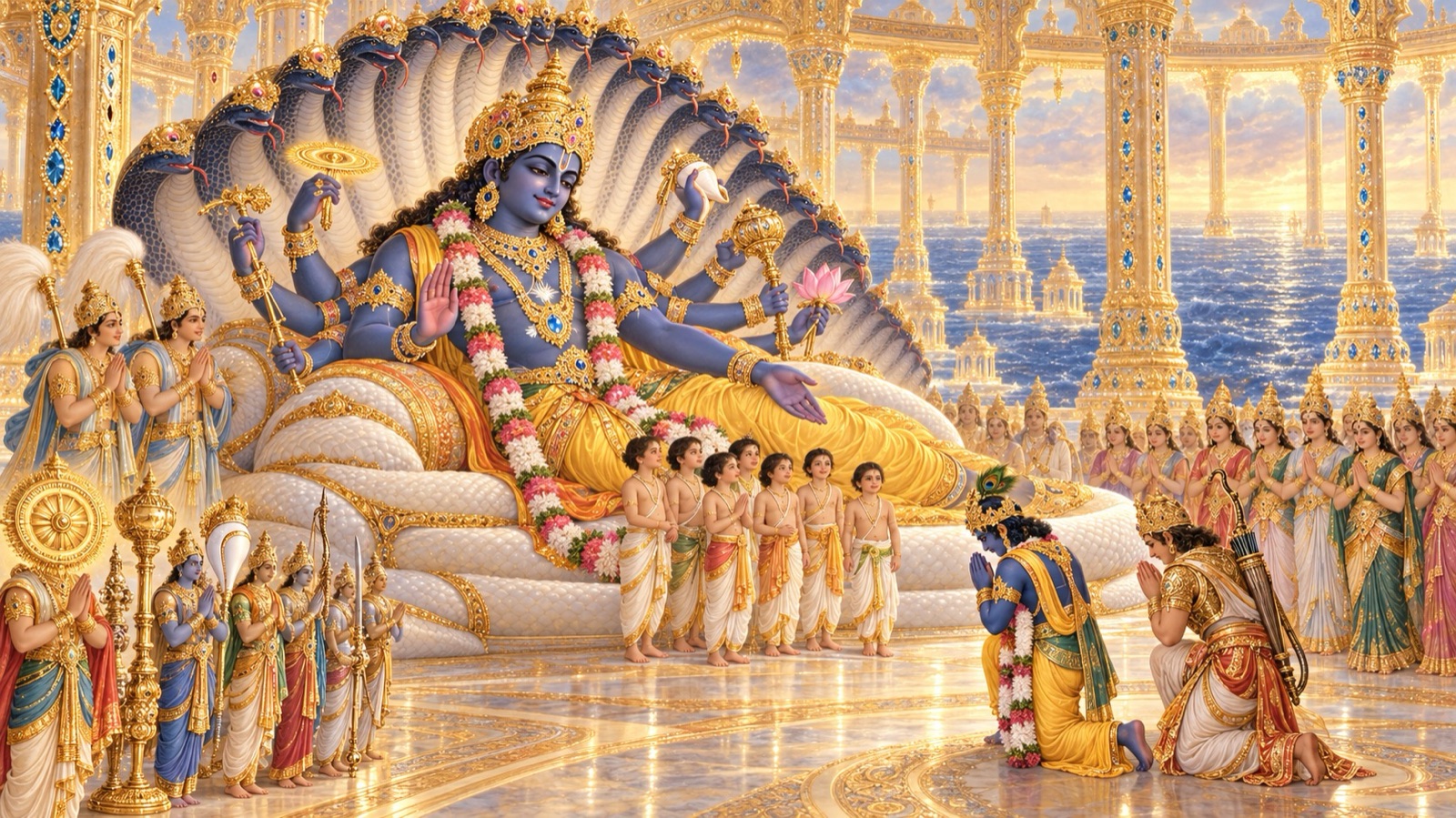
A sage kicks the chest of the Lord of Vaikuntha and is answered with a bowed head; a brahmana of Dvaraka loses nine newborn sons; and Arjuna, humbled by a failed vow, is carried by Krishna beyond the universe to the Supreme Person who had taken the boys only to behold the two of them.
Om Namo Bhagavate Vasudevaya.
Om Namo Bhagavate Vasudevaya.
Om Namo Bhagavate Vasudevaya.
Welcome back to Srimad Bhagavatam Wisdom, our devotional journey through the sacred histories and teachings of the Srimad Bhagavat Mahapurana. This eighty-ninth chapter of the Tenth Canto joins two histories that teach one truth: Bhrigu learns which of the three great lords is supreme, and Arjuna, unable to save a brahmana’s children, learns before Maha-Vishnu whose power his prowess had always been.
Chapter Information
- Scripture: Śrīmad Bhāgavata Mahāpurāṇa
- Canto: 10 (Book Ten, Latter Half)
- Chapter: 89 (Discourse 89)
- Chapter title: Krishna and Arjuna Retrieve a Brahmana’s Sons
- Principal speaker: Sukadeva Gosvami (narrating to King Parikshit)
- Principal listener: King Parikshit
- Main setting: The Sarasvatī’s bank; the abodes of Brahmā, Śiva and Viṣṇu; Dvārakā; Mahā-Viṣṇu’s realm beyond the universe
- Central subject: Bhrigu’s test of the three lords; the brahmana whose sons die at birth; Arjuna’s vow and failure; the sons returned by Mahā-Viṣṇu
- Principal verse range: Canto 10, Chapter 89, verses 1–65
- Primary edition: Gita Press Śrīmad Bhāgavata Mahāpurāṇa (English, Part II)
The Sages’ Question and the Testing of Brahmā and Śiva
Sukadeva told King Parikshit that once, on the bank of the Sarasvatī, sages gathered for a sacrificial session fell to debating which of the three lords of creation — Brahmā, Viṣṇu or Śiva — was the greatest, and sent Bhṛgu, the son of Brahmā, to find out.
Bhṛgu went first to his father’s court and, to test Brahmā’s goodness, neither bowed nor offered praise. Brahmā flared up, blazing with his own splendour; but remembering that the offender was his son, he quelled the anger by his own reason, as fire is put out by water, which is born of fire itself. At Kailāsa, Lord Śiva rose in delight to embrace his brother, but Bhṛgu drew back, declaring that Śiva had strayed from the path and flouted the Vedic injunctions. Śiva’s eyes blazed and he lifted his trident to strike; the Goddess Pārvatī fell at his feet and calmed him, and Bhṛgu went on to Vaikuṇṭha, where Lord Janārdana dwells.
The Kick in Vaikuṇṭha and the Lord’s Humility
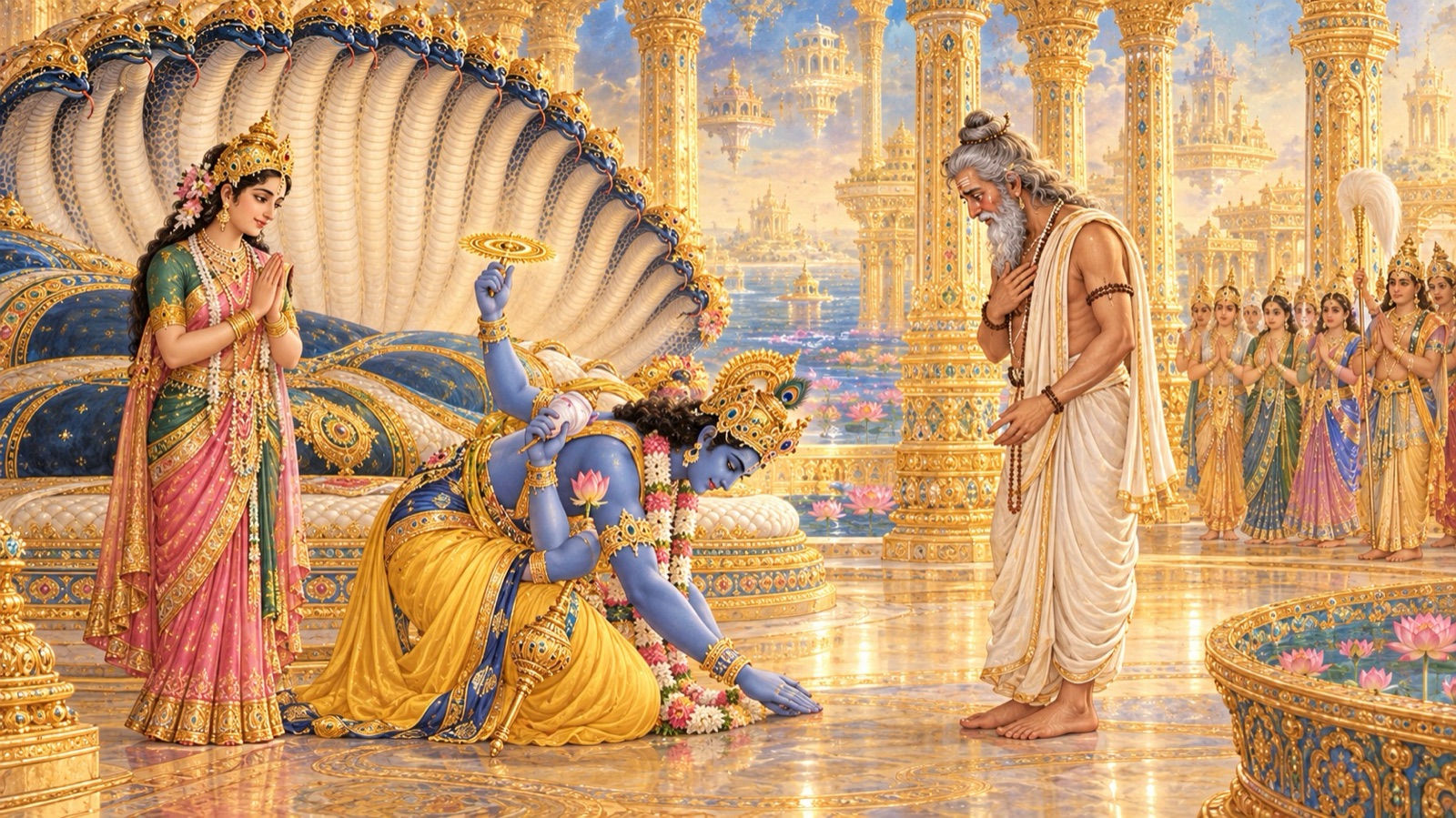
There the Lord lay with His head in the lap of Lakṣmī, and the sage struck Him on the chest with his foot. At once the Lord, the refuge of the saintly, rose with Lakṣmī, came down from His couch and bowed His head to the sage. “Welcome, O brahmana; be seated and rest a moment,” He said. “We did not know you had come, O lord; pray forgive us.” Finding the sage’s feet tender, He pressed them with His own hands and asked that He, His realm and the world-guardians within Him be purified by the water of those feet, which sanctifies the holy places themselves. Then He spoke:
अद्याहं भगवँल्लक्ष्म्या आसमेकान्तभाजनम् ।
वत्स्यत्युरसि मे भूतिर्भवत्पादहतांहस: ॥ ११ ॥
adyāhaṁ bhagavaḻ lakṣmyā āsam ekānta-bhājanam vatsyaty urasi me bhūtir bhavat-pāda-hatāṁhasaḥ
Meaning: O worshipful one, today I have become the sole shelter of the goddess of fortune; she will dwell upon My chest, now that the touch of your foot has removed My sins. (Canto 10, Chapter 89, verse 11)
Bhṛgu’s Return and the Verdict of the Sages
Hearing these words spoken in a deep, gentle voice, Bhṛgu was satisfied to the core; choked with devotion and with tears in his eyes, he could say nothing. Returning to the sages who expound the Veda, he narrated all he had experienced.
तन्निशम्याथ मुनयो विस्मिता मुक्तसंशया: ।
भूयांसं श्रद्दधुर्विष्णुं यत: शान्तिर्यतोऽभयम् ॥ १४ ॥
tan niśamyātha munayo vismitā mukta-saṁśayāḥ bhūyāṁsaṁ śraddadhur viṣṇuṁ yataḥ śāntir yato ‘bhayam
Meaning: Hearing this, the sages, astonished and freed from all doubt, placed their greater faith in Viṣṇu, from whom come peace and from whom comes fearlessness. (Canto 10, Chapter 89, verse 14)
The sages praised Him further: from Him come dharma, knowledge with renunciation, the eightfold mastery of yoga and the fame that cleanses the mind; He is the supreme goal of peaceful, possessionless sages who have laid aside the rod of violence; goodness is His beloved form and the brahmanas His worshipful deities; and though Rākṣasas, Asuras and gods are all made by His māyā, goodness alone is the means to reach Him. These brahmanas of the Sarasvatī reached their conclusion to remove the doubts of men, and by serving the lotus feet of the Supreme Person they attained His abode. Suta Gosvami added for the sages of Naimiṣāraṇya that this nectar from the lotus mouth of Vyāsa’s son destroys the fear of worldly existence and relieves the weary traveller who drinks it through his ears.
The Brahmana at the Palace Gate of Dvārakā
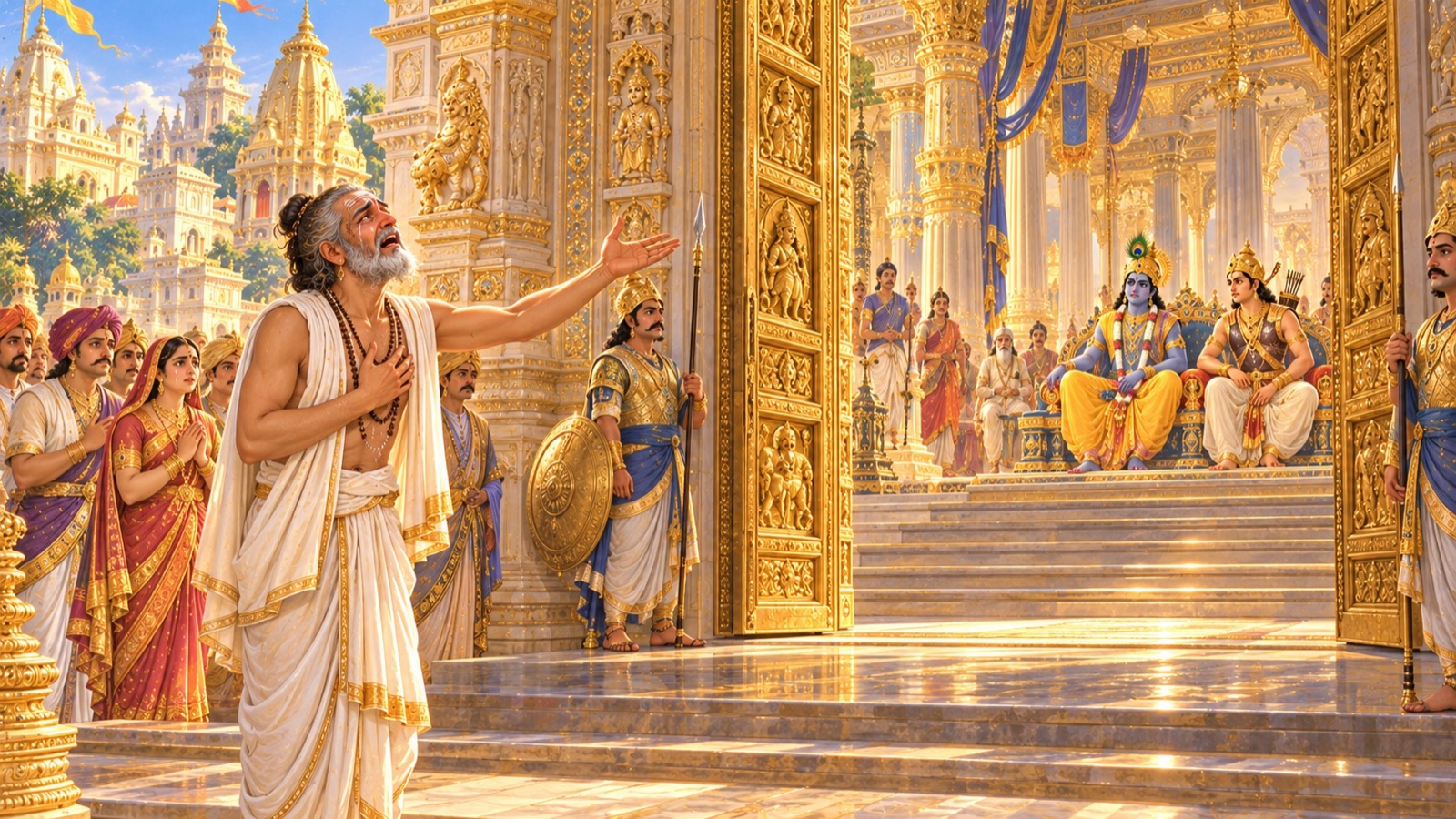
Sukadeva then turned to Dvārakā, where the wife of a brahmana gave birth to a son who died the moment he touched the ground. The brahmana carried the body to the gate of the royal palace and wept: “My child has died through the sins of this pretender-kshatriya, this hater of brahmanas, deceitful, greedy and given to his senses. Subjects of such a violent, ill-natured and unrestrained king waste away in poverty and sorrow.” A second son died in the same way, and a third, and each time the father brought the body to the gate with the same lament.
When the ninth child had died, Arjuna happened to be sitting near Keśava and heard the complaint. He answered proudly: “O brahmana, is there no one in your city who can hold a bow? These pretenders to kingship sit like brahmanas at a sacrifice. Where brahmanas grieve over lost wealth, wives or children, the rulers are mere actors dressed as kshatriyas, living to fill their bellies.”
Arjuna’s Vow
Then Arjuna bound himself with a vow before the grieving father: “O lord, I will protect the offspring of you two afflicted ones; and if I fail to keep my word, I will enter the fire and so burn away my sin.”
The brahmana was unconvinced: when Saṅkarṣaṇa, Vāsudeva, Pradyumna the best of bowmen and Aniruddha the peerless warrior had failed to protect his children, how could Arjuna do what those lords of the universe could not? It was childish talk he could not believe. Arjuna replied, “I am neither Saṅkarṣaṇa nor Kṛṣṇa nor Kṛṣṇa’s son, O brahmana — I am Arjuna, whose bow is Gāṇḍīva. Do not belittle the prowess that once pleased the three-eyed Lord. I will conquer Death himself in battle and bring your children back.” Reassured, the brahmana went home content.
The Cage of Arrows
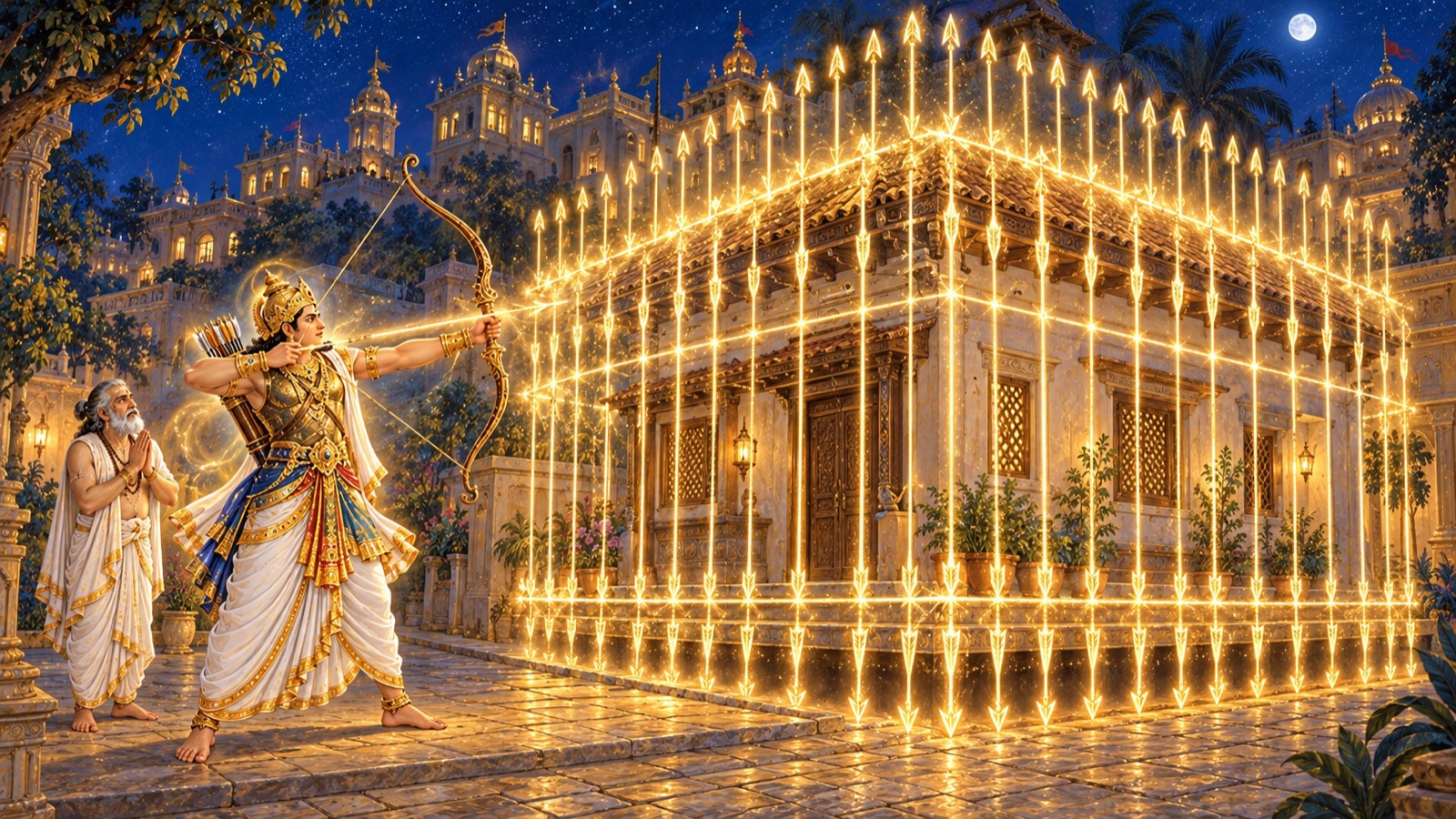
When his wife’s time drew near, the anxious brahmana hurried to Arjuna crying, “Save my child from death!” Arjuna sipped water, bowed to Maheśvara, called to mind his celestial weapons and strung Gāṇḍīva. He fenced the house of confinement on every side, above and below, with mantra-charged arrows until it stood within a cage of arrows. The child was born and cried again and again — and then, in his very body, vanished through the sky.
Before Krishna Himself the brahmana now reviled Arjuna: “See my folly, that I trusted the boast of a eunuch! Whom Pradyumna, Aniruddha, Rāma and Keśava could not save, who else could protect? Shame on lying Arjuna and on the bow of this self-praiser, who thinks he can bring back what destiny has taken.”
Arjuna’s Search and the Lord’s Assurance
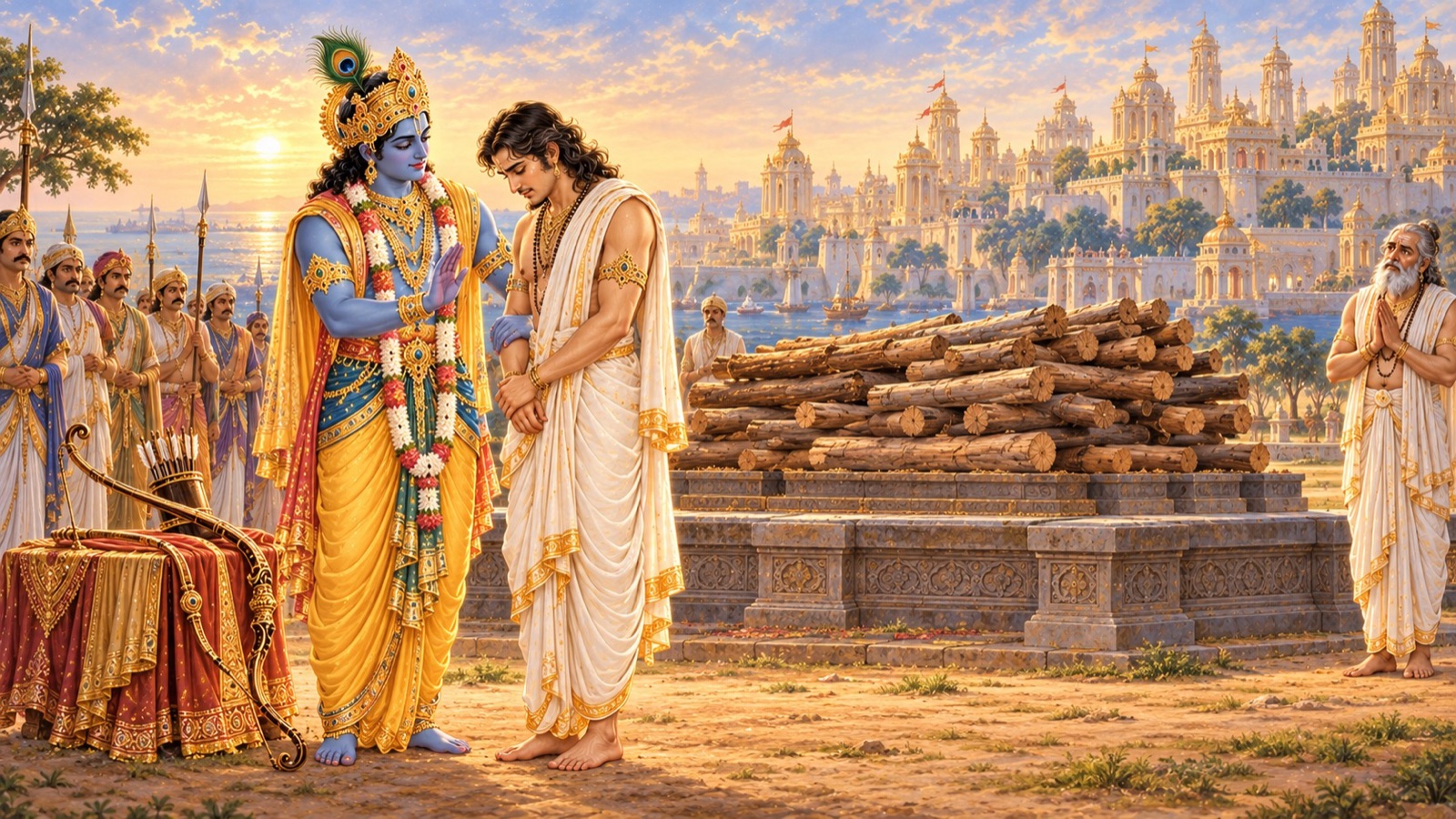
Stung by the curse, Arjuna resorted to mystic knowledge and sped to Saṁyamanī, the city of Yama. Not finding the child there, he went with weapons raised to the cities of Indra, Agni, Nirṛti, Soma, Vāyu and Varuṇa, down to Rasātala and up to the heights of heaven, and found him nowhere. Unable to redeem his promise, he resolved to enter the fire; but Krishna held him back.
दर्शये द्विजसूनूंस्ते मावज्ञात्मानमात्मना ।
ये ते न: कीर्तिं विमलां मनुष्या: स्थापयिष्यन्ति ॥ ४५ ॥
darśaye dvija-sūnūṁs te māvajñātmānam ātmanā ye te naḥ kīrtiṁ vimalāṁ manuṣyāḥ sthāpayiṣyanti
Meaning: I shall show you the brahmana’s sons; do not despise yourself. These very men who now reproach you will establish our spotless fame. (Canto 10, Chapter 89, verse 45)
Beyond the Coverings of the Universe
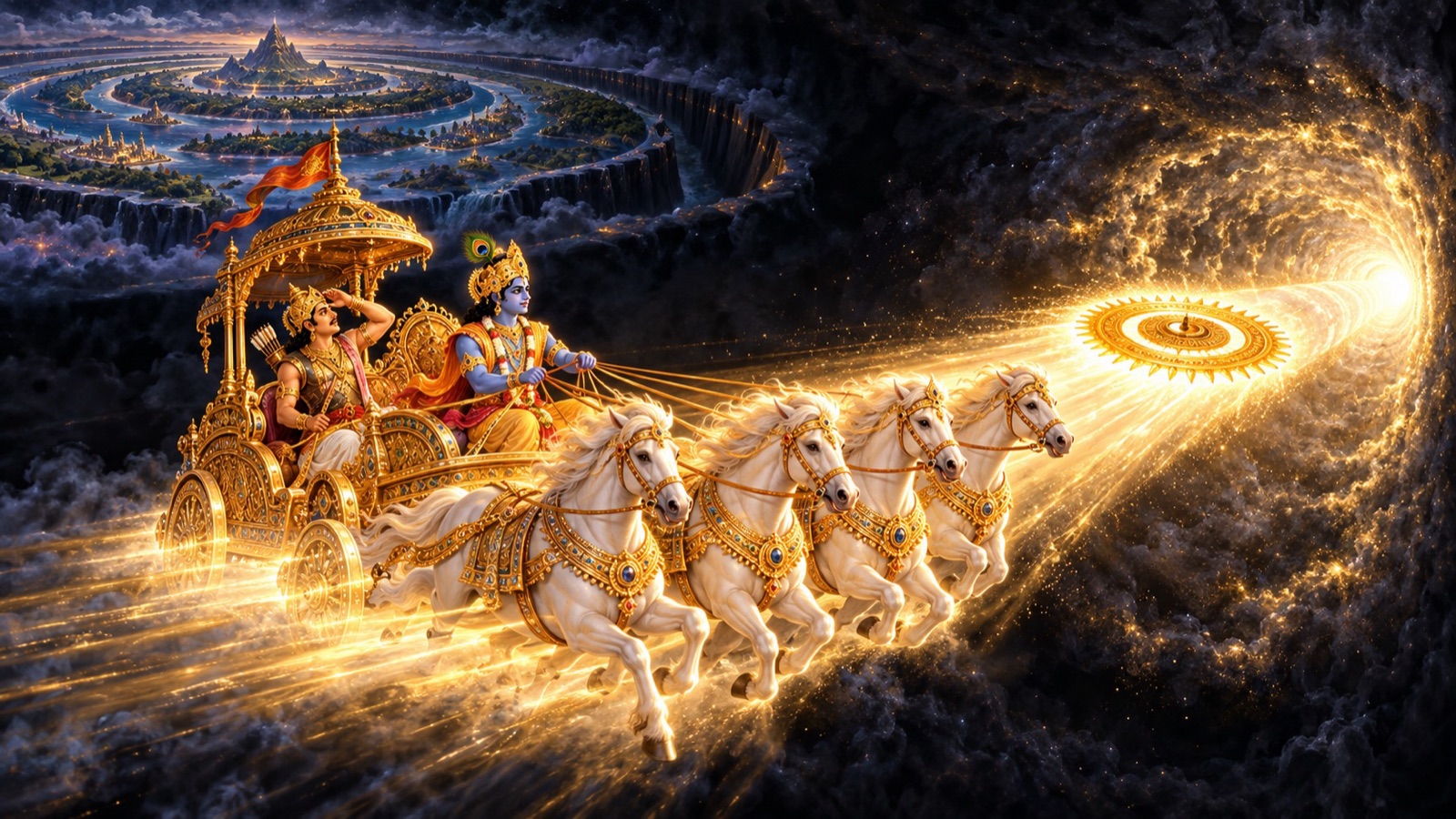
The Lord mounted His divine chariot with Arjuna and set out toward the west. Crossing the seven islands with their seven seas and seven mountain ranges each, and passing beyond Lokāloka, He entered a vast darkness in which the horses Śaibya, Sugrīva, Meghapuṣpa and Balāhaka lost their way. Krishna, the Lord of the masters of yoga, sent His discus ahead, blazing like a thousand suns; swift as thought, Sudarśana tore through that dreadful gloom as an arrow from Rāma’s bowstring pierces the Rākṣasa host. Along the path it opened, the chariot passed into a supreme, infinite, all-pervading light that made Arjuna close his eyes; beyond it lay water heaved into great waves by a mighty wind, and a wondrous palace shining with thousands of jewelled pillars.
The Supreme Person on the Serpent Couch
In that palace lay Ananta of the thousand hoods, each hood radiant with gems, his eyes fierce, his body white as Kailāsa, his necks and tongues dark blue. Upon his coils Arjuna beheld the Supreme Person of persons: dark as a rain-cloud, in brilliant yellow, serene of face, with eight long and graceful arms, the Kaustubha at His neck, the Śrīvatsa on His chest and a forest garland to His knees. Nanda, Sunanda and His attendants served Him, with His weapons in personal form and His energies Puṣṭi, Śrī, Kīrti and Ajā — the master even of Brahmā. Acyuta bowed to that infinite Lord, His own Self in another form; Arjuna, awestruck, bowed after Him, and the two stood with folded palms. Smiling, the Lord spoke in a deep and resonant voice.
द्विजात्मजा मे युवयोर्दिदृक्षुणा
मयोपनीता भुवि धर्मगुप्तये ।
कलावतीर्णाववनेर्भरासुरान्
हत्वेह भूयस्त्वरयेतमन्ति मे ॥ ५८ ॥
dvijātmajā me yuvayor didṛkṣuṇā mayopanītā bhuvi dharma-guptaye kalāvatīrṇāv avaner bharāsurān hatveha bhūyas tvarayetam anti me
Meaning: Desiring to see you both, I had the brahmana’s sons brought here to Me. You two have descended with your portions upon the earth to protect dharma; when you have slain the demons who burden the earth, come back quickly to Me. (Canto 10, Chapter 89, verse 58)
“You are the sages Nara and Nārāyaṇa,” He continued; “though your desires are fulfilled and you are foremost of all, practise dharma for the stability of the world, as an example for men.”
Here the whole chapter finds its purpose. The nine infants were lost neither to a king’s sin nor to any weakness in Arjuna’s arrows; the Supreme Lord Himself drew them beyond the universe, making a father’s grief and a hero’s broken vow the thread by which He brought Nara and Nārāyaṇa into His presence — lifting His devotees’ eyes to the vastness of His love and sending them back as humble servants of dharma whose every power is His gift.
The Sons Restored
Saying “Om,” the two Krishnas bowed to the almighty Lord, took the brahmana’s sons and returned joyfully to Dvārakā by the way they had come, giving the boys to the brahmana, each with his own form and his own age. And Arjuna came home a humbler man.
निशाम्य वैष्णवं धाम पार्थ: परमविस्मित: ।
यत्किञ्चित् पौरुषं पुंसां मेने कृष्णानुकम्पितम् ॥ ६२ ॥
niśāmya vaiṣṇavaṁ dhāma pārthaḥ parama-vismitaḥ yat kiñcit pauruṣaṁ puṁsāṁ mene kṛṣṇānukampitam
Meaning: Having beheld the abode of Viṣṇu, Pārtha was utterly astonished, and he understood that whatever prowess men possess is only the mercy of Krishna. (Canto 10, Chapter 89, verse 62)
Sukadeva closed by recalling that, displaying many such feats, the Lord lived as though enjoying the world’s pleasures, performed magnificent sacrifices and showered every blessing on His subjects like Indra sending rain in season; slaying unrighteous rulers Himself or through Arjuna and others, He easily established dharma through Yudhiṣṭhira and the righteous kings.
Principal Teachings of This Chapter
1. Greatness is measured by forbearance. Brahmā mastered his anger and Śiva’s was calmed by Pārvatī, but only Viṣṇu met a kick with a bowed head and a blessing.
2. Peace and fearlessness come from Viṣṇu. Verse 14 names the two gifts the sages found in Him, śānti and abhaya, and goodness is the path that leads there.
3. A proud promise still binds — and the Lord redeems it. Arjuna could not keep his word, yet Krishna turned his failure into the occasion of his deepest vision.
4. The highest souls act for the world’s sake. Verse 59 calls Krishna and Arjuna Nara and Nārāyaṇa and bids them practise dharma for others, though they lack nothing.
5. Every power a man has is Krishna’s mercy. Verse 62 is what Arjuna carried back: strength and success are loans from the Lord, never possessions of the ego.
A Devotional Reflection
Two men are humbled in this chapter, and both are blessed by it. Bhṛgu came to Vaikuṇṭha as an examiner and left as a devotee in tears, because the Lord he had struck answered him with tenderness. Arjuna came as a champion and set out for the west with nothing left to offer but his life, and the Lord, instead of accepting it, showed him the One before whom even Krishna bows. We too try Him with our doubts and promise Him more than we can perform, and He answers not with Brahmā’s fire or Śiva’s trident but with pressed feet and the quiet words “do not despise yourself” — and then shows us more than we knew to ask.
A Daily Devotional Practice
Today, before any work that depends on your skill or strength, pause and offer it to the Lord with Arjuna’s realisation in mind: whatever power this body or mind holds is His gift. Offer back whatever is accomplished at the day’s end, chanting gently: Om Namo Bhagavate Vasudevaya.
Conclusion
The eighty-ninth chapter of the Tenth Canto sets the bowed head of the Lord of Vaikuṇṭha beside the folded palms of Krishna and Arjuna before the Lord of the causal ocean, and in both one Supreme Person is revealed: greatest because most forbearing, the source of peace and fearlessness, drawing His devotees to Himself through grief and failure only to send them back to serve the world. May we carry home Arjuna’s humility, knowing all our prowess to be His mercy.
May the divine wisdom of Srimad Bhagavatam awaken pure devotion within our hearts.
Om Namo Bhagavate Vasudevaya.
Jay Shree Madhav.
References and Attribution
- Primary edition: Gita Press, Śrīmad Bhāgavata Mahāpurāṇa (English, Part II), Book Ten (Latter Half), Discourse 89, printed pp. 503–509.
- Series: Srimad Bhagavatam Wisdom · Biswa Sanatan Dharma Seva Trust.
- Presented following the spiritual guidance and recommendation of Pandit Dr. Shri Kashinath Mishra.
This is an original, faithful retelling in the writer’s own words, with brief quoted verses shown in Devanāgarī and transliteration and their meanings given as summaries. It is not a reproduction of any single publisher’s continuous translation or commentary. No affiliation with or endorsement by any publisher is implied.
Jay Shree Madhav