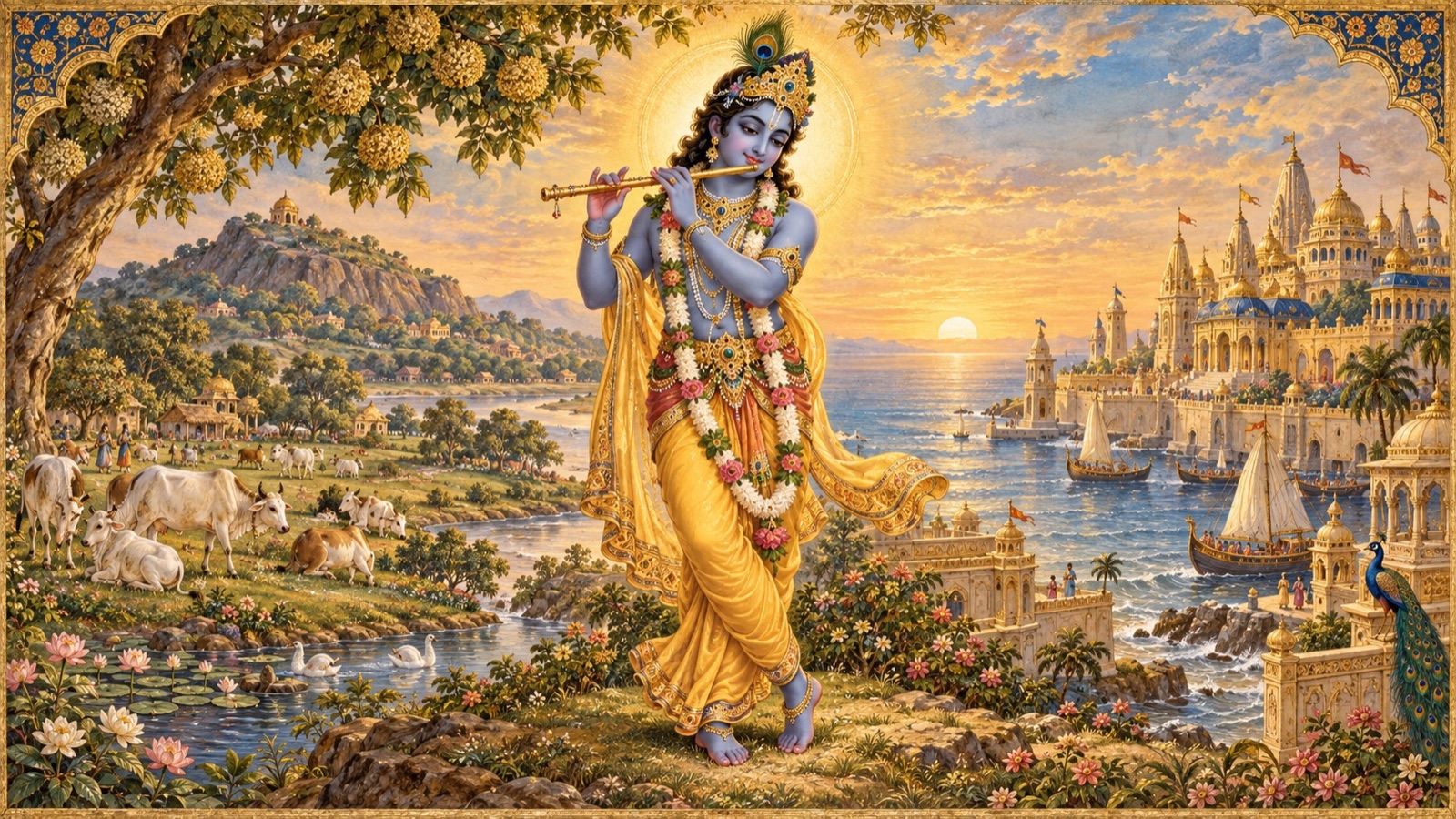
The queens of Dvaraka confide their love to the osprey and the moon, the Yadus forget their very bodies in thought of Him, and Sukadeva lays the Tenth Canto at the feet of the Lord who dwells in every heart.
Om Namo Bhagavate Vasudevaya.
Om Namo Bhagavate Vasudevaya.
Om Namo Bhagavate Vasudevaya.
Welcome back to Srimad Bhagavatam Wisdom, our devotional journey through the sacred histories and teachings of the Srimad Bhagavat Mahapurana. In this ninetieth and last chapter of the Tenth Canto, Sukadeva shows King Parikshit the Lord’s life among His queens in Dvaraka, lets him overhear the words those queens address to the birds, the moon and the clouds, counts the family descended from Him, and closes the canto with verses of praise devotees have treasured ever since.
Chapter Information
- Scripture: Śrīmad Bhāgavata Mahāpurāṇa
- Canto: 10 (Book Ten, Latter Half)
- Chapter: 90 (Discourse 90, the last of the Tenth Canto)
- Chapter title: Summary of Lord Krishna’s Glories
- Principal speaker: Sukadeva Gosvami (with the queens’ songs)
- Principal listener: King Parikshit
- Main setting: Dvārakā — its palaces, gardens and lotus lakes
- Central subject: Krishna’s household life in Dvaraka; the queens’ words of love to the creatures of nature; His sons and the vast Yadu dynasty; the closing glorification of hearing His pastimes
- Principal verse range: Canto 10, Chapter 90, verses 1–50
- Primary edition: Gita Press Śrīmad Bhāgavata Mahāpurāṇa (English, Book Ten)
Context From the Previous Chapter
In Chapter 89 Krishna and Arjuna journeyed beyond the edge of the universe to the abode of the Supreme Person and brought back the brahmana’s lost sons. Sukadeva ended that discourse by observing that the Lord seemed to live as a man who enjoys the world, even while He slew unrighteous kings and re-established dharma through Yudhishthira.
The Lord of Lakshmi in His Own City
Sukadeva began again. The roads of Dvaraka thronged day and night with elephants, adorned soldiers, horses and golden chariots; flowering gardens loud with birds and bees ringed the city; and the heroes of the Yadu race counted it a privilege to live there. In that city, His own favourite city, the Lord of Lakshmi dwelt in perfect ease. He was the one beloved husband of more than sixteen thousand queens, each with a mansion of surpassing splendour, and assuming as many forms as He had wives He lived with each in her own home.
Every mansion had its own lake, its clear water fragrant with lotus pollen and ringing with the calls of swans and cranes. There the Lord would delight in the water with His queens while Gandharvas sang His glories and bards sounded drums and lutes; the queens would playfully sprinkle Him from syringes and He would drench them in return, like Kubera at play among the Yaksha women. Afterwards Krishna and His queens gave the garments and ornaments they had worn to the dancers and musicians who lived by their art. His gait, His words, His glances, His smiles and His affectionate jests captured the hearts of His consorts entirely.
The Queens Speak to the Birds, the Moon and the Clouds
Krishna was the whole of their life, the sole possessor of their hearts. Absorbed in thought of their lotus-eyed Lord, they would fall silent and then suddenly speak as one speaks in love’s madness, feeling the ache of separation even while He was present. Sukadeva asked the king to listen to those words.
कुररि विलपसि त्वं वीतनिद्रा न शेषे स्वपिति जगति रात्र्यामीश्वरो गुप्तबोधः ।
वयमिव सखि कच्चिद् गाढनिर्भिन्नचेता नलिननयनहासोदारलीलेक्षितेन ॥ १५ ॥
kurari vilapasi tvaṁ vīta-nidrā na śeṣe svapiti jagati rātryām īśvaro gupta-bodhaḥ vayam iva sakhi kaccid gāḍha-nirbhinna-cetā nalina-nayana-hāsodāra-līlekṣitena
Meaning: O kurari bird, you lament and cannot sleep, while the Lord, His consciousness hidden, sleeps, and the world sleeps with Him in the night. Friend, has your heart too been pierced to its depths, like ours, by the generous, playful glance and smile of the lotus-eyed Lord? (Canto 10, Chapter 90, verse 15)
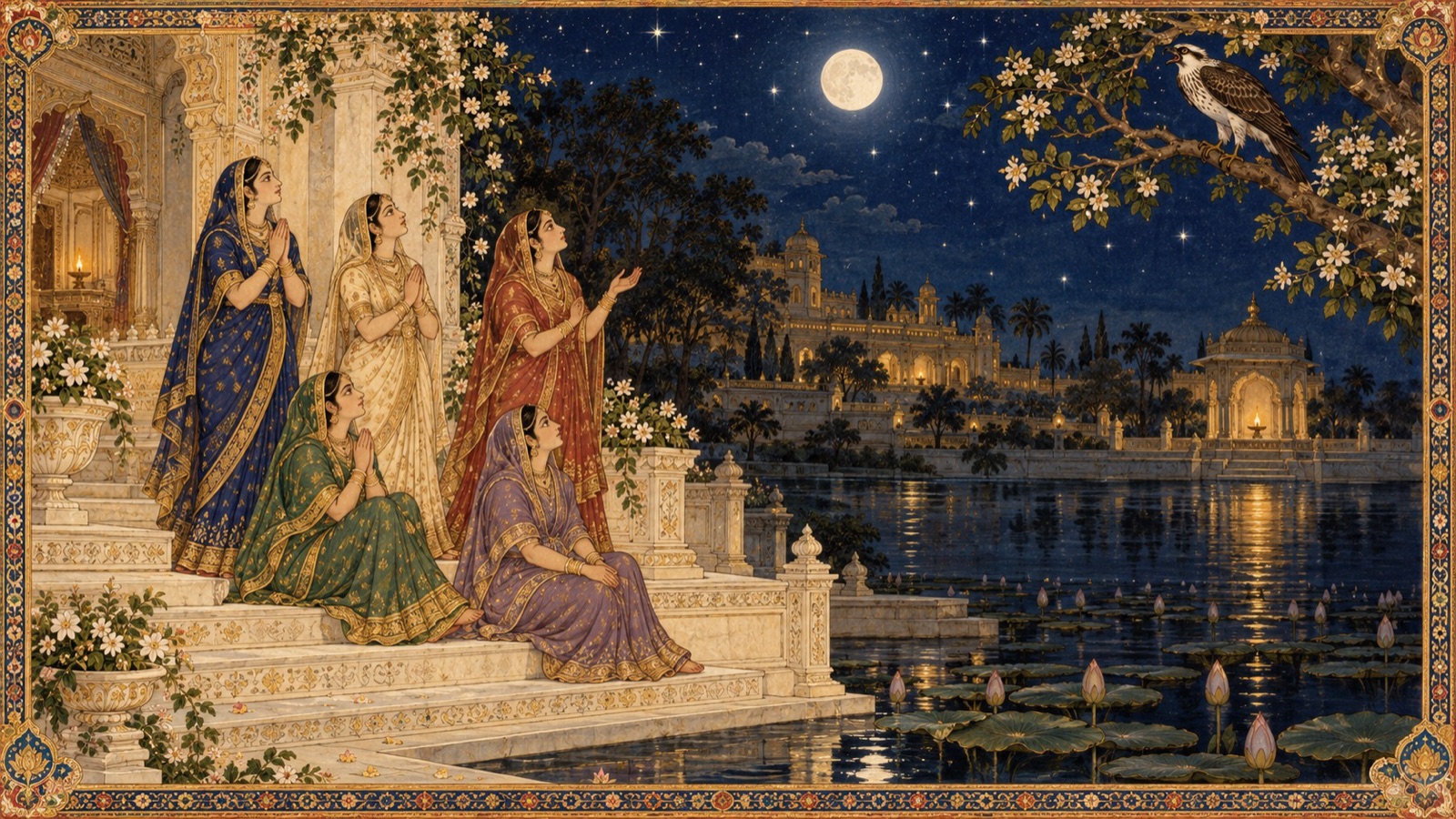
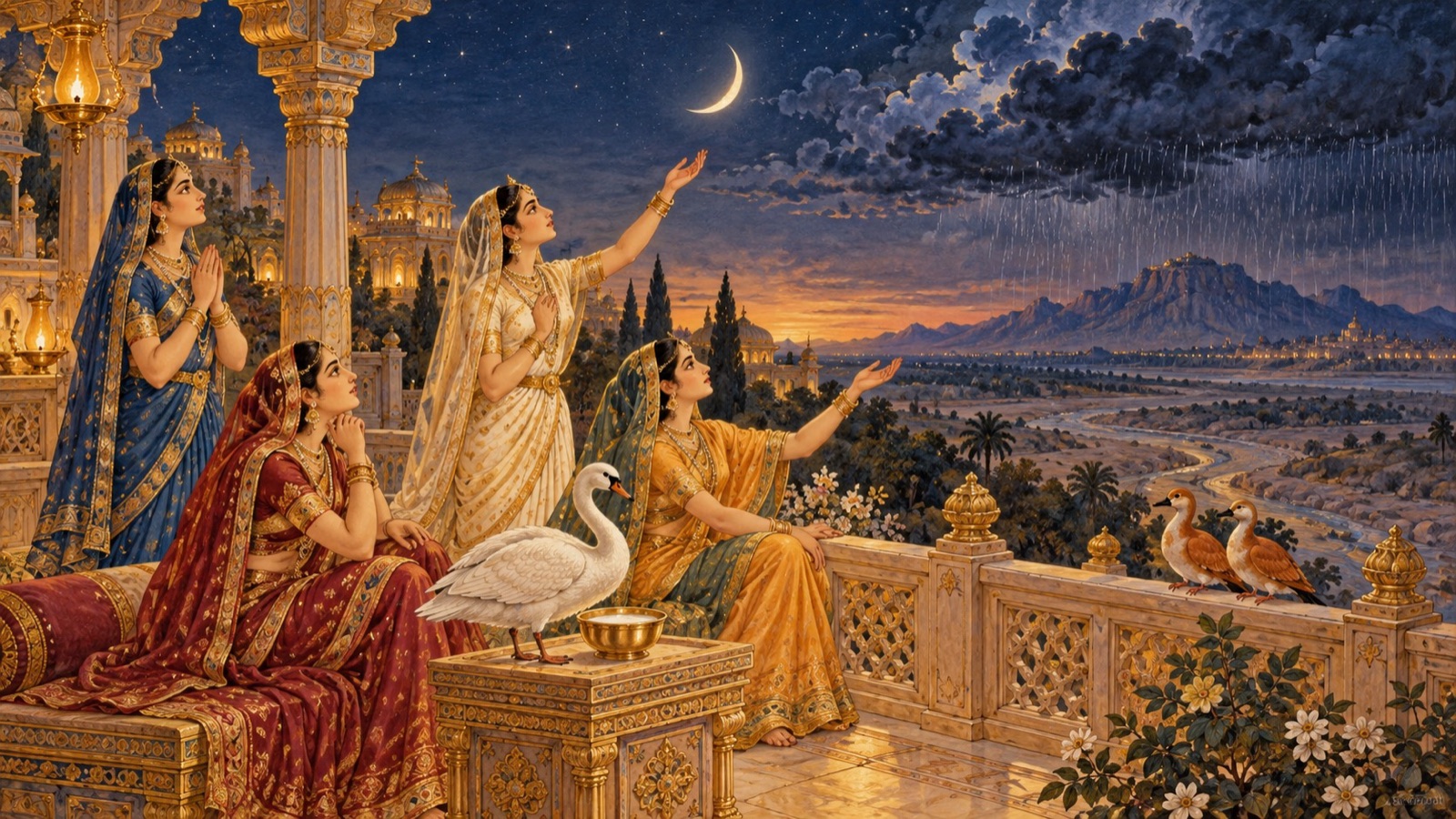
To the chakravaki they said: you close your eyes and cry so piteously in the night — have you lost your mate, or do you long, as we do, to serve the Lord and wear in your braid the garland fallen from His feet? To the ocean: you roar without rest; has our beloved stolen your gravity and calm, as He has stolen ours? To the moon: you have wasted away until your rays cannot drive back the darkness; have you, like us, forgotten the sweet words of our Lord and fallen mute? To the southern wind: what wrong have we done you, that you stir desire in hearts already torn by His sidelong glances? To the cloud: your colour is His colour, and you must be dear to Him, for like us you remember Him without ceasing and shed streams of tears. To the cuckoo: your voice is sweet as His own and brings life even to the dead — tell us what we may do for you today. To the mountain: you hold up the earth, yet you neither move nor speak; are you too longing to bear the Lord’s lotus feet upon your peaks? To the dried-up rivers: you have lost your lotuses and grown thin, as we have withered without His loving glance, because the clouds no longer bring you the ocean’s water. And to the swan: welcome, drink a little milk and tell us of our beloved — is that fickle friend well, and does He remember calling us His dearest? Then, half in pique, they declared they would not go to Him; let the messenger bring Him here, but without Lakshmi — or does Lakshmi alone claim to love Him exclusively?
The Fruit of Such Love
इतीदृशेन भावेन कृष्णे योगेश्वरेश्वरे ।
क्रियमाणेन माधव्यो लेभिरे परमां गतिम् ॥ २५ ॥
itīdṛśena bhāvena kṛṣṇe yogeśvareśvare kriyamāṇena mādhavyo lebhire paramāṁ gatim
Meaning: By cherishing such love toward Krishna, the Lord of the masters of yoga, the wives of Madhava attained the supreme destination. (Canto 10, Chapter 90, verse 25)
The Lord’s pastimes, sung in exquisite poems, draw the minds of women who merely hear of them; what then of those who beheld Him with their own eyes? And who could measure the austerities of these queens who, with the Teacher of the universe as their husband, massaged His feet, bathed Him, fed Him and served Him with every loving attention?
The Supreme Householder
एवं वेदोदितं धर्ममनुतिष्ठन् सतां गतिः ।
गृहं धर्मार्थकामानां मुहुश्चादर्शयत् पदम् ॥ २८ ॥
evaṁ vedoditaṁ dharmam anutiṣṭhan satāṁ gatiḥ gṛhaṁ dharmārtha-kāmānāṁ muhuś cādarśayat padam
Meaning: Thus, practising the dharma declared in the Vedas, He who is the refuge of the saintly demonstrated again and again that the household is the place where religious merit, prosperity and legitimate enjoyment may all be attained. (Canto 10, Chapter 90, verse 28)
That is why the Lord had embraced the exalted way of the householder. His queens numbered sixteen thousand one hundred and eight; the eight foremost, Rukmini and the others, with their sons, had already been named in order, and each of the remaining queens also bore Him ten sons — no wonder, Sukadeva said, since the Lord is almighty and His resolve never fails.
His Sons and the Vastness of the Yadu Dynasty
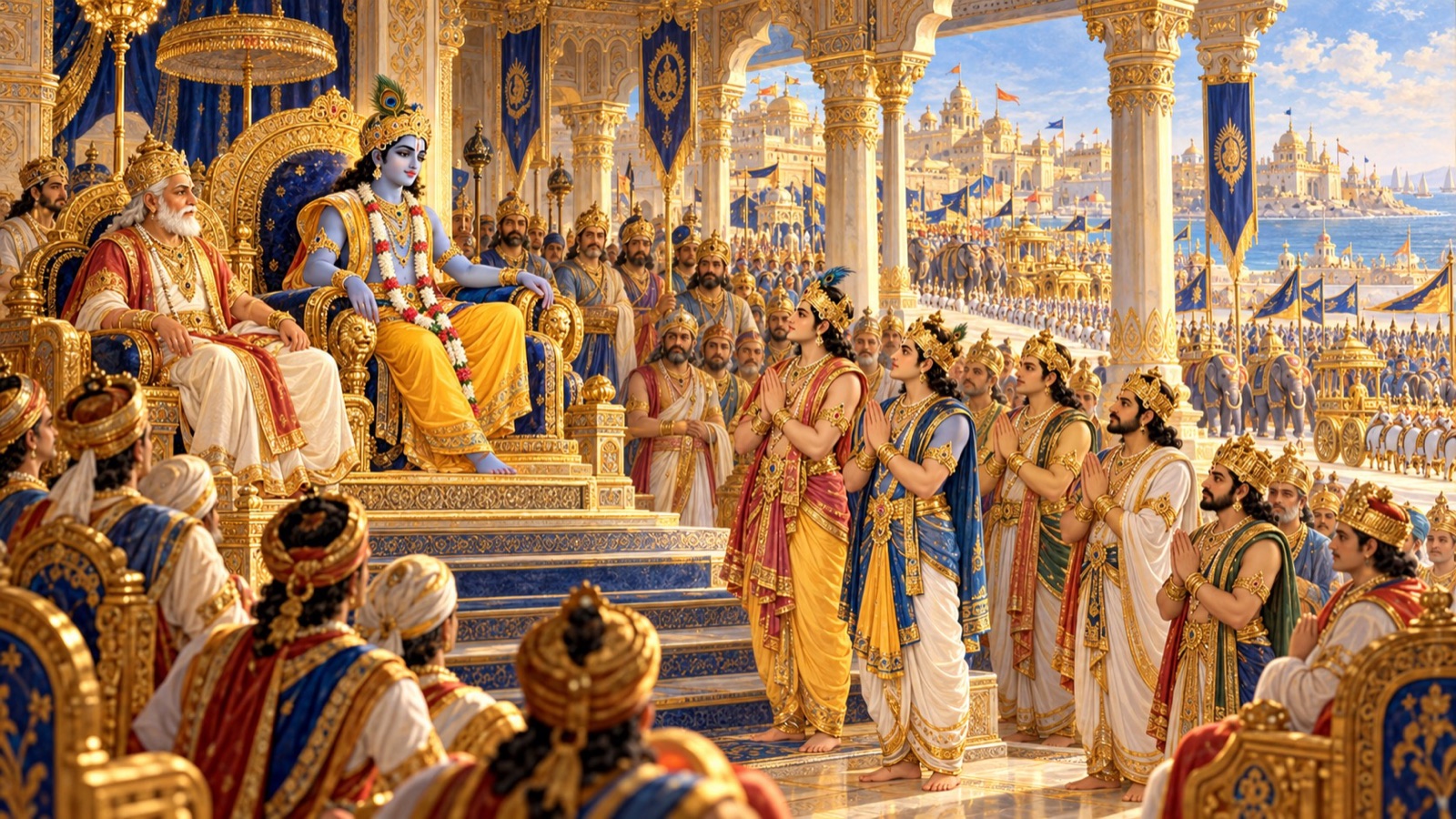
Among those sons of boundless valour, eighteen were great chariot-warriors of renown: Pradyumna, Aniruddha, Diptiman, Bhanu, Samba, Madhu, Brihadbhanu, Chitrabhanu, Vrika, Aruna, Pushkara, Vedabahu, Shrutadeva, Sunandana, Chitrabahu, Virupa, Kavi and Nyagrodha. First among them was Pradyumna, born of Rukmini and equal to his father. He married the daughter of Rukmi, and their son was Aniruddha, strong as ten thousand elephants. Aniruddha married the daughter of Rukmi’s son, and from them was born Vajra, who alone would survive the Yadus’ destruction by the iron club born of the brahmana sages’ curse. Vajra’s son was Pratibahu, his son Subahu, then Shantasena and Shatasena. None born in this line was poor, weak or short-lived; all were devoted to the brahmanas and blessed with many sons. Its illustrious men could not be counted in tens of thousands of years; the teachers of the Yadu children alone numbered three crore and eighty-eight lakh, and King Ugrasena was attended by warriors numbering ten trillion. Who, then, could count the Yadus themselves?
Why the Gods Took Birth Among the Yadus
Many terrible asuras slain in the ancient wars between gods and demons were reborn among men and, proud and arrogant, began to oppress the people. To chastise them the gods, at the Supreme Lord’s direction, took birth in the family of Yadu, which spread into one hundred and one branches. Krishna was the guide and master of them all, and every Yadava who followed Him faithfully flourished.
शय्यासनाटनालापक्रीडास्नानादिकर्मसु ।
न विदुः सन्तमात्मानं वृष्णयः कृष्णचेतसः ॥ ४६ ॥
śayyāsanāṭanālāpa- krīḍā-snānādi-karmasu na viduḥ santam ātmānaṁ vṛṣṇayaḥ kṛṣṇa-cetasaḥ
Meaning: Whether lying down, sitting, walking, conversing, playing, bathing or doing their other daily tasks, the Vrishnis, their consciousness absorbed in Krishna, did not even notice their own bodies. (Canto 10, Chapter 90, verse 46)
The Glory of the Lord Who Descended Among the Yadus
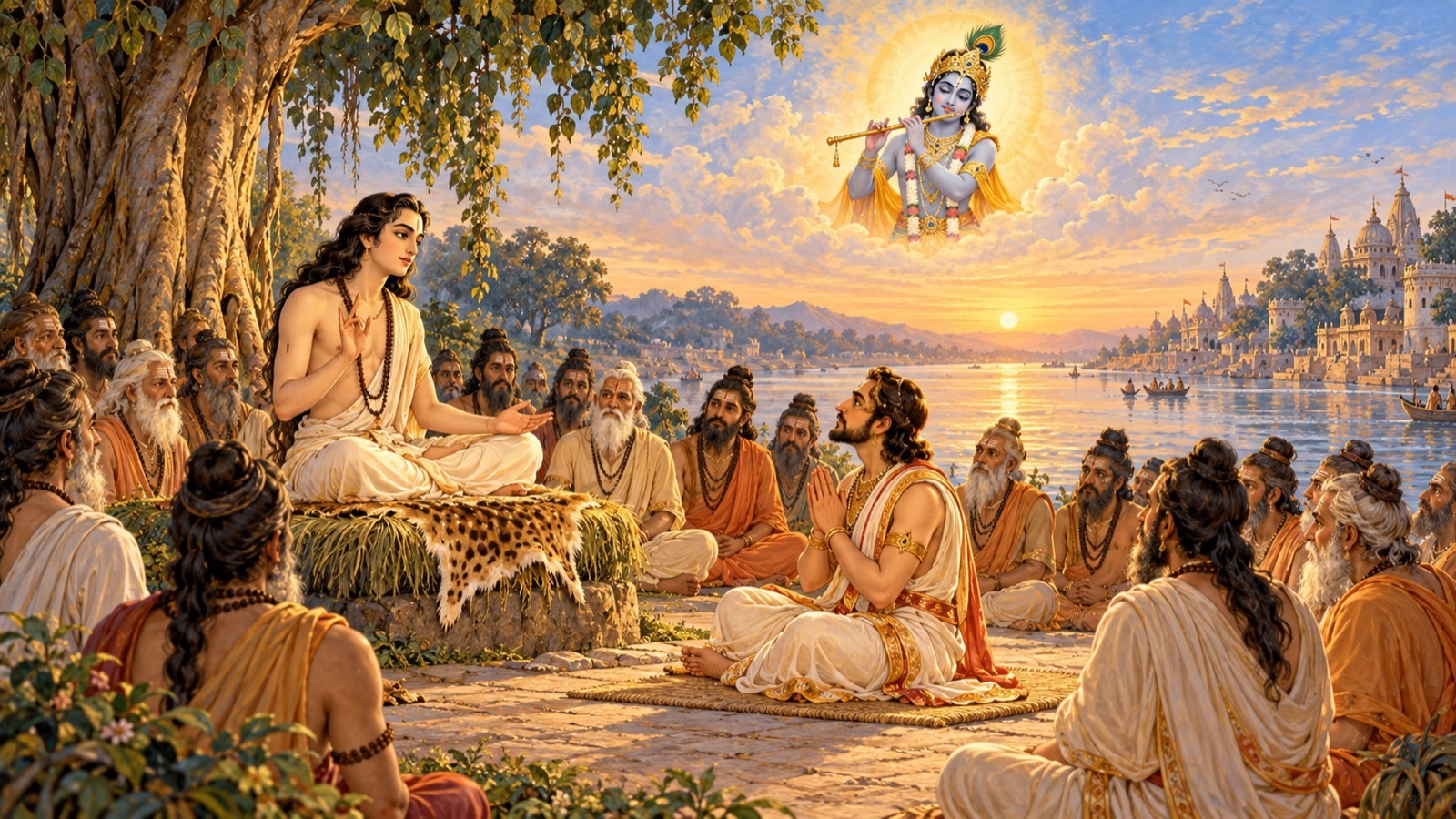
Sukadeva then rose to praise. The Ganga that washes the Lord’s feet is holy indeed, yet when He Himself appeared among the Yadus, His fame surpassed even that river as a place of pilgrimage. Those who hated Him and those who loved Him alike attained His own nature; Lakshmi, for whom others strive, ever serves Him; His name, heard or uttered, destroys all inauspiciousness; the dharma of the sages’ lines flows from Him; and in His hand He bears the discus, the wheel of time. For such a Lord to relieve the earth’s burden is no wonder at all.
जयति जननिवासो देवकीजन्मवादो यदुवरपरिषत् स्वैर्दोर्भिरस्यन्नधर्मम् ।
स्थिरचरवृजिनघ्नः सुस्मितश्रीमुखेन व्रजपुरवनितानां वर्धयन् कामदेवम् ॥ ४८ ॥
jayati jana-nivāso devakī-janma-vādo yadu-vara-pariṣat svair dorbhir asyann adharmam sthira-cara-vṛjina-ghnaḥ su-smita-śrī-mukhena vraja-pura-vanitānāṁ vardhayan kāma-devam
Meaning: All glory to Him who dwells in every being, who is said to have taken birth from Devaki, who is attended by the assembly of the foremost Yadus and casts out unrighteousness with His own arms; He removes the sorrow of all moving and unmoving creatures, and with His gently smiling, beautiful face He deepens the love of the women of Vraja and of the city. (Canto 10, Chapter 90, verse 48)
The Closing Words of the Tenth Canto
So the Supreme Person, who lies beyond material nature, sportively assumed a form in order to protect the path He Himself had laid down, and performed deeds befitting that form — deeds that cut the bonds of karma for whoever contemplates them. Whoever longs to serve the feet of the best of the Yadus should hear of those deeds.
मर्त्यस्तयानुसवमेधितया मुकुन्दश्रीमत्कथाश्रवणकीर्तनचिन्तयैति ।
तद्धाम दुस्तरकृतान्तजवापवर्गं ग्रामाद् वनं क्षितिभुजोऽपि ययुर्यदर्थाः ॥ ५० ॥
martyas tayānusavam edhitayā mukunda- śrīmat-kathā-śravaṇa-kīrtana-cintayaiti tad dhāma dustara-kṛtānta-javāpavargaṁ grāmād vanaṁ kṣiti-bhujo ‘pi yayur yad-arthāḥ
Meaning: Through devotion nourished at every moment by hearing, chanting and remembering the beautiful stories of Mukunda, a mortal reaches that abode where the otherwise irresistible force of death has no sway — the realm for whose sake even kings have left their homes for the forest. (Canto 10, Chapter 90, verse 50)
With this the canto that began in Devaki’s prison closes in Dvaraka, and tells us why it was spoken. The Lord who dwells in every heart chose to be “said to be born of Devaki”, so that hearts could love Him in a form they could see, serve and ache for. The queens’ bewildered songs and the Vrishnis’ forgetfulness of their bodies show what that love does to a soul, and it carried the queens to the supreme destination. His householder life shows that the Vedic path need not be abandoned to reach Him. And because every deed of that descended form severs karma for whoever hears it, the hearing itself becomes the way home — the very practice by which Parikshit, with seven days to live, was being led beyond death.
Principal Teachings of This Chapter
1. Love for the Lord may look like madness to the world. The queens speak to birds, rivers and clouds because their hearts are too full to stay silent; such absorption led them to the supreme goal.
2. The householder’s life is a sacred path. By living in Dvaraka with His queens and sons, the Lord showed that dharma, prosperity and lawful happiness may be won at home when life follows the Vedas.
3. Perfect remembrance is possible amid daily life. The Vrishnis ate, walked and bathed without noticing their bodies, so fixed were they on Krishna; ordinary duties can become unbroken meditation.
4. The Lord’s descent sanctifies more than any holy river. His fame outshines the Ganga, and even those who hated Him attained His nature.
5. Hearing His pastimes is the road to His abode. Every act of His descended form cuts the bonds of karma for those who contemplate it, and devotion fed by hearing and chanting leads where death has no power.
A Devotional Reflection
It is striking that the Tenth Canto chooses to end not with a battle but with women talking to birds. Sukadeva wants us to leave Dvaraka with this picture: hearts so saturated with Krishna that an osprey’s night cry or a thinning moon becomes an occasion to speak of Him. We may never equal that intensity, yet the direction is open to us: a raincloud, a river running low in summer, a bird calling before dawn can each become a reminder of Him. The canto’s parting gift is an invitation to let everything we see and do become His.
A Daily Devotional Practice
Today, choose one thing in nature you see every day — the moon, a cloud, a bird’s call, a river — and each time you notice it, let it remind you of the Lord, as the queens of Dvaraka did, and speak a sentence of love to Him in your heart. Before sleep, hear a few verses of His pastimes. Begin now by chanting gently: Om Namo Bhagavate Vasudevaya.
Conclusion
The ninetieth chapter closes the Tenth Canto in Dvaraka, where the Lord of Lakshmi lived among His queens, whose love overflowed into songs to the creatures of nature and carried them to the supreme destination. Sukadeva counted the countless Yadus whose minds never left Him, and gathered the canto into verses of glorification: the Lord who dwells in all beings took birth among men, lifted the earth’s burden, and left pastimes whose hearing alone frees from karma and leads to His deathless abode. May we make the hearing and remembering of His stories the daily nourishment of our devotion.
May the divine wisdom of Srimad Bhagavatam awaken pure devotion within our hearts.
Om Namo Bhagavate Vasudevaya.
Jay Shree Madhav.
References and Attribution
- Primary edition: Gita Press, Śrīmad Bhāgavata Mahāpurāṇa (English), Book Ten (Latter Half), Discourse 90, printed pages 509–515.
- Series: Srimad Bhagavatam Wisdom · Biswa Sanatan Dharma Seva Trust.
- Presented following the spiritual guidance and recommendation of Pandit Dr. Shri Kashinath Mishra.
This is an original, faithful retelling in the writer’s own words, with brief quoted verses shown in Devanāgarī and transliteration and their meanings given as summaries. It is not a reproduction of any single publisher’s continuous translation or commentary. No affiliation with or endorsement by any publisher is implied.
Jay Shree Madhav