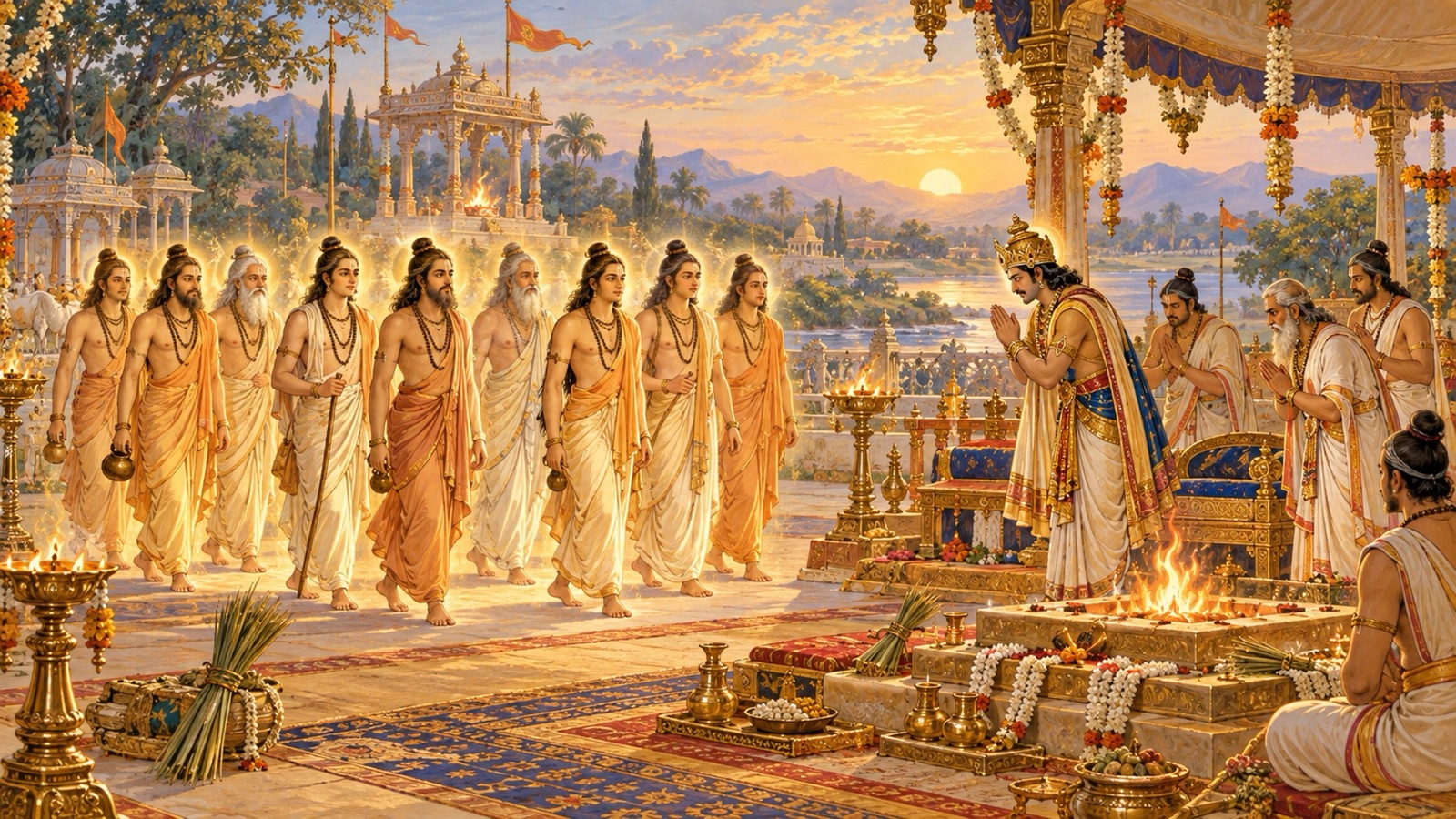
In an ancient assembly, nine radiant sage-brothers — the Yogendras born of Rishabha — arrive at the sacrifice of the enlightened King Nimi, who rises with all his priests to welcome them and to ask the one question that matters most: what leads a mortal to everlasting good?
Om Namo Bhagavate Vasudevaya.
Om Namo Bhagavate Vasudevaya.
Om Namo Bhagavate Vasudevaya.
Welcome to Srimad Bhagavatam Wisdom, a devotional journey through the sacred histories and teachings of the Srimad Bhagavat Mahapurana. Having heard how Lord Sri Krishna quietly set in motion the withdrawal of His own dynasty, King Parikshit now hears from Sukadeva Gosvami a discourse that turns from history toward the very heart of spiritual life. It is a conversation within a conversation: the divine sage Narada, visiting Vasudeva in Dwaraka, recalls an ancient dialogue between the enlightened King Nimi of Videha and nine perfected sages — the Yogendras — who reveal the secret of bhagavata-dharma, the devotional path that frees a mortal from all fear. In this second discourse the Bhagavatam begins to lay open the treasures of pure devotion that will flower fully in the Uddhava Gita to come.
Chapter Information
- Scripture: Śrīmad Bhāgavata Mahāpurāṇa
- Canto: 11 (Book Eleven)
- Chapter: 2 (Discourse 2)
- Chapter title: Maharaja Nimi Meets the Nine Yogendras
- Principal speaker: Sukadeva Gosvami, narrating to King Parikshit; within the narration, Narada recounts to Vasudeva the words of the sage Kavi and the sage Havi before King Nimi
- Principal listener: King Parikshit; within the narration, Vasudeva, and King Nimi with his assembly
- Main setting: Dwaraka (Narada’s visit to Vasudeva) and, in the remembered legend, the sacrificial arena of King Nimi in ancient Ajanabha (Bharatavarsha)
- Central subject: The devotional path (bhagavata-dharma) that pleases the Lord and frees the soul from all fear, and the marks of the Lord’s true devotee
- Principal verse range: Canto 11, Chapter 2, verses 1–55
- Primary edition: Gita Press Śrīmad Bhāgavata Mahāpurāṇa
Narada’s Visits to Dwaraka
Sukadeva continues, telling King Parikshit that the divine sage Narada, ever eager to wait upon Sri Krishna, would frequently stay in Dwaraka — the city guarded by the arms of Govinda. What sensible person, Sukadeva remarks, possessing sound senses, would ever neglect to worship the lotus-feet of Lord Mukunda, feet adored even by Brahma and the foremost of the gods?
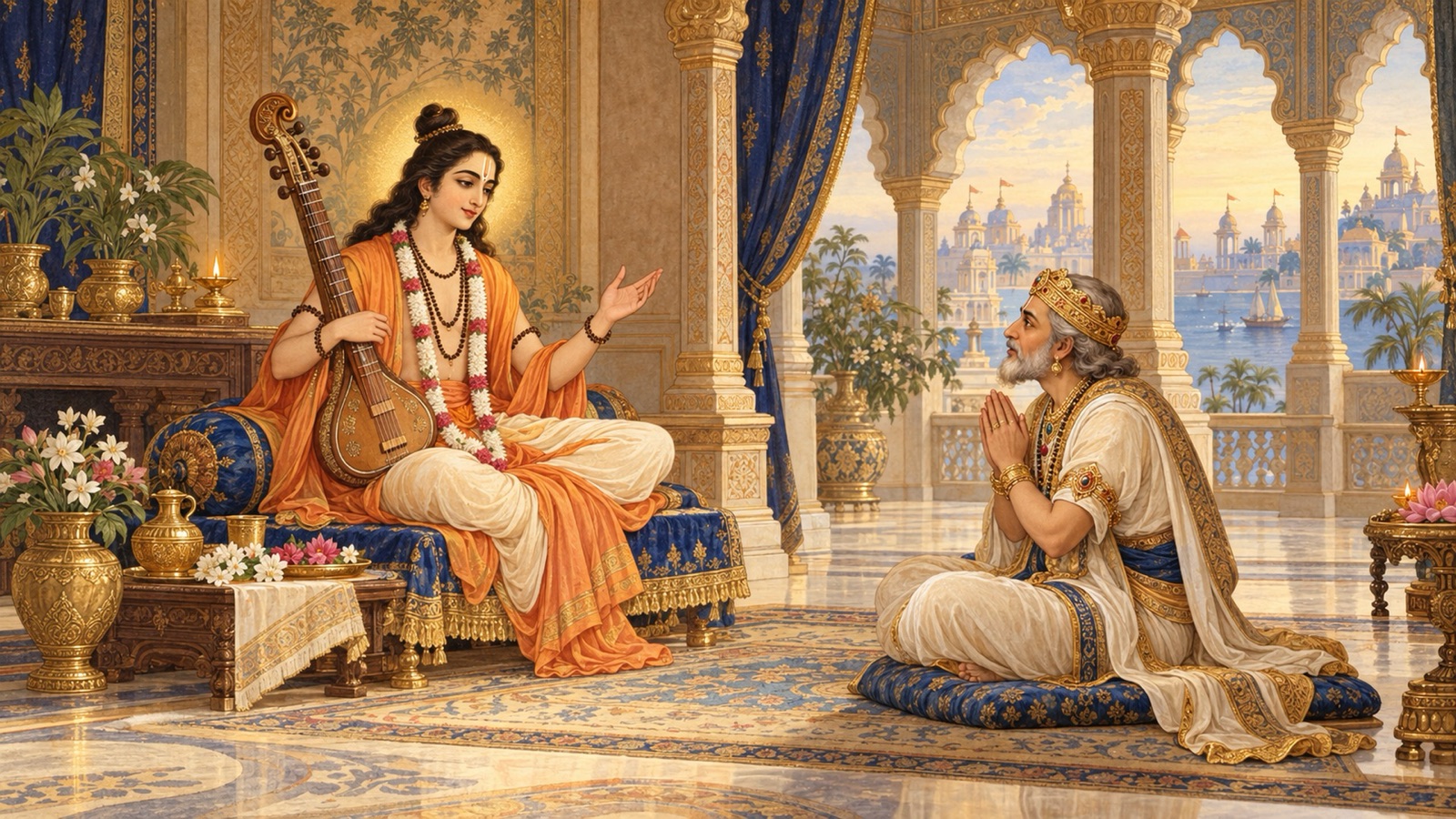
On one such visit Narada came to the house of Vasudeva, Krishna’s own father. Vasudeva welcomed the sage, worshipped him and seated him comfortably, and then, with humility, opened his heart.
Vasudeva’s Question
Vasudeva reflected that the coming of saints is a blessing to all beings — as the movements of parents are for the welfare of their children. The gods, he observed, may bring both joy and sorrow according to one’s own actions, serving worshippers like a shadow that follows the doer; but the saints, devoted wholly to the Lord, are compassionate to the distressed without regard for merit. In that spirit he made his request.
ब्रह्मंस्तथापि पृच्छामो धर्मान् भागवतांस्तव । याञ्छ्रुत्वा श्रद्धया मर्त्यो मुच्यते सर्वतोभयात् ॥ ७ ॥
brahmaṁs tathāpi pṛcchāmo dharmān bhāgavatāṁs tava yāñ chrutvā śraddhayā martyo mucyate sarvato bhayāt
Meaning: O Brahmana, we therefore ask you to describe those devotional duties that please the Lord — hearing which with faith a mortal is freed from all fear. (Canto 11, Chapter 2, verse 7)
Vasudeva confessed that in a former birth he had worshipped the eternal, liberation-giving Lord only for the boon of a worthy son, and not for liberation itself, deluded as he was by the Lord’s Maya. Now, he pleaded, let the sage so instruct him that he might be freed, easily and surely, from this fearful worldly existence beset with misery on every side.
Narada Recalls an Ancient Legend
Pleased and reminded of the Lord’s own glories, Narada praised the inquiry: this course of devotion, he said, purifies at once — whether heard of, spoken of, meditated upon, honored, or merely approved when practiced by others. In this connection he recalled an ancient dialogue between the high-souled King Nimi of Videha and the enlightened sons of Rishabha.
Narada traced their lineage: from Swayambhuva Manu came Priyavrata, then Agnidhra, then Nabhi, and then Rishabha — a partial descent of Lord Vasudeva who came to teach the path of renunciation leading to liberation. Rishabha had a hundred sons, all learned in the Vedas. The eldest was the great devotee Bharata, after whom this sacred land is named. Of the remaining sons, nine became rulers of the nine islands, eighty-one became Brahmanas devoted to sacred rites, and the last nine became supremely blessed sages, naked and free, established in the knowledge of the Self.
Their names were Kavi, Havi, Antariksha, Prabuddha, Pippalayana, Avirhotra, Drumila, Chamasa, and Karabhajana. Seeing the whole universe, gross and subtle, as non-different from the Lord and from their own selves, they wandered the worlds at will, unattached to any place or being.

The Nine Sages Come to King Nimi’s Sacrifice
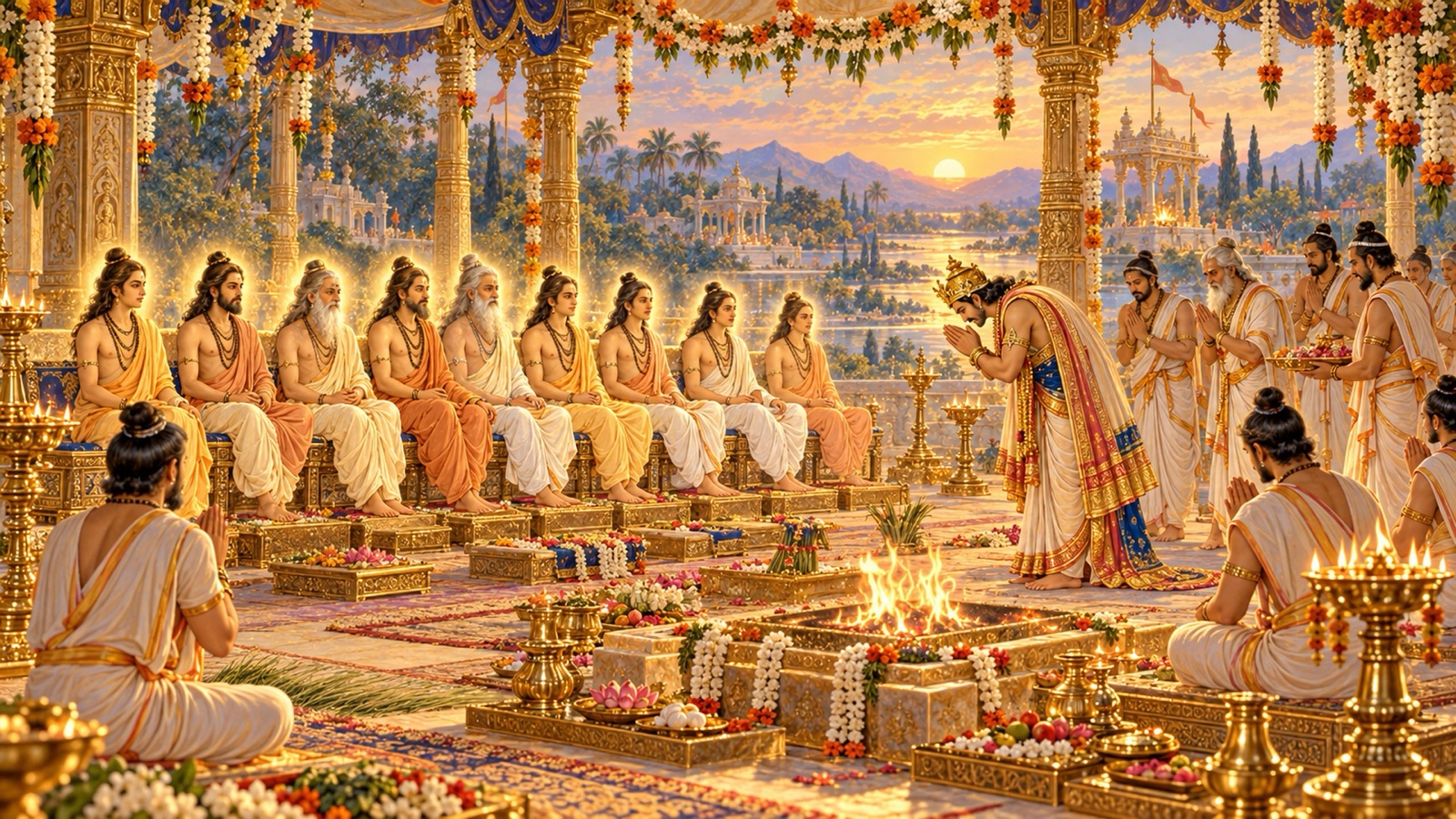
One day these nine sages came of their own accord to a great sacrifice being performed by King Nimi, an enlightened soul, in the ancient land of Ajanabha. Seeing them arrive — effulgent as the sun and earnestly devoted to the Lord — the king, the sacred fires, and the officiating Brahmanas all rose together to welcome them. Recognizing them as great devotees of Narayana, King Nimi worshipped them in the order of their seniority and, bending low with humility, put his questions to them.
King Nimi’s Question
King Nimi concluded that these must be direct associates of Lord Vishnu, for the Lord’s devotees roam the worlds to purify them. The human body, he observed, is a rare gift and even so is fleeting; rarer still, within human life, is the meeting with such devotees. Seizing the moment, he asked what leads to lasting welfare.
अत आत्यन्तिकं क्षेमं पृच्छामो भवतोऽनघाः । संसारेऽस्मिन् क्षणार्धोऽपि सत्सङ्गः शेवधिर्नृणाम् ॥ ३० ॥
ata ātyantikaṁ kṣemaṁ pṛcchāmo bhavato ‘naghāḥ saṁsāre ‘smin kṣaṇārdho ‘pi sat-saṅgaḥ śevadhir nṛṇām
Meaning: O sinless ones, we therefore ask you about the ultimate good; for in this world of birth and death, even half a moment’s association with the saintly is a priceless treasure for human beings. (Canto 11, Chapter 2, verse 30)
If they judged him worthy to hear, he asked, let them describe the righteous duties dear to the Lord, pleased with which the birthless Lord bestows His very Self upon His devotee. So questioned, the sages praised the king, his priests and the supervisors of the sacrifice, and gladly began to speak in turn.
Kavi Speaks — The Path That Never Fails
The first sage, Kavi, replied that for one whose mind is ever disturbed by mistaking this perishable body for the self, the safest of all courses is to worship the Lord’s lotus-feet; through such worship all fear completely disappears. These devotional paths, he explained, were taught by the Lord Himself for the soul’s own attainment — so effective that even the unlearned may follow them.
ये वै भगवता प्रोक्ता उपाया ह्यात्मलब्धये । अञ्जः पुंसामविदुषां विद्धि भागवतान् हि तान् ॥ ३४ ॥
ye vai bhagavatā proktā upāyā hy ātma-labdhaye añjaḥ puṁsām aviduṣāṁ viddhi bhāgavatān hi tān
Meaning: Know that the means taught by the Lord Himself for self-realization are the devotional duties (bhagavata-dharma), by which even ignorant persons may easily attain the goal. (Canto 11, Chapter 2, verse 34)
Resorting to these paths, Kavi said, a person never goes astray — even one who runs along them with eyes closed will neither stumble nor take a false step. Whatever one does with body, speech, mind, senses, intelligence or one’s very nature, let it all be consecrated as an offering to the supreme Lord Narayana. The soul turned away from the Lord forgets its true self through Maya, falls into the false belief that the body is the self, and is gripped by fear. Therefore a discerning person should worship the Lord with exclusive devotion, honoring the spiritual teacher as the very Deity and as one’s own self, and should still the restless mind from which doubts arise.
The Ecstasy of Devotion
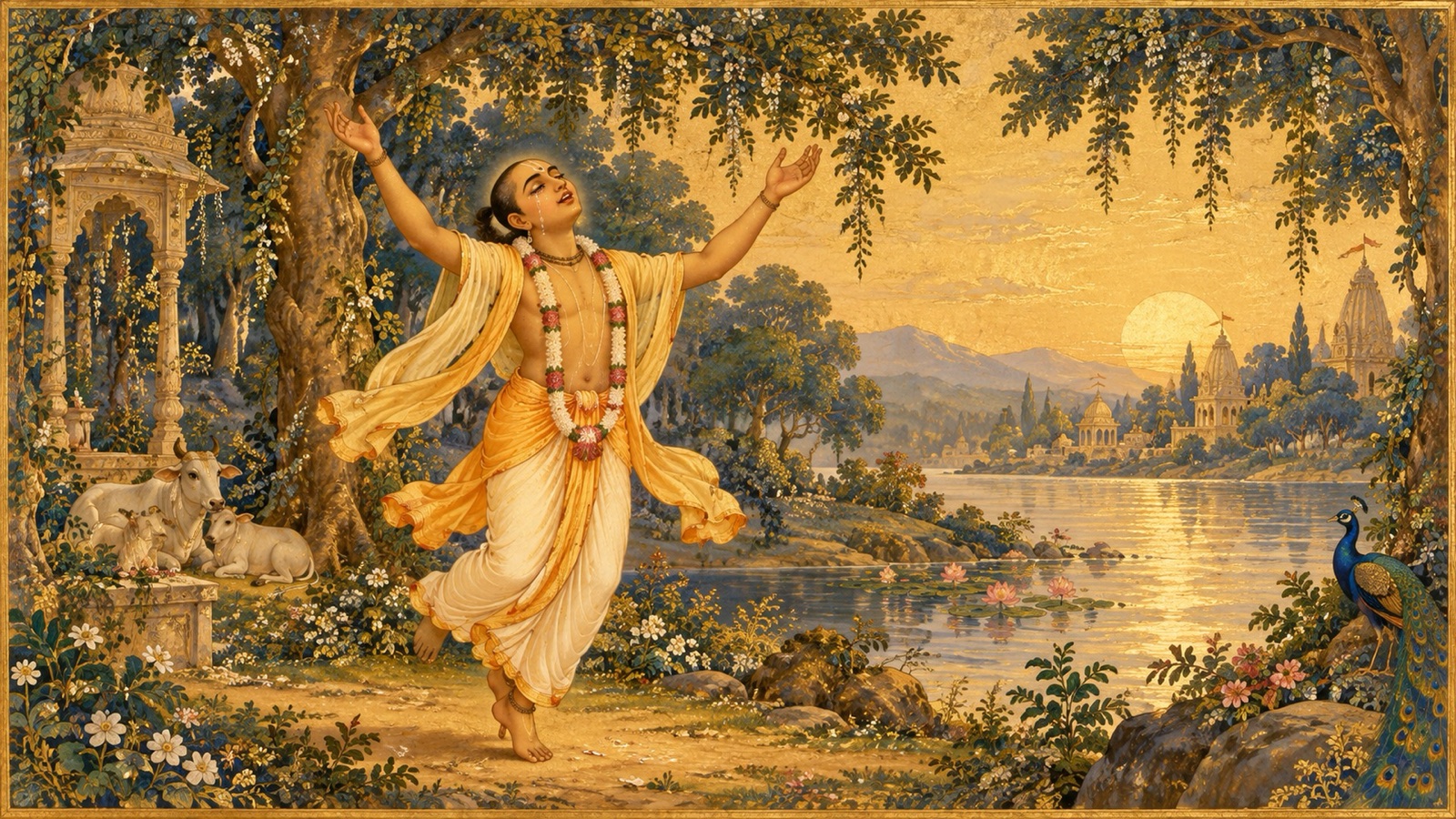
Then Kavi described the sweet transformation such devotion brings. Hearing of the Lord’s auspicious descents and singing the names that celebrate His deeds, one should move freely through the world, without fear of ridicule and without attachment. The devotee whose heart melts with love for the beloved Lord’s names is carried beyond the bounds of ordinary conduct.
एवंव्रतः स्वप्रियनामकीर्त्या जातानुरागो द्रुतचित्त उच्चैः । हसत्यथो रोदिति रौति गाय- त्युन्मादवन्नृत्यति लोकबाह्यः ॥ ४० ॥
evaṁ-vrataḥ sva-priya-nāma-kīrtyā jātānurāgo druta-citta uccaiḥ hasaty atho roditi rauti gāyaty unmāda-van nṛtyati loka-bāhyaḥ
Meaning: Firm in this vow, his heart melting as he sings the names of his beloved Lord, and love awakened within him, he loudly laughs, weeps, cries out, sings and dances like one possessed — transcending the conventions of ordinary people. (Canto 11, Chapter 2, verse 40)
Such a devotee, Kavi continued, bows with reverence to the sky, air, fire, water, earth, the heavenly bodies, living beings, all directions, trees, rivers and seas — regarding them all as the very body of the Lord.
Where Devotion, Detachment and Realization Meet
Kavi then gave a beautiful image for the sure signs of progress. As one who eats feels satisfaction, nourishment and relief from hunger with every morsel, so in one who takes shelter of the Lord, three things arise together — devotion to the Lord, direct realization of Him, and detachment from all else.
इत्यच्युताङ्घ्रिं भजतोऽनुवृत्त्या भक्तिर्विरक्तिर्भगवत्प्रबोधः । भवन्ति वै भागवतस्य राजं- स्ततः परां शान्तिमुपैति साक्षात् ॥ ४३ ॥
ity acyutāṅghriṁ bhajato ‘nuvṛttyā bhaktir viraktir bhagavat-prabodhaḥ bhavanti vai bhāgavatasya rājaṁs tataḥ parāṁ śāntim upaiti sākṣāt
Meaning: Thus, O king, for one who constantly serves the feet of the infallible Lord, devotion, detachment and realization of the Lord arise together; and through them he directly attains the supreme peace. (Canto 11, Chapter 2, verse 43)
Havi Speaks — The Marks of a Devotee
Delighted, King Nimi next asked the sages to describe the characteristics of the Lord’s devotee: how he lives, how he behaves and speaks, and what makes him dear to the Lord. The second sage, Havi, answered by distinguishing degrees of devotion. The topmost devotee sees the Lord within all beings and all beings within the Lord.
सर्वभूतेषु यः पश्येद् भगवद्भावमात्मनः । भूतानि भगवत्यात्मन्येष भागवतोत्तमः ॥ ४५ ॥
sarva-bhūteṣu yaḥ paśyed bhagavad-bhāvam ātmanaḥ bhūtāni bhagavaty ātmany eṣa bhāgavatottamaḥ
Meaning: One who sees the presence of the Lord — the Self — in all beings, and sees all beings resting in the Lord, is the topmost devotee. (Canto 11, Chapter 2, verse 45)
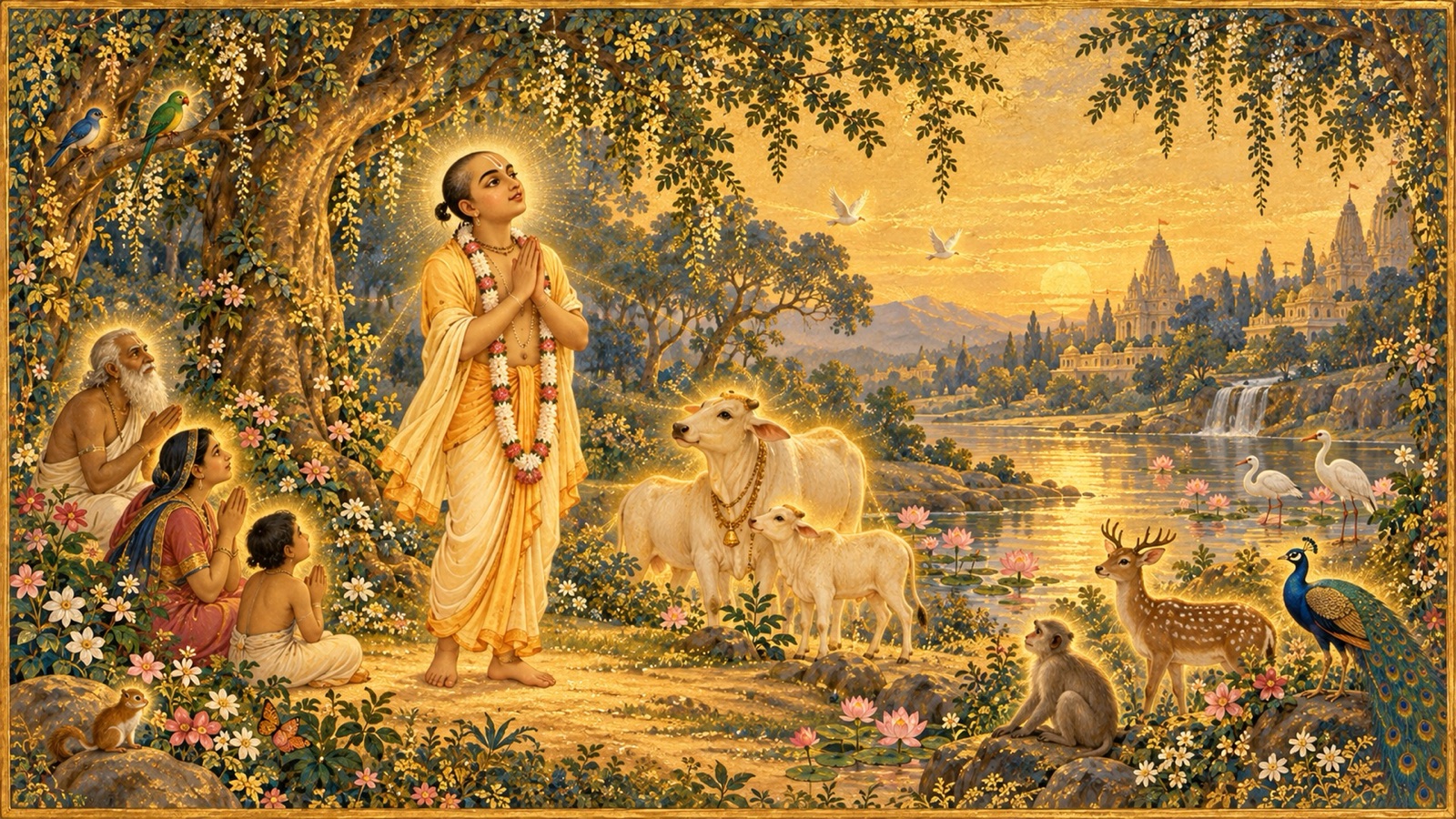
The second-rate devotee, Havi explained, loves the Lord, befriends His devotees, is compassionate to the ignorant and indifferent to the envious — yet still makes distinctions among them. The ordinary devotee worships the Lord faithfully in the sacred image, but does not yet serve His devotees and other beings. Havi went on to describe the qualities of the highest devotees: they are never overwhelmed by the body’s demands of birth and death, hunger, fatigue, fear and longing; they never identify the self with the body’s caste or condition; they treat their own and others’ possessions alike, viewing all beings with an equal and peaceful eye. Even for the sovereignty of the three worlds, and not for even half an instant, would such a one turn away from the Lord’s lotus-feet. In them the memory of the Lord remains ever fresh, and the Lord Himself never abandons the heart to which His feet are bound.
Principal Teachings of This Chapter
1. Bhagavata-dharma frees the soul from all fear. The whole discourse answers a single question — what practice, heard with faith, releases a mortal from fear? The answer is loving service of the Lord’s feet, taught by the Lord Himself (verses 7, 33-34).
2. The path is open even to the unlearned. These devotional duties are so gracious that even one who follows them “with eyes closed” does not stumble — devotion does not depend on scholarship, but on sincerity (verses 34-35).
3. Consecrate every act to the Lord. Whatever we do with body, speech, mind or intellect can become worship when offered to Narayana — turning ordinary life into continuous devotion (verse 36).
4. Love awakened overflows into ecstasy. As devotion ripens, the melted heart laughs, weeps, sings and dances beyond convention — a sign that the name of the beloved Lord has truly taken hold (verse 40).
5. Devotion, realization and detachment grow together. Like satisfaction, nourishment and the end of hunger with each morsel, these three arise simultaneously in the devotee and lead to supreme peace (verse 43).
6. The greatest devotee sees the Lord everywhere. The topmost bhagavata beholds every creature as resting in the Lord and the Lord pervading every creature, and so lives in unbroken remembrance and equal vision (verse 45).
A Devotional Reflection
There is a quiet reassurance in this chapter for anyone who has ever felt unequal to the spiritual path. The sages do not begin with austerities we cannot perform or philosophy we cannot grasp. They begin with the tenderest fact: our minds are restless because we have mistaken this fragile body for our very selves, and from that single error every fear is born. Their remedy is not a burden but a refuge — to take shelter of the Lord’s feet and to offer Him the ordinary substance of our days. What moves the heart most is Kavi’s promise that even one who runs this path “with eyes closed” will not fall. We are not asked to see the whole way clearly before we begin; we are asked only to begin, in faith, and to let devotion, understanding and freedom grow in us together, morsel by morsel, until the beloved names melt the heart and the Lord Himself becomes the guest who never departs.
A Daily Devotional Practice
Today, choose one ordinary action — a meal prepared, work completed, a kindness done — and consciously offer it to the Lord before you begin, in the spirit of Kavi’s teaching to consecrate all that we do to Narayana. As you offer it, softly chant the name of your beloved Lord: “Om Namo Bhagavate Vasudevaya.” Let even this small act of dedication remind you that the whole of life can become worship, and that even half a moment turned toward the saintly and the sacred is, as King Nimi said, a priceless treasure.
Conclusion
The second discourse of Book Eleven opens the great inner theme of the Bhagavatam: the path of loving devotion that pleases the Lord and dissolves all fear. Through Narada’s memory of King Nimi and the nine Yogendras, we hear the sage Kavi reveal bhagavata-dharma — the sure, gracious, universally accessible way of taking shelter of the Lord’s feet, consecrating every act to Him, and singing His names until the heart melts in love — and we hear the sage Havi describe the tender marks by which the Lord’s devotees may be known. Devotion, realization and detachment, we learn, ripen together and carry the soul to supreme peace. As the questions of the wise King Nimi continue, the remaining Yogendras will speak in turn, unfolding still deeper facets of this same imperishable wisdom.
May the divine wisdom of Srimad Bhagavatam awaken pure devotion within our hearts.
Om Namo Bhagavate Vasudevaya.
Jay Shree Madhav.
References and Attribution
- Primary edition: Gita Press, Śrīmad Bhāgavata Mahāpurāṇa (English, complete), Book Eleven, Discourse 2, pages 518–523.
- Series: Srimad Bhagavatam Wisdom · Biswa Sanatan Dharma Seva Trust.
- Presented following the spiritual guidance and recommendation of Pandit Dr. Shri Kashinath Mishra.
This is an original, faithful retelling in the writer’s own words, with brief quoted verses shown in Devanāgarī and transliteration and their meanings given as summaries. It is not a reproduction of any single publisher’s continuous translation or commentary. No affiliation with or endorsement by any publisher is implied.
Jay Shree Madhav