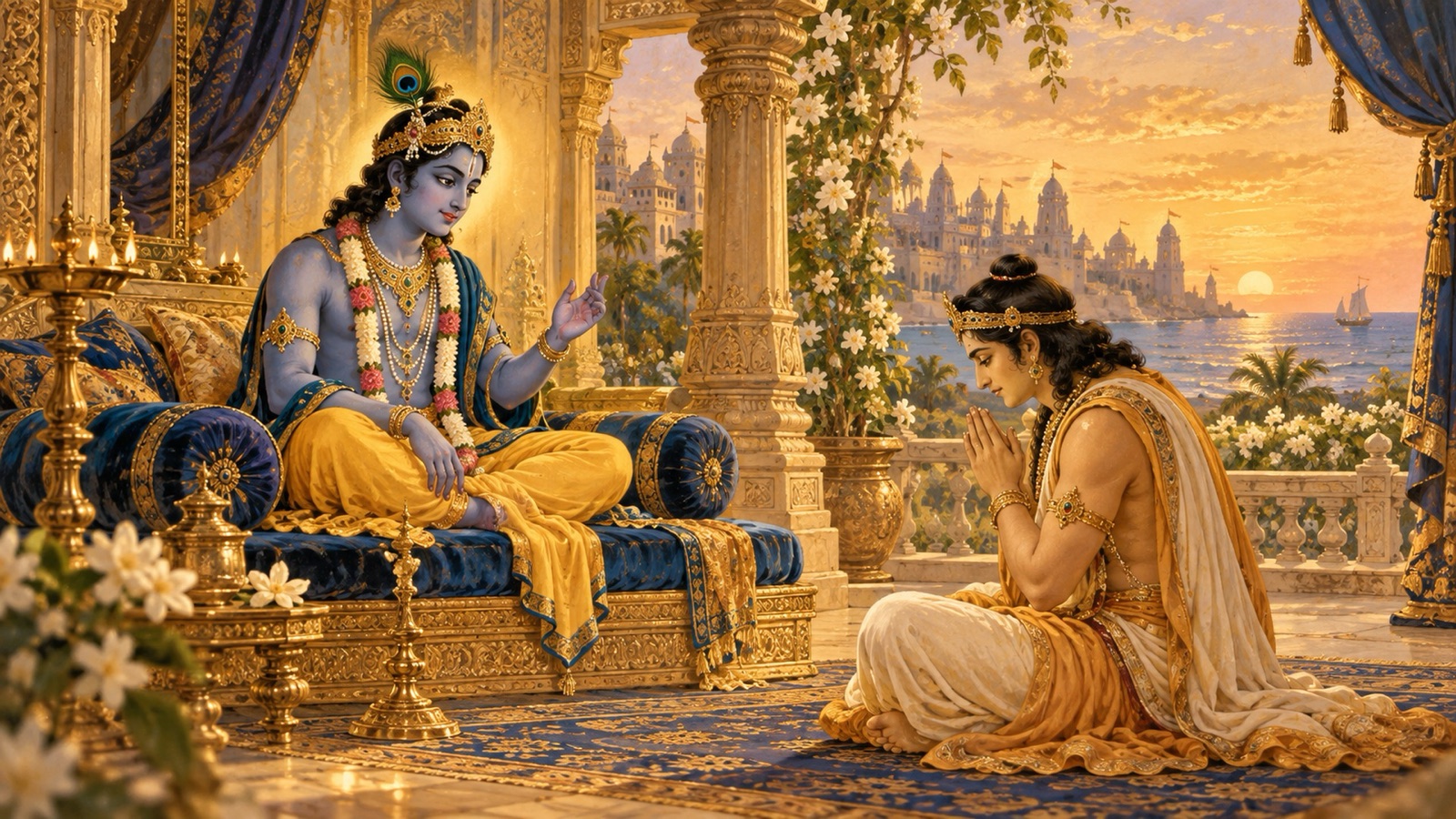
Lord Sri Krishna continues His teaching to Uddhava, revealing the soul as ever distinct from the body, the futility of desire-driven action, and the emptiness of both earthly and heavenly enjoyments — for even the joys of heaven end in a fall, and only knowledge of the Self brings lasting freedom.
Om Namo Bhagavate Vasudevaya.
Om Namo Bhagavate Vasudevaya.
Om Namo Bhagavate Vasudevaya.
Welcome to Srimad Bhagavatam Wisdom, a devotional journey through the sacred histories and teachings of the Srimad Bhagavat Mahapurana. In the previous chapters the Lord had related, through the story of the avadhuta and his twenty-four gurus, the wisdom of renunciation and equal vision. Now He speaks again in His own voice, guiding Uddhava into the heart of that wisdom. He teaches him to perform his prescribed duties in a spirit of surrender and without desire, to serve a true preceptor, and to realize the Self as forever distinct from the body — as fire is distinct from the wood it burns. Then, with piercing clarity, the Lord exposes the emptiness of every enjoyment the world and even the heavens can offer: the pleasures of earth end in death, and the delights of heaven, won by good deeds, end in a reluctant fall when merit is spent. There is no lasting happiness for the embodied soul who clings to the modes of nature; freedom comes only through knowledge of the Self. The chapter closes as Uddhava, moved by these truths, begins to ask how the soul comes to be bound at all.
Chapter Information
- Scripture: Śrīmad Bhāgavata Mahāpurāṇa
- Canto: 11 (Book Eleven)
- Chapter: 10 (Discourse 10)
- Chapter title: The Emptiness of Worldly and Heavenly Enjoyments
- Principal speaker: Sri Krishna, instructing Uddhava; the whole related by Sukadeva Gosvami to King Parikshit
- Principal listener: Uddhava; and, in the framing narration, King Parikshit
- Main setting: Dwaraka, in the Lord’s dialogue with Uddhava on the eve of His departure
- Central subject: The performance of duty without desire, service to the preceptor, the soul as distinct from the body, and the emptiness of both earthly and heavenly enjoyments
- Principal verse range: Canto 11, Chapter 10, verses 1–37
- Primary edition: Gita Press Śrīmad Bhāgavata Mahāpurāṇa
Context from the Previous Chapter
In Chapter 9, the wandering ascetic completed his teaching of the twenty-four gurus, honouring the rare gift of human birth and taking his leave, leaving King Yadu free of attachment and serene. The Lord had related that whole story to Uddhava as a mirror of the renunciation He was calling him to embrace. Now the Lord resumes His teaching directly, showing Uddhava how to live that renunciation and why every worldly and heavenly enjoyment falls short of the freedom found in the Self.
Duty Without Desire, and Service to the Preceptor
The Lord began by directing Uddhava to attend faithfully to the duties He had taught, taking refuge in Him and following the conduct proper to his station, but without any craving for its fruits.
श्रीभगवानुवाच मयोदितेष्ववहित: स्वधर्मेषु मदाश्रय: । वर्णाश्रमकुलाचारमकामात्मा समाचरेत् ॥ १ ॥
śrī-bhagavān uvāca mayoditeṣv avahitaḥ sva-dharmeṣu mad-āśrayaḥ varṇāśrama-kulācāram akāmātmā samācaret
Meaning: The Lord said: Taking refuge in Me and attentive to the duties I have taught, a person free of selfish desire should carry out the conduct proper to his order, stage of life and family. (Canto 11, Chapter 10, verse 1)
Having thus purified his mind, the Lord said, Uddhava should observe how the actions of worldly people, who take sense-pleasures to be real, in fact yield the opposite of what they seek and end in misery; for the sense of endless differences, produced by the modes of nature, is as unreal as the images of a dream. One devoted to the Lord should perform all obligatory duties yet give up every action prompted by desire; and one fully absorbed in inquiry into the Self need not depend even on prescribed rites. The seeker should serve a tranquil preceptor who has realized the Lord, free of pride, envy, sloth and possessiveness, firm in devotion, seeking only Self-knowledge and never given to fault-finding or idle talk, unattached to wife, children, home and wealth, and even-minded toward all.
The Soul Is Distinct from the Body
The Lord then revealed the heart of self-knowledge: the soul, the self-luminous witness, is forever distinct from both the subtle and the gross body — as fire, which burns and illumines, is distinct from the wood it consumes.
विलक्षण: स्थूलसूक्ष्माद् देहादात्मेक्षिता स्वदृक् । यथाग्निर्दारुणो दाह्याद् दाहकोऽन्य: प्रकाशक: ॥ ८ ॥
vilakṣaṇaḥ sthūla-sūkṣmād dehād ātmekṣitā sva-dṛk yathāgnir dāruṇo dāhyād dāhako ’nyaḥ prakāśakaḥ
Meaning: The self-luminous soul, the seer, is distinct from the gross and subtle body — just as fire, which burns and reveals, is distinct from the firewood it consumes. (Canto 11, Chapter 10, verse 8)
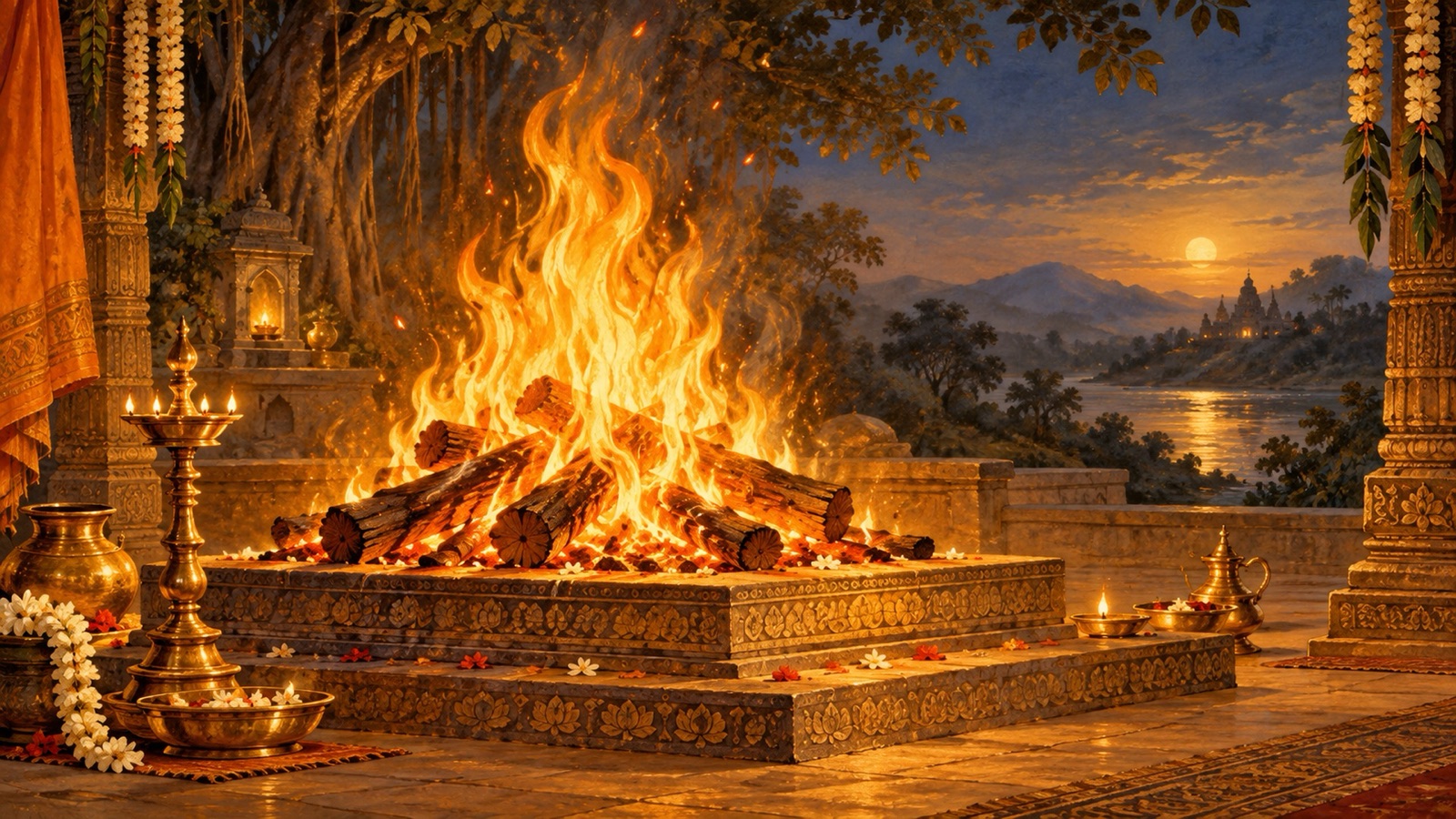
Yet just as fire entering wood seems to take on the wood’s shape, size and destructibility, so the soul, entering a body, appears to take on its attributes; and this misidentification, born of the modes of nature, is the very cause of the soul’s wandering through birth after birth. It is dispelled only by true knowledge of the Self, gained by careful inquiry.
The Fire of Knowledge
To show how such knowledge arises, the Lord gave a beautiful image drawn from the kindling of the sacred fire, where two sticks are churned together to produce flame.
आचार्योऽरणिराद्य: स्यादन्तेवास्युत्तरारणि: । तत्सन्धानं प्रवचनं विद्यासन्धि: सुखावह: ॥ १२ ॥
ācāryo ’raṇir ādyaḥ syād ante-vāsy uttarāraṇiḥ tat-sandhānaṁ pravacanaṁ vidyā-sandhiḥ sukhāvahaḥ
Meaning: The teacher is the lower kindling-stick, the disciple the upper, and the instruction between them the churning; the joyful fire of knowledge that is thus produced brings blessedness. (Canto 11, Chapter 10, verse 12)
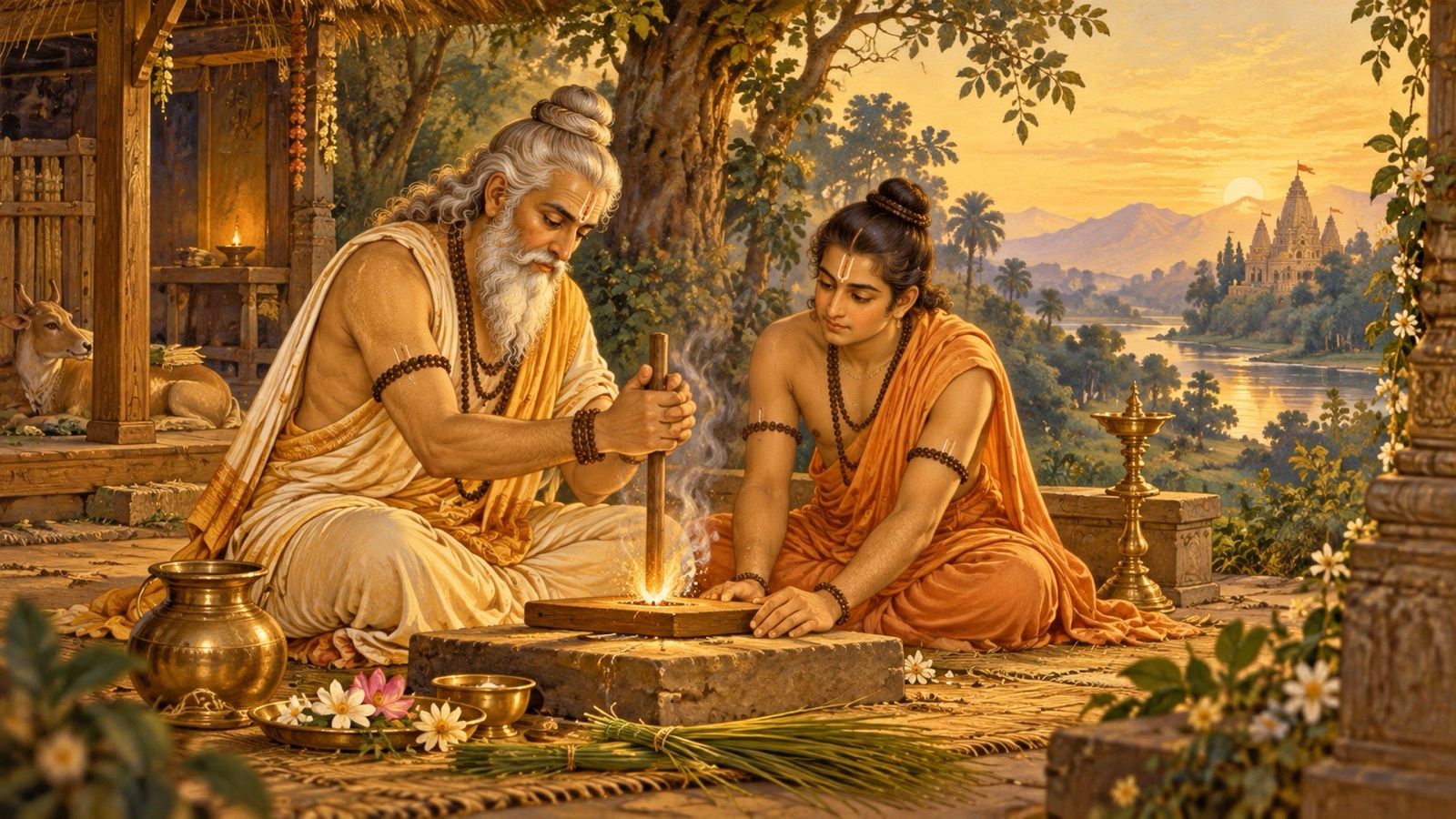
The pure wisdom gained from a true teacher, the Lord said, burns away the illusion woven of the three modes, and the very modes with it; and at last the intellect itself grows still, like a fire whose fuel is spent.
The Emptiness of Earthly Enjoyment
The Lord then turned to expose the hollowness of all enjoyment. Even the learned, because they dwell in bodies, find no true happiness, and even fools are not spared sorrow; so the pride of both is empty. However cleverly people learn to gain pleasure and avoid pain, none has ever found a way to escape death. And with death always near, what pleasure can wealth or enjoyment truly give?
कोऽन्वर्थ: सुखयत्येनं कामो वा मृत्युरन्तिके । आघातं नीयमानस्य वध्यस्येव न तुष्टिद: ॥ २० ॥
ko ’nv arthaḥ sukhayaty enaṁ kāmo vā mṛtyur antike āghātaṁ nīyamānasya vadhyasyeva na tuṣṭi-daḥ
Meaning: What wealth or enjoyment can truly gladden a person when death stands near? — no more than the condemned, being led to the place of execution, can take joy in anything. (Canto 11, Chapter 10, verse 20)
The Emptiness of Heavenly Enjoyment
Nor is the bliss of heaven any different, the Lord continued. Like earthly pleasure, it too is spoiled by rivalry, envy, decline and decay, and, hedged about with obstacles, it often proves as fruitless as a failed harvest.
श्रुतं च दृष्टवद् दुष्टं स्पर्धासूयात्ययव्ययै: । बह्वन्तरायकामत्वात् कृषिवच्चापि निष्फलम् ॥ २१ ॥
śrutaṁ ca dṛṣṭa-vad duṣṭaṁ spardhāsūyātyaya-vyayaiḥ bahv-antarāya-kāmatvāt kṛṣi-vac cāpi niṣphalam
Meaning: The joy of heaven, of which we hear, is flawed like the pleasures we see — marred by rivalry, envy, decline and loss; and beset with many obstacles, it proves as fruitless as a crop that fails. (Canto 11, Chapter 10, verse 21)
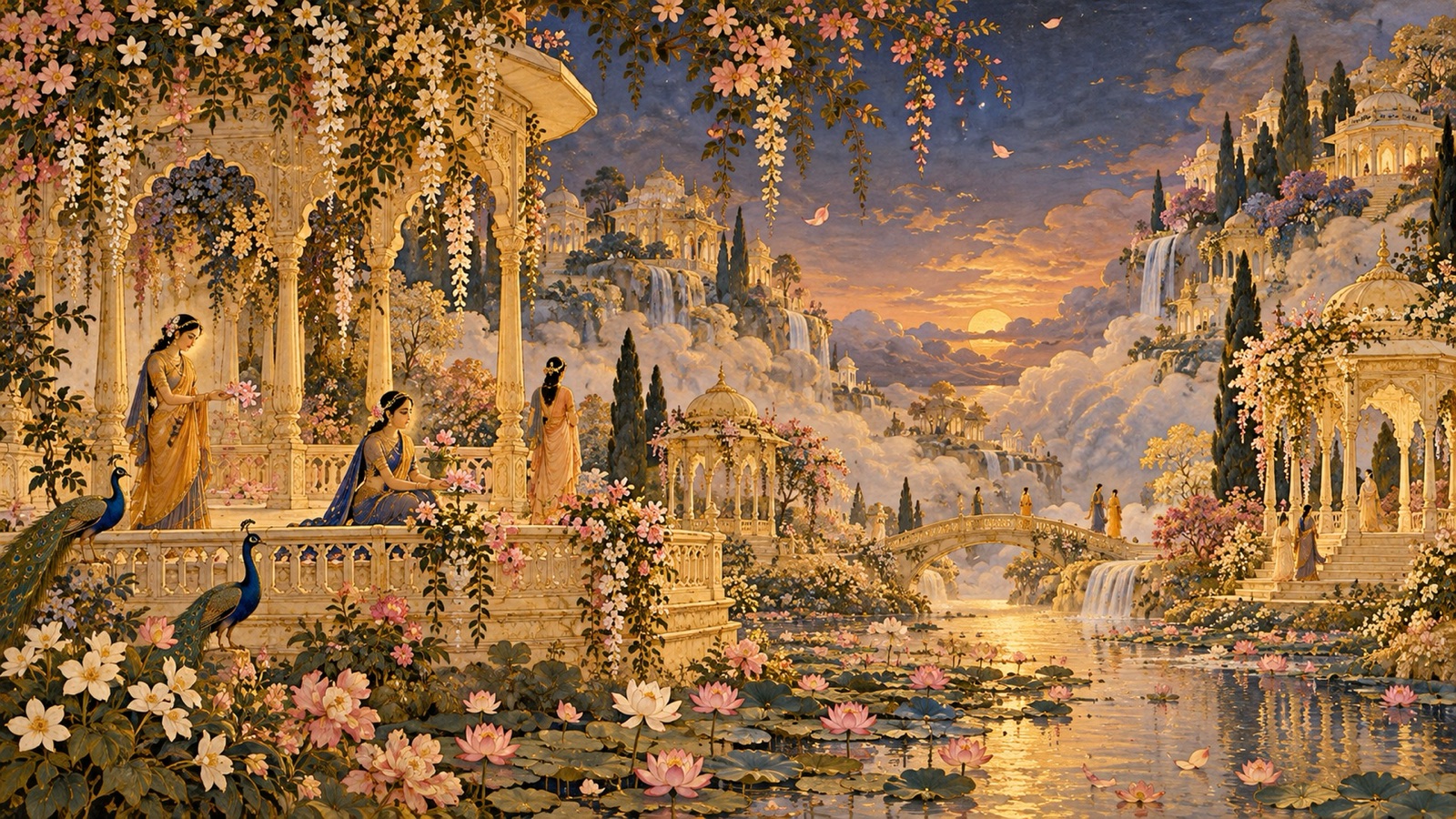
He described how one who performs sacrifices and propitiates the gods rises to heaven and enjoys its pleasures, taking a radiant form, riding in a celestial chariot amid heavenly companions and song. Yet even as he sports there, he does not notice his coming fall.
तावत् स मोदते स्वर्गे यावत् पुण्यं समाप्यते । क्षीणपुण्य: पतत्यर्वागनिच्छन् कालचालित: ॥ २६ ॥
tāvat sa modate svarge yāvat puṇyaṁ samāpyate kṣīṇa-puṇyaḥ pataty arvāg anicchan kāla-cālitaḥ
Meaning: He rejoices in heaven only so long as his merit lasts; when his merit is spent, he falls, against his will, driven downward by the force of time. (Canto 11, Chapter 10, verse 26)
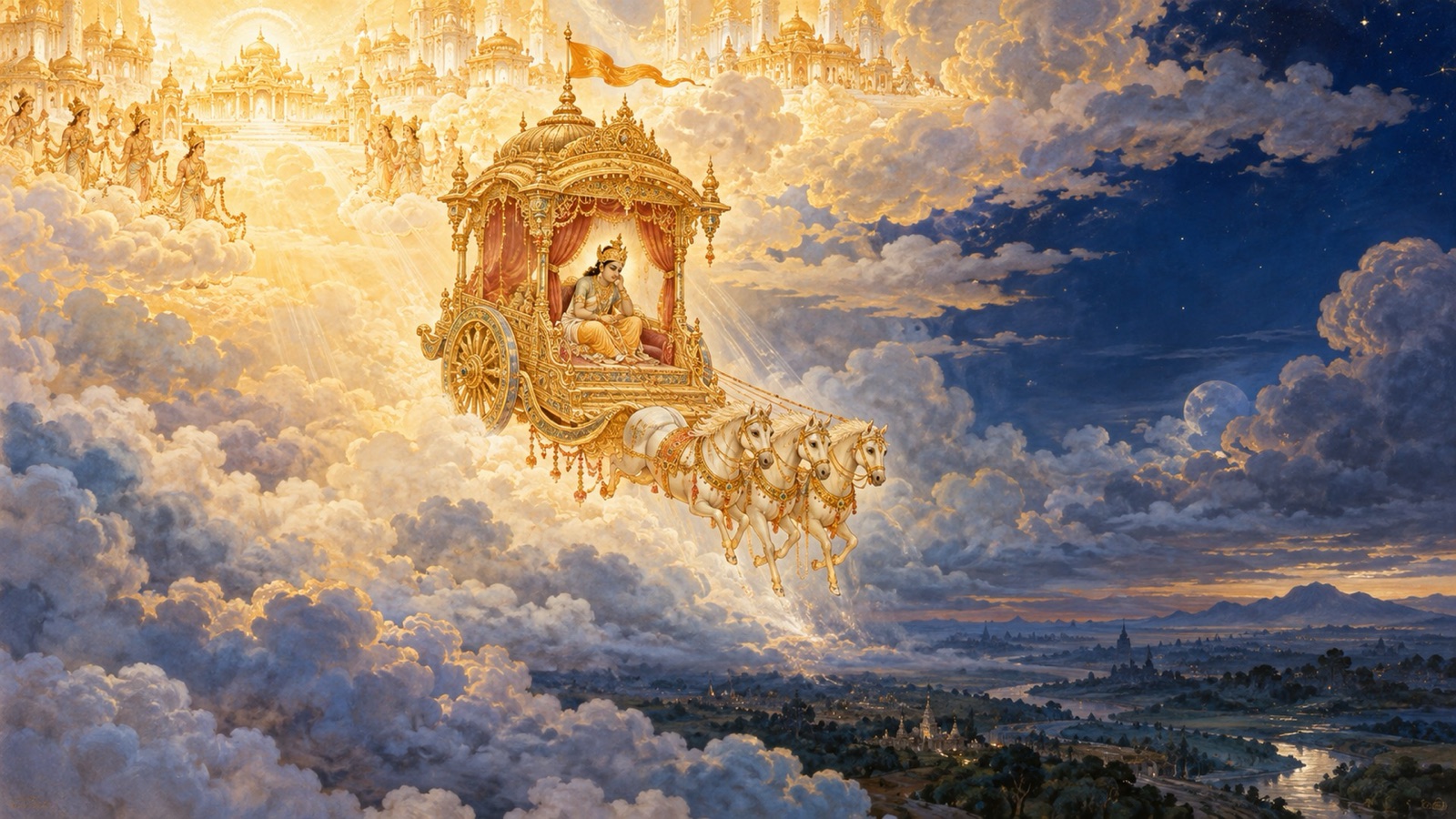
Those who instead keep company with the wicked, delight in wrongdoing and lose mastery of their senses sink to lower realms and lowly births. Clothed in body after body, a person performs actions that bring misery, takes on yet another body as their fruit, and so finds only a little happiness in the world. Even the great rulers of the cosmic regions, and Brahma himself, live in awe of the Lord as Time.
The Lord as Time and the Root of Bondage
The senses, prompted by the modes of nature, drive a person to action, and the embodied soul, identifying with body and senses, reaps the fruit. As long as the diversity of the modes prevails, the one Self appears as many; as long as it appears as many, the state of dependence continues; and as long as dependence continues, there is fear before the Lord. Those who take shelter in the modes are thus deluded and come to grief. The Lord revealed that He Himself is known by many names when the equilibrium of the modes is stirred into creation.
काल आत्मागमो लोक: स्वभावो धर्म एव च । इति मां बहुधा प्राहुर्गुणव्यतिकरे सति ॥ ३४ ॥
kāla ātmāgamo lokaḥ svabhāvo dharma eva ca iti māṁ bahudhā prāhur guṇa-vyatikare sati
Meaning: Time, the Self, the scriptures, the world, one’s nature and Dharma — by such many names do the wise call Me, when the modes of nature are stirred into activity. (Canto 11, Chapter 10, verse 34)
Uddhava’s Question
Hearing all this, Uddhava was moved to ask a searching question about the very nature of bondage: if the soul is truly distinct from the modes born of the body, how does it come to be bound by them at all?
श्रीउद्धव उवाच गुणेषु वर्तमानोऽपि देहजेष्वनपावृत: । गुणैर्न बध्यते देही बध्यते वा कथं विभो ॥ ३५ ॥
śrī-uddhava uvāca guṇeṣu vartamāno ’pi deha-jeṣv anapāvṛtaḥ guṇair na badhyate dehī badhyate vā kathaṁ vibho
Meaning: Uddhava said: O Lord, though dwelling amid the modes born of the body, why is the embodied soul not bound by them — or, if it is, how does such bondage come about? (Canto 11, Chapter 10, verse 35)
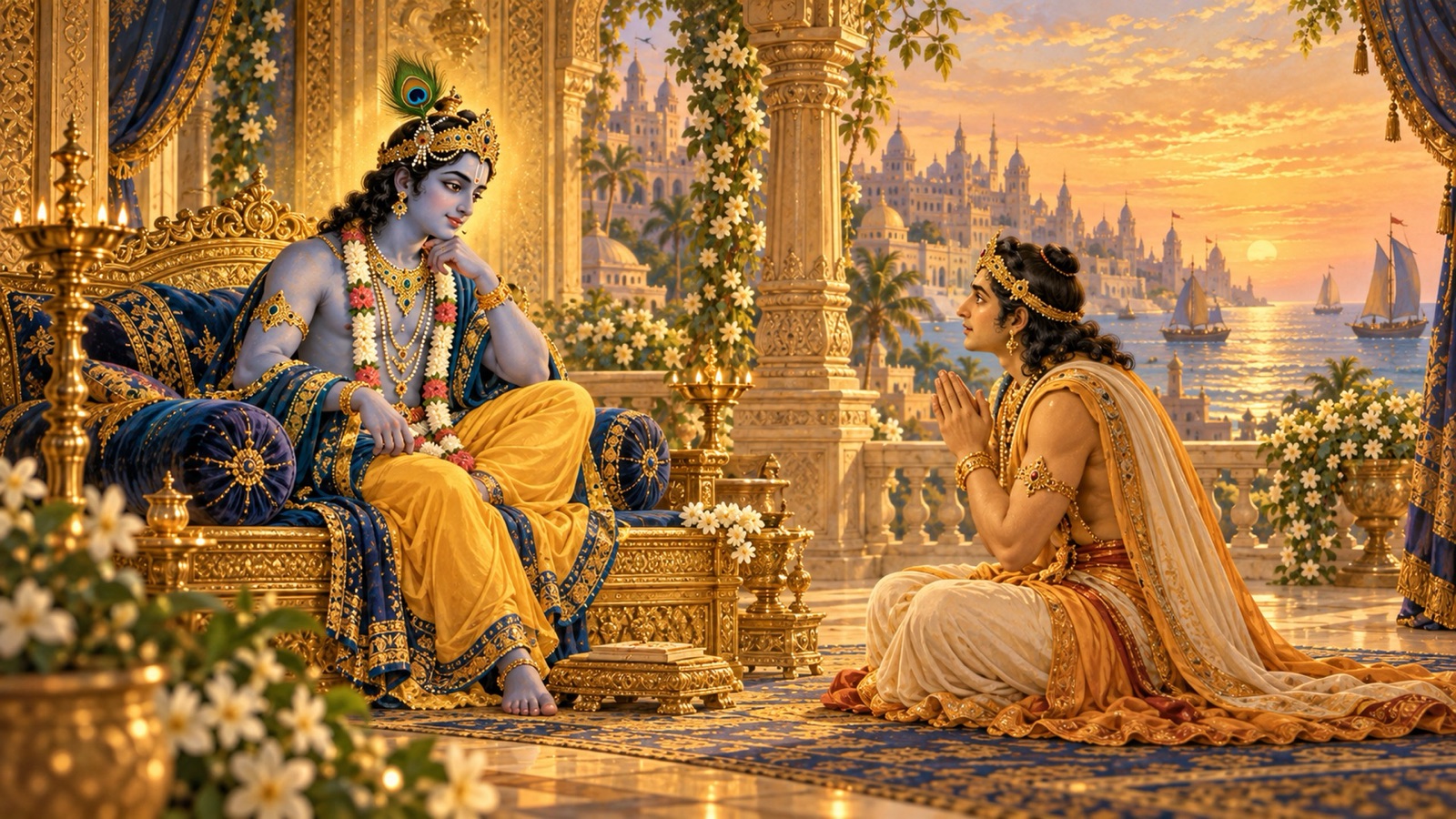
He asked further how a soul, whether bound or freed, behaves and may be recognized — how it eats, rests, sleeps, sits and moves — and begged the Lord, the foremost in resolving doubts, to clear his uncertainty as to whether the same Self is at once ever-bound and ever-free. With this question the discourse closes, and the Lord’s answer opens the chapter that follows.
Principal Teachings of This Chapter
1. Do your duty in surrender, without desire. The devotee performs prescribed duties as an offering to the Lord, giving up all craving for their fruits (verses 1-4).
2. Serve a true preceptor with humility. Freedom from pride, envy and possessiveness, and devoted service to a realized teacher, prepare the heart for knowledge (verses 5-7).
3. The soul is not the body. As fire is distinct from the wood it burns, the self-luminous soul is forever distinct from the gross and subtle body; misidentifying with the body is the root of all wandering (verses 8-11).
4. Knowledge is kindled like sacred fire. The teacher, the disciple and the instruction between them are like the churning that brings forth the blessed fire of knowledge, which burns away illusion (verses 12-13).
5. Earthly and heavenly enjoyments are alike empty. With death always near, no pleasure can truly satisfy; and even the joys of heaven end in a reluctant fall when merit is spent (verses 18-26).
6. Bondage arises from the modes of nature. So long as the soul identifies with the modes, it appears manifold and dependent; freedom comes only through knowledge of the Self (verses 31-34).
A Devotional Reflection
This chapter can seem stern at first, for it strips away one comfort after another — the pleasures of the world, the pride of learning, even the shining rewards of heaven. But its severity is a kindness. The Lord is not condemning joy; He is freeing us from placing our hope where it can only fail us. Every enjoyment He examines shares the same flaw: it ends. The condemned man cannot enjoy the walk to his fate, and the soul in heaven, for all its splendour, is quietly falling even as it revels. What the Lord offers in place of these fading things is something that does not end — the knowledge of who we truly are. The image of fire and wood is a gentle reassurance hidden within the teaching: whatever the body suffers or enjoys, the soul that witnesses it remains untouched, luminous, free. And the way to that freedom is beautifully humble — to do our duty as an offering, to sit at the feet of one who knows, and to let the quiet friction of teaching and listening kindle a light within. It is fitting that the chapter ends not with a conclusion but with Uddhava’s honest question, for the spiritual life advances not by pretending to understand, but by asking, in trust, from the heart.
A Daily Devotional Practice
Today, practise the Lord’s teaching that the soul is distinct from the body. Sit quietly for a few minutes and gently observe your own thoughts, sensations and feelings as they come and go, silently noting that you are the one who witnesses them, not the passing states themselves — as fire is other than the wood it lights. Then, releasing your hold on some passing pleasure or worry, turn inward to the Lord and softly repeat His holy name: “Om Namo Bhagavate Vasudevaya.” In this simple watchfulness you begin to taste the freedom this chapter points to — resting, even briefly, as the luminous witness, untouched and at peace in Him.
Conclusion
The tenth discourse of Book Eleven carries the Lord’s teaching to Uddhava into the heart of self-knowledge and detachment. Sri Krishna calls him to perform his duties in surrender and without desire, to serve a realized preceptor, and to know the self-luminous soul as forever distinct from the body, as fire from the wood it burns. He shows that such knowledge is kindled like a sacred fire between teacher and disciple, and that it burns away the illusion of the modes. Then, unflinchingly, He exposes the emptiness of every enjoyment: earthly pleasures shadowed always by death, and heavenly joys that end in a reluctant fall when merit is spent. So long as the soul clings to the modes of nature it remains bound, appearing manifold and dependent; freedom lies only in knowledge of the Self. The chapter closes as Uddhava, stirred by these truths, asks how the soul comes to be bound at all — a question the Lord will answer in the discourse to follow.
May the divine wisdom of Srimad Bhagavatam awaken pure devotion within our hearts.
Om Namo Bhagavate Vasudevaya.
Jay Shree Madhav.
References and Attribution
- Primary edition: Gita Press, Śrīmad Bhāgavata Mahāpurāṇa (English, complete), Book Eleven, Discourse 10, pages 558–560.
- Series: Srimad Bhagavatam Wisdom · Biswa Sanatan Dharma Seva Trust.
- Presented following the spiritual guidance and recommendation of Pandit Dr. Shri Kashinath Mishra.
This is an original, faithful retelling in the writer’s own words, with brief quoted verses shown in Devanāgarī and transliteration and their meanings given as summaries. It is not a reproduction of any single publisher’s continuous translation or commentary. No affiliation with or endorsement by any publisher is implied.
Jay Shree Madhav