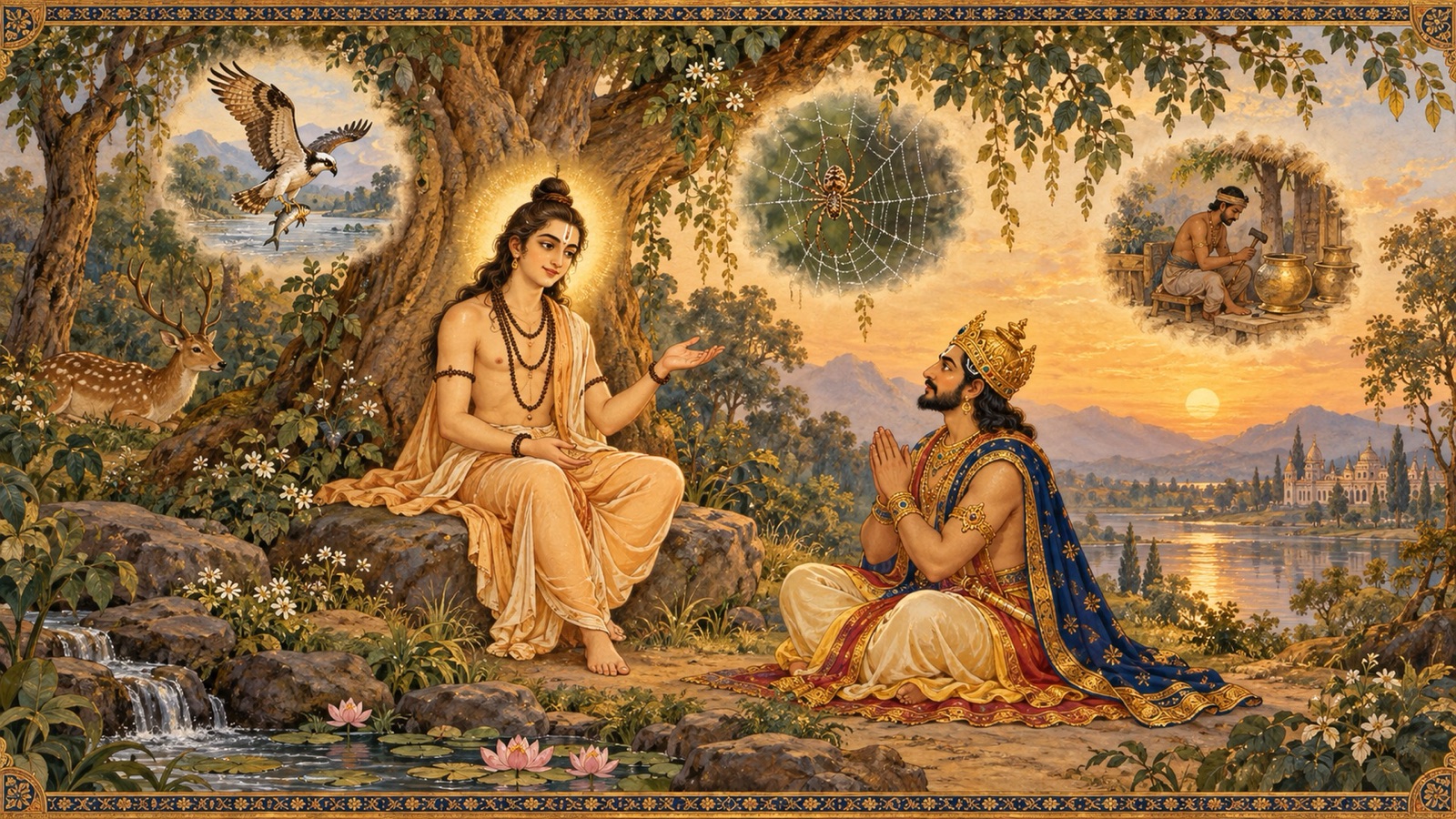
The wandering ascetic brings his great teaching to its culmination, drawing seven final lessons from the creatures and craftsmen he encounters, and of the body itself as a final teacher, before honouring the rare gift of human birth and taking his leave.
Om Namo Bhagavate Vasudevaya.
Om Namo Bhagavate Vasudevaya.
Om Namo Bhagavate Vasudevaya.
Welcome to Srimad Bhagavatam Wisdom, a devotional journey through the sacred histories and teachings of the Srimad Bhagavat Mahapurana. In the previous chapter, the wandering ascetic told King Yadu of nine of his teachers, closing with the moving story of Pingala the courtesan, who found peace by giving up all hope. In this chapter he brings his discourse to its close, drawing his final seven lessons from a bird releasing its prey, a carefree child, a quiet maiden, an absorbed craftsman, a reptile, an insect that spins its own snare, and a stinging wasp — and then the greatest lesson of all, drawn from his own body: that this rare human birth, so frail and fleeting, is the one open door to liberation and must not be squandered. Having taught that comprehensive wisdom is gathered from many teachers, not one, the ascetic takes his leave; and King Yadu, freed of all attachment, is left in perfect peace of mind. So ends the beautiful teaching of the twenty-four gurus, which the Lord related to Uddhava.
Chapter Information
- Scripture: Śrīmad Bhāgavata Mahāpurāṇa
- Canto: 11 (Book Eleven)
- Chapter: 9 (Discourse 9)
- Chapter title: The Avadhuta’s Final Teachers and the Rare Human Birth
- Principal speaker: The avadhuta Brahmana (Dattatreya), answering King Yadu; the whole related by Sri Krishna to Uddhava, and by Sukadeva Gosvami to King Parikshit
- Principal listener: King Yadu; and, in the framing narration, Uddhava and King Parikshit
- Main setting: An ancient meeting of King Yadu and a wandering ascetic, within the Lord’s narration to Uddhava at Dwaraka
- Central subject: The lessons the ascetic learned from his last seven gurus and from his own body, the supreme value of human birth, and the close of the discourse of the twenty-four teachers
- Principal verse range: Canto 11, Chapter 9, verses 1–33
- Primary edition: Gita Press Śrīmad Bhāgavata Mahāpurāṇa
Context from the Previous Chapter
In Chapter 8, the ascetic told King Yadu of nine more of his teachers — the python, the sea, the moth, the bee, the elephant, the honey-gatherer, the deer and the fish — and related the awakening of Pingala the courtesan, who cut off every worldly hope and took refuge in the Lord. This chapter continues the same discourse to its conclusion, as the ascetic names his remaining teachers and reflects on the priceless opportunity of human life.
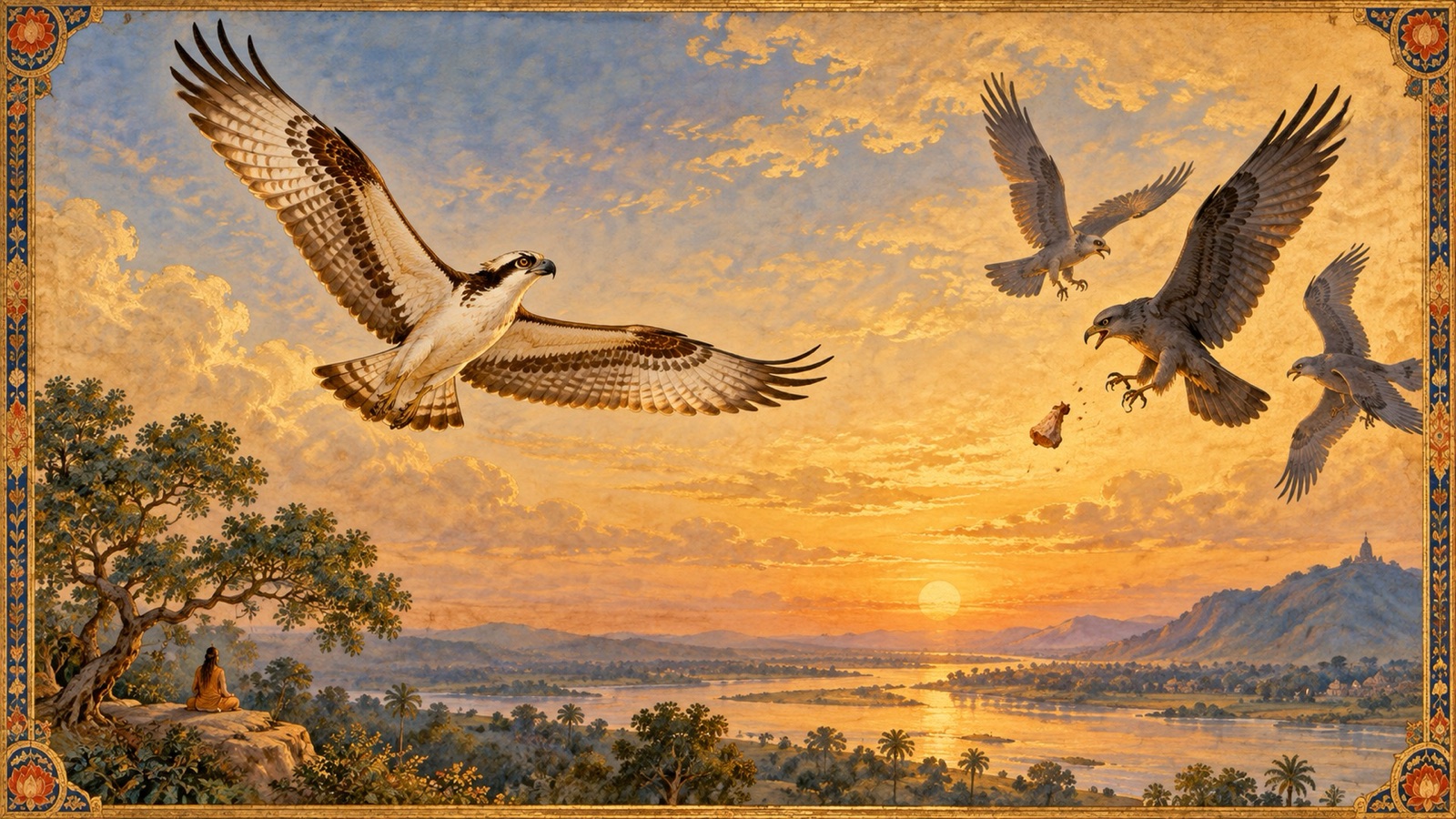
The Osprey — the Burden of Possession
The Brahmana began this portion with a principle that runs through all the lessons to follow: whatever a person holds most dear becomes, in the end, a source of sorrow, and only the one who is free of grasping finds unending happiness.
श्रीब्राह्मण उवाच परिग्रहो हि दु:खाय यद् यत्प्रियतमं नृणाम् । अनन्तं सुखमाप्नोति तद् विद्वान् यस्त्वकिञ्चन: ॥ १ ॥
śrī-brāhmaṇa uvāca parigraho hi duḥkhāya yad yat priyatamaṁ nṛṇām anantaṁ sukham āpnoti tad vidvān yas tv akiñcanaḥ
Meaning: The Brahmana said: Whatever is most dear to a person becomes a cause of grief, for possession itself brings sorrow; but the wise one who owns nothing attains unending happiness. (Canto 11, Chapter 9, verse 1)
He had seen this truth in an osprey. The bird had caught a piece of flesh, and at once other, stronger ospreys that had none fell upon it. Only when it let the flesh drop did the harried bird find peace.
सामिषं कुररं जघ्नुर्बलिनोऽन्ये निरामिषा: । तदामिषं परित्यज्य स सुखं समविन्दत ॥ २ ॥
sāmiṣaṁ kuraraṁ jaghnur balino ’nye nirāmiṣāḥ tadāmiṣaṁ parityajya sa sukhaṁ samavindata
Meaning: Stronger ospreys that had no flesh attacked the osprey that carried some; but when it let the flesh fall, that bird found peace and happiness. (Canto 11, Chapter 9, verse 2)
The Child — Carefree in the Self
From an innocent child the ascetic learned to be untouched by honour or dishonour and free of anxiety for home and family. Like a carefree child, he wandered the world sporting in the Self and devoted to it alone. Two kinds of people, he observed, are free of care and immersed in supreme bliss: the guileless child who knows nothing, and the sage who has transcended the three modes of nature and realized the Supreme.
The Maiden — the Wisdom of Solitude
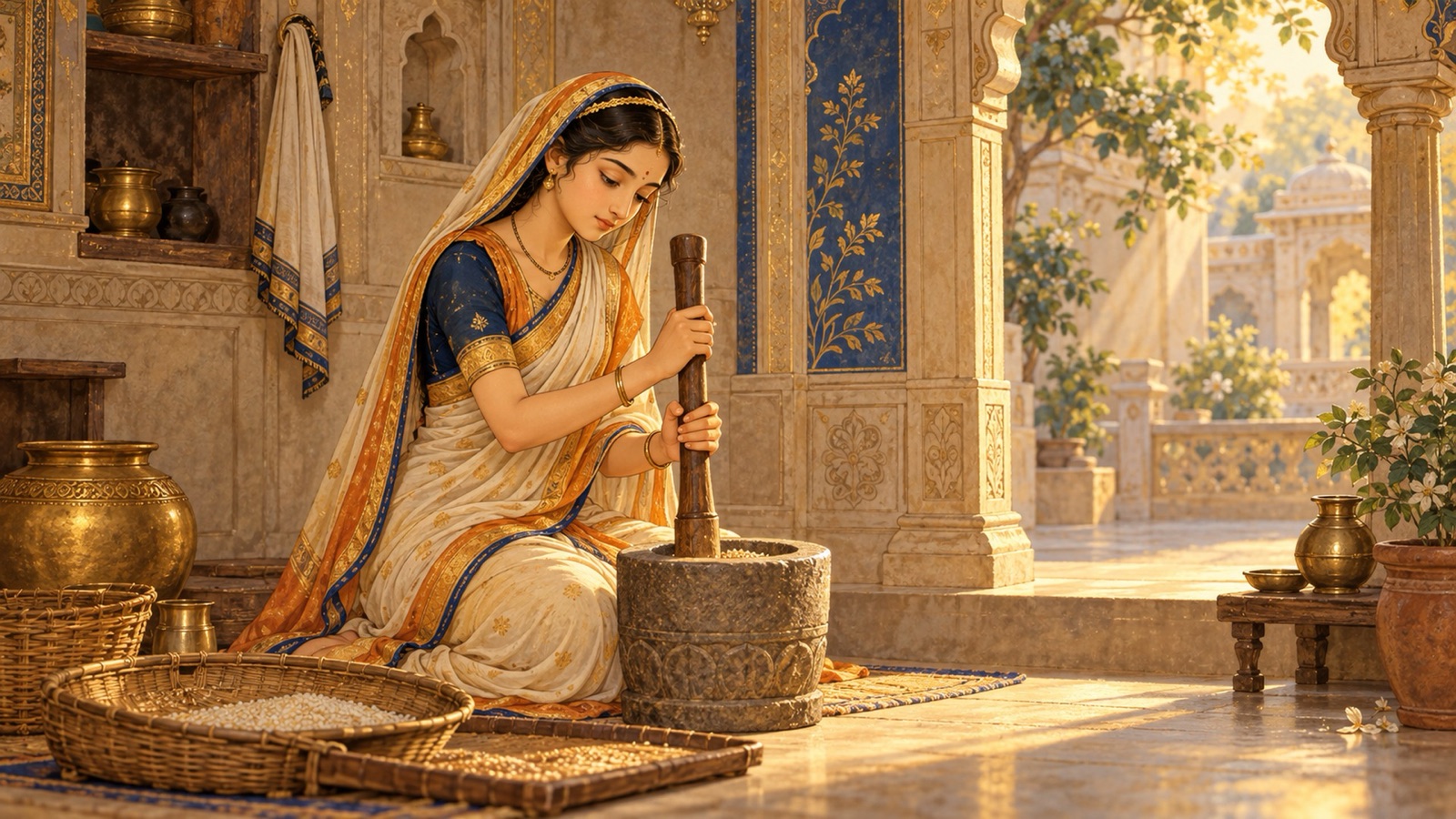
From a certain maiden the ascetic learned the value of solitude. Suitors had come to her house to seek her hand while her family was away, and she herself had to prepare food for them. As she pounded the paddy, the many conch-shell bangles on her wrists jingled loudly. Ashamed that her guests might hear and know her poverty, she broke the bangles one by one until only two remained on each wrist; but even two still clashed, so she broke one more, leaving a single bangle on each wrist, which made no sound at all. From this the ascetic drew his lesson.
वासे बहूनां कलहो भवेद् वार्ता द्वयोरपि । एक एव वसेत्तस्मात् कुमार्या इव कङ्कण: ॥ १० ॥
vāse bahūnāṁ kalaho bhaved vārtā dvayor api eka eva vaset tasmāt kumāryā iva kaṅkaṇaḥ
Meaning: Where many dwell together there is quarrel, and even between two there is idle talk; therefore one should live alone, like the single bangle on the maiden’s wrist. (Canto 11, Chapter 9, verse 10)
The Arrow-Maker — the Power of Concentration
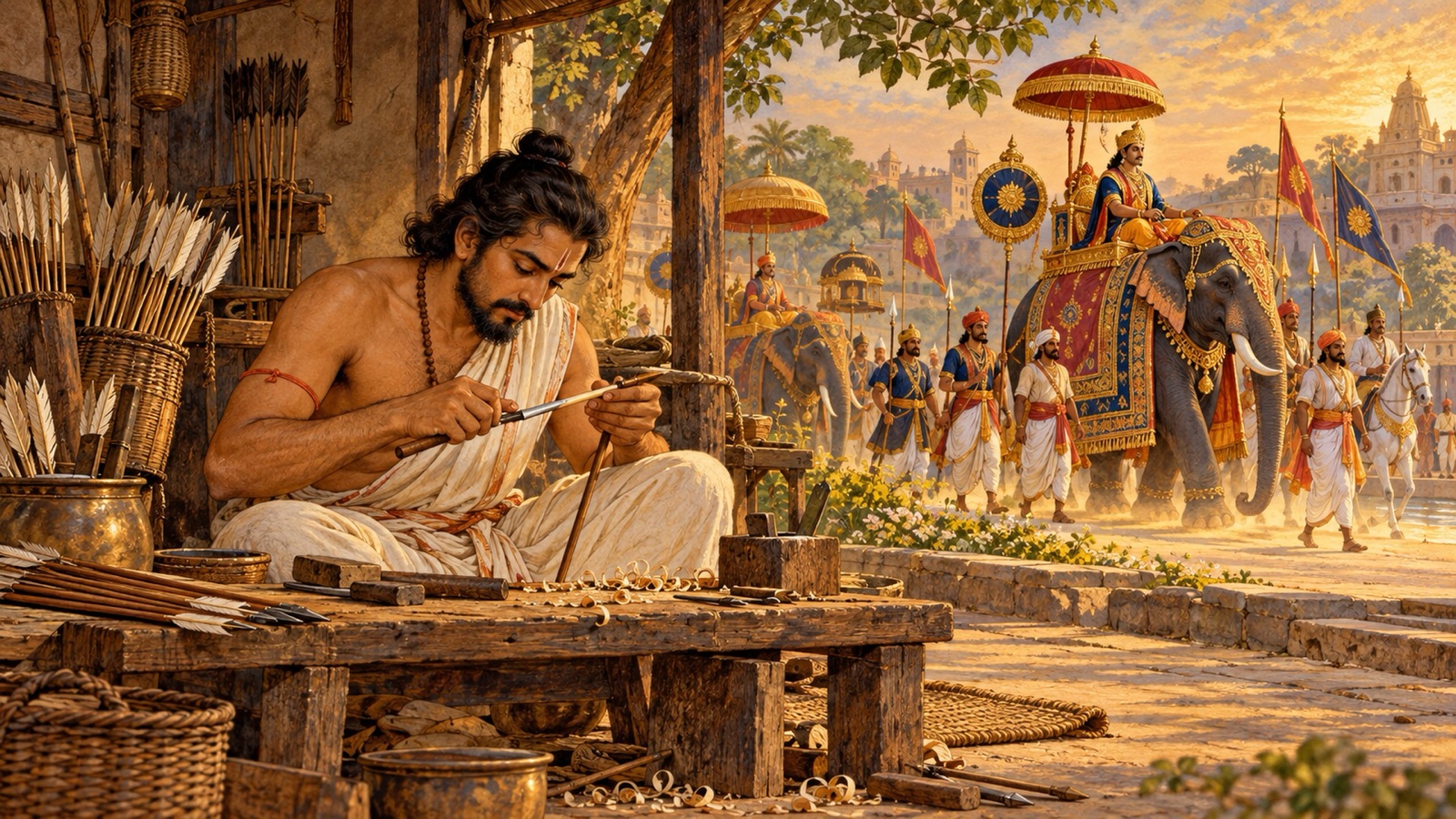
From an arrow-maker the ascetic learned single-pointed concentration. One should steady the mind by restraining it along with the breath, holding a firm posture, and practising dispassion and constant vigilance, until the mind rests absorbed in the one Supreme and the restless and dull impulses fade away. So complete was the arrow-maker’s absorption in his work that, as he shaped his arrow, he did not even notice a king passing close beside him.
तदैवमात्मन्यवरुद्धचित्तो न वेद किञ्चिद् बहिरन्तरं वा । यथेषुकारो नृपतिं व्रजन्त- मिषौ गतात्मा न ददर्श पार्श्वे ॥ १३ ॥
tadaivam ātmany avaruddha-citto na veda kiñcid bahir antaraṁ vā yatheṣu-kāro nṛpatiṁ vrajantam iṣau gatātmā na dadarśa pārśve
Meaning: As the arrow-maker, his mind wholly absorbed in his arrow, did not notice the king passing at his very side, so one whose mind is fixed within upon the Self knows nothing outside or within. (Canto 11, Chapter 9, verse 13)
The Serpent — Freedom from a Fixed Abode
From the serpent the ascetic learned that the seeker should wander alone with no fixed dwelling, ever watchful, dwelling in a cave, sparing of speech and free of visible marks of identity. For a person whose very body is perishable to labour at building a house is a useless source of misery; better to be like the serpent, which contentedly makes its home in a hole dug by others.
The Spider — the Lord Who Weaves the Worlds
From the spider the ascetic learned the deepest lesson of all — how the Supreme Lord brings forth, sustains and withdraws the entire universe by His own power. At the end of a cosmic age the one almighty Lord, self-existent and the support of all, dissolves the created worlds through His Time-Energy, and remains alone, undifferentiated. Then, by His own unaided power, He stirs His Maya of the three modes and brings forth the cosmic thread, the Mahat-tattva, through which the whole variegated creation is woven and the individual soul enters the world. Just as a spider spins its web out of its own heart, sports in it, and draws it back into itself again, so the Supreme Lord projects, maintains and reabsorbs all the worlds.
यथोर्णनाभिर्हृदयादूर्णां सन्तत्य वक्त्रत: । तया विहृत्य भूयस्तां ग्रसत्येवं महेश्वर: ॥ २१ ॥
yathorṇanābhir hṛdayād ūrṇāṁ santatya vaktrataḥ tayā vihṛtya bhūyas tāṁ grasaty evaṁ maheśvaraḥ
Meaning: As the spider spins its thread out of its own heart through its mouth, sports with it, and then draws it back again, so does the Supreme Lord create, sustain and withdraw the universe. (Canto 11, Chapter 9, verse 21)

The Wasp — We Become What We Contemplate
From the wasp the ascetic learned that a living being takes on the very form on which it fixes its mind, whether through love, hatred or fear. He had watched a wasp confine a smaller insect in its nest; and the trapped creature, dwelling in constant, fearful contemplation of the wasp, was at last transformed into a wasp itself, without even leaving its former body.
कीट: पेशस्कृतं ध्यायन् कुड्यां तेन प्रवेशित: । याति तत्सात्मतां राजन् पूर्वरूपमसन्त्यजन् ॥ २३ ॥
kīṭaḥ peśaskṛtaṁ dhyāyan kuḍyāṁ tena praveśitaḥ yāti tat-sātmatāṁ rājan pūrva-rūpam asantyajan
Meaning: The insect confined in its nest by the wasp, meditating on the wasp in fear, attains its nature and is transformed into it, O king, without even abandoning its former body. (Canto 11, Chapter 9, verse 23)
The Body — the Final Teacher, and the Rare Human Birth
Having named these teachers, the ascetic turned to one last guru — his own body. This body, subject to birth and death and forever a source of afflictions, is itself a teacher, for it awakens renunciation and discernment; though it serves for a time to contemplate the truth, it truly belongs to others, who will one day consume it, and so the wise, seeing this, wander free of all clinging. A person toils to earn wealth for the sake of pleasures and to maintain an ever-growing circle of family and possessions, only to die at last like a tree that leaves behind a seed for another to spring up — his desires sowing the seed of yet another birth. His senses drag him this way and that, each pulling in its own direction like quarrelling co-wives.
Yet among all the bodies the Lord created — of trees, reptiles, beasts, birds and fish — He was satisfied only when He fashioned the human form, endowed with reason and able to realize Him. This rare human birth, won after countless lives and frail though it is, is the very means of attaining life’s highest goal; the wise should therefore strive swiftly for liberation before the body falls, for sense-enjoyment can be had in any species, but self-realization only here.
लब्ध्वा सुदुर्लभमिदं बहुसम्भवान्ते मानुष्यमर्थदमनित्यमपीह धीर: । तूर्णं यतेत न पतेदनुमृत्यु याव- न्नि:श्रेयसाय विषय: खलु सर्वत: स्यात् ॥ २९ ॥
labdhvā su-durlabham idaṁ bahu-sambhavānte mānuṣyam artha-dam anityam apīha dhīraḥ tūrṇaṁ yateta na pated anu-mṛtyu yāvan niḥśreyasāya viṣayaḥ khalu sarvataḥ syāt
Meaning: Having gained, after many births, this rare human form — the giver of life’s highest goal, though it be impermanent — a wise person should strive swiftly for liberation before the body falls; for sense-enjoyment may be had in every species, but the supreme good only here. (Canto 11, Chapter 9, verse 29)
Thus freed of attachment and egotism, filled with dispassion and possessing the light of knowledge gathered from all his teachers, the ascetic said he wandered the world established in the Self. And he closed with the very reason he had sought so many gurus: that firm and complete wisdom cannot be gained from a single teacher, for the one Supreme Truth, without a second, has been sung in many ways by the sages.
न ह्येकस्माद् गुरोर्ज्ञानं सुस्थिरं स्यात् सुपुष्कलम् । ब्रह्मैतदद्वितीयं वै गीयते बहुधर्षिभि: ॥ ३१ ॥
na hy ekasmād guror jñānaṁ su-sthiraṁ syāt su-puṣkalam brahmaitad advitīyaṁ vai gīyate bahudharṣibhiḥ
Meaning: Firm and full knowledge cannot be gained from a single teacher; for this Brahman, one without a second, is sung of in many ways by the sages. (Canto 11, Chapter 9, verse 31)
The Close of the Avadhuta’s Discourse
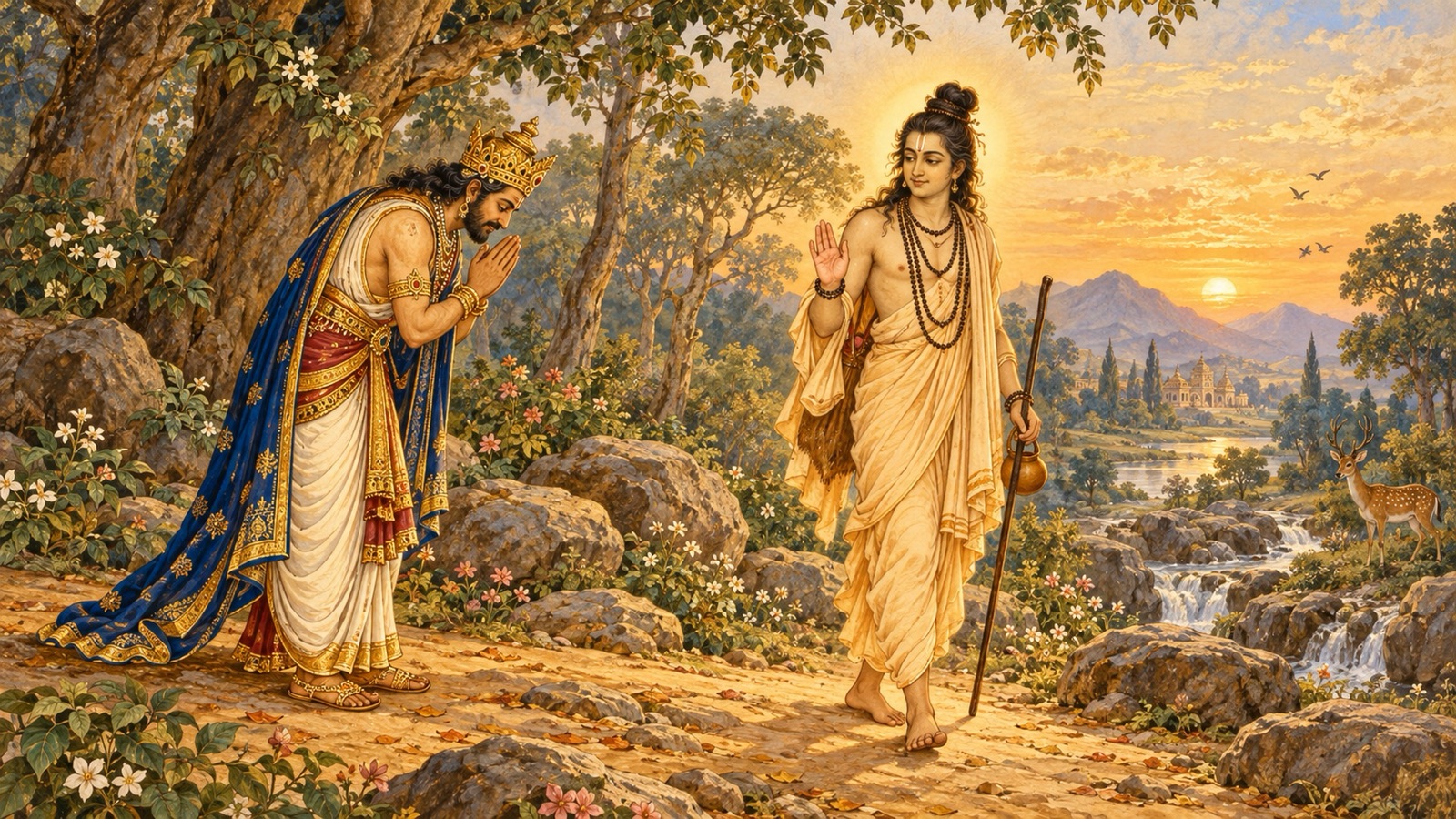
Having thus spoken to King Yadu, the Brahmana of deep wisdom was honoured and adored by the king, took his leave, and went his way in gladness. And King Yadu — the remote ancestor of the Yadus — having listened to the discourse of the Avadhuta, understood to be Lord Dattatreya, was freed of all attachment and attained an even, tranquil mind.
अवधूतवच: श्रुत्वा पूर्वेषां न: स पूर्वज: । सर्वसङ्गविनिर्मुक्त: समचित्तो बभूव ह ॥ ३३ ॥
avadhūta-vacaḥ śrutvā pūrveṣāṁ naḥ sa pūrva-jaḥ sarva-saṅga-vinirmuktaḥ sama-citto babhūva ha
Meaning: Having heard the words of the Avadhuta, that ancestor of ours was freed from every attachment and became even-minded and serene. (Canto 11, Chapter 9, verse 33)
Principal Teachings of This Chapter
1. Possession is the seed of sorrow. As the osprey found peace only when it dropped its prey, the soul that grasps nothing attains unending happiness (verses 1-2).
2. Be carefree as a child, and dwell in solitude. Freedom from anxiety over honour and family, and a quiet life apart from needless company, keep the seeker’s heart at peace (verses 3-10).
3. Concentration is the heart of practice. Like the arrow-maker who did not see the king pass by, one whose mind is absorbed in the Self is undisturbed by the world within or without (verses 11-13).
4. The Lord weaves and withdraws the worlds by His own power. As a spider spins its web from itself and draws it back, so the Supreme Lord creates, sustains and dissolves the entire universe (verses 16-21).
5. We become what we contemplate. As the trapped insect, dwelling on the wasp, becomes a wasp, so the mind is shaped by whatever it dwells upon — a call to fix it upon the Lord (verses 22-23).
6. The human birth is a rare and open door to liberation. Won after countless lives, this frail body is the one means of realizing the Supreme; the wise strive for it swiftly, for wisdom is gathered from many teachers and life is short (verses 24-31).
A Devotional Reflection
This chapter gathers up the whole teaching of the twenty-four gurus and presses it into a single, urgent point: the preciousness of this human life. The ascetic has shown us that wisdom lies everywhere, waiting in a bird that drops its prey, a girl’s silent bangle, a craftsman lost in his work, a spider at its web. But the last and greatest teacher is the body we carry — not because it is to be adored, but because it is the one vessel in all creation through which the soul can turn and know its Lord. There is a gentle urgency in his words. Sense-pleasure, he reminds us, is available to every creature, from insect to god; only the human being can seek the supreme good, and only for a fleeting while. It is a call not to anxiety but to earnestness — to use this rare and passing gift well, to gather wisdom humbly from all that life sets before us, and to fix the mind, like the trapped insect on the wasp, wholly upon the Lord, until we take on His very nature. And it is beautifully fitting that the discourse ends not in the ascetic’s triumph but in King Yadu’s peace: one soul, having truly listened, set free.
A Daily Devotional Practice
Today, reflect for a few quiet minutes on the ascetic’s final lesson — that this human life is a rare and open door. Bring to mind one way you can honour that gift today: a moment of prayer, an act of kindness, a turning of the mind away from a passing craving and toward the Lord. As the insect became what it contemplated, gently fill your mind with Him by repeating His holy name: “Om Namo Bhagavate Vasudevaya.” In this small, earnest turning you practise the very heart of this chapter — using the precious gift of human birth to draw nearer, moment by moment, to the Supreme.
Conclusion
The ninth discourse of Book Eleven brings the teaching of the twenty-four gurus to its close. The wandering ascetic tells King Yadu of his last seven teachers: the osprey, who taught that possession breeds sorrow; the carefree child and the solitary maiden; the arrow-maker, who taught deep concentration; the serpent, content without a home; the spider, who revealed how the Lord weaves and withdraws the worlds; and the wasp, who showed that we become what we contemplate. Last of all he honours his own body as a teacher, and with it the rare and fleeting gift of human birth — the one open door to liberation, not to be lost. Having taught that wisdom is gathered from many teachers, the ascetic, understood to be Lord Dattatreya, takes his leave, and King Yadu is freed of all attachment and left serene. So concludes this luminous portion of the Uddhava Gita, which the Lord related to Uddhava as a mirror of the renunciation He was calling him to embrace.
May the divine wisdom of Srimad Bhagavatam awaken pure devotion within our hearts.
Om Namo Bhagavate Vasudevaya.
Jay Shree Madhav.
References and Attribution
- Primary edition: Gita Press, Śrīmad Bhāgavata Mahāpurāṇa (English, complete), Book Eleven, Discourse 9, pages 554–557.
- Series: Srimad Bhagavatam Wisdom · Biswa Sanatan Dharma Seva Trust.
- Presented following the spiritual guidance and recommendation of Pandit Dr. Shri Kashinath Mishra.
This is an original, faithful retelling in the writer’s own words, with brief quoted verses shown in Devanāgarī and transliteration and their meanings given as summaries. It is not a reproduction of any single publisher’s continuous translation or commentary. No affiliation with or endorsement by any publisher is implied.
Jay Shree Madhav