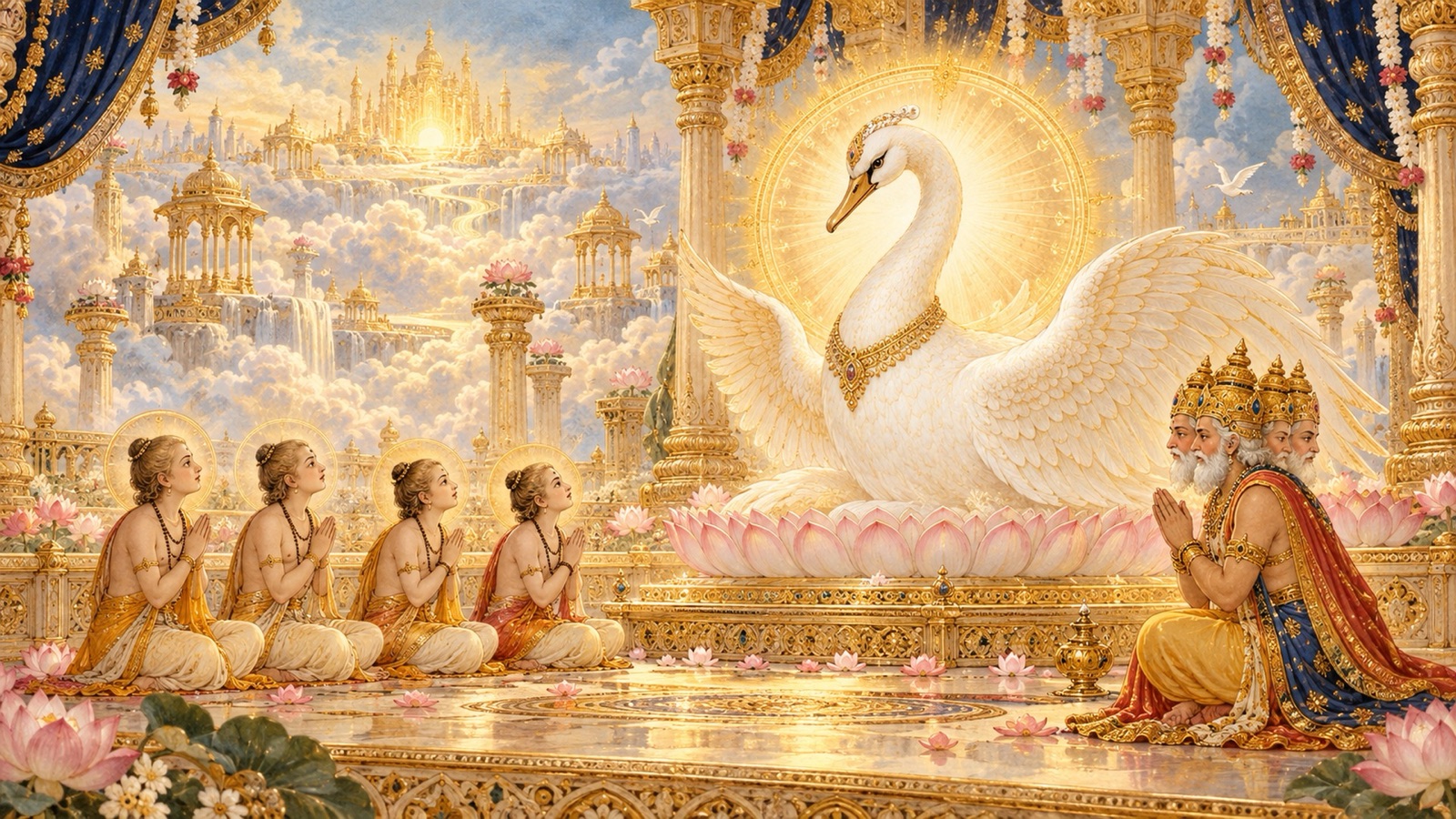
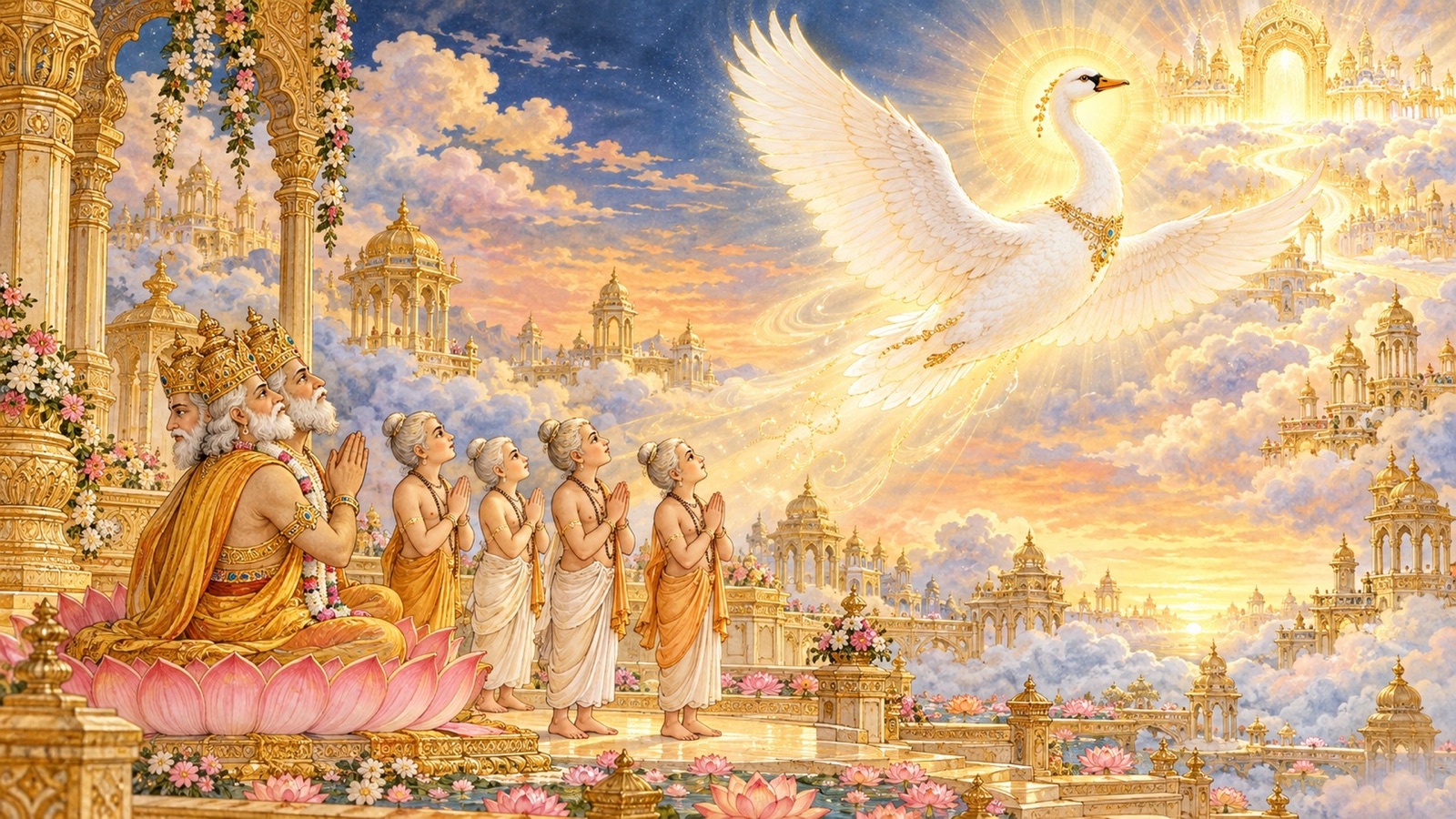
Lord Sri Krishna teaches Uddhava how to conquer the mind by cultivating goodness, and then relates a sacred memory — how, long ago, He appeared as a radiant Swan to answer the questions of Sanaka and his brothers, unfolding the timeless wisdom now known as the Song of the Swan.
Om Namo Bhagavate Vasudevaya.
Om Namo Bhagavate Vasudevaya.
Om Namo Bhagavate Vasudevaya.
Welcome to Srimad Bhagavatam Wisdom, a devotional journey through the sacred histories and teachings of the Srimad Bhagavat Mahapurana. In the previous chapter the Lord sang the glory of holy company and called Uddhava to take refuge in Him alone. Now He turns to the inner battle of the mind. The three modes of nature — goodness, passion and darkness — belong to the intellect, He teaches, not to the Self; and by cultivating goodness one may master passion and darkness, and at last rise beyond even goodness into pure peace. When Uddhava asks why people pursue the very pleasures they know will harm them, the Lord explains the restless power of passion and how the wise gently gather the mind again and again. Then, at Uddhava’s request, He shares a luminous memory: how, in the beginning, the sages Sanaka and his brothers put a subtle question to their father Brahma, who could not answer it; and how the Lord Himself appeared before them as a radiant Swan and unfolded the deepest truth of the Self — the teaching cherished ever since as the Hamsa Gita, the Song of the Swan.
Chapter Information
- Scripture: Śrīmad Bhāgavata Mahāpurāṇa
- Canto: 11 (Book Eleven)
- Chapter: 13 (Discourse 13)
- Chapter title: The Song of the Divine Swan (Hamsa Gita)
- Principal speaker: Sri Krishna, instructing Uddhava; within His narration, the Lord as the Divine Swan instructing Sanaka and his brothers; the whole related by Sukadeva Gosvami to King Parikshit
- Principal listener: Uddhava; within the narration, Sanaka and the sages and Brahma; and King Parikshit
- Main setting: Dwaraka, in the Lord’s dialogue with Uddhava; within the narration, the realm of Brahma at the dawn of creation
- Central subject: Mastering the modes of nature by cultivating goodness, the restlessness of the mind, and the Lord’s teaching as the Divine Swan on the Self as witness
- Principal verse range: Canto 11, Chapter 13, verses 1–42
- Primary edition: Gita Press Śrīmad Bhāgavata Mahāpurāṇa
Context from the Previous Chapter
In Chapter 12, the Lord sang the glory of holy company, recalled how the Gopis reached Him through pure love, and called Uddhava to take refuge in Him alone and be free of all fear, showing how the axe of knowledge cuts the ego’s bondage. This chapter continues that inner teaching, turning to the mastery of the mind and the modes of nature, and crowning it with the ancient Song of the Divine Swan.
Conquer the Modes by Cultivating Goodness
The Lord began by revealing that the three modes of nature — goodness (sattva), passion (rajas) and darkness (tamas) — belong to the intellect, not to the Self. By strengthening goodness one can subdue passion and darkness, and at last transcend even goodness itself through serene detachment.
श्रीभगवानुवाच सत्त्वं रजस्तम इति गुणा बुद्धेर्न चात्मन: । सत्त्वेनान्यतमौ हन्यात् सत्त्वं सत्त्वेन चैव हि ॥ १ ॥
śrī-bhagavān uvāca sattvaṁ rajas tama iti guṇā buddher na cātmanaḥ sattvenānyatamau hanyāt sattvaṁ sattvena caiva hi
Meaning: The Lord said: Goodness, passion and darkness are modes of the intellect, not of the Self. By goodness one should conquer both passion and darkness, and then goodness itself by goodness in the form of serene detachment. (Canto 11, Chapter 13, verse 1)
From goodness grown strong, He said, arises devotion to Him; and goodness itself is nurtured by sattvika things — pure scripture, water, company, place, time, work, birth, meditation, sacred sound and purifying rites — and by turning away from all that the wise condemn. As goodness grows, ignorance about the body and its modes is dispelled by knowledge; and the body born of the shifting modes at last burns itself out and subsides, like a fire kindled by the friction of bamboo.
वेणुसङ्घर्षजो वह्निर्दग्ध्वा शाम्यति तद्वनम् । एवं गुणव्यत्ययजो देह: शाम्यति तत्क्रिय: ॥ ७ ॥
veṇu-saṅgharṣa-jo vahnir dagdhvā śāmyati tad-vanam evaṁ guṇa-vyatyaya-jo dehaḥ śāmyati tat-kriyaḥ
Meaning: As the fire born of the friction of bamboo burns down the whole grove and then subsides, so the body, born of the interplay of the modes, at last consumes itself and comes to rest. (Canto 11, Chapter 13, verse 7)

Why We Chase What Harms Us
Uddhava then asked a very human question: if people generally know that sense-pleasures are a source of misery, why do they still pursue them?
श्रीउद्धव उवाच विदन्ति मर्त्या: प्रायेण विषयान् पदमापदाम् । तथापि भुञ्जते कृष्ण तत्कथं श्वखराजवत् ॥ ८ ॥
śrī-uddhava uvāca vidanti martyāḥ prāyeṇa viṣayān padam āpadām tathāpi bhuñjate kṛṣṇa tat kathaṁ śva-kharāja-vat
Meaning: Uddhava said: People generally know that sense-objects are a source of misery; why then, O Krishna, do they still indulge in them, like a dog, an ass or a goat? (Canto 11, Chapter 13, verse 8)
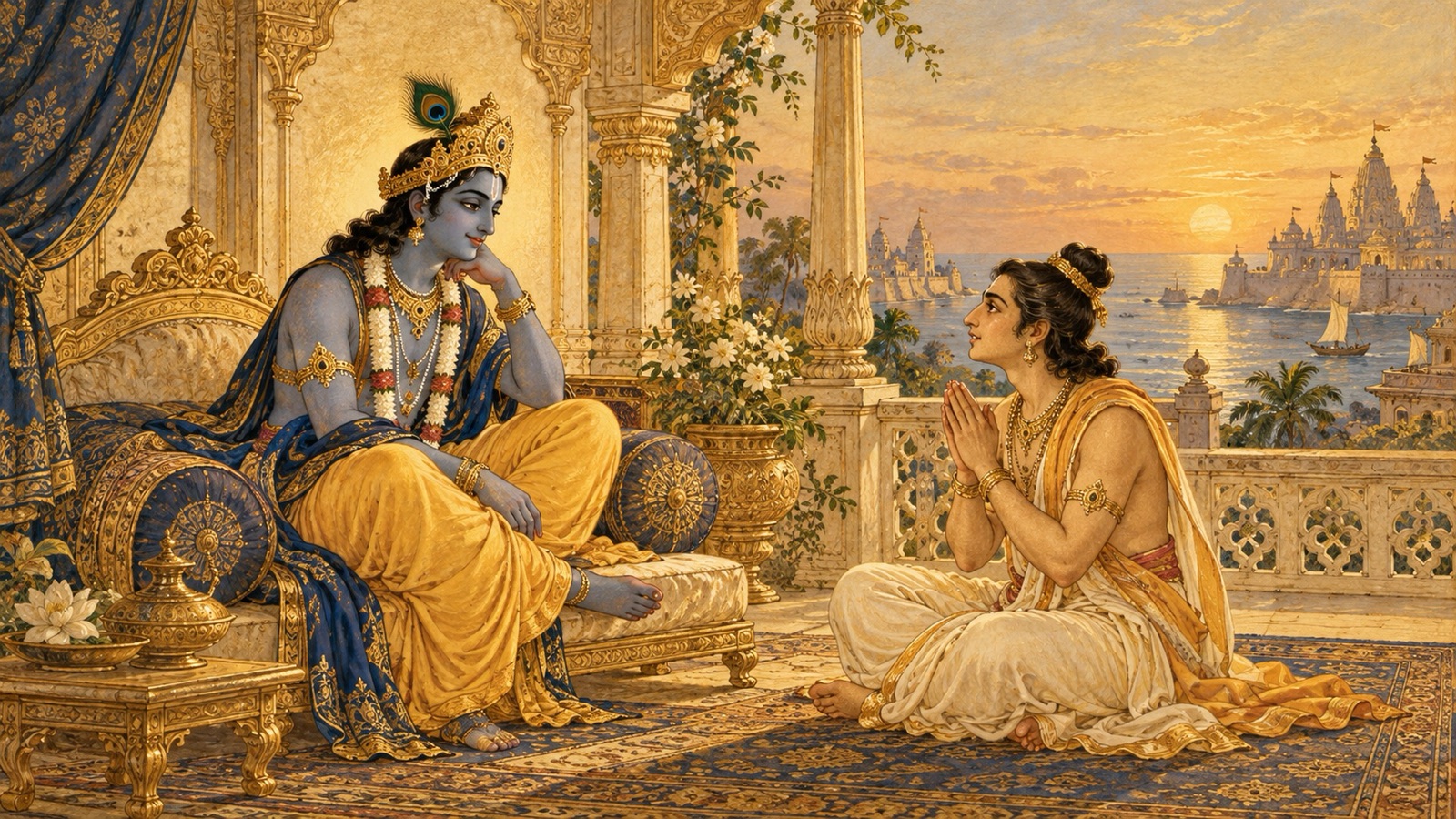
The Lord replied that passion, surging up even in a mind born of goodness, floods it with restless craving; the undiscerning person, overpowered by that impetuous force, is swept into pursuit of pleasure. But the one who discriminates, though his mind too is sometimes disturbed by passion and darkness, gathers it back again with effort, mindful of the harm in sense-pleasure, and does not become attached. He should control the breath, steady his gaze, and, at the appointed times, slowly compose the mind and fix it on the Lord alone — the very Yoga, He said, that He once taught to Brahma and the sages.
The Question of Sanaka and His Brothers
At this, Uddhava asked when and how the Lord had taught that Yoga to Sanaka and his brothers. The Lord then related the sacred memory. Long ago, the four mind-born sons of Brahma — Sanaka and his brothers — put to their father a subtle question: since the mind naturally clings to sense-objects, and sense-objects leave their imprint upon the mind, how can the two ever be separated from one another? Brahma, absorbed in his work of creation and unable to see to the heart of it, fixed his mind on the Lord for help. And the Lord, to hint at the answer, appeared before them in the form of a Swan — the bird said to separate milk from water.
स मामचिन्तयद् देव: प्रश्नपारतितीर्षया । तस्याहं हंसरूपेण सकाशमगमं तदा ॥ १९ ॥
sa mām acintayad devaḥ praśna-pāra-titīrṣayā tasyāhaṁ haṁsa-rūpeṇa sakāśam agamaṁ tadā
Meaning: Wishing to reach the far shore of the question, Brahma fixed his mind upon Me; and I then came before him in the form of a Swan. (Canto 11, Chapter 13, verse 19)
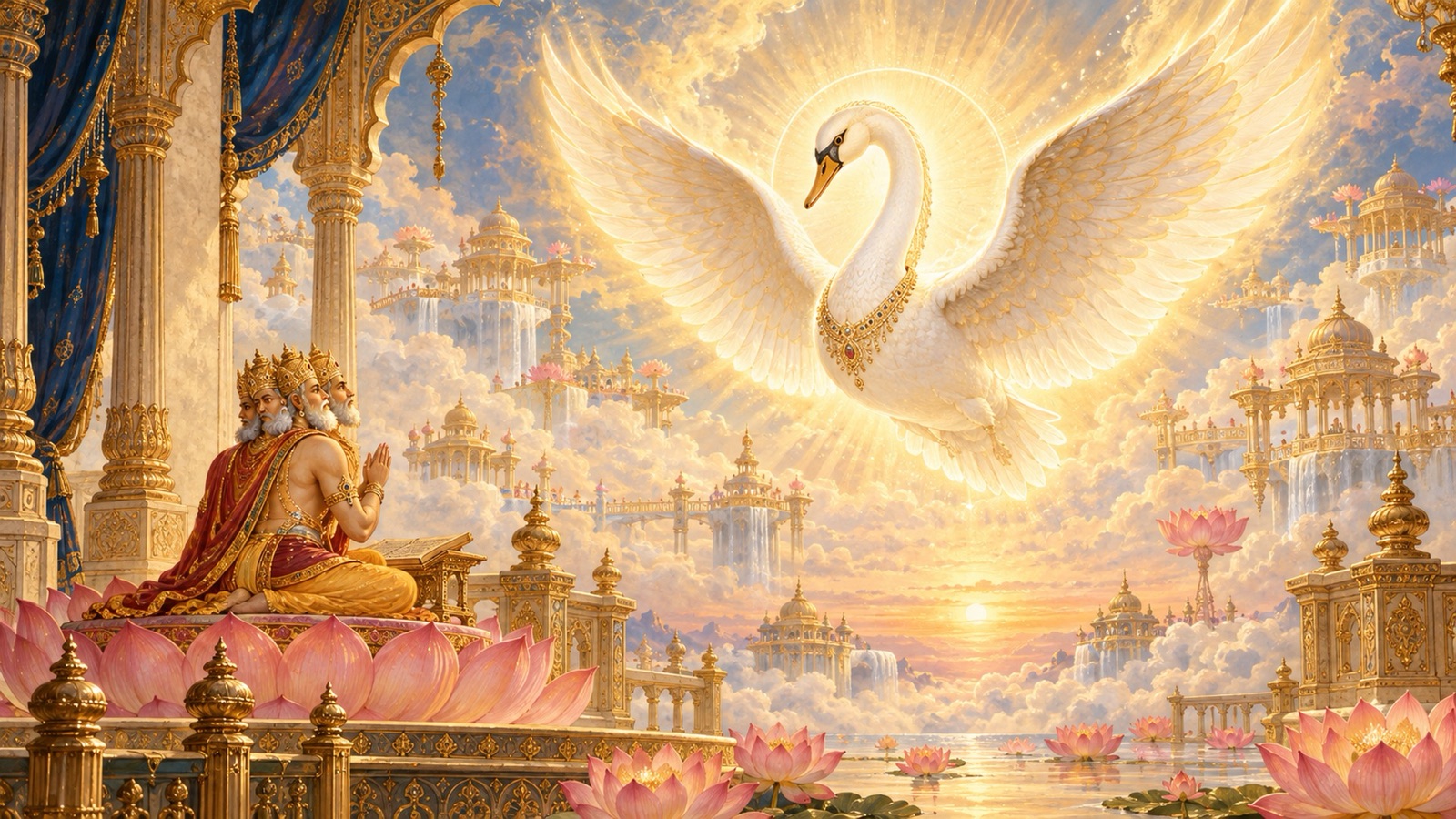
Beholding the radiant Swan, the sages approached, bowed at His feet, placed Brahma at their head, and asked, “Who are You?”
दृष्ट्वा मां त उपव्रज्य कृत्वा पादाभिवन्दनम् । ब्रह्माणमग्रत: कृत्वा पप्रच्छु: को भवानिति ॥ २० ॥
dṛṣṭvā māṁ ta upavrajya kṛtvā pādābhivandanam brahmāṇam agrataḥ kṛtvā papracchuḥ ko bhavān iti
Meaning: Beholding Me, the sages came near, bowed at My feet, placed Brahma before them, and asked, “Who are You?” (Canto 11, Chapter 13, verse 20)
The Swan’s Answer — All Is the One Self
The Lord, as the Swan, gave a profound reply. If the Self is one undivided reality, He said, the very question “who are you?” cannot finally divide it; whatever is grasped by the mind, expressed in speech, or perceived by the senses is nothing other than Himself.
मनसा वचसा दृष्ट्या गृह्यतेऽन्यैरपीन्द्रियै: । अहमेव न मत्तोऽन्यदिति बुध्यध्वमञ्जसा ॥ २४ ॥
manasā vacasā dṛṣṭyā gṛhyate ’nyair apīndriyaiḥ aham eva na matto ’nyad iti budhyadhvam añjasā
Meaning: Whatever is grasped by the mind, by speech, by sight or by the other senses is I Myself, and nothing exists apart from Me; know this truly and at once. (Canto 11, Chapter 13, verse 24)
The mind clings to sense-objects, He explained, and the objects imprint themselves on the mind; but both belong to the body, not to the Self. The soul that becomes one with Him gives up both, resting in its own true nature. And He revealed the great key: waking, dreaming and deep sleep are states of the intellect, arising from the modes — while the Self stands apart from them all, their silent witness.
जाग्रत् स्वप्न: सुषुप्तं च गुणतो बुद्धिवृत्तय: । तासां विलक्षणो जीव: साक्षित्वेन विनिश्चित: ॥ २७ ॥
jāgrat svapnaḥ suṣuptaṁ ca guṇato buddhi-vṛttayaḥ tāsāṁ vilakṣaṇo jīvaḥ sākṣitvena viniścitaḥ
Meaning: Waking, dream and deep sleep are states of the intellect arising from the modes of nature; the Self is distinct from them all, established as their witness. (Canto 11, Chapter 13, verse 27)
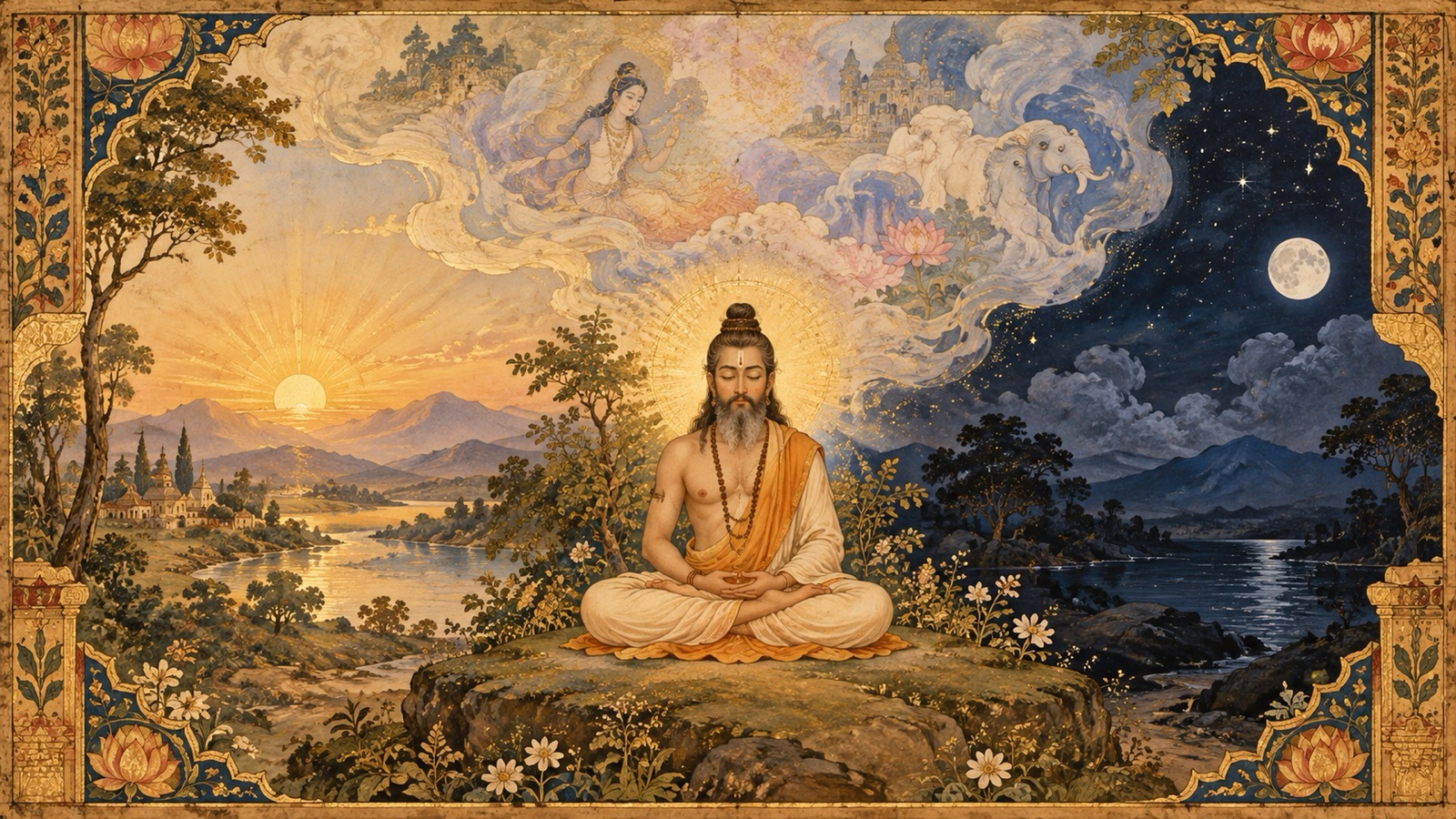
So long as the sense of the reality of separate objects persists, the Lord said, a person is asleep even while awake, as one dreams within a dream. Therefore, established in Him, the transcendent one seated in the heart, the sages should give up the mistaken bondage of mind and sense, and rest in the Self — awakened, untouched by the play of the modes, as one who has woken from a dream.
The Sages Awakened, and the Swan Departs
Their great doubt thus resolved by the Divine Swan, Sanaka and his brothers worshipped the Lord with supreme devotion and glorified Him with hymns of praise. Honoured and adored by the sages, the Lord returned to His own abode before the very eyes of Brahma.
तैरहं पूजित: सम्यक् संस्तुत: परमर्षिभि: । प्रत्येयाय स्वकं धाम पश्यत: परमेष्ठिन: ॥ ४२ ॥
tair ahaṁ pūjitaḥ saṁyak saṁstutaḥ paramarṣibhiḥ pratyeyāya svakaṁ dhāma paśyataḥ parameṣṭhinaḥ
Meaning: Duly worshipped and glorified by those great sages, I returned to My own abode, even as Brahma looked on. (Canto 11, Chapter 13, verse 42)
Principal Teachings of This Chapter
1. The modes belong to the mind, not the Self. Goodness, passion and darkness are qualities of the intellect; the Self is ever untouched by them (verse 1).
2. Cultivate goodness, then rise beyond it. By strengthening goodness through pure company, food, place and practice, one masters passion and darkness — and finally transcends even goodness in serene peace (verses 1-7).
3. Passion drives us to chase what harms us. Even a mind rooted in goodness can be flooded by restless passion; the wise gently gather the mind again and again, mindful of the sorrow in sense-pleasure (verses 8-13).
4. Fix the mind on the Lord at the appointed times. By steadying breath and gaze and composing the mind on Him, the seeker practises the very Yoga the Lord taught Brahma and the sages (verses 13-14).
5. The Lord came as the Swan to teach the Self. To answer a question beyond Brahma, the Lord appeared as the Swan, revealing that all that is perceived is nothing but Himself (verses 15-24).
6. The Self is the witness of all states. Waking, dream and deep sleep belong to the mind; the Self stands apart as their unchanging witness, and awakening to this ends all bondage (verses 25-42).
A Devotional Reflection
At the centre of this chapter stands one of the loveliest images in the Bhagavata — the Lord appearing as a Swan. It is said that a swan can drink milk mixed with water and leave the water behind, taking only the milk; and so the Lord comes in this form to teach the sages how to separate the pure Self from the mixture of mind and sense-objects in which it seems dissolved. There is great tenderness in the picture. Even Brahma, the first of beings, meets a question he cannot answer, and does the one wise thing: he turns his mind to the Lord. And the Lord does not scold or withhold; He comes at once, in a gentle and beautiful form, and answers not with abstraction but with the astonishing intimacy that all we perceive is nothing but Himself. The chapter’s practical heart is just as kind. It does not demand that we never feel the pull of passion; it tells us plainly that even a good mind will be stirred, and asks only that we keep gathering it back, again and again, like the discerning one who returns his wandering mind to the Lord. And it leaves us with the great secret of the witness: that behind our waking, dreaming and sleeping, untouched by them all, is the quiet Self, watching in peace. To glimpse that witness, even for a moment, is to begin to wake from the long dream.
A Daily Devotional Practice
Today, practise the way of the Swan — learning to separate the pure from the mixed. At a quiet time, sit and watch your own mind as its thoughts, moods and impulses come and go, and gently notice that you are the one who witnesses them, not the passing states themselves. Whenever the mind is pulled toward some restless craving, gather it back, without harshness, and turn it to the Lord seated in your heart, softly repeating His holy name: “Om Namo Bhagavate Vasudevaya.” In this simple watchfulness you follow the very teaching of the Divine Swan — parting the changeless Self from the shifting mind, and resting, if only for a while, as the peaceful witness the Lord revealed you to be.
Conclusion
The thirteenth discourse of Book Eleven, the Song of the Divine Swan, carries the Lord’s teaching to Uddhava into the mastery of the mind and the modes of nature. Goodness, passion and darkness, He teaches, belong to the intellect, not the Self; by cultivating goodness one conquers passion and darkness, and at last rises beyond even goodness into peace. When Uddhava asks why people chase the pleasures they know will harm them, the Lord reveals the restless power of passion and the patient gathering of the mind by the wise. Then He shares the sacred memory of how He appeared as a radiant Swan to answer the question of Sanaka and his brothers, teaching that all that is perceived is nothing but Himself, and that the Self is the changeless witness of waking, dream and deep sleep. Their doubt resolved, the sages worshipped Him, and the Swan returned to His abode. So this luminous chapter calls us to part the pure Self from the shifting mind and rest, awake and at peace, in the Lord within.
May the divine wisdom of Srimad Bhagavatam awaken pure devotion within our hearts.
Om Namo Bhagavate Vasudevaya.
Jay Shree Madhav.
References and Attribution
- Primary edition: Gita Press, Śrīmad Bhāgavata Mahāpurāṇa (English, complete), Book Eleven, Discourse 13, pages 569–572.
- Series: Srimad Bhagavatam Wisdom · Biswa Sanatan Dharma Seva Trust.
- Presented following the spiritual guidance and recommendation of Pandit Dr. Shri Kashinath Mishra.
This is an original, faithful retelling in the writer’s own words, with brief quoted verses shown in Devanāgarī and transliteration and their meanings given as summaries. It is not a reproduction of any single publisher’s continuous translation or commentary. No affiliation with or endorsement by any publisher is implied.
Jay Shree Madhav