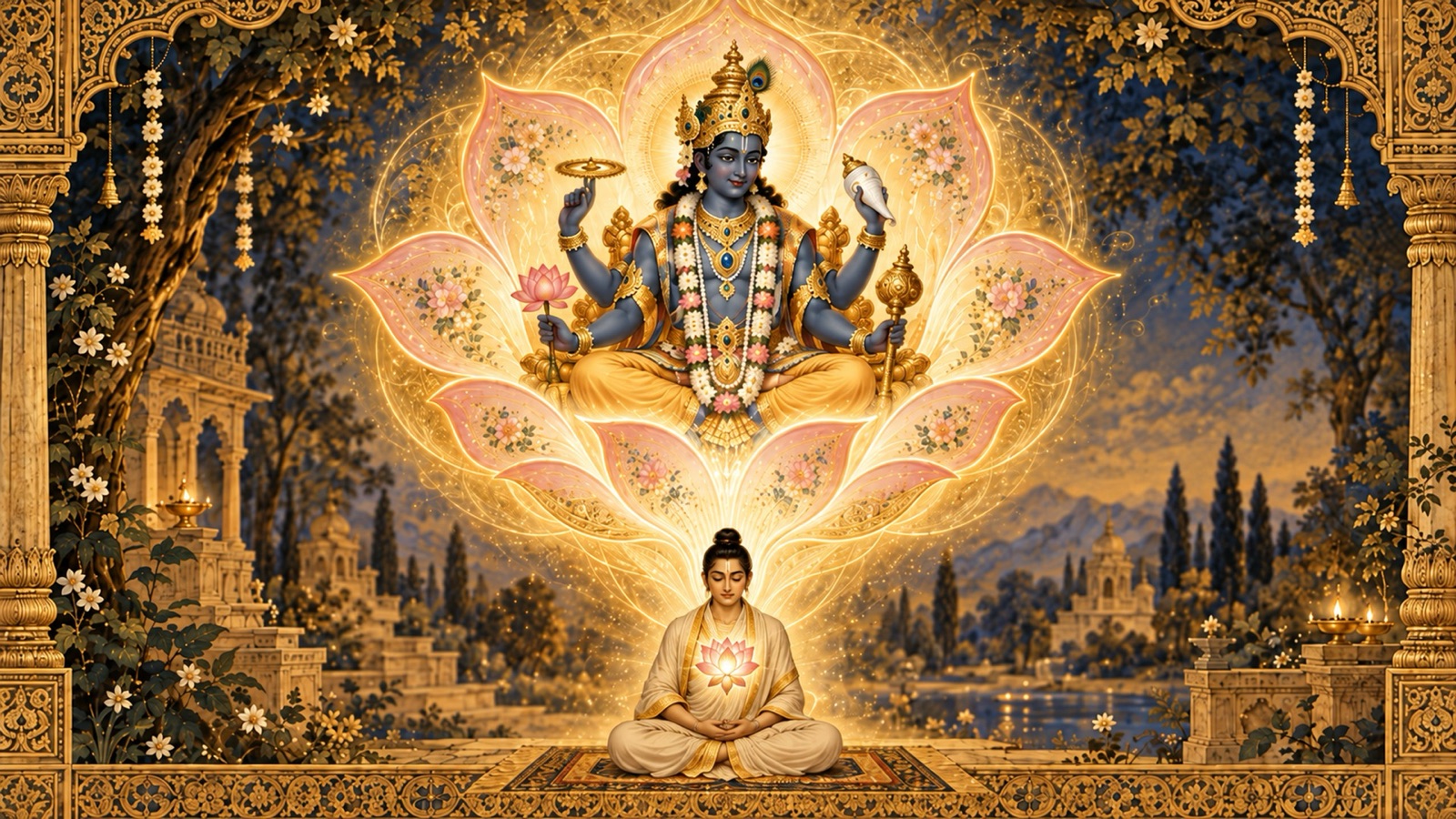
Uddhava asks the Lord to name the one path above all others, and Sri Krishna unveils devotion’s hidden glory, its power to consume sin, its signs of a melting heart, and the sacred art of meditation on His form within the lotus of the heart.
Om Namo Bhagavate Vasudevaya.
Om Namo Bhagavate Vasudevaya.
Om Namo Bhagavate Vasudevaya.
Welcome to Srimad Bhagavatam Wisdom, a devotional journey through the sacred histories and teachings of the Srimad Bhagavat Mahapurana. Uddhava asks whether, among the many disciplines the sages praise, one path truly stands first. Krishna answers that loving devotion is complete in itself, and wherever it lives, the heart trembles, weeps and sings. Then He unfolds the art of meditation, from breath and posture to a radiant vision of His own form within the heart.
Chapter Information
- Scripture: Śrīmad Bhāgavata Mahāpurāṇa
- Canto: 11 (Book Eleven)
- Chapter: 14 (Discourse 14)
- Chapter title: Lord Krishna Explains the Yoga System to Uddhava
- Principal speaker: Sri Krishna, related by Sukadeva Gosvami to King Parikshit
- Principal listener: Uddhava; and King Parikshit
- Main setting: Dwaraka
- Central subject: The glory of bhakti-yoga above every other path, and the science of meditation on the Lord’s form
- Principal verse range: Canto 11, Chapter 14, verses 1–46
- Primary edition: Gita Press Śrīmad Bhāgavata Mahāpurāṇa
Context from the Previous Chapter
In Chapter 13, the Lord taught Uddhava to master the modes of nature through goodness, recalling how, as a radiant Swan, He once revealed that the Self is the changeless witness of waking, dream and deep sleep. Having understood who he is, Uddhava now asks how that is to be lived.
The Many Paths, and the One Uddhava Seeks
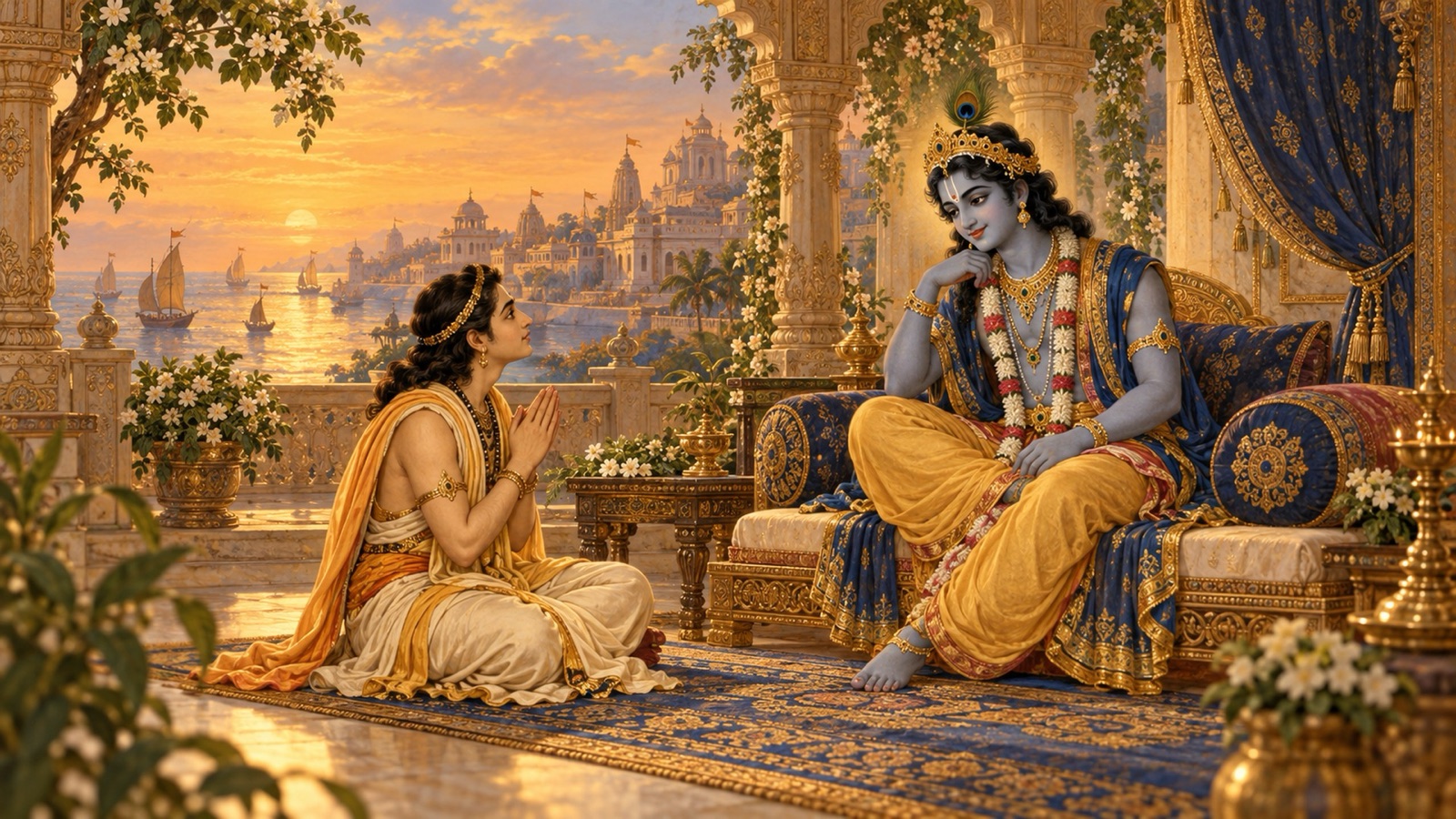
Uddhava submitted a question any sincere seeker still asks: the Veda speaks of so many disciplines for reaching the highest good — does one stand first, or must the seeker simply choose among equals? He recalled, too, that Krishna had already called the path of devotion — by which the mind lets go of every attachment and rests in Him alone — independent of all the rest.
श्रीउद्धव उवाच वदन्ति कृष्ण श्रेयांसि बहूनि ब्रह्मवादिन: । तेषां विकल्पप्राधान्यमुताहो एकमुख्यता ॥ १ ॥ भवतोदाहृत: स्वामिन् भक्तियोगोऽनपेक्षित: । निरस्य सर्वत: सङ्गं येन त्वय्याविशेन्मन: ॥ २ ॥
śrī-uddhava uvāca vadanti kṛṣṇa śreyāṁsi bahūni brahma-vādinaḥ teṣāṁ vikalpa-prādhānyam utāho eka-mukhyatā bhavatodāhṛtaḥ svāmin bhakti-yogo ‘napekṣitaḥ nirasya sarvataḥ saṅgaṁ yena tvayy āviśen manaḥ
Meaning: Uddhava submitted: Exponents of the Veda speak of many a course of discipline leading to the highest good, O Krishna. Does one hold pre-eminence by the striver’s own choice, or does importance belong to only one? The discipline of devotion, by which the mind, shaking off attachment for everything else, becomes fixed on You, has been declared by You as independent of every other discipline, my Master. (Canto 11, Chapter 14, verses 1–2)
The Eternal Word, Lost and Restored
The glorious Lord traced this teaching to its source. In time, He said, the Veda disappears at the great dissolution, and at each new creation He delivers it again — to Brahma, then through Manu and the seven great seers to every order of being (verses 3–7). Shaped by differing mixtures of goodness, passion and darkness, their grasp of that one teaching grew as varied as their own natures, until some wandered into heretical views (verses 8–9). So one calls the highest good religious merit, another pleasure, another wealth or austerity — and every such reward, He said, has a beginning and an end, the fruit of action, leaving only fleeting delight (verses 10–11). Here is the thread this discourse pulls toward: every worldly good is bound by time; devotion alone is not a means to some further end but is itself the Lord’s own nearness — why no discipline will capture Him as devotion does, and only loving faith lets Him be grasped.
The Boundless Joy of a Soul Surrendered
Where, the Lord asked, could the happiness of one fixed on Me, expecting nothing else, ever be found among minds set only on sense-delights? All four directions grow full of joy to one who calls nothing his own and rests content in Me alone, no longer longing even for Brahma’s seat, Indra’s realm, or liberation apart from Me (verses 12–14). Then the Lord spoke with astonishing tenderness of how dear such a soul is to Him.
न तथा मे प्रियतम आत्मयोनिर्न शङ्कर: । न च सङ्कर्षणो न श्रीर्नैवात्मा च यथा भवान् ॥ १५ ॥
na tathā me priyatama ātma-yonir na śaṅkaraḥ na ca saṅkarṣaṇo na śrīr naivātmā ca yathā bhavān
Meaning: Neither Brahma, My own being, nor Shiva, My own Self; neither Balarama, My brother, nor Sri, My consort; nor even My own person is so dear to Me as you are. (Canto 11, Chapter 14, verse 15)
He follows ceaselessly in the footsteps of such a soul — peaceful, without enmity, seeing all beings equally — to be purified by that soul’s footdust; His all-blissful nature can be known only by one whose mind, free of desire, claims nothing as its own (verses 16–17).
The Power of Devotion
Even a devotee not yet fully in command of his senses, the Lord continued, is generally not overpowered by sense-objects, for his devotion, however newly kindled, is already powerful.
यथाग्नि: सुसमृद्धार्चि: करोत्येधांसि भस्मसात् । तथा मद्विषया भक्तिरुद्धवैनांसि कृत्स्नश: ॥ १९ ॥
yathāgniḥ su-samṛddhārciḥ karoty edhāṁsi bhasmasāt tathā mad-viṣayā bhaktir uddhavaināṁsi kṛtsnaśaḥ
Meaning: As blazing fire reduces firewood to ashes, so, O Uddhava, does devotion toward Me burn away the sins of its possessor, utterly and completely. (Canto 11, Chapter 14, verse 19)
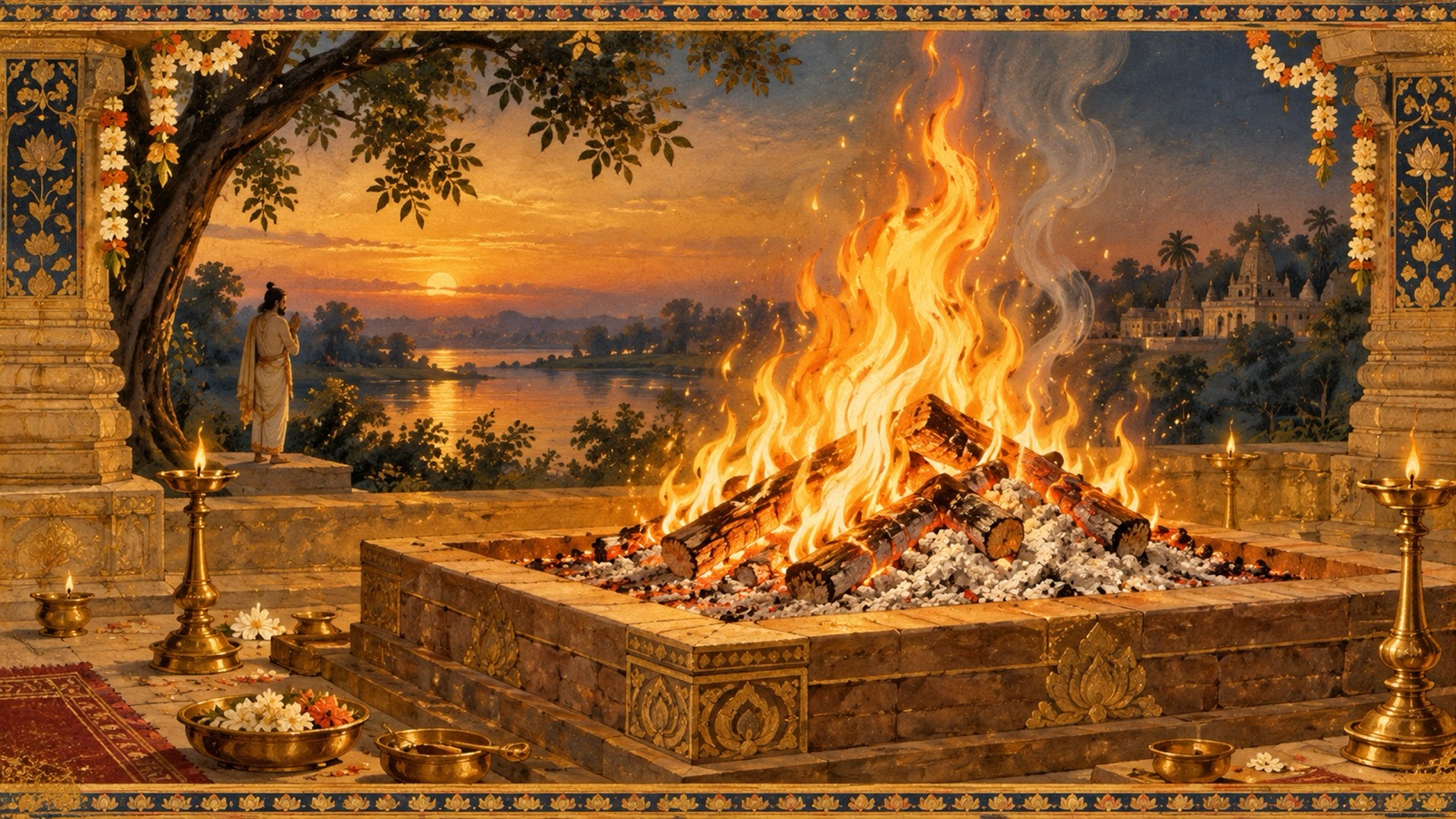
Neither Yoga, Sankhya, scriptural study, austerity nor renunciation, the Lord said, can captivate Him as devotion does (verse 20) — and He explained why.
भक्त्याहमेकया ग्राह्य: श्रद्धयात्मा प्रिय: सताम् । भक्ति: पुनाति मन्निष्ठा श्वपाकानपि सम्भवात् ॥ २१ ॥
bhaktyāham ekayā grāhyaḥ śraddhayātmā priyaḥ satām bhaktiḥ punāti man-niṣṭhā śva-pākān api sambhavāt
Meaning: By devotion alone, with faith, am I — the beloved Self of the saints — to be grasped; devotion fixed on Me purifies even those born into the lowest of families. (Canto 11, Chapter 14, verse 21)
Piety joined with truthfulness, or learning joined with austerity, He added, cannot thoroughly cleanse a mind empty of devotion (verse 22).
The Signs of a Heart Melted in Love
How, the Lord asked, can devotion be known except by hair standing on end, a melting heart and tears of joy (verse 23)?
वाग् गद्गदा द्रवते यस्य चित्तं रुदत्यभीक्ष्णं हसति क्वचिच्च । विलज्ज उद्गायति नृत्यते च मद्भक्तियुक्तो भुवनं पुनाति ॥ २४ ॥
vāg gadgadā dravate yasya cittaṁ rudaty abhīkṣṇaṁ hasati kvacic ca vilajja udgāyati nṛtyate ca mad-bhakti-yukto bhuvanaṁ punāti
Meaning: A devotee whose voice falters with emotion, whose heart melts, who weeps again and again, laughs, sings unashamed and dances in love of Me — such a soul purifies the world. (Canto 11, Chapter 14, verse 24)
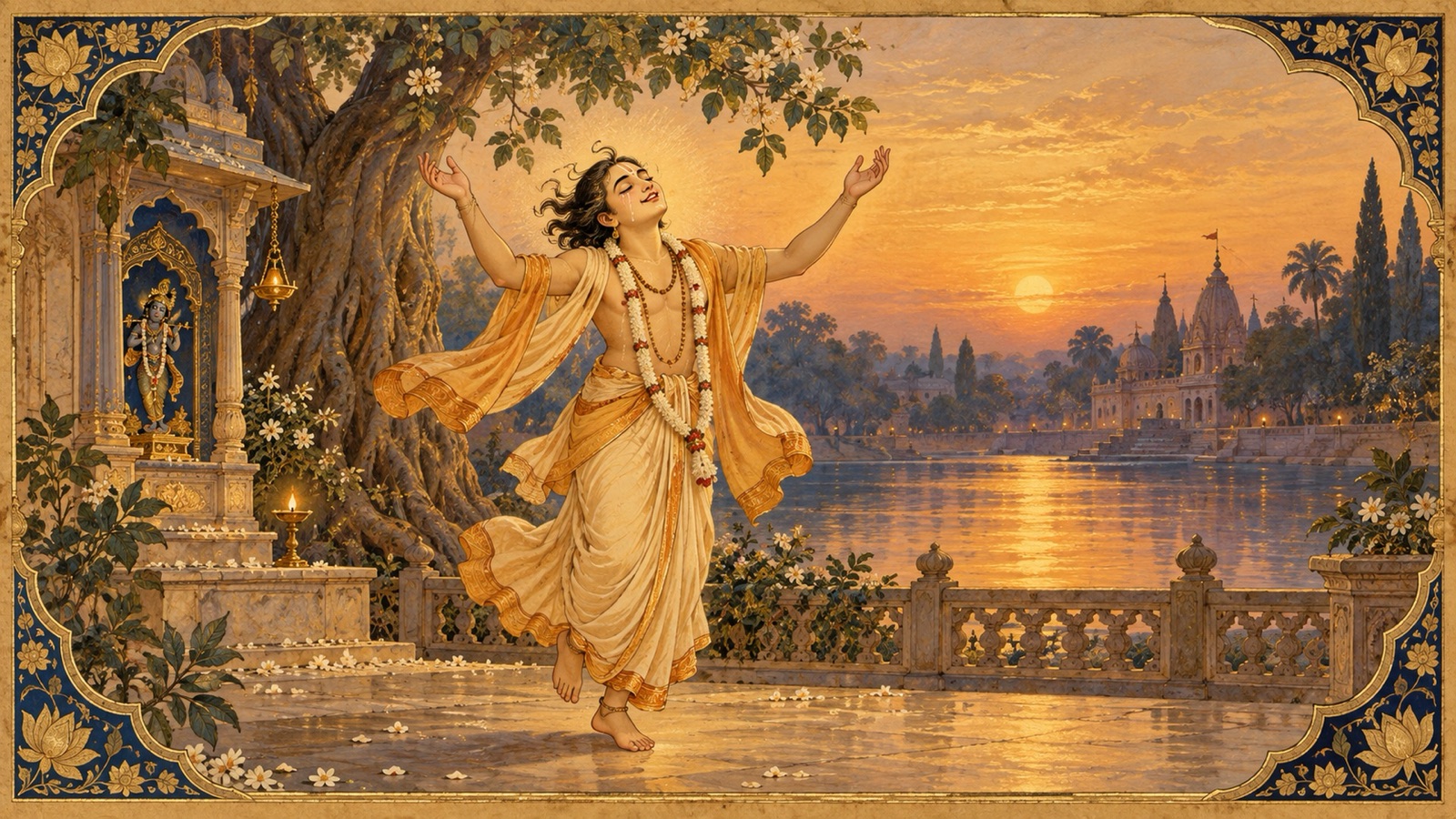
Just as gold, heated in fire, sheds its dross, so does the soul, through devotion, shake off the seeds of its past deeds and attain oneness with Him; and the more the mind is cleansed by hearing and recounting His stories, the more clearly it perceives the subtle reality of the Self, as a treated eye comes to see even the smallest things (verses 25–26).
Turning the Mind Homeward
The mind that dwells on sense-objects grows attached to them, while the mind that remembers Him is absorbed in Him alone; let the seeker release unreal things, no more substantial than a dream, and settle the purified mind on Him (verses 27–28). For a season, He counselled, withdraw from unsettling company and sit in a safe, quiet place, remembering Him without weariness (verses 29–30).
Uddhava Asks How to Meditate
Moved by this, Uddhava asked one more thing of the lotus-eyed Lord: how, and in what form, should a seeker of liberation contemplate Him (verse 31)?
The Seat, the Breath, and the Sacred Syllable
The glorious Lord replied with patient, practical detail.
श्रीभगवानुवाच सम आसन आसीन: समकायो यथासुखम् । हस्तावुत्सङ्ग आधाय स्वनासाग्रकृतेक्षण: ॥ ३२ ॥ प्राणस्य शोधयेन्मार्गं पूरकुम्भकरेचकै: । विपर्ययेणापि शनैरभ्यसेन्निर्जितेन्द्रिय: ॥ ३३ ॥
śrī-bhagavān uvāca sama āsana āsīnaḥ sama-kāyo yathā-sukham hastāv utsaṅga ādhāya sva-nāsāgra-kṛtekṣaṇaḥ prāṇasya śodhayen mārgaṁ pūra-kumbhaka-recakaiḥ viparyayeṇāpi śanair abhyasen nirjitendriyaḥ
Meaning: Seated on a seat of moderate height, body upright and at ease, hands resting palm-upward in the lap, the gaze fixed gently on the tip of the nose, the senses mastered, one should cleanse the breath-path through slow inhalation, retention and exhalation, practised also in reverse order. (Canto 11, Chapter 14, verses 32–33)

Carried by the breath, Om should then rise in the mind, fine and unbroken as a lotus fibre, followed by a nasal resonance continuous as a temple bell; practised ten times at each of the three daily hours, the seeker gains mastery of the breath within a month (verses 34–35).
The Vision of the Lord within the Heart
Then the Lord painted, with a mother’s tenderness, the vision every seeker longs for: picture the heart as an inverted lotus, its stalk rising upward, now open with eight wakeful petals; upon its pericarp place the sun, the moon and fire, and in the midst of that fire remember His own form — tranquil, gracious, four long and graceful arms, a lovely neck, a gentle smile, alligator-shaped earrings, golden raiment against skin dark as a rain-cloud, the mark of Srivatsa, a garland of forest flowers, anklets, the Kaustubha gem’s glow, a brilliant diadem and armlets — beautiful in every limb, with eyes full of grace (verses 36–41). Meditate on this gentle form, He said, resting the mind in turn upon each limb — and then comes the decisive step.
इन्द्रियाणीन्द्रियार्थेभ्यो मनसाकृष्य तन्मन: । बुद्ध्या सारथिना धीर: प्रणयेन्मयि सर्वत: ॥ ४२ ॥
indriyāṇīndriyārthebhyo manasākṛṣya tan manaḥ buddhyā sārathinā dhīraḥ praṇayen mayi sarvataḥ
Meaning: Withdrawing the senses from their objects by the mind, and the mind itself from all else by the intellect, let the steady soul, with intellect as charioteer, direct it wholly toward Me. (Canto 11, Chapter 14, verse 42)
Gathering the Mind into the Infinite
Next, settle the gathered mind on a single limb alone — the gracious, smiling face; then release it even from the face, to rest on the Lord’s all-pervading Self, boundless as the sky, and, passing beyond that too, cease to think of anything (verses 43–44). What follows is among the most luminous verses in the whole Bhagavatam.
एवं समाहितमतिर्मामेवात्मानमात्मनि । विचष्टे मयि सर्वात्मन् ज्योतिर्ज्योतिषि संयुतम् ॥ ४५ ॥
evaṁ samāhita-matir mām evātmānam ātmani vicaṣṭe mayi sarvātman jyotir jyotiṣi saṁyutam
Meaning: With mind thus made steady, he beholds Me as his own Self within himself, and sees himself, O Soul of all, truly merged in Me, as one light merges into another. (Canto 11, Chapter 14, verse 45)

The Freedom That Follows
The Lord closed with a promise to every sincere practitioner.
ध्यानेनेत्थं सुतीव्रेण युञ्जतो योगिनो मन: । संयास्यत्याशु निर्वाणं द्रव्य ज्ञानक्रियाभ्रम: ॥ ४६ ॥
dhyānenetthaṁ su-tīvreṇa yuñjato yogino manaḥ saṁyāsyaty āśu nirvāṇaṁ dravya jñāna-kriyā-bhramaḥ
Meaning: For the yogi who unites his mind through such intense meditation, the misconceived notions of matter, knowledge and action will soon vanish, and he will swiftly attain the highest peace. (Canto 11, Chapter 14, verse 46)
Principal Teachings of This Chapter
1. Devotion alone is complete in itself. Every other discipline is a means to a further end; devotion needs no support, for it is the Lord’s own nearness (verses 1–2, 20–21).
2. Every worldly goal is bound by time; devotion is boundless. Religion, fame, pleasure and power bear fruit that begins and ends; only the soul surrendered to the Lord knows joy filling every direction (verses 10–14).
3. Nothing is dearer to the Lord than a devotee’s heart. Not Brahma, Shiva, Balarama nor Sri is as dear to Him as a surrendered soul (verse 15).
4. Devotion alone captures the Lord and consumes all sin. As fire reduces wood to ashes, devotion burns away sin; by faith alone is the Lord grasped (verses 18–21).
5. True devotion shows itself in trembling, tears and song. A choked voice, a melting heart, tears, laughter and dance are devotion’s own signs, purifying the world (verses 22–26).
6. The seeker steadies breath, posture and the sound of Om. Through posture, controlled breath and Om practised thrice daily, the mind is tamed and readied for the Lord (verses 27–35).
7. Meditation on His form leads beyond form into union. Visualising His four-armed form in the heart’s lotus, the seeker gathers the mind limb by limb until it rests as one light merged in the Light of all lights (verses 36–46).
A Devotional Reflection
What lingers most, after sitting with this teaching, is not a method but a face — gracious, smiling, asking simply to be remembered within the heart. It would have been enough for Krishna to rank devotion above the world’s many paths; instead He shows how near He already is to a heart turned toward Him. He asks for no flawless seeker: even one whose senses are not yet conquered is carried past danger by a little devotion, as a small kindled fire can burn down a forest. We are not asked to arrive pure before loving Him; loving Him is itself what purifies. And when that love is real, it will break the voice, wet the eyes, and turn the body into song. To sit with this chapter is to feel invited, not instructed, to breathe quietly and let the mind wander home to the face waiting at the heart’s centre.
A Daily Devotional Practice
Today, set aside a few quiet minutes to practise this chapter in miniature. Sit comfortably, let the breath slow, and gently picture the Lord’s smiling face resting in the lotus of your heart. When the mind wanders, draw it back gently and soften it with His holy name: “Om Namo Bhagavate Vasudevaya.” Even a few minutes offered with sincerity is the very devotion the Lord calls complete in itself.
Conclusion
The fourteenth discourse of Book Eleven answers the question with which it opens: among every path the world names, devotion to the Lord alone is sufficient unto itself. Sri Krishna shows how every worldly goal is bound by time and sorrow, and declares that no soul is dearer to Him than one whose heart rests wholly in His own. Devotion alone, He says, can capture Him and burn away sin, showing itself in trembling, tears and song. Then, answering Uddhava’s request, He opens the art of meditation — posture, breath, Om, and the vision of His own form within the heart — guiding the seeker beyond that vision into the silence where the soul finds itself merged in Him, one light joined to another.
May the divine wisdom of Srimad Bhagavatam awaken pure devotion within our hearts.
Om Namo Bhagavate Vasudevaya.
Jay Shree Madhav.
References and Attribution
- Primary edition: Gita Press, Śrīmad Bhāgavata Mahāpurāṇa (English, complete), Book Eleven, Discourse 14, pages 575–579.
- Series: Srimad Bhagavatam Wisdom · Biswa Sanatan Dharma Seva Trust.
- Presented following the spiritual guidance and recommendation of Pandit Dr. Shri Kashinath Mishra.
This is an original, faithful retelling in the writer’s own words, with brief quoted verses shown in Devanāgarī and transliteration and their meanings given as summaries. It is not a reproduction of any single publisher’s continuous translation or commentary. No affiliation with or endorsement by any publisher is implied.
Jay Shree Madhav