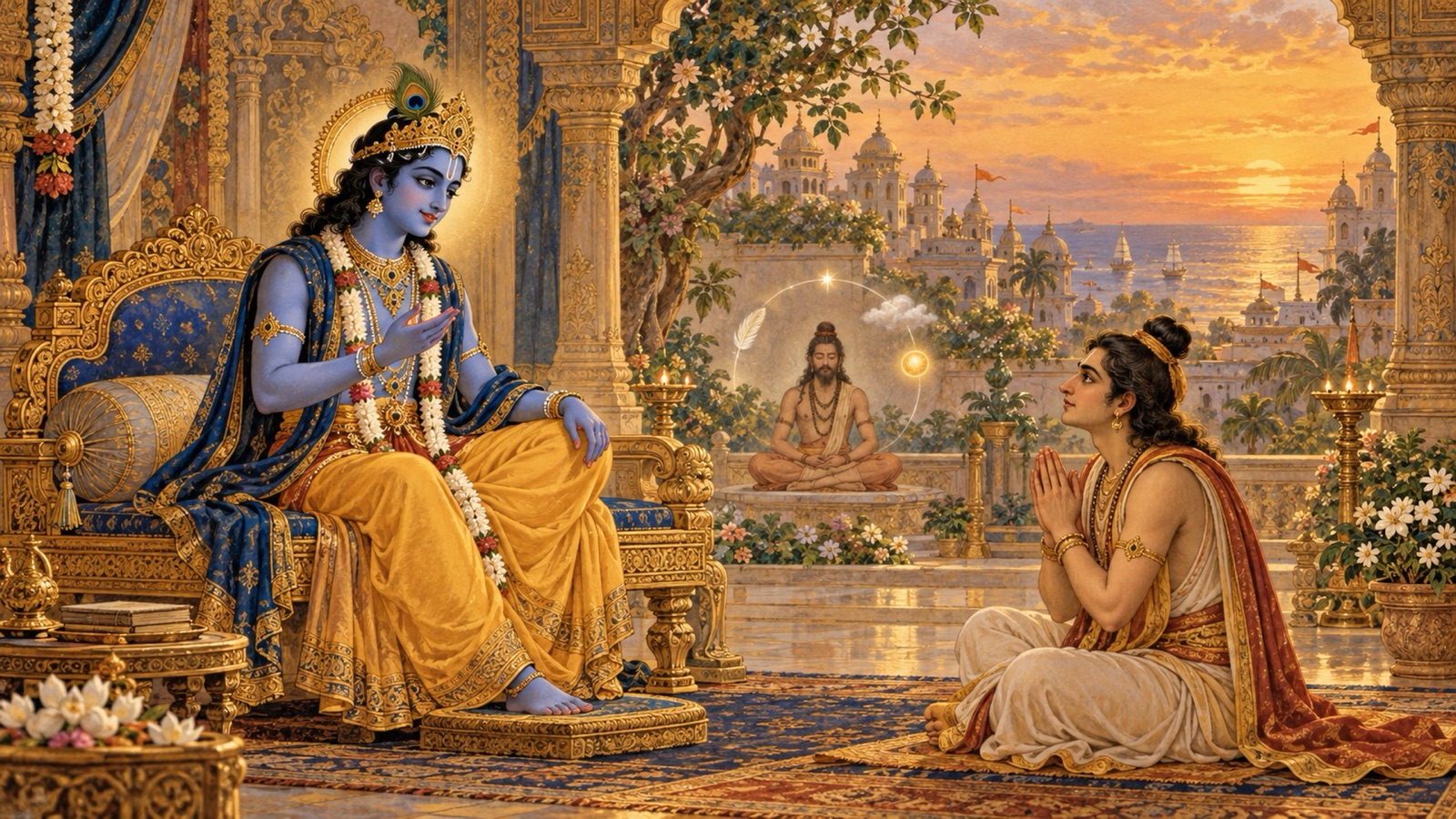
Lord Sri Krishna answers Uddhava’s question about the Siddhis, the mystic perfections that wait upon the yogi whose mind is fixed on Him — and then, with the same breath, reveals that for the soul who seeks Him alone, every one of these wonders is only a delay along the way.
Om Namo Bhagavate Vasudevaya.
Om Namo Bhagavate Vasudevaya.
Om Namo Bhagavate Vasudevaya.
Welcome to Srimad Bhagavatam Wisdom, a devotional journey through the sacred histories and teachings of the Srimad Bhagavat Mahapurana. Moved by the Lord’s teaching on inward meditation, Uddhava now longs to know what wonders crown the yogi who attains such absorption. The Lord answers with evident tenderness, naming the eighteen Siddhis one by one and showing how each is won by fixing the mind upon a particular aspect of Himself — and then, as gently as a father calling a wandering child home, tells Uddhava that these very powers become obstacles for the soul whose one desire is the Lord Himself.
Chapter Information
- Scripture: Śrīmad Bhāgavata Mahāpurāṇa
- Canto: 11 (Book Eleven)
- Chapter: 15 (Discourse 15)
- Chapter title: Lord Krishna’s Description of Mystic Yoga Perfections
- Principal speaker: Sri Krishna, instructing Uddhava; the whole related by Sukadeva Gosvami to King Parikshit
- Principal listener: Uddhava; and King Parikshit
- Main setting: Dwaraka, in the Lord’s continuing dialogue with Uddhava
- Central subject: The eighteen Siddhis (mystic perfections) of Yoga, the meditation by which each is attained, and the Lord’s teaching that for His devotee these very Siddhis are obstacles, not the goal
- Principal verse range: Canto 11, Chapter 15, verses 1–36
- Primary edition: Gita Press Śrīmad Bhāgavata Mahāpurāṇa
Context from the Previous Chapter
In Chapter 14, the Lord taught Uddhava the eightfold path of Yoga, by which the seeker pictures His own gracious form within the heart and, step by step, withdraws the mind until it rests in Him as a flame rests in fire. It is from that depth of absorption that Uddhava now speaks.
Uddhava Asks About the Siddhis
The Lord opened this teaching almost as a promise: mystic perfections themselves come and wait upon the yogi of steady mind who has mastered the senses and the breath and fixed that mind on Him.
श्रीभगवानुवाच जितेन्द्रियस्य युक्तस्य जितश्वासस्य योगिन: । मयि धारयतश्चेत उपतिष्ठन्ति सिद्धय: ॥ १ ॥
śrī-bhagavān uvāca jitendriyasya yuktasya jita-śvāsasya yoginaḥ mayi dhārayataś ceta upatiṣṭhanti siddhayaḥ
Meaning: The glorious Lord began: Siddhis of various kinds wait upon the Yogi of steady mind who has conquered his senses, controlled his breath, and fixes his mind upon Me. (Canto 11, Chapter 15, verse 1)
Hearing this, Uddhava asked further: by what mode of concentration is which Siddhi gained, and how; and how many Siddhis are there in all, since the Lord Himself is their bestower upon the yogis?
The Eighteen Siddhis Are Named
The Lord replied that eighteen Siddhis, with their modes of concentration, have been taught by masters who have crossed to the far shore of Yoga. Eight abide chiefly in Him; the other ten are won through sattva-guna, the mode of goodness.
श्रीभगवानुवाच सिद्धयोऽष्टादश प्रोक्ता धारणा योगपारगै: । तासामष्टौ मत्प्रधाना दशैव गुणहेतव: ॥ ३ ॥
śrī-bhagavān uvāca siddhayo ‘ṣṭādaśa proktā dhāraṇā yoga-pāra-gaiḥ tāsām aṣṭau mat-pradhānā daśaiva guṇa-hetavaḥ
Meaning: The glorious Lord replied: Eighteen Siddhis, together with their modes of concentration, have been taught by those who have attained perfection in Yoga. Of these, eight abide chiefly in Me; the other ten follow from the mode of goodness. (Canto 11, Chapter 15, verse 3)
The eight that are the Lord’s own by nature He named at once: anima, becoming small as an atom; mahima, growing vast; laghima, extreme lightness; prapti, free access to the senses of all creation; prakamya, the power to enjoy at will; ishitva, dominion over Maya; vashita, freedom from attachment to sense-pleasure; and kamavasayita, the fulfilment of every desire.
अणिमा महिमा मूर्तेर्लघिमा प्राप्तिरिन्द्रियै: । प्राकाम्यं श्रुतदृष्टेषु शक्तिप्रेरणमीशिता ॥ ४ ॥ गुणेष्वसङ्गो वशिता यत्कामस्तदवस्यति । एता मे सिद्धय: सौम्य अष्टावौत्पत्तिका मता: ॥ ५ ॥
aṇimā mahimā mūrter laghimā prāptir indriyaiḥ prākāmyaṁ śruta-dṛṣṭeṣu śakti-preraṇam īśitā guṇeṣv asaṅgo vaśitā yat-kāmas tad avasyati etā me siddhayaḥ saumya aṣṭāv autpattikā matāḥ
Meaning: Anima, mahima and laghima belong to the body; prapti is contact with the senses of all creation; prakamya is the power to enjoy whatever is heard of or seen; ishita is the power to move Maya and her potencies; vashita is freedom from attachment to the senses; and whatever one desires, that one attains — this is kamavasayita. These eight Siddhis, O gentle one, are natural to Me. (Canto 11, Chapter 15, verses 4–5)
Ten further Siddhis follow from sattva-guna: freedom from hunger, thirst and old age; sight and hearing from any distance; movement swift as the mind; the power to assume any form; to enter another’s body; to leave the body at will; the privilege of sporting with the gods; the fulfilment of any resolve; and a command unobstructed anywhere. He named a further minor set too: knowledge of past, present and future; equanimity amid heat and cold, joy and sorrow; reading others’ thoughts; the power to neutralise fire, sun, water and poison; and freedom from defeat at anyone’s hands (verses 6–8).
How Each Siddhi Is Won
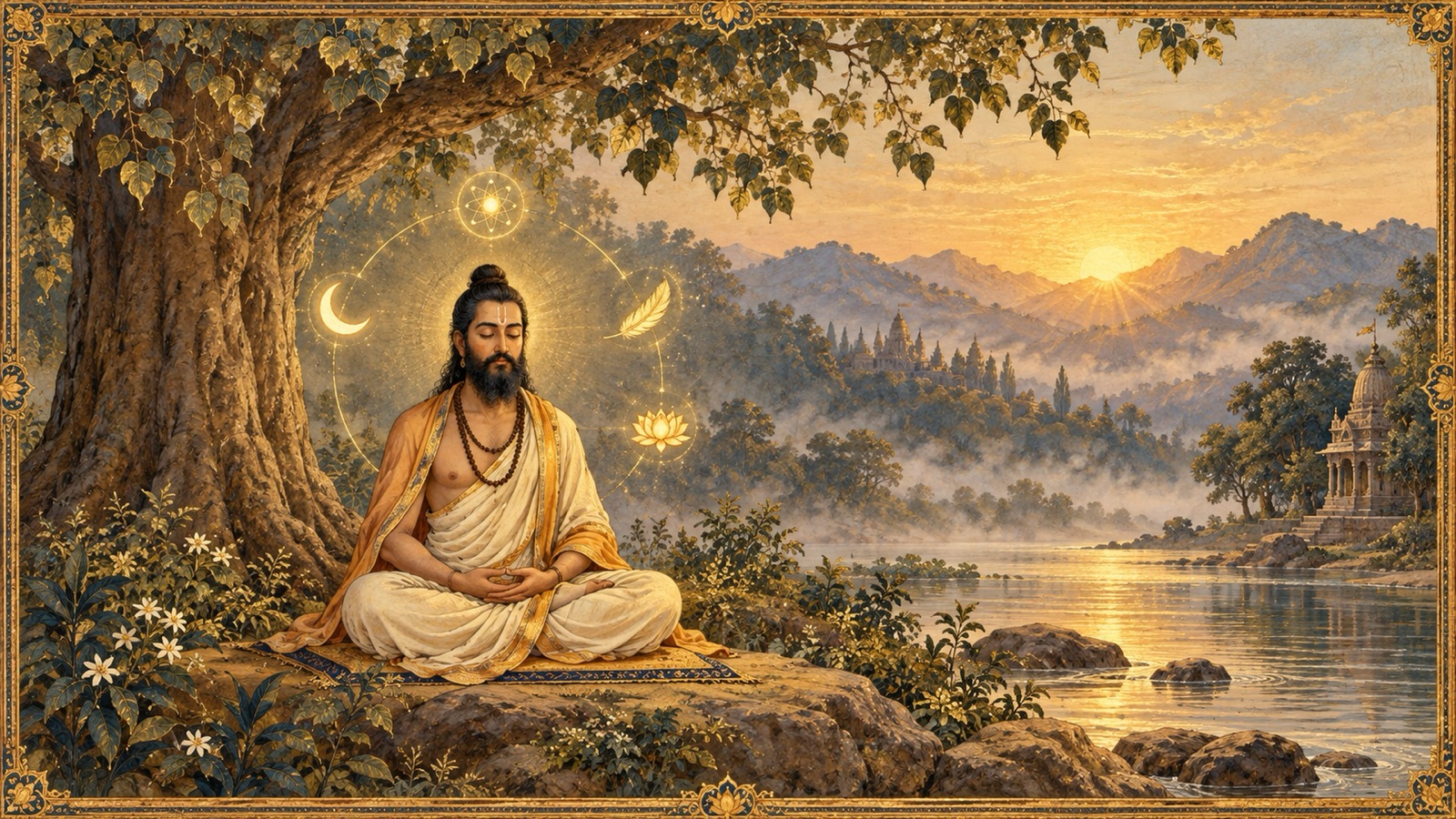
The Lord then revealed, meditation by meditation, that every Siddhi is the fruit of fixing the mind not on the power itself but on Him. On the subtle elements brings anima; on Mahat-tattva, cosmic intelligence, brings mahima; on the atoms brings laghima; on the cosmic ego born of goodness brings prapti, mastery over all senses; on the principle born of the Unmanifest brings prakamya, the highest power of enjoyment; and on the all-pervading Witness and Ruler of Maya brings ishitva, mastery over every embodied self (verses 9–15).
Of all these inward visions, one shines with a special tenderness: the yogi who steadies his mind upon the Lord as Narayana — the fourth, transcendent principle, called by the very name Bhagavan — takes on the Lord’s own qualities and attains vashita, freedom from every attachment.
नारायणे तुरीयाख्ये भगवच्छब्दशब्दिते । मनो मय्यादधद् योगी मद्धर्मा वशितामियात् ॥ १६ ॥
nārāyaṇe turīyākhye bhagavac-chabda-śabdite mano mayy ādadhad yogī mad-dharmā vaśitām iyāt
Meaning: The yogi who fixes his mind on Me as Lord Narayana, called the fourth or transcendent principle and known by the name Bhagavan, acquires My own qualities and attains vashita. (Canto 11, Chapter 15, verse 16)
Meditating on the Lord as attributeless Brahman brings supreme bliss, the essence of kamavasayita; meditating on Him as Lord Aniruddha, pure Lord of Svetadvipa, brings purity and freedom from the six waves of hunger, grief and death (verses 17–18). One lovely vision deserves its own verse: contemplating the unexpressed cosmic sound within the Lord, the yogi becomes able to hear, like a swan attentive to the subtlest note, the voices of beings far beyond ordinary hearing.
मय्याकाशात्मनि प्राणे मनसा घोषमुद्वहन् । तत्रोपलब्धा भूतानां हंसो वाच: शृणोत्यसौ ॥ १९ ॥
mayy ākāśātmani prāṇe manasā ghoṣam udvahan tatropalabdhā bhūtānāṁ haṁso vācaḥ śṛṇoty asau
Meaning: Mentally perceiving the unexpressed sound within Me as the cosmic breath, taintless and all-pervading like the sky, the yogi — like a swan discerning what is pure — becomes able to hear the voices of living beings manifested within it. (Canto 11, Chapter 15, verse 19)
Uniting the eye with the sun brings far sight, the whole universe beheld; uniting mind, body and breath with the Lord brings manojava, so the body is found wherever the mind has gone; and by the sheer force of concentration on Him the yogi may take on whatever form his mind conceives — this very concentration, He says, is the ground of every Siddhi (verses 20–22).
Entering Another’s Body, and Leaving the Body at Will
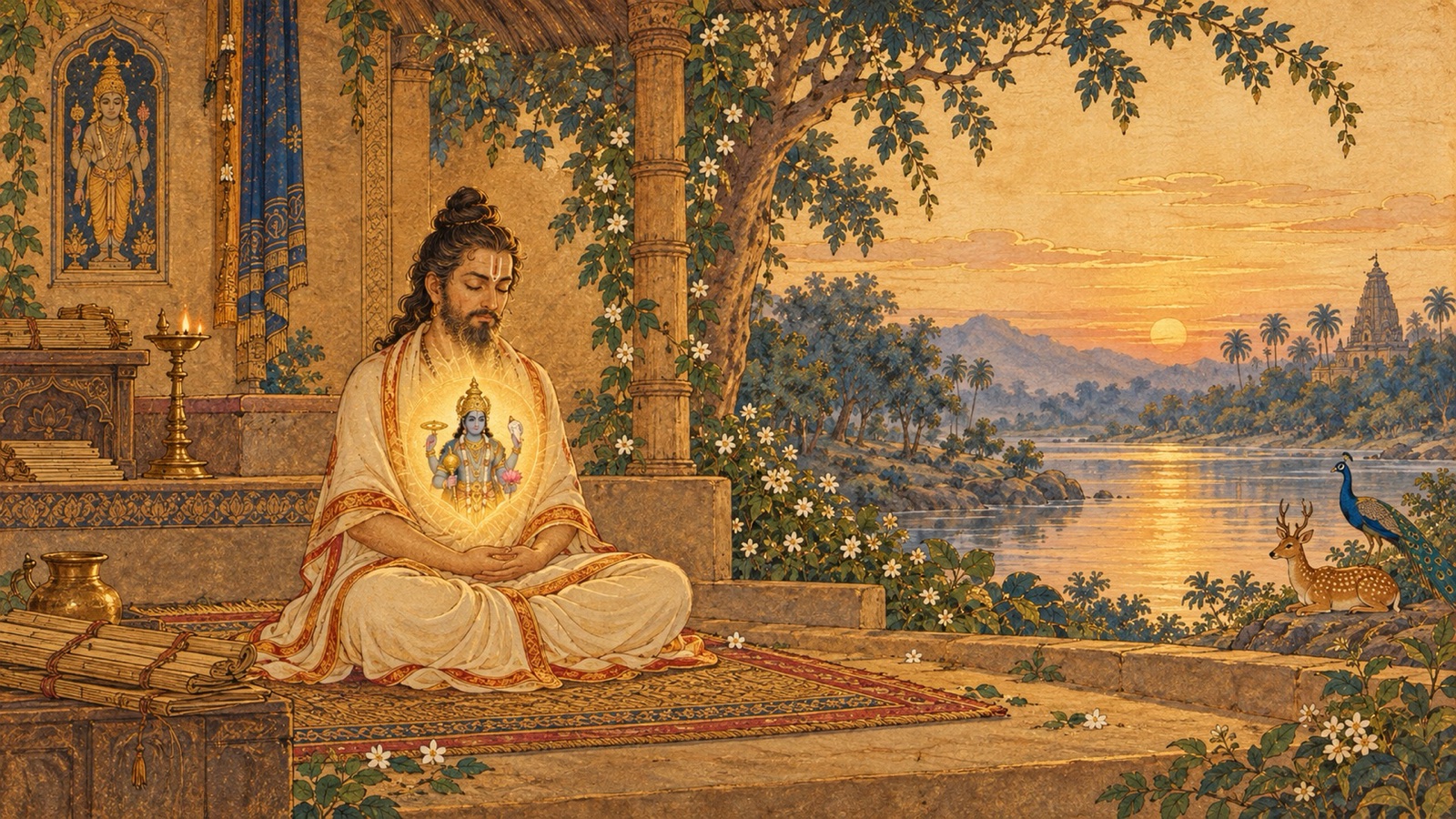
Two further Siddhis concern mastery over the body itself. The yogi seeking to enter another, untenanted body dwells in thought upon himself as already present there, and his vital air leaves his own body and enters the other as a black bee passes from flower to flower. And the yogi who raises the vital air in succession through the heart, chest, throat and crown of the head may leave the body at the time of his own choosing (verses 23–24). Here too the Lord’s emphasis is the same: it is steady concentration upon Him, carried into the subtlest workings of breath and mind, that grants this mastery — never force, but a quiet, practised absorption.
Sporting With the Gods, and the Fruits of Devotion
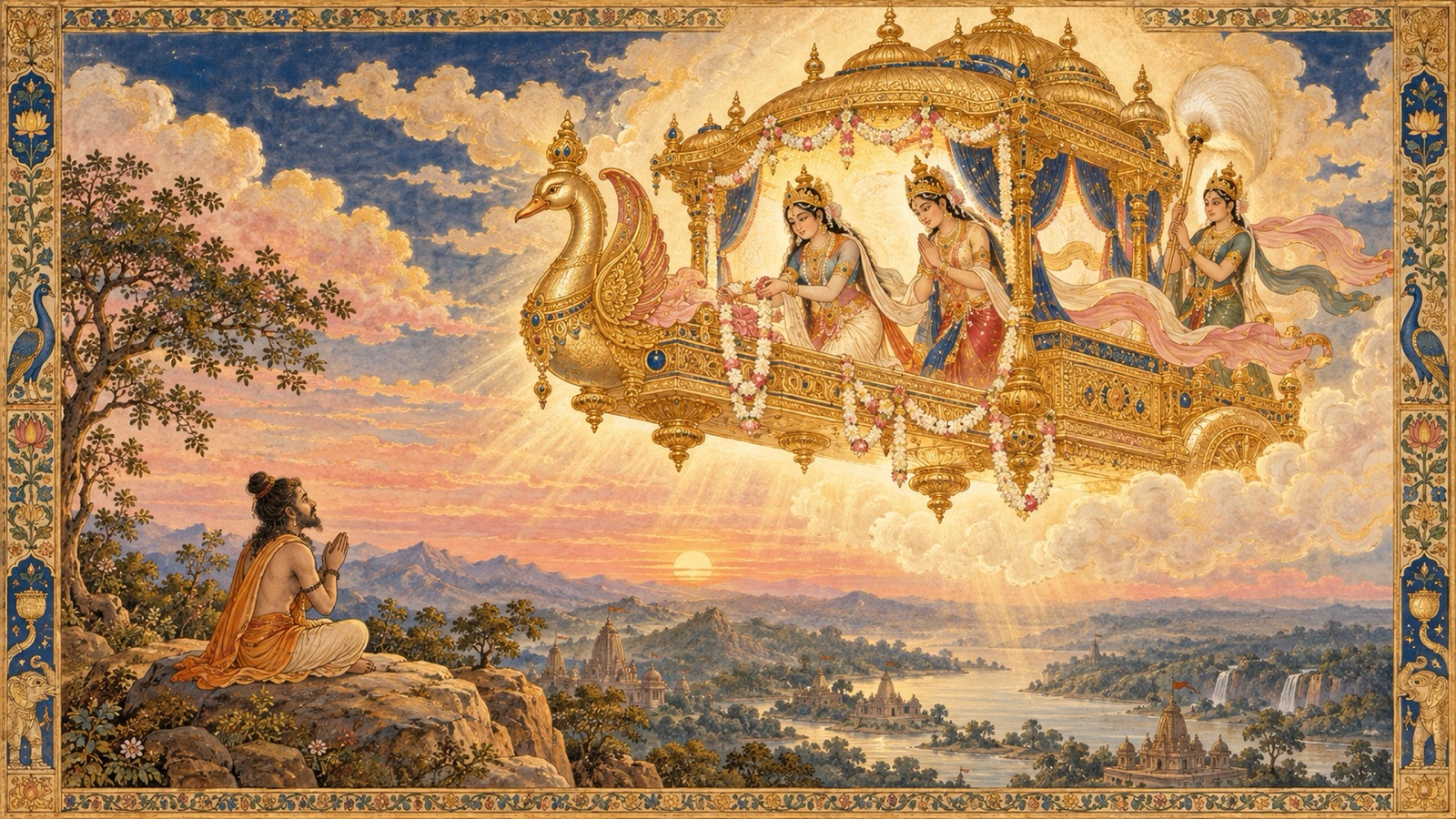
The Lord then turned to gentler gifts. One who wishes to sport in the pleasure-garden of the celestials should contemplate the pure goodness that constitutes His own personality; and the Apsaras, who are themselves rays of that goodness, come bearing celestial cars to receive him.
विहरिष्यन् सुराक्रीडे मत्स्थं सत्त्वं विभावयेत् । विमानेनोपतिष्ठन्ति सत्त्ववृत्ती: सुरस्त्रिय: ॥ २५ ॥
vihariṣyan surākrīḍe mat-sthaṁ sattvaṁ vibhāvayet vimānenopatiṣṭhanti sattva-vṛttīḥ sura-striyaḥ
Meaning: One wishing to sport in the pleasure-garden of the gods should contemplate the goodness that abides in Me; in response, the celestial nymphs, who are rays of that very goodness, come bearing aerial cars to receive him. (Canto 11, Chapter 15, verse 25)
Whatever a devoted soul resolves upon, fixing the mind on the Lord, is duly attained; and the command of one who has taken on His disposition of mastery meets no obstruction anywhere (verses 26–27). Direct knowledge of past, present and future comes to the yogi whose mind, purified through devotion, is held in steady concentration upon the Lord; his body, seasoned through such Yoga, can no more be harmed by fire than water can harm the creatures within it; and one who contemplates the Lord’s own glorious manifestations becomes unconquerable (verses 28–30).
Every Siddhi Waits Upon the Devotee — Yet the Wise Call Them Obstacles
Having unfolded the Siddhis one by one, the Lord drew His teaching to its heart. All of these wait upon the sage who worships Him through such concentration; indeed, what Siddhi could be difficult for one who has thus conquered senses, mind, breath and body (verses 31–32)? And then, with a tenderness that reshapes the whole chapter, He turns the catalogue of wonders on its head.
अन्तरायान् वदन्त्येता युञ्जतो योगमुत्तमम् । मया सम्पद्यमानस्य कालक्षपणहेतव: ॥ ३३ ॥
antarāyān vadanty etā yuñjato yogam uttamam mayā sampadyamānasya kāla-kṣapaṇa-hetavaḥ
Meaning: The wise speak of these very Siddhis as obstacles for the one who is practising the highest Yoga and seeking union with Me, for they merely cause a delay in his reaching that goal. (Canto 11, Chapter 15, verse 33)
The Lord does not say the Siddhis are false; He says only that, for the soul whose true aim is Him alone, every one of these wonders is a place to linger rather than the destination. And He is just as plain about what does, and does not, lie within their power.
जन्मौषधितपोमन्त्रैर्यावतीरिह सिद्धय: । योगेनाप्नोति ता: सर्वा नान्यैर्योगगतिं व्रजेत् ॥ ३४ ॥
janmauṣadhi-tapo-mantrair yāvatīr iha siddhayaḥ yogenāpnoti tāḥ sarvā nānyair yoga-gatiṁ vrajet
Meaning: Whatever Siddhis can be gained here through birth, through herbs, through austerity or through sacred mantras, all of these the Yogi attains through Yoga as well; but the supreme goal of Yoga cannot be reached by any of those other means. (Canto 11, Chapter 15, verse 34)
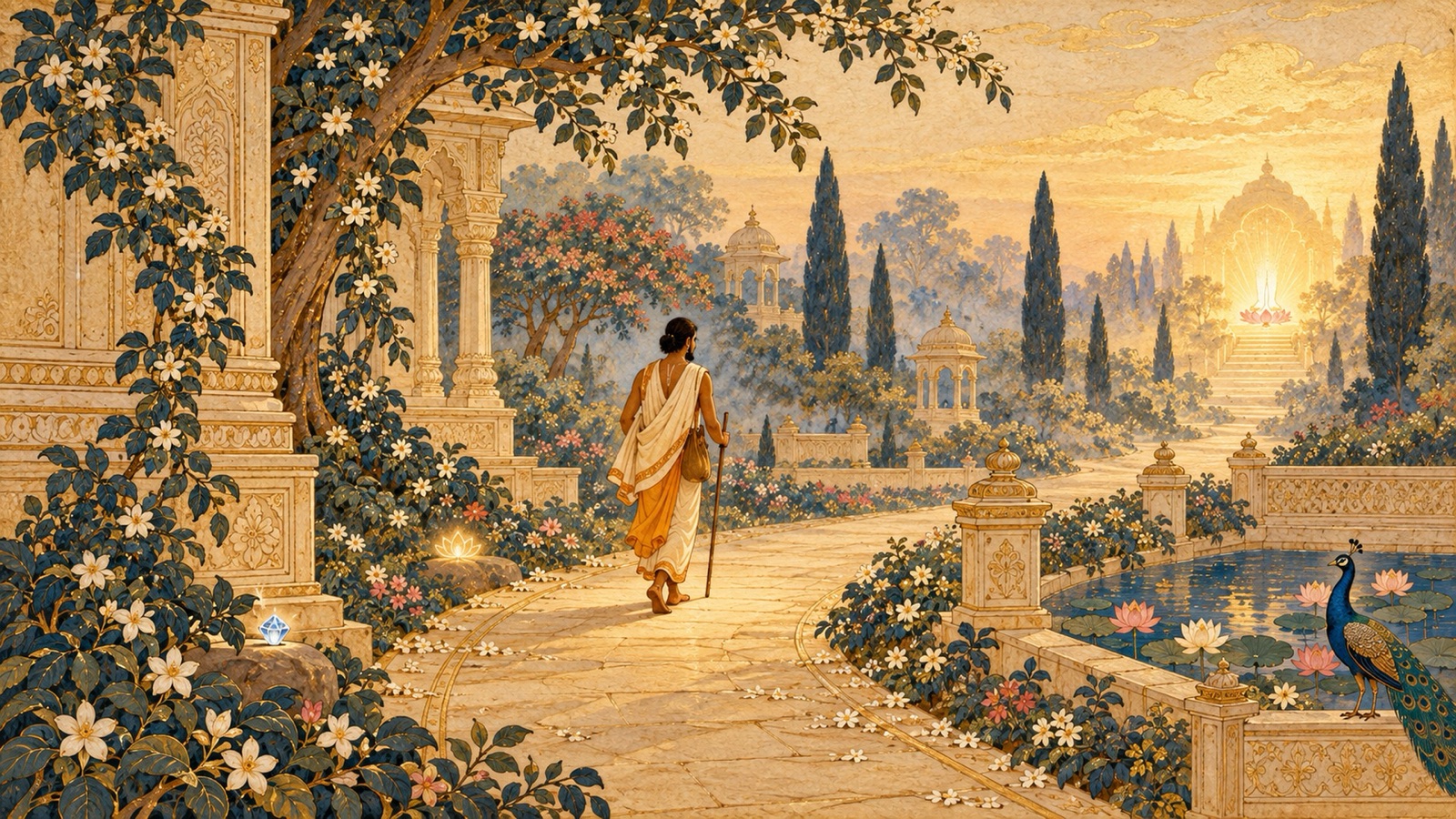
This is the single teaching a devotee carries away from the whole catalogue. The Lord names the eighteen Siddhis so fully, and explains their meditations in such loving detail, not to tempt Uddhava toward power but to show that even these extraordinary gifts are nothing but the overflow of a mind fixed upon Him. Birth, herbs, austerity and mantra can each yield some Siddhi, but only Yoga carries the soul to the one reward that truly matters — a life established in Him. For the sadhaka who has glimpsed this, every Siddhi that appears along the way is simply set gently aside, the way one gathers back a wandering mind, so that the eyes never leave the Lord’s feet.
The Lord — Source and Indwelling Self of All
The Lord closed by declaring His own place at the root of it all — the source and controller of every Siddhi, and of Yoga, Sankhya, Dharma, and even the teachers of the Veda (verse 35). And He ended with the deepest word of all — He is not a distant giver of gifts but the very Self seated within every being, their outer enclosure besides, though never bound by anything Himself.
अहमात्मान्तरो बाह्योऽनावृत: सर्वदेहिनाम् । यथा भूतानि भूतेषु बहिरन्त: स्वयं तथा ॥ ३६ ॥
aham ātmāntaro bāhyo ‘nāvṛtaḥ sarva-dehinām yathā bhūtāni bhūteṣu bahir antaḥ svayaṁ tathā
Meaning: I am the inmost Self as well as the outer enclosure of all embodied beings, though I remain Myself unenclosed by anything — just as the elements both pervade and surround the bodies of living creatures. (Canto 11, Chapter 15, verse 36)
Principal Teachings of This Chapter
1. Every Siddhi waits upon the mind fixed on the Lord. Mystic perfection is never the fruit of ambition alone; it comes to the yogi who has conquered the senses and breath and holds the mind steadily upon Him (verse 1).
2. The eighteen Siddhis have two sources. Eight belong chiefly to the Lord’s own nature — anima, mahima, laghima, prapti, prakamya, ishitva, vashita and kamavasayita — while ten others, and a minor set, arise through sattva-guna (verses 3–8).
3. Each Siddhi is the fruit of a particular meditation on the Lord. Fixing the mind on Him as the subtle elements, as Narayana, or as the cosmic breath, the yogi receives the corresponding power, since the power was never separate from Him (verses 9–24).
4. Devotion unlocks the gentlest and the gravest of these gifts alike. Sporting with the celestials, perceiving the three times, being unharmed by fire, becoming unconquerable — all follow naturally from a heart purified by bhakti (verses 25–30).
5. Siddhis are obstacles, not the goal, for the devotee. This is the chapter’s central teaching. The Lord Himself calls these powers obstacles — kala-kshapana-hetavah, “causes of a delay” — for the soul practising the highest Yoga, since lingering over any Siddhi postpones the one true attainment, union with Him. Whatever can be won through birth, herbs, austerity or mantra can also be won through Yoga; but the supreme reward, eternal life in His presence, comes by no other path (verses 31–34). A true Vaishnava never seeks a Siddhi for its own sake; if one appears unbidden, it is received the way one receives a wayside flower while walking steadily toward home.
6. The Lord is the one source and indwelling Self of all. He is the root of every Siddhi, of Yoga, of Sankhya, of Dharma, and of the knowers of the Veda; and He dwells within every being as their inmost Self even while surrounding them, untouched Himself by any enclosure (verses 35–36).
A Devotional Reflection
What stays with the heart, after the list of eighteen wonders has been read, is not any single power but the way the Lord speaks of them. He does not withhold the Siddhis as forbidden fruit, nor dangle them as rewards; He simply shows Uddhava how each is reached, because every one of them, at its root, is only Himself, approached from a different angle of the mind. Then He gently takes the ground away from beneath it all, saying none of this is the point. There is something reassuring in that: the Lord is not testing His devotee with powers to chase, but teaching that the very closeness of mind which produces a Siddhi, carried a little further in love, leads the soul past every wonder and into His own presence. A devotee who reads this chapter need feel no ambition stirred by anima or ishitva; what should stir instead is the quiet recognition that a mind this absorbed in the Lord, offered wholly in surrender, can reach the Lord Himself.
A Daily Devotional Practice
Today, practise setting the small gift aside for the greater one. Whenever something pleasant comes your way unasked for — a compliment, a small success, an unexpected ease — pause and offer it quietly to the Lord rather than lingering in it, the way this chapter teaches that even a genuine Siddhi should be received and released. Then return the mind to Him, repeating His holy name: “Om Namo Bhagavate Vasudevaya.” In that small, repeated choice — noticing the gift, but walking on toward the Giver — lies the heart of what this chapter asks of every sincere seeker.
Conclusion
The fifteenth discourse of Book Eleven carries Uddhava’s question about the Siddhis into one of the most luminous teachings of the whole Bhagavatam. The Lord names the eighteen mystic perfections, explains the meditation that unlocks each, and shows that every power is simply the overflow of a mind truly fixed upon Him. Then He tells Uddhava what matters far more: for the soul seeking union with Him, these very Siddhis are obstacles, delays upon a road whose destination is the Lord Himself. Whatever can be won by birth, herb, austerity or mantra can be won by Yoga too, but the supreme reward comes by no other path. And in the end He reveals He was never apart from any of it — the source of every Siddhi, and the inmost Self dwelling within every being He also surrounds. So this chapter leaves the devotee not grasping after wonders, but walking on, steadily, toward the One who is Himself the only wonder worth seeking.
May the divine wisdom of Srimad Bhagavatam awaken pure devotion within our hearts.
Om Namo Bhagavate Vasudevaya.
Jay Shree Madhav.
References and Attribution
- Primary edition: Gita Press, Śrīmad Bhāgavata Mahāpurāṇa (English, complete), Book Eleven, Discourse 15, pages 580–584.
- Series: Srimad Bhagavatam Wisdom · Biswa Sanatan Dharma Seva Trust.
- Presented following the spiritual guidance and recommendation of Pandit Dr. Shri Kashinath Mishra.
This is an original, faithful retelling in the writer’s own words, with brief quoted verses shown in Devanāgarī and transliteration and their meanings given as summaries. It is not a reproduction of any single publisher’s continuous translation or commentary. No affiliation with or endorsement by any publisher is implied.
Jay Shree Madhav