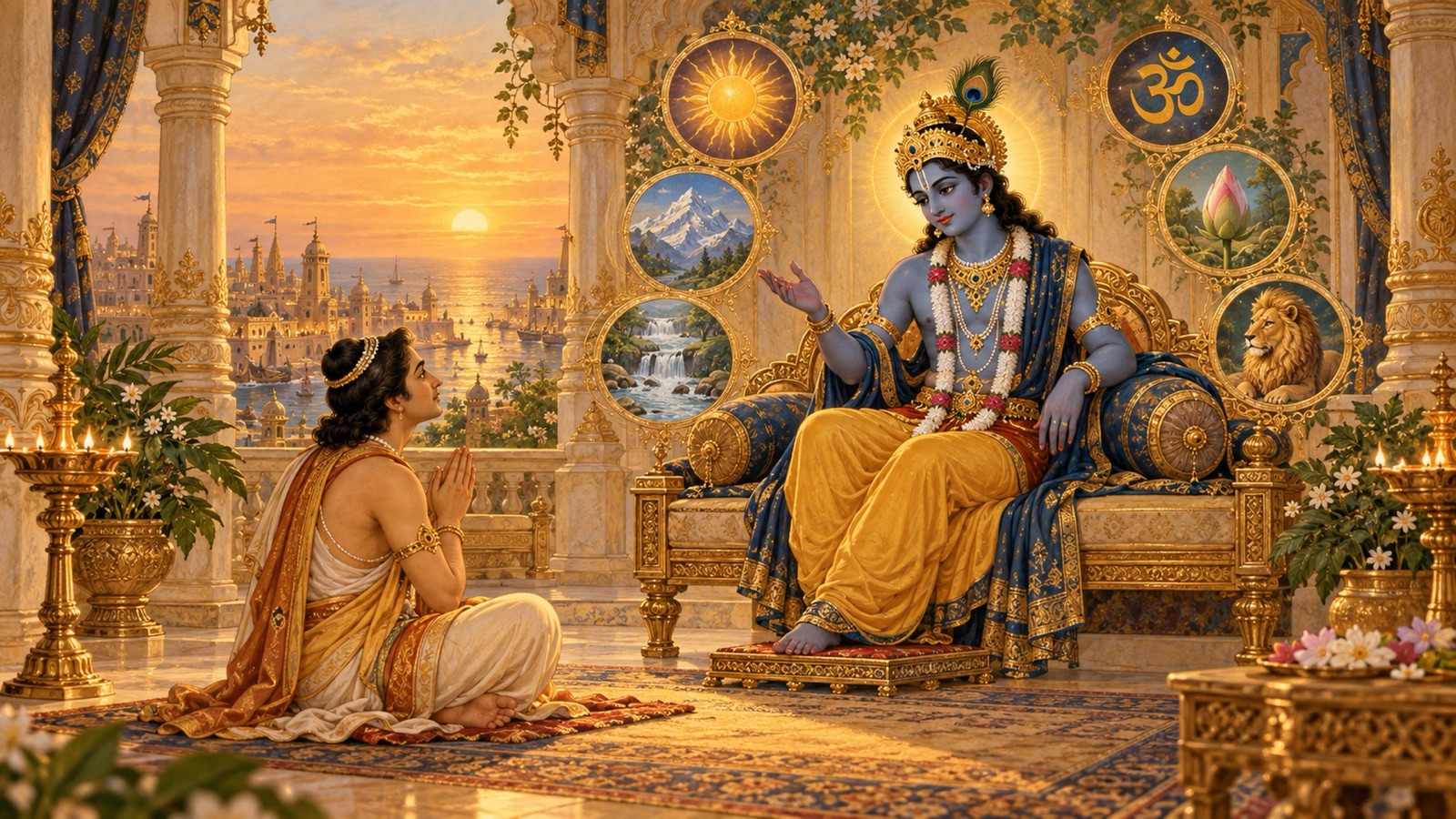
At Uddhava’s request, Lord Sri Krishna unveils the radiant web of His own glories — hidden within the sun and the Himalaya, the sacred Ganga and the syllable Om — and then calls His beloved devotee to gather every sense back to Him alone.
Om Namo Bhagavate Vasudevaya.
Om Namo Bhagavate Vasudevaya.
Om Namo Bhagavate Vasudevaya.
Welcome to Srimad Bhagavatam Wisdom, a devotional journey through the sacred histories and teachings of the Srimad Bhagavat Mahapurana. In the quiet of Dwaraka, Uddhava asks his Lord the question that has drawn seekers across the ages: by which particular glories, hidden everywhere within creation, may a devotee most easily remember and reach Him? Sri Krishna answers at length, pouring His own splendour through sun and stars, sacred rivers and silent mountains, before leading Uddhava gently back to the one practice that gathers every scattered glory into the heart.
Chapter Information
- Scripture: Śrīmad Bhāgavata Mahāpurāṇa
- Canto: 11 (Book Eleven)
- Chapter: 16 (Discourse 16)
- Chapter title: The Lord’s Opulence
- Principal speaker: Sri Krishna, instructing Uddhava; the whole related by Sukadeva Gosvami to King Parikshit
- Principal listener: Uddhava; and King Parikshit
- Main setting: Dwaraka, in the Lord’s continuing dialogue with Uddhava
- Central subject: The Lord enumerates His divine manifestations (vibhutis) pervading all of creation, and calls the devotee to gather speech, mind, breath and senses back to Him alone
- Principal verse range: Canto 11, Chapter 16, verses 1–44
- Primary edition: Gita Press Śrīmad Bhāgavata Mahāpurāṇa
Uddhava’s Longing to Know the Lord’s Hidden Glories
Uddhava bows before his Lord and speaks from the fullness of his heart.
श्रीउद्धव उवाच त्वं ब्रह्म परमं साक्षादनाद्यन्तमपावृतम् । सर्वेषामपि भावानां त्राणस्थित्यप्ययोद्भव: ॥ १ ॥
śrī-uddhava uvāca tvaṁ brahma paramaṁ sākṣād anādy-antam apāvṛtam sarveṣām api bhāvānāṁ trāṇa-sthity-apyayodbhavaḥ
Meaning: Uddhava said: You are indeed the Supreme Brahman, without beginning or end and never covered by illusion; You alone are the cause of the protection, maintenance, dissolution and arising of all that exists. (Canto 11, Chapter 16, verse 1)
Only the Brahmanas who truly understand the Vedas, he says, can worship the Lord exactly as He is, abiding equally in all beings, high or low — worship still beyond an unpurified mind. Let the Lord name those very forms of Himself by contemplating which the great sages attain supreme perfection. Though He moves concealed within every creature as its life-giver, those deluded by His own power behold all things yet fail to behold Him, their very witness. So Uddhava makes his plea outright.
या: काश्च भूमौ दिवि वै रसायां विभूतयो दिक्षु महाविभूते । ता मह्यमाख्याह्यनुभावितास्ते नमामि ते तीर्थपदाङ्घ्रिपद्मम् ॥ ५ ॥
yāḥ kāś ca bhūmau divi vai rasāyāṁ vibhūtayo dikṣu mahā-vibhūte tā mahyam ākhyāhy anubhāvitās te namāmi te tīrtha-padāṅghri-padmam
Meaning: Whatever manifestations of Yours, invested with Your own divine splendour, exist on this earth, in the heavens, in the nether world or in the four quarters, O Lord of boundless power, kindly describe them to me; I bow to Your lotus feet, the refuge of every sacred place. (Canto 11, Chapter 16, verse 5)
The Lord as the Self, Friend and Ruler of All Beings
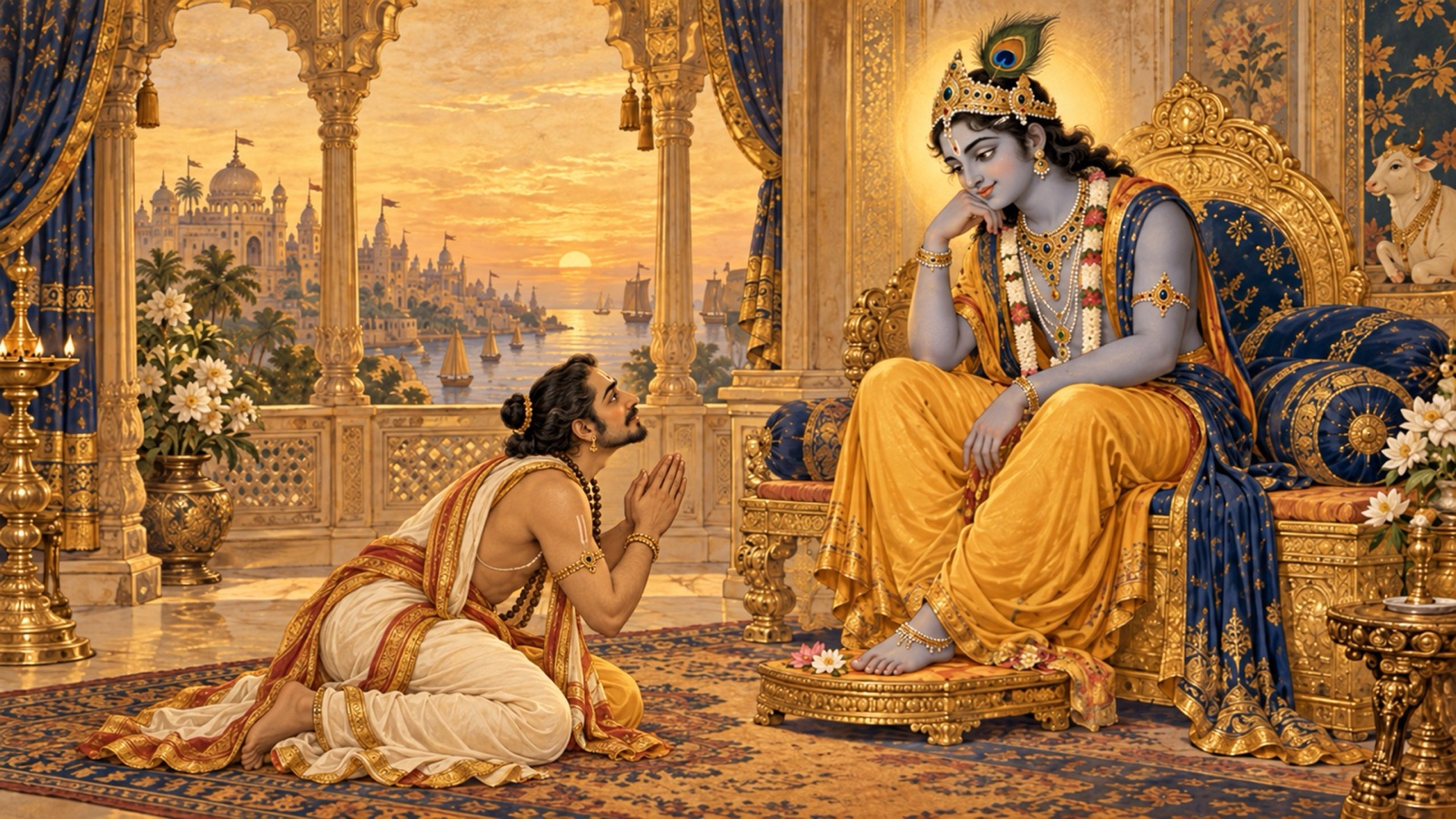
Before answering, the Lord recalls that this same question was once asked of Him by Arjuna at Kurukshetra, when he stood unwilling to fight his own kinsmen. Thinking as an ordinary man thinks — “I am the slayer, and this man is slain” — and judging the killing of kin for a kingdom to be sin, Arjuna had drawn back. Roused from that delusion by the Lord’s own reasoning, he had questioned Him at the head of the battlefield in the very spirit Uddhava now questions Him. The Lord gives Uddhava the same answer He gave there.
अहमात्मोद्धवामीषां भूतानां सुहृदीश्वर: । अहं सर्वाणि भूतानि तेषां स्थित्युद्भवाप्यय: ॥ ९ ॥
aham ātmoddhavāmīṣāṁ bhūtānāṁ suhṛd īśvaraḥ ahaṁ sarvāṇi bhūtāni teṣāṁ sthity-udbhavāpyayaḥ
Meaning: I am the very Self of these beings, their well-wishing friend and their Ruler, O Uddhava; I am all these beings, and I alone am their arising, their continuance and their final dissolution. (Canto 11, Chapter 16, verse 9)
Hidden in Time, the Mind and the Sacred Syllable Om
From this foundation the Lord begins His great enumeration.
अहं गतिर्गतिमतां काल: कलयतामहम् । गुणानां चाप्यहं साम्यं गुणिन्यौत्पत्तिको गुण: ॥ १० ॥
ahaṁ gatir gatimatāṁ kālaḥ kalayatām aham gunāṇāṁ cāpy ahaṁ sāmyaṁ guṇiny autpattiko guṇaḥ
Meaning: I am the motion in all that moves, and I am Time, the subduer of every subduer; I am the balance among the three modes of nature, and the quality natural to a thing possessing qualities. (Canto 11, Chapter 16, verse 10)
He is the active intelligence among the products of the three modes, Mahat-tattva among vast things, the individual soul among subtle principles, and the mind among things hardest to conquer (verses 10–11).
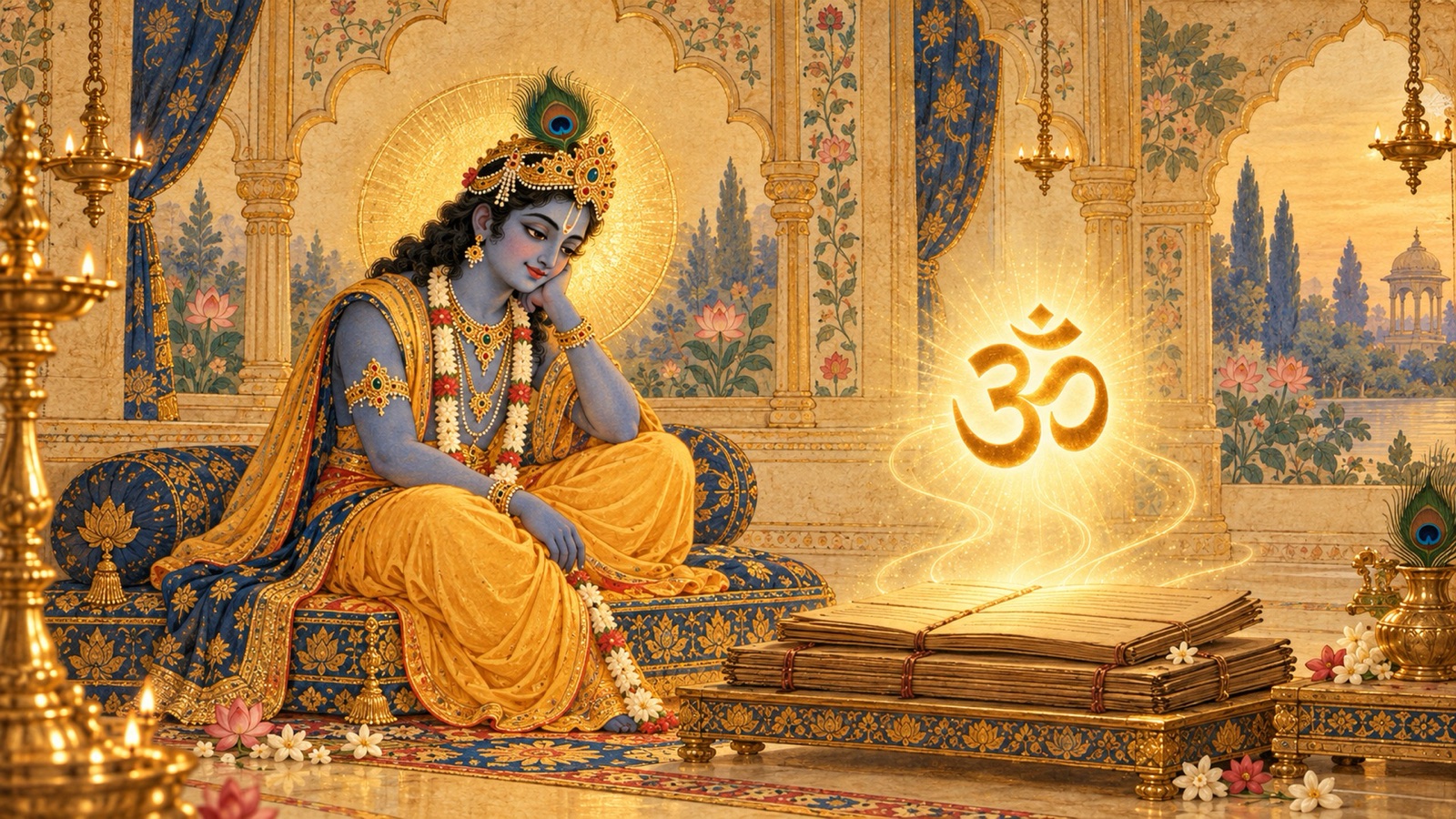
हिरण्यगर्भो वेदानां मन्त्राणां प्रणवस्त्रिवृत् । अक्षराणामकारोऽस्मि पदानिच्छन्दसामहम् ॥ १२ ॥
hiraṇyagarbho vedānāṁ mantrāṇāṁ praṇavas tri-vṛt akṣarāṇām a-kāro ‘smi padāni cchandasām aham
Meaning: Of the Vedas I am Brahma, their first teacher; of sacred utterances I am the three-syllabled Pranava, Om; of the letters I am the letter A, and of the sacred metres I am the Gayatri. (Canto 11, Chapter 16, verse 12)
Among the Gods, the Sages and the Stars
The Lord’s glory shines through the chief of every order of being. Among the gods He is Indra; among the Vasus, Agni; among Aditi’s sons, Vishnu; among the Rudras, Nilalohita, Lord Shiva. Among the Brahma-born sages He is Bhrigu; among royal sages, Swayambhuva Manu; among celestial sages, Narada; among cows, Kamadhenu. Among the Siddhas He is Kapila; among birds, Garuda; among the Prajapatis, Daksha; among the manes, Aryama. Among the Daityas He is their ruler Prahlada; among stars and plants, the moon; among Yakshas and Rakshasas, Kubera, lord of treasures. He is Airavata among elephants, Varuna among water-creatures, the sun among all that shines, and the king among men. He is Uchchaihshrava among horses, gold among metals, Yama among punishers, Vasuki among serpents. He is Ananta among the rulers of snakes, the lion among beasts, sannyasa among the four stages of life, and the Brahmana class among the four grades of society (verses 13–19).
Among the Rivers, the Mountains and the Sacred Fires
Of the sacred streams, the Lord says, He is one above all others.
तीर्थानां स्रोतसां गङ्गा समुद्र: सरसामहम् । आयुधानां धनुरहं त्रिपुरघ्नो धनुष्मताम् ॥ २० ॥
tīrthānāṁ srotasāṁ gaṅgā samudraḥ sarasām aham āyudhānāṁ dhanur ahaṁ tripura-ghno dhanuṣmatām
Meaning: Of the sacred streams I am the river Ganga, and of the standing waters I am the ocean; of weapons I am the bow, and of its wielders I am Lord Shiva, the destroyer of the three cities. (Canto 11, Chapter 16, verse 20)
He is Mount Meru among great abodes, and the Himalaya among places difficult of access; the sacred fig tree among trees, and barley among annual plants. He is Vasishtha among family priests, Brihaspati among Veda-devoted sages, Skanda among leaders of armies, and Brahma Himself among guides of the righteous path. Among sacrificial acts He is the daily recitation of the Vedas, among sacred vows He is harmlessness, and among purifying agencies He is the purity carried in air, fire, the sun, water and a Brahmana’s truthful word (verses 21–23).

Among the Virtues, the Seasons and the Wise
Among the limbs of yoga He is Samadhi; among those seeking victory, sound political wisdom; among the sciences of right understanding, the discernment of Spirit from Matter; and among debaters on perception, their very doubt. Among women He is Shatarupa, consort of Swayambhuva Manu; among men, Manu himself; among ascetics, the sage Narayana; among lifelong celibates, Sanatkumara. Among paths of dharma He is renunciation; among all that brings fearlessness, thought withdrawn from without; among the ways of secrecy, kind speech and silence; and among primal pairs, Brahma, who became both man and woman. Among the ever-wakeful He is the revolving year; among seasons, the months of Chaitra and Vaishakha; among months, Margashirsha; among lunar mansions, Abhijit. Among the four ages He is Krita Yuga; among the self-controlled, the sages Asita and Devala; among the compilers of the Vedas, Krishna Dwaipayana Vyasa; and among the wise, the self-possessed Shukracharya (verses 24–28).
Of My Own Devotees, I Am You, Uddhava
Here the Lord’s voice turns personal, and the vast catalogue becomes, for a moment, a private gift to His friend.
वासुदेवो भगवतां त्वं तु भागवतेष्वहम् । किम्पुरुषाणां हनुमान् विद्याध्राणां सुदर्शन: ॥ २९ ॥
vāsudevo bhagavatāṁ tvaṁ tu bhāgavateṣv aham kimpuruṣānāṁ hanumān vidyādhrāṇāṁ sudarśanaḥ
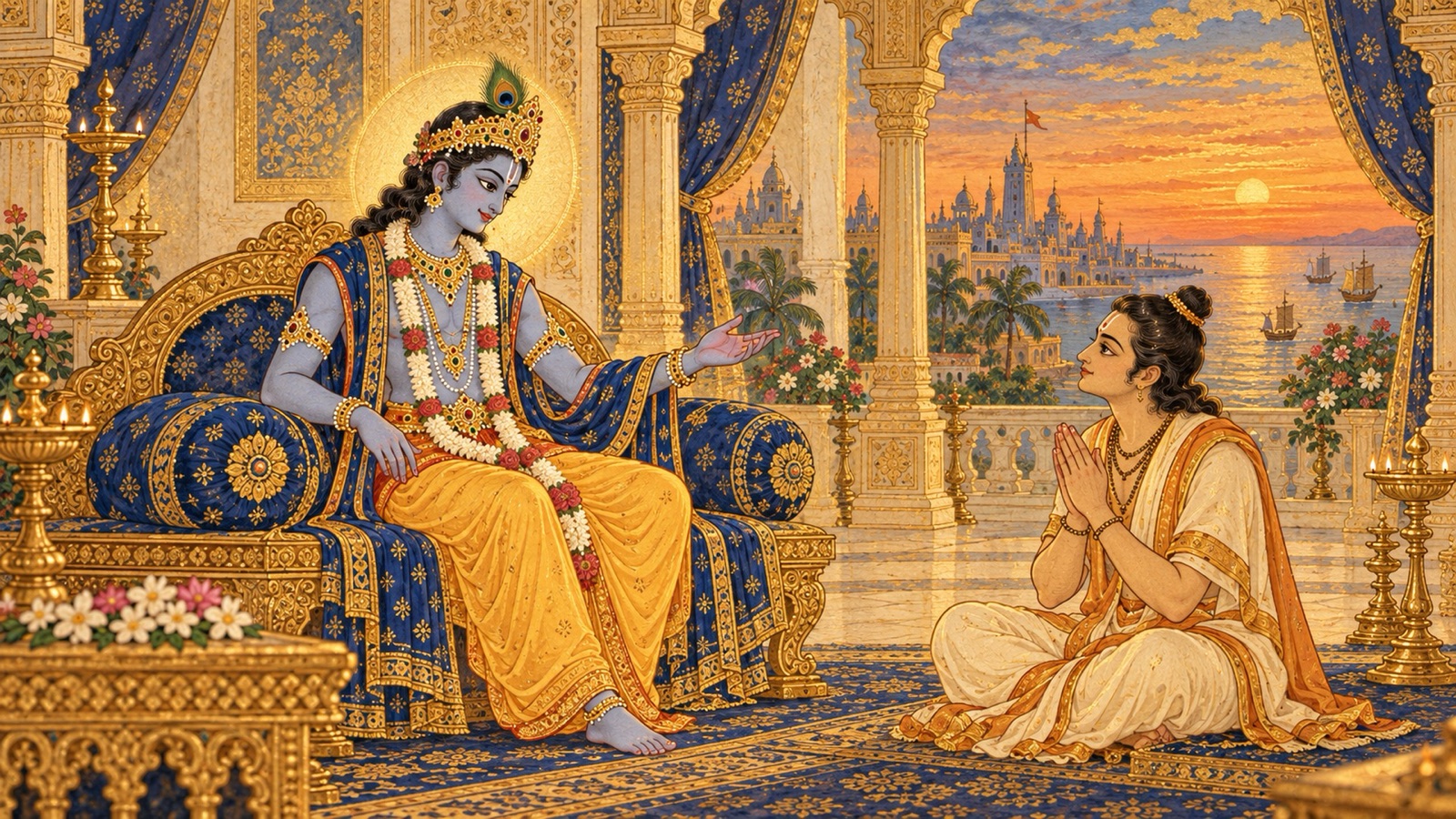
Meaning: Of divine personages I am Vasudeva, and of My own devotees, I am you, O Uddhava; of the Kimpurushas I am Hanuman, and of the Vidyadharas I am Sudarshan. (Canto 11, Chapter 16, verse 29)
Among precious stones He is the ruby, and among lovely things, the lotus bud; among sacred grasses, kusha; among offerings into the fire, cow’s ghee. Among those who labour for wealth He is the wealth itself; among the deceitful, the trick that is played; He is the endurance of the enduring and the courage of the courageous. He is the strength of the strong, in body and in mind, and every act offered by His devotees is His own; and among the nine sacred forms worshipped by the Satvatas, He is Vasudeva, first and highest (verses 30–32).
Hidden in Water’s Taste, Fire’s Light and the Sound of the Sky
Among the Gandharvas and Apsaras He is Vishvavasu and Purvachitti; He is the firmness of mountains, and the fragrance of the earth (verse 33). He is the fine taste in water, and among the most radiant, fire.
अपां रसश्च परमस्तेजिष्ठानां विभावसु: । प्रभा सूर्येन्दुताराणां शब्दोऽहं नभस: पर: ॥ ३४ ॥
apāṁ rasaś ca paramas tejiṣṭhānāṁ vibhāvasuḥ prabhā sūryendu-tārāṇāṁ śabdo ‘haṁ nabhasaḥ paraḥ
Meaning: I am the fine taste in water, and among the most radiant I am fire; I am the brilliance shining in the sun, the moon and the stars, and I am the sound that pervades the ether beyond all else. (Canto 11, Chapter 16, verse 34)
He is Bali among those devoted to the Brahmanas, and Arjuna among the valiant; He Himself is the genesis, continuance and final dissolution of created beings. He is every function of the senses — locomotion, speech, grasping, enjoyment, and the power to touch, see, taste, hear and smell — indeed the very faculty of perception within every sense. He is the seven subtle elements that are both cause and effect — earth, air, ether, water, fire, the cosmic ego and Mahat-tattva — their modifications, the individual soul, the unmanifest root of matter, the three modes, and Brahman, the Absolute; He is even the reckoning of these categories, their knowledge, and the final realisation of the truth behind them (verses 35–37).
Nothing Exists Anywhere Apart From Me
The great enumeration now gathers into one overwhelming truth.
मयेश्वरेण जीवेन गुणेन गुणिना विना । सर्वात्मनापि सर्वेण न भावो विद्यते क्वचित् ॥ ३८ ॥
mayeśvareṇa jīvena guṇena guṇinā vinā sarvātmanāpi sarveṇa na bhāvo vidyate kvacit
Meaning: Apart from Me — the Lord, the individual soul, the three modes of nature and all that is made of them, the Self of all and the all itself — nothing whatsoever exists, anywhere. (Canto 11, Chapter 16, verse 38)
In time, He tells Uddhava, He could number every atom in existence, yet never His own manifestations, for He brings forth universes by the millions.
तेज: श्री: कीर्तिरैश्वर्यं ह्रीस्त्याग: सौभगं भग: । वीर्यं तितिक्षा विज्ञानं यत्र यत्र स मेंऽशक: ॥ ४० ॥
tejaḥ śrīḥ kīrtir aiśvaryaṁ hrīs tyāgaḥ saubhagaṁ bhagaḥ vīryaṁ titikṣā vijñānaṁ yatra yatra sa me ‘ṁśakaḥ
Meaning: Wherever there is glory, prosperity, fame, lordship, modesty, generosity, grace, good fortune, valour, endurance or true knowledge, know that to be but a fragment of My own splendour. (Canto 11, Chapter 16, verse 40)
This is the quiet heart of the teaching. The Lord does not scatter these countless glories before Uddhava to be merely admired, as one counts jewels in a treasury. He gives them so that His devotee’s eye, falling anywhere — on a river, a sage, a season, a flower — may be drawn back to Him, and never rest content with the surface of things. Every excellence anywhere becomes a doorway; and a mind trained to see the doorway everywhere soon cannot forget the One standing just within it. This is why the enumeration must end not in a longer list, but in instruction.
Beyond Every Glory — Gathering Speech, Mind and Breath Unto the Lord
Having shown Uddhava the whole shining world as His own glory, the Lord gently sets the catalogue aside.
एतास्ते कीर्तिता: सर्वा: सङ्क्षेपेण विभूतय: । मनोविकारा एवैते यथा वाचाभिधीयते ॥ ४१ ॥
etās te kīrtitāḥ sarvāḥ saṅkṣepeṇa vibhūtayaḥ mano-vikārā evaite yathā vācābhidhīyate
Meaning: These, in brief, are all the manifestations of My glory that I have told you; they are, after all, but movements of the mind, given shape only as they are expressed in words. (Canto 11, Chapter 16, verse 41)
What matters now, He says, is not the list but the one who hears it.
वाचं यच्छ मनो यच्छ प्राणान् यच्छेन्द्रियाणि च । आत्मानमात्मना यच्छ न भूय: कल्पसेऽध्वने ॥ ४२ ॥
vācaṁ yaccha mano yaccha prāṇān yacchedriyāṇi ca ātmānam ātmanā yaccha na bhūyaḥ kalpase ‘dhvane
Meaning: Restrain your speech, restrain your mind, restrain your breath, and restrain your senses; master your very self by your own self, and you shall no more be set upon the path of birth and death. (Canto 11, Chapter 16, verse 42)
The vows, austerities and charity of one who fails to master speech and mind through right understanding, the Lord warns, leak away unnoticed, like water seeping from an unbaked clay pot. He closes with the one practice that holds everything else together.
तस्माद्वचोमन:प्राणान् नियच्छेन्मत्परायण: । मद्भक्तियुक्तया बुद्ध्या तत: परिसमाप्यते ॥ ४४ ॥
tasmād vaco manaḥ prāṇān niyacchen mat-parāyaṇaḥ mad-bhakti-yuktayā buddhyā tataḥ parisamāpyate
Meaning: Therefore let one devoted to Me restrain speech, mind and breath with an intellect steeped in devotion to Me; by this alone does the journey reach its end. (Canto 11, Chapter 16, verse 44)
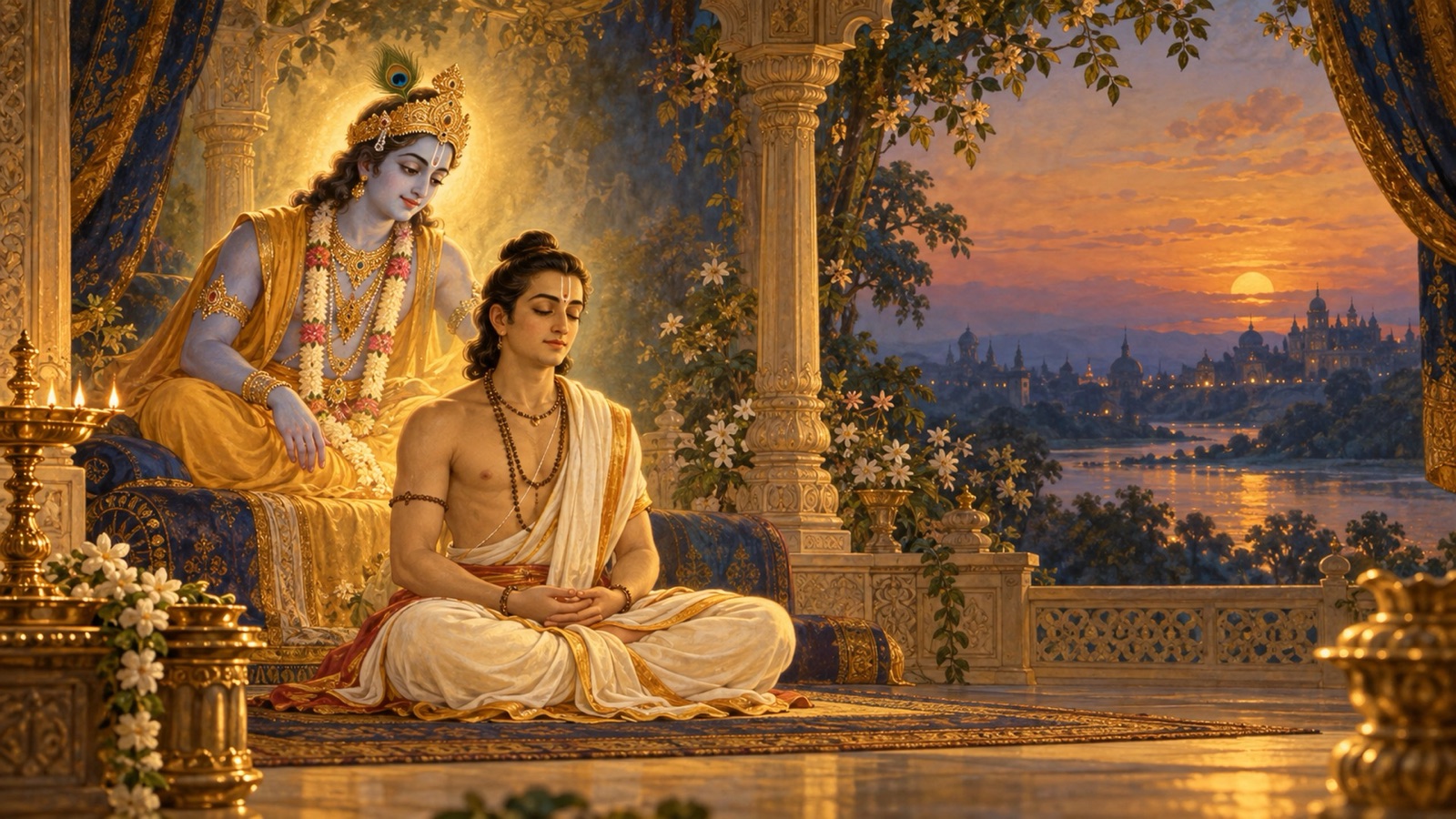
Principal Teachings of This Chapter
1. The Lord is the Self, friend and ruler of every being. He is not merely the cause of creation from a distance; He is the very Self within each creature, its well-wisher, and the one who brings it into being, sustains it and draws it home again (verse 9).
2. Every excellence in the world is His fragment. Whatever is strongest, purest or most beautiful in any order of being — among gods, sages, rivers, seasons, virtues or creatures — is named by the Lord as Himself in that form (verses 10–37).
3. The vibhutis exist to turn the mind homeward, not to be merely admired. By showing that glory, strength and wisdom wherever they appear are His own fragments, the Lord trains the devotee’s gaze to pass through every excellent thing and rest on its Source (verse 40).
4. Nothing exists apart from Him. He is simultaneously the Supreme Controller, the embodied soul, nature’s three modes and every category built from them; no separate reality stands outside Him anywhere (verse 38).
5. His glories can never be exhausted by counting. Though He could number every atom in existence, His own manifestations remain beyond reckoning, for He brings forth universes by the millions (verse 39).
6. The catalogue of glories is not the goal — mastery of self is. All these wonders are, in the end, only words; the true teaching is to restrain speech, mind, breath and senses, mastering the self by the self, so as to be freed from the road of birth and death (verses 41–42).
7. Devotion completes the mastery. An intellect steeped in devotion to the Lord is what finally gathers speech, mind and breath into stillness and brings the journey to its end (verse 44).
A Devotional Reflection
What moves me most here is how the Lord answers Uddhava’s longing not with a cold list but with affection for His own creation. He speaks of the Ganga and the Himalaya, the moon and the lion, the humble barley and the lovely lotus bud, as though each were dear to Him in its particular way — because each is a trace of His own hand. Then, in the middle of this immense catalogue, He turns and names a single human being: “Of My own devotees, I am you, Uddhava.” There is no higher glory in the whole chapter than that quiet sentence. It tells every reader of this scripture that the same nearness is offered to us — that the Lord who fills the sun and the sacred river is just as present within the heart that simply loves Him. Yet the chapter does not let us rest in wonder alone. It ends by turning our attention away from the dazzling list and back toward our own speech, mind and breath, reminding us that beholding the Lord’s glory everywhere is only the beginning; the task given to us is to gather ourselves, patiently and with devotion, until we come to rest in Him alone.
A Daily Devotional Practice
Today, choose one ordinary thing you encounter often — a river, a tree, the morning light, even your own breath — and let it remind you, for a few quiet moments, that whatever is excellent or beautiful in it is a fragment of the Lord’s own glory. Then, following His own closing instruction to Uddhava, sit quietly and gently gather your speech, mind and breath inward, letting them settle on Him alone. Softly repeat His holy name, “Om Namo Bhagavate Vasudevaya,” and offer this small act of restraint to Him as your devotion. In this simple practice you walk the very path laid out for Uddhava — seeing His glory everywhere, and then quietly bringing every scattered sense home to Him.
Conclusion
In this sixteenth discourse of Book Eleven, Uddhava asks his beloved Lord to reveal the glories through which a devotee may most easily remember and reach Him, and Sri Krishna answers with the same teaching He once gave Arjuna at Kurukshetra: that He is the very Self, friend and ruler of all beings. He then unfolds Himself through the whole of creation — through time and mind, Om and the Vedas, gods and sages, the Ganga and the Himalaya, the virtues and the seasons, and, most tenderly, through His own devotee Uddhava. Every strength and beauty anywhere, He declares, is but a fragment of His splendour, never to be exhausted by counting. Yet having shown all this, He sets the catalogue gently aside, calling Uddhava instead to quiet his speech, settle his mind, steady his breath and govern his senses through an intellect steeped in devotion — for only this, and not the list of wonders however vast, brings the soul’s long journey to its true end.
May the divine wisdom of Srimad Bhagavatam awaken pure devotion within our hearts.
Om Namo Bhagavate Vasudevaya.
Jay Shree Madhav.
References and Attribution
- Primary edition: Gita Press, Śrīmad Bhāgavata Mahāpurāṇa (English, complete), Book Eleven, Discourse 16, pages 584–588.
- Series: Srimad Bhagavatam Wisdom · Biswa Sanatan Dharma Seva Trust.
- Presented following the spiritual guidance and recommendation of Pandit Dr. Shri Kashinath Mishra.
This is an original, faithful retelling in the writer’s own words, with brief quoted verses shown in Devanāgarī and transliteration and their meanings given as summaries. It is not a reproduction of any single publisher’s continuous translation or commentary. No affiliation with or endorsement by any publisher is implied.
Jay Shree Madhav