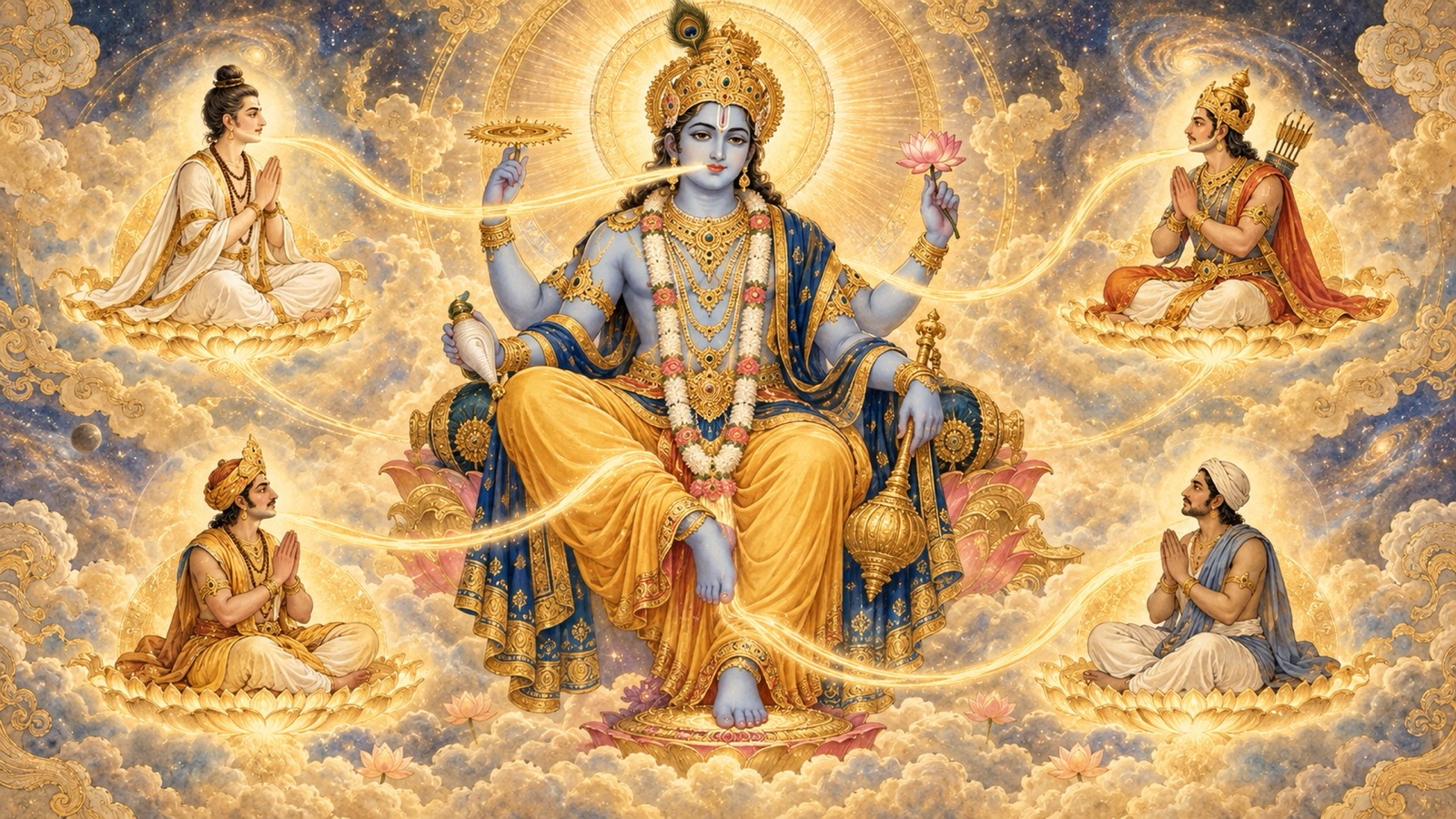
Uddhava begs the Lord not to let the sacred path of duty vanish from the earth, and Sri Krishna answers with joy — tracing the four Varnas and four Asramas to His own cosmic form, and showing how every one of them, rightly walked in devotion, leads home to Him.
Om Namo Bhagavate Vasudevaya.
Om Namo Bhagavate Vasudevaya.
Om Namo Bhagavate Vasudevaya.
Welcome to Srimad Bhagavatam Wisdom, a devotional journey through the sacred histories and teachings of the Srimad Bhagavat Mahapurana. Uddhava turns to a gentle but vital matter: the sacred duties by which every soul may be carried toward devotion. Sri Krishna answers with delight, showing why even the humblest daily task, rightly offered, becomes worship.
Chapter Information
- Scripture: Śrīmad Bhāgavata Mahāpurāṇa
- Canto: 11 (Book Eleven)
- Chapter: 17 (Discourse 17)
- Chapter title: Lord Krishna’s Description of the Varnasrama System
- Principal speaker: Sri Krishna, instructing Uddhava; the whole related by Sukadeva Gosvami to King Parikshit
- Principal listener: Uddhava; and King Parikshit
- Main setting: Dwaraka
- Central subject: The origin and duties of the four Varnas and four Asramas, and how devotion is engendered through one’s own appointed duty
- Principal verse range: Canto 11, Chapter 17, verses 1–58
- Primary edition: Gita Press Śrīmad Bhāgavata Mahāpurāṇa
Context from the Previous Chapter
In Chapter 16, the Lord revealed His own glorious manifestations and urged Uddhava to restrain speech, mind, breath and the senses, fixing his eyes on Him alone. He now turns to a question Uddhava has long carried: how devotion is engendered through the duty proper to one’s own station.
Uddhava’s Plea for a Vanishing Path
Uddhava submitted that the righteous course expressive of devotion — open to all who follow the duties of the four Varnas and Asramas — had been taught by the Lord long ago, as the Divine Swan, to Brahma Himself.
श्रीउद्धव उवाच यस्त्वयाभिहित: पूर्वं धर्मस्त्वद्भक्तिलक्षण: । वर्णाश्रमाचारवतां सर्वेषां द्विपदामपि ॥ १ ॥ यथानुष्ठीयमानेन त्वयि भक्तिर्नृणां भवेत् । स्वधर्मेणारविन्दाक्ष तन् ममाख्यातुमर्हसि ॥ २ ॥
śrī-uddhava uvāca yas tvayābhihitaḥ pūrvaṁ dharmas tvad-bhakti-lakṣaṇaḥ varṇāśramācāravatāṁ sarveṣāṁ dvi-padām api yathānuṣṭhīyamānena tvayi bhaktir nṛṇāṁ bhavet sva-dharmeṇāravindākṣa tan mamākhyātum arhasi
Meaning: Uddhava submitted: O lotus-eyed Lord, please now explain fully the righteous course marked by devotion, which You taught before to all who observe the duties of the four Varnas and Asramas — how, through one’s own duty, such devotion is awakened. (Canto 11, Chapter 17, verses 1–2)
That course, he recalled, had long since vanished from the earth; and when the Lord Himself departed, who would remain to teach or defend it? Let Him declare, Uddhava begged, how and upon whom this devotion-bearing Dharma had been enjoined.
The Age of the Hamsa
Delighted, Sukadeva Gosvami related, Sri Hari began to teach the eternal duties of the Varnas and Asramas, a question He called righteous, leading to the highest good.
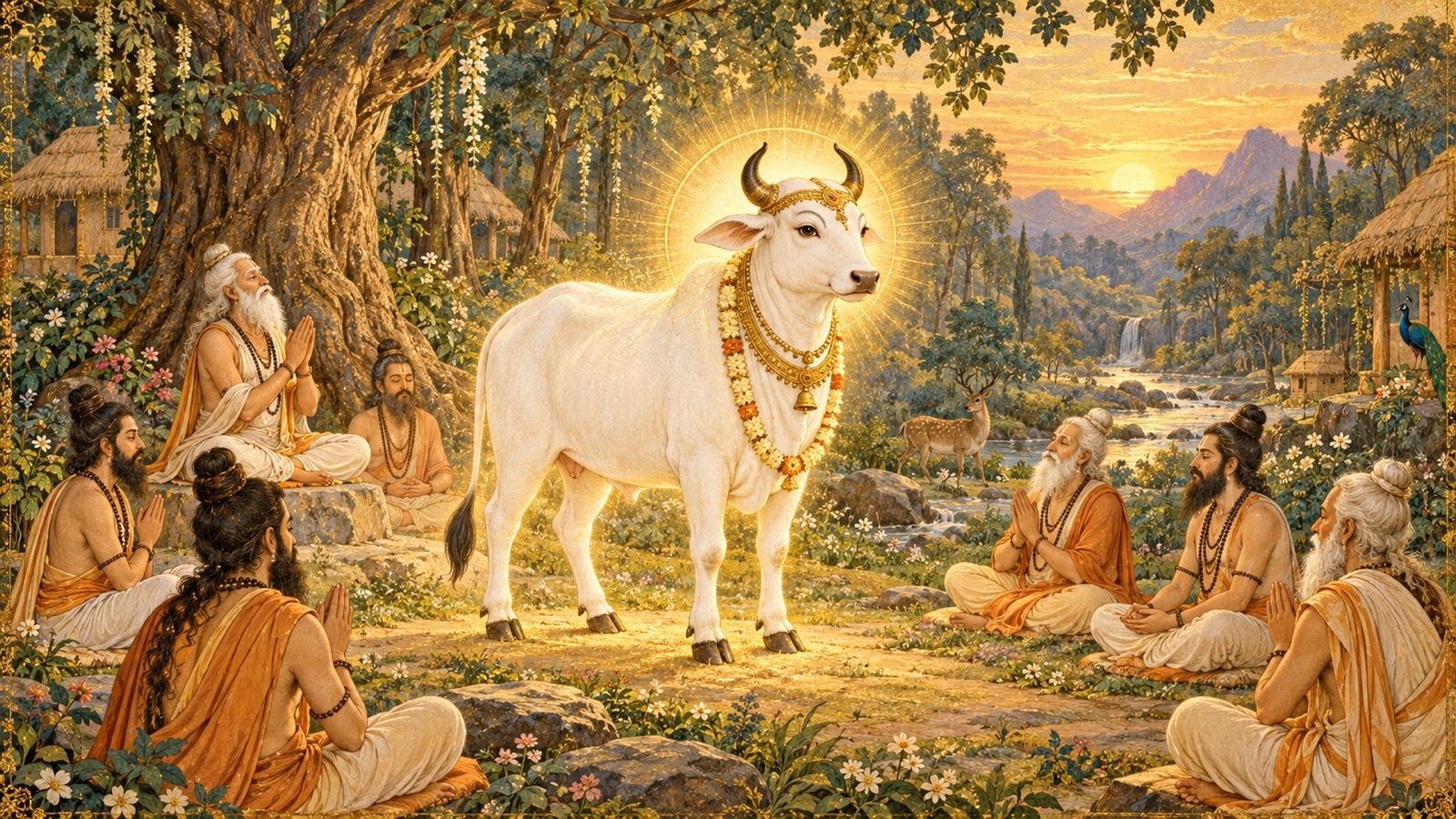
In the first Satya Yuga, humanity was of a single order called Hamsa, for people, by birth into that age, already had life’s purpose fulfilled — hence it is called Krita Yuga, the age of accomplishment.
आदौ कृतयुगे वर्णो नृणां हंस इति स्मृत: । कृतकृत्या: प्रजा जात्या तस्मात् कृतयुगं विदु: ॥ १० ॥
ādau kṛta-yuge varṇo nṛṇāṁ haṁsa iti smṛtaḥ kṛta-kṛtyāḥ prajā jātyā tasmāt kṛta-yugaṁ viduḥ
Meaning: In the very first Satya Yuga, mankind was known by a single order called Hamsa; the people, by their very birth, had already accomplished life’s purpose — hence that age is remembered as Krita Yuga. (Canto 11, Chapter 17, verse 10)
In that beginning the Veda was only the mystic syllable OM, and the Lord Himself was dharma, appearing as a four-footed bull; those gentle, austere souls worshipped none but Him, the immaculate Hamsa. At the opening of Treta Yuga, the threefold Veda — Rik, Sama and Yajus — arose from His own heart, and from it appeared sacrifice itself.
Born of the Cosmic Person
From Brahma, who sprang from the cosmic Person, arose the four Varnas — Brahmana, Kshatriya, Vaishya and Shudra — from the mouth, arms, thighs and feet, each known by its own nature and conduct.
विप्रक्षत्रियविट्शूद्रा मुखबाहूरुपादजा: । वैराजात् पुरुषाज्जाता य आत्माचारलक्षणा: ॥ १३ ॥
vipra-kṣatriya-viṭ-śūdrā mukha-bāhūru-pāda-jāḥ vairājāt puruṣāj jātā ya ātmācāra-lakṣaṇāḥ
Meaning: The Brahmanas, Kshatriyas, Vaishyas and Shudras were born from the mouth, arms, thighs and feet of the cosmic Person, each known by its own inborn nature and conduct. (Canto 11, Chapter 17, verses 13–15)
So too the four Asramas arose from His form — householder from His hips, celibate student from His heart, forest-dweller from His chest, renunciate from His crown. Each order’s nature reflected its origin — yet, as He was about to reveal, this is no ladder of worth, for beneath these natures lies one dharma shared by all.
One Dharma for Every Varna
A calm, tamed mind, austerity, purity and contentment, a truthful heart given to the Lord — such is a Brahmana’s nature.
शमो दमस्तप: शौचं सन्तोष: क्षान्तिरार्जवम् । मद्भक्तिश्च दया सत्यं ब्रह्मप्रकृतयस्त्विमा: ॥ १६ ॥
śamo damas tapaḥ śaucaṁ santoṣaḥ kṣāntir ārjavam mad-bhaktiś ca dayā satyaṁ brahma-prakṛtayas tv imāḥ
Meaning: Control of mind and senses, austerity, purity, contentment, forbearance, straightforwardness, devotion to Me, compassion and truthfulness — these are a Brahmana’s inborn qualities. (Canto 11, Chapter 17, verse 16)
Majesty and valour mark the Kshatriya; faith and liberality, the Vaishya; guileless service to the Brahmanas, cow and gods, the Shudra. Those outside this order show the opposite. Yet one dharma binds every Varna without exception:
अहिंसा सत्यमस्तेयमकामक्रोधलोभता । भूतप्रियहितेहा च धर्मोऽयं सार्ववर्णिक: ॥ २१ ॥
ahiṁsā satyam asteyam akāma-krodha-lobhatā bhūta-priya-hitehā ca dharmo ’yaṁ sārva-varṇikaḥ
Meaning: Non-violence, truthfulness, abstaining from theft, freedom from lust, anger and greed, and seeking what is kind to all beings — this is the one sacred duty shared by every Varna alike. (Canto 11, Chapter 17, verse 21)
With this closing verse the Lord’s intention becomes plain: the differing natures described are not a hierarchy but a variety of service, and beneath each one the same gentle, truthful heart is asked of every soul.
The Brahmachari’s Years in the Guru’s House
After the sacred-thread ceremony, the student dwelt in his preceptor’s house, senses controlled, reciting and reflecting on the Vedas. He wore the girdle of Munja grass, Rudraksha beads and the sacred thread, kept silence while bathing or at the fire oblation, and observed strict celibacy, worshipping the fire, sun, Acharya, cow and Brahmanas each morning and evening.
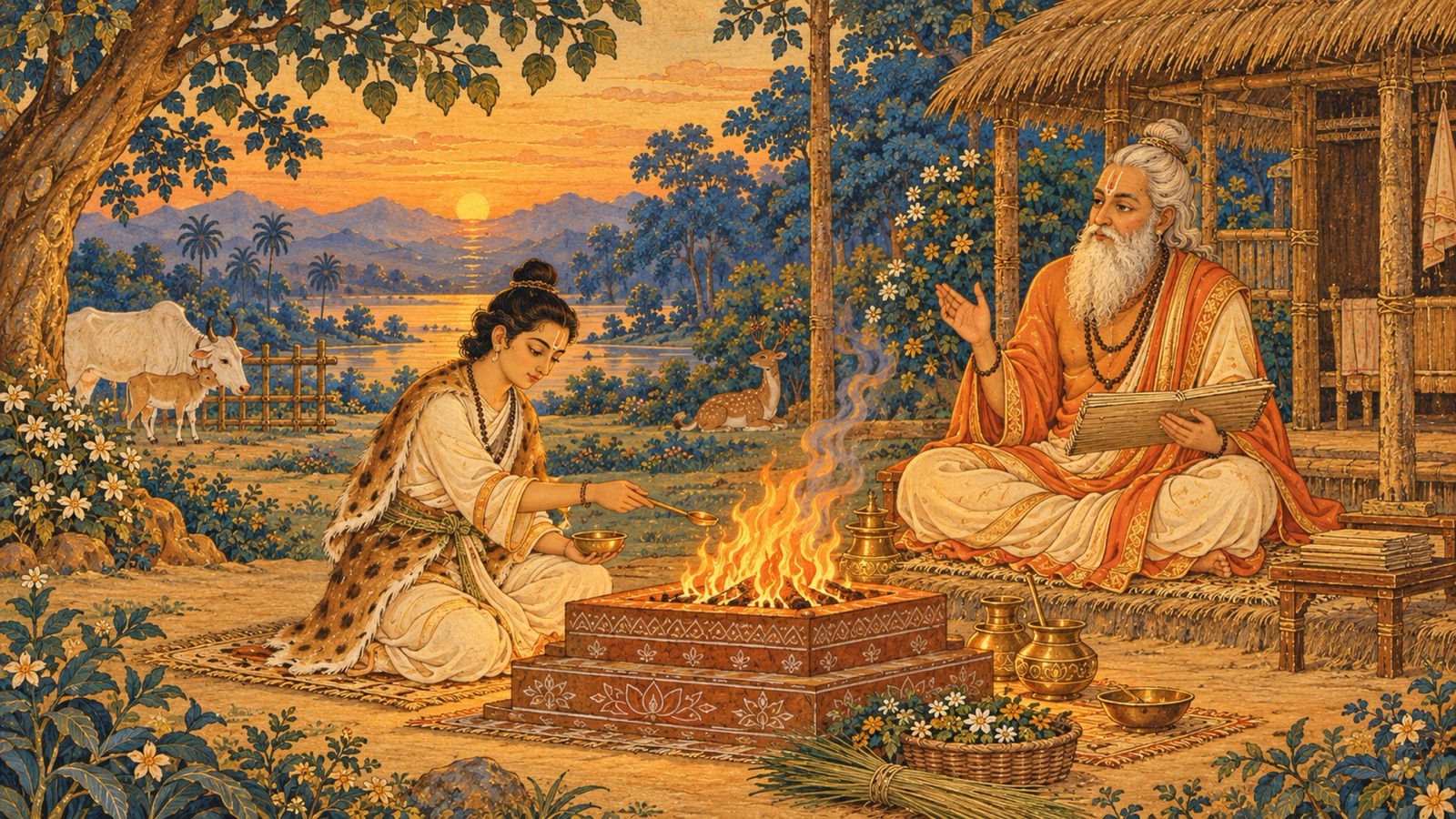
Above all, the disciple should know his Acharya to be none other than the Lord Himself, and never disrespect him as an ordinary mortal, for the guru carries within him the presence of all the gods.
आचार्यं मां विजानीयान्नावमन्येत कर्हिचित् । न मर्त्यबुद्ध्यासूयेत सर्वदेवमयो गुरु: ॥ २७ ॥
ācāryaṁ māṁ vijānīyān navamanyeta karhicit na martya-buddhyāsūyeta sarva-deva-mayo guruḥ
Meaning: The disciple should know the Acharya to be Myself, and never disrespect him as a mere mortal — for the guru is the embodiment of all the gods. (Canto 11, Chapter 17, verse 27)
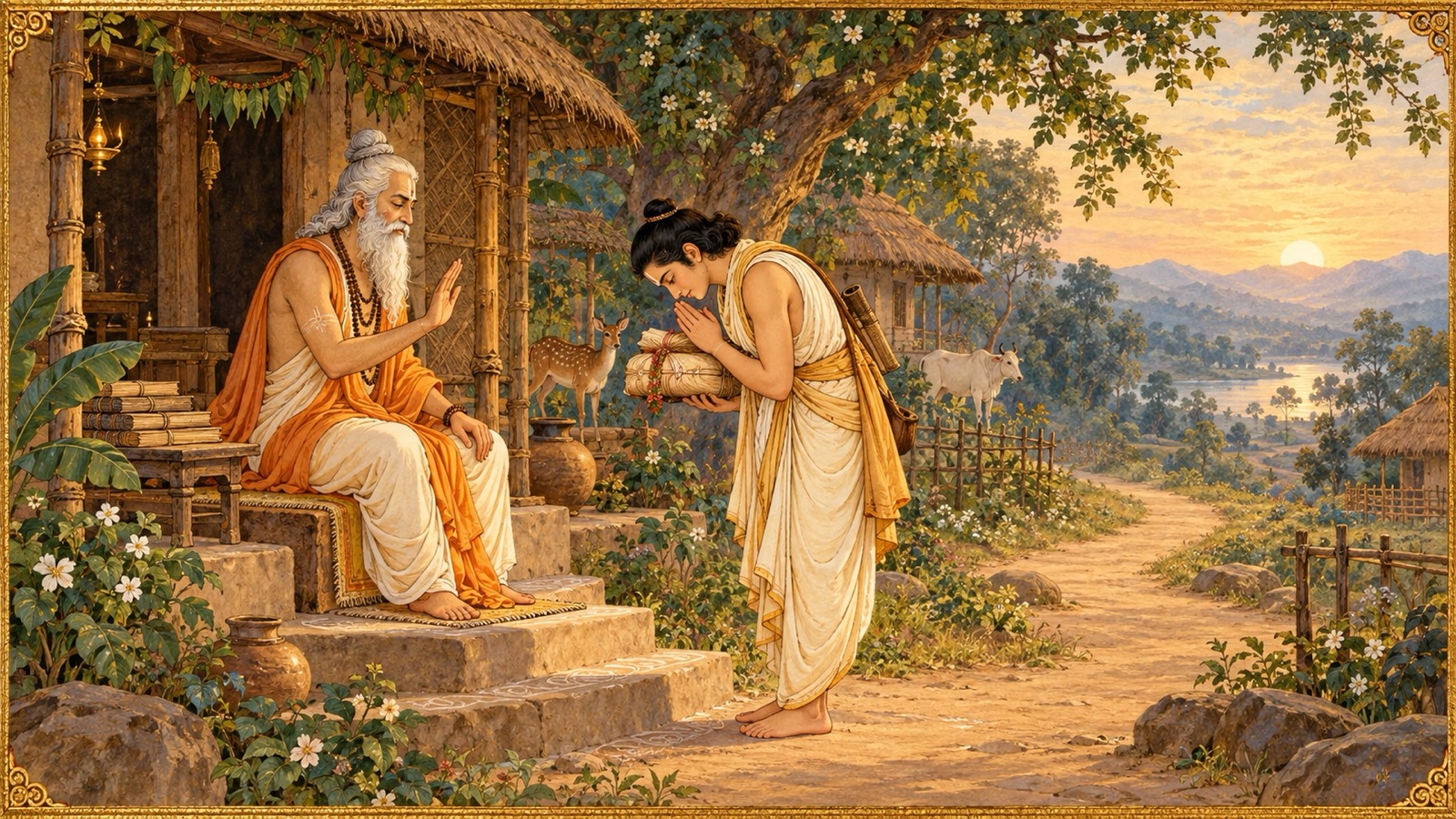
Bringing alms morning and evening, he offered all he received to his preceptor, and served him with joined palms like the humblest of servants until his learning was complete.
Seeing the One Lord Everywhere
A student wishing, after this life, to reach the realm of Brahma was to surrender his body to his preceptor for further study, holding fast his vow of celibacy. Resplendent with sacred learning and free of sin, such a Brahmachari saw no difference anywhere, worshipping the Supreme equally in fire, guru, self and every being.
अग्नौ गुरावात्मनि च सर्वभूतेषु मां परम् । अपृथग्धीरुपासीत ब्रह्मवर्चस्व्यकल्मष: ॥ ३२ ॥
agnau gurāv ātmani ca sarva-bhūteṣu māṁ param apṛthag-dhīr upasīta brahma-varcasvy akalmaṣaḥ
Meaning: Resplendent with sacred learning and free from sin, let the Brahmachari worship Me, the Supreme, without any sense of difference — in fire, in guru, in his own self, and in every being. (Canto 11, Chapter 17, verse 32)
Those who were not householders turned away from the sight of women; this rule of purity, prayer and seeing the Lord in every being belonged to all three of the first Asramas alike. A Brahmachari who mastered the Vedas through tapas became resplendent like fire, attaining the Lord as His devotee.
Entering a Householder’s Life
When a student had grasped the Vedas’ purport, he offered Dakshina to his preceptor and underwent the Samavartana rite, the bath marking his return home. From there he might enter household life, retire to the forest, or go forth as a renunciate — passing through the Asramas in order, never returning to a lower one. Should he marry, he was to take a wife of his own Varna, blameless and younger than himself.
The Brahmana’s Vocation, and the Lord’s Promise
Sacrifice, study and gift-giving are duties of every twice-born soul; but accepting gifts, teaching the Vedas and officiating as priest belong to the Brahmana alone. Since gifts erode his austerity, he does better to live by the other two, or even glean grain left in the fields — this body being given not for enjoyment but for seeking truth. Content with little, his soul given to the Lord, he attains peace. To this the Lord added His tender promise:
समुद्धरन्ति ये विप्रं सीदन्तं मत्परायणम् । तानुद्धरिष्ये नचिरादापद्भ्यो नौरिवार्णवात् ॥ ४४ ॥
samuddharanti ye vipraṁ sīdantaṁ mat-parāyaṇam tān uddhariṣye na cirād āpadbhyo naur ivārṇavāt
Meaning: Those who lift up a distressed Brahmana devoted to Me — them I shall swiftly deliver from calamity, as a boat rescues the drowning from the sea. (Canto 11, Chapter 17, verse 44)
Duty in Times of Adversity
A wise king should deliver his people from calamity, like a father. A Brahmana in hardship may turn to trade or even the sword — never to serving one of lower station; a Kshatriya may live by trade or hunting; a Vaishya may take a Shudra’s calling, a Shudra an artisan’s craft — yet once past, none should cling to a lesser calling.
The Householder’s Daily Worship
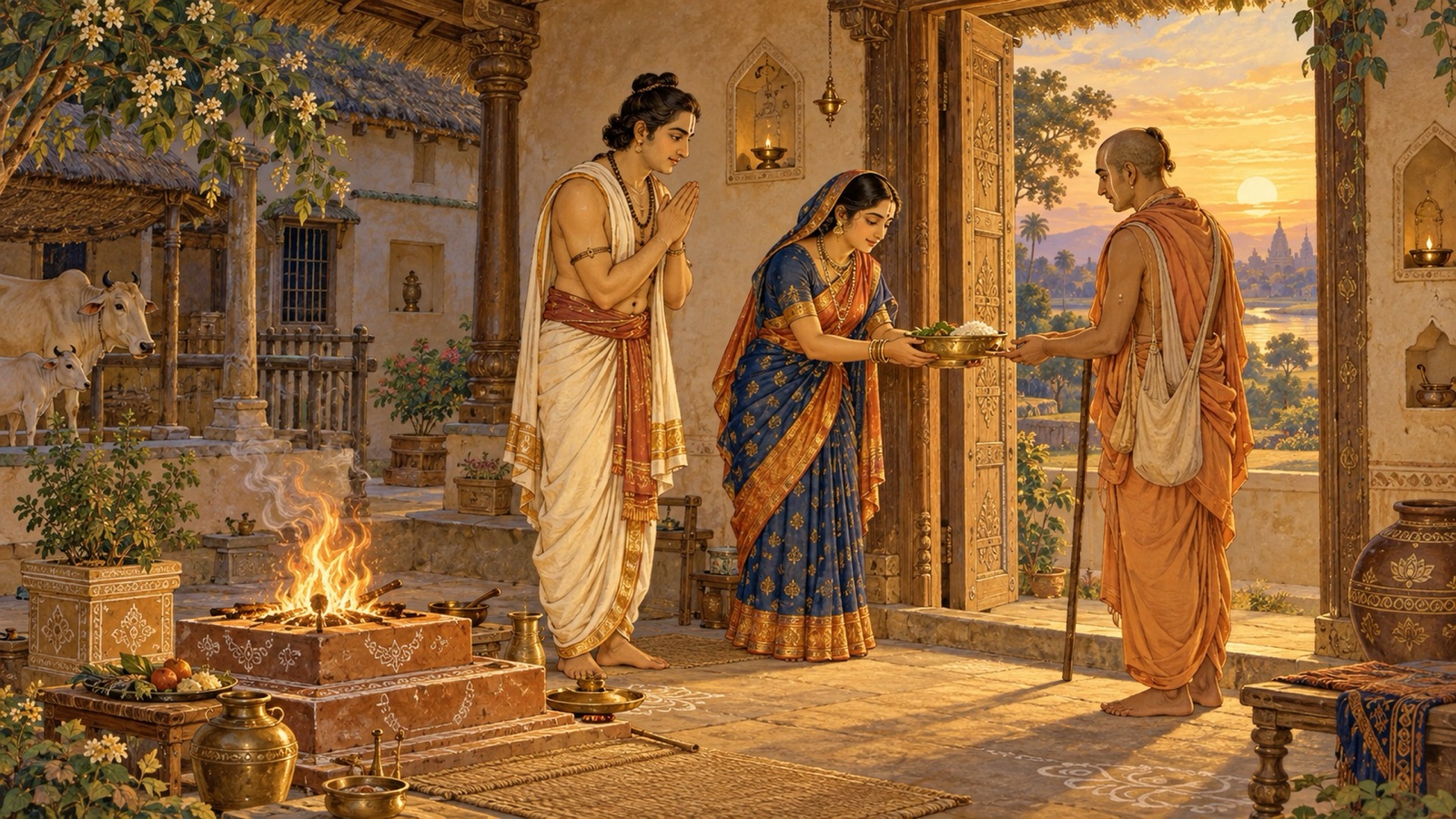
A householder should daily, within his means, worship the gods, sages, ancestors and all beings as forms of the Lord Himself — through fire oblations, Vedic recitation, Sraddha and Tarpana for the departed, offerings to humble creatures, and hospitality to guests — with wealth honestly earned, never at the cost of hardship to his dependents.
The Peril of Attachment, the Freedom of the Unattached
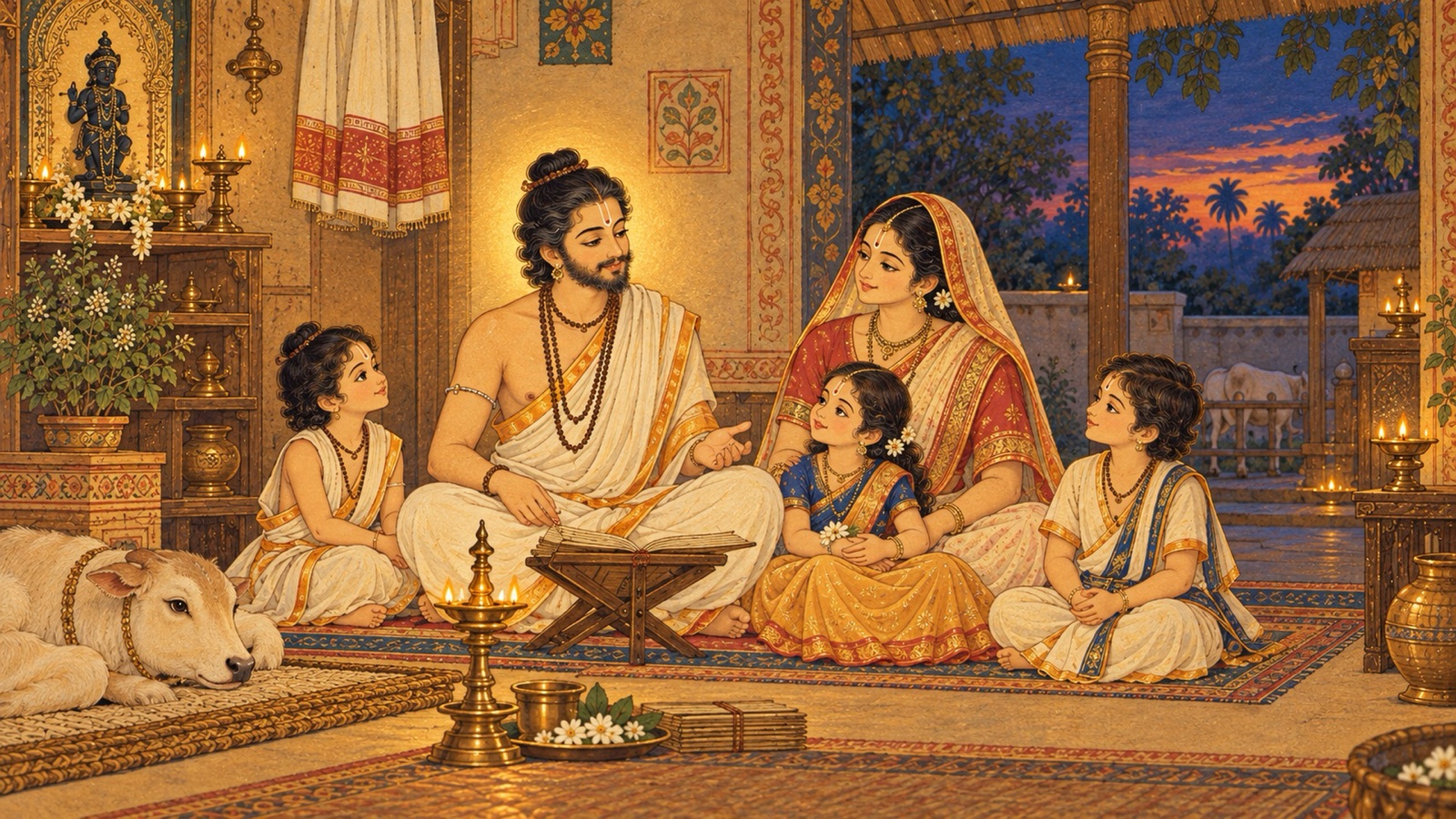
Even a householder should never become entangled in his family. The coming together of sons, wife and kin, the Lord said, is no more than travellers meeting at a wayside inn — with every change of body they part like figures of a dream. Living at home as though merely a guest, free of “I” and “mine,” he remains inwardly free, and may continue as a householder, withdraw to the forest, or, with a son, go forth as a renunciate.
But the one whose mind clings to house and wealth, ruled by his wife and clouded by “I” and “mine,” becomes bound indeed, his thoughts running on: “Alas, my aged parents, my wife and young children — left without me, how will they live?”
एवं गृहाशयाक्षिप्तहृदयो मूढधीरयम् । अतृप्तस्ताननुध्यायन् मृतोऽन्धं विशते तम: ॥ ५८ ॥
evaṁ gṛhāśayākṣipta- hṛdayo mūḍha-dhīr ayam atṛptas tān anudhyāyan mṛto ’ndhaṁ viśate tamaḥ
Meaning: Thus, his heart seized by attachment to his household, this bewildered man, still unsated, dies brooding upon his family, and descends into blinding darkness. (Canto 11, Chapter 17, verse 58)
Principal Teachings of This Chapter
1. Devotion ripens through one’s own duty. The dharma of the four Varnas and Asramas is the means by which devotion is engendered (verses 1–2, 9–10).
2. Every Varna and Asrama is born of the Divine Person. Society’s orders and life’s stages arise from the Lord’s cosmic form, each a sacred part of one whole, not a ladder of worth (verses 13–15).
3. Each nature is God-given, yet one duty unites all. The Lord names each Varna’s virtues, then declares non-violence, truth and kindness equally asked of every soul (verses 16–21).
4. Honour the guru as the Lord Himself. Serving one’s teacher without disrespect is, in truth, worshipping the Lord within him (verse 27).
5. See the one Lord everywhere. Worshipping Him equally in fire, teacher, self and every being marks readiness for the Supreme (verse 32).
6. The Lord swiftly protects those who protect His devotee. Whoever lifts up a distressed soul devoted to Him is promised deliverance in turn (verse 44).
7. Clinging to “I” and “mine” is the one true bondage. One who treats family as lasting is bound; one who lives among them as a grateful guest, offered to the Lord, remains free even at home (verse 58).
A Devotional Reflection
What moves the heart here is not the variety of duties but the tenderness beneath them. The Lord hands down no ladder for souls to climb over one another; He hands down one duty of gentleness and truth, asking only that each soul walk toward it from wherever it stands — a fire-altar, a throne, or the humble service of one who owns little. Even the brahmachari’s long austerity is an exercise in seeing rightly: that his guru and every creature he meets are the one Lord in many forms. And when the Lord turns to the householder anxious over his family, He does not despise that love; He only asks that it be held as a cherished guest — warmly, never clutched.
A Daily Devotional Practice
Today, take up whatever duty already belongs to you — your work, or your care of family or elders — and before beginning, pause and offer it silently to the Lord. If you have a teacher or elder, practise seeing them, even briefly, as the Lord’s own representative. At day’s end, look upon your loved ones as a traveller looks at dear companions met along the road — precious, yet not yours to possess — while softly repeating: “Om Namo Bhagavate Vasudevaya.”
Conclusion
This seventeenth discourse answers Uddhava’s plea that the sacred path of duty never vanish from the earth. Sri Krishna traces it to its source — the single Hamsa order of the first Golden Age, and the four Varnas and Asramas born of His own cosmic form, each with its own nature yet bound by one duty of nonviolence, truth and kindness. He describes the brahmachari’s years with a guru seen as the Lord Himself, the householder’s daily worship and duty to raise a family without being swallowed by it, and His promise to lift up whoever lifts up a distressed devotee. The chapter closes with a gentle warning: the heart clinging to house and kin walks toward darkness, while the heart holding that family as a beloved guest, offered to the Lord, walks toward freedom. Every Varna and Asrama, rightly lived, is a path the Lord has opened back to His own feet.
May the divine wisdom of Srimad Bhagavatam awaken pure devotion within our hearts.
Om Namo Bhagavate Vasudevaya.
Jay Shree Madhav.
References and Attribution
- Primary edition: Gita Press, Śrīmad Bhāgavata Mahāpurāṇa (English, complete), Book Eleven, Discourse 17, pages 589–594.
- Series: Srimad Bhagavatam Wisdom · Biswa Sanatan Dharma Seva Trust.
- Presented following the spiritual guidance and recommendation of Pandit Dr. Shri Kashinath Mishra.
This is an original, faithful retelling in the writer’s own words, with brief quoted verses shown in Devanāgarī and transliteration and their meanings given as summaries. It is not a reproduction of any single publisher’s continuous translation or commentary. No affiliation with or endorsement by any publisher is implied.
Jay Shree Madhav