
Continuing His parting instruction to Uddhava, Lord Sri Krishna unfolds the sacred path that lies beyond the household — the forest-dweller’s austerities, the wandering mendicant’s staff and water-pot, and the single truth that crowns every stage of life: whatever duty is offered to the Lord in loving devotion becomes the sure road home.
Om Namo Bhagavate Vasudevaya.
Om Namo Bhagavate Vasudevaya.
Om Namo Bhagavate Vasudevaya.
Welcome to Srimad Bhagavatam Wisdom, a devotional journey through the sacred histories and teachings of the Srimad Bhagavat Mahapurana. Continuing His final counsel to Uddhava, the glorious Lord now describes the life beyond the household: matted hair and bark garments in the forest, and then the single staff and water-pot of the homeless wanderer. He teaches that silence, non-violence and a steady breath — not the staff one carries — truly mark a sannyasi, and that the wise see the very same Self shining in every creature, bearing praise and blame alike. For every stage of life, down to the householder’s simple chastity and kindness, He names the one thread binding them all — devotion offered to Him alone.
Chapter Information
- Scripture: Śrīmad Bhāgavata Mahāpurāṇa
- Canto: 11 (Book Eleven)
- Chapter: 18 (Discourse 18)
- Chapter title: Description of Varnasrama-dharma
- Principal speaker: Sri Krishna, instructing Uddhava; the whole related by Sukadeva Gosvami to King Parikshit
- Principal listener: Uddhava; and King Parikshit
- Main setting: Dwaraka, in the Lord’s final dialogue with Uddhava
- Central subject: The duties of the forest-dweller (vanaprastha) and the renunciate (sannyasi), the true marks of a sannyasi, and the sacred duties of the householder-devotee, all crowned by devotion to the Lord
- Principal verse range: Canto 11, Chapter 18, verses 1–48
- Primary edition: Gita Press Śrīmad Bhāgavata Mahāpurāṇa
Context from the Previous Chapter
In the previous discourse, the Lord described duties proper to each class and calling, and how a householder should daily honour the gods, the sages, the ancestors and all beings as His own manifestations. He closed with a telling contrast: the householder who lives unattached, knowing wife and children as fellow travellers met at a wayside inn, walks free; but the one bound by craving for wealth and offspring sinks at death into blinding darkness. Having set before Uddhava the choice of remaining a devoted householder, retiring to the forest, or renouncing the world, the Lord now unfolds each path in turn.
Entering the Forest — The Vanaprastha’s Austerities
The glorious Lord began again, turning first to the life of the forest-dweller.
श्रीभगवानुवाच वनं विविक्षु: पुत्रेषु भार्यां न्यस्य सहैव वा । वन एव वसेच्छान्तस्तृतीयं भागमायुष: ॥ १ ॥
śrī-bhagavān uvāca vanaṁ vivikṣuḥ putreṣu bhāryāṁ nyasya sahaiva vā vana eva vasec chāntas tṛtīyaṁ bhāgam āyuṣaḥ
Meaning: The glorious Lord began again: A householder eager to retire into the forest should, with his senses fully mastered, entrust his wife to the care of his sons — or take her with him — and spend the third portion of his life dwelling there alone. (Canto 11, Chapter 18, verse 1)
His food should be only wild bulbs, roots and fruits fit for the sacred fire, his covering only bark, grass or deerskin; he should let his hair and beard grow untended, bathe three times daily in the manner of a hermit, and sleep upon the bare earth.
ग्रीष्मे तप्येत पञ्चाग्नीन् वर्षास्वासारषाड्जले । आकण्ठमग्न: शिशिर एवंवृत्तस्तपश्चरेत् ॥ ४ ॥
grīṣme tapyeta pañcāgnīn varṣāsv āsāra-ṣāḍ jale ākaṇtha-magnaḥ śiśira evaṁ vṛttas tapaś caret
Meaning: In the heat of summer he should sit surrounded by five fires; through the rains he should stand exposed to the falling showers; and in the coldest months of winter he should remain immersed in water up to the neck — living thus, he should practise his austerities. (Canto 11, Chapter 18, verse 4)

He eats only what fire has cooked or time has ripened, gathering each day’s own food rather than relying on stores. Even here he keeps the sacred fire-rites of each season — but never, the Lord was firm, by the sacrifice of an animal. Such tapas, carried to its end, leads the hermit through Maharloka to the Lord’s own presence; none, He added, could be more foolish than to spend so precious a discipline chasing some small, passing wish.
From the Forest to the Staff of Renunciation
When old age makes such austerity impossible, the forest-dweller may gather the sacred fires he has tended back into himself and, mind fixed on the Lord, enter the very fire — an ancient, deliberate rite of consecration, not despair. But if a genuine distaste instead arises even for the heavenly worlds won by pious deeds, he may step forth at once as a homeless wanderer, having worshipped the Lord by the prescribed rites and surrendered all he owns to the priests who served him. Even the gods, the Lord added, fearing lest such a soul outstrip them to the Supreme, sometimes raise obstacles through a wife or kinsman — obstacles the determined seeker must never let turn him back.
बिभृयाच्चेन्मुनिर्वास: कौपीनाच्छादनं परम् । त्यक्तं न दण्डपात्राभ्यामन्यत् किञ्चिदनापदि ॥ १५ ॥
bibhṛyāc cen munir vāsaḥ kaupīnācchādanaṁ param tyaktaṁ na daṇḍa-pātrābhyām anyat kiñcid anāpadi
Meaning: If the sannyasi keeps any covering at all, let it be no more than a single cloth to cover his loins; apart from his staff and water-pot, he should hold on to nothing else he has renounced, save in times of real necessity. (Canto 11, Chapter 18, verse 15)

The True Marks of a Sannyasi
The sannyasi takes each step only after scanning the ground, lest he harm some unseen creature; drinks only water strained through cloth; speaks only what truth can bear out; and acts only as his purified conscience allows.
मौनानीहानिलायामा दण्डा वाग्देहचेतसाम् । न ह्येते यस्य सन्त्यङ्ग वेणुभिर्न भवेद् यति: ॥ १७ ॥
maunānīhānilāyāmā daṇḍā vāg-deha-cetasām na hy ete yasya santy aṅga veṇubhir na bhaved yatiḥ
Meaning: Silence is the rod that governs speech, freedom from self-seeking action the rod that governs the body, and control of the breath the rod that governs the mind; one who does not hold these three rods is no true sannyasi for carrying a staff of bamboo alone. (Canto 11, Chapter 18, verse 17)
His outward rule is simple: he begs only from worthy Brahmanas at no more than seven houses, content with whatever is given; before eating, he sets aside a share for the Lord and for all beings, then eats in silence what remains. Alone and unattached, he wanders the earth delighting in the Self, meditating on it as not different from the Lord Himself.
अन्वीक्षेतात्मनो बन्धं मोक्षं च ज्ञाननिष्ठया । बन्ध इन्द्रियविक्षेपो मोक्ष एषां च संयम: ॥ २२ ॥
anvīkṣetātmano bandhaṁ mokṣaṁ ca jñāna-niṣṭhayā bandha indriya-vikṣepo mokṣa eṣāṁ ca saṁyamaḥ
Meaning: Through steadfast inquiry he should examine the true nature of the soul’s bondage and liberation: bondage is nothing but the senses scattered outward, and liberation is simply their full mastery. (Canto 11, Chapter 18, verse 22)
For this reason he masters the six senses — the five outer senses with the restless mind — and roams the sacred earth, its rivers, mountains and hermitages, begging often at the retreats of fellow ascetics, for food so gathered purifies the mind swiftly and carries the seeker soon to life’s true goal.
Equanimity and the One Self in All Beings
He should never mistake this passing world for something real, since all that is seen must one day perish; such a soul rests settled in his own real nature, beyond the outward rule of any single order, bearing harsh words with patience and holding no one in contempt, never making an enemy of any being for the body’s sake (verses 26-31).
एक एव परो ह्यात्मा भूतेष्वात्मन्यवस्थित: । यथेन्दुरुदपात्रेषु भूतान्येकात्मकानि च ॥ ३२ ॥
eka eva paro hy ātmā bhūteṣv ātmany avasthitaḥ yathendur uda-pātreṣu bhūtāny ekātmakāni ca
Meaning: The one supreme Self dwells alike within every creature and within one’s own self, just as the single moon appears reflected in many vessels of water; and all beings, in their essence, are of that one and the same Self. (Canto 11, Chapter 18, verse 32)
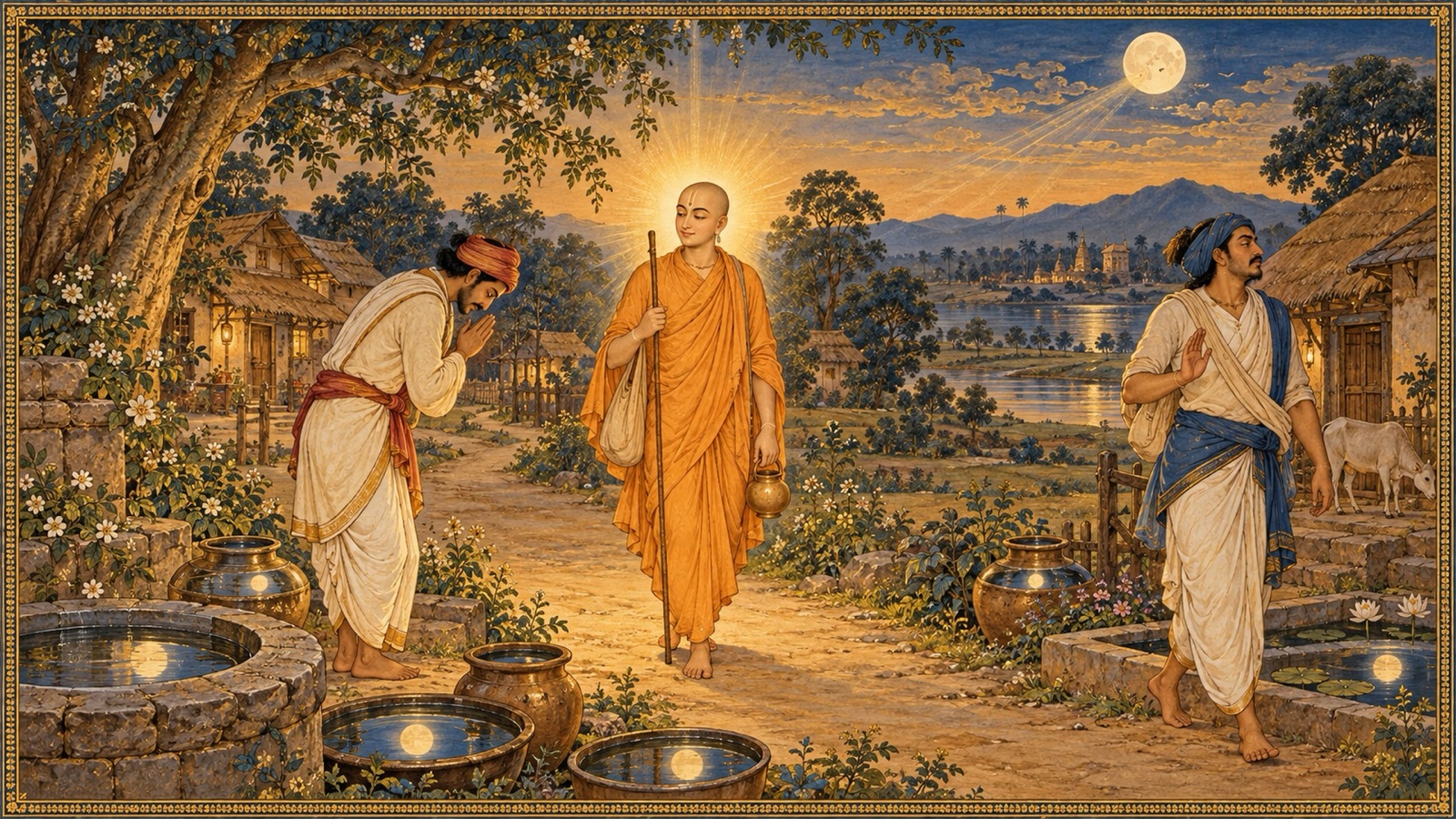
Steadfast in this vision, he neither grieves when alms fail nor rejoices when they come in plenty, knowing both lie in the Lord’s hands; what still lingers of former habit continues only by the pull of past deeds, until death at last unites him, fully and forever, with the Lord.
The Guru, and a Word of Caution
One who has grown weary of sense-pleasure, yet has not been instructed in the duties that lead to the Lord, should humbly seek a teacher absorbed in contemplation of Him, serving with faith until the Supreme is known. But the Lord was equally plain about renunciation’s counterfeit: one who carries the sannyasi’s staff while his senses remain unmastered deceives the gods he has ceased to worship, deceives himself, and deceives the Lord within his own heart — such a one, He warned, forfeits both this world and the next.
The Fourfold Dharma and the Householder-Devotee
Gathering every thread of His teaching, the Lord set the duties of all four stages of life side by side.
भिक्षोर्धर्म: शमोऽहिंसा तप ईक्षा वनौकस: । गृहिणो भूतरक्षेज्या द्विजस्याचार्यसेवनम् ॥ ४२ ॥
bhikṣor dharmaḥ śamo ‘hiṁsā tapa īkṣā vanaukasaḥ gṛhiṇo bhūta-rakṣejyā dvijasyācārya-sevanam
Meaning: The sacred duty of the renunciate mendicant is peace of mind and harmlessness; of the forest-dweller, austerity and inquiry into truth; of the householder, protection of all creatures and the performance of sacrifice; and of the celibate student, service to his teacher. (Canto 11, Chapter 18, verse 42)
And lest the householder imagine devotion lies beyond his reach, the Lord turned at once to describe that duty in full.
ब्रह्मचर्यं तप: शौचं सन्तोषो भूतसौहृदम् । गृहस्थस्याप्यृतौ गन्तु: सर्वेषां मदुपासनम् ॥ ४३ ॥
brahmacaryaṁ tapaḥ śaucaṁ santoṣo bhūta-sauhṛdam gṛhasthasyāpy ṛtau gantuḥ sarveṣāṁ mad-upāsanam
Meaning: Chastity, austerity, purity, contentment and goodwill toward all beings are the sacred duty even of the householder who approaches his wife only in her season; and worship of Me alone is the duty common to every one of these stages of life. (Canto 11, Chapter 18, verse 43)
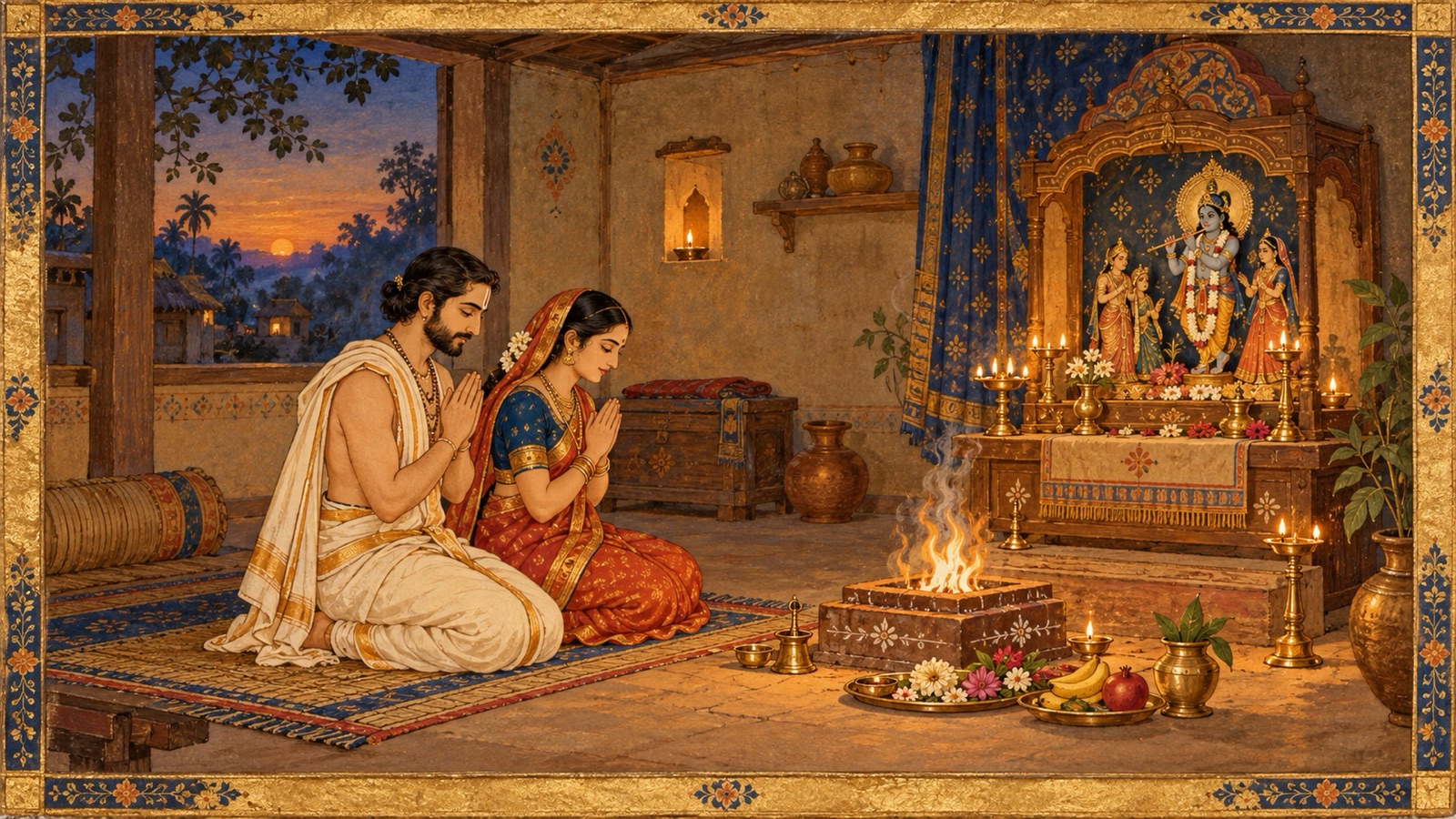
Whoever worships the Lord in this way, through the very duty proper to his own place in life, seeking nothing beyond His pleasure, comes in time to see every living being as none other than the Lord Himself — and so attains a devotion that nothing can shake.
Devotion — the Crown of Every Dharma
भक्त्योद्धवानपायिन्या सर्वलोकमहेश्वरम् । सर्वोत्पत्त्यप्ययं ब्रह्म कारणं मोपयाति स: ॥ ४५ ॥
bhaktyoddhavānapāyinyā sarva-loka-maheśvaram sarvotpatty-apyayaṁ brahma kāraṇaṁ mopayāti saḥ
Meaning: Through unfailing devotion, O Uddhava, such a soul attains to Me — the supreme Lord of all the worlds, the Absolute, the very cause from which all beings arise and into which they dissolve. (Canto 11, Chapter 18, verse 45)
A heart so purified by such faithful living soon carries within it both the knowledge that hears of His glory and the realization that tastes it directly, and comes to Him without delay.
वर्णाश्रमवतां धर्म एष आचारलक्षण: । स एव मद्भक्तियुतो नि:श्रेयसकर: पर: ॥ ४७ ॥
varṇāśramavatāṁ dharma eṣa ācāra-lakṣaṇaḥ sa eva mad-bhakti-yuto niḥśreyasa-karaḥ paraḥ
Meaning: This, marked by its rules of conduct, is the sacred duty proper to each class and stage of life; yet that very same duty, when joined with devotion to Me, becomes the supreme means of the highest good. (Canto 11, Chapter 18, verse 47)
Here the Lord reveals why He has walked Uddhava through every stage of life rather than naming one alone as supreme. The rules of varna and ashrama — what to eat, whom to serve, how to beg or how to worship — are, by themselves, only a code of conduct: useful, even necessary, but able at most to order a life well. Devotion offered within those very duties is what transforms them into something more: the one sure means to the highest good. A sannyasi’s staff, a householder’s hearth-fire, a student’s service at his teacher’s feet — none of these saves on its own strength; offered to the Lord in love, each becomes the very same path home. This is the hidden unity beneath the chapter’s variety of rule and discipline. With this, the Lord told Uddhava, He had answered exactly what Uddhava had come to ask.
Principal Teachings of This Chapter
1. Three doors, one destination. Whether a soul dwells as a forest-ascetic, takes up the staff of a sannyasi, or remains a householder, each is a doorway the Lord Himself has opened — not a hierarchy of worth, but paths suited to different hearts (verses 1-15).
2. The staff does not make the sannyasi. Silence, freedom from self-seeking action and mastery of the breath are the true marks of renunciation; without them, the outward symbols of the order are empty (verse 17).
3. Bondage and liberation both live in the senses. To scatter the senses outward is bondage; to gather and govern them is liberation — the very same faculties, turned two different ways (verse 22).
4. One Self shines in every being. As the single moon is reflected in many vessels of water, the same Self dwells in every creature; realizing this, the wise bear praise and blame alike and make an enemy of no one (verses 31-32).
5. The unready should serve a guru in humility. One not yet instructed in the duties that lead to the Lord should take shelter of a teacher absorbed in Him, serving with faith until the Supreme is known (verses 38-39).
6. A warning against mere appearance. One who wears the sannyasi’s staff without mastering his senses deceives the gods, himself and the Lord within his own heart, and loses both this world and the next (verses 40-41).
7. Devotion is the crown of every dharma. The very same rules of conduct that belong to one’s class and stage of life become, when offered to the Lord in love, the supreme means to the highest good — the one truth beneath every path this chapter describes (verse 47).
A Devotional Reflection
There is something deeply tender in watching the Lord walk Uddhava through this chapter’s many doors, rather than pointing to just one. He does not ask every soul to flee to the forest, nor tell every householder that devotion lies beyond reach until circumstances change. He simply shows what each stage of life asks of the heart, and folds every one of them — the forest-dweller’s fire, the wanderer’s begging bowl, the householder’s evening worship — into the same current of love flowing toward Him. We are not asked to become someone we are not; only to offer what we already are, wherever we stand, to the Lord who dwells equally in every heart. Nothing in the chapter is more moving than the moon reflected in many vessels — one light, countless bowls of water, no vessel closer to the moon than any other. To see that same light in the one who praises us and the one who abuses us is to begin living this teaching.
A Daily Devotional Practice
Today, choose one ordinary duty that belongs to your own place in life — care for family, an hour of study, any small service you would normally perform without a second thought — and offer it consciously to the Lord before you begin. If harsh words come your way, practise the patience described here: neither disturbed nor disturbing in return, remembering the one Self reflected equally in the one who speaks them. Close the day by softly repeating the Lord’s holy name, “Om Namo Bhagavate Vasudevaya,” letting even this simplest of acts become devotion offered through duty.
Conclusion
The eighteenth discourse of Book Eleven carries Uddhava through the full sweep of life’s sacred stages — the forest-dweller’s quiet austerities, and the sannyasi’s deeper renunciation, marked not by the staff he carries but by silence, non-violence and a mastered breath. Bondage and liberation, the Lord teaches, are both questions of where the senses are turned, and the one Self shines equally in every creature, so the wise meet praise and blame with the very same even temper. For the soul not yet ready, He recommends humble service at a guru’s feet, and for the one who wears renunciation’s robe without its inward discipline, a clear warning. He then turns to the householder’s own simple duties — chastity, purity, contentment, kindness — declaring the very same worship asked of every stage of life alike. The chapter’s deepest word is this: dharma becomes the supreme means to the highest good only when offered to the Lord in loving devotion.
May the divine wisdom of Srimad Bhagavatam awaken pure devotion within our hearts.
Om Namo Bhagavate Vasudevaya.
Jay Shree Madhav.
References and Attribution
- Primary edition: Gita Press, Śrīmad Bhāgavata Mahāpurāṇa (English, complete), Book Eleven, Discourse 18, pages 595–600.
- Series: Srimad Bhagavatam Wisdom · Biswa Sanatan Dharma Seva Trust.
- Presented following the spiritual guidance and recommendation of Pandit Dr. Shri Kashinath Mishra.
This is an original, faithful retelling in the writer’s own words, with brief quoted verses shown in Devanāgarī and transliteration and their meanings given as summaries. It is not a reproduction of any single publisher’s continuous translation or commentary. No affiliation with or endorsement by any publisher is implied.
Jay Shree Madhav