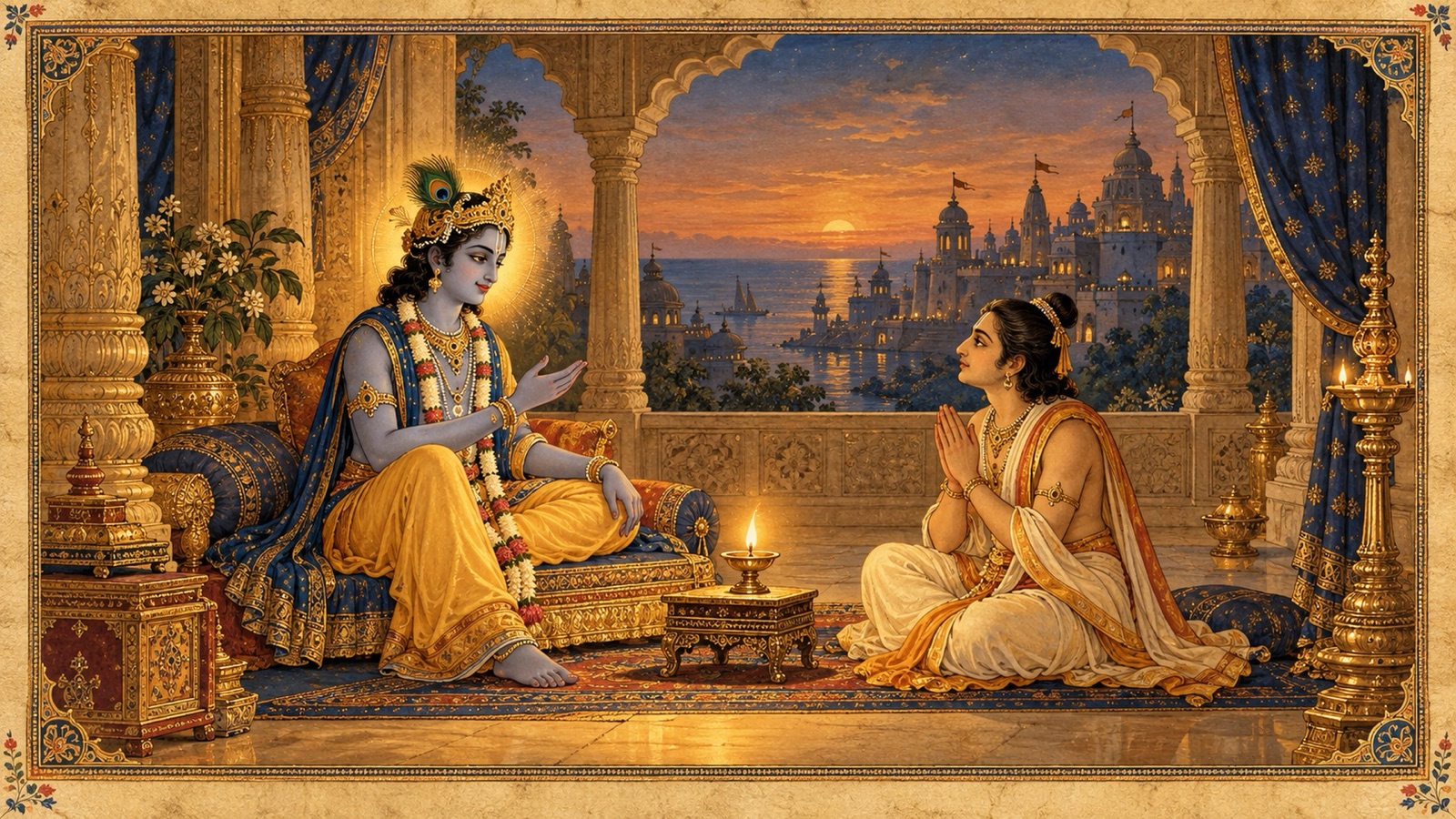
Lord Sri Krishna resumes His teaching to Uddhava, declaring that the ray of knowledge joined with realization and devotion outshines every other purifying endeavour, and then, remembering the ancient instruction of Bhishma to King Yudhishthira, unfolds the stepping-stones of devotion and defines, one by one, the very virtues a seeking soul longs to understand.
Om Namo Bhagavate Vasudevaya.
Om Namo Bhagavate Vasudevaya.
Om Namo Bhagavate Vasudevaya.
Welcome, dear devotee, to Srimad Bhagavatam Wisdom, a devotional journey through the sacred histories and teachings of the Srimad Bhagavat Mahapurana. Here the glorious Lord takes up, for Uddhava’s sake, the crown jewel of all spiritual endeavour: knowledge that is not dry speculation but living realization, wedded always to dispassion and to loving devotion. Uddhava, burning under the threefold misery of this world, begs the Lord for shelter; and the Lord answers by recalling a sacred memory from the end of the great war — how the dying Bhishma once taught King Yudhishthira this very path, naming the deeds that give rise to devotion, and defining, with tender precision, every virtue a sincere soul longs to understand: the Yamas and Niyamas, calmness and endurance, true wealth and true poverty, the real friend and the real home, and at last the one mark that separates virtue from fault.
Chapter Information
- Scripture: Śrīmad Bhāgavata Mahāpurāṇa
- Canto: 11 (Book Eleven)
- Chapter: 19 (Discourse 19)
- Chapter title: The Perfection of Spiritual Knowledge
- Principal speaker: Sri Krishna, instructing Uddhava; within His narration, Bhishma instructing King Yudhishthira; the whole related by Sukadeva Gosvami to King Parikshit
- Principal listener: Uddhava; within the narration, King Yudhishthira; and King Parikshit
- Main setting: Dwaraka, in the Lord’s dialogue with Uddhava; within the narration, the field near Kurukshetra where the dying Bhishma instructed Yudhishthira after the great war
- Central subject: Knowledge joined with dispassion, realization and devotion; the stepping-stones that give rise to bhakti-yoga; and the Lord’s precise definitions of the Yamas, Niyamas and the many virtues Uddhava asks about
- Principal verse range: Canto 11, Chapter 19, verses 1–45
- Primary edition: Gita Press Śrīmad Bhāgavata Mahāpurāṇa
Context from the Previous Chapter
In the eighteenth discourse, the Lord described the duties proper to each order of life — the student, the householder, the forest-dweller and the renunciant — and showed how a soul grown weary of the sorrow that follows every sense-pleasure should seek a teacher absorbed in contemplation. He taught that disinterested performance of one’s own duty, offered to Him alone, purifies the heart and at last opens the eyes to His own divine nature. Having shown how righteous action ripens into devotion, the Lord now turns to unveil the very perfection of that knowledge.
The Lamp of Knowledge That Leads to the Self
The glorious Lord resumed His teaching. He declared that a soul equipped with learning that culminates in direct realization — one who has truly known the Self and no longer leans on mere inference — should recognize this whole world of differences as only a phantom appearing within Him, and should finally offer up even this knowledge at His feet.
श्रीभगवानुवाच यो विद्याश्रुतसम्पन्न: आत्मवान् नानुमानिक: । मायामात्रमिदं ज्ञात्वा ज्ञानं च मयि सन्न्यसेत् ॥ १ ॥
śrī-bhagavān uvāca yo vidyā-śruta-sampannaḥ ātmavān nānumānikaḥ māyā-mātram idaṁ jñātvā jñānaṁ ca mayi sannyaset
Meaning: The glorious Lord said: one equipped with learning that culminates in direct realization, who has known the Self and no longer rests on inference, should know this world of differences to be a mere phantom appearing in Me — and should at last surrender even that knowledge unto Me. (Canto 11, Chapter 19, verse 1)
To such a knower, the Lord said, He Himself is the only beloved object, the goal and the very means of reaching it; no austerity, pilgrimage, muttered prayer or act of charity brings about the perfection that a single ray of true knowledge accomplishes. Sages of old worshipped Him, their inmost Controller, within their own hearts, and so attained Him as the highest perfection. And the threefold play of body, senses and mind that seems to rest upon the soul, He said, is only an illusion resting between a beginning and an end it never truly touches — the Self, like the rope beneath an imagined snake, remains forever unchanged by birth, growth, decay and death.
Uddhava’s Cry from the Ocean of Fear
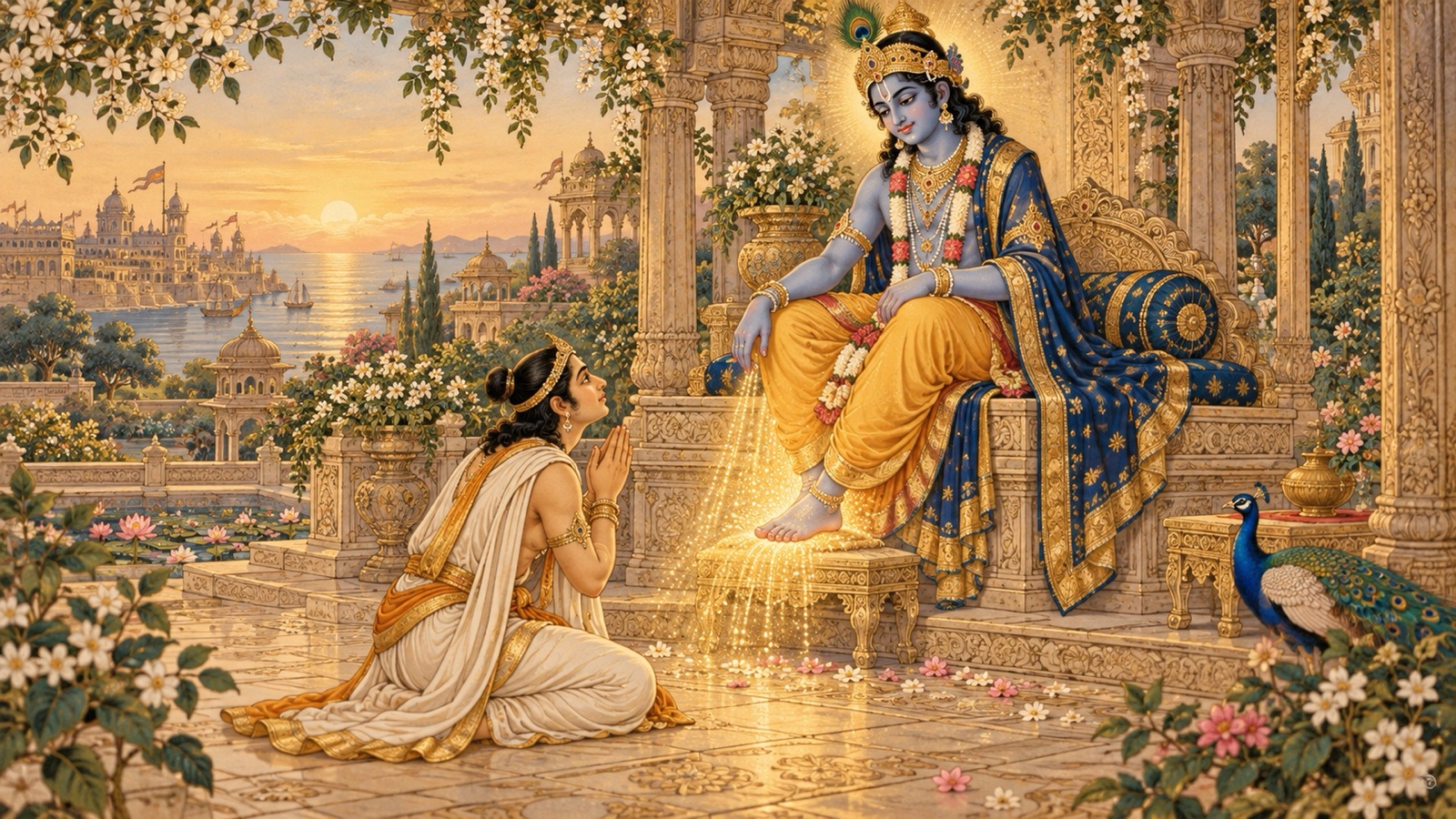
Deeply moved, Uddhava begged the Lord of the universe to expound, in full and in His own true nature, this purifying and most ancient wisdom — knowledge joined with dispassion and direct realization, and the path of devotion sought even by Brahma and the great ones. Tormented on every side by the threefold misery and burning in the fearful road of birth and rebirth, he said he could see no shelter anywhere except beneath the Lord’s own feet, which rain nectar like a cooling umbrella upon all who take refuge there. This soul, he pleaded, has fallen into the deep pit of worldly existence, bitten by the serpent of Time and yet thirsting fiercely for the merest trifles of sense-pleasure; let the Lord, of boundless glory, lift such a one up, and bathe him with words of liberating grace.
The Memory of King Yudhishthira and Bhishma
In answer, the Lord recalled how, long ago, King Yudhishthira — who bore no enmity toward any creature — once put this very question to Bhishma, the foremost among those devoted to righteousness, while all the elders listened. When the great war between the Bharatas had ended, Yudhishthira, still grieving the death of his kinsmen, asked the dying Bhishma about the course of conduct that leads to liberation. “I shall now relate to you,” the Lord told Uddhava, “those very teachings, rich with knowledge, dispassion, direct realization, faith and devotion, which I once heard from the lips of Bhishma, of heavenly vow.”
What Knowledge and Realization Truly Are
The Lord then defined His terms with care. True knowledge is that by which a soul perceives, within every created being, the subtle principles of nature, the senses and faculties, the gross elements and the three modes, and through them perceives the single reality running through them all. Direct realization goes further still: one no longer sees the many as merely pervaded by the one, but sees that one reality alone, arrived at by pondering how every modification of the three modes arises, continues and dissolves. That alone is real which stands at the beginning and end of creation and runs through every stage between. Among the means of knowledge — scriptural testimony, direct perception, tradition and inference — a discerning soul, finding no lasting ground for the endless divisions of matter, withdraws from them in quiet dispassion; and since every fruit of ritual action is subject to change, the wise look upon even the unseen worlds, up to the realm of Brahma himself, as touched by sorrow and perishable, just as this visible one is.
The Stepping-Stones That Lead to Devotion
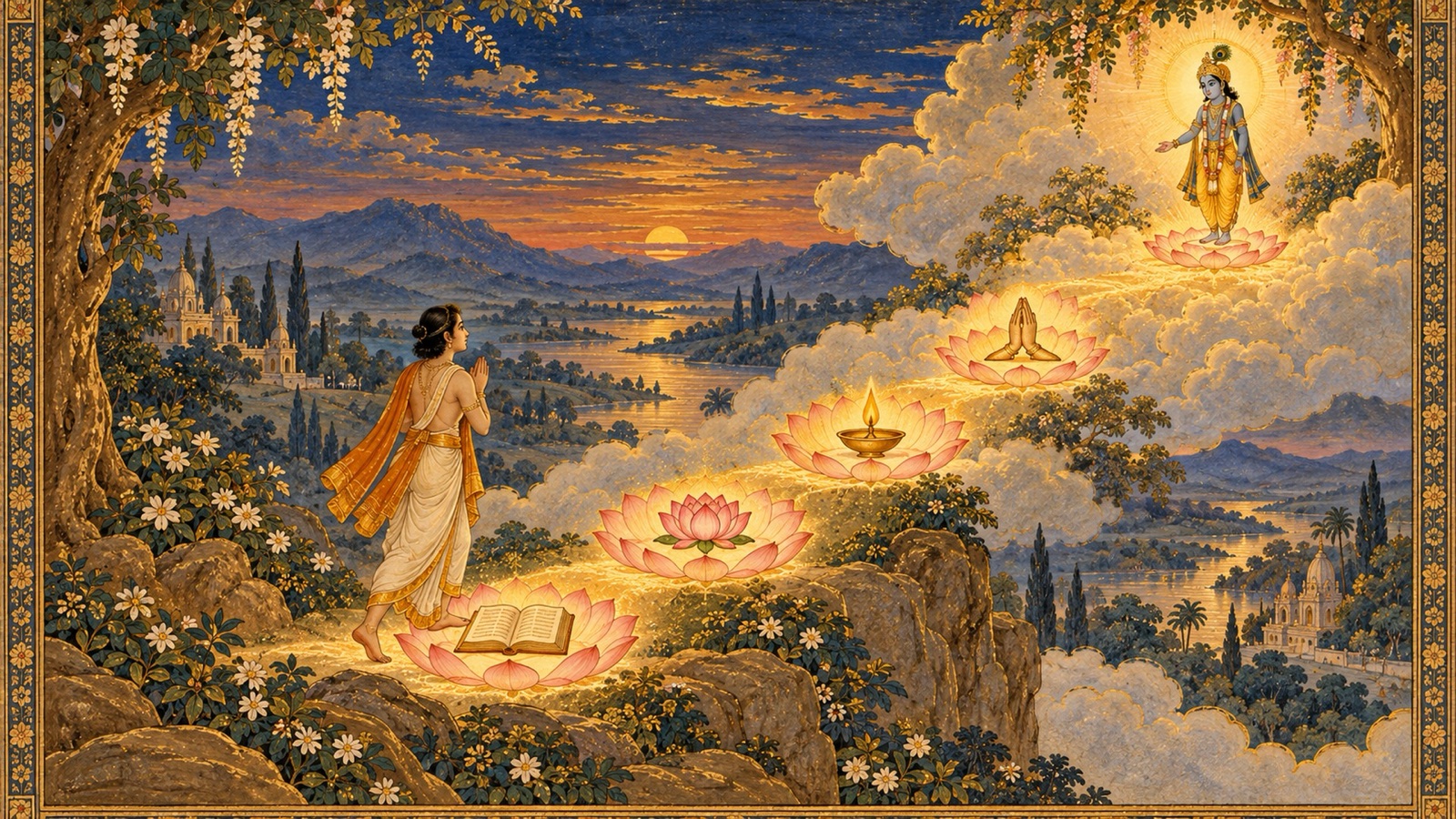
The path of devotion, the Lord said, He had already shown Uddhava once; yet because Uddhava’s heart had grown so fond of it, He would describe once more the royal road by which devotion to Him is born. What follows is among the most cherished of all passages in the Bhagavata — the very stepping-stones of bhakti-yoga.
श्रद्धामृतकथायां मे शश्वन्मदनुकीर्तनम् । परिनिष्ठा च पूजायां स्तुतिभि: स्तवनं मम ॥ २० ॥ आदर: परिचर्यायां सर्वाङ्गैरभिवन्दनम् । मद्भक्तपूजाभ्यधिका सर्वभूतेषु मन्मति: ॥ २१ ॥ मदर्थेष्वङ्गचेष्टा च वचसा मद्गुणेरणम् । मय्यर्पणं च मनस: सर्वकामविवर्जनम् ॥ २२ ॥ मदर्थेऽर्थपरित्यागो भोगस्य च सुखस्य च । इष्टं दत्तं हुतं जप्तं मदर्थं यद् व्रतं तप: ॥ २३ ॥ एवं धर्मैर्मनुष्याणामुद्धवात्मनिवेदिनाम् । मयि सञ्जायते भक्ति: कोऽन्योऽर्थोऽस्यावशिष्यते ॥ २४ ॥
śraddhāmṛta-kathāyāṁ me śaśvan mad-anukīrtanam pariniṣṭhā ca pūjāyāṁ stutibhiḥ stavanaṁ mama ādaraḥ paricaryāyāṁ sarvāṅgair abhivandanam mad-bhakta-pūjābhyadhikā sarva-bhūteṣu man-matiḥ mad-artheṣv aṅga-ceṣṭā ca vacasā mad-guṇeraṇam mayy arpaṇaṁ ca manasaḥ sarva-kāma-vivarjanam mad-arthe ’rtha-parityāgo bhogasya ca sukhasya ca iṣṭaṁ dattaṁ hutaṁ japtaṁ mad-arthaṁ yad vrataṁ tapaḥ evaṁ dharmair manuṣyāṇām uddhavātma-nivedinām mayi sañjāyate bhaktiḥ ko ’nyo ’rtho ’syāvaśiṣyate
Meaning: Steady faith in hearing My nectar-like stories, constant remembrance and chanting of My names, firm devotion in worship and singing hymns of praise, loving eagerness in rendering service, bowing before Me with all the limbs of the body, honouring My devotees even above honouring Me, beholding Me present in every living being, turning every bodily act toward My purposes, speaking only of My glories, offering the mind entirely to Me and giving up every other desire, renouncing wealth, enjoyment and comfort for My sake, and performing sacrifice, charity, fire-oblation, sacred vow and austerity only for My pleasure — by living in this way, O Uddhava, one who has offered his very self to Me finds devotion to Me arising naturally in his heart. And once that devotion has come, what else remains to be gained? (Canto 11, Chapter 19, verses 20–24)
The Mind Surrendered, the Mind Astray
When the mind, the Lord continued, is tranquil and nourished by goodness and offered up to Him, it naturally acquires righteousness, knowledge, dispassion and divine opulence; but when the same mind scatters among many objects, running after the senses and growing heavy with passion, it falls instead into the opposite — unrighteousness, ignorance, passion and the loss of divine grace. And then, with piercing clarity, the Lord redefined the very terms that every seeker takes for granted.
धर्मो मद्भक्तिकृत् प्रोक्तो ज्ञानं चैकात्म्यदर्शनम् । गुणेष्वसङ्गो वैराग्यमैश्वर्यं चाणिमादय: ॥ २७ ॥
dharmo mad-bhakti-kṛt prokto jñānaṁ caikātmya-darśanam guṇesv asaṅgo vairāgyam aiśvaryaṁ cāṇimādayaḥ
Meaning: That alone is called righteousness which gives rise to devotion unto Me; that alone is called knowledge which sees the one Self present in all; freedom from attachment to the modes of nature is dispassion; and the mystic powers, beginning with the power to become minute, are divine opulence. (Canto 11, Chapter 19, verse 27)
Here is the single key that unlocks everything the Lord is about to say in the rest of this chapter. Every lofty word a seeker has learned to revere — dharma, jnana, vairagya, aishvarya — the Lord quietly measures by one standard alone: does it lead the heart toward Him? A rite that leaves devotion untouched is not truly dharma in His eyes; a vision that does not see the one Self everywhere is not truly knowledge. When Uddhava now asks his long list of questions, the Lord will answer every one of them by this same quiet measure, so that by the end of the chapter even the most ordinary virtue is shown to be, at its root, a doorway to loving Him.
Uddhava’s Garland of Questions
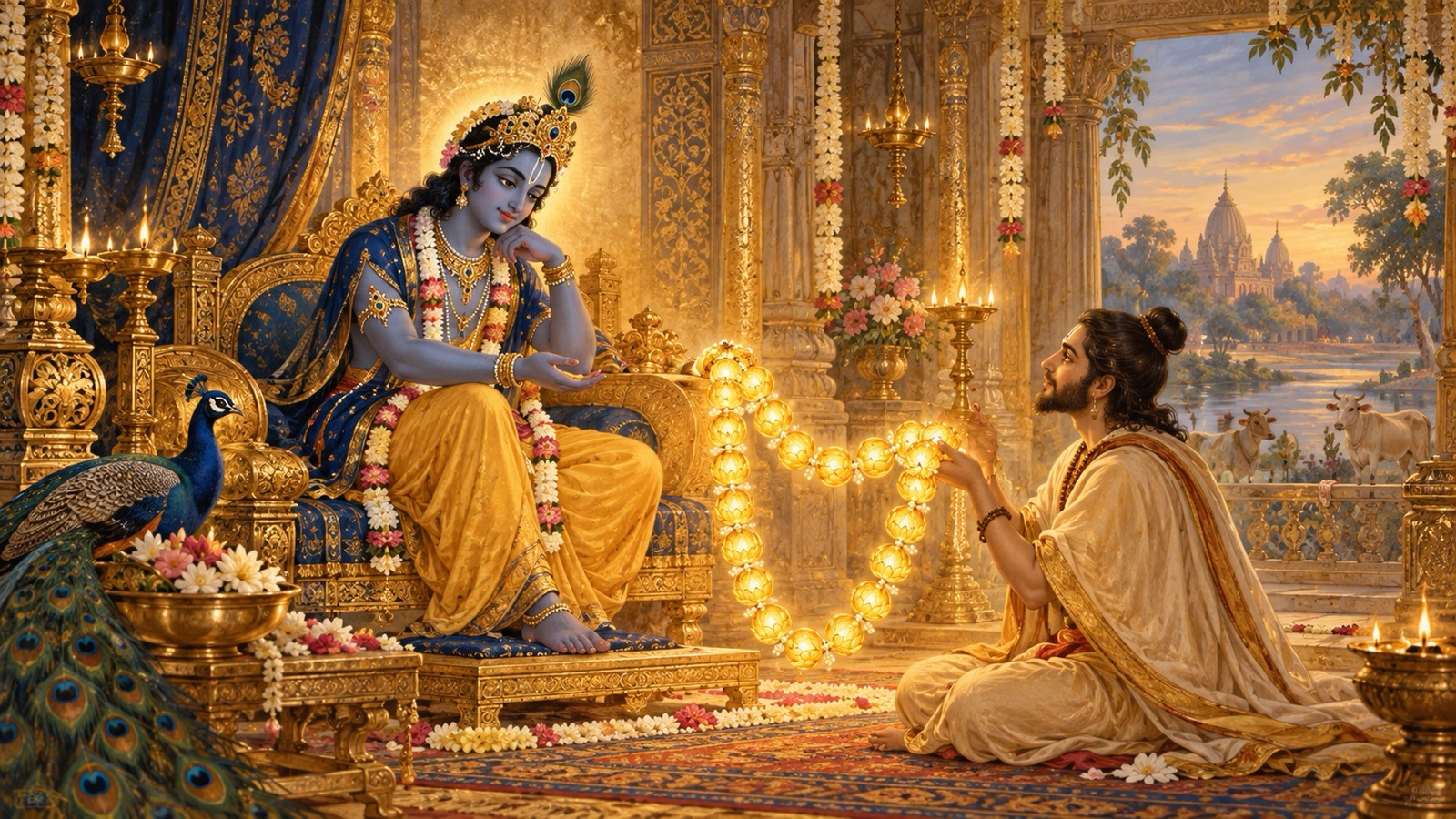
Eager to understand every shade of righteous living, Uddhava then poured out a whole garland of questions, one flowing into the next: of how many kinds are the Yamas and Niyamas? What is calmness, sense-control, forbearance and firmness? What is charity, austerity, valour, truth and uprightness? What is renunciation, true wealth, sacrifice and the priestly gift? What is a man’s real strength, his fortune, his gain and his highest learning? What is modesty, beauty, happiness and misery? Who is truly wise and who a fool, which is the right path and which the wrong, what is heaven and what is hell, who is a true friend and what is one’s real home? Who is rich, who is poor, who is pitiable, and who alone is master of himself? Kindly answer each of these, Uddhava asked, together with its opposite, O Protector of the virtuous.
The Twelve Yamas and the Twelve Niyamas
The glorious Lord answered at once, naming the first of the twenty-four disciplines Uddhava had asked about.
अहिंसा सत्यमस्तेयमसङ्गो ह्रीरसञ्चय: । आस्तिक्यं ब्रह्मचर्यं च मौनं स्थैर्यं क्षमाभयम् ॥ ३३ ॥ शौचं जपस्तपो होम: श्रद्धातिथ्यं मदर्चनम् । तीर्थाटनं परार्थेहा तुष्टिराचार्यसेवनम् ॥ ३४ ॥ एते यमा: सनियमा उभयोर्द्वादश स्मृता: । पुंसामुपासितास्तात यथाकामं दुहन्ति हि ॥ ३५ ॥
ahiṁsā satyam asteyam asaṅgo hrīr asañcayaḥ āstikyaṁ brahmacaryaṁ ca maunaṁ sthairyaṁ kṣamābhayam śaucaṁ japas tapo homaḥ śraddhātithyaṁ mad-arcanam tīrthāṭanaṁ parārthehā tuṣṭir ācārya-sevanam ete yamāḥ sa-niyamā ubhayor dvādaśa smṛtāḥ puṁsām upāsitās tāta yathā-kāmaṁ duhanti hi
Meaning: The glorious Lord said: non-violence, truthfulness, non-stealing, freedom from attachment, modesty, non-hoarding, faith in the scriptures, celibacy, silence, steadiness, forgiveness and fearlessness — these are declared to be the twelve Yamas. Bodily and mental purity, muttering sacred prayers, austerity, oblation into the sacred fire, hospitality born of faith, worship of Me, pilgrimage to holy places, working for the welfare of others, contentment and service to the preceptor — these are the twelve Niyamas. Observed with devotion, O dear one, these twenty-four surely bring about their fruit according to the sincerity with which they are practised. (Canto 11, Chapter 19, verses 33–35)
The Lord Defines Every Virtue
Having named the Yamas and Niyamas, the Lord went on, without pause, to define each remaining virtue Uddhava had asked about. Calmness is the intellect fixed on Him; sense-control is mastery of the senses; forbearance is patient endurance of sorrow with conquest over tongue and sex, and firmness is that same steadiness held fast. Laying aside punishment — forgiving one who could rightly be chastised — is the highest charity; renouncing desire is austerity; conquering one’s lower nature is valour; seeing the one Self equally in all is truthfulness. Speech both truthful and pleasing is uprightness; non-attachment to one’s own actions is purity; entering the renounced order is true renunciation. Righteousness is a man’s most prized wealth; the Lord Himself is the sacrifice; imparting true knowledge is the real priestly gift; and mastering the breath is the supreme strength, for by it alone the restless mind is tamed.
Then He answered the rest just as swiftly. His own divine state is true fortune, devotion to Him the highest gain; seeing past the apparent divisions in the one Self is learning, and shrinking from forbidden acts is modesty. Freedom from want is beauty; rising above both joy and sorrow is happiness, while craving the pleasures that promise happiness is misery; and understanding both bondage and liberation marks the truly wise, as mistaking the body for the self marks the fool. The path that leads to Him is right; whatever scatters the mind is wrong. Goodness rising is heaven, darkness thickening is hell; the true friend and teacher is the Lord Himself, and the human body is the real home. One rich in good qualities is wealthy; one never content is poor; one who has not mastered his senses is pitiable; and one whose mind no longer clings to sense-objects is master of himself — while one still attached to them is, in truth, a slave. Having answered every question, the Lord closed with the one teaching that gathers up all the rest.
एत उद्धव ते प्रश्ना: सर्वे साधु निरूपिता: । किं वर्णितेन बहुना लक्षणं गुणदोषयो: । गुणदोषदृशिर्दोषो गुणस्तूभयवर्जित: ॥ ४५ ॥
eta uddhava te praśnāḥ sarve sādhu nirūpitāḥ kiṁ varṇitena bahunā lakṣaṇaṁ guṇa-doṣayoḥ guṇa-doṣa-dṛśir doṣo guṇas tūbhaya-varjitaḥ
Meaning: These questions of yours, O Uddhava, have now all been fittingly answered; but why speak at such length? The mark of virtue and fault can be told in a single line: to keep looking for the faults and merits of others is itself the fault, while the virtue that is free of both — that sees neither merit nor demerit — is virtue indeed. (Canto 11, Chapter 19, verse 45)
Principal Teachings of This Chapter
1. Even sacred knowledge must finally be surrendered unto the Lord. The highest learning does not end in itself; it ends by being offered, with the whole self, at the Lord’s feet (verse 1).
2. The heart’s cry from the ocean of fear is answered by grace alone. No amount of austerity or ritual equals the shelter found beneath the Lord’s feet, which rain nectar on the one who takes refuge there (verses 9–10).
3. Devotion grows through plain, repeatable acts of love. Hearing His stories, chanting His names, serving Him, honouring His devotees, and offering every word and deed to Him — these ordinary practices, followed with sincerity, are themselves the stepping-stones by which devotion is born in the heart (verses 20–24).
4. True dharma is whatever kindles devotion to the Lord. This is the single theological key of the whole chapter: the Lord quietly redefines righteousness, knowledge, dispassion and even mystic power by one measure alone — whether each truly draws the soul toward loving Him. A rite that leaves the heart unmoved toward Him is not really dharma; a vision that does not see Him in all beings is not really knowledge. Every virtue Uddhava goes on to ask about is answered by this same yardstick, so that even the most ordinary quality — contentment, truthfulness, hospitality — is shown to be, at its root, a door that opens toward the Lord (verse 27).
5. The Yamas and Niyamas are a garland, not a burden. Non-violence, truthfulness, contentment, worship, service to the preceptor and the rest are not harsh restrictions but twenty-four ways of shaping a life that is already turned toward God (verses 33–35).
6. Ordinary words carry extraordinary meaning when seen through the Lord’s eyes. Strength is the breath mastered; charity is forgiveness; truth is seeing the one Self in all; the real home is this very body, given for the soul’s awakening (verses 36–39).
7. The last word on virtue is freedom from judging others. After answering every question, the Lord closes with the simplest teaching of all: to go on noticing the faults and merits of others is itself the fault; true virtue sees neither (verse 45).
A Devotional Reflection
What moves me most in this chapter is how patiently the Lord answers. Uddhava does not ask one question but an entire string of them, about strength and wealth, happiness and misery, heaven and hell, the wise man and the fool. It would have been easy for the Lord to wave such a list away as mere curiosity. Instead He takes each word in turn, as a jeweller takes up one gem after another, and sets it gently into its true place. And when He reaches the end, after naming the Yamas, the Niyamas, and every shade of virtue a human heart can name, He does not leave us with a longer list to memorize. He leaves us with one sentence: stop looking for fault in others, and you have already found what you were asking about. There is such mercy in that closing line. It tells me the Lord is not interested in how many virtues I can recite, but in whether my gaze toward others has softened. Every careful definition in this chapter finally bends toward that one small, daily choice — to see a brother or sister without judgment, and so to glimpse, a little more clearly, the one Self the Lord has been describing all along.
A Daily Devotional Practice
Today, take up the chapter’s final and gentlest teaching. Each time you notice yourself quietly cataloguing another person’s faults — or even their merits, held up for comparison — pause, and let the thought go without following it. In that small space, silently offer the moment to the Lord with His holy name: “Om Namo Bhagavate Vasudevaya.” This is the practice Sri Krishna gave Uddhava at the very close of His teaching: virtue that is free from the habit of judging is virtue indeed, and it is available to us the moment we choose to set the habit down.
Conclusion
The nineteenth discourse of Book Eleven carries Uddhava, and every reader after him, from the heights of pure knowledge down into the plainest details of daily virtue. The Lord begins by asking that even sacred learning be surrendered at His feet, and shows Uddhava the stepping-stones — hearing, chanting, serving, honouring His devotees — by which ordinary devotion grows. He recalls how Bhishma once taught this same path to Yudhishthira, then defines, with unhurried tenderness, the Yamas and Niyamas and every virtue a sincere heart could ask about: strength, wealth, happiness, friendship, heaven and hell. Through it all runs one quiet thread — that dharma itself is simply whatever draws the soul closer to Him. And He closes with the gentlest teaching of the whole Bhagavata: that virtue, in the end, is freedom from judging others. May we carry this teaching gently into our own days, offering each small act, and each moment of withheld judgment, as devotion at His feet.
May the divine wisdom of Srimad Bhagavatam awaken pure devotion within our hearts.
Om Namo Bhagavate Vasudevaya.
Jay Shree Madhav.
References and Attribution
- Primary edition: Gita Press, Śrīmad Bhāgavata Mahāpurāṇa (English, complete), Book Eleven, Discourse 19, pages 601–606.
- Series: Srimad Bhagavatam Wisdom · Biswa Sanatan Dharma Seva Trust.
- Presented following the spiritual guidance and recommendation of Pandit Dr. Shri Kashinath Mishra.
This is an original, faithful retelling in the writer’s own words, with brief quoted verses shown in Devanāgarī and transliteration and their meanings given as summaries. It is not a reproduction of any single publisher’s continuous translation or commentary. No affiliation with or endorsement by any publisher is implied.
Jay Shree Madhav