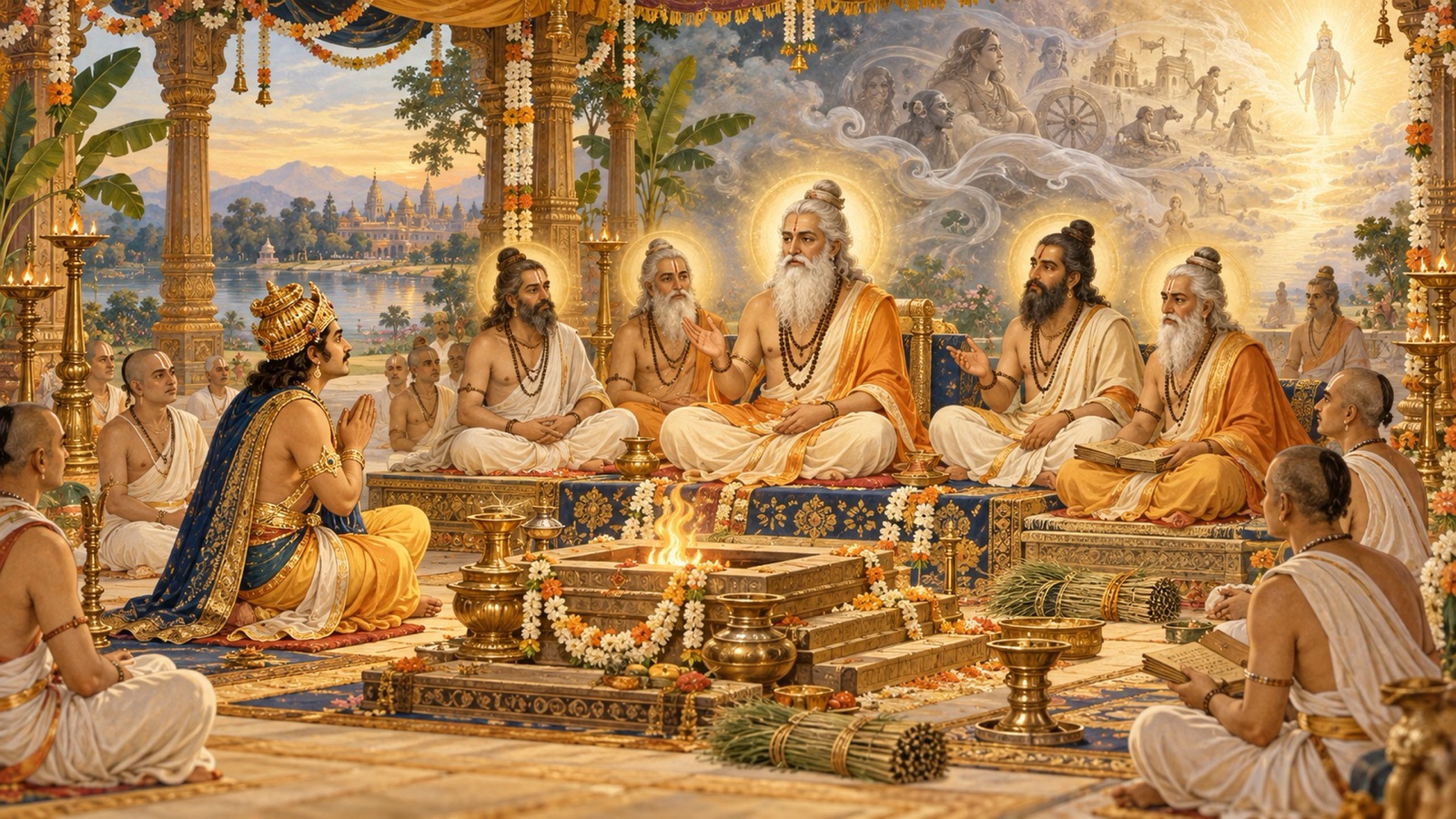
The dialogue at King Nimi’s sacrifice deepens into its greatest theme: what is the deluding energy that binds the soul to birth and death, and by what sure path may a mortal cross beyond it? Three of the nine Yogendras answer in turn, unfolding the nature of Maya, the shelter of a true teacher, the imperishable Self, and the loving worship that sets the soul free.
Om Namo Bhagavate Vasudevaya.
Om Namo Bhagavate Vasudevaya.
Om Namo Bhagavate Vasudevaya.
Welcome to Srimad Bhagavatam Wisdom, a devotional journey through the sacred histories and teachings of the Srimad Bhagavat Mahapurana. In the previous discourse the enlightened King Nimi welcomed nine perfected sages to his sacrifice, and the first two — Kavi and Havi — revealed the path of loving devotion and the marks of the Lord’s true devotee. Now the king’s questions turn toward the deepest mystery of all: the Lord’s deluding potency, Maya, which binds the embodied soul to the wheel of birth and death, and the way by which that soul may be freed. In answer, three more of the Yogendras — Antariksha, Prabuddha and Pippalayana, joined at last by Avirhotra — speak in turn, so that this third discourse becomes a complete map of bondage and release.
Chapter Information
- Scripture: Śrīmad Bhāgavata Mahāpurāṇa
- Canto: 11 (Book Eleven)
- Chapter: 3 (Discourse 3)
- Chapter title: Liberation from the Illusory Energy
- Principal speaker: The sages Antariksha, Prabuddha, Pippalayana and Avirhotra, answering in turn; the whole recalled by Narada to Vasudeva and narrated by Sukadeva Gosvami to King Parikshit
- Principal listener: King Nimi with his assembly; within the frame, Vasudeva and King Parikshit
- Main setting: The sacrificial arena of King Nimi in ancient Ajanabha (Bharatavarsha)
- Central subject: The nature of the Lord’s deluding energy (Maya), the process of creation and dissolution, the shelter of a true guru, the imperishable Self, and the path of action and worship that carries the soul beyond illusion
- Principal verse range: Canto 11, Chapter 3, verses 1–55
- Primary edition: Gita Press Śrīmad Bhāgavata Mahāpurāṇa
Context from the Previous Chapter
In Chapter 2, the divine sage Narada, visiting Vasudeva in Dwaraka, recalled an ancient meeting between King Nimi of Videha and the nine Yogendras, the perfected sons of Rishabha. The sage Kavi described bhagavata-dharma — the loving service of the Lord that frees the soul from all fear — and the sage Havi described the qualities of the Lord’s devotees. The king, delighted, continues his inquiry, and the remaining sages now take up the questions he places before them.
King Nimi Asks About Maya
King Nimi began by asking the sages to reveal the true nature of the Lord’s Maya — the deluding potency of the supreme Lord Vishnu that bewilders even those who are themselves masters of illusion. A mortal sorely afflicted by worldly sorrow, he said, he had heard their nectar-like words about Sri Hari, the very antidote to such affliction, and still felt no satiety, longing to hear them again and again (verses 1-2).
Antariksha Speaks — The Soul Caught in the Whirl
The sage Antariksha answered. Maya, he explained, is the energy by which the most ancient Person, figuring as the source of creation, evolves through the gross elements all forms of life, great and small, for the enjoyment and the ultimate liberation of the embodied souls who are His own particles. Having entered every form as its indwelling controller, the Supreme Person divides Himself as the mind and the ten senses, and through them the soul tastes the pleasures of the world (verses 3-4).
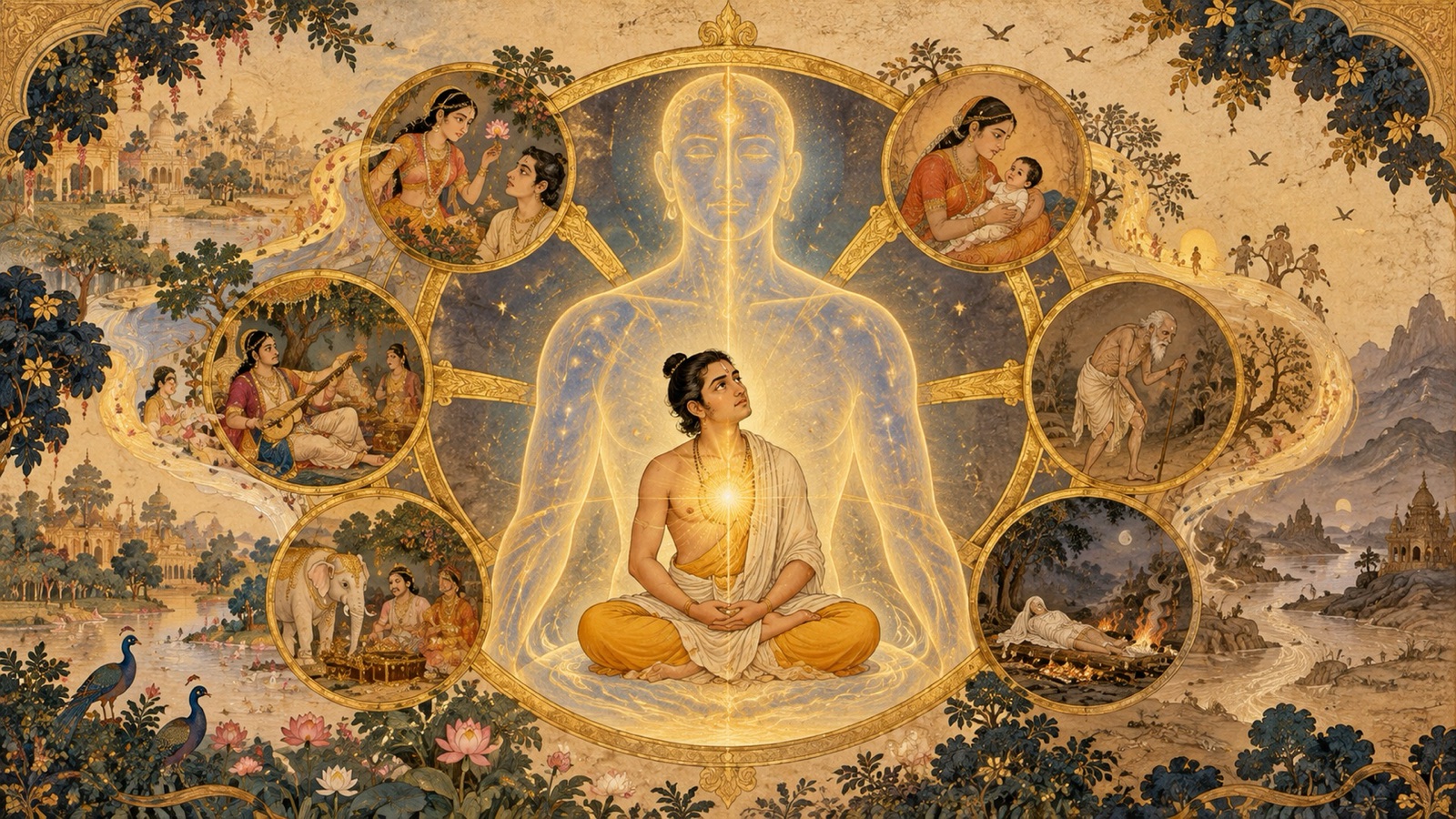
Enjoying sense pleasures through senses lit by that inner controller, Antariksha continued, the embodied soul mistakes itself for the created body and grows attached to it. Acting from selfish motives and reaping the agreeable and disagreeable fruits of countless past deeds, it revolves helplessly through birth and death, carrying many evils, until the final dissolution of the world (verses 5-7).
The Great Dissolution
Antariksha then described that dissolution. When the elements are about to be withdrawn, the beginningless Time-Spirit draws the manifest universe back toward the unmanifest primordial Matter. A terrible drought of a hundred years scorches the three worlds; a fire rising from the mouths of Sankarshana burns everything from the depths below and, driven by the wind, spreads in every direction; clouds of universal dissolution pour rains as thick as an elephant’s trunk for a hundred years, until the cosmos is submerged in water (verses 8-11).

One by one, he said, the elements are stripped of their qualities and merged into their causes — earth into water, water into fire, fire into air, air into ether, and ether into the ego, which merges into the mahat-tattva, then into primordial Nature, and finally into Brahma. Such, Antariksha concluded, is the Lord’s threefold Maya, woven of sattva, rajas and tamas, which creates, sustains and annihilates the world (verses 12-16).
Nimi Asks How to Cross Maya
King Nimi then asked the practical question at the heart of the whole discourse: how may men who look upon the gross body as their very self easily cross over this divine Maya, so hard to overcome for those who have not mastered their own minds (verse 17)?
Prabuddha Speaks — Take Shelter of a True Teacher
The sage Prabuddha replied. First, he said, one should observe how husband and wife, striving for happiness and freedom from sorrow, reap only the opposite; what lasting joy can come from wealth won by painful effort and ending in death, or from house, children, friends and cattle, all fleeting? Even the heavenly regions, gained by good deeds, are transient and troubled by rivalry, discord and fear of a fall. Seeing this, one who desires the highest good should take shelter of a true spiritual teacher.
तस्माद् गुरुं प्रपद्येत जिज्ञासुः श्रेय उत्तमम् । शाब्दे परे च निष्णातं ब्रह्मण्युपशमाश्रयम् ॥ २१ ॥
tasmād guruṁ prapadyeta jijñāsuḥ śreya uttamam śābde pare ca niṣṇātaṁ brahmaṇy upaśamāśrayam
Meaning: Therefore one who seeks the highest good should take shelter of a spiritual teacher who is well versed in the scriptures, has realized the supreme Reality, and rests in peace, free from attachment and hatred. (Canto 11, Chapter 3, verse 21)
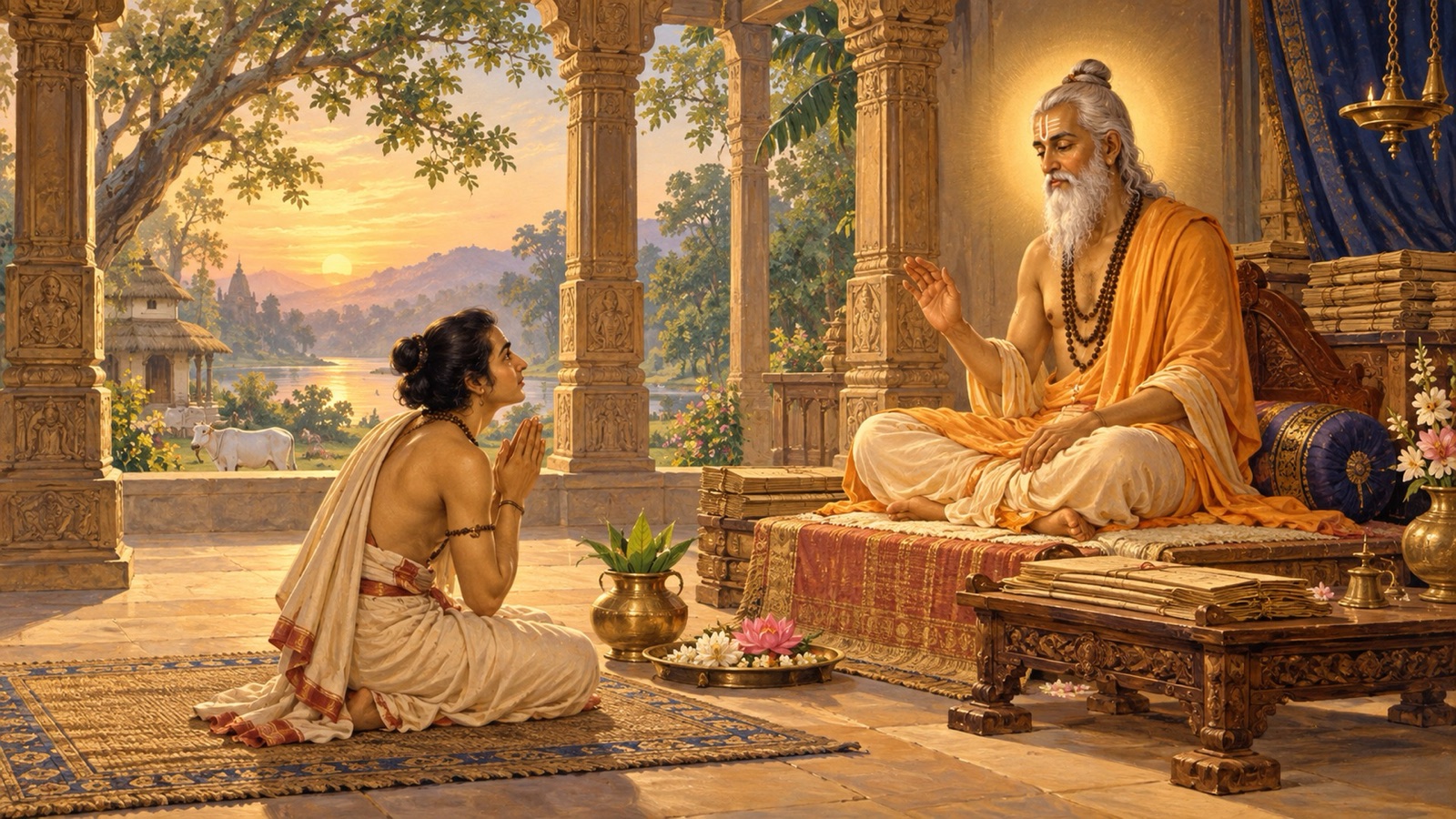
Serving such a teacher as one’s very self and beloved deity, Prabuddha said, the disciple learns the ways of life dear to the Lord’s devotees, by which Sri Hari — the Soul of all who gives Himself to His devotees — is pleased. He learns detachment from body, children and possessions and attachment to the Lord’s devotees; compassion, friendliness and humility; purity, endurance, control of speech, study of scripture, sincerity, continence, non-violence and evenness of mind under pleasure and pain. He learns to see the Self and the Ruler pervading all, to live simply and contentedly, and to devote his words and deeds to the truth (verses 18-26).
The Life of the Lord’s Devotees
Prabuddha went on to describe the sweetness of this life. The devotee learns to hear, sing and dwell upon the advent, pastimes and excellences of Sri Hari, and to do everything for His sake; to offer to the Lord his rites, gifts, austerities, righteous conduct — even wife, children, home and his very life; to love those who have realized Krishna as their own Self, and to serve all beings as the Lord’s embodiments. Remembering and reminding one another of Sri Hari, whose glory destroys countless sins, the devotees’ hearts overflow.
क्वचिद् रुदन्त्यच्युतचिन्तया क्वचि- द्धसन्ति नन्दन्ति वदन्त्यलौकिकाः । नृत्यन्ति गायन्त्यनुशीलयन्त्यजं भवन्ति तूष्णीं परमेत्य निर्वृताः ॥ ३२ ॥
kvacid rudanty acyuta-cintayā kvacid dhasanti nandanti vadanty alaukikāḥ nṛtyanti gāyanty anuśīlayanty ajaṁ bhavanti tūṣṇīṁ param etya nirvṛtāḥ
Meaning: Sometimes, thinking of the infallible Lord, they weep; sometimes they laugh, rejoice and speak to Him as though present; they dance and sing and meditate upon the birthless Lord; and sometimes, having reached the Supreme, they grow silent and serene — their conduct passing beyond all convention. (Canto 11, Chapter 3, verse 32)
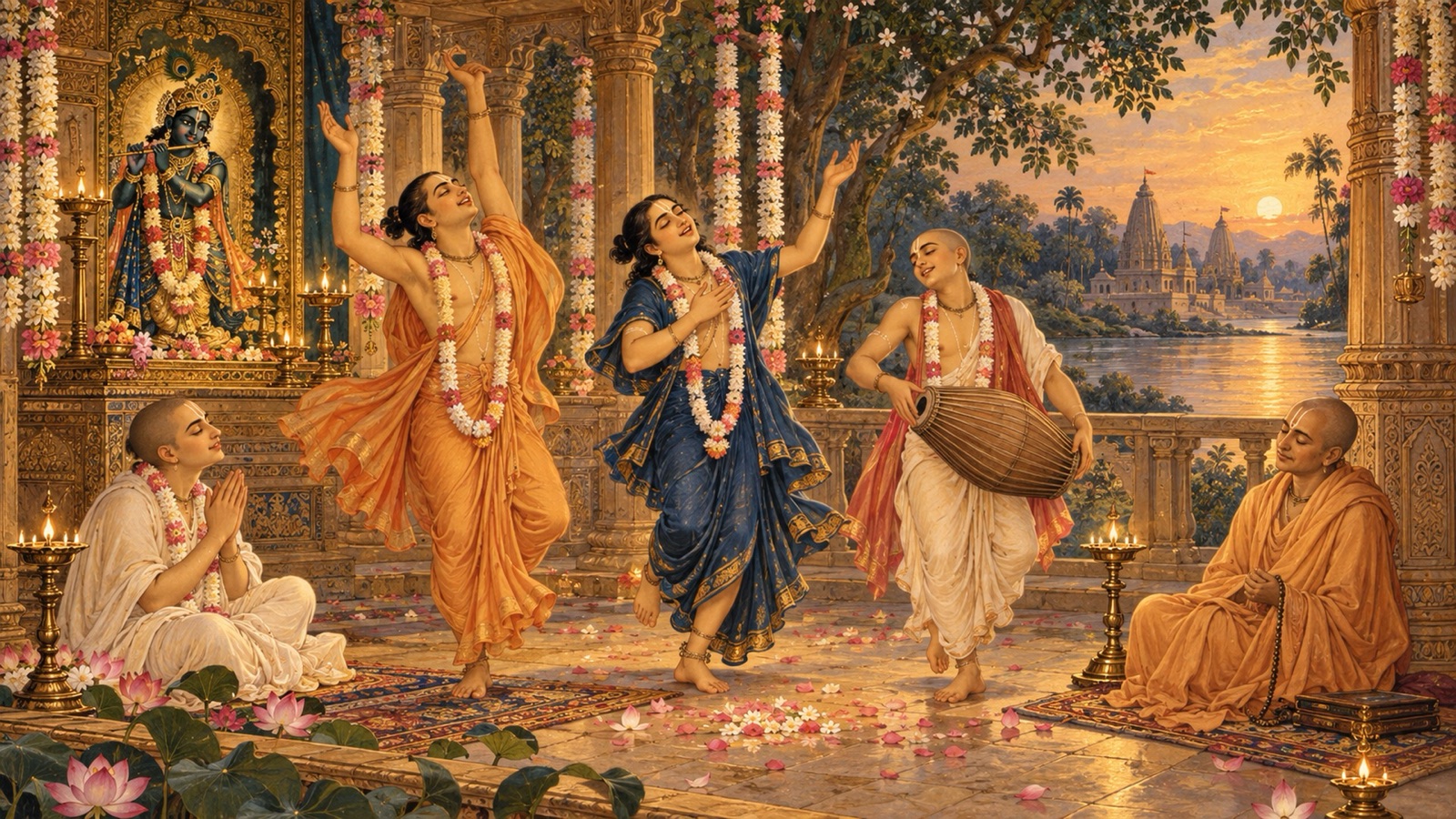
Thus learning and following the ways of the Lord’s devotees, his devotion ripening into pure love, the devotee crosses the unfathomable ocean of illusion with ease.
इति भागवतान् धर्मान् शिक्षन् भक्त्या तदुत्थया । नारायणपरो मायामञ्जस्तरति दुस्तराम् ॥ ३३ ॥
iti bhāgavatān dharmān śikṣan bhaktyā tad-utthayā nārāyaṇa-paro māyām añjas tarati dustarām
Meaning: Thus learning the devotional duties and, through the devotion born of them, becoming wholly devoted to Narayana, one easily crosses the otherwise impassable Maya. (Canto 11, Chapter 3, verse 33)
Pippalayana Speaks — The Supreme Reality
King Nimi next asked the sages to explain the real nature of the Supreme Self, called by the name Narayana (verse 34). The sage Pippalayana replied that the supreme Reality is the cause of the creation, sustenance and dissolution of the universe, yet has no cause of its own; It is present in waking, dream and deep sleep, and beyond them all, and by It the body, senses, breath and mind perform their functions. As sparks cannot illumine the fire from which they spring, so mind, speech, sight, intellect and the senses cannot grasp It; even the Veda describes It only by indication, denying of It all limiting terms (verses 35-37).

This Self, Pippalayana continued, is never born and never dies, neither grows nor decays; It is the witness of all things that come and go, omnipresent and eternally pure consciousness. Just as the sunlight shows itself plainly to clear eyes, so the truth of the Self is directly revealed to the pure heart of one who is earnestly devoted to the Lord, longs for His feet, and has cleansed the mind of all impurity born of qualities and actions (verses 38-40).
Avirhotra Speaks — The Path of Action and Worship
The king then asked about the yoga of action by which a person may quickly burn away his karma and attain the knowledge that follows freedom from all action; and he asked why the sages his father had once questioned had remained silent (verses 41-42). The sage Avirhotra answered that prescribed duties, prohibitions and their transgressions can be known only from the Vedas, which are the revelation of God; even the learned are bewildered here, for the Veda speaks in a hidden way.
परोक्षवादो वेदोऽयं बालानामनुशासनम् । कर्ममोक्षाय कर्माणि विधत्ते ह्यगदं यथा ॥ ४४ ॥
parokṣa-vādo vedo ‘yaṁ bālānām anuśāsanam karma-mokṣāya karmāṇi vidhatte hy agadaṁ yathā
Meaning: This Veda speaks in veiled, indirect language, instructing the immature as a father does; it enjoins works in order to lead one at last beyond all works — just as a bitter medicine is given to a child under the guise of something sweet. (Canto 11, Chapter 3, verse 44)
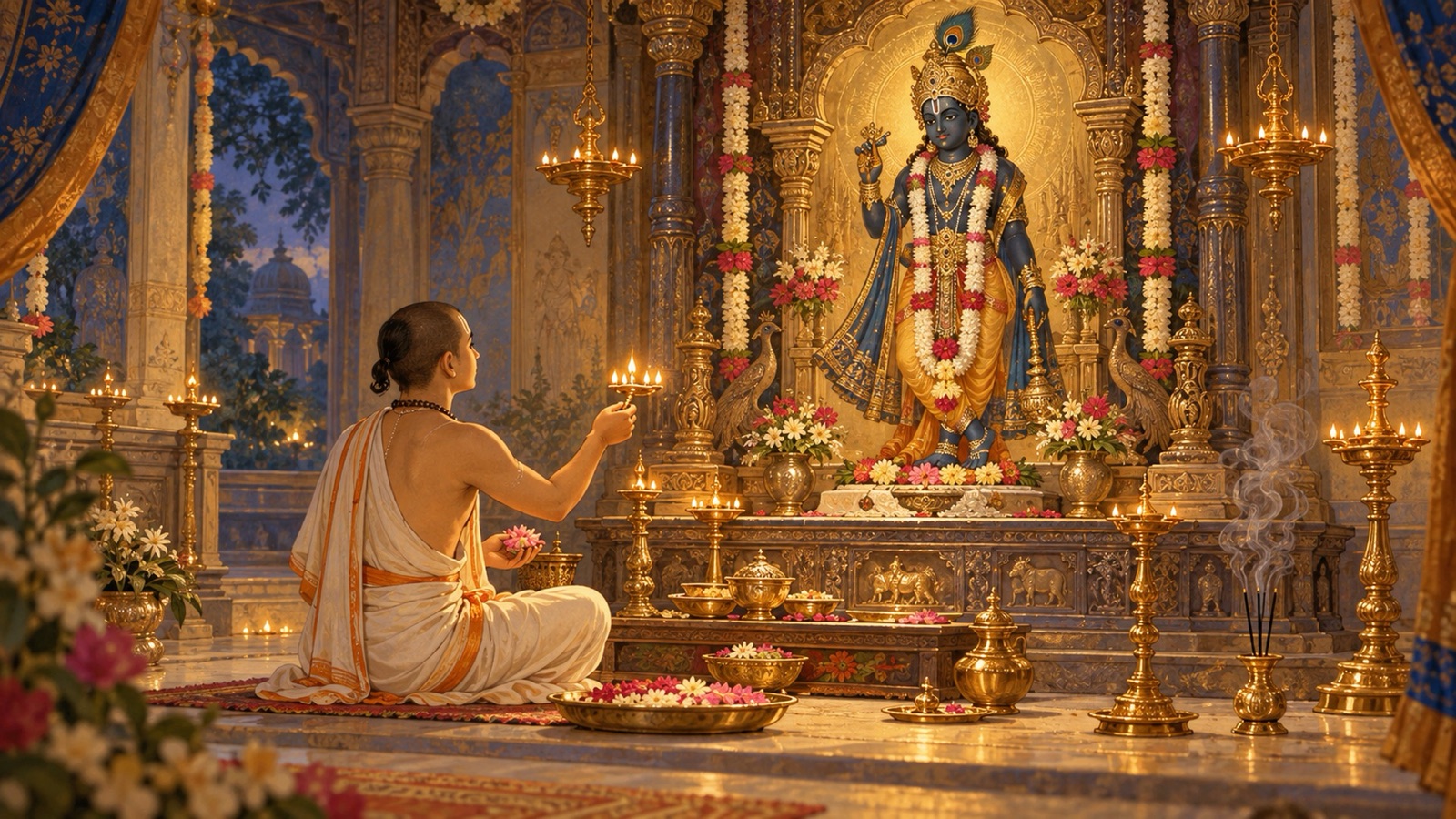
One who neglects the actions the Vedas enjoin falls into sin and wanders from death to death, Avirhotra said; but one who performs prescribed actions without attachment to their fruits, offering them all to the Lord, attains the ultimate fulfilment, which is the knowledge born of freedom from action. To cut the knot of the heart — the false sense of “I” and “mine” — one should worship Lord Kesava with Vedic and Tantric rites, worshipping the Deity in the image, in fire, in the sun, in water, in a guest or in one’s own heart, having first purified the articles, the place, oneself and the image (verses 45-54).
एवमग्न्यर्कतोयादावतिथौ हृदये च यः । यजतीश्वरमात्मानमचिरान्मुच्यते हि सः ॥ ५५ ॥
evam agny-arka-toyādāv atithau hṛdaye ca yaḥ yajatīśvaram ātmānam acirān mucyate hi saḥ
Meaning: Whoever thus worships the Lord, the Universal Soul, in the fire, the sun, water and the like, in a guest, or within his own heart, is very soon set free. (Canto 11, Chapter 3, verse 55)
Principal Teachings of This Chapter
1. Maya is the Lord’s own energy, serving the soul’s release. The deluding potency that binds the soul is not an alien power but the Lord’s own energy, unfolded so that His fragmental parts may both experience the world and, in time, find their way back to freedom (verses 3-4).
2. Attachment to the body is the root of bondage. Mistaking the created body for the self, and acting from selfish motive, the soul revolves helplessly through birth and death — the whole wheel turns on this single error (verses 5-7).
3. The highest good begins with a true teacher. Seeing the transience of all gains, earthly and heavenly, the seeker takes shelter of a guru versed in scripture, established in realization and at peace (verse 21).
4. Devotion ripens into love that crosses illusion. In the company of devotees the heart melts — weeping, singing, dancing, then falling silent in the Supreme — and by such love one easily crosses the otherwise impassable Maya (verses 32-33).
5. The Self is the unborn witness, known through pure devotion. Beyond the reach of mind and speech, the imperishable Self is revealed directly to the heart purified by loving service of the Lord (verses 38-40).
6. Action offered to the Lord leads beyond action. Duties done without attachment and surrendered to the Lord — and worship offered to Him everywhere, even within the heart — set the soul quickly free (verses 44, 55).
A Devotional Reflection
This chapter can feel, at first, like a vast cosmology — the wheeling of births, the burning and drowning of worlds, the merging of element into element. Yet its heart is intensely personal. The sages trace the whole immensity of Maya only to set beside it something small and near enough to hold: a teacher’s feet, the company of those who love the Lord, an act of worship offered with a pure heart. They do not ask us to master the cosmos; they ask us to stop mistaking the fragile body for our very self, and to let devotion do quietly what philosophy alone cannot. There is deep comfort in Pippalayana’s image of sunlight upon clear eyes — the truth of the Self is not manufactured by our striving but revealed to a heart made clean by love. And there is joy in the picture of the devotees who weep and laugh and sing together, for it tells us that the way beyond illusion is not grim but glad.
A Daily Devotional Practice
Today, in the spirit of Avirhotra’s teaching, offer one act of worship — however simple — with a purified and attentive heart. Before a sacred image, a lamp, or simply within your own heart, offer a flower, a light, or a few sincere words to the Lord, and consciously dedicate the act to Him alone. As you do, chant softly: “Om Namo Bhagavate Vasudevaya.” Let this small, wholehearted offering remind you that the Lord may be worshipped anywhere — in fire and water, in a guest, and above all within the heart — and that such worship, faithfully done, is itself a step across the ocean of illusion.
Conclusion
The third discourse of Book Eleven lays out, with rare completeness, the whole journey of the soul from bondage to freedom. Antariksha reveals Maya as the Lord’s threefold energy and traces the wheel of birth and the great dissolution; Prabuddha points to the shelter of a true teacher and the love-filled life of the devotees that carries one across illusion; Pippalayana unveils the imperishable Self, known not by argument but by a purified, devoted heart; and Avirhotra shows how action offered to the Lord, and worship rendered to Him everywhere, lead swiftly to release. Through all four voices runs a single assurance: the same Lord whose energy binds the soul also, through loving devotion, sets it free. As King Nimi’s questions continue, the next discourse will turn to the wondrous descents of that very Lord into the world.
May the divine wisdom of Srimad Bhagavatam awaken pure devotion within our hearts.
Om Namo Bhagavate Vasudevaya.
Jay Shree Madhav.
References and Attribution
- Primary edition: Gita Press, Śrīmad Bhāgavata Mahāpurāṇa (English, complete), Book Eleven, Discourse 3, pages 524–530.
- Series: Srimad Bhagavatam Wisdom · Biswa Sanatan Dharma Seva Trust.
- Presented following the spiritual guidance and recommendation of Pandit Dr. Shri Kashinath Mishra.
This is an original, faithful retelling in the writer’s own words, with brief quoted verses shown in Devanāgarī and transliteration and their meanings given as summaries. It is not a reproduction of any single publisher’s continuous translation or commentary. No affiliation with or endorsement by any publisher is implied.
Jay Shree Madhav