
Lord Sri Krishna continues His teaching to Uddhava, showing why purity and impurity, virtue and fault are set by His own gracious law rather than fixed in things themselves — and unveiling, at the last, the deepest secret of the Vedas: that every word of scripture speaks only of Him.
Om Namo Bhagavate Vasudevaya.
Om Namo Bhagavate Vasudevaya.
Om Namo Bhagavate Vasudevaya.
Welcome to Srimad Bhagavatam Wisdom, a devotional journey through the sacred histories and teachings of the Srimad Bhagavat Mahapurana. Here Lord Krishna answers a question every sincere seeker eventually asks — why does scripture, meant to free us, also bind us with rules of pure and impure, right and wrong? Speaking to His beloved Uddhava, He shows these rules to be a father’s gentle discipline, given only to lead the soul home. And at the close, He opens something rarer still: the hidden sound at the root of the Vedas, which, rightly heard, utters nothing but His own holy Name.
Chapter Information
- Scripture: Śrīmad Bhāgavata Mahāpurāṇa
- Canto: 11 (Book Eleven)
- Chapter: 21 (Discourse 21)
- Chapter title: Lord Krishna’s Explanation of the Vedic Path
- Principal speaker: Sri Krishna, instructing Uddhava; the whole related by Sukadeva Gosvami to King Parikshit
- Principal listener: Uddhava; and, in the outer frame of the Bhagavatam, King Parikshit
- Main setting: Dwaraka, in the Lord’s ongoing dialogue with His dear friend and devotee Uddhava
- Central subject: Why purity and impurity are declared by scriptural law rather than fixed in things; the true purpose of the Vedas’ promised rewards; and the secret of the Vedas as the Lord’s own sound
- Principal verse range: Canto 11, Chapter 21, verses 1–43
- Primary edition: Gita Press Śrīmad Bhāgavata Mahāpurāṇa
Context from the Previous Chapter
In Chapter 20, Uddhava asked the Lord a question that had quietly troubled him: the Veda, which both commands and forbids, is itself the means by which good and evil are known — so how can that same word also set such distinctions aside and lead a soul beyond them? This chapter carries forward the Lord’s reply, showing that the rules of scripture are a wise discipline meant only to steady the soul on its way home to Him.
The Paths Not to Be Forsaken
The Lord began plainly: those who turn away from His three paths — devotion, knowledge and right, unattached action — and chase small, fleeting desires through restless senses remain caught in the wheel of birth and death.
श्रीभगवानुवाच य एतान् मत्पथो हित्वा भक्तिज्ञानक्रियात्मकान् । क्षुद्रान् कामांश्चलै: प्राणैर्जुषन्त: संसरन्ति ते ॥ १ ॥
śrī-bhagavān uvāca / ya etān mat-patho hitvā / bhakti-jñāna-kriyātmakān / kṣudrān kāmāṁś calaiḥ prāṇair / juṣantaḥ saṁsaranti te
Meaning: The Lord said: Those who forsake these paths of Mine — devotion, knowledge and right action — and indulge trivial desires through restless senses continue to wander in birth and death. (Canto 11, Chapter 21, verse 1)
Steadfastness in one’s own appointed duty is virtue, He said; its opposite is fault. Purity and impurity are declared even of the very same things, only to settle doubt about them, for the sake of righteousness, honest dealing and livelihood (verses 2–4).
One Law, Many Forms
The same five elements — earth, water, fire, air and ether — compose every embodied being, from Brahma down to the lowliest plant, each joined to its own portion of the self. Yet the Veda, for each creature’s true good, assigns differing names and distinctions even among things alike at the root — not because such things are inherently so, but to give order to action itself. A tract of land or a span of time becomes fit or unfit for a sacred purpose according to its own condition, and that from which right action withdraws is, for that reason alone, called a fault (verses 5–9).

The Many Ways a Soul and a Thing Are Purified
Grain, wood, bone, cloth, metals, hides and earthen things are each purified in their own way — by time, air, fire, earth or water; whatever removes the stain of an impure thing and restores its natural state is its true purifier. But the purification of the one who acts, the Lord said, is of a higher order — coming through bathing, charity, austerity, the sacraments, righteous deeds, and, above all, through remembering Him.
स्नानदानतपोऽवस्थावीर्यसंस्कारकर्मभि: । मत्स्मृत्या चात्मन: शौचं शुद्ध: कर्माचरेद्द्विज: ॥ १४ ॥
snāna-dāna-tapo-’vasthā-vīrya-saṁskāra-karmabhiḥ / mat-smṛtyā cātmanaḥ śaucaṁ śuddhaḥ karmācared dvijaḥ
Meaning: The purity of the self is brought about by bathing, charity, austerity, fitness of age and strength, the sacraments and righteous deeds — and, above all, by remembering Me; only when so purified should one proceed to one’s duty. (Canto 11, Chapter 21, verse 14)
The purity of a sacred formula comes from learning it properly; the purity of an act lies simply in offering it to Him. Righteousness is accomplished through these six — place, time, substance, agent, formula and deed (verses 10–15).
When the Rule Itself Makes the Rule
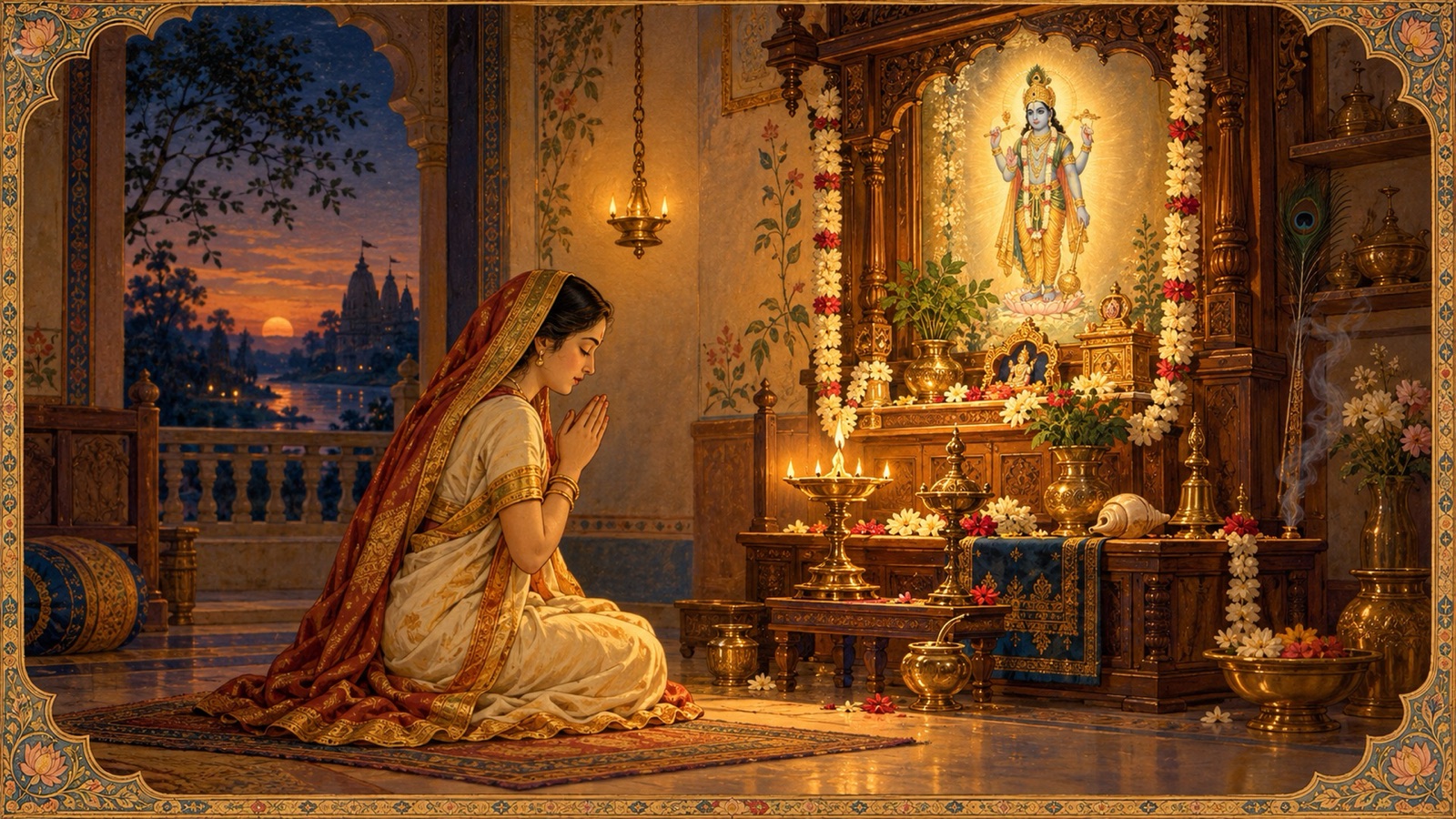
By scripture’s own authority, what is a virtue in one circumstance can become a fault in another, and a fault a virtue — the rule that fixes good and bad for a purpose is itself the ground of the distinction, not some quality hidden in the object. For one already fallen, an act sinful for another is no further degradation, just as one already lying on the ground cannot fall further. From this the Lord drew the deeper principle: a person becomes free of attachment to whatever he simply ceases to pursue (verses 16–17).
यतो यतो निवर्तेत विमुच्येत ततस्तत: । एष धर्मो नृणां क्षेम: शोकमोहभयापह: ॥ १८ ॥
yato yato nivarteta vimucyeta tatas tataḥ / eṣa dharmo nṛṇāṁ kṣemaḥ śoka-moha-bhayāpahaḥ
Meaning: From whatever a person withdraws himself, from just that he becomes free; this is the righteous course that brings true good to humankind, dispelling grief, delusion and fear. (Canto 11, Chapter 21, verse 18)
How a Single Misunderstanding Unravels a Soul
From a mistaken sense of an object’s goodness springs attachment; from attachment, desire; from desire alone, quarrel among men. From quarrel comes anger, scarcely restrained; from anger, delusion; and by delusion a person’s power of judgment is swiftly darkened. Bereft of judgment, a living being becomes as good as nothing at all, clinging to sense-pleasure, knowing neither the Self nor what lies beyond it, living as uselessly as a tree and breathing like a mere bellows (verses 19–22).
The Sweetness Offered Before the Deeper Truth
Here the Lord unveils something many take for the Vedas’ very aim — their promise of heaven and earthly blessing. He says plainly that this is not where the path ends; it exists only to draw a reluctant heart a little nearer, in the way an elder sweetens the mouth before a necessary dose.
फलश्रुतिरियं नृणां न श्रेयो रोचनं परम् । श्रेयोविवक्षया प्रोक्तं यथा भैषज्यरोचनम् ॥ २३ ॥
phala-śrutir iyaṁ nṝṇāṁ na śreyo rocanaṁ param / śreyo-vivakṣayā proktaṁ yathā bhaiṣajya-rocanam
Meaning: This promise of reward held out to men is not itself the supreme good; it is spoken only to awaken a taste for what will truly benefit them — just as a sweet is offered before a bitter medicine. (Canto 11, Chapter 21, verse 23)
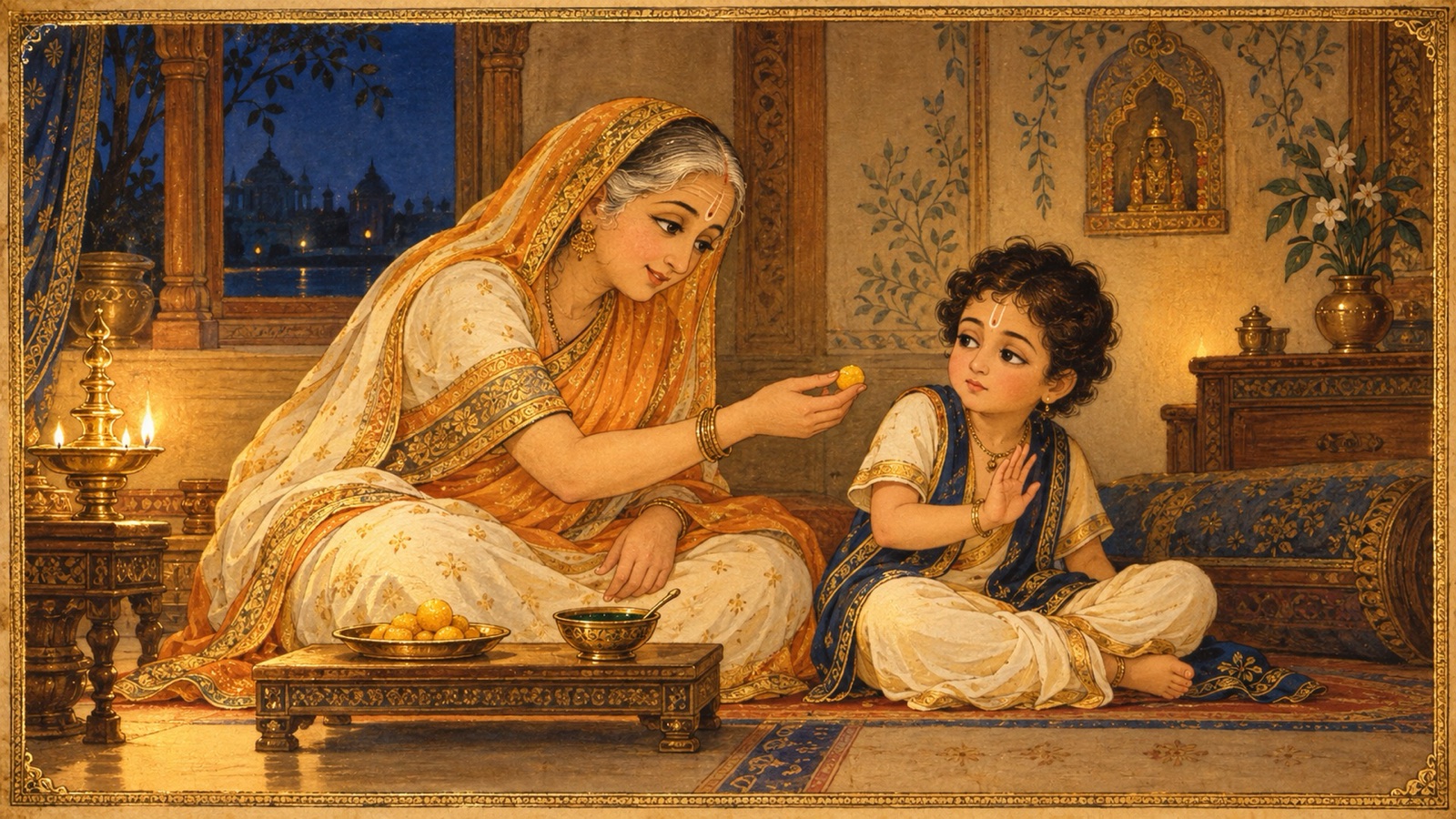
Mortals are, from birth, attached to their desires, their life and their kin, though these very attachments cause their own sorrow. Not grasping the Vedas’ hidden intent, some mistake this flowering promise for the fruit itself, dazzled by the sacrificial fire and wearied by its smoke, and so fail to know Him who dwells, unseen, within their own heart — as mist-dimmed eyes fail to see what stands close before them (verses 24–28).
The Hidden Intent Behind Sacrifice
Here the Lord speaks with unusual directness about a point He clearly wishes corrected. Whatever appetite a soul may still carry for taking life has no license beyond a duly ordained sacrifice, He says, and scripture never turns even that into a command.
ते मे मतमविज्ञाय परोक्षं विषयात्मका: । हिंसायां यदि राग: स्याद् यज्ञ एव न चोदना ॥ २९ ॥ हिंसाविहारा ह्यालब्धै: पशुभि: स्वसुखेच्छया । यजन्ते देवता यज्ञै: पितृभूतपतीन् खला: ॥ ३० ॥
te me matam avijñāya parokṣaṁ viṣayātmakāḥ / hiṁsāyāṁ yadi rāgaḥ syād yajña eva na codanā / hiṁsā-vihārā hy ālabdhaiḥ paśubhiḥ sva-sukhecchayā / yajante devatā yajñaiḥ pitṛ-bhūta-patīn khalāḥ
Meaning: Not understanding this hidden intent of Mine, those wicked men who delight in bloodshed as a pastime, their minds set on their own pleasure, worship the gods, the departed and the lords of lesser spirits through sacrifices performed with creatures slain for their own gratification. (Canto 11, Chapter 21, verses 29–30)
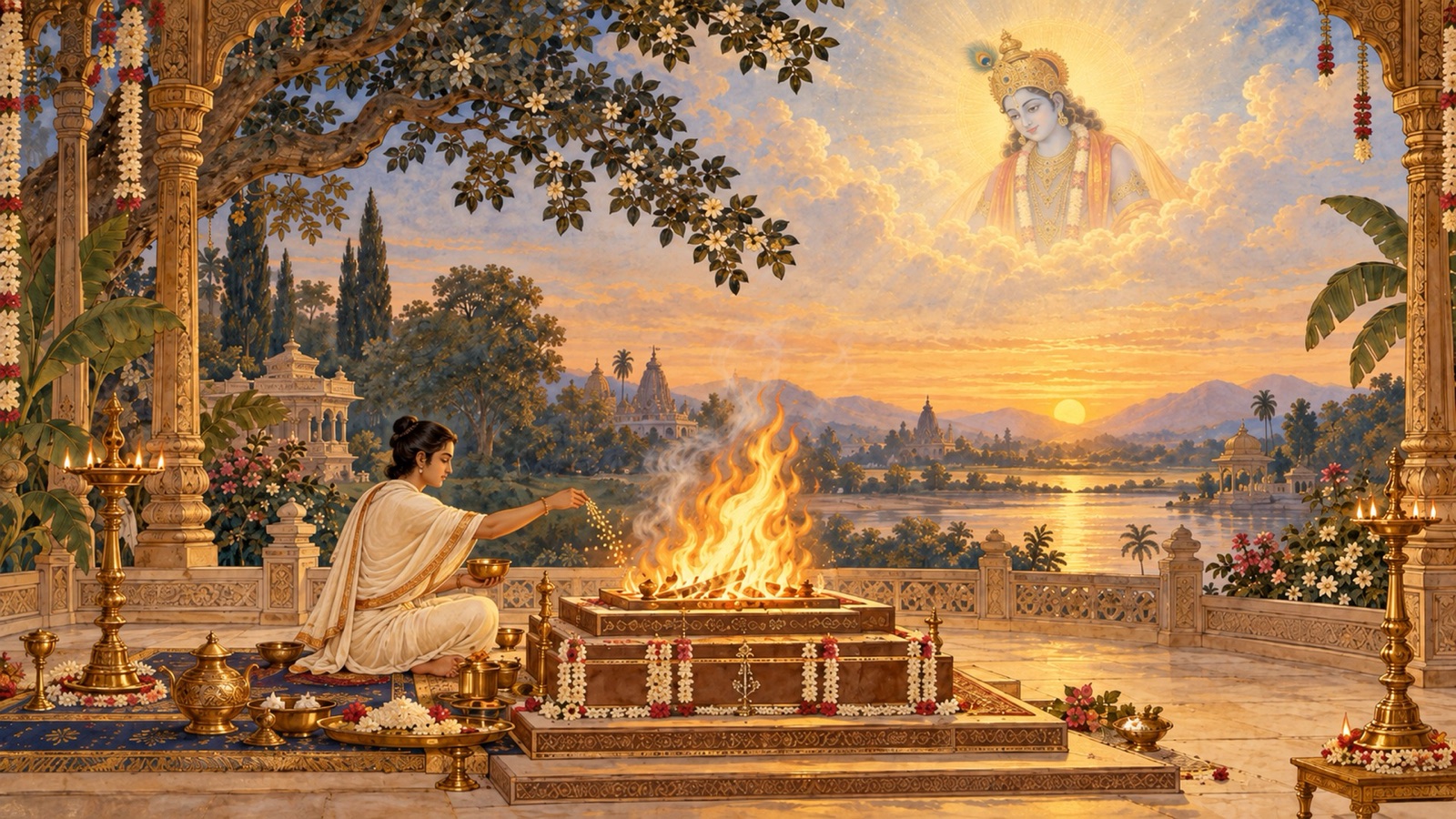
Such people treasure the other world as sweet to hear of though fleeting as a dream, spending their wealth on it as a merchant risks his whole fortune. Rooted in passion, goodness and ignorance, they worship Indra and the gods who are likewise bound by these three modes — not the Lord, who stands beyond them — hoping that heaven’s enjoyment will end only in rebirth among great families on earth. So scattered are their minds by such lovely words that even talk of the Lord fails to attract them (verses 31–34).
The Threefold Veda and Its Love of the Hidden Meaning
And yet, the Lord says, the Vedas were never truly about any of this. Embracing their three divisions — of ritual action, of worship, and of knowledge — they hold the Supreme Self as their one true subject, and both the sages and the Vedic word itself speak of it only indirectly; such indirect teaching, He says, is dear to Him as well, for it is given so that the sincere may seek and find, not merely be told (verse 35).
The Secret Sound From Which the Vedas Rise
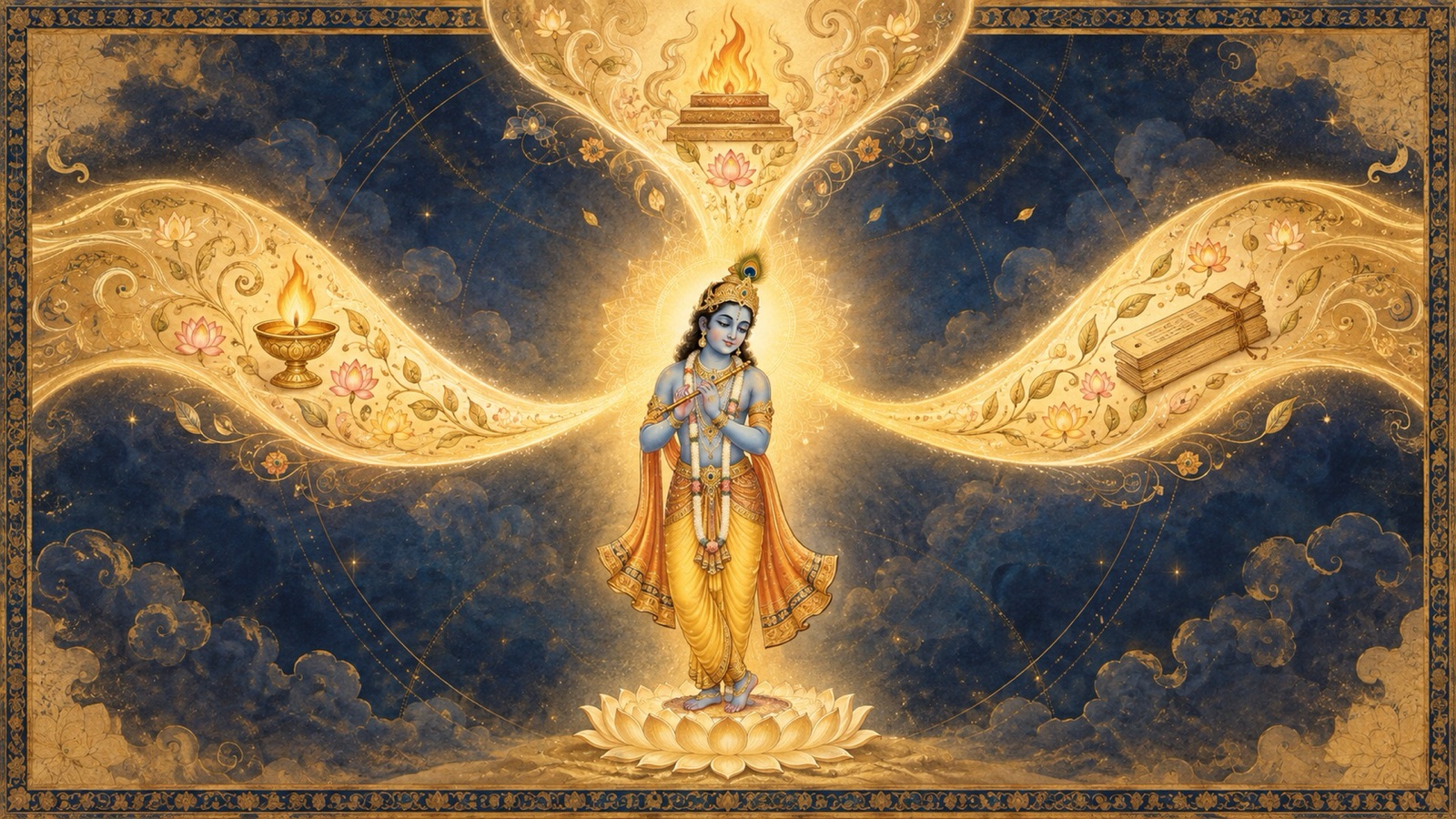
What follows is among the most luminous passages in the whole Bhagavatam. The Veda, the Lord reveals, is Brahman in the very form of sound — woven of the vital breath, the mind and speech, a reality as boundless and unfathomable as the ocean itself.
मयोपबृंहितं भूम्ना ब्रह्मणानन्तशक्तिना । भूतेषु घोषरूपेण बिसेषूर्णेव लक्ष्यते ॥ ३७ ॥
mayopabṛṁhitaṁ bhūmnā brahmaṇānanta-śaktinā / bhūteṣu ghoṣa-rūpeṇa viseṣūrṇeva lakṣyate
Meaning: Sustained by Me, the boundless Brahman of infinite potency, this Veda is perceived by the wise within every creature as the unstruck sound — as subtly present there as the fine fibre running through a lotus stalk. (Canto 11, Chapter 21, verse 37)

As a spider draws its web from its own heart and sends it forth through its mouth, so this same resonant breath, moving through the mind, pours forth the thousand channels of uttered speech — every letter born of Om, woven through countless languages, and rising in metres remembered by name: Gayatri, Ushnik, Anushtup, Brihati, Pankti, Trishtup, Jagati, Aticchanda, Atyashti, Atijagati and Ativirat. It is the Lord Himself who sends this speech forth, and the Lord Himself who, in His own time, draws it back within (verses 38–41).
None but the Lord Knows the Heart of the Veda
None other than the Lord, He says, truly knows the heart of this sacred speech — what it enjoins, what it reveals, and what it first proposes and then, in its deepest portion, gently sets aside. This is the thread quietly binding the whole chapter: the law of purity, the promise of heaven and the music of the Veda are three stages of one patient teaching, each arranged to carry a soul nearer to Him before it is released even from the teaching itself. The Veda enjoins Him alone as the sacrifice, names Him alone beneath its many deities, and whatever it speaks of as different from Him, only to withdraw that difference again, proves to be nothing other than Himself.
मां विधत्तेऽभिधत्ते मां विकल्प्यापोह्यते त्वहम् । एतावान् सर्ववेदार्थ: शब्द आस्थाय मां भिदाम् । मायामात्रमनूद्यान्ते प्रतिषिध्य प्रसीदति ॥ ४३ ॥
māṁ vidhatte ’bhidhatte māṁ vikalpyāpohyate tv aham / etāvān sarva-vedārthaḥ śabda āsthāya māṁ bhidām / māyā-mātram anūdyānte pratiṣidhya prasīdati
Meaning: It enjoins Me alone as the sacrifice; it names Me alone in its many deities; and whatever it attributes to Me as separate, only to negate again, is likewise nothing but Myself. Resting upon Me, the Veda speaks of this appearance of difference as Maya, and having set it aside, falls silent and content. This, in its entirety, is the meaning of all the Vedas. (Canto 11, Chapter 21, verse 43)
Principal Teachings of This Chapter
1. Purity and impurity are declared by scripture, not fixed in the thing itself. The rule exists to guide conduct, not to describe a permanent quality hidden in matter (verses 3, 7).
2. True purification rises from body to soul, and finds its height in remembering the Lord. Bathing, charity and the sacraments purify the body and the deed; the self is purified, above all, by remembering Him, and an act is purified only by being offered to Him (verses 10–15).
3. The very law that defines right and wrong can also lift its own restriction. A fault in one circumstance can, by scriptural ordinance, be no fault in another; the freedom this points toward is detachment, which dispels grief, delusion and fear (verses 16–18).
4. A single misreading of what is “good” can unravel a whole life. Attachment leads to desire, desire to quarrel, quarrel to anger, and anger to a darkness that swallows judgment itself (verses 19–22).
5. The Vedas’ promised rewards are a kindness on the way to something greater, not the destination. Like a sweet given before medicine, heaven’s promise exists only to draw an unwilling mind toward its true good; mistaking the blossom for the fruit leaves a soul no closer to the Lord within (verses 23–28).
6. Scripture never makes violence a duty, and the Lord names those who twist it so as wicked. Any appetite for bloodshed has no scriptural license beyond a duly ordained sacrifice; those who slay for pleasure and call it worship have missed the Lord’s intent (verses 29–34).
7. The entire Veda, in every one of its three divisions, speaks of nothing but the Lord. The rules of purity regulate conduct, the promise of heaven awakens a reluctant taste for the good, and the sacred sound of the Veda rises from and returns to Him alone — scripture first describes the world of differences, then dissolves that world back into the one Reality it was always pointing toward. To hear the Veda this way is to stop collecting its rules and start recognizing its Author (verses 35–43).
A Devotional Reflection
There is a particular mercy in a teacher who explains His own rules. Many scriptures simply command; here we watch the Lord’s reasoning unfold, as a parent at last explains to a grown child why certain boundaries were set — not to confine, but to protect a heart not yet ready for the whole truth at once. It is tender to picture the Vedas’ heavenly promises as a sweet placed on the tongue before a needed medicine, tender too that the Lord grieves for those who mistake that sweet for the cure and never come looking for Him, though He sits, unseen, within their own hearts all along. Then, just when the teaching seems to close in rules of purity and sacrifice, it opens onto something vast and musical — the Vedas as living sound, breathed out and drawn back by the Lord as naturally as a spider spins its own web. To sit with this chapter is to feel scripture turn intimate: not a wall of rules to fear, but a voice that was only ever trying to say one Name.
A Daily Devotional Practice
Today, practise seeing past the sweetness to the cure it was meant to lead you toward. Notice one small desire you have been chasing simply because it is pleasant to imagine, and ask, as the Lord asks here, whether it is the fruit itself or merely a flower offered along the way. Then sit quietly for a few minutes and turn your attention inward to the Lord already present in your heart, repeating with love: “Om Namo Bhagavate Vasudevaya.” In that turning, from the flower toward the fruit, you walk the very path this chapter reveals.
Conclusion
In this twenty-first discourse of Book Eleven, Lord Krishna answers Uddhava’s bewilderment with a teaching of great depth and tenderness. Purity and fault, He shows, are not fixed properties hidden in things but a loving discipline set by scripture to steady the soul; true purification rises, at last, to the simple remembrance of His name. He reveals why the Vedas sweeten their deeper truth with promises of heaven, and why those who mistake that sweetness for the final fruit, or twist ritual into licence for violence, remain blind to Him though He dwells, unseen, within their own hearts. And at the last, the teaching rises into pure wonder: the Vedas themselves prove to be His own sacred sound, sent forth and drawn back by Him alone, every syllable uttering nothing but His one Name. To walk this chapter with Uddhava is to learn how to hear scripture as the Lord Himself hears it — a voice that was always, only, calling us home.
May the divine wisdom of Srimad Bhagavatam awaken pure devotion within our hearts.
Om Namo Bhagavate Vasudevaya.
Jay Shree Madhav.
References and Attribution
- Primary edition: Gita Press, Śrīmad Bhāgavata Mahāpurāṇa (English, complete), Book Eleven, Discourse 21, pages 610–616.
- Series: Srimad Bhagavatam Wisdom · Biswa Sanatan Dharma Seva Trust.
- Presented following the spiritual guidance and recommendation of Pandit Dr. Shri Kashinath Mishra.
This is an original, faithful retelling in the writer’s own words, with brief quoted verses shown in Devanāgarī and transliteration and their meanings given as summaries, not a reproduction of any publisher’s continuous translation or commentary. No affiliation with or endorsement by any publisher is implied.
Jay Shree Madhav