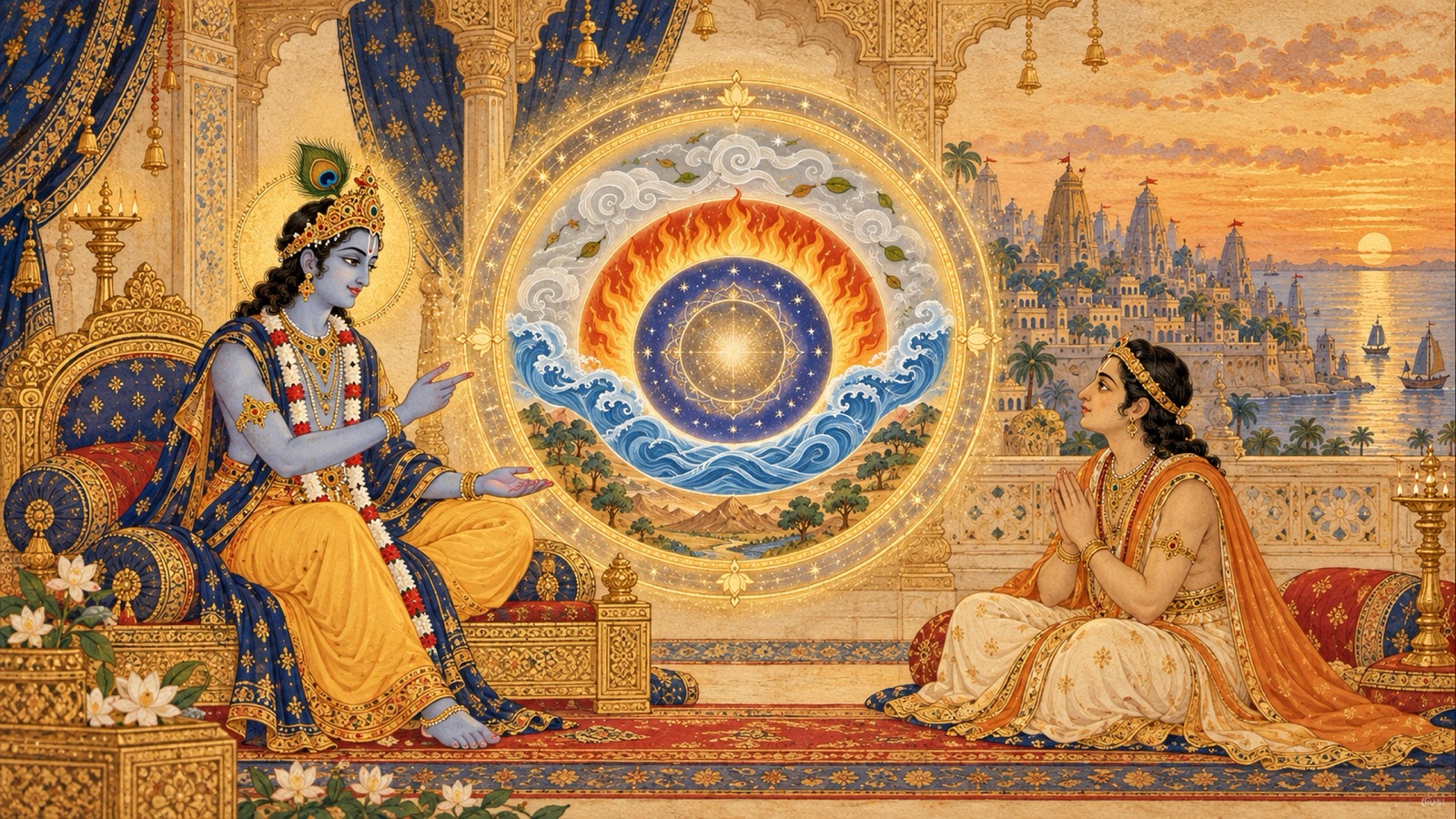
Uddhava asks why the sages number the fundamental principles of creation so variously, and Lord Krishna reconciles every count, then shows how Purusha and Prakriti, though eternally distinct, seem to merge, and how the soul quietly passes from body to body.
Om Namo Bhagavate Vasudevaya.
Om Namo Bhagavate Vasudevaya.
Om Namo Bhagavate Vasudevaya.
Welcome to Srimad Bhagavatam Wisdom, a devotional journey through the Srimad Bhagavat Mahapurana. In the chapter before this one, the Lord revealed Himself as the eternal Veda, drawing all diversity back into Himself. Now Uddhava brings a puzzle that has troubled seekers since the dawn of creation: twenty-eight, twenty-five, seventeen, or as few as four — which reckoning of the fundamental principles is correct? The Lord’s answer is among the gentlest teachings in the whole Bhagavatam: every count is true, for every category folds into every other; Purusha and Prakriti, though utterly distinct, seem to merge within the body; and the soul, though changeless, seems to wander from body to body only because the mind, carrying the seeds of its own past deeds, mistakes a borrowed home for itself.
Chapter Information
- Scripture: Śrīmad Bhāgavata Mahāpurāṇa
- Canto: 11 (Book Eleven)
- Chapter: 22 (Discourse 22)
- Chapter title: Enumeration of the Elements of Material Creation
- Principal speaker: Sri Krishna, instructing Uddhava; the whole related by Sukadeva Gosvami to King Parikshit
- Principal listener: Uddhava; and King Parikshit
- Main setting: Dwaraka
- Central subject: The many counts of the tattvas, Purusha and Prakriti’s distinction and seeming oneness, and the soul’s passage from body to body
- Principal verse range: Canto 11, Chapter 22, verses 1–60
- Primary edition: Gita Press Śrīmad Bhāgavata Mahāpurāṇa
Context from the Previous Chapter
In Chapter 21, the Lord taught Uddhava that He, as the infinite Brahma, is the hidden source of the Veda, which names and enjoins all things, then sets them aside as illusion and grows quiet in Him. This chapter carries that silence into a new question: how many principles compose the many?
Uddhava Asks — How Many Are the Tattvas?
Uddhava placed before the Lord a question that had long puzzled him: the Lord had once spoken of twenty-eight categories, yet the sages speak variously of twenty-six down to as few as four. With what purpose do they declare so wide a variety?
श्रीउद्धव उवाच कति तत्त्वानि विश्वेश सङ्ख्यातान्यृषिभि: प्रभो । नवैकादश पञ्च त्रीण्यात्थ त्वमिह शुश्रुम ॥ १ ॥ केचित् षड्विंशतिं प्राहुरपरे पञ्चविंशतिम् । सप्तैके नव षट् केचिच्चत्वार्येकादशापरे । केचित् सप्तदश प्राहु: षोडशैके त्रयोदश ॥ २ ॥ एतावत्त्वं हि सङ्ख्यानामृषयो यद्विवक्षया । गायन्ति पृथगायुष्मन्निदं नो वक्तुमर्हसि ॥ ३ ॥
śrī-uddhava uvāca kati tattvāni viśveśa saṅkhyātāny ṛṣibhiḥ prabho navaikādaśa pañca trīṇy āttha tvam iha śuśruma kecit ṣaḍ-viṁśatiṁ prāhur apare pañca-viṁśatiṁ saptaike nava ṣaṭ kecic catvāry ekādaśāpare kecit saptadaśa prāhuḥ ṣoḍaśaike trayodaśa etāvattvaṁ hi saṅkhyānām ṛṣayo yad-vivakṣayā gāyanti pṛthag āyuṣmann idaṁ no vaktum arhasi
Meaning: Shri Uddhava said: How many principles have the sages enumerated, O Ruler of the universe? You Yourself spoke of twenty-eight in all; yet some declare twenty-six, others twenty-five, seven, nine, six, four, eleven, seventeen, sixteen or thirteen. With what intention do the sages speak of so many numbers? (Canto 11, Chapter 22, verses 1–3)
Why the Sages Count Differently
The glorious Lord replied that whatever the Brahmanas declare is right, for nothing is impossible to those who speak while grasping His own Maya; His three gunas lie behind every dispute, each sage certain his own count alone is correct, yet once mind and senses are mastered, the sense of difference subsides, and the quarrel with it. (Canto 11, Chapter 22, verse 4)
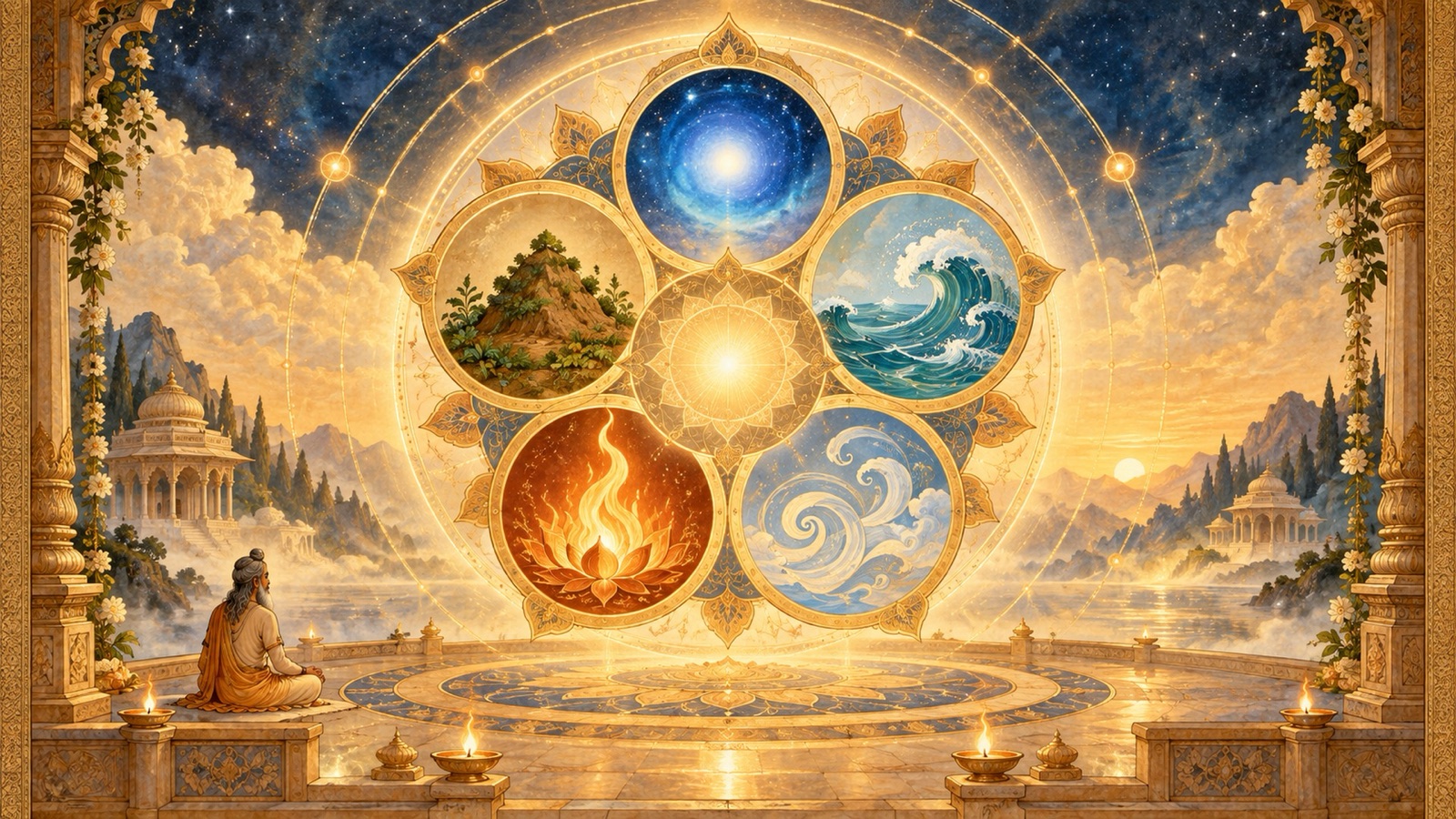
The deeper secret: every category already contains every other, cause implying effect and effect implying cause. Some add God as a distinct twenty-sixth principle; others keep to twenty-five, seeing soul and God as one essence. Traced to their root, the categories yield nine — Purusha, Prakriti, cosmic intelligence, cosmic ego, five elements — or seven, or six, naming the elements with the Supreme Person as sixth, ruler of His own creation, or four, naming fire, water and earth as sprung from that Spirit. From the instruments of experience they become seventeen, sixteen, thirteen, eleven or nine, by further groupings of the same — every reckoning standing equally on reason. (Canto 11, Chapter 22, verses 10–25)
Prakriti Seems One with Purusha
Uddhava then turned to a more intimate puzzle: Prakriti and Purusha are wholly distinct, he said, yet their difference is never seen, since each is glimpsed within the other — the Spirit appears only through the body, and the body seems inseparable from the Self. Would the Lord resolve this, since only He knows the working of His own Maya? (Canto 11, Chapter 22, verses 26–28)
The Lord Declares: Prakriti and Purusha Are Truly Distinct
The glorious Lord answered plainly.
श्रीभगवानुवाच प्रकृति: पुरुषश्चेति विकल्प: पुरुषर्षभ । एष वैकारिक: सर्गो गुणव्यतिकरात्मक: ॥ २९ ॥
śrī-bhagavān uvāca prakṛtiḥ puruṣaś ceti vikalpaḥ puruṣarṣabha eṣa vaikārikaḥ sargo guṇa-vyatikarātmakaḥ
Meaning: The glorious Lord said: Prakriti and Purusha are radically different from one another, O best of men; this very distinction appears to us as the created universe, born of the disturbance and interplay of the three gunas. (Canto 11, Chapter 22, verse 29)
His Maya, built of these gunas, throws up this difference in countless forms. What seems threefold in every act of knowing — the knower, the world known, and the power joining them — is one play of Maya: the eye belongs to the self, the colour to the world, the sun’s hidden light to the gods; the senses, mind and reason all carry this threefold character, though the Self witnessing them stands apart, luminous by its own nature. From this working of Time arises the ancient, substanceless debate over whether the Self, apart from the body, exists — a debate that does not cease for minds turned from Him. (Canto 11, Chapter 22, verses 30–33)

How the Soul Passes from Body to Body
Moved by this, Uddhava asked the question nearest every heart: how does the one Self, present everywhere alike, take up one body and lay down another, as that body’s past deeds decide? How can action belong to the actionless, or birth and death to that which knows neither — a matter scarcely anyone truly understands. (Canto 11, Chapter 22, verses 34–35)
श्रीभगवानुवाच मन: कर्ममयं नृणामिन्द्रियै: पञ्चभिर्युतम् । लोकाल्लोकं प्रयात्यन्य आत्मा तदनुवर्तते ॥ ३६ ॥
śrī-bhagavān uvāca manaḥ karma-mayaṁ nṛṇām indriyaiḥ pañcabhir yutam lokāl lokaṁ prayāty anya ātmā tad-anuvartate
Meaning: The glorious Lord replied: United with the five senses, the mind of embodied souls — made of the latent impressions of their own past deeds — travels from body to body, and the soul, though distinct from the mind, follows it as though bound to it. (Canto 11, Chapter 22, verse 36)
Birth and Death as the Mind’s Forgetting
Carried by this gathered karma, the mind at death dwells on what has been seen or heard before, and is drawn into a new body matching those impressions, losing all memory of what came before — this forgetting is, in truth, nothing other than death. Equally, the wise call it birth when the mind, through attachment, comes to identify wholly with a new body, as one identifies with a body in a dream, forgetting the earlier dream’s body and feeling the present one entirely new, though old. This appearance of body, senses and mind within the one unchanging Self creates every sense of inner and outer difference. (Canto 11, Chapter 22, verses 37–41)
Like a Flame Passing from Lamp to Lamp
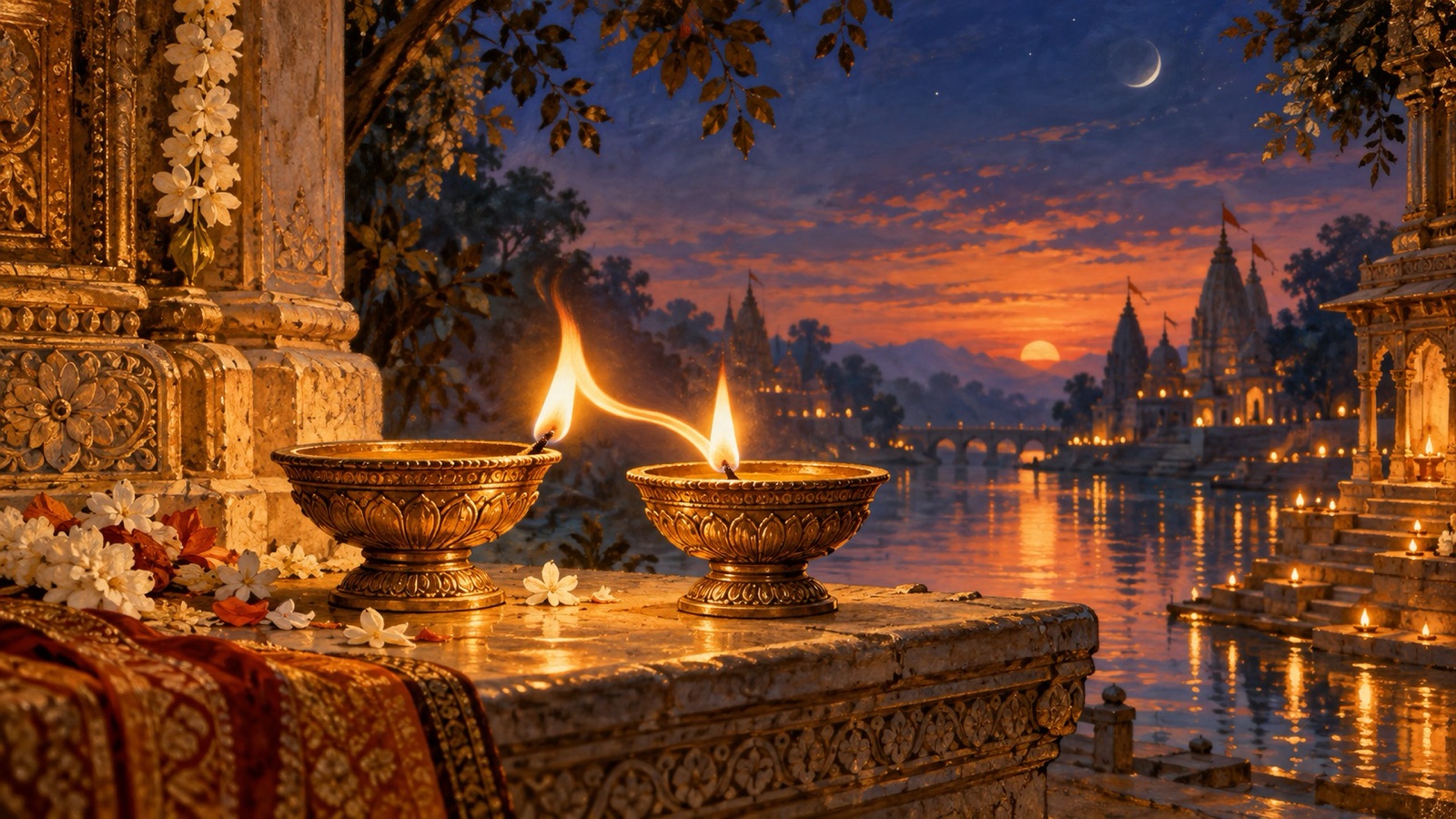
Every created being, dear Uddhava, arises and perishes at every moment, carried by Time’s imperceptibly swift current; only its subtlety keeps this unnoticed, as with the flame of a lamp, the water of a stream, or the fruit of a tree.
सोऽयं दीपोऽर्चिषां यद्वत्स्रोतसां तदिदं जलम् । सोऽयं पुमानिति नृणां मृषा गीर्धीर्मृषायुषाम् ॥ ४४ ॥
so ’yaṁ dīpo ’rciṣāṁ yadvat srotasāṁ tad idaṁ jalam so ’yaṁ pumān iti nṛṇāṁ mṝṣā gīr dhīr mṝṣāyuṣām
Meaning: Just as men speak falsely of a flame, saying “this is that same lamp,” or of flowing water, saying “this is that same stream,” so the unwise falsely say “this is that same person” of a body — a mere habit of mistaken understanding among those whose lifetime is itself passing away. (Canto 11, Chapter 22, verse 44)
Even so, the soul, carried only by the seed of its past karma, is never truly born and never dies; through illusion it only seems to take birth and perish, as fire seems to appear with firewood, and vanish when that contact ends. (Canto 11, Chapter 22, verse 45)
The Nine States of the Body, and the Seed That Does Not Die
The body passes through nine states — womb-entry, gestation and birth; infancy, boyhood, youth, middle age, old age; and death. A soul caught in false identification with matter accepts these as its own, though another, by the Lord’s grace, succeeds in disowning them. Just as one’s birth can be inferred from a son’s birth, and one’s death from a father’s death, so one who truly knows birth and death can never be subject to either. (Canto 11, Chapter 22, verses 46–48)
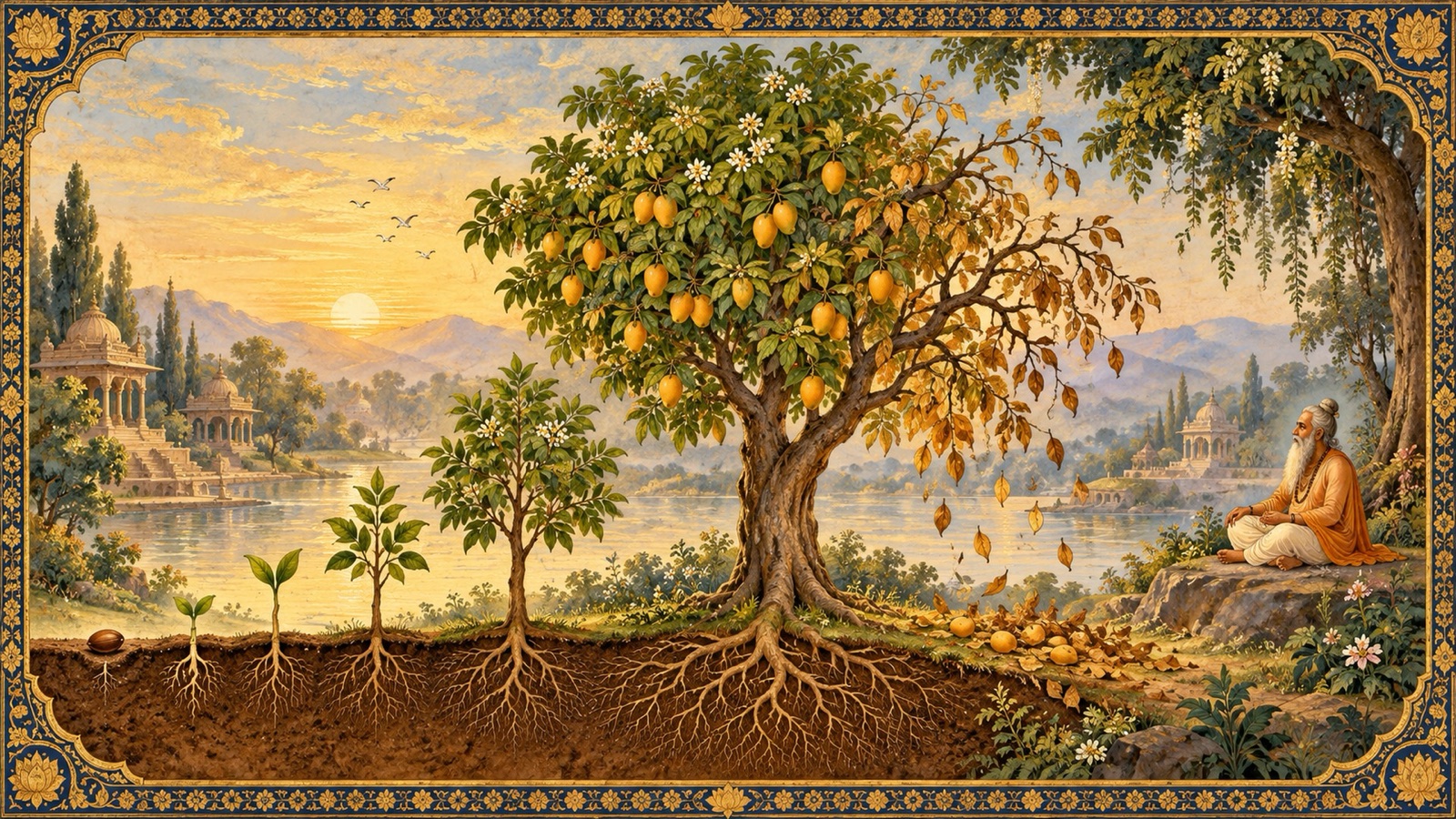
तरोर्बीजविपाकाभ्यां यो विद्वाञ्जन्मसंयमौ । तरोर्विलक्षणो द्रष्टा एवं द्रष्टा तनो: पृथक् ॥ ४९ ॥
taror bīja-vipākābhyāṁ yo vidvāñ janma-saṁyamau taror vilakṣaṇo draṣṭā evaṁ draṣṭā tanoḥ pṛthak
Meaning: One who understands how a tree sprouts from its seed, and withers after bearing fruit, is clearly distinct from the tree, as its seer; even so, the seer of the body — the soul — is distinct from the body itself. (Canto 11, Chapter 22, verse 49)
Bound by the Three Gunas, Freed by the Witness
Failing this distinction, and clinging to sense-pleasure as the only reality, the ignorant soul is swept through birth and rebirth — rising among gods through goodness, descending among ordinary people through passion, or sinking toward lower creation through the grief of darkness. Yet the soul never truly acts; it is like a man who, watching others dance, imitates them, mistaking their movement for his own — just as trees beside flowing water seem themselves to move, so the body’s activity is merely reflected upon the unmoving Self. All such experience, like a dream, is false, and this wandering does not end for one who dwells on sense-pleasure as his own, any more than a dream’s troubles end for one not yet awake. (Canto 11, Chapter 22, verses 50–55)
Do Not Feed the Vile Senses
Therefore, Uddhava, the Lord said, do not indulge the objects of the senses through these unworthy senses; see this illusion of duality for what it is — a mere appearance born of failing to grasp one’s own true Self. (Canto 11, Chapter 22, verse 56)
Whether reproached, insulted, struck, bound, or deprived of one’s livelihood by the malicious, one who truly seeks blessedness should rescue himself by his own reasoning. Uddhava humbly asked how he might attain such understanding, confessing that even the learned find such outrage hard to bear, except those sheltered at the Lord’s feet, their passions stilled through loving service to His names. (Canto 11, Chapter 22, verses 57–60)
Principal Teachings of This Chapter
1. Every count of the tattvas is true. Each reckoning is valid, for every category folds into every other as cause and effect (verses 4–25).
2. Prakriti and Purusha are truly distinct, though they seem one. The Lord’s own Maya, through the three gunas, makes the eternal Self seem bound to the body (verses 29–33).
3. The mind, not the Self, travels from body to body. The soul merely follows the mind through misplaced identification (verse 36).
4. Birth and death are the mind’s forgetting and remembering. Both belong to the mind, not the unchanging soul (verses 37–41).
5. Time’s hidden motion makes all things seem momentarily the same. As a flame or a stream is falsely called “the same,” so is a body; only the soul within truly is not (verses 44–45).
6. The soul is the silent seer of the body’s nine states. As one who knows a seed’s sprouting stands apart from the tree, so the soul stands apart from the body (verse 49).
7. Remembrance of the Lord is the only shelter from life’s blows. Those sheltered at His feet bear insult and loss through reason and devotion (verses 56–60).
A Devotional Reflection
What is most touching here is the Lord’s patience before He ever corrects anyone. Uddhava comes with a question that could easily be waved aside — surely the sages should simply agree on one number — yet the Lord first honours every count, showing how each flows from a reasonable way of seeing the one creation. There is a quiet lesson for all who grow attached to their own understanding: truth can wear many faces without ceasing to be truth, held with reason and offered without pride. Having honoured every view, the Lord then leads Uddhava to what truly matters — the soul who asks is not the body being counted. The lamp whose flame seems the same from night to night is never truly the same flame, yet something within watches it change, unchanging itself. To remember that watcher amid our own shifting seasons is to begin to stand where Uddhava stood.
A Daily Devotional Practice
Today, when you feel certain your own view alone is correct in some small dispute, pause and remember how the Lord first honoured every sage’s count; let that memory soften you toward whoever disagrees. And when some insult or hardship threatens your peace, recall that you are the seer, not the seen — the flame’s witness, not the flame — and rest a few breaths in that remembrance, softly repeating: “Om Namo Bhagavate Vasudevaya.”
Conclusion
The twenty-second discourse of Book Eleven answers, with great tenderness, a question that could have divided seekers: how many are the true principles of creation? Every count the sages give is right, the Lord shows, for all things fold into one another as cause and effect; and from there He leads Uddhava to what truly matters — Spirit and Matter, though radically distinct, only seem to merge through His own Maya, and the soul, though it never travels anywhere, appears to pass from body to body merely because the mind forgets and is reborn, bearing the fruit of its former deeds. Like a flame called “the same” from one night to the next, the body changes endlessly while the soul remains its quiet, unmoving witness — held by that remembrance, even the hardest blows of the world may be met with grace.
May the divine wisdom of Srimad Bhagavatam awaken pure devotion within our hearts.
Om Namo Bhagavate Vasudevaya.
Jay Shree Madhav.
References and Attribution
- Primary edition: Gita Press, Śrīmad Bhāgavata Mahāpurāṇa (English, complete), Book Eleven, Discourse 22, pages 616–623.
- Series: Srimad Bhagavatam Wisdom · Biswa Sanatan Dharma Seva Trust.
- Presented following the spiritual guidance and recommendation of Pandit Dr. Shri Kashinath Mishra.
This is an original, faithful retelling in the writer’s own words, with brief quoted verses shown in Devanāgarī and transliteration and their meanings given as summaries. It is not a reproduction of any single publisher’s continuous translation or commentary. No affiliation with or endorsement by any publisher is implied.
Jay Shree Madhav