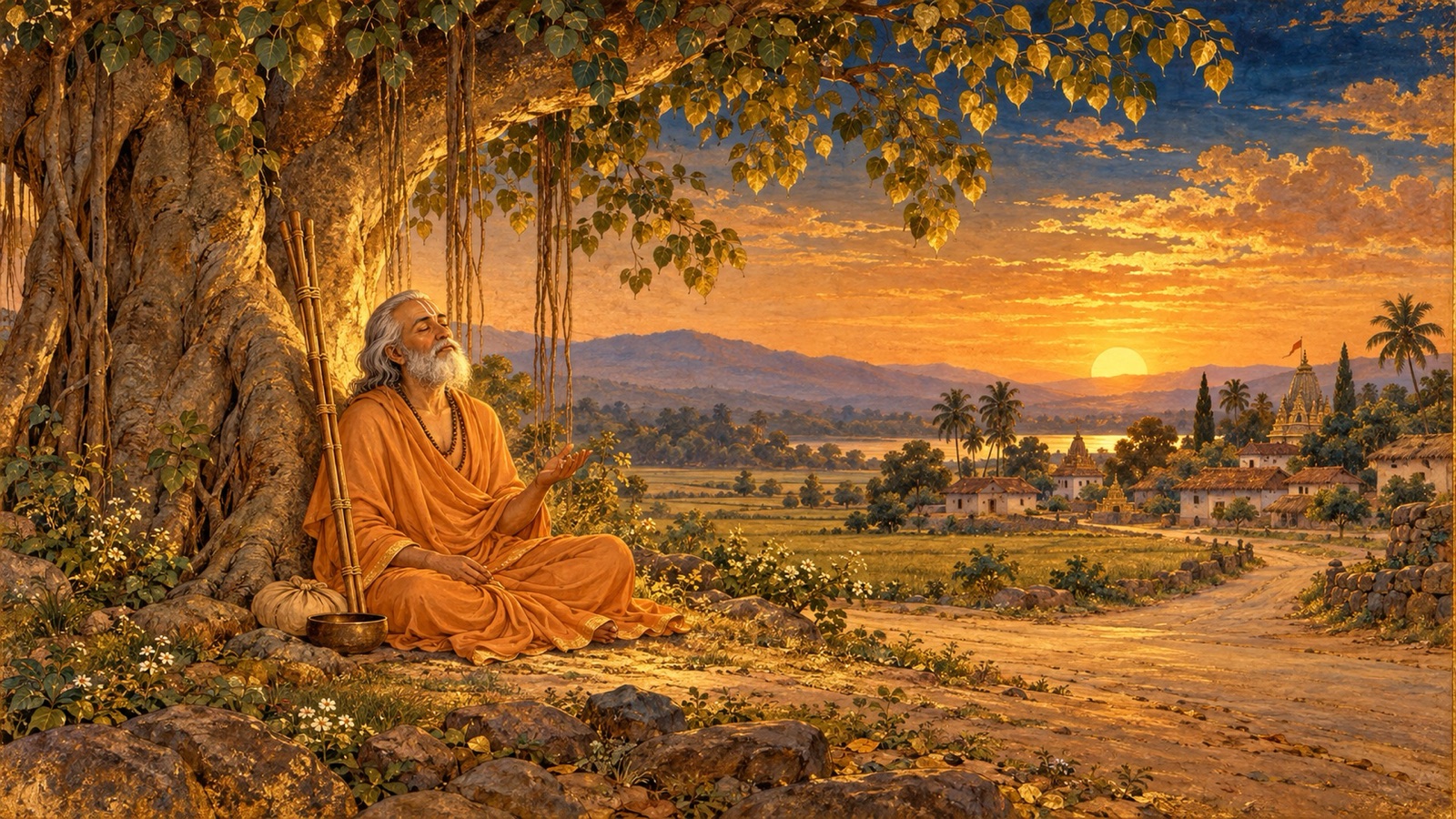
A wealthy, miserly brahmana of Avanti loses his fortune and his family’s love, becomes a wandering mendicant, and sings a sacred song the Lord Himself treasures — the song that reveals the mind alone as the root of all joy and sorrow.
Om Namo Bhagavate Vasudevaya.
Om Namo Bhagavate Vasudevaya.
Om Namo Bhagavate Vasudevaya.
Welcome to Srimad Bhagavatam Wisdom, a devotional journey through the sacred histories of the Srimad Bhagavat Mahapurana. Uddhava has just asked the Lord how a soul who knows the Self to be beyond birth and death can still bear the cruelty and ridicule of the wicked. In answer, Lord Sri Krishna gives him a story — of a rich, miserly brahmana of Avanti who lost his fortune, was cast out by his own household, and wandered the earth as a beggar, mocked at every step yet unshaken within. In the end he sang a song so precious that Krishna treasures it still, and now gives it to Uddhava, and through him, to us.
Chapter Information
- Scripture: Śrīmad Bhāgavata Mahāpurāṇa
- Canto: 11 (Book Eleven)
- Chapter: 23 (Discourse 23)
- Chapter title: The Song of the Avanti Brahmana
- Principal speaker: Sri Krishna, instructing Uddhava; within His narration, the forbearing brahmana of Avanti; the whole related by Sukadeva Gosvami to King Parikshit
- Principal listener: Uddhava; and King Parikshit
- Main setting: Dwaraka, in the Lord’s dialogue with Uddhava; within the narration, Avanti and the towns and villages of the earth
- Central subject: Enduring the world’s cruelty without bitterness, the ruin that miserliness brings, and the mind as the true root of all joy and sorrow
- Principal verse range: Canto 11, Chapter 23, verses 1–61
- Primary edition: Gita Press Śrīmad Bhāgavata Mahāpurāṇa
Context from the Previous Chapter
In Chapter 22, the Lord described the nine states through which the body passes, and taught Uddhava that the seer of the body is forever distinct from it, untouched by birth or death. Uddhava then asked how such a knower should still endure the reproach and cruelty of the wicked, since even wise souls find it hard to bear. This chapter is the Lord’s answer.
When Harsh Words Wound Deeper Than Arrows
The Lord began gently: scarcely any soul, however pious, can keep the mind unshaken when struck by the abusive words of a wicked tongue.
न तथा तप्यते विद्ध: पुमान् बाणैस्तु मर्मगै: । यथा तुदन्ति मर्मस्था ह्यसतां परुषेषव: ॥ ३ ॥
na tathā tapyate viddhaḥ pumān bāṇais tu marma-gaiḥ yathā tudanti marma-sthā hy asatāṁ paruṣeṣavaḥ
Meaning: A man pierced by arrows that have entered his vital parts does not suffer as much as he does from the shaft-like harsh words of the wicked, which lodge in the heart and torment it long after. (Canto 11, Chapter 23, verse 3)
For this reason, the wise tell a most sacred story — of a mendicant subjected to every indignity by wicked people, who yet stayed full of composure, recognizing it all as the ripened fruit of his own former deeds.
The Wealthy but Joyless Brahmana of Avanti
In Avanti there lived a brahmana rich in wealth but poor in everything that matters — miserly, lustful, greedy and quick to anger, a farmer and trader by occupation. Neither kinsman nor guest ever received a kind word from him; his home knew no piety or sacred rite; and so wrapped up was he in guarding what he had that he denied comfort even to his own body. His wife, sons, daughters and servants, disgusted by his hardness, came at last to wish him only ill.
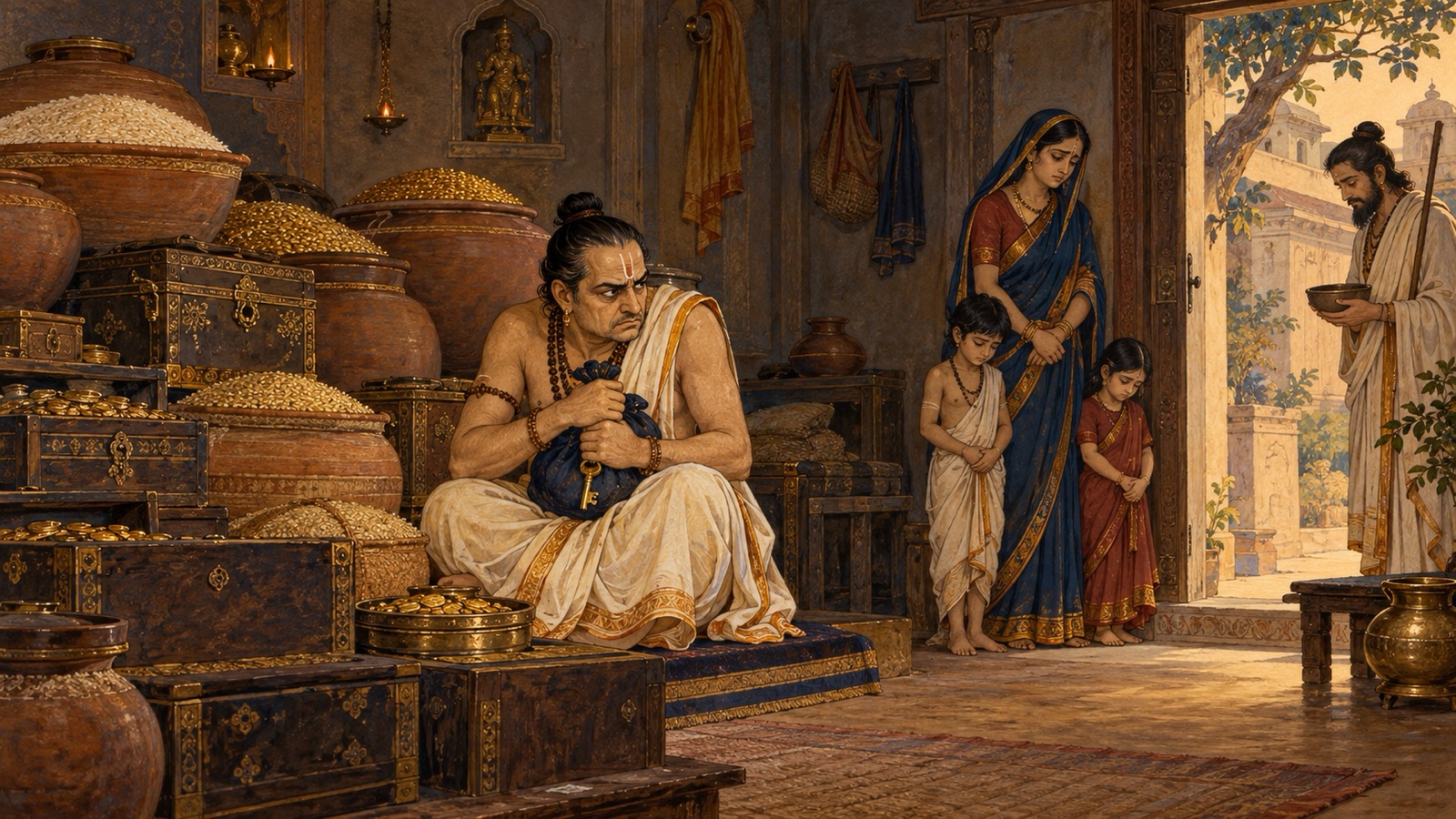
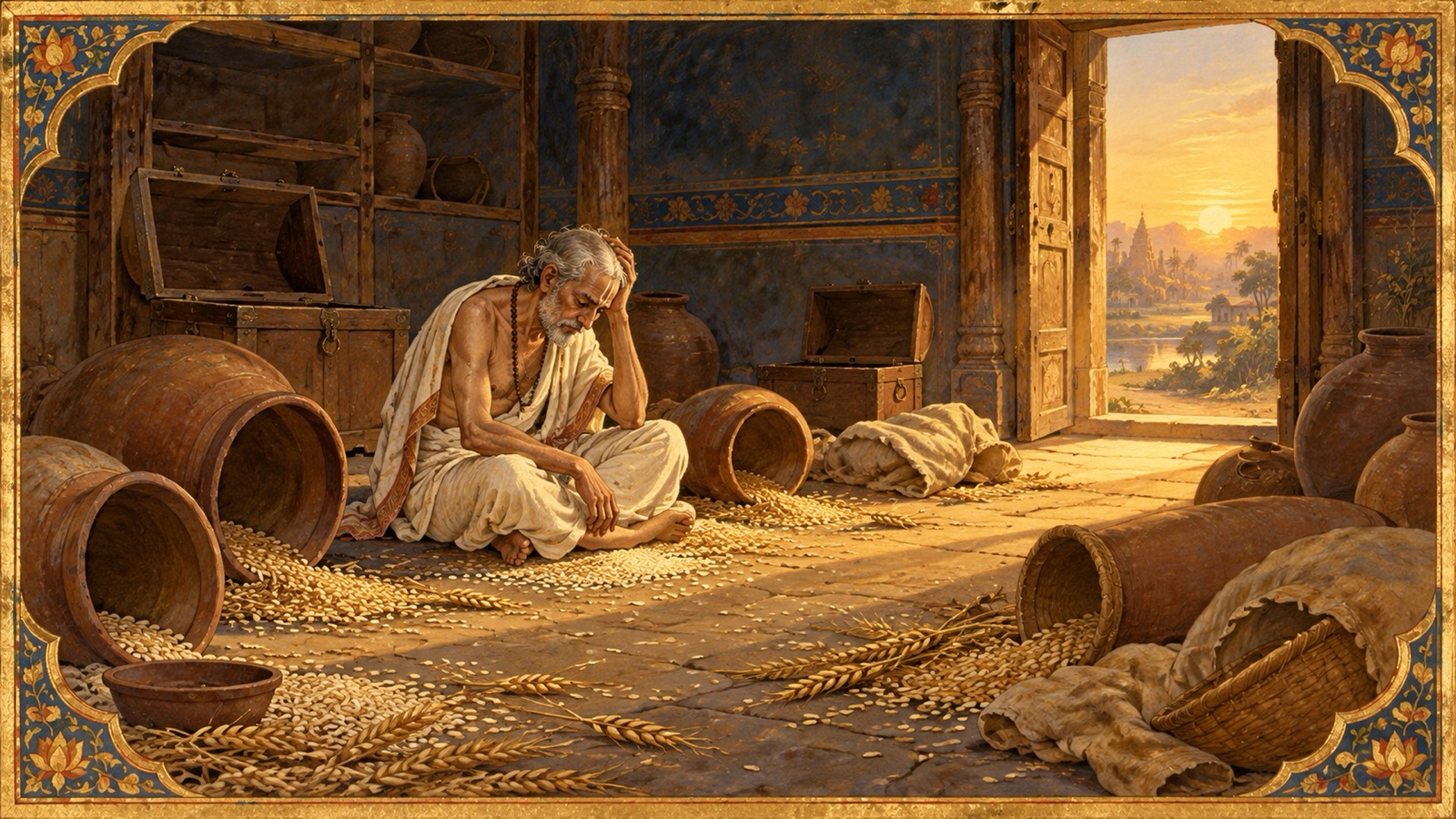
The five claimants upon every household — the gods, the ancestors, the humble creatures, the guest at the door, and the sages — grew angry with him, for he guarded his riches like a Yaksha and gave to none of them. His store of merit thus spent, his wealth met with its own destruction: his relations seized a portion, robbers another, and fire, time, the king and misfortune swallowed the rest. Stripped of everything and neglected even by his own people, the brahmana sank into a grief he could not master, his throat choked with tears.
Wealth, the Abode of Every Evil
Alone with his sorrow, the brahmana saw his life clearly, and lamented. What a pity, he said, that this body was worn out for wealth that served neither dharma nor true enjoyment! A miser’s riches never bring comfort; in life they torment the soul, and in death lead him to hell. Even a little greed mars a man’s finest qualities as leprosy mars a beautiful body. Earning wealth, keeping it, spending it, losing it — each brings only exertion and grief; and from wealth alone spring fifteen evils, from theft and violence to pride and gambling, so one who seeks true freedom should flee its very name. Kin who once loved him turn to enemies over a single coin; and he who wins the rare gift of a human, brahmana birth, and squanders it chasing riches, meets only ruin.
स्वर्गापवर्गयोर्द्वारं प्राप्य लोकमिमं पुमान् । द्रविणे कोऽनुषज्जेत मर्त्योऽनर्थस्य धामनि ॥ २३ ॥
svargāpavargayor dvāraṁ prāpya lokam imaṁ pumān draviṇe ko ‘nuṣajjeta martyo ‘narthasya dhāmani
Meaning: Having obtained this human body, which is the very gateway to heaven and to liberation, what mortal would still cling to wealth — the abode of every evil? (Canto 11, Chapter 23, verse 23)
He who guards his riches like a Yaksha, pleasing neither gods nor kin nor even himself, only hastens his own fall, the brahmana said. My fortune, years and strength — through which the wise attain their highest good — I have spent chasing wealth. What can I accomplish now, grown old?
Despondency as a Bark Across the Ocean
He wondered why he kept letting this futile hunger drive him, concluding that some unseen power holds the whole world under its spell. Then his grief turned to grace.
नूनं मे भगवांस्तुष्ट: सर्वदेवमयो हरि: । येन नीतो दशामेतां निर्वेदश्चात्मन: प्लव: ॥ २८ ॥
nūnaṁ me bhagavāṁs tuṣṭaḥ sarva-deva-mayo hariḥ yena nīto daśām etāṁ nirvedaś cātmanaḥ plavaḥ
Meaning: Surely Sri Hari, who embodies all the gods, is pleased with me, for He it is who has brought me to this plight; and this very despondency will serve me as a bark to carry me across the ocean of worldly bondage. (Canto 11, Chapter 23, verse 28)
Awake now to his own true good, he resolved to spend his remaining days thinning this body through simple askesis, trusting the gods to bless him — remembering how King Khatvanga, in a single moment, had reached the abode of Vishnu itself.
A Peaceful Mendicant, Ill-Treated Yet Unshaken
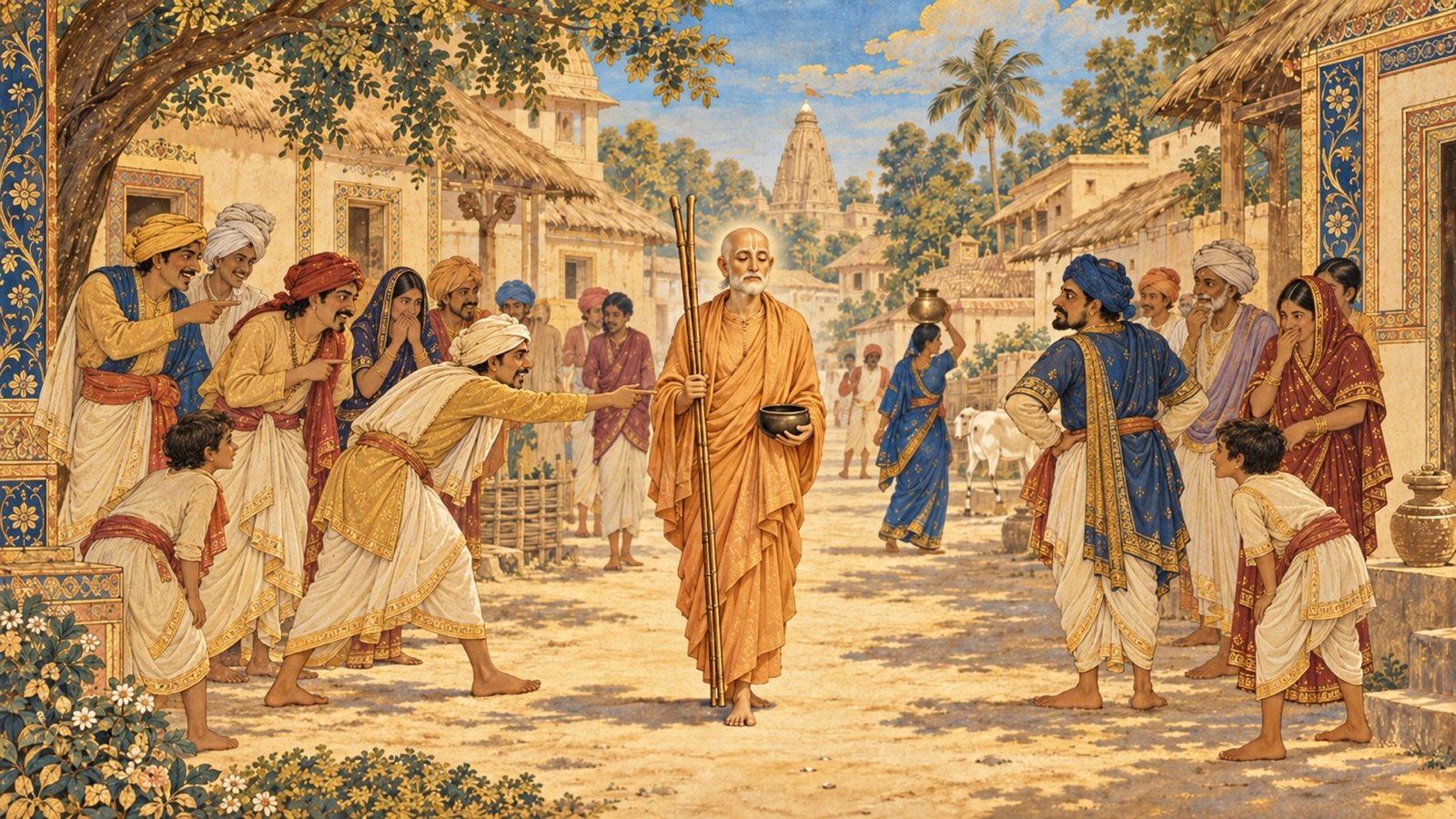
So resolved, the brahmana untied the knots of ego and possessiveness in his heart, and became a peaceful mendicant, mind and senses mastered, wandering unknown and unattached through towns and villages for alms alone.
But wicked people, seeing this unkempt, aging ascetic, ill-treated him in countless ways, dignified though he remained throughout. Some snatched his triple staff, his bowl, his seat, his rudraksha beads, his quilt — returning them only to snatch them away once more, even seizing the very alms he sat down to eat by the riverside. The basest among the crowd spat upon him and taunted him without cease, forced him to speak when he kept silence and struck him when he would not; some called him a thief, others bound him with rope, and still others mocked him as a hypocrite who had taken up the staff only because his wealth was gone, or jeered at his stillness as a heron’s cunning patience.
Whatever befell him — from other beings, from providence, or from his own body — the brahmana met each as the fruit of his own former deeds, and did not waver. Resting in that steadfastness, he sang the following song.
The Mendicant’s Song — The Mind Alone Is the Cause
नायं जनो मे सुखदु:खहेतु- र्न देवतात्मा ग्रहकर्मकाला: । मन: परं कारणमामनन्ति संसारचक्रं परिवर्तयेद् यत् ॥ ४२ ॥
nāyaṁ jano me sukha-duḥkha-hetur na devatātmā graha-karma-kālāḥ manaḥ paraṁ kāraṇam āmananti saṁsāra-cakraṁ parivartayed yat
Meaning: Neither these people, nor any deity, nor my own self, nor the stars, nor karma, nor time is the cause of my joy and sorrow. The sages declare the mind alone to be the real cause — the mind which alone sets turning the wheel of worldly existence. (Canto 11, Chapter 23, verse 42)
The powerful mind, he sang, generates the three gunas, and from them spring actions pure, dark and mixed, and from those actions, destinies to match (verse 43). The Lord dwells beside this mind as its unattached witness, merely watching; but the soul who takes the mind as its own self, enjoying the play of the gunas through it, becomes bound. Every true discipline — charity, duty, vows, study — finds its culmination in controlling the mind, for mastery of the mind alone is the highest yoga.
समाहितं यस्य मन: प्रशान्तं दानादिभि: किं वद तस्य कृत्यम् । असंयतं यस्य मनो विनश्यद् दानादिभिश्चेदपरं किमेभि: ॥ ४६ ॥
samāhitaṁ yasya manaḥ praśāntaṁ dānādibhiḥ kiṁ vada tasya kṛtyam asaṁyataṁ yasya mano vinaśyad dānādibhiś ced aparaṁ kim ebhiḥ
Meaning: Tell me, what need has a man of charity and such practices if his mind is already calm and composed? And if his mind is unrestrained and perishing, what else can charity and such practices accomplish for him? (Canto 11, Chapter 23, verse 46)
Neither Others, Nor Gods, Nor Stars, Nor Karma, Nor Time
The brahmana then turned, one by one, to the things the world blames for its sorrow. The senses, even the gods presiding over them, bow to the mind’s command, yet the mind bows to no one — so formidable that whoever subdues it is worthy of worship even by the gods. Those unable to conquer this inner enemy turn outward, making friends and foes of other men; and mistaking this body of the mind’s own making for the self, they wander lost in an endless darkness.
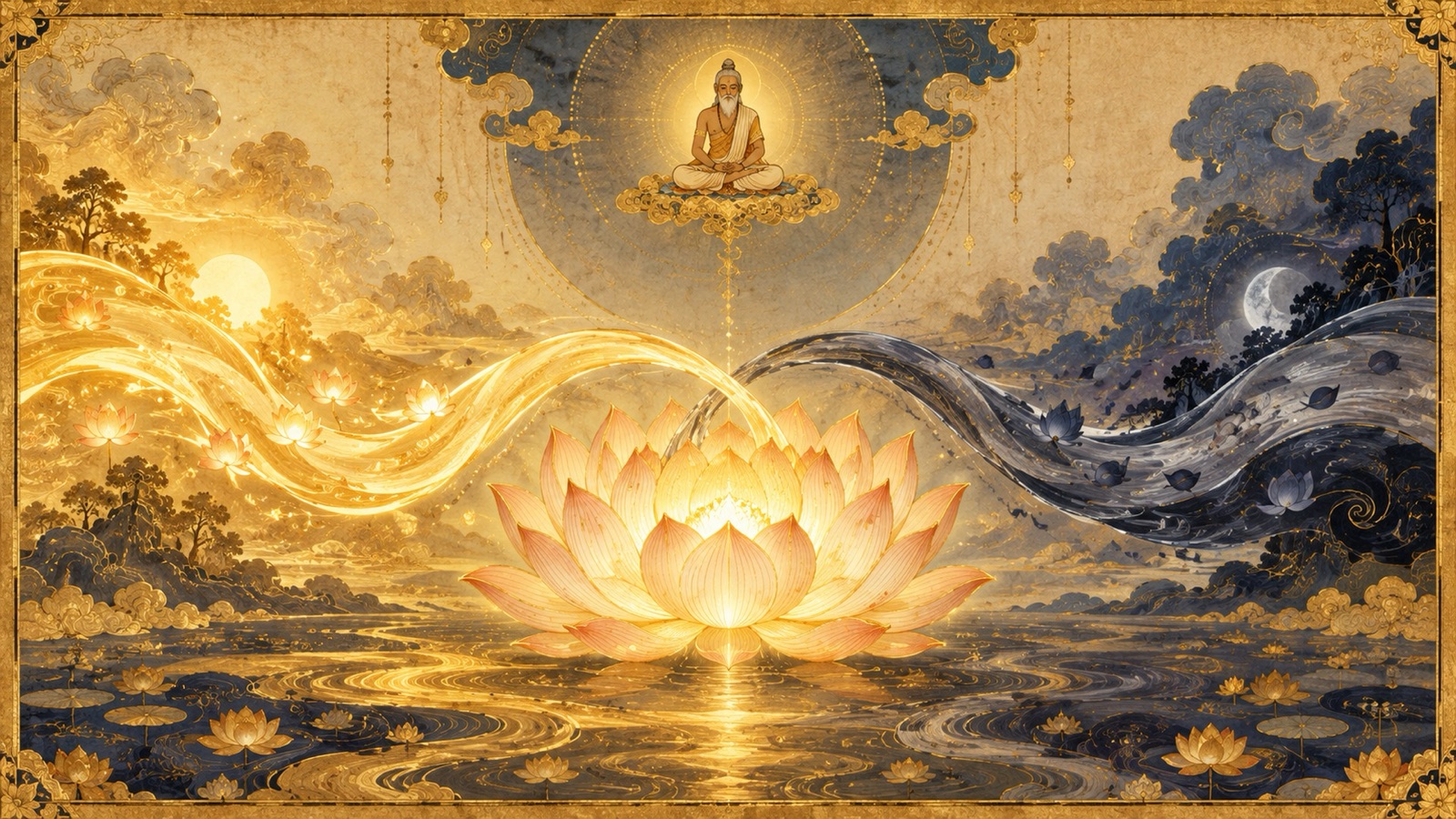
If another is blamed for one’s joy or sorrow, he reasoned, what fault is that of the soul, which neither gives nor suffers either — any more than one should be angry at either tooth when one’s own tongue is bitten? If a god is blamed, it is only one limb struck by another. If the soul itself is the cause, no other exists to blame. If the stars are blamed, they touch only the birth-bound body, never the birthless soul. If karma is blamed, the body alone is unconscious and the soul alone is pure wisdom, so karma has nowhere to stand. And if time is blamed, the soul, one with time as a fragment of Brahman, can no more be scorched by its own fire than a flame can burn itself.
Through none, nowhere, never, he sang, can the Self beyond Prakriti ever truly be touched by joy and sorrow, however much the ego alone seems to suffer them; the one who awakens to this fears no creature. Holding to this ancient truth of the great sages, I shall cross this darkness through devoted service at the feet of Sri Krishna alone.
The Song Ends, and the Lord’s Word to Uddhava
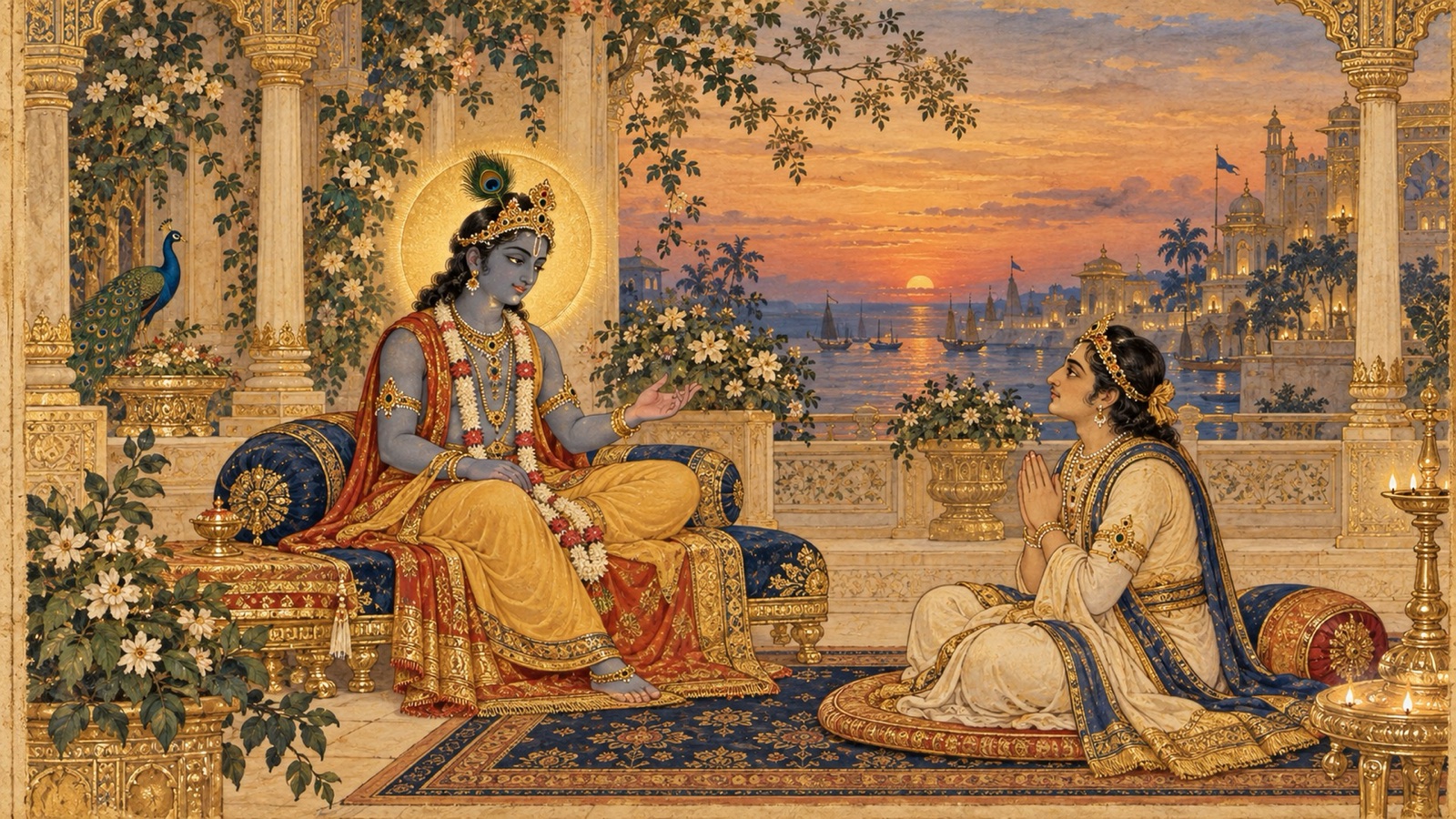
The Lord brought the story to its close. Though he had lost his entire fortune, the ascetic’s despondency had lifted; though ill-treated at every turn, he never swerved from his righteous path, and it was in this steady peace that he sang. None else, the Lord affirmed, brings joy or sorrow to the embodied soul — friends, foes, this whole world, are an illusion of the mind, born of ignorance of the Self.
“Therefore, dear Uddhava,” the Lord said, “fix your intellect upon Me, and by every means subdue the mind — this alone is the highest attainment of yoga.”
य एतां भिक्षुणा गीतां ब्रह्मनिष्ठां समाहित: । धारयञ्छ्रावयञ्छृण्वन्द्वन्द्वैर्नैवाभिभूयते ॥ ६१ ॥
ya etāṁ bhikṣuṇā gītāṁ brahma-niṣṭhāṁ samāhitaḥ dhārayañ chrāvayañ chṛṇvan dvandvair naivābhibhūyate
Meaning: Whoever, with a composed mind, bears in memory, recites to others, or simply hears this song sung by the mendicant, resting as it does upon Brahman, is never again overpowered by the pairs of opposites. (Canto 11, Chapter 23, verse 61)
Principal Teachings of This Chapter
1. Harsh words wound more deeply than any weapon. A blow to the body heals faster than a cruel tongue’s shaft, lodged in the heart (verse 3).
2. Miserliness starves the very ties it should nourish. Guarding wealth like a Yaksha, honouring neither gods, guests, ancestors nor kin, costs a man both worlds (verses 6–11).
3. Wealth without dharma becomes the root of every evil. Earning, keeping, spending and losing it bring only grief, and from it spring the fifteen evils that undo a human life (verses 16–24).
4. Even ruin can be the Lord’s hidden mercy. The brahmana’s despondency, born of his own loss, becomes the bark that carries him across the ocean of rebirth (verse 28).
5. Ill-treatment born of one’s own past deeds is to be borne, not resented. The forbearing mendicant takes every indignity as his own karma working itself out (verses 33–41).
6. The mind alone is the true cause of joy and sorrow. Not people, gods, fate, karma or time — only the restless mind turns the wheel of worldly life (verses 42–43).
7. Subduing the mind, fixed on the Lord, is the highest yoga. Charity, vows and learning bear fruit only through control of the mind, and amount to nothing without it (verses 46, 60).
A Devotional Reflection
There is something deeply consoling in this brahmana’s story, because it refuses to let us hide behind our circumstances. He had every reason to blame his relatives, the robbers, the mocking crowds, even the gods he had neglected — yet his song names none of them as the true cause of his sorrow. He turns the lamp inward and finds that the mind alone was ever the architect of his suffering, just as it had once been the architect of his miserly joy. This is no counsel of despair but of freedom: if the mind alone binds, the mind alone, surrendered to the Lord, can also release. His awakening comes not from comfort but from loss — only when he has nothing left to hoard does he discover the Self that no insult could ever touch. Krishna asks Uddhava, and every one of us, to carry this song in the heart as a shield against life’s pairs of opposites.
A Daily Devotional Practice
Today, when someone’s word or deed stings you, pause before reacting and ask gently within: is it truly this person causing my pain, or my own mind? Recall the forbearing mendicant of Avanti, and silently offer the moment to the Lord, repeating His holy name: “Om Namo Bhagavate Vasudevaya.” In this small pause lies the very practice his song teaches — withdrawing the mind from blame, and resting it in remembrance of the Lord, the one true shelter beyond every pair of opposites.
Conclusion
The twenty-third discourse of Book Eleven answers Uddhava’s question about bearing the world’s cruelty through the story of a brahmana of Avanti. Rich but miserly, he lost his fortune, was cast off by his own household, and became a wandering mendicant, mocked at every turn yet unshaken, meeting it all with quiet acceptance. In that steadfastness he sang a song that has outlived him: that neither people, gods, stars, karma nor time, but the mind alone, is the cause of every joy and sorrow, and that subduing the mind, fixed upon the Lord, is the highest attainment of yoga. Whoever hears or remembers this song, Krishna promises, is never overpowered by life’s dualities. May we, like this brahmana, learn to seek the one true cause within, and find there the Lord who was waiting all along.
May the divine wisdom of Srimad Bhagavatam awaken pure devotion within our hearts.
Om Namo Bhagavate Vasudevaya.
Jay Shree Madhav.
References and Attribution
- Primary edition: Gita Press, Śrīmad Bhāgavata Mahāpurāṇa (English, complete), Book Eleven, Discourse 23, pages 622–630.
- Series: Srimad Bhagavatam Wisdom · Biswa Sanatan Dharma Seva Trust.
- Presented following the spiritual guidance and recommendation of Pandit Dr. Shri Kashinath Mishra.
This is an original, faithful retelling in the writer’s own words, with brief quoted verses shown in Devanāgarī and transliteration and their meanings given as summaries. It is not a reproduction of any single publisher’s continuous translation or commentary. No affiliation with or endorsement by any publisher is implied.
Jay Shree Madhav