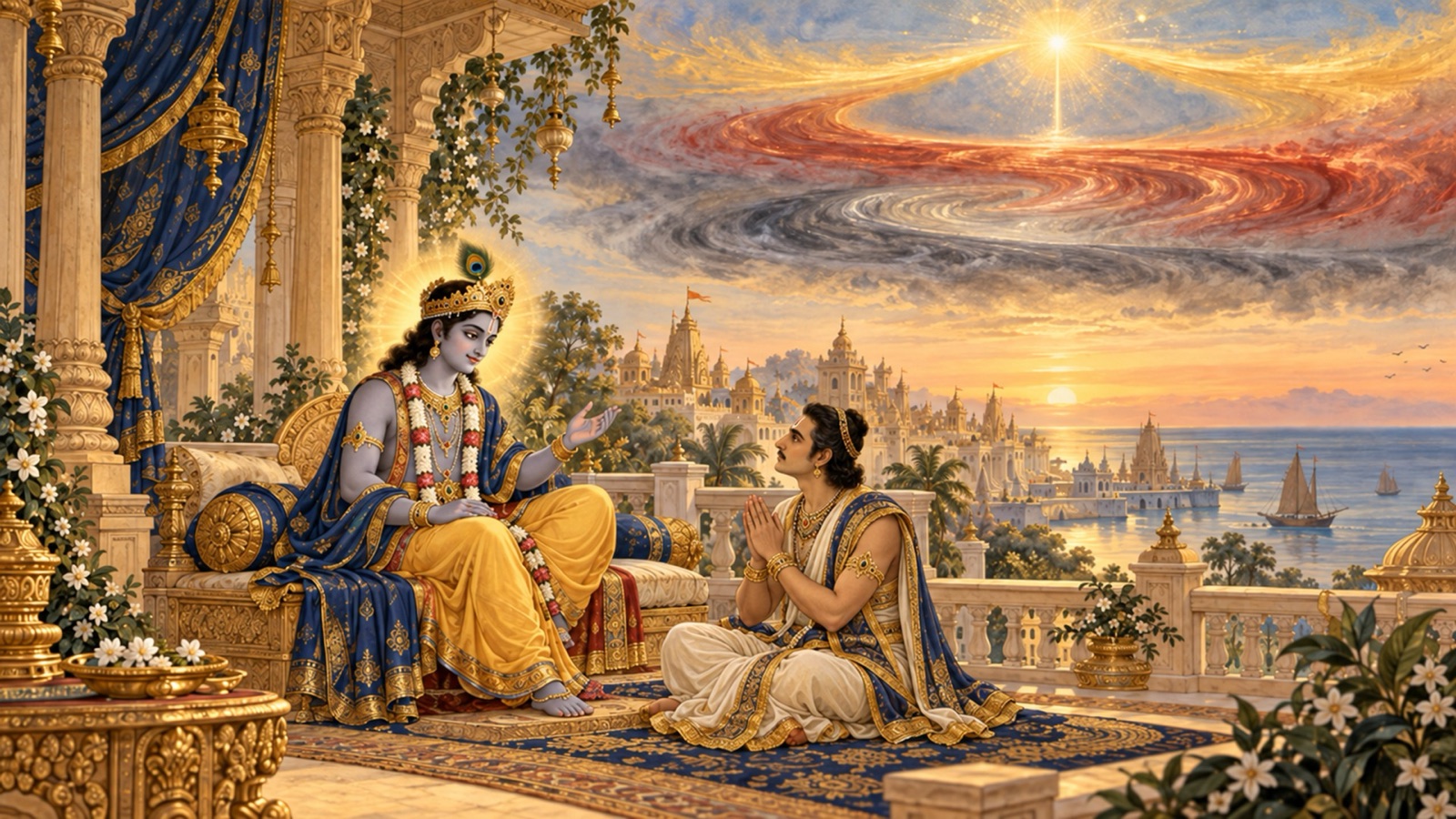
In Dwaraka, the Lord unveils to Uddhava the hidden anatomy of sattva, rajas and tamas — the three strands weaving every thought, action and destiny of the embodied soul — and the one path of devotion by which a soul may slip free of their weaving altogether.
Om Namo Bhagavate Vasudevaya.
Om Namo Bhagavate Vasudevaya.
Om Namo Bhagavate Vasudevaya.
Welcome, dear devotee, to Srimad Bhagavatam Wisdom, our journey through the sacred pages of the Srimad Bhagavat Mahapurana. The Lord now turns to something practical: how sattva, rajas and tamas take hold of a person’s mind, worship and destiny, and how a sincere soul may rise beyond all three into Him.
Chapter Information
- Scripture: Śrīmad Bhāgavata Mahāpurāṇa
- Canto: 11 (Book Eleven)
- Chapter: 25 (Discourse 25)
- Chapter title: The Three Modes of Nature and Beyond
- Principal speaker: Sri Krishna, instructing Uddhava; the whole related by Sukadeva Gosvami to King Parikshit
- Principal listener: Uddhava; and King Parikshit
- Main setting: Dwaraka, in the Lord’s continuing dialogue with Uddhava
- Central subject: How the three modes of nature — goodness, passion and ignorance — govern every aspect of embodied life, and how devotion alone carries the soul beyond them to the Lord
- Principal verse range: Canto 11, Chapter 25, verses 1–36
- Primary edition: Gita Press Śrīmad Bhāgavata Mahāpurāṇa
Context from the Previous Chapter
In Chapter 24, the Lord expounded to Uddhava the ancient doctrine of Sankhya — how the one undivided Reality appeared, through Maya, as the duality of Prakriti and Purusha, how the three modes unfolded the whole universe, and how, in dissolution, all of it is drawn back into Him alone. Having shown the soul its origin, the Lord now shows it the forces still shaping its present life.
The Lord Resolves to Teach the Powers of the Three Modes
Sri Krishna began again, turning to Uddhava and calling him “best among men.” He would now explain, He said, exactly how each of the three modes — working independently of the others — lays hold of a person and shapes what that person becomes.
श्रीभगवानुवाच गुणानामसम्मिश्राणां पुमान् येन यथा भवेत् । तन्मे पुरुषवर्येदमुपधारय शंसत: ॥ १ ॥
śrī-bhagavān uvāca guṇānām asammiśrāṇāṁ pumān yena yathā bhavet tan me puruṣa-varyedam upadhāraya śaṁsataḥ
Meaning: The glorious Lord said: Now understand from Me, O best among men, exactly how a person is shaped by each of the three modes, acting quite independently of one another, as I explain it to you. (Canto 11, Chapter 25, verse 1)
The Qualities Born of Goodness, Passion and Ignorance
Having promised this teaching, the Lord unfolded it with care. Goodness, or sattva, shows as mastery of mind and senses, sound judgment, truthfulness, compassion, contentment, humility, freedom from craving, and quiet delight in being oneself. Passion, or rajas, shows as restless hunger for sense-pleasure, arrogance, insatiable appetite, a sharp sense of “mine” against “yours,” love of praise, and the exertion of sheer ambition. And ignorance, or tamas, shows as intolerance, falsehood, malice, quarrelsomeness, grief, confusion, gloom, excessive sleep, fear and sloth. The Lord named these almost exhaustively, so Uddhava might also learn how all three, in combination, govern a soul.
Even the simple feeling “I am peaceful,” “I am passionate,” or “I am angry” — and “these qualities belong to me” — is itself a joint product of the three modes, as is every act performed through mind, senses and breath together. Even the devotion with which a person pursues righteousness, wealth and pleasure is shaped by all three gunas at once: rites performed with an eye to reward are coloured by rajas, mere clinging to household life by tamas, and quiet devotion to duty for its own sake by sattva.
Reading the Modes in Conduct and in Worship
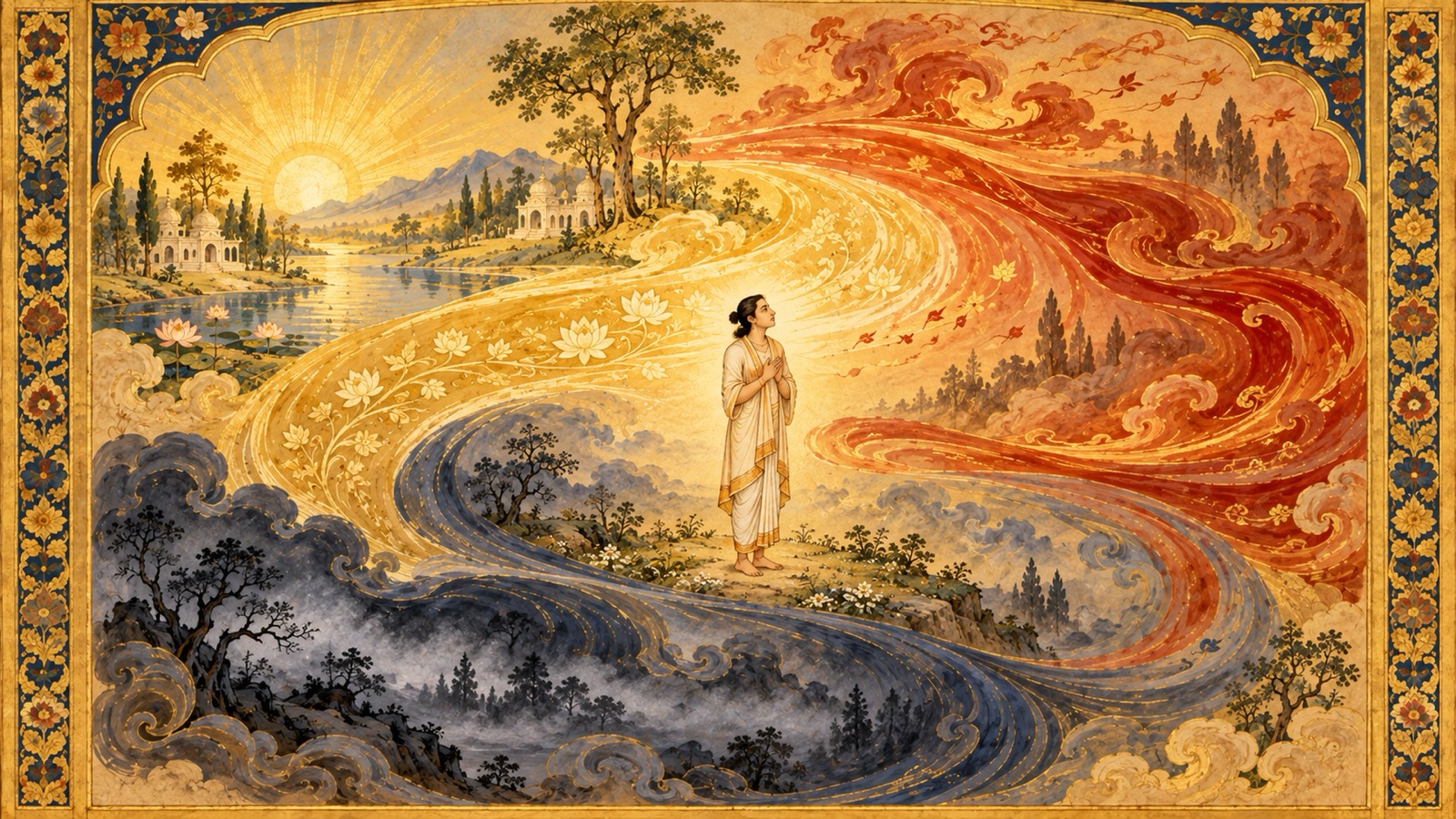
From these signs one may read a person’s inner nature: self-control reveals sattva, restless passion rajas, anger tamas. The same key applies to worship — through duty without selfish motive is sattvika; seeking sense-pleasure is rajasika; wishing harm on another is tamasika.
Then the Lord revealed something precious: these three modes touch only the embodied soul — never Himself. They arise only in the mind of the jiva, who alone becomes bound through them by clinging to body and senses. The gunas belong forever to the traveller, never to the One who watches the journey.
The Clear Marks of Sattva, Rajas and Tamas
The Lord then gave Uddhava a simple way to recognise which mode is in the ascendant. When sattva — luminous, clear and tranquil — prevails, a person is marked by wisdom and happiness. When rajas — restless and attached — prevails, a person is seized by craving for status and wealth, and unhappiness even amid constant motion. And when tamas — which clouds judgment — prevails, a person falls into grief, confusion, excessive sleep and helpless dependence on others.
यदा चित्तं प्रसीदेत इन्द्रियाणां च निर्वृति: । देहेऽभयं मनोऽसङ्गं तत् सत्त्वं विद्धि मत्पदम् ॥ १६ ॥
yadā cittaṁ prasīdeta indriyāṇāṁ ca nirvṛtiḥ dehe ‘bhayaṁ mano-‘saṅgaṁ tat sattvaṁ viddhi mat-padam
Meaning: When the mind grows clear and the senses rest, at peace, away from their objects; when the body is free of fear and the mind free of attachment — know that this is sattva, which carries the soul toward Me. (Canto 11, Chapter 25, verse 16)
When instead the intellect is pulled in every direction and the mind finds no rest, that is the mark of rajas; and when reason itself grows dim and only ignorance and gloom remain, that is the mark of tamas. The Lord added that this same rise and fall of the modes strengthens, in turn, the god-like, demon-like or goblin-like impulses within every heart.
Waking, Dream, Sleep — and the Fourth State Beyond Them
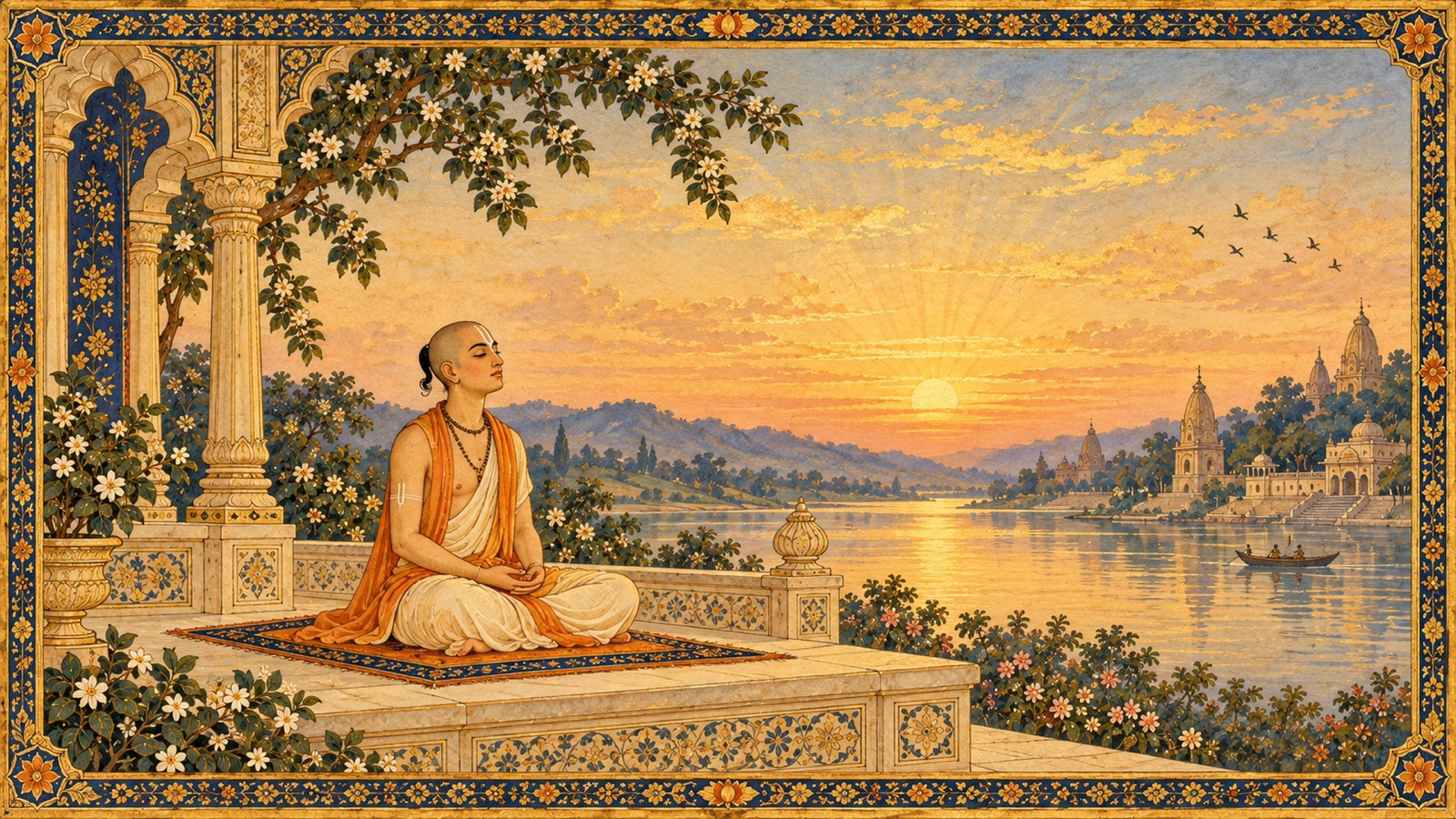
From the modes of the mind, the Lord turned to the modes of consciousness itself. Waking belongs to sattva, dream to rajas, and deep, dreamless sleep to tamas. But running quietly through all three alike, untouched by any of them, is a fourth state — the Self, forever the same.
सत्त्वाज्जागरणं विद्याद् रजसा स्वप्नमादिशेत् । प्रस्वापं तमसा जन्तोस्तुरीयं त्रिषु सन्ततम् ॥ २० ॥
sattvāj jāgaraṇaṁ vidyād rajasā svapnam ādiśet prasvāpaṁ tamasā jantos turīyaṁ triṣu santatam
Meaning: Know waking to arise from sattva, and dream to be governed by rajas; deep sleep belongs to tamas — while a fourth state runs continuously through all three, the same in each. (Canto 11, Chapter 25, verse 20)
By the same law, those devoted to the Vedic path rise ever higher through sattva; those given to tamas sink lower, even into unmoving life; while those ruled by rajas remain in the middle world of human birth. At death, the same law holds: a soul steeped in sattva ascends to the higher worlds, one steeped in rajas returns to the human plane, one steeped in tamas descends to suffering — but a soul risen beyond all three modes does not go anywhere at all. It comes, simply, to Him.
सत्त्वे प्रलीना: स्वर्यान्ति नरलोकं रजोलया: । तमोलयास्तु निरयं यान्ति मामेव निर्गुणा: ॥ २२ ॥
Meaning: Those who pass on absorbed in sattva ascend to the heavens; those absorbed in rajas return to the world of men; those absorbed in tamas sink down to suffering — but those who have gone beyond the three modes altogether attain to Me alone. (Canto 11, Chapter 25, verse 22)
Every Corner of Life Woven by the Modes, and the Thread Beyond Them
The Lord then showed Uddhava that nothing escapes the weaving of the three modes — and that everything also carries a thread leading beyond them, into Him. Duty done for Him without reward is sattvika; done for reward, rajasika; done to harm another, tamasika. Knowledge of the pure Self is sattvika; knowledge tangled with the body, rajasika; the dull knowledge of mere eating and drinking, tamasika — while knowledge of Him stands beyond all three. A forest dwelling is sattvika, a village rajasika, a gambling house tamasika — but His own temple stands beyond the modes entirely.
वनं तु सात्त्विको वासो ग्रामो राजस उच्यते । तामसं द्यूतसदनं मन्निकेतं तु निर्गुणम् ॥ २५ ॥
vanaṁ tu sāttviko vāso grāmo rājasa ucyate tāmasaṁ dyūta-sadanaṁ man-niketaṁ tu nirguṇam
Meaning: A forest is a sattvika dwelling, a village is called rajasika, and a gambling house is tamasika — but My own temple stands entirely beyond the three modes. (Canto 11, Chapter 25, verse 25)
Likewise, the doer unattached to the fruit is sattvika, one blinded by passion for it rajasika, one who has lost all sense of right and wrong tamasika — while the doer who depends on Him alone stands beyond the modes. Faith in spiritual truth is sattvika, in mere rites rajasika, in wrong as though right tamasika — but faith in His worship transcends all three. Food wholesome and simply obtained is sattvika, chosen only for taste rajasika, impure or harmful tamasika — yet food offered to Him rises beyond them. And joy from the Self is sattvika, from the senses rajasika, from intoxication tamasika — while joy in remembering Him lies beyond the modes.
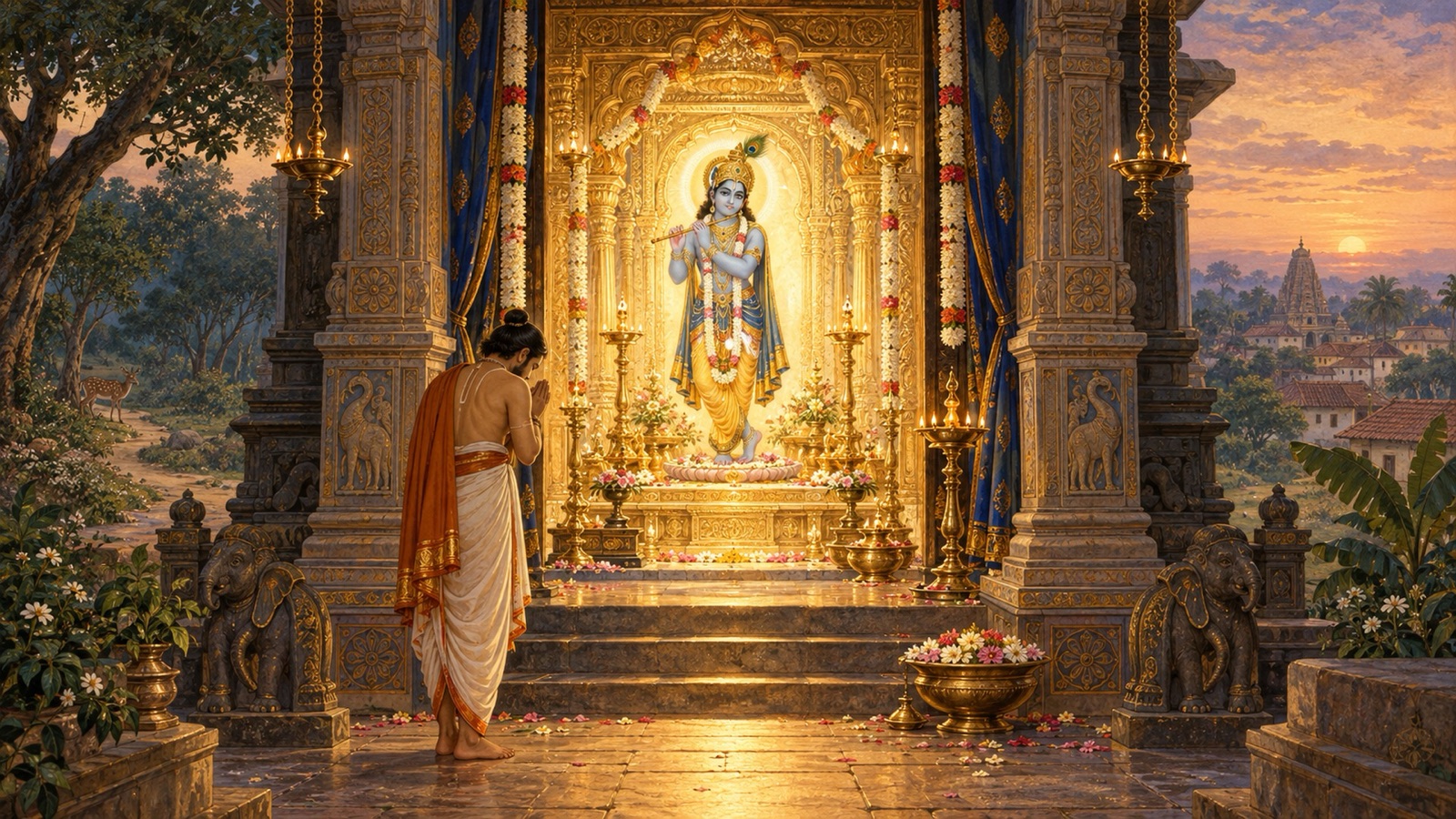
All of this — food, abode, the fruit one seeks, the hours by which one lives, knowledge, action, one’s very nature as a doer, faith, the state of consciousness, the form of life, and the final destiny a soul reaches — is, the Lord said, built entirely of the three modes. Whatever is seen, heard or thought is, without exception, a weaving of sattva, rajas and tamas.
Here lies the quiet heart of this teaching. The Lord multiplies this catalogue not merely to instruct Uddhava in categories, but so he will see that no corner of embodied life, however small, escapes the three modes, and no mere change of place or diet can by itself carry a soul beyond their reach. One thread alone runs outside the whole tapestry, surfacing again and again — whatever is turned toward Him. The lesson is deliberately relentless, so the remedy shines all the clearer: the way out of the gunas is not another guna, but loving surrender to the One who was never woven into them.
The Path Beyond the Modes — Devotion That Carries the Soul to the Lord
The Lord now revealed the one sure way out of this weaving.
एता: संसृतय: पुंसो गुणकर्मनिबन्धना: । येनेमे निर्जिता: सौम्य गुणा जीवेन चित्तजा: । भक्तियोगेन मन्निष्ठो मद्भावाय प्रपद्यते ॥ ३२ ॥
etāḥ saṁsṛtayaḥ puṁso guṇa-karma-nibandhanāḥ yeneme nirjitāḥ saumya guṇā jīvena citta-jāḥ bhakti-yogena man-niṣṭho mad-bhāvāya prapadyate
Meaning: Such, O gentle Uddhava, are the wanderings of the soul, bound by the modes and the actions they prompt. But the soul by whom these mind-born modes have been thoroughly conquered — who, through the path of devotion, stands firmly fixed in Me — becomes fit to attain My own state of being. (Canto 11, Chapter 25, verse 32)
Therefore, having obtained this rare human body, in which alone true knowledge becomes possible, the wise should shake off attachment to the three modes and turn to worship Him. Free from clinging, senses mastered, such a devotee should overcome rajas and tamas by cultivating sattva — and then, united with Him, subdue even sattva itself through the very desirelessness that is sattva’s own highest fruit. Freed in this way, the soul lets go of its subtle identity of mind and ego, and attains to Him alone.
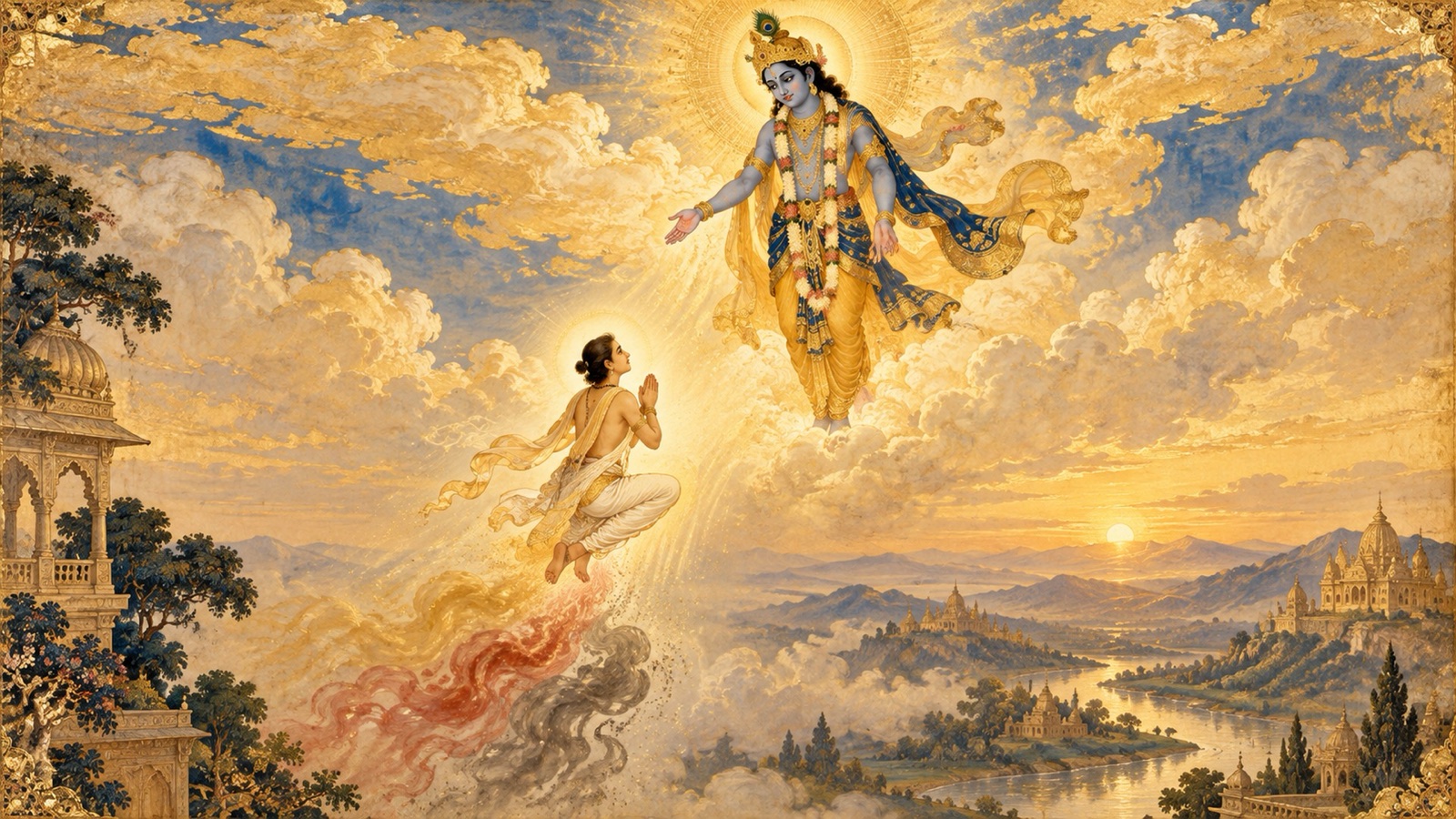
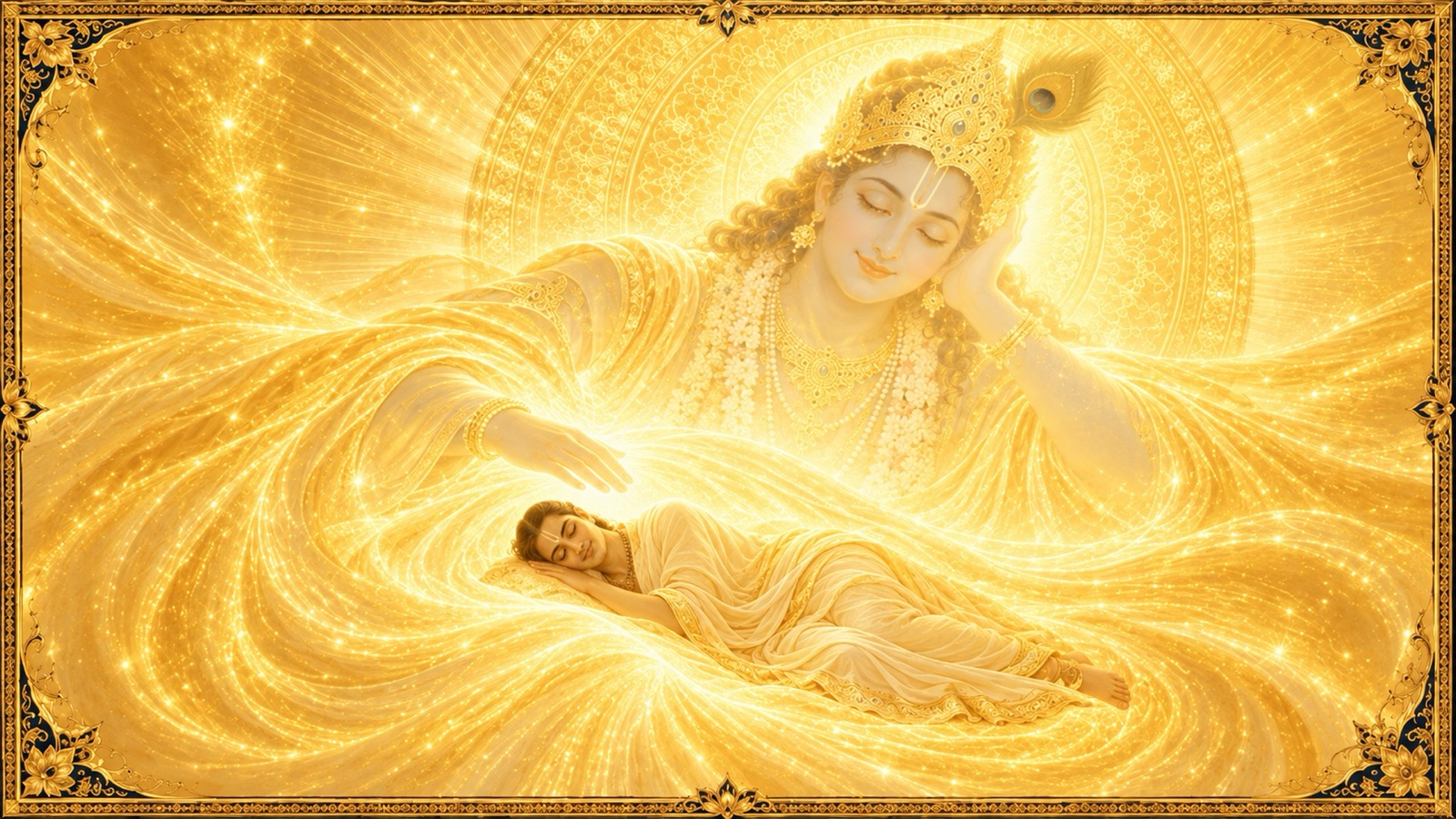
Completely released from that subtle selfhood, and filled now entirely with Him, such a soul no longer wanders outward toward the senses, nor turns inward to brood upon itself.
जीवो जीवविनिर्मुक्तो गुणैश्चाशयसम्भवै: । मयैव ब्रह्मणा पूर्णो न बहिर्नान्तरश्चरेत् ॥ ३६ ॥
jīvo jīva-vinirmukto guṇaiś cāśaya-sambhavaiḥ mayaiva brahmaṇā pūrṇo na bahir nāntaraś caret
Meaning: The soul, freed from its very jivahood and from the modes born of the mind, filled completely with Me, the Supreme Spirit, no longer wanders outward to the senses nor turns inward upon itself — liberated, even while it yet lives. (Canto 11, Chapter 25, verse 36)
Principal Teachings of This Chapter
1. Each mode shapes the soul on its own terms. Sattva gives rise to self-mastery and quiet contentment; rajas to restless craving and ambition; tamas to intolerance, gloom and sloth — a person’s inner nature can be read from these very signs (verses 1-5, 9).
2. Even “I” and “mine” are woven of the modes. Every act done through mind, senses and breath is a joint product of the three gunas, down to how one pursues duty, wealth and pleasure (verses 6-8).
3. The modes bind the soul, never the Lord. Sattva, rajas and tamas arise only in the mind of the embodied being; the jiva alone becomes entangled by clinging to body and senses, while the Lord stands forever untouched (verse 12).
4. Goodness alone turns the heart toward the Lord. When the mind grows clear, fearless and free of attachment, sattva leads toward Him; rajas shows as agitation, tamas as the collapse of reason itself (verses 13-18).
5. Waking, dream and sleep arise from the modes; the Self runs changeless through all three. The same law governs the soul’s destiny after death — yet a soul risen beyond the three modes comes to the Lord alone (verses 19-22).
6. No corner of life escapes the modes — except what is turned toward Him. Food, abode, action, knowledge, faith and joy are each divided by the three gunas, yet whatever is offered or known in relation to the Lord rises beyond them (verses 23-31).
7. Devotion alone carries the soul beyond the modes, even beyond goodness itself. By cultivating sattva one conquers rajas and tamas; by desireless union with the Lord one conquers even sattva, becoming liberated while still living (verses 32-36).
A Devotional Reflection
What moves me most here is the Lord’s sheer honesty. He promises Uddhava no single trick, no one place to live or food to eat, that will magically free him from the three modes — because there is nowhere in this world that sattva, rajas and tamas have not already reached. Our moods, our worship, our very sense of “I,” our food and our dreams are each a thread in their weaving. And yet, hidden in plain sight within every category He names, one exception keeps reappearing: whatever is placed in relation to Him simply steps outside the three modes. Devotion is not one more mode competing with the others; it is the one doorway in the wall. That is why even sattva must at last be let go — not by force, but by resting so completely in Him that goodness quietly releases its own hold.
A Daily Devotional Practice
Today, notice which mode is moving through you. Feeling contentment or clarity, recognise sattva and let it carry you toward remembrance of the Lord. Feeling restlessness or craving, recognise rajas, and instead of acting at once, pause and offer the feeling to Him. Feeling gloom or sloth, recognise tamas, and resist its pull by turning briefly to His name. Before your next meal, offer it mentally to Him; before your next task, perform it as duty to Him rather than for its reward. Rest a little more, in each small choice, in the one thread never woven into the modes — the Lord Himself. Repeat quietly as you do: “Om Namo Bhagavate Vasudevaya.”
Conclusion
In this twenty-fifth discourse, Sri Krishna shows Uddhava how completely sattva, rajas and tamas govern the embodied soul’s qualities, worship, consciousness, destiny after death, and every corner of life, from food to faith. Yet one truth shines through the whole catalogue: whatever is turned toward the Lord rises beyond the three modes entirely. Through bhakti-yoga, a soul conquers rajas and tamas by sattva, and at last conquers even sattva by resting wholly in Him — becoming free, filled with the Lord, while still living in this world.
May the divine wisdom of Srimad Bhagavatam awaken pure devotion within our hearts.
Om Namo Bhagavate Vasudevaya.
Jay Shree Madhav.
References and Attribution
- Primary edition: Gita Press, Śrīmad Bhāgavata Mahāpurāṇa (English, complete), Book Eleven, Discourse 25, pages 634–638.
- Series: Srimad Bhagavatam Wisdom · Biswa Sanatan Dharma Seva Trust.
- Presented following the spiritual guidance and recommendation of Pandit Dr. Shri Kashinath Mishra.
This is an original, faithful retelling in the writer’s own words, with brief quoted verses shown in Devanāgarī and transliteration and their meanings given as summaries. It is not a reproduction of any single publisher’s continuous translation or commentary. No affiliation with or endorsement by any publisher is implied.
Jay Shree Madhav