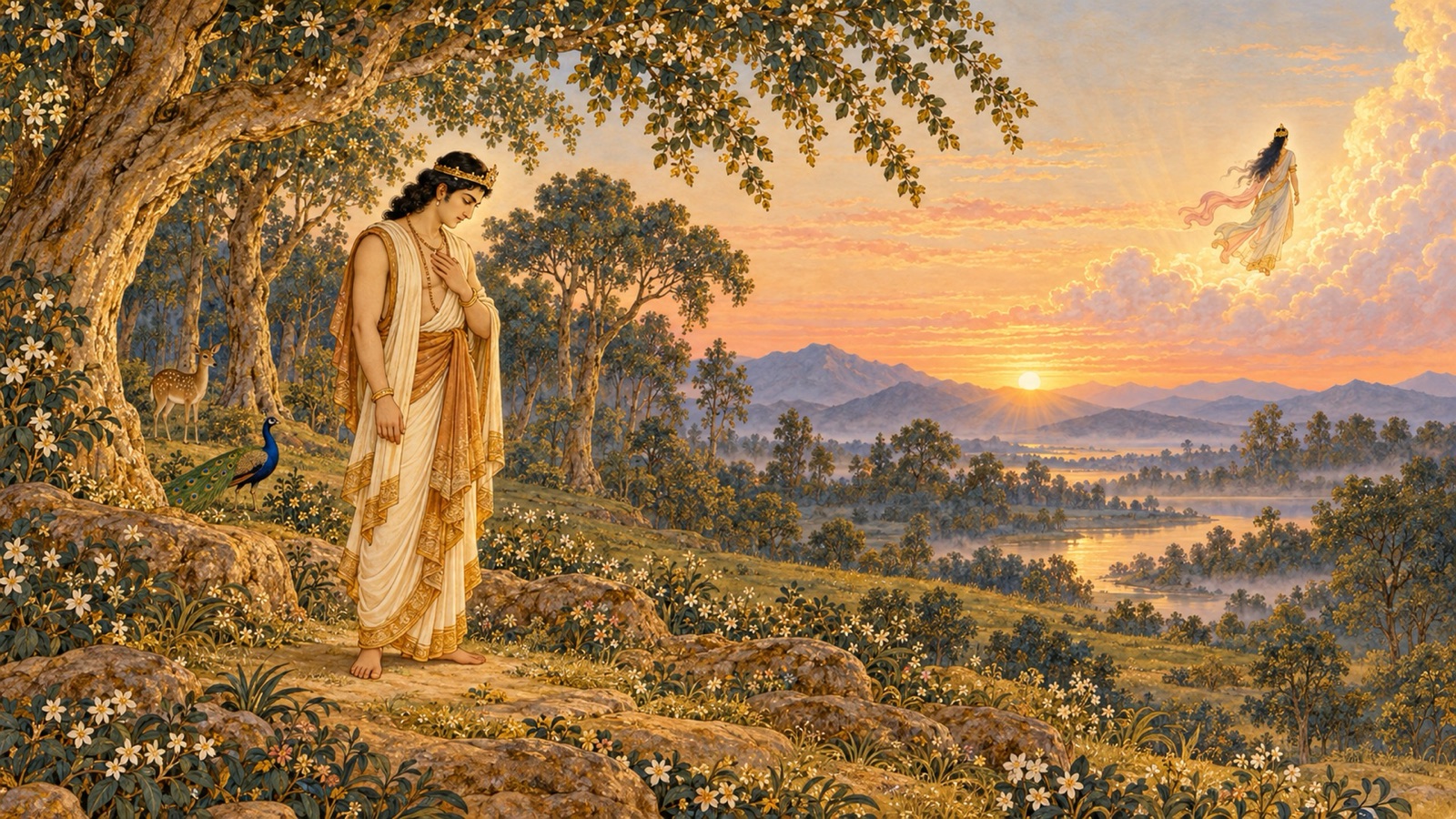
A great emperor once lost years of his life to the spell of a celestial beauty — and found, in the ashes of that infatuation, the one true shelter: the company of saints. Lord Krishna sings to Uddhava the song of King Pururava’s sorrow and release.
Om Namo Bhagavate Vasudevaya.
Om Namo Bhagavate Vasudevaya.
Om Namo Bhagavate Vasudevaya.
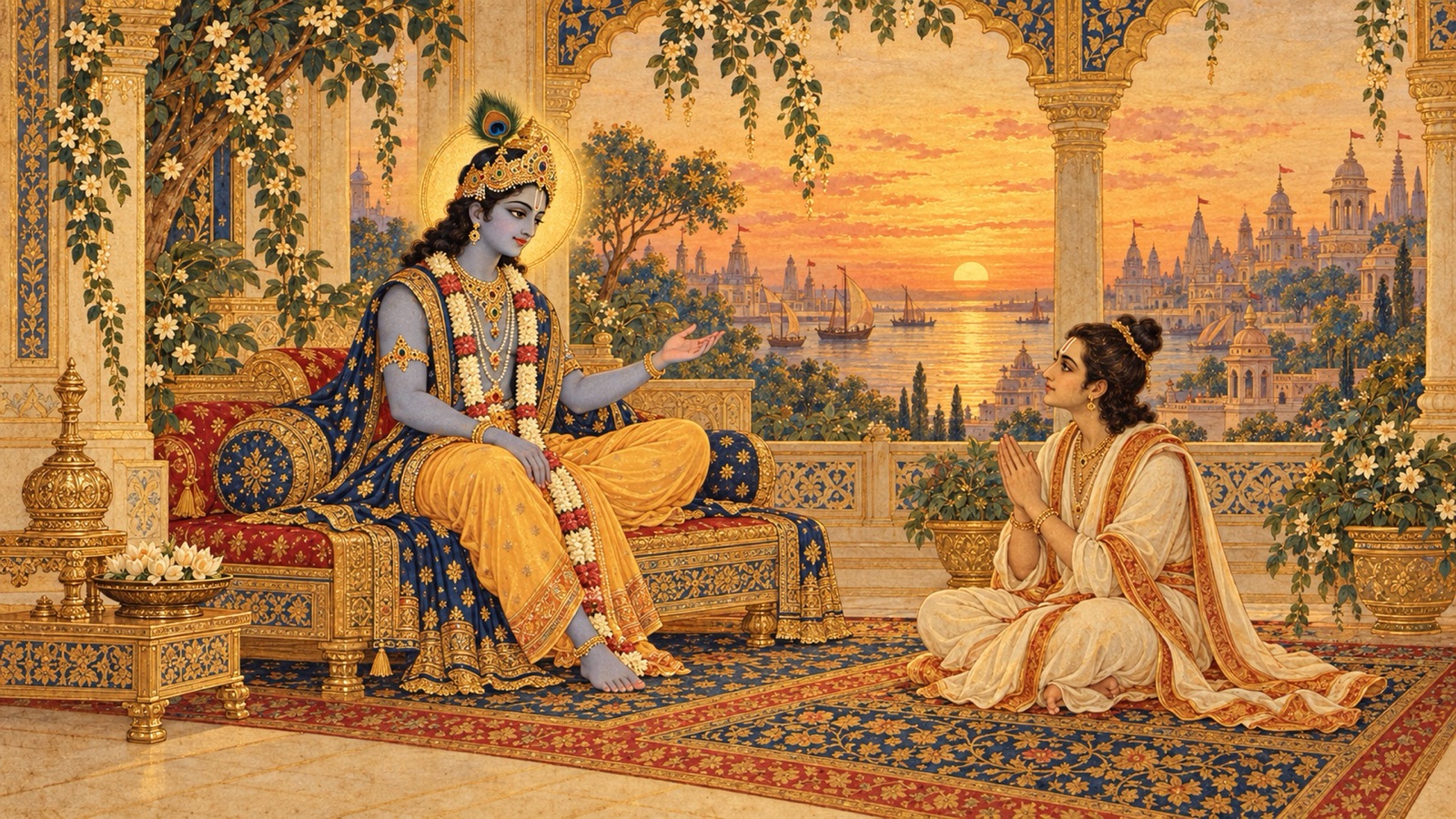
Welcome, dear devotees, to Srimad Bhagavatam Wisdom, a loving journey through the sacred narrations of the Srimad Bhagavat Mahapurana. Here the Supreme Lord, seated with His beloved Uddhava, does not merely state a truth — He sings it through the voice of a king. Emperor Pururava once gave his heart entirely to the celestial nymph Urvashi, and when she departed he wandered the forest in open grief, crying out her name like a man undone. From the depths of that sorrow, the king awakened to the whole of his delusion, renounced it, and sang of what had bound him and of what alone can set a soul free. Krishna offers this ancient song to Uddhava not as a tale of scandal but as a mirror for every seeking heart — and crowns it with His own tender praise of the saints, whose company alone heals the wound that passion leaves behind.
Chapter Information
- Scripture: Śrīmad Bhāgavata Mahāpurāṇa
- Canto: 11 (Book Eleven)
- Chapter: 26 (Discourse 26)
- Chapter title: The Aila-gita
- Principal speaker: Sri Krishna, instructing Uddhava; within His narration, King Pururava (Aila) sings his own song; the whole related by Sukadeva Gosvami to King Parikshit
- Principal listener: Uddhava; within the narrated memory, Pururava himself, crying out his own anguish while wandering
- Main setting: Dwaraka, in the Lord’s dialogue with Uddhava; within the narration, the forest where the grieving king once wandered
- Central subject: The folly of lust, shown through King Pururava’s confession and renunciation, followed by the Lord’s teaching on the glory of holy company
- Principal verse range: Canto 11, Chapter 26, verses 1–35
- Primary edition: Gita Press Śrīmad Bhāgavata Mahāpurāṇa
Context from the Previous Chapter
In the chapter just before this one, the Lord taught Uddhava how goodness, passion and darkness shape every state of the embodied soul, and how one who masters them through devotion comes to rest in Him alone, free even while living. This chapter gives that teaching a human face: a king whose soul was, for a time, utterly overpowered by passion, and who found his way back to goodness and beyond it.
The Lord’s Warning Against Evil Company
The glorious Lord began again, telling Uddhava that this human body is the priceless vessel through which His true nature can be known; whoever takes up a life pleasing to Him comes, in the end, to Him — supreme bliss seated within his own heart.
श्रीभगवानुवाच मल्लक्षणमिमं कायं लब्ध्वा मद्धर्म आस्थित: । आनन्दं परमात्मानमात्मस्थं समुपैति माम् ॥ १ ॥
śrī-bhagavān uvāca mal-lakṣaṇam imaṁ kāyaṁ labdhvā mad-dharma āsthitaḥ ānandaṁ paramātmānam ātma-sthaṁ samupaiti mām
Meaning: The Lord said: Having attained this human body, the very means of knowing My true nature, one who takes up the course of life dear to Me reaches, at last, Me — the embodiment of supreme bliss, seated within his own heart. (Canto 11, Chapter 26, verse 1)
Such a soul, fully freed through firm devotion, no longer clings to the fleeting objects of sense even while living among them, knowing them to be mere appearances woven by the Lord’s deluding power. From this the Lord gives a grave warning: never seek the fellowship of the unworthy, those who live only to gratify the body’s cravings, for whoever follows such company is dragged, like one blind man led by another, into darkness.
सङ्गं न कुर्यादसतां शिश्नोदरतृपां क्वचित् । तस्यानुगस्तमस्यन्धे पतत्यन्धानुगान्धवत् ॥ ३ ॥
saṅgaṁ na kuryād asatāṁ śiśnodara-tṛpāṁ kvacit tasyānugas tamasy andhe pataty andhānugāndha-vat
Meaning: One should never, under any circumstance, seek the company of the unworthy, who live only to satisfy the body’s cravings; for whoever follows such a one falls into blinding darkness, as a blind man led by another blind man tumbles into a pit. (Canto 11, Chapter 26, verse 3)
The Story Behind the Song
To show how true this warning is, the Lord recalled a story from the ancient chronicles — not of a common man, but of Pururava, a universal emperor of great renown, celebrated among gods and kings alike. For a season he had lived enraptured with the celestial nymph Urvashi; separation from her plunged him into bewildered sorrow, and even their meeting again at Kurukshetra did not truly free his heart. So complete was his infatuation that once, as she rose and left his side in the night, the king sprang up and followed her in a state of utter abandon, calling out, “Wait, my merciless one!” For years together, lost in her, he scarcely knew when the sun rose or set. It is at the far end of this bewilderment that Pururava lifts his voice and sings the song the Lord now shares with Uddhava.
Pururava’s Lament
In anguished self-examination, the fallen king marvels, almost in disbelief, at the scale of the delusion that had overtaken him — how years of his one precious life had slipped away while his mind lay entirely in another’s keeping.
अहो मे आत्मसम्मोहो येनात्मा योषितां कृत: । क्रीडामृगश्चक्रवर्ती नरदेवशिखामणि: ॥ ९ ॥
aho me ātma-sammoho yenātmā yoṣitāṁ kṛtaḥ krīḍā-mṛgaś cakravartī naradeva-śikhāmaṇiḥ
Meaning: Alas, how great is my own self-delusion — by which I, a universal emperor, the very crest-jewel of kings, allowed myself to become a mere plaything of infatuation. (Canto 11, Chapter 26, verse 9)
He confesses, with no excuse offered for himself, that he ran after her half out of his senses, abandoning his own throne and dignity as though they were nothing more than straw. Though Urvashi had once counselled him plainly and with wisdom, the infatuation lodged within him would not loosen its hold.
बोधितस्यापि देव्या मे सूक्तवाक्येन दुर्मते: । मनोगतो महामोहो नापयात्यजितात्मन: ॥ १६ ॥
bodhitasyāpi devyā me sūkta-vākyena durmateḥ mano-gato mahā-moho nāpayāty ajitātmanaḥ
Meaning: Even though that gracious lady had counselled me plainly and well, the deep infatuation lodged in my unsteady mind refused to depart — so uncontrolled had my own heart become. (Canto 11, Chapter 26, verse 16)
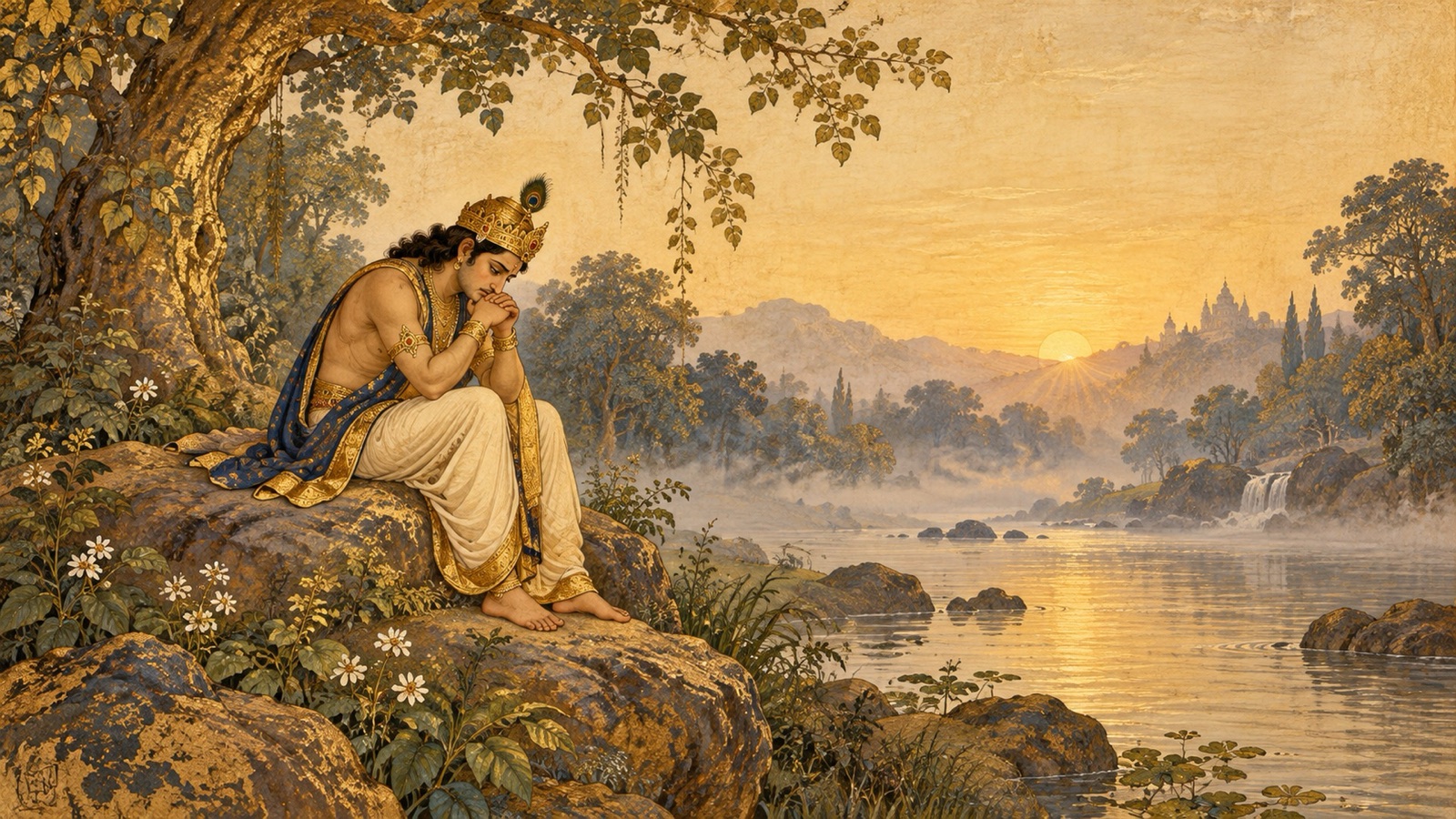
He goes further still, and with real humility lays the fault nowhere but upon himself: Urvashi had done him no true wrong, he says, any more than a rope does wrong to the frightened man who mistakes it in the dark for a serpent — the error lay entirely in his own untrained senses.
The King Sees Clearly
Out of this honest grief comes a clarity Pururava had never possessed before. He reflects that the very body we so praise and cling to is, in truth, impermanent and lowly in its end, destined to become ash or dust; and he wonders how strange it is that the heart so readily lavishes devotion upon what cannot last. From this comes his hard-won resolve: that one who cares for his own lasting good must guard where his gaze and company linger, for it is never the person or thing itself, but the meeting of an untrained sense with its object, that sets the mind churning.
अथापि नोपसज्जेत स्त्रीषु स्त्रैणेषु चार्थवित् । विषयेन्द्रियसंयोगान्मन: क्षुभ्यति नान्यथा ॥ २२ ॥
athāpi nopasajjeta strīṣu straiṇeṣu cārtha-vit viṣayendriya-saṁyogān manaḥ kṣubhyati nānyathā
Meaning: Therefore let one who truly knows his own good take care not to let his gaze or company linger upon whatever stirs such longing, nor upon those devoted to it; for it is the meeting of the senses with their objects, and nothing else, that sets the mind into turmoil. (Canto 11, Chapter 26, verse 22)
An object never seen or heard of, he reasons, can stir no such storm; so the wise soul, by quietly withdrawing the senses from what disturbs them, allows the mind at last to settle and grow still.
Pururava Renounces the World
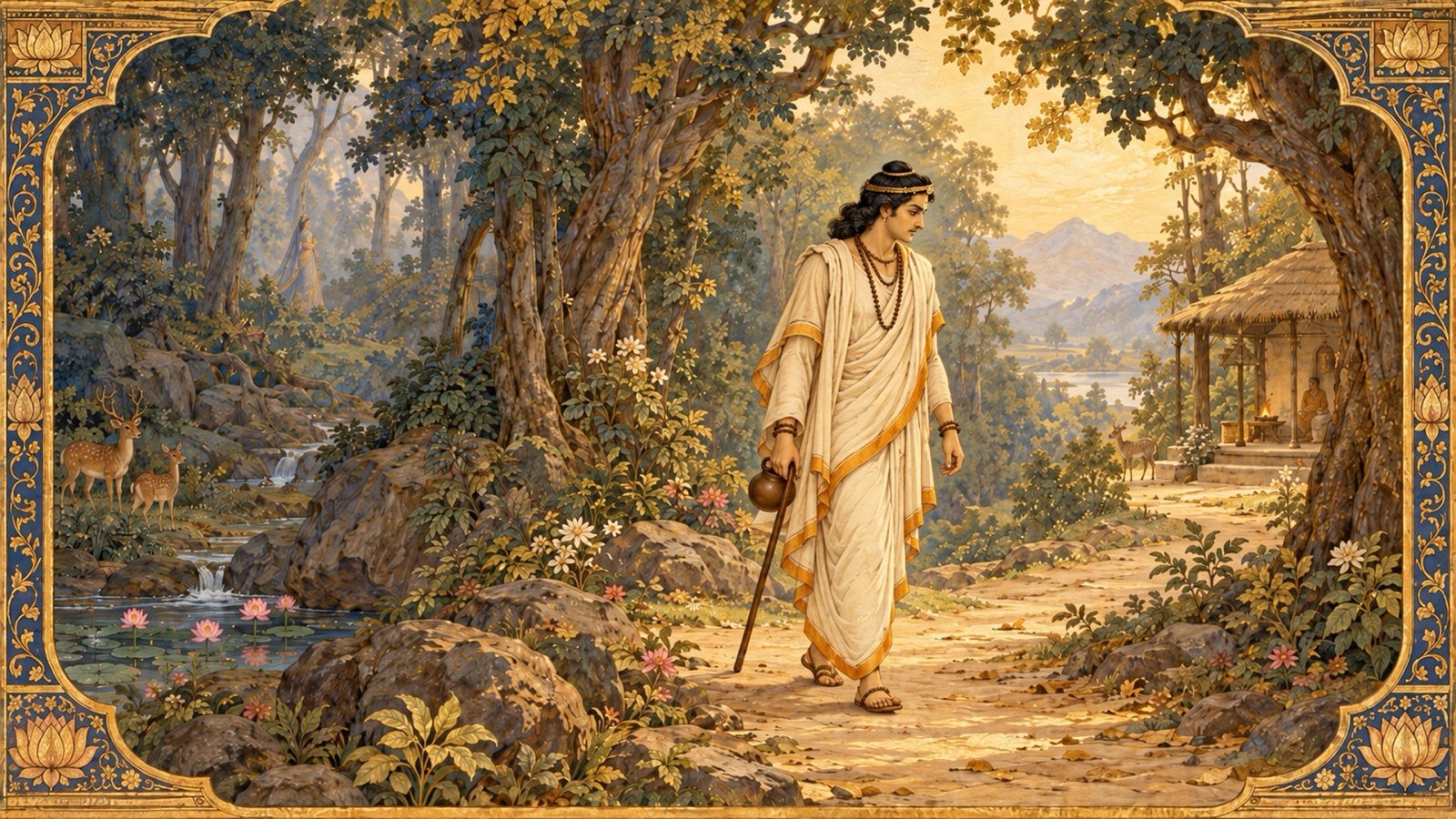
Singing this song at the very top of his voice, Pururava — once the pride of gods and men alike — walked away from the whole realm of Urvashi’s enchantment. In that moment he awakened to the Lord seated as his own innermost Self, and his long delusion fell away like a worn garment. He then retired entirely from worldly life, a free man at last.
The Glory of Holy Company
It is here, with Pururava’s own grief as His evidence, that the Lord turns the lesson toward its true purpose — not merely a warning against evil company, but the far greater good on its other side. Let the wise, having cast off unworthy fellowship, seek the company of the righteous, for their words alone cut through the mind’s deep entanglement.
Saints of this kind desire nothing for themselves; their hearts rest wholly in Him, perfectly serene, looking upon every being with the same loving eye. They claim nothing as their own, hold no pride of self, and remain undisturbed by pleasure and pain alike.
सन्तोऽनपेक्षा मच्चित्ता: प्रशान्ता: समदर्शिन: । निर्ममा निरहङ्कारा निर्द्वन्द्वा निष्परिग्रहा: ॥ २७ ॥
santo ‘napekṣā mac-cittāḥ praśāntāḥ sama-darśinaḥ nirmamā nirahaṅkārā nirdvandvā niṣparigrahāḥ
Meaning: The saints desire nothing, their hearts are fixed wholly on Me; perfectly at peace, they look upon all beings with an equal eye. They claim nothing as “mine,” hold no pride of self, remain unmoved by the pairs of opposites, and own no possessions. (Canto 11, Chapter 26, verse 27)
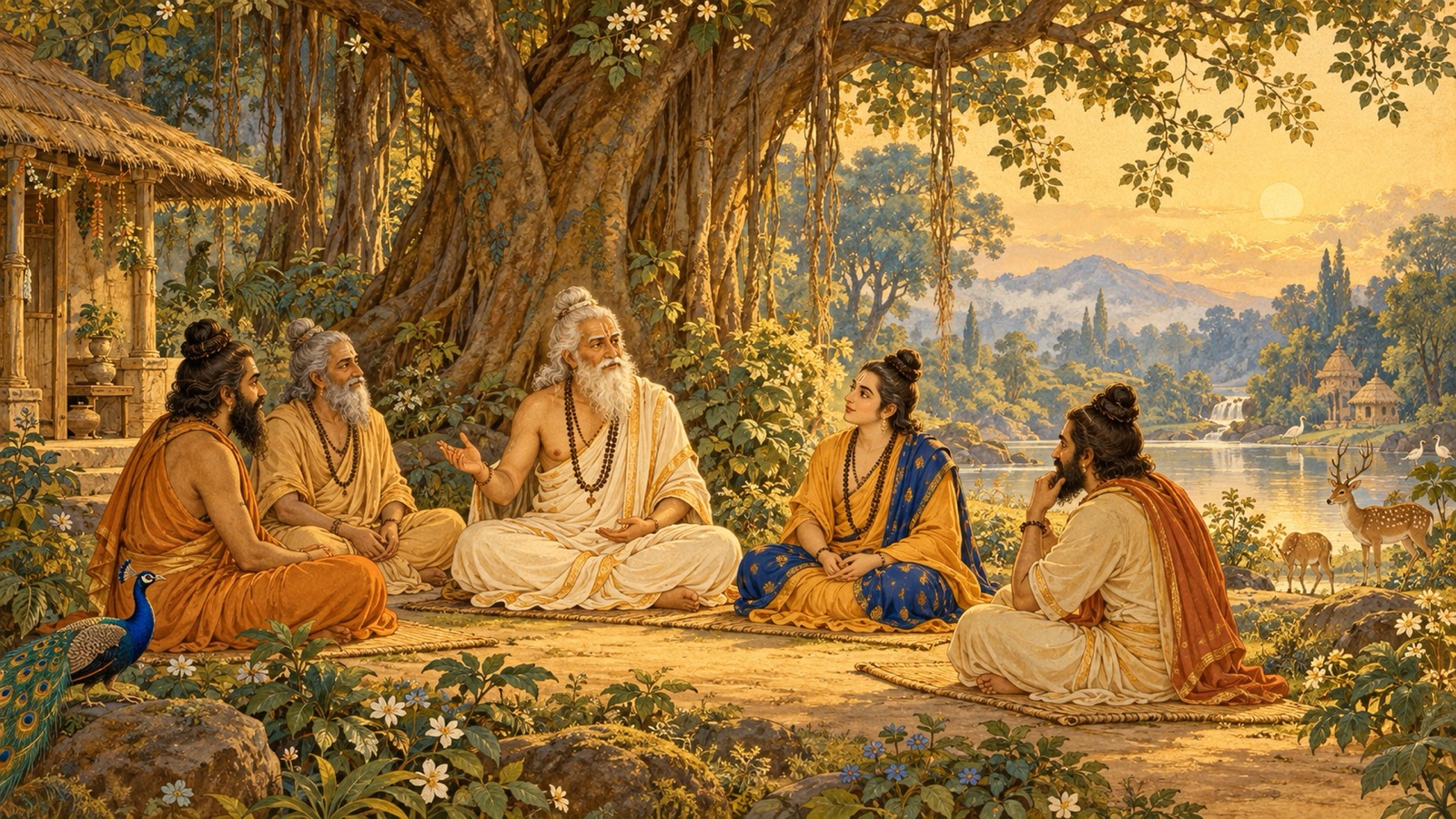
This, in truth, is the heart of what the Lord wishes Uddhava — and every one of us — to carry from Pururava’s sorrow. A king who had conquered the earth could not conquer his own mind alone; what no willpower could achieve, the mere fellowship of saints accomplishes gently, for their presence dissolves the attachments that bind us from within. It is in the gatherings of such fortunate souls that His own sacred stories are forever told — stories that heal all who delight in hearing them — and those who hear, sing and honour them with faith come, in time, to true devotion. What more could such a soul need, having found the one Cause of all, full of eternal being, knowledge and bliss? As cold and darkness vanish before a blazing fire, so the heart’s hardness and the dread of future birth melt away before one who serves pious souls with love. As a sturdy boat is the refuge for those drowning, saints who have attained deep peace are the highest refuge for souls sinking in the ocean of worldly life — for as breath is life, and piety the only wealth carried beyond death, so the saints alone shelter one who fears to be born again.
सन्तो दिशन्ति चक्षूंषि बहिरर्क: समुत्थित: । देवता बान्धवा: सन्त: सन्त आत्माहमेव च ॥ ३४ ॥
santo diśanti cakṣūṁṣi bahir arkaḥ samutthitaḥ devatā bāndhavāḥ santaḥ santa ātmāham eva ca
Meaning: The sun, however brightly it rises, gives only the outer eye; it is the saints who grant the inner eye of true wisdom. The saints, therefore, are our true gods, our true kin, and our very Self — and indeed, they are none other than I Myself. (Canto 11, Chapter 26, verse 34)
Free in the Self
Freed at last from longing for Urvashi’s company or her celestial realm, King Pururava — remembered also as Aila — wandered this earth with a heart wholly content, bound by nothing, delighting only in the Self within.
वैतसेनस्ततोऽप्येवमुर्वश्या लोकनिष्पृह: । मुक्तसङ्गो महीमेतामात्मारामश्चचार ह ॥ ३५ ॥
vaitasenas tato ‘py evam urvaśyā loka-niṣpṛhaḥ mukta-saṅgo mahīm etām ātmārāmaś cacāra ha
Meaning: Thus Pururava, free from every longing for Urvashi’s realm, released from all attachment, wandered this earth delighting in the Self alone. (Canto 11, Chapter 26, verse 35)

Principal Teachings of This Chapter
1. This body is a priceless chance to know the Lord. The soul who lives in a manner pleasing to the Lord reaches Him at last, dwelling within the very heart (verse 1).
2. Guard your company with care. Fellowship with those ruled only by bodily craving drags the mind into darkness, as one blind man following another falls into a pit (verse 3).
3. The fault lies in the untrained self, not in the world. Pururava’s confession teaches that it is never an external person or object that truly binds us, but our own untrained senses meeting their objects (verses 9–22).
4. The Lord turns even our falls into teaching. Krishna relates a king’s deepest humbling not to shame him but to show, through one soul’s honest grief, how delusion arises and may be undone — the theological heart of the chapter: no sorrow is wasted once it is laid at the Lord’s feet (verses 7–25).
5. Holy company succeeds where willpower alone fails. A mighty emperor could not free his own mind by resolve; only the fellowship of saints, whose words cut through deep attachment, accomplishes what nothing else can (verses 26–27).
6. The saints are our truest refuge. As fire dispels cold and darkness, and a boat saves the drowning, saintly company dissolves ignorance and carries the soul across the ocean of birth and death — for the saints, the Lord says, are nothing other than Himself (verses 31–34).
A Devotional Reflection
There is something deeply merciful in how the Lord teaches this chapter’s lesson. He does not simply command Uddhava, “avoid bad company, seek good company.” He tells a story — not of some distant villain, but of a great and celebrated king, brought low by the very passion that quietly tempts every human heart. In letting Pururava’s own voice carry the teaching, the Lord honours the dignity even of a fall; nothing in this song humiliates the king, it simply lets us watch, with him, as sorrow slowly becomes wisdom. And what moves the heart most is where the song finally arrives — not at despair, but at the saints, the gentle remedy that was always close at hand. If a king who ruled the whole earth could not master his own mind by willpower, how much less can any of us — and how great a relief to learn that we were never asked to try alone.
A Daily Devotional Practice
Today, in honour of this chapter, seek out — even briefly — the company of those whose hearts turn toward the Lord: a few quiet minutes with His stories, a word with a fellow devotee, or simply sitting before His image with a prayerful heart. As you do, call to mind Pururava’s honest confession, let it soften any pride that still clings to your mind, and turn that mind gently toward the Lord within, repeating with love: “Om Namo Bhagavate Vasudevaya.” In this small act of seeking holy company, you walk the very path that freed a grieving emperor and can free any heart that longs for peace.
Conclusion
In the Aila-gita, the Lord gives Uddhava a teaching wrapped inside a confession. King Pururava, undone for years by infatuation with the celestial Urvashi, finally sees with painful clarity how his own untrained senses, and not any other, had bound him — and in that seeing, his delusion breaks, and he walks away a free man, delighting only in the Self. But the Lord does not let the chapter end in grief; He lifts it into praise of the saints, whose fellowship alone succeeds where willpower fails, granting the inner eye that even the rising sun cannot give. A king who ruled the earth could not rule his own mind alone — but through the mercy of holy company, he found the one refuge that never fails. May we, too, treasure such company above every other possession.
May the divine wisdom of Srimad Bhagavatam awaken pure devotion within our hearts.
Om Namo Bhagavate Vasudevaya.
Jay Shree Madhav.
References and Attribution
- Primary edition: Gita Press, Śrīmad Bhāgavata Mahāpurāṇa (English, complete), Book Eleven, Discourse 26, pages 638–643.
- Series: Srimad Bhagavatam Wisdom · Biswa Sanatan Dharma Seva Trust.
- Presented following the spiritual guidance and recommendation of Pandit Dr. Shri Kashinath Mishra.
This is an original, faithful retelling in the writer’s own words, with brief quoted verses shown in Devanāgarī and transliteration and their meanings given as summaries. It is not a reproduction of any single publisher’s continuous translation or commentary. No affiliation with or endorsement by any publisher is implied.
Jay Shree Madhav