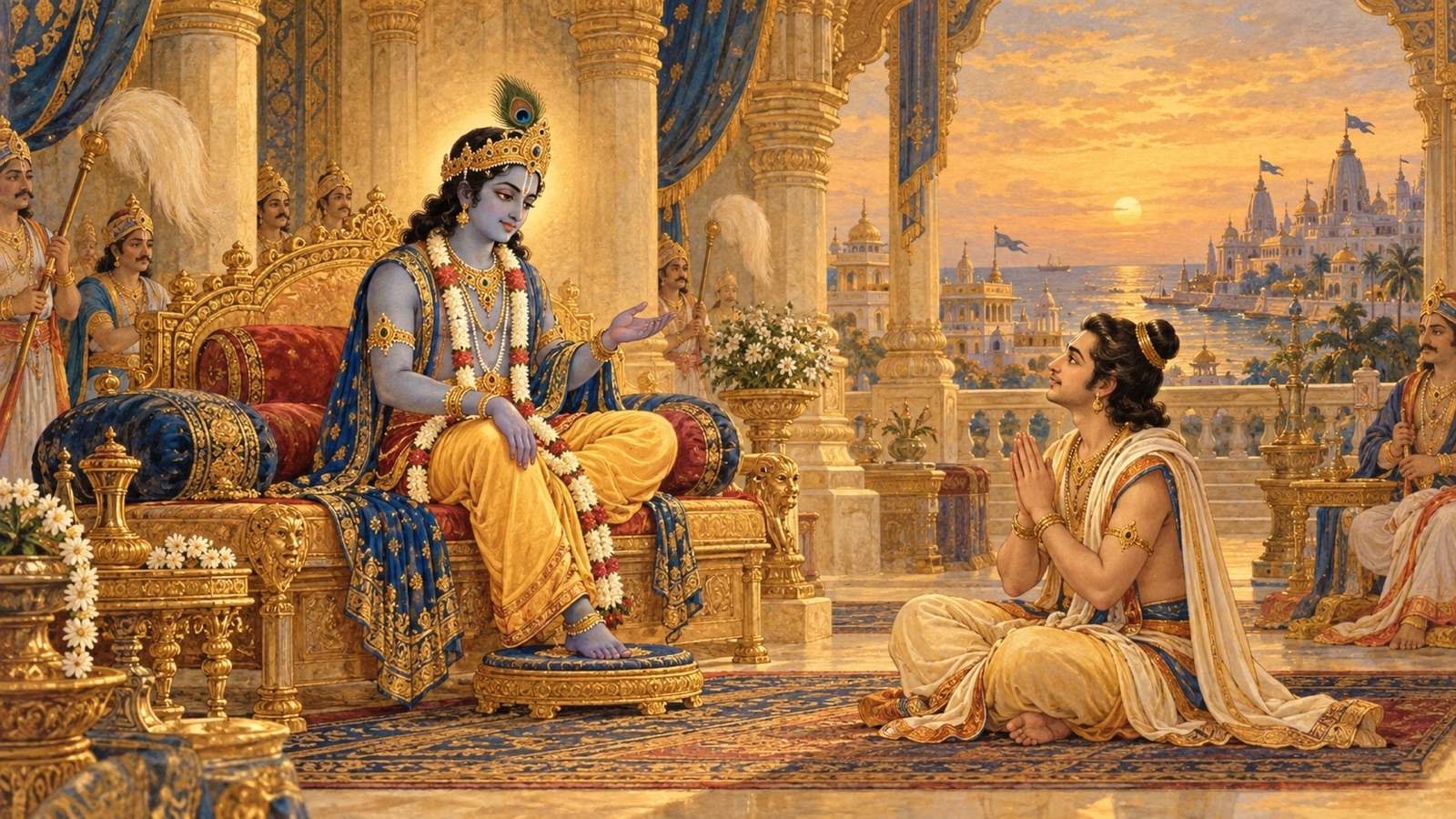
Uddhava asks Sri Krishna how a devotee should worship Him, and the Lord lovingly teaches the whole path of kriya-yoga — purifying the body, welcoming His presence into a sacred image, offering flowers and fire, and bowing at last in full surrender.
Om Namo Bhagavate Vasudevaya.
Om Namo Bhagavate Vasudevaya.
Om Namo Bhagavate Vasudevaya.
Welcome to Srimad Bhagavatam Wisdom, a devotional journey through the sacred histories and teachings of the Srimad Bhagavat Mahapurana. In the previous discourse, the Lord told of King Pururava’s awakening from his grief over the nymph Urvashi, and praised the saints whose very company frees a soul from bondage. Now Uddhava, his heart stirred by that praise, turns to something every devotee longs to know: how, in practice, should one worship the Lord who needs nothing from anyone? Sri Krishna, addressed here as teacher and father, answers step by step — how to purify oneself, prepare an altar or a holy image, bathe and dress the Lord with love, feed Him, meet Him within the sacred fire, and finally surrender completely at His feet.
Chapter Information
- Scripture: Śrīmad Bhāgavata Mahāpurāṇa
- Canto: 11 (Book Eleven)
- Chapter: 27 (Discourse 27)
- Chapter title: Lord Krishna’s Instructions on the Process of Deity Worship
- Principal speaker: Sri Krishna, instructing Uddhava; the whole related by Sukadeva Gosvami to King Parikshit
- Principal listener: Uddhava; and King Parikshit
- Main setting: Dwaraka, in the Lord’s dialogue with Uddhava
- Central subject: Kriya-yoga — the sacred process of worshipping the Lord’s holy image: purification, invocation, bathing, adornment, offerings, the sacred fire, prostration, and the fruit such devoted worship bears
- Principal verse range: Canto 11, Chapter 27, verses 1–55
- Primary edition: Gita Press Śrīmad Bhāgavata Mahāpurāṇa
Context from the Previous Chapter
In Discourse Twenty-Six, the Lord told how King Pururava, maddened by separation from the nymph Urvashi, awakened at last to his true Self and renounced the world. The Lord then praised the blessing of holy company, whose fellowship quietly dissolves the soul’s deepest attachments. This chapter follows directly from that praise, as Uddhava now asks the Lord to teach him the sacred, practical path of worshipping Him in form.
Uddhava’s Question — The Path of Sacred Worship
Filled with devotion, Uddhava bowed before the Lord and begged Him to explain kriya-yoga — the course of worship by which His own devotees, the Sattvatas, adore Him. He recalled that sages such as Narada, and teachers such as Vyasa and Brihaspati, had always declared this worship the highest good for humankind, flowing first from the Lord’s own lips to Brahma. It was, he said, fit for every class and stage of life, and the very path of blessedness even for the humble. He asked the lotus-eyed Protector of devotees to loosen, once and for all, the bonds of ritual duty by teaching him this path with love.
श्रीउद्धव उवाच क्रियायोगं समाचक्ष्व भवदाराधनं प्रभो । यस्मात्त्वां ये यथार्चन्ति सात्वता: सात्वतर्षभ ॥ १ ॥
śrī-uddhava uvāca kriyā-yogaṁ samācakṣva bhavad-ārādhanaṁ prabho yasmāt tvāṁ ye yathārcanti sātvatāḥ sātvatarṣabha
Meaning: Uddhava said: O Lord, best of the Sattvatas, kindly explain to me the kriya-yoga, the course of worship by which Your own devotees adore You, and why they worship You in these particular ways. (Canto 11, Chapter 27, verse 1)
Many Doors, One Worship
The glorious Lord began by saying He would teach this boundless subject in brief and in right order. His worship, He said, may be offered in three ways — by Vedic rite, by Tantric rite, or by a blend of both — and one should worship Him by whichever procedure is truly dear to his own heart, treating the Lord as one’s own teacher and father, and approaching Him without any deceit.
अर्चायां स्थण्डिलेऽग्नौ वा सूर्ये वाप्सु हृदि द्विज: । द्रव्येण भक्तियुक्तोऽर्चेत् स्वगुरुं माममायया ॥ ९ ॥
arcāyāṁ sthaṇḍile ’gnau vā sūrye vāpsu hṛdi dvijaḥ dravyeṇa bhakti-yukto ’rcet sva-guruṁ mām amāyayā
Meaning: The twice-born should worship Me, his own teacher, with sincere devotion and without deceit, offering fitting articles — through a sacred image, a consecrated altar, the sacred fire, the sun, water, or the cavity of his own heart. (Canto 11, Chapter 27, verse 9)
Love Above Opulence
The Lord then described the preparation for worship: cleansing the body, bathing with clay and sacred ash while chanting Vedic and Tantric mantras, and undertaking a vow that wipes away the stains of past deeds. He spoke of the eight kinds of sacred images — of stone, wood, metal, clay, sandal-paste, a painting, sand, or one held purely within the mind — movable and immovable, each with its own rule for invocation. Precious articles should be used when a devotee has the means, He said, but one free of guile may worship with whatever is simply at hand — for in the cavity of the heart, worship is offered with love alone.
स्नानालङ्करणं प्रेष्ठमर्चायामेव तूद्धव । स्थण्डिले तत्त्वविन्यासो वह्नावाज्यप्लुतं हवि: ॥ १६ ॥ सूर्ये चाभ्यर्हणं प्रेष्ठं सलिले सलिलादिभि: । श्रद्धयोपाहृतं प्रेष्ठं भक्तेन मम वार्यपि ॥ १७ ॥
snānālaṅkaraṇaṁ preṣṭham arcāyām eva tūddhava sthaṇḍile tattva-vinyāso vahnāv ājya-plutaṁ haviḥ sūrye cābhyarhaṇaṁ preṣṭhaṁ salile salilādibhiḥ śraddhayopāhṛtaṁ preṣṭhaṁ bhaktena mama vāry api
Meaning: Bathing and loving adornment are most dear to Me in the worship of a sacred image, O Uddhava; in a consecrated altar, the placing of the deities in their places; in the sacred fire, oblations drenched in ghee; before the sun, due reverence; in water, the offering of water itself. Even a little water offered to Me with faith by My devotee is very dear to Me. (Canto 11, Chapter 27, verses 16–17)
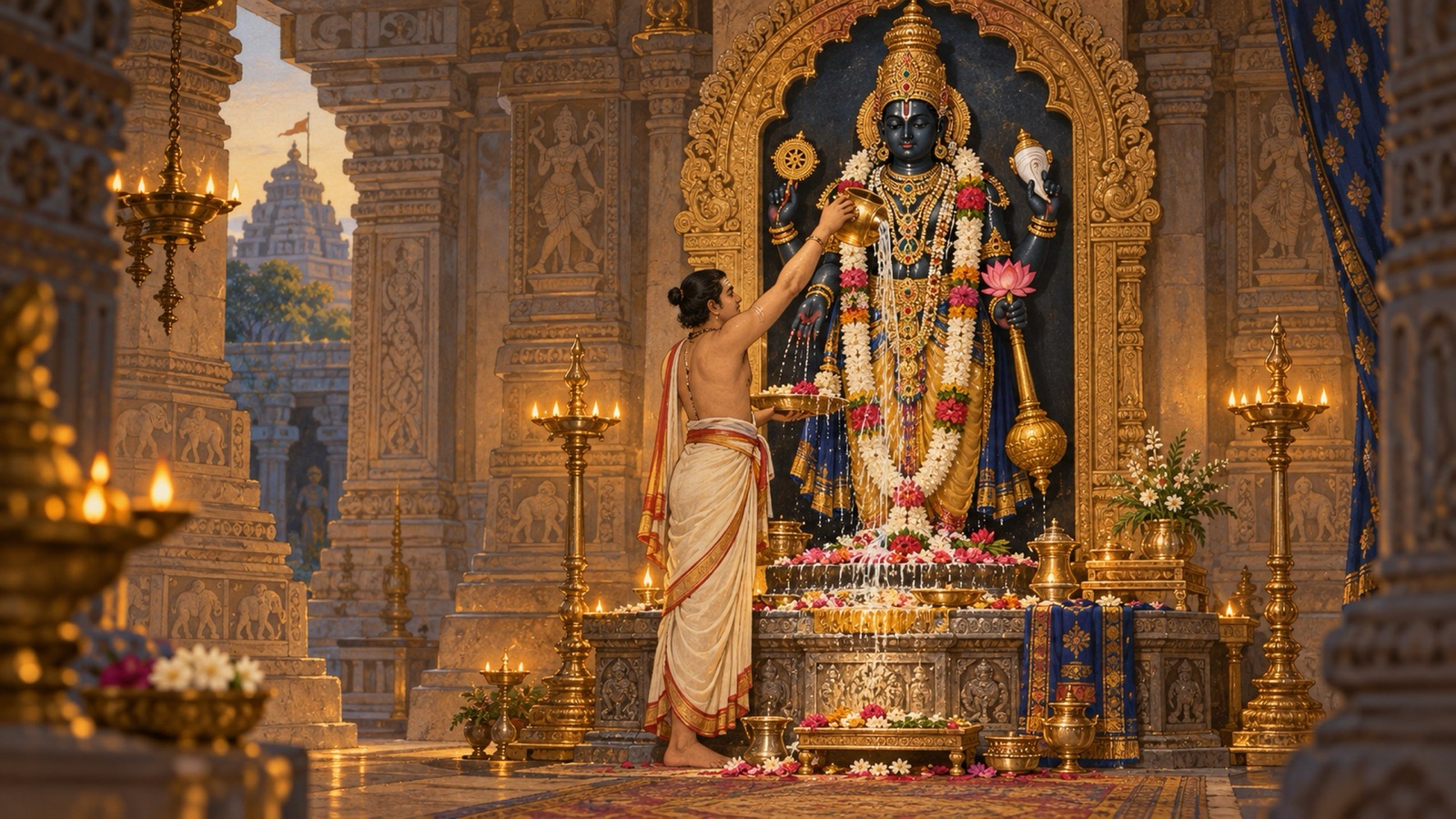
Preparing the Altar and Welcoming the Lord’s Presence
Purified and seated upon a seat of kusha grass, facing the image, the worshipper should begin by consecrating his own hands and limbs with sacred syllables, then gently cleanse the image and prepare the vessels of water for washing the Lord’s feet, hands and mouth, each hallowed with its own mantra. Meditating within his own body as refined by mystic fire and nectar, he should fix his mind upon the Lord’s subtle form seated on the lotus of the heart, worship it inwardly, and then invite that very presence into the outer image — installing the Lord upon a seat built, in meditation, from the four feet of Dharma, Knowledge, Dispassion and Majesty. In due order he should then honour the Lord’s own emblems — the Sudarshana discus, the conch Panchajanya, the mace, sword, bow and arrows, and the Kaustubha gem — and then His attendants, Garuda before Him, Durga, Ganesha, Vyasa and Vishvaksena, his own teacher, and the guardian deities of every quarter, each honoured in turn.
Bathing, Adorning and Feeding the Lord
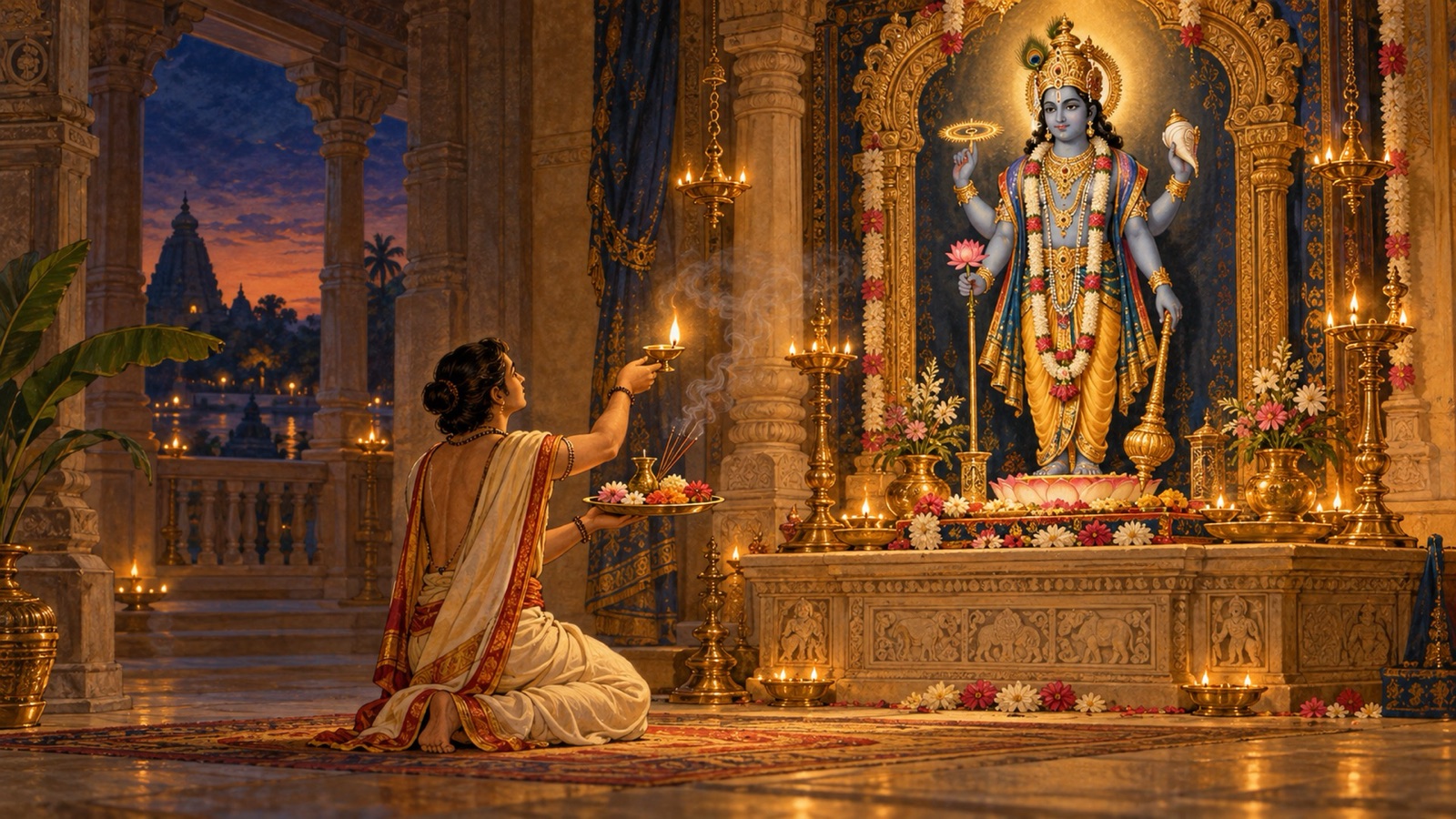
If his means allow, the devotee should bathe the Lord daily in water made fragrant with sandal-paste, camphor, saffron and aloe-wood, chanting sacred hymns. He should lovingly robe the Lord in fine raiments, offer the sacred thread, jewels and garlands of tulsi leaves; present water for His feet and mouth, flowers, incense, a lamp and food. One of greater means may offer a full feast of milk-sweets and ghee-cakes; and, on sacred days, or daily if he is able, may anoint the Lord with fragrant oil, bathe Him with milk and honey, clothe Him in silk, and fill the hour with song and dance offered purely in His honour.
The Sacred Fire — Beholding the Lord’s Radiant Form
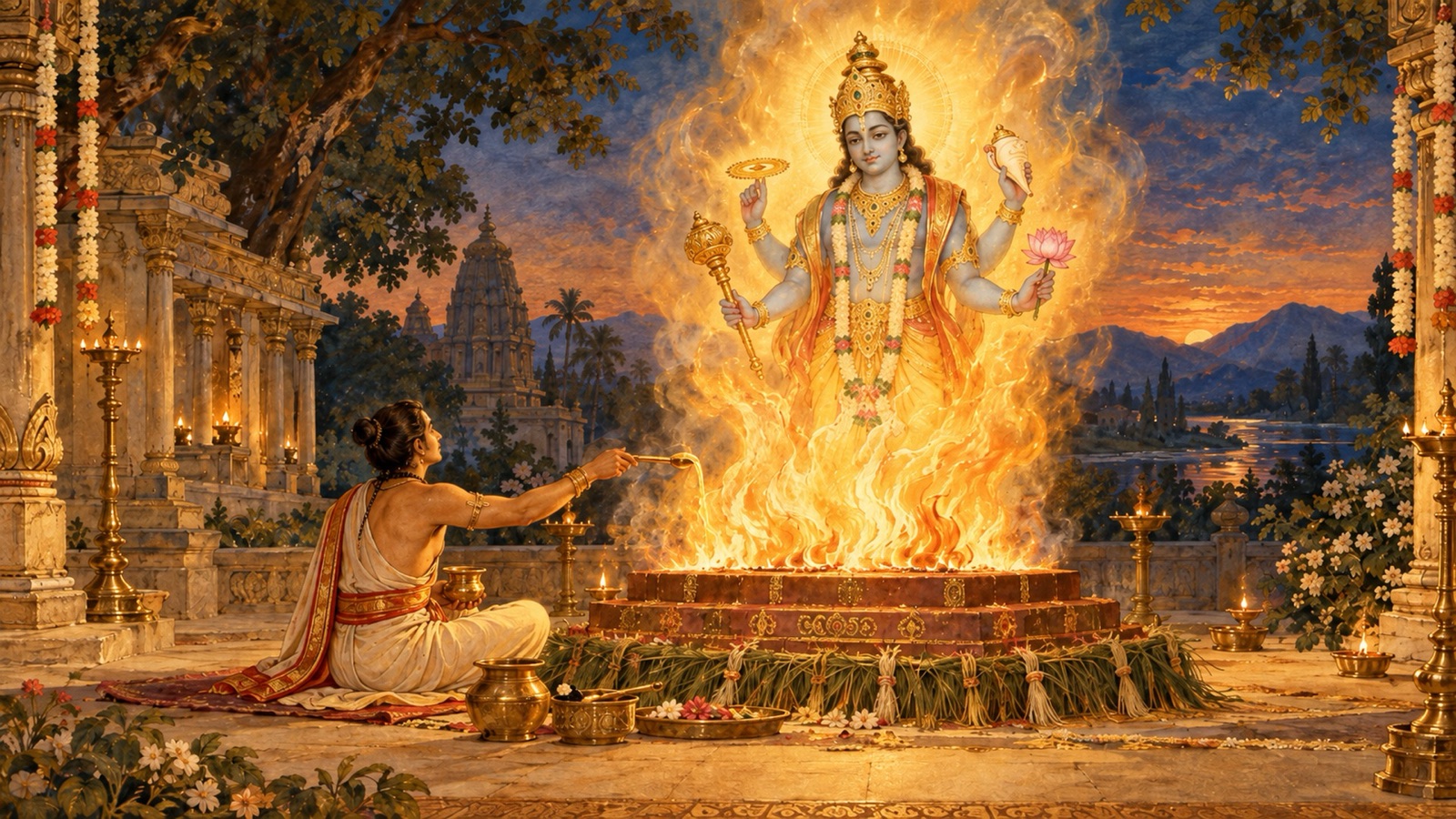
The Lord then taught the rite of the sacred fire: the sacrificial pit dug and prepared with due ceremony, the fire kindled and gathered, enclosed on every side with blades of kusha grass and sprinkled with consecrated water. Gazing into those flames, the worshipper should behold the Lord there in His radiant form.
तप्तजाम्बूनदप्रख्यं शङ्खचक्रगदाम्बुजै: । लसच्चतुर्भुजं शान्तं पद्मकिञ्जल्कवाससम् ॥ ३८ ॥ स्फुरत्किरीटकटककटिसूत्रवराङ्गदम् । श्रीवत्सवक्षसं भ्राजत्कौस्तुभं वनमालिनम् ॥ ३९ ॥
tapta-jāmbūnada-prakhyaṁ śaṅkha-cakra-gadāmbujaiḥ lasac-catur-bhujaṁ śāntaṁ padma-kiñjalka-vāsasam sphurat-kirīṭa-kaṭaka kaṭi-sūtra-varāṅgadam śrīvatsa-vakṣasaṁ bhrājat-kaustubhaṁ vana-mālinam
Meaning: There in the sacred fire he should meditate upon Me, radiant like molten gold, My four arms bearing the conch, discus, mace and lotus, serene, robed in silk the colour of a lotus’s filaments, crowned, adorned with bracelets, girdle and armlets, the mark of Srivatsa upon My chest, the brilliant Kaustubha gem shining there, garlanded with forest flowers. (Canto 11, Chapter 27, verses 38–39)
Beholding the Lord thus, the worshipper should offer the sacrificial sticks soaked in ghee, make the prescribed offerings of ghee, and pour oblations with the root mantra and the sixteen verses of the Purusha-sukta, duly honouring Dharma and the other seats of the Lord’s throne, completing the rite with the final Svishtakrit offering.
Prostration and the Devotee’s Prayer
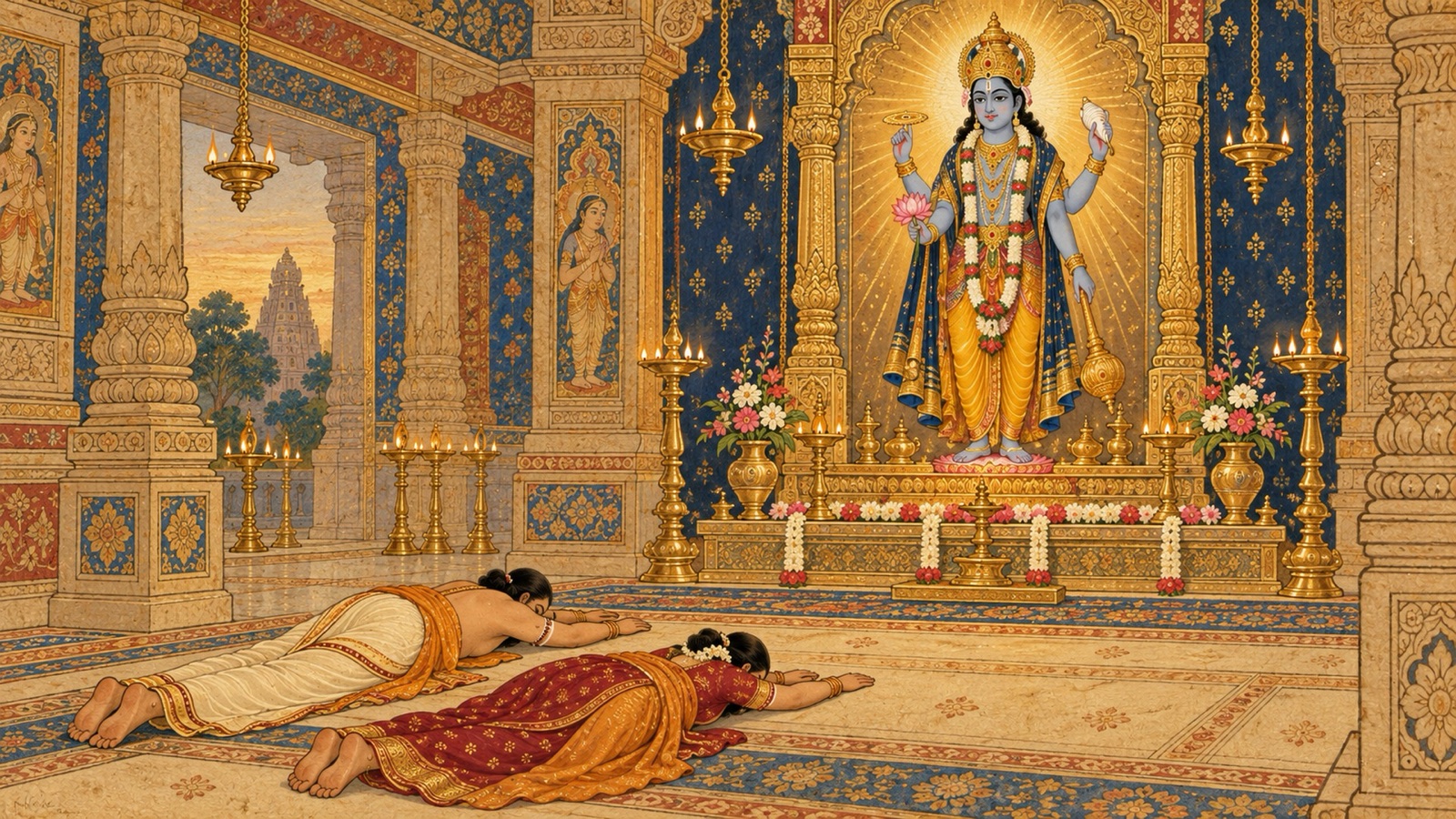
Having worshipped the Lord present in the fire and offered oblations to His attendants, the devotee should return to his seat, repeat the root mantra, and offer water for rinsing the Lord’s mouth, giving the remnants to Vishvaksena with fragrant betel and a shower of flowers. He should celebrate and recount the Lord’s deeds, dance for joy, and tell or listen to His stories a while. Glorifying the Lord with hymns both great and small, drawn from the Puranas or composed from his own heart, and praying, “Be gracious, O Lord,” he should at last fall flat upon the ground like a rod, arms folded, crying out in utter surrender.
स्तवैरुच्चावचै: स्तोत्रै: पौराणै: प्राकृतैरपि । स्तुत्वा प्रसीद भगवन्निति वन्देत दण्डवत् ॥ ४५ ॥
stavair uccāvacaiḥ stotraiḥ paurāṇaiḥ prākṛtair api stutvā prasīda bhagavann iti vandeta daṇḍa-vat
Meaning: Glorifying Me with hymns both great and small, from the Puranas or composed from the heart, and praying, “Be gracious, O Lord,” the devotee should bow down flat upon the ground, like a rod, in complete surrender. (Canto 11, Chapter 27, verse 45)
The Fruit of This Worship — Devotion Itself
The Lord then revealed the heart beneath all this ceremony. Wherever and in whatever form faith calls a soul to worship Him, there he should worship — for the Lord, the Soul of the universe, dwells equally in the sacred image, in every living being, and in the worshipper’s own self; true worship never divides what is, in truth, one. Through this path of kriya-yoga, whether Vedic or Tantric, a soul attains from Him the fulfilment his heart truly desires. Yet the Lord did not let the ritual stand as the final word: the entire discipline, He revealed, is at heart a doorway rather than a destination.
मामेव नैरपेक्ष्येण भक्तियोगेन विन्दति । भक्तियोगं स लभत एवं य: पूजयेत माम् ॥ ५३ ॥
mām eva nairapekṣyeṇa bhakti-yogena vindati bhakti-yogaṁ sa labhata evaṁ yaḥ pūjayeta mām
Meaning: One who worships Me in this way, free from every personal expectation, attains Me alone through the yoga of devotion; such a worshipper easily attains bhakti-yoga itself. (Canto 11, Chapter 27, verse 53)
Temples Built in Love, and a Sacred Trust
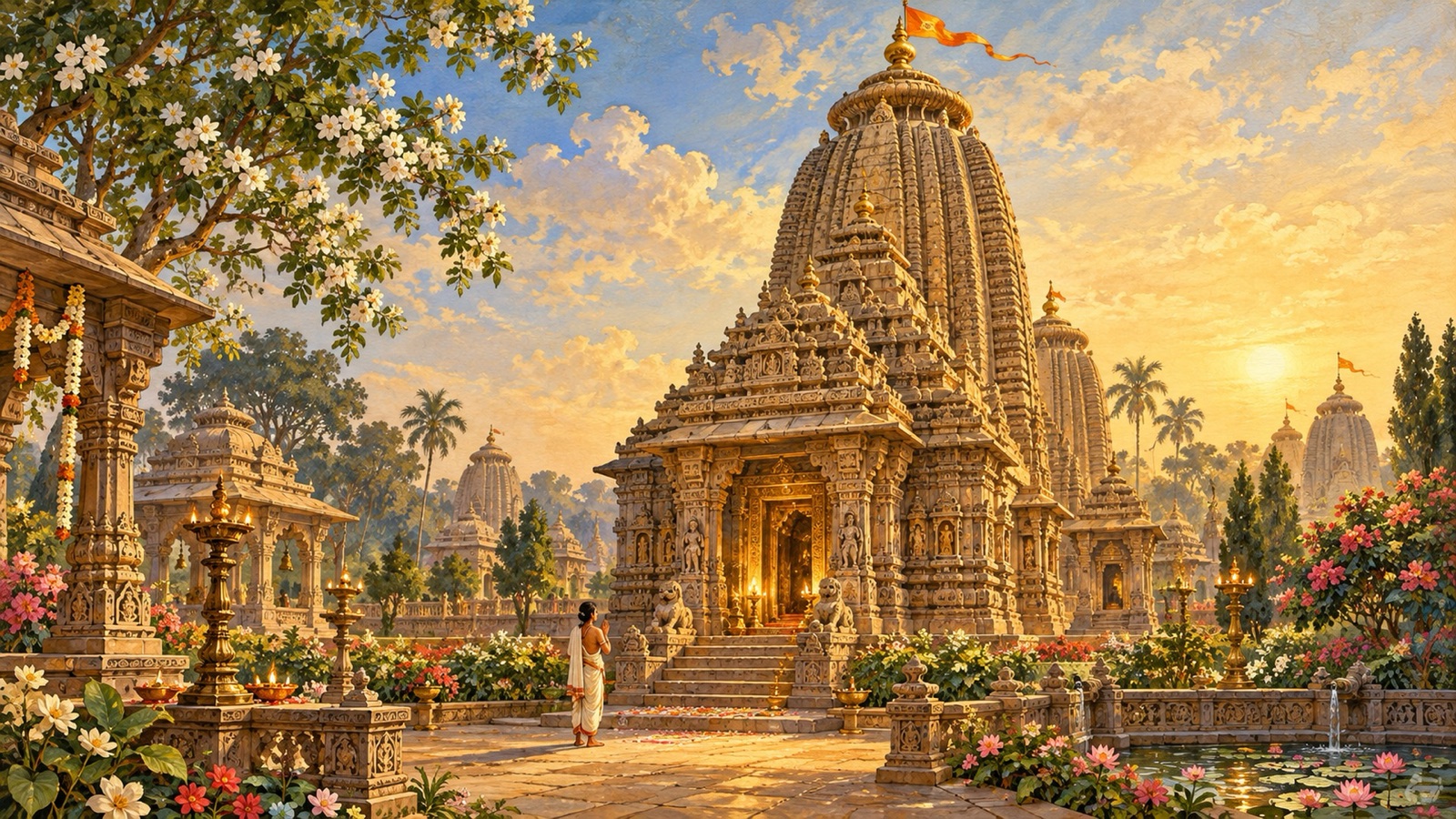
A devotee who has the means, the Lord said, should raise for Him a strong and lasting house of worship, install His sacred image there, and grant fields, markets or villages to sustain its daily worship and festivals forever. Through the consecration of the image alone, one may attain sovereignty of the whole earth; through building the temple, dominion over all three worlds; and through worship offered with all three together, one may rise even to a state of equality with the Lord. But the Lord also gave a solemn warning: whoever seizes an endowment once given to a deity or a devoted brahmana is born, for ten million years, as a creature that feeds on filth — a fate shared alike by the one who commits the wrong, the one who helps it, and the one who merely approves it.
Principal Teachings of This Chapter
1. Worship takes many forms, but is one in spirit. Whether by Vedic rite, Tantric rite, or a union of both, and whether the devotee turns to a holy image, a prepared altar, the flame of sacrifice, the sun’s light, flowing water, or the silence within the heart, every sincere act of worship reaches the very same Lord (verses 7–9).
2. Devotion matters more than expense. A single cup of water given in sincere faith touches the Lord more deeply than a lavish feast given without love; it is the heart behind the gift, not its cost, that He treasures (verses 16–18).
3. The Lord dwells equally in all. True worship never divides Him from His creation — He is present alike in the sacred image, in every being, and in the worshipper’s own self (verse 48).
4. Ritual culminates in pure devotion. The whole discipline of kriya-yoga is not an end in itself but a doorway; worship offered without personal motive opens directly into bhakti-yoga, loving devotion itself, which is the true treasure the ritual was always meant to carry (verses 49, 53).
5. The devotee’s final refuge is surrender. After every offering has been made, the worshipper falls at the Lord’s feet, confessing fear of the ocean of birth and death, and seeks shelter in Him alone (verses 45–47).
6. A temple is a sacred and lasting trust. To build and endow a home for the Lord’s worship is to share in His own glory; to betray that trust brings a grave and lasting consequence (verses 50–55).
A Devotional Reflection
What lingers after this chapter is not the long list of articles and rites, but the tenderness beneath it. The Lord, who needs nothing from anyone, asks to be treated as one’s own teacher and father — bathed, dressed, fed, and finally embraced in surrender, as though He were truly present and glad of the love being poured out. In nearly the same breath He says a cup of water offered with faith moves Him more than a banquet offered without it. There is something freeing in this: a poor man with only a lamp and a flower, and a king with gardens and granaries to give, stand on exactly the same ground before Him, for what He receives is never the object itself but the love carrying it. The elaborate forms this chapter describes are not a wall between the devotee and the Lord; they are love being taught how to use its hands.
A Daily Devotional Practice
Today, offer the Lord something small with your whole heart. Light a lamp, place a flower, or simply pour a cup of water before an image or picture of the Lord — or, if none is near, before the altar of your own heart — and offer it slowly, without hurry, as though He Himself were truly receiving it. As you offer it, speak softly His holy name: “Om Namo Bhagavate Vasudevaya.” Let this brief, sincere act remind you, as the Lord taught Uddhava, that no offering is too small when it is given in love.
Conclusion
Uddhava asks the Lord to teach him kriya-yoga, the sacred art of formal worship, and Sri Krishna answers with a father’s patience — guiding him through purification, the forms an image may take, the preparation of the altar, the bathing and adorning and feeding of the Lord, the vision of His radiant four-armed form within the sacred fire, and the devotee’s final prostration in surrender. At every turn the Lord shifts the emphasis from grandeur to love, declaring that a little water offered with faith outshines any costly gift offered without it, and that He dwells equally in the image, in all beings and in the worshipper’s own self. The whole discipline, He reveals, is not its own end: worship offered without personal motive carries the soul directly into bhakti-yoga, pure loving devotion — the one fruit this chapter has been quietly pointing toward all along.
May the divine wisdom of Srimad Bhagavatam awaken pure devotion within our hearts.
Om Namo Bhagavate Vasudevaya.
Jay Shree Madhav.
References and Attribution
- Primary edition: Gita Press, Śrīmad Bhāgavata Mahāpurāṇa (English, complete), Book Eleven, Discourse 27, pages 642–648.
- Series: Srimad Bhagavatam Wisdom · Biswa Sanatan Dharma Seva Trust.
- Presented following the spiritual guidance and recommendation of Pandit Dr. Shri Kashinath Mishra.
This is an original, faithful retelling in the writer’s own words, with brief quoted verses shown in Devanāgarī and transliteration and their meanings given as summaries. It is not a reproduction of any single publisher’s continuous translation or commentary. No affiliation with or endorsement by any publisher is implied.
Jay Shree Madhav