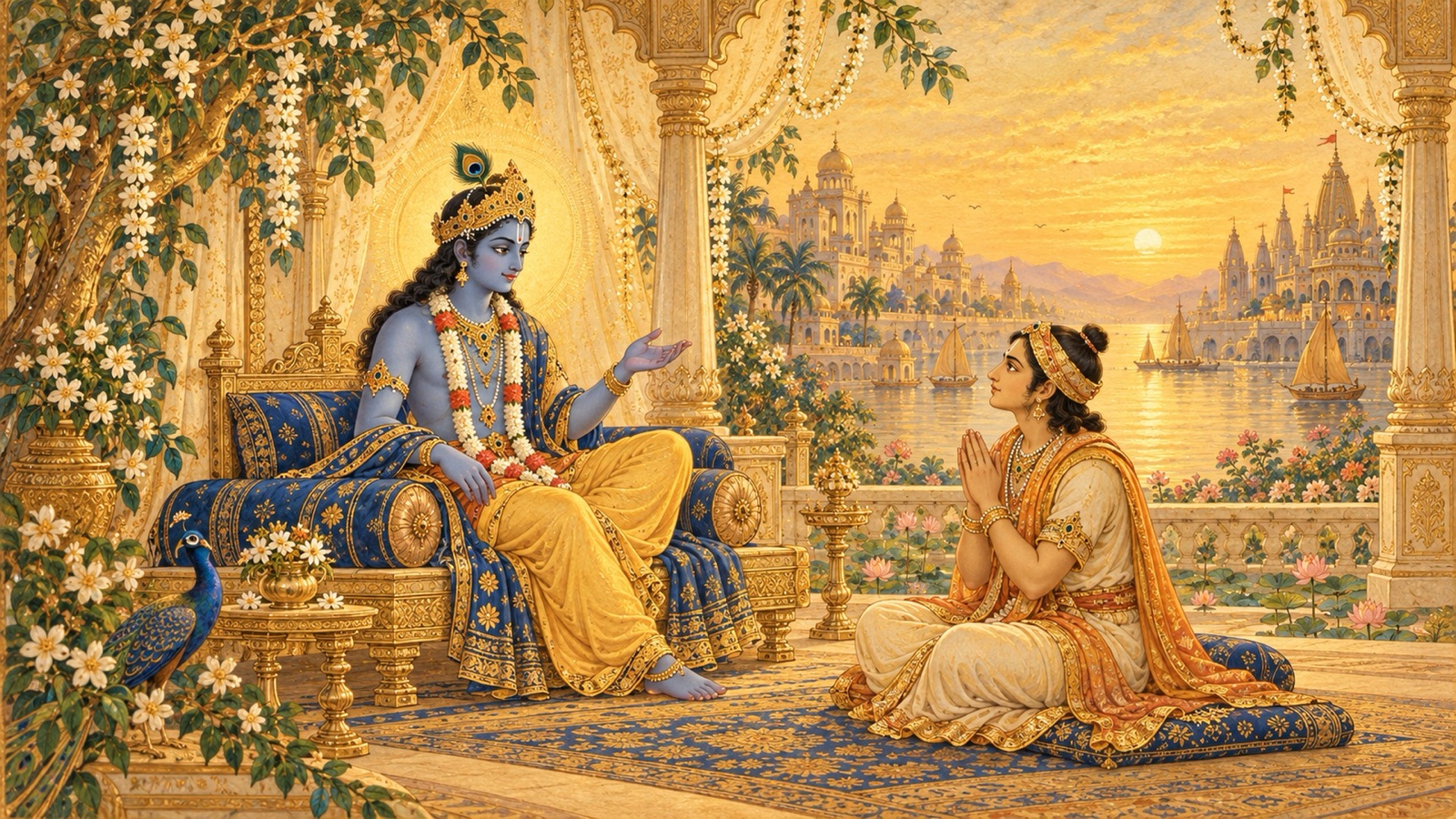
Having taught Uddhava the loving rites of worship, Lord Krishna now opens before him the deepest of all knowledge — one undivided Self shining in every being, a world of praise and blame that is only a dream not yet broken, and a wisdom that finds its true safety only in loving dependence upon Him.
Om Namo Bhagavate Vasudevaya.
Om Namo Bhagavate Vasudevaya.
Om Namo Bhagavate Vasudevaya.
Welcome to Srimad Bhagavatam Wisdom, a devotional journey through the sacred histories of the Srimad Bhagavat Mahapurana. Having taught Uddhava the rites of worship, the Lord now unfolds the highest truth: one Self shining in every being, a dream of duality still to break, and a knowledge that comes to rest, in the end, only at His feet.
Chapter Information
- Scripture: Śrīmad Bhāgavata Mahāpurāṇa
- Canto: 11 (Book Eleven)
- Chapter: 28 (Discourse 28)
- Chapter title: Jnana-yoga — The Path of Knowledge
- Principal speaker: Sri Krishna, instructing Uddhava; the whole related by Sukadeva Gosvami to King Parikshit
- Principal listener: Uddhava; and King Parikshit
- Main setting: Dwaraka
- Central subject: The one Self in all beings, the unreality of duality, the Self as the changeless witness, and devotion as the remedy for every obstacle on the path of Yoga
- Principal verse range: Canto 11, Chapter 28, verses 1–44
- Primary edition: Gita Press Śrīmad Bhāgavata Mahāpurāṇa
Context from the Previous Chapter
In the previous discourse, the Lord taught Uddhava how to worship Him in the sacred image — the mantras, the bathing and adornment, the sacred fire and the offerings of devotion — declaring that such worship leads to union with Him. Having finished this teaching on outer worship, the Lord now turns to the inner worship of knowledge: the vision of the one Self in all.
The One Self Behind All Natures
The glorious Lord began again, giving Uddhava His deepest teaching yet.
श्रीभगवानुवाच परस्वभावकर्माणि न प्रशंसेन्न गर्हयेत् । विश्वमेकात्मकं पश्यन् प्रकृत्या पुरुषेण च ॥ १ ॥
śrī-bhagavān uvāca para-svabhāva-karmāṇi na praśaṁsen na garhayet viśvam ekātmakaṁ paśyan prakṛtyā puruṣeṇa ca
Meaning: The glorious Lord said: Seeing this universe as one in substance, brought about by the union of Prakriti and Purusha, a person should neither praise nor condemn the nature and deeds of another. (Canto 11, Chapter 28, verse 1)
He who exalts or denounces another’s bent of mind strays from his own purpose, clinging to a duality that is not real. As the soul, overpowered by sleep, sinks from waking into dream and then into dreamless slumber, so one who sees the many instead of the one truth falls into distraction and, in time, into ignorance. In duality there is no fixed good and no fixed evil, for whatever the tongue speaks or the mind pictures is simply untrue. A reflection on water, an answering echo, the pale shimmer of shell mistaken for silver — none of these are real, yet they move us as though they were; so too the body goes on stirring fear until it dissolves away.
The Universe Is the Self Itself
This universe, the Lord continued, is the one Supreme Spirit, able to take on every form.
आत्मैव तदिदं विश्वं सृज्यते सृजति प्रभु: । त्रायते त्राति विश्वात्मा ह्रियते हरतीश्वर: ॥ ६ ॥
ātmaiva tad idaṁ viśvaṁ sṛjyate sṛjati prabhuḥ trāyate trāti viśvātmā hriyate haratīśvaraḥ
Meaning: This universe is nothing but the Spirit itself, which creates and is created, protects and is protected, destroys and is destroyed — at once the one who acts and the one acted upon. (Canto 11, Chapter 28, verse 6)
Beyond that one Spirit the wise find no second reality; creation, continuance and dissolution within it are baseless, and the play of seer, seen and seeing is the work of Maya, built of the three gunas. Whoever ripens in this knowledge neither praises nor reviles, but moves through the world as freely as the sun, walking unattached through a world known to be unreal apart from the Spirit.

Uddhava’s Question — Who Undergoes Birth and Death?
Hearing this, Uddhava submitted a question born of honest wonder. Transmigration is surely not undergone by the soul, the self-luminous perceiver, nor by the body, the mere object perceived; and yet it is certainly experienced. By whom, then, is it undergone?
श्रीउद्धव उवाच नैवात्मनो न देहस्य संसृतिर्द्रष्टृदृश्ययो: । अनात्मस्वदृशोरीश कस्य स्यादुपलभ्यते ॥ १० ॥
śrī-uddhava uvāca naivātmano na dehasya saṁsṛtir draṣṭṛ-dṛśyayoḥ anātma-sva-dṛśor īśa kasya syād upalabhyate
Meaning: Uddhava said: O Lord, transmigration belongs neither to the soul, the seer, nor to the body, the thing seen; so by whom, then, is it experienced? (Canto 11, Chapter 28, verse 10)
The soul is undecaying, pure, self-effulgent like fire; the body is as insensate as wood. Which of the two, then, truly wanders through birth after birth?
The Dream That Will Not Break
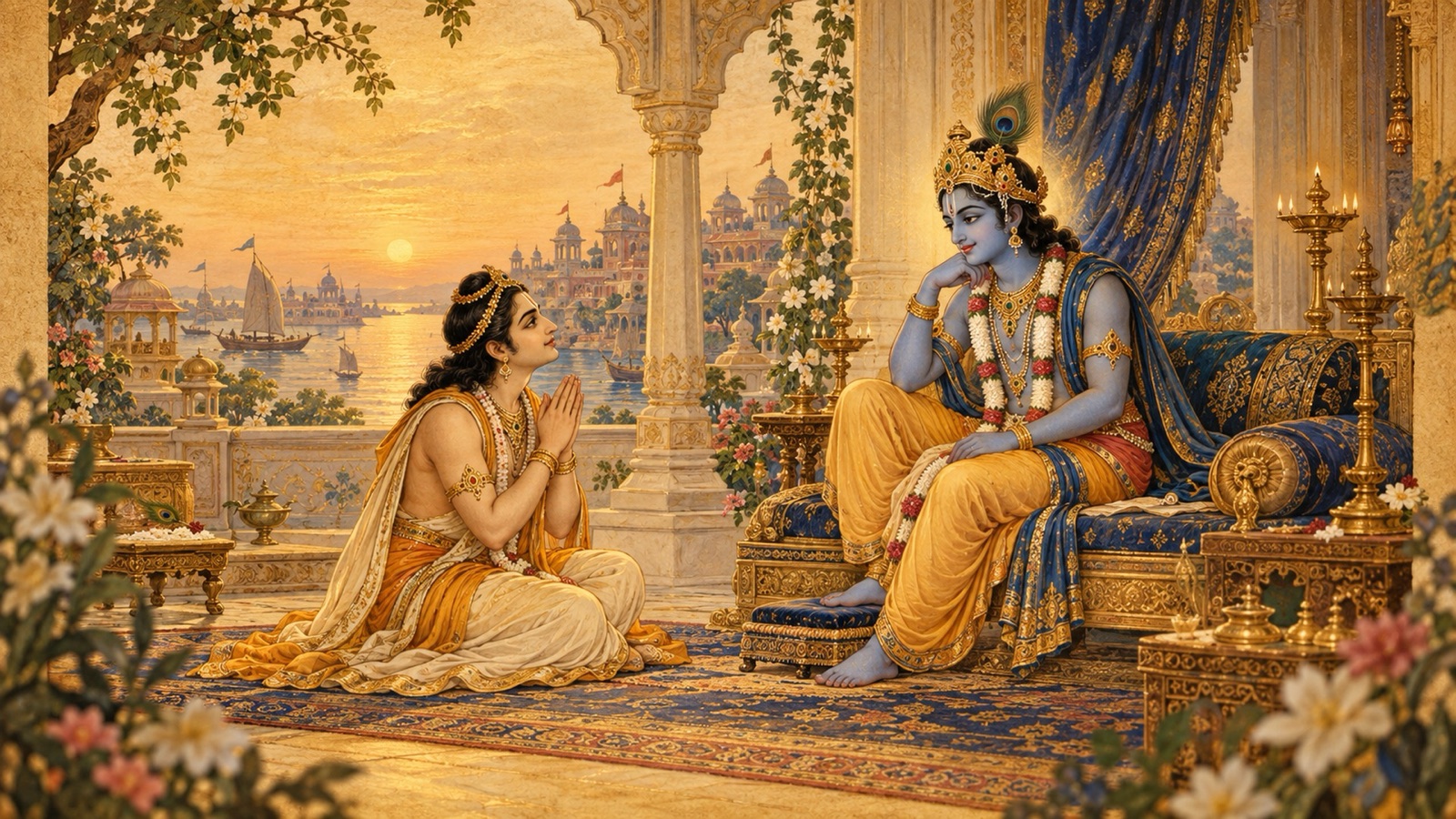
The Lord answered with great tenderness. So long as the undiscriminating soul remains in contact with body, senses and vital airs, this round of joy and sorrow bears fruit, though it has no reality at all. It does not cease for a soul absorbed in sense-objects any more than a dream’s troubles cease for a sleeper before the dream breaks, though nothing in it, not even the dreaming body, is real. That same dream which tortures the unawakened cannot trouble one who has woken; so what torments the ignorant leaves the wise untouched. Grief, delight, fear, anger, greed and craving, even birth and death, belong only to the ego, never the Self. The spirit hidden behind body, senses and mind, mistaking itself for them, is called the jiva, revolving through samsara under Time — until the contemplative soul, cutting down this rootless ego-tree with the sword of wisdom sharpened by worship, wanders free of all thirst.
The Gold That Wears Many Names
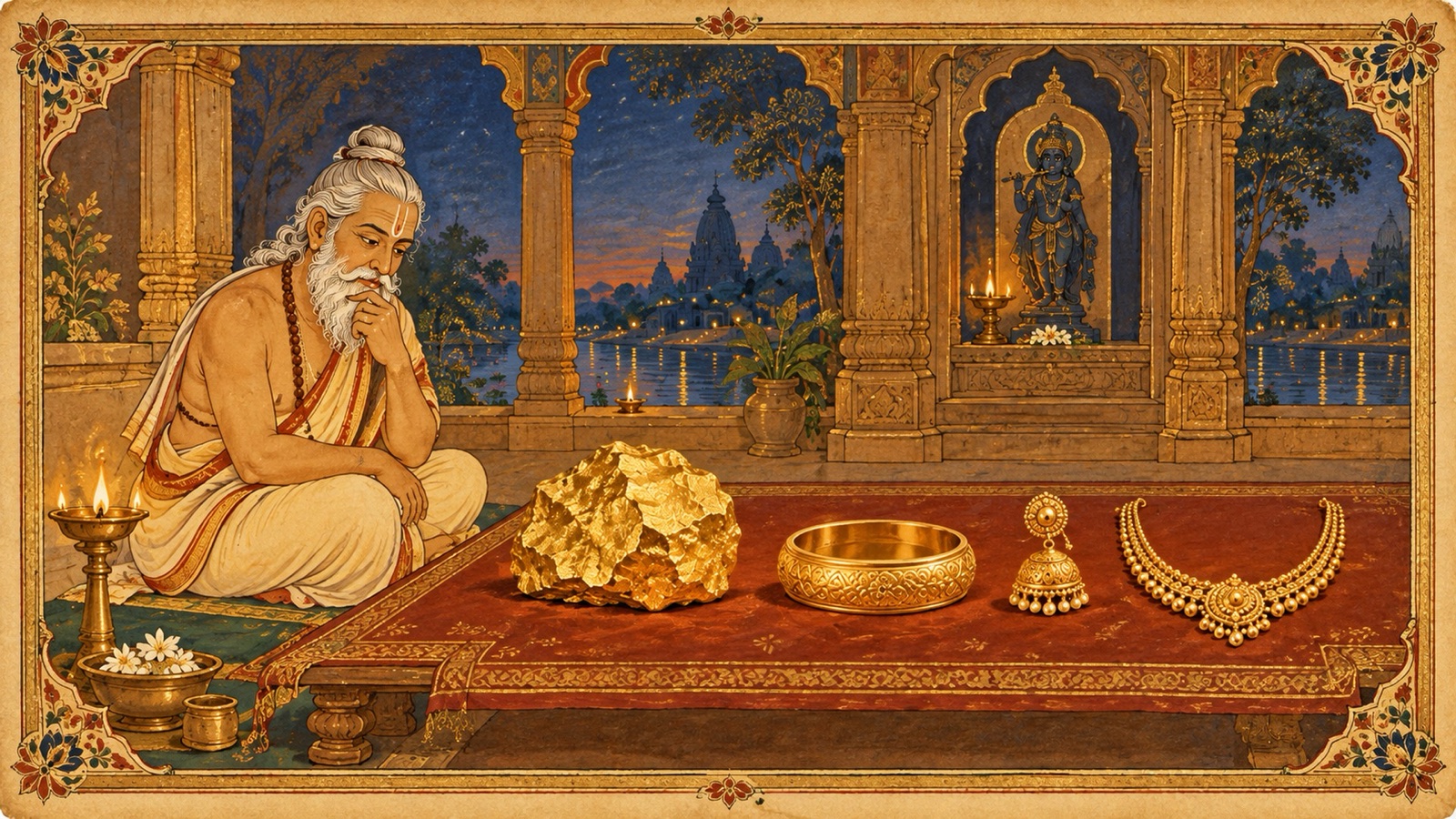
True wisdom, the Lord said, is the clear discrimination of the Self from all that is not the Self, reached through Vedic teaching, the word of exalted souls, reasoning and realization. Such discrimination yields one conviction: whatever existed before creation and remains after its dissolution must be present now, in the middle too — and that is Brahma, the one cause and revealer of this universe.
यथा हिरण्यं स्वकृतं पुरस्तात् पश्चाच्च सर्वस्य हिरण्मयस्य । तदेव मध्ये व्यवहार्यमाणं नानापदेशैरहमस्य तद्वत् ॥ १९ ॥
yathā hiraṇyaṁ sv-akṛtaṁ purastāt paścāc ca sarvasya hiraṇ-mayasya tad eva madhye vyavahāryamāṇaṁ nānāpadeśair aham asya tadvat
Meaning: As gold, before being wrought into ornaments and after they are melted down, remains the same gold even while called by many names in the middle — earring, bangle and so on — so do I exist before and after this universe, and am called by many names even in its midst, for the creation is nothing other than Myself. (Canto 11, Chapter 28, verse 19)
That alone is real, the Lord said, by which the mind’s three states and this threefold world become visible, and which persists even when every such distinction dissolves, as in deep samadhi. What never existed before creation and will not remain after it does not exist now either, except in name — for an effect is never other than the cause from which it arose.
The Sun Behind the Clouds
By this discrimination, and by the grace of a true preceptor, one grows sated with the bliss of realization and withdraws from the senses. The body — earth, senses, breath, mind, reason — however dressed, is simply not the Self. What is gained or lost when the senses, made of the gunas, are tossed about? What does the sun gain or lose when clouds gather or drift away? Just as the open sky stays untouched by wind, fire, rain or season, so the transcendent Self is never stained by the impurities that drag the body-bound soul through transmigration.
The Mind’s Unhealed Wound and the Cure of Devotion
And yet, the Lord continued, attachment to sense-pleasure must still be given up with patient care.
तथापि सङ्ग: परिवर्जनीयो गुणेषु मायारचितेषु तावत् । मद्भक्तियोगेन दृढेन यावद् रजो निरस्येत मन:कषाय: ॥ २७ ॥
tathāpi saṅgaḥ parivarjanīyo guṇeṣu māyā-raciteṣu tāvat mad-bhakti-yogena dṛḍhena yāvad rajo nirasyeta manaḥ-kaṣāyaḥ
Meaning: Even so, attachment to the modes of nature fashioned by Maya must be carefully renounced, until the mind’s impurity of passion is cast off by the firm practice of devotion unto Me. (Canto 11, Chapter 28, verse 27)
Just as a carelessly treated disease keeps sprouting fresh pain, a mind whose passions and old karma remain unburned, still clinging to wealth and family, brings down the yogi who has not reached perfection. Such souls, frustrated by obstacles placed before them as if by the gods, still return to Yoga by the strength of habit from former births, though never again to mere ritual. The ignorant soul acts until death, tossed between joy and sorrow; the enlightened soul, seated in that same body, is not so tossed, his thirst already ceased in the bliss of realization.
Awake Even While Walking
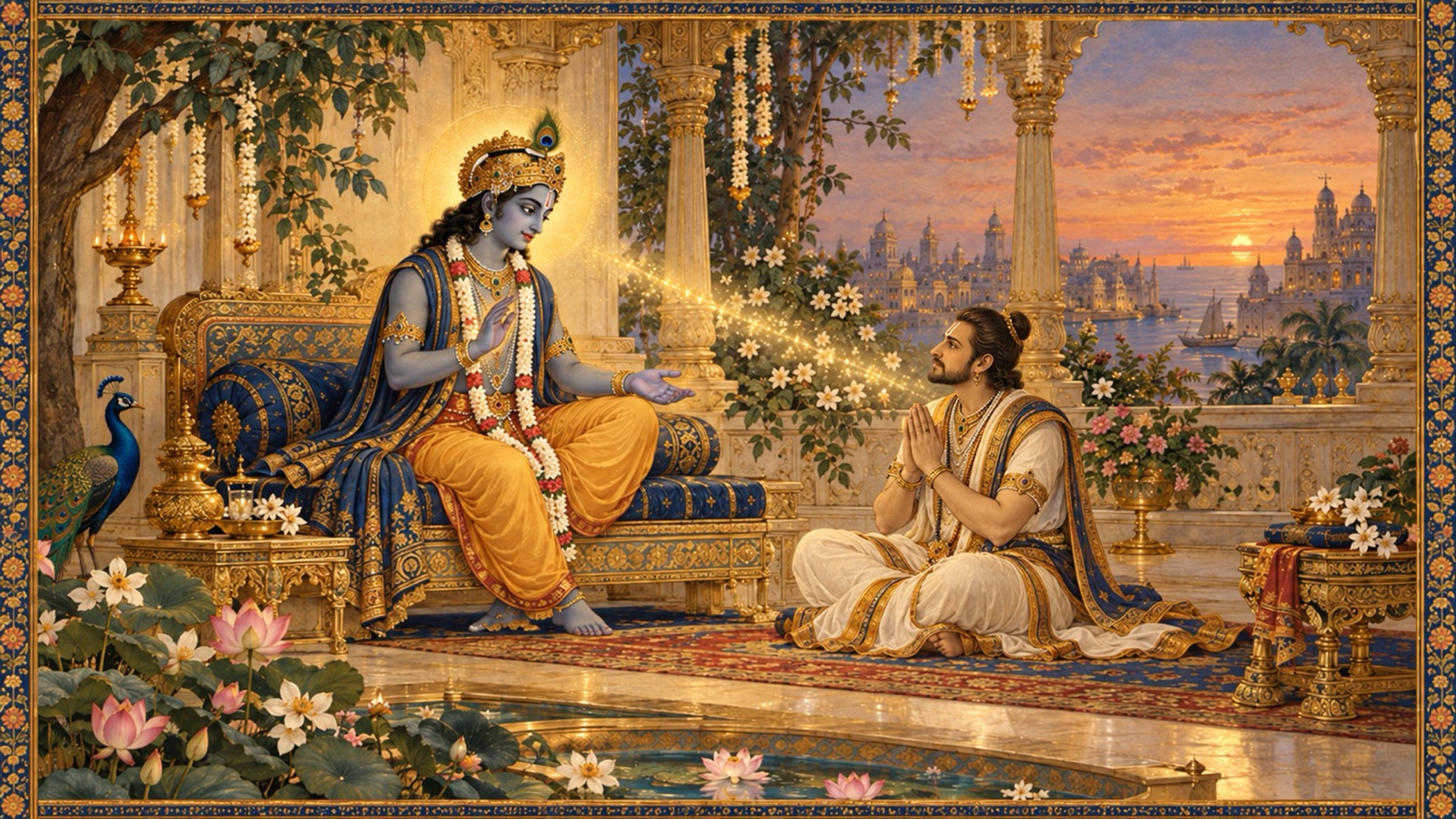
One whose mind rests wholly in the Self, the Lord said, scarcely notices whether the body stands, sits, walks or lies down. If such a person still perceives the objects his senses reach toward, he does not mistake them for anything more real than the Self — any more than a man risen from sleep mistakes a vanished dream for something that truly was. This whole fabric of body and mind, woven of the three gunas, once mistaken for the Self, dissolves now in the light of knowledge, dear Uddhava — though the Self can never be grasped, nor cast away. Just as sunrise only disperses darkness without creating anything that was not already there, true realization of Me merely dispels the darkness over the mind. The Self is never truly hidden; it is self-luminous, beyond birth, beyond every proof, unbounded by time or place, remaining one without a second even when all words fall silent, for speech and the senses move only when impelled by It. The very notion of difference within this one Self is wholly a delusion, with no ground anywhere but in the mind itself.
The Remedy for Obstacles on the Path
If a yogi’s body is suddenly visited by some calamity, the Lord said, here is the remedy. Heat and cold may be overcome through concentration on the moon and sun; the ailments of wind, through yogic postures joined with concentration on the breath; and others, from evil stars or serpents, through austerity, sacred formulas and medicine, as each requires.
कांश्चिन्ममानुध्यानेन नामसङ्कीर्तनादिभि: । योगेश्वरानुवृत्त्या वा हन्यादशुभदान् शनै: ॥ ४० ॥
kāṁścin mamānudhyānena nāma-saṅkīrtanādibhiḥ yogeśvarānuvṛttyā vā hanyād aśubha-dān śanaiḥ
Meaning: Some obstacles — those that yield evil results, such as lust and anger — one should gradually overcome through contemplation upon Me and the loud chanting of My holy names, and others, such as hypocrisy and pride, by humbly attending upon the masters of Yoga. (Canto 11, Chapter 28, verse 40)
Some seekers take up Yoga chiefly for mystic power, but the wise set little store by such a goal, for the body is as perishable as the fruit of a tree. Even should a diligent yogi’s body grow unusually fit, a wise man does not cling to that fitness or let it draw him from practice; he remains devoted to the Lord alone.
The Chapter’s Closing Word
To this teaching the Lord gave one final, luminous assurance, gathering knowledge and devotion into a single promise.
योगचर्यामिमां योगी विचरन् मदपाश्रय: । नान्तरायैर्विहन्येत नि:स्पृह: स्वसुखानुभू: ॥ ४४ ॥
yoga-caryām imāṁ yogī vicaran mad-apāśrayaḥ nāntarāyair vihanyeta niḥspṛhaḥ sva-sukhānubhūḥ
Meaning: The yogi who, taking shelter in Me, carries on this practice of Yoga is never baffled by obstacles; he is free of every hankering and rests always in the bliss of Self-realization. (Canto 11, Chapter 28, verse 44)
Principal Teachings of This Chapter
1. One Self, every nature. Seeing the universe as a single manifestation of the Supreme, a wise person neither praises nor condemns another’s nature, since clinging to duality pulls one from one’s purpose (verses 1-2).
2. A dream not yet broken. The pain of this world persists for a soul absorbed in sense-objects exactly as a dream’s troubles persist for an unawakened sleeper, and dissolves the moment the soul wakes in knowledge (verses 3, 12-14).
3. The ego-tree cut at the root. Discernment of the Self from body and mind, gained through scripture, the word of exalted souls, reasoning and realization, cuts down the rootless ego-tree that drives the soul through endless becoming (verses 16-18).
4. The changeless witness. As the sun is unmoved by passing clouds and the sky untouched by wind or season, the Self stands forever apart from the body and its gunas, their silent witness (verses 25-26, 31-35).
5. Knowledge finds its safety only in devotion. The Lord does not leave Uddhava with knowledge alone; He shows where it rests secure. The mind’s passion is uprooted only by firm devotion to Him, and the obstacles that overturn imperfect yogis yield not to effort alone but to contemplating Him and chanting His holy names. Jnana-yoga, this chapter shows, is completed and protected by bhakti, for the yogi who depends on the Lord is never finally baffled (verses 27, 40, 43-44).
6. The Lord prescribes the cure. The Lord gives the struggling yogi, beset by illness or temptation, a patient and practical remedy — concentration, posture, austerity, and above all remembrance of Him — so no sincere seeker need despair of reaching the goal (verses 38-41).
A Devotional Reflection
What moves the heart here is not only the depth of this teaching but its tenderness. The Lord could have left Uddhava with knowledge alone — the Self is one, the world a dream, the ego a rootless tree to be cut down. Such a teaching, by itself, can feel cold, a truth for the strong and the already-free. But Krishna will not leave it there. Again and again He turns to the ordinary struggler — the yogi stumbling under old habits, the one whose body falls ill upon the path — and for each He offers a remedy, and the remedy is always Himself. To chant His name, to contemplate Him, simply to take shelter at His feet: these are not lesser practices for those who cannot manage “real” knowledge. They are the very things that make knowledge safe to hold. A truth without shelter can frighten; a truth held in loving dependence on the Lord becomes, instead, a quiet freedom — the gift Krishna gives Uddhava, and gives us too.
A Daily Devotional Practice
Today, try to see the one light shining within everyone you meet, and let that seeing soften any urge to praise or condemn. Whenever a restless craving or a flash of anger rises, pause and do as the Lord prescribes here: quietly repeat His holy name, “Om Namo Bhagavate Vasudevaya,” and let the mind settle, however briefly, in that remembrance — knowledge held safely in devotion.
Conclusion
This discourse carries Uddhava, and us with him, toward the summit of the path of knowledge. The Lord teaches that one undivided Self pervades the universe, that the praise and blame we offer each other rest on illusion, and that the pain of this world, like a dream’s trouble, persists only until the soul awakens. Through gold recast into many ornaments and clouds passing before an unmoved sun, He shows how the Self remains forever free of the body and its gunas, their silent witness. Yet He does not leave this knowledge standing alone; again and again He turns to the struggling seeker and offers, as the true cure, remembrance of Himself — contemplation, the chanting of His holy names, shelter at His feet. So the chapter closes where all true knowledge must close: in loving dependence on the Lord, where no obstacle can finally overcome the one who depends on Him.
May the divine wisdom of Srimad Bhagavatam awaken pure devotion within our hearts.
Om Namo Bhagavate Vasudevaya.
Jay Shree Madhav.
References and Attribution
- Primary edition: Gita Press, Śrīmad Bhāgavata Mahāpurāṇa (English, complete), Book Eleven, Discourse 28, pages 648-654.
- Series: Srimad Bhagavatam Wisdom · Biswa Sanatan Dharma Seva Trust.
- Presented following the spiritual guidance and recommendation of Pandit Dr. Shri Kashinath Mishra.
This is an original, faithful retelling in the writer’s own words, with brief quoted verses shown in Devanāgarī and transliteration and their meanings given as summaries. It is not a reproduction of any single publisher’s continuous translation or commentary. No affiliation with or endorsement by any publisher is implied.
Jay Shree Madhav