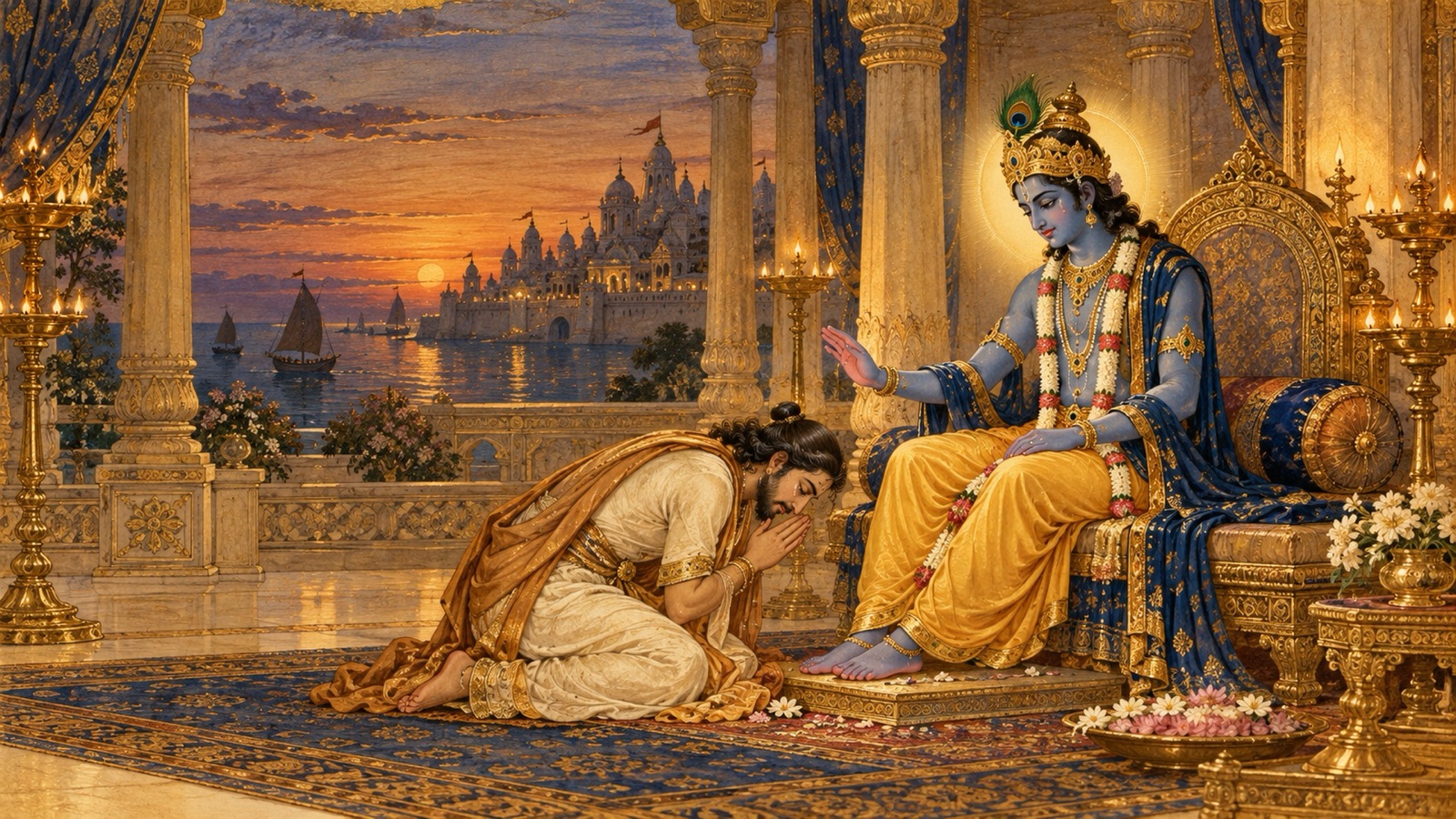
At the close of His long teaching to Uddhava, Lord Sri Krishna reveals the simplest of all paths — to see Himself present in every creature and to bow before that presence without pride — and then sends His beloved friend to the forest hermitage of Badarikashrama to carry that vision into a lifetime of quiet devotion.
Om Namo Bhagavate Vasudevaya.
Om Namo Bhagavate Vasudevaya.
Om Namo Bhagavate Vasudevaya.
Welcome to Srimad Bhagavatam Wisdom, a devotional journey through the sacred histories and teachings of the Srimad Bhagavat Mahapurana. Uddhava, with disarming honesty, confesses that mastering the mind through Yoga feels beyond him. In this closing discourse of the Uddhava-gita, the Lord answers with the gentlest of all teachings — a devotion so simple that anyone may practise it, through nothing more than remembering Him always, beholding Him in every creature, and bowing before every being He has made. The chapter closes tenderly, as Uddhava receives his Lord’s blessing and sets out for the forest of Badarikashrama.
Chapter Information
- Scripture: Śrīmad Bhāgavata Mahāpurāṇa
- Canto: 11 (Book Eleven)
- Chapter: 29 (Discourse 29)
- Chapter title: Bhakti-yoga
- Principal speaker: Sri Krishna, instructing Uddhava; Uddhava also speaks, in question and grateful praise; the whole related by Sukadeva Gosvami to King Parikshit
- Principal listener: Uddhava; and, in the outer frame, King Parikshit
- Main setting: Dwaraka, at the close of the Lord’s teaching to Uddhava, before his departure for Badarikashrama
- Central subject: The easy path of devotion — seeing the Lord in every being and bowing before all creation — and Uddhava’s farewell journey to Badarikashrama
- Principal verse range: Canto 11, Chapter 29, verses 1–49
- Primary edition: Gita Press Śrīmad Bhāgavata Mahāpurāṇa
Context from the Previous Chapter
In Chapter 28, the Lord had taught Uddhava the discipline of Sankhya — discerning the Self from the body and the modes of nature — and described the obstacles of Yoga, closing with the assurance that one who depends on Him alone is never baffled by them. Uddhava now turns to his Lord with one final question.
Uddhava Asks for the Easy Path
Uddhava submitted that this discipline of Yoga, however true, seemed extremely hard to practise for one who had not yet conquered his own mind. He asked the Lord, plainly, to tell him the way by which a person might easily attain perfection.
श्रीउद्धव उवाच सुदुस्तरामिमां मन्ये योगचर्यामनात्मन: । यथाञ्जसा पुमान् सिद्ध्येत् तन्मे ब्रूह्यञ्जसाच्युत ॥ १ ॥
śrī-uddhava uvāca su-dustarām imāṁ manye yoga-caryām anātmanaḥ yathāñjasā pumān siddhyet tan me brūhy añjasācyuta
Meaning: Uddhava submitted: I consider this Yogic discipline extremely hard to practise for one who has not mastered his mind. Pray tell me plainly, O infallible Lord, the way by which a person may easily attain perfection. (Canto 11, Chapter 29, verse 1)
Even the sincere, he said, grow weary trying to curb the mind by force; that is why the discerning take the simpler refuge of the Lord’s own lotus feet. Uddhava marvelled that the Lord, before whom even Brahma bows, should so delight in His surrendered devotees, as He once delighted in simple creatures as Sri Rama and in His childhood at Vrindavana — appearing as the teacher without and the Inner Controller within, driving all impurity from the surrendered heart.
Sri Krishna Smiles and Begins to Teach
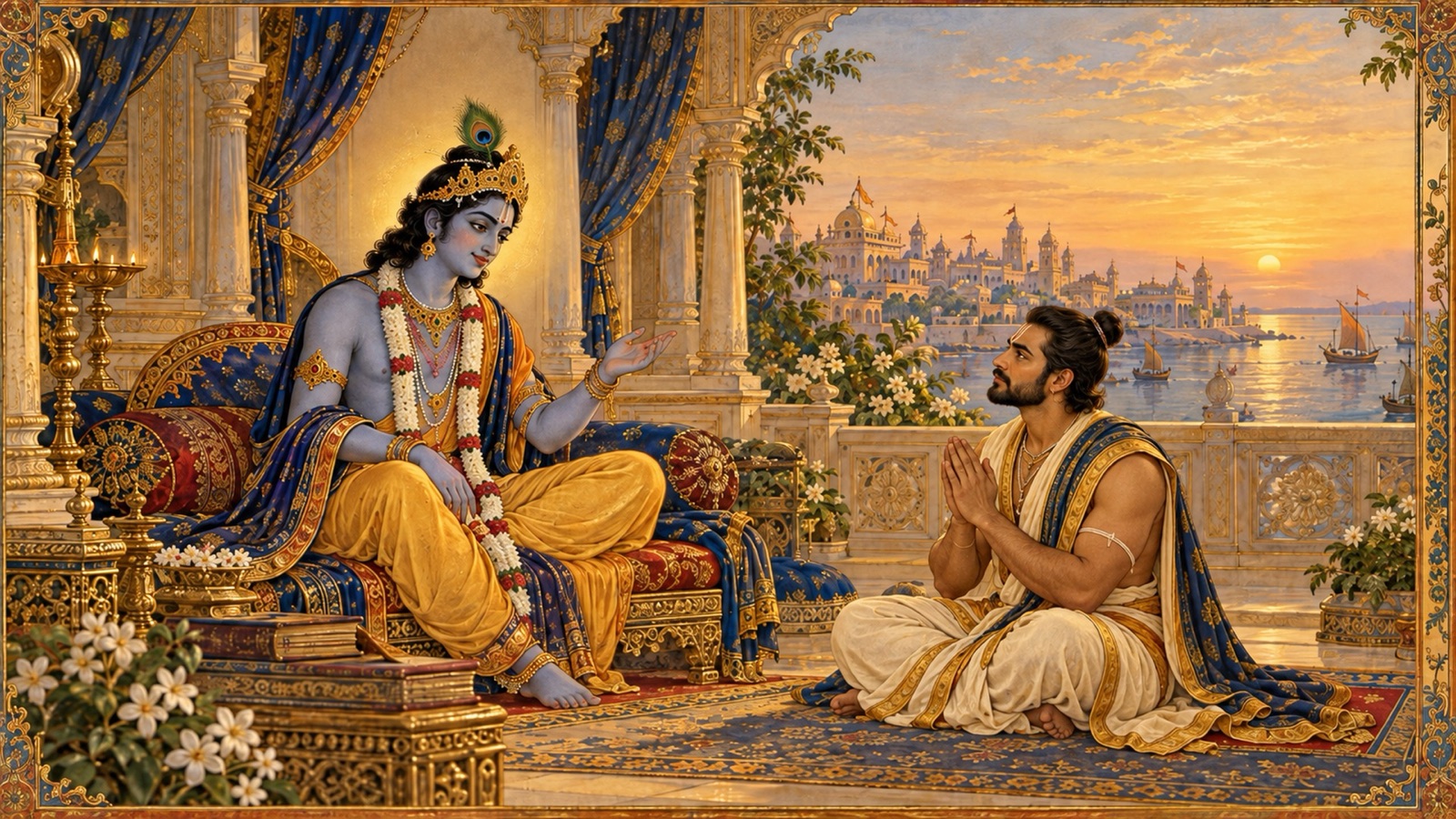
Hearing Uddhava’s question, asked with a heart wholly given to Him, Sri Krishna — the Lord even of Brahma, Vishnu and Shiva — turned to him with a smile of utmost tenderness, and began, in loving words, to teach.
The Simplest of All Courses of Conduct
The Lord said He would reveal the most auspicious conduct pleasing to Him — conduct which, followed with reverence, lets even a mortal conquer death itself.
कुर्यात् सर्वाणि कर्माणि मदर्थं शनकै: स्मरन् । मय्यर्पितमनश्चित्तो मद्धर्मात्ममनोरति: ॥ ९ ॥
kuryāt sarvāṇi karmāṇi mad-arthaṁ śanakaiḥ smaran mayy arpita-manaś-citto mad-dharmātma-mano-ratiḥ
Meaning: With mind and heart offered to Me, a person should, little by little, learn to perform every action for My sake, remembering Me all the while. (Canto 11, Chapter 29, verse 9)
He should keep company with the pious devoted to Him, the Lord continued, and honour Him on sacred days with festivals and song; and with a heart made pure, he should learn to behold the one Supreme Self pervading every creature, as untouched as the open sky.
Seeing the One Self in All Creation
Here the Lord opened the very heart of His teaching. The one who regards every being as none other than Himself, looking with the same loving eye upon the learned and the lowly, the thief and the devoted, is truly wise.
इति सर्वाणि भूतानि मद्भावेन महाद्युते । सभाजयन् मन्यमानो ज्ञानं केवलमाश्रित: । ब्राह्मणे पुक्कसे स्तेने ब्रह्मण्येऽर्के स्फुलिङ्गके । अक्रूरे क्रूरके चैव समदृक् पण्डितो मत: ॥ १३-१४ ॥
iti sarvāṇi bhūtāni mad-bhāvena mahā-dyute sabhājayan manyamāno jñānaṁ kevalam āśritaḥ brāhmaṇe pukkase stene brahmaṇye ’rke sphuliṅgake akrūre krūrake caiva sama-dṛk paṇḍito mataḥ
Meaning: O radiant one, honouring every being as Myself, and resting wholly in this knowledge — looking with an equal eye upon a learned Brahmana and the lowliest outcaste, a thief and the devoted, the sun and a spark, the gentle and the cruel — such a one is regarded as truly wise. (Canto 11, Chapter 29, verses 13–14)
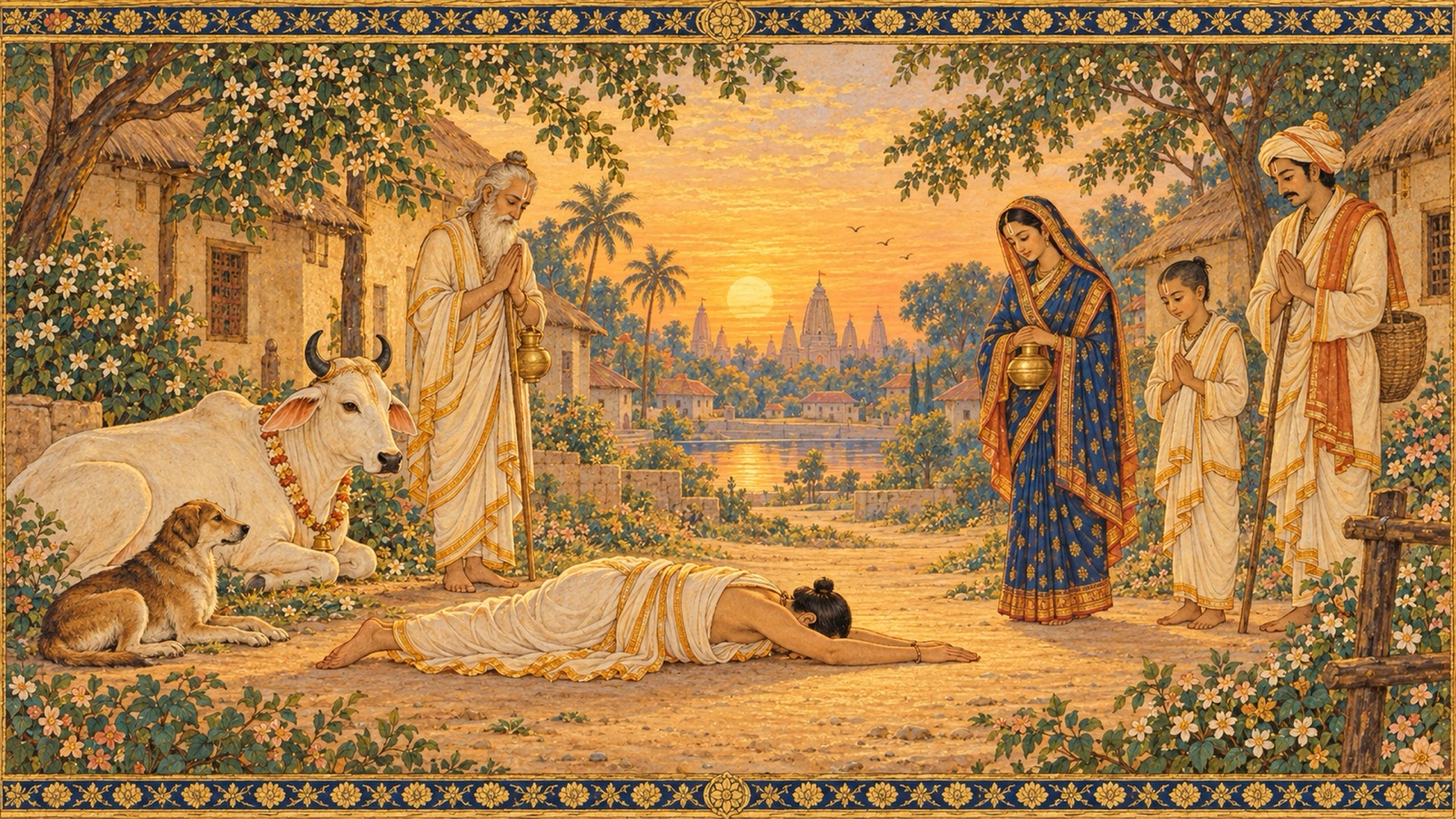
From a mind held in this vision, rivalry, fault-finding and contempt soon fall away. Then came the Lord’s most searching instruction: setting aside bodily pride entirely, the devotee should bow low to the ground before every being, offering the humblest and the most honoured the very same reverence.
विसृज्य स्मयमानान् स्वान् दृशं व्रीडां च दैहिकीम् । प्रणमेद् दण्डवद् भूमावाश्वचाण्डालगोखरम् ॥ १६ ॥
visṛjya smayamānān svān dṛśaṁ vrīḍāṁ ca daihikīm praṇamed daṇḍa-vad bhūmāv ā-śva-cāṇḍāla-go-kharam
Meaning: Giving up the laughter of his own people and all shame born of the body, he should fall full length upon the earth and bow before every creature, from the dog, the outcaste, the cow and the ass, to the most honoured among men. (Canto 11, Chapter 29, verse 16)
Until this conviction stood firmly rooted in the heart, the Lord said, one should continue worshipping Him in this way with speech, mind and body; and once all is seen as Brahman alone, the seeker, doubts dissolved, may rest at last from such outward striving.
अयं हि सर्वकल्पानां सध्रीचीनो मतो मम । मद्भाव: सर्वभूतेषु मनोवाक्कायवृत्तिभि: ॥ १९ ॥
ayaṁ hi sarva-kalpānāṁ sadhrīcīno mato mama mad-bhāvaḥ sarva-bhūteṣu mano-vāk-kāya-vṛttibhiḥ
Meaning: Of all the disciplines there are, this alone I consider the truest and the best — to see Me present in every being, through the engagement of mind, speech and body. (Canto 11, Chapter 29, verse 19)
There is no loss whatsoever in this course, the Lord assured Uddhava, for it is free of craving; even a fruitless act, offered without self-interest, is lifted to the level of righteousness. Here, He said, lies true wisdom — that through this perishable frame, one may attain, even in this life, to Him, the one changeless reality.
The Whole of the Vedanta, and the Gift of Sharing It
This teaching, the Lord said, holds the entire substance of the Vedanta, difficult even for the gods to grasp; whoever treasures it will come to know the everlasting Brahman hidden within the Vedas. To any teacher who shares it generously, He promised His own Self in return, and the reverent listener comes thereby to practise the highest devotion.
The Lord then asked, with affection, whether Uddhava’s grief had truly been dispelled, and cautioned that this teaching should never reach the hypocrite or the irreverent, but should be shared with whoever is pure-hearted — even those born outside the learned castes, and women, wherever true devotion lives. Nothing remains to be known, He said, by one who has drunk this knowledge, just as nothing remains after the nectar of immortality itself.
Krishna’s Gift of Union With Himself
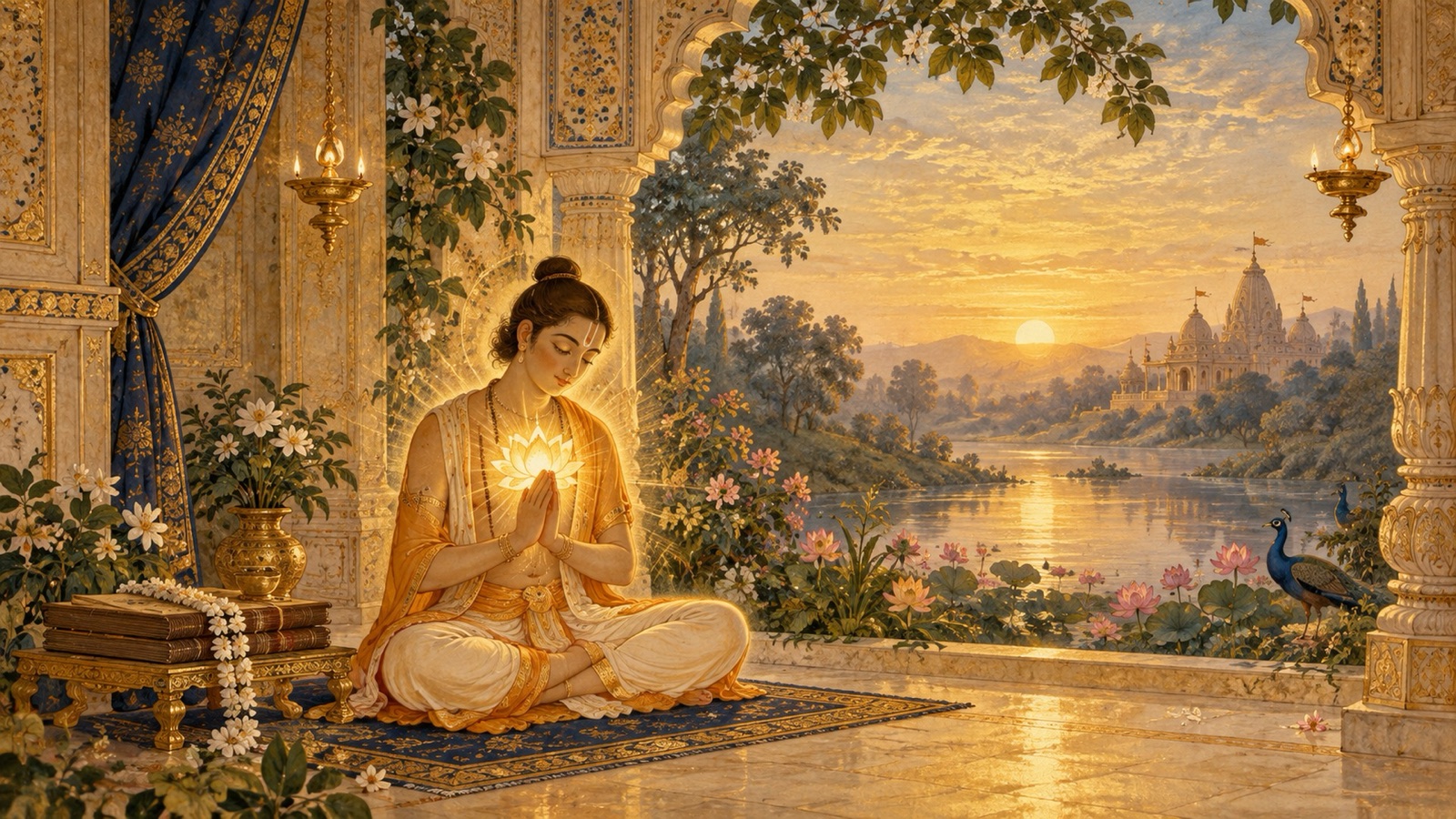
To devotees such as Uddhava, the Lord gives at once the entire fourfold aim of life, which others reach only piecemeal. When a mortal relinquishes every claim upon his own actions and offers his whole self to the Lord, that soul is chosen for the rarest grace, crossing into immortality and union with Him.
Uddhava’s Heart Overflows
Hearing this teaching, Uddhava stood with folded palms, his eyes brimming with tears, and for a long moment could say nothing, his voice choked by love. Steadying his heart with effort, and counting himself blessed, he touched his head to the Lord’s feet and found his voice.
The darkness of ignorance he had carried, Uddhava said, had been swept away by the Lord’s teaching, as cold flees before fire; the lamp of wisdom had been restored to him by the Lord’s compassion alone. The bond of affection for his kinsmen, spread by the Lord’s own Maya, had been cut through by the sword of Self-realization. With deep humility he asked only that unfailing love for the Lord’s lotus feet might abide in his heart forever.
Krishna Sends Uddhava to the Sacred Forest
In answer, the Lord instructed Uddhava to go, by His own command, to His hermitage known as Badarikashrama, and there live out this very teaching in body and spirit.
गच्छोद्धव मयादिष्टो बदर्याख्यं ममाश्रमम् । तत्र मत्पादतीर्थोदे स्नानोपस्पर्शनै: शुचि: ॥ ४१ ॥
gacchoddhava mayādiṣṭo badary-ākhyaṁ mamāśramam tatra mat-pāda-tīrthode snānopasparśanaiḥ śuciḥ
Meaning: Go now, Uddhava, by My command, to My hermitage called Badari; there, purified by bathing in the waters that have touched My feet. (Canto 11, Chapter 29, verse 41)
So instructed, Uddhava was to live simply, clothed in bark, sustained by wild fruit, patient under heat and cold, gentle, self-controlled and at peace, his mind and speech absorbed in the Lord — and so, rising above the three courses that await the soul, he would at last attain to the Lord Himself.
Uddhava’s Farewell and the Road to the Himalayas
Thus instructed, Uddhava circled the Lord reverently, and then, placing his head upon the Lord’s feet, bathed them with tears he could not hold back, his heart overflowing even though the teaching had carried him beyond joy and sorrow. Unable to bear the parting easily, he lingered, bowing again and again, before taking his leave — bearing upon his own head, as a cherished gift, the wooden sandals that had touched those sacred feet.

Carrying the Lord enshrined in the innermost chamber of his heart, the great devotee journeyed on until he reached Vishala, the sacred forest also known as Badarikashrama; and there, practising austerity exactly as his Lord had taught him, he attained in time to that very state of being one with Sri Hari.
The Treasure of This Teaching
Whoever tastes even the smallest portion of this nectar of wisdom — given by Sri Krishna to His beloved devotee — is not only liberated in his own heart, but becomes, through his company, a means of liberation for the whole world. Sri Sukadeva Gosvami, having related this discourse to King Parikshit, closed it with his own heartfelt bow to the Lord.
भवभयमपहन्तुं ज्ञानविज्ञानसारं निगमकृदुपजह्रे भृङ्गवद् वेदसारम् । अमृतमुदधितश्चापाययद् भृत्यवर्गान् पुरुषमृषभमाद्यं कृष्णसंज्ञं नतोऽस्मि ॥ ४९ ॥
bhava-bhayam apahantuṁ jñāna-vijñāna-sāraṁ nigama-kṛd upajahre bhṛṅga-vad veda-sāram amṛtam udadhitaś cāpāyayad bhṛtya-vargān puruṣam ṛṣabham ādyaṁ kṛṣṇa-saṁjñaṁ nato ‘smi
Meaning: To end the fear of worldly bondage, the Author of the Vedas, like a bee gathering honey, drew out the essence of the Vedas as knowledge and realization, and also gave His devoted servants the nectar churned from the ocean of milk; to that foremost and original Person, known as Sri Krishna, I offer my humble bow. (Canto 11, Chapter 29, verse 49)
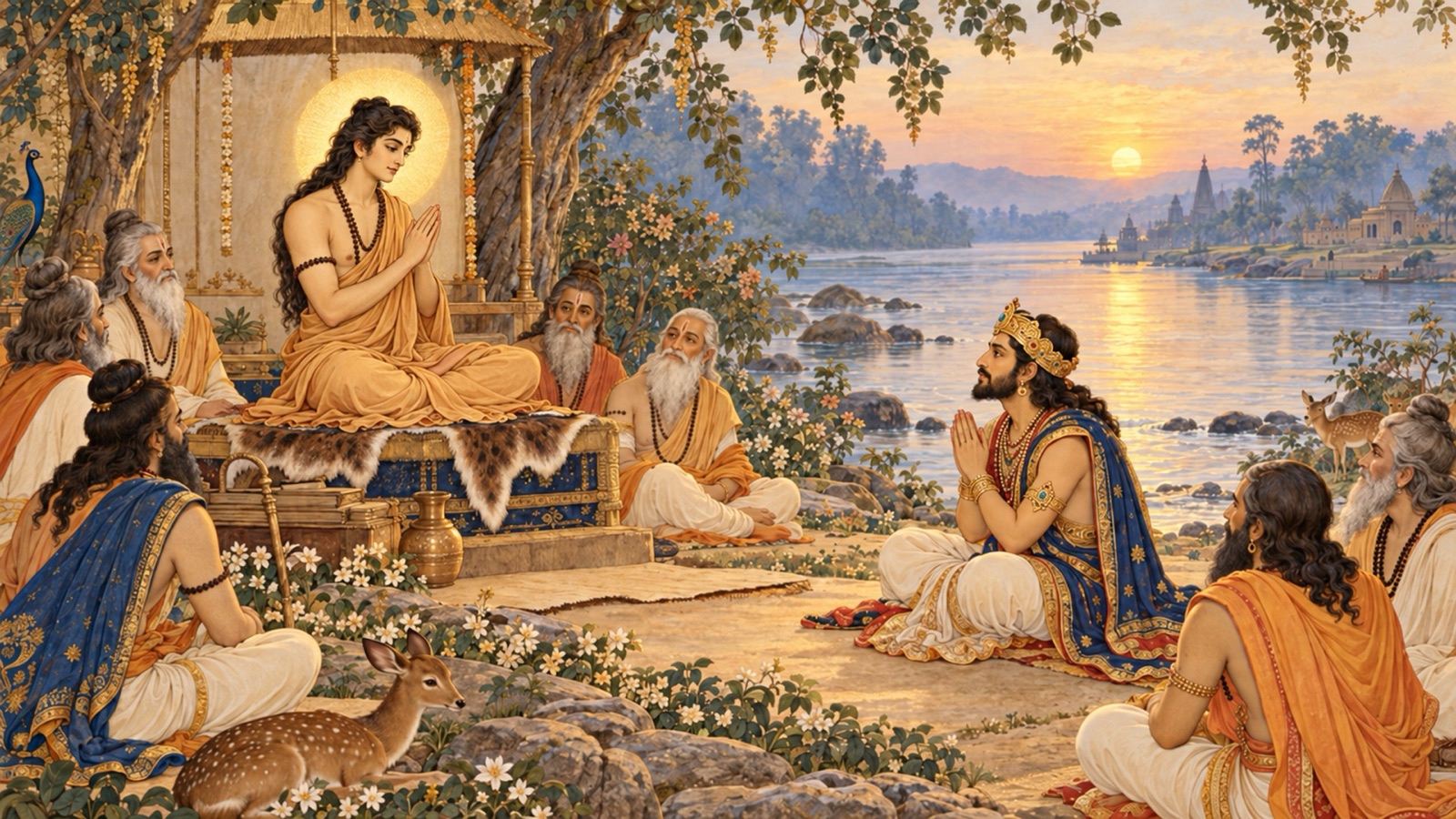
Principal Teachings of This Chapter
1. There is an easy path for every seeker. Where mastery of the mind through Yoga alone can feel beyond reach, the Lord offers a gentler way — remembering Him in every action, offering duty to Him alone, little by little (verses 1, 9).
2. Devotion is the simplest and most complete of all disciplines. After so much teaching on knowledge and Yoga, the Lord’s closing word is this: seeing Him present in all beings through mind, speech and body is the path He calls truest and best. It asks no rare qualification of birth or learning — it may be practised even by those the world counts lowly, and by women, wherever true devotion lives. Bhakti thus holds the very fruit that knowledge and Yoga seek by harder roads, open equally to every heart (verses 13–14, 19, 31).
3. Equal vision dissolves pride. To honour the learned and the outcaste, the devotee and the thief, the sun and the spark, with the same loving eye, is to let rivalry, fault-finding and contempt fall quietly away (verses 13–15).
4. Bow before all creation without shame. The Lord asks His devotee to set aside social pride entirely and bow to every being, however humble, recognising His own presence within each one (verse 16).
5. Surrender of every action brings the rarest grace. The soul who relinquishes all claim upon his own deeds and offers himself entirely to the Lord is chosen for union with Him, crossing over from mortality into the immortal (verses 33–34).
6. A life of remembrance is its own fulfilment. Sent to Badarikashrama, Uddhava shows what this teaching looks like when lived out fully — simplicity, patience, and a mind and speech absorbed in the Lord, carried quietly to the end of his days (verses 41–47).
A Devotional Reflection
What stays with the heart from this chapter is its tenderness. Uddhava admits that his own restless mind cannot be forced into stillness — and the Lord does not ask him to try harder at what has already proven so hard. Instead He offers something anyone can do: remember Me, see Me in everyone you meet, and let your pride bow down before the humblest creature you find. Nothing here needs a scholar’s mind or a yogi’s discipline, only a willing heart. True wisdom, in the Lord’s own picture of it, is simply the ability to look at a thief and a saint, a spark and the sun, with the very same love. And when Uddhava finally has to leave, his grief is not hidden; he weeps freely, even as a liberated soul, for love of Krishna is the crown of realization here, not something it leaves behind.
A Daily Devotional Practice
Today, practise the bow of equal vision that the Lord taught Uddhava. Choose one moment to set aside any sense of being greater than another, and quietly honour the Lord’s presence in someone the world tends to overlook — a stranger, an unnoticed worker, even an animal in your path. Offer this small humility silently to the Lord within your own heart. Close by softly repeating His holy name: “Om Namo Bhagavate Vasudevaya.” In this simple gesture, you walk the path the Lord called the easiest and best of all.
Conclusion
The twenty-ninth discourse of Book Eleven brings the Uddhava-gita to its luminous close. When Uddhava confesses that mastering the mind through Yoga feels beyond him, the Lord answers with the gentlest of all paths — to remember Him in every action, to see Him alive in every creature, and to bow without pride before all He has made. This vision, He says, is open to every sincere heart, whatever its birth or learning. Overcome with gratitude, Uddhava can barely speak, and asks only for love that never fails. The Lord then sends him to Badarikashrama to live out this teaching, and Uddhava departs in tears, bearing his Lord’s sandals upon his own head, until he attains, through quiet devotion, to the state of Sri Hari Himself. Here lies the chapter’s central gift — the path to the Lord is not reserved for the few, but lies open, through humble love, to every heart.
May the divine wisdom of Srimad Bhagavatam awaken pure devotion within our hearts.
Om Namo Bhagavate Vasudevaya.
Jay Shree Madhav.
References and Attribution
- Primary edition: Gita Press, Śrīmad Bhāgavata Mahāpurāṇa (English, complete), Book Eleven, Discourse 29, pages 654–659.
- Series: Srimad Bhagavatam Wisdom · Biswa Sanatan Dharma Seva Trust.
- Presented following the spiritual guidance and recommendation of Pandit Dr. Shri Kashinath Mishra.
This is an original, faithful retelling in the writer’s own words, with brief quoted verses shown in Devanāgarī and transliteration and their meanings given as summaries. It is not a reproduction of any single publisher’s continuous translation or commentary. No affiliation with or endorsement by any publisher is implied.
Jay Shree Madhav