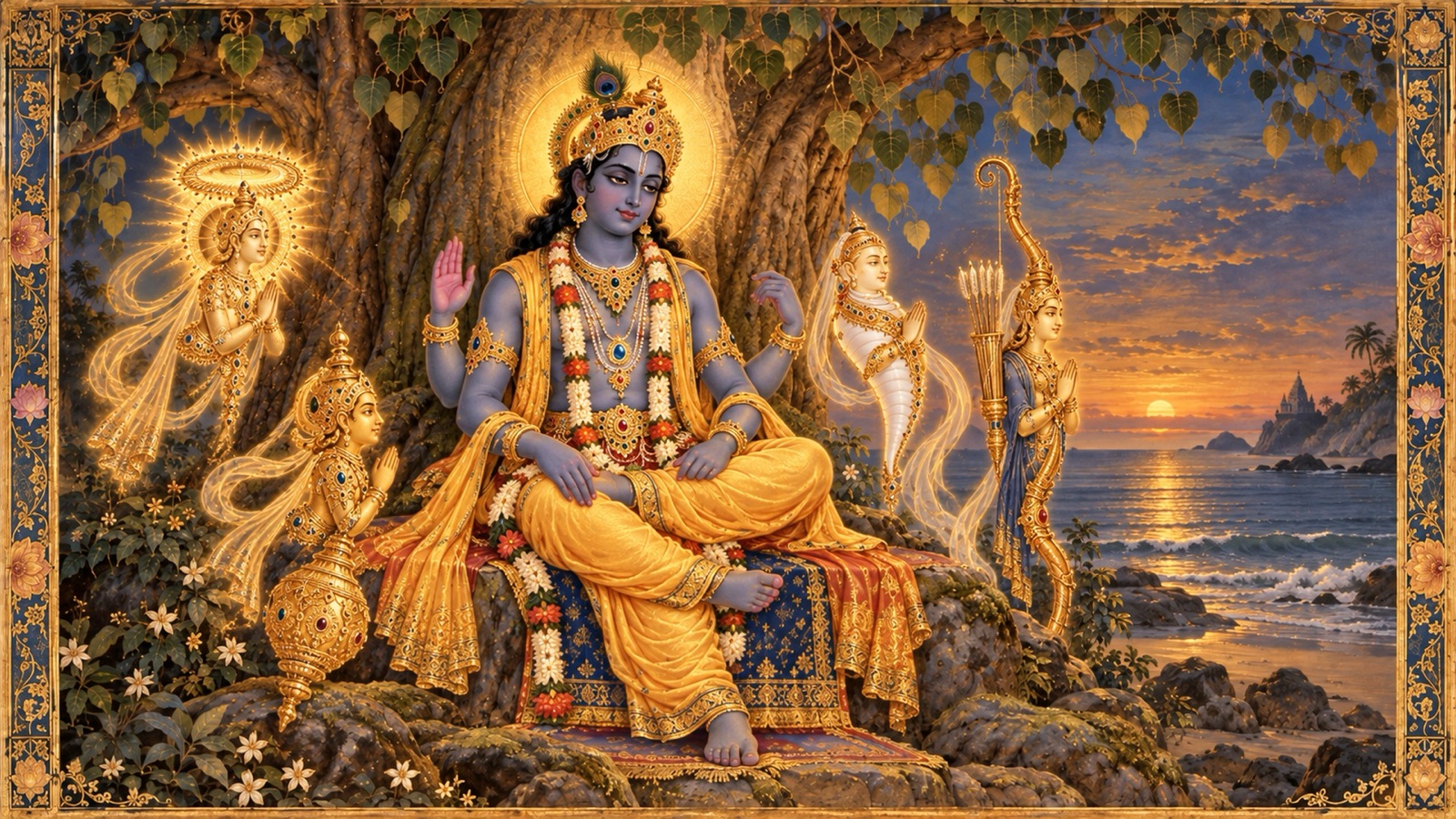
As dire omens gather over Dwaraka, Sri Krishna leads the Yadu elders to the shores of Prabhasa, where an old curse comes to its appointed end; and once His own kinsmen have departed this world, the Lord sits in radiant stillness beneath a sacred pippala tree, blesses the hunter whose arrow touches His foot, and sends His charioteer home with His final words of love.
Om Namo Bhagavate Vasudevaya.
Om Namo Bhagavate Vasudevaya.
Om Namo Bhagavate Vasudevaya.
Welcome to Srimad Bhagavatam Wisdom, a devotional journey through the sacred histories and teachings of the Srimad Bhagavat Mahapurana. Uddhava has gone to Badarikashrama, and King Parikshit now asks Sukadeva Gosvami what the Lord did next in Dwaraka. The sage answers with the most solemn hour of this whole canto, when an ancient curse comes to fulfilment and the Lord, in perfect freedom, lays aside His earthly form.
Chapter Information
- Scripture: Śrīmad Bhāgavata Mahāpurāṇa
- Canto: 11 (Book Eleven)
- Chapter: 30 (Discourse 30)
- Chapter title: The Disappearance of the Yadu Dynasty
- Principal speaker: Sukadeva Gosvami, narrating to King Parikshit; within the narration, Sri Krishna, speaking to the Yadus, to Jara, and to Daruka
- Principal listener: King Parikshit; within the narration, the Yadu elders, Jara, and Daruka
- Main setting: Dwaraka; the shore of Prabhasa where the Sarasvati meets the sea; the foot of a pippala tree nearby
- Central subject: The fulfilment of the Brahmanas’ curse in the Yadus’ end, Balarama’s yogic departure, and the Lord’s own disappearance
- Principal verse range: Canto 11, Chapter 30, verses 1–50
- Primary edition: Gita Press Śrīmad Bhāgavata Mahāpurāṇa
Context from the Previous Chapter
In Chapter 29, Sri Krishna completed His teaching to Uddhava on the Self and sent him to Badarikashrama. Uddhava bowed at His feet and departed in tears, his doubts resolved. This chapter turns to Dwaraka, where Parikshit asks what befell the Lord and His kinsmen once His devotee had gone.
Portents Over Dwaraka
King Parikshit asked: Uddhava had gone to the forest; what then did the Lord, the father of all beings, do next in Dwaraka? How did Sri Krishna, the foremost of the Yadus, cast off that body which was the delight of every eye? (verses 1–3)
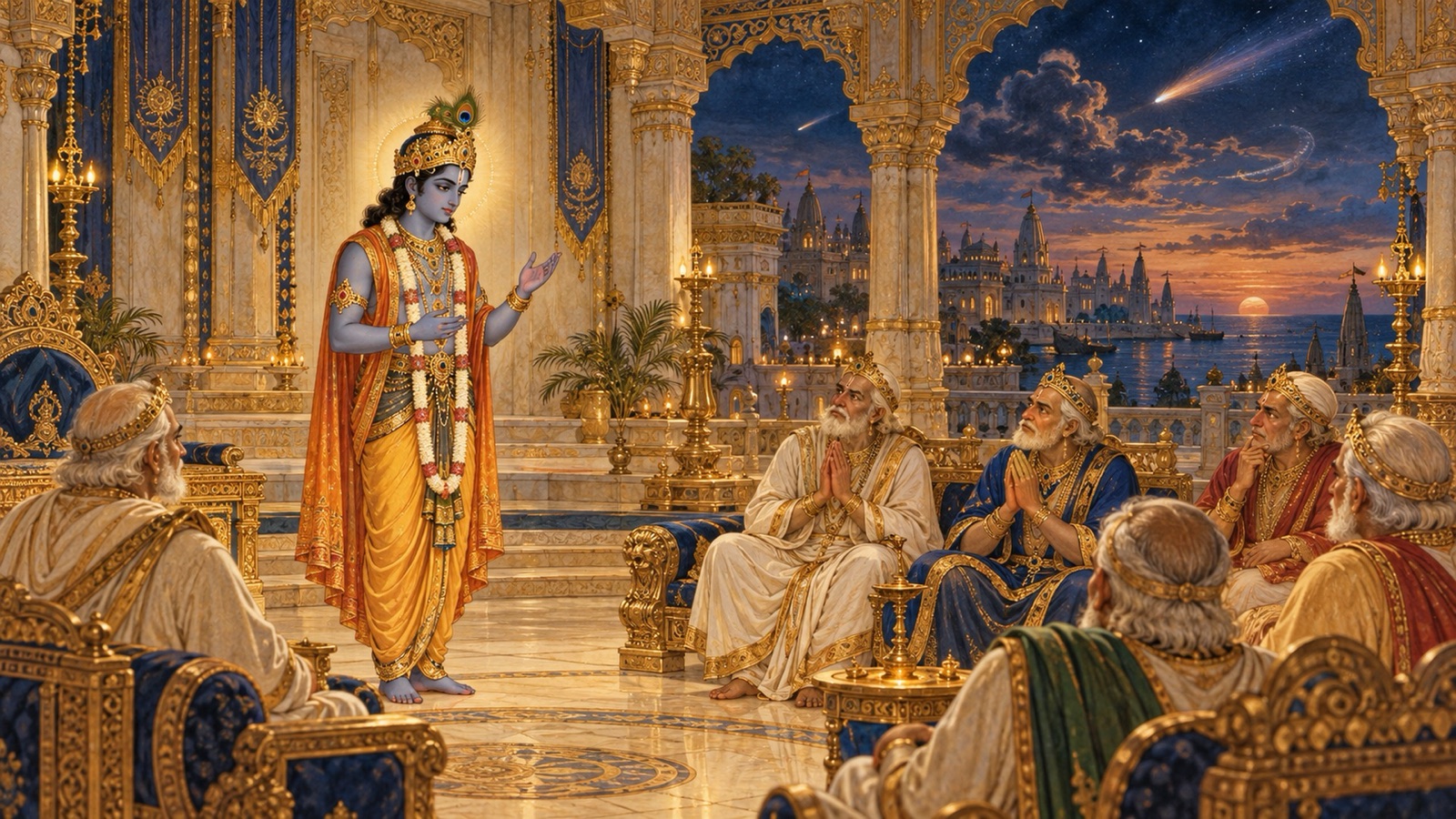
Sukadeva Gosvami answered that terrible portents now appeared in the heavens, on the earth and in the air. Seeing them, Sri Krishna spoke to the Yadu elders gathered in their assembly hall, Sudharma.
श्रीभगवानुवाच एते घोरा महोत्पाता द्वार्वत्यां यमकेतव: । मुहूर्तमपि न स्थेयमत्र नो यदुपुङ्गवा: ॥ ५ ॥
śrī-bhagavān uvāca ete ghorā mahotpātā dvārvatyāṁ yama-ketavaḥ muhūrtam api na stheyam atra no yadu-puṅgavāḥ
Meaning: The Lord said: “These terrible portents now appearing over Dwaraka proclaim its ruin. Not for a moment longer should we remain here, O chiefs of the Yadus.” (Canto 11, Chapter 30, verse 5)
He told them to send the women, children and aged at once to the sacred ground of Sankhoddhara, while the men went together to Prabhasa, where the river Sarasvati turns west to meet the sea.
The Pilgrimage to Prabhasa
At Prabhasa, the Lord instructed, they should bathe in the sacred river, fast, and worship the gods with full concentration of mind, and honour the Brahmanas with gifts of cows, land, gold and fine garments. Such worship of the gods, the Brahmanas and the cows, He said, is the surest way to turn aside misfortune and the highest means to real happiness (verse 9).
Hearing this, the Yadu elders answered, “So be it,” and journeyed to Prabhasa by boat and by chariot, where they carried out, with deep devotion, every rite the Lord had enjoined.
The Curse Awakens
Then, their judgement overtaken by destiny, the assembled heroes drank deeply of a potent liquor called Maireyaka, whose very fumes unseat the mind. Flushed with pride and bewildered by the Lord’s own enchanting power, those great warriors fell into bitter strife.
महापानाभिमत्तानां वीराणां दृप्तचेतसाम् । कृष्णमायाविमूढानां सङ्घर्ष: सुमहानभूत् ॥ १३ ॥
mahā-pānābhimattānāṁ vīrāṇāṁ dṛpta-cetasām kṛṣṇa-māyā-vimūḍhānāṁ saṅgharṣaḥ su-mahān abhūt
Meaning: Among those heroes — intoxicated with the heady drink, swollen with pride, and bewildered by the enchanting power of Krishna — a very great quarrel arose. (Canto 11, Chapter 30, verse 13)
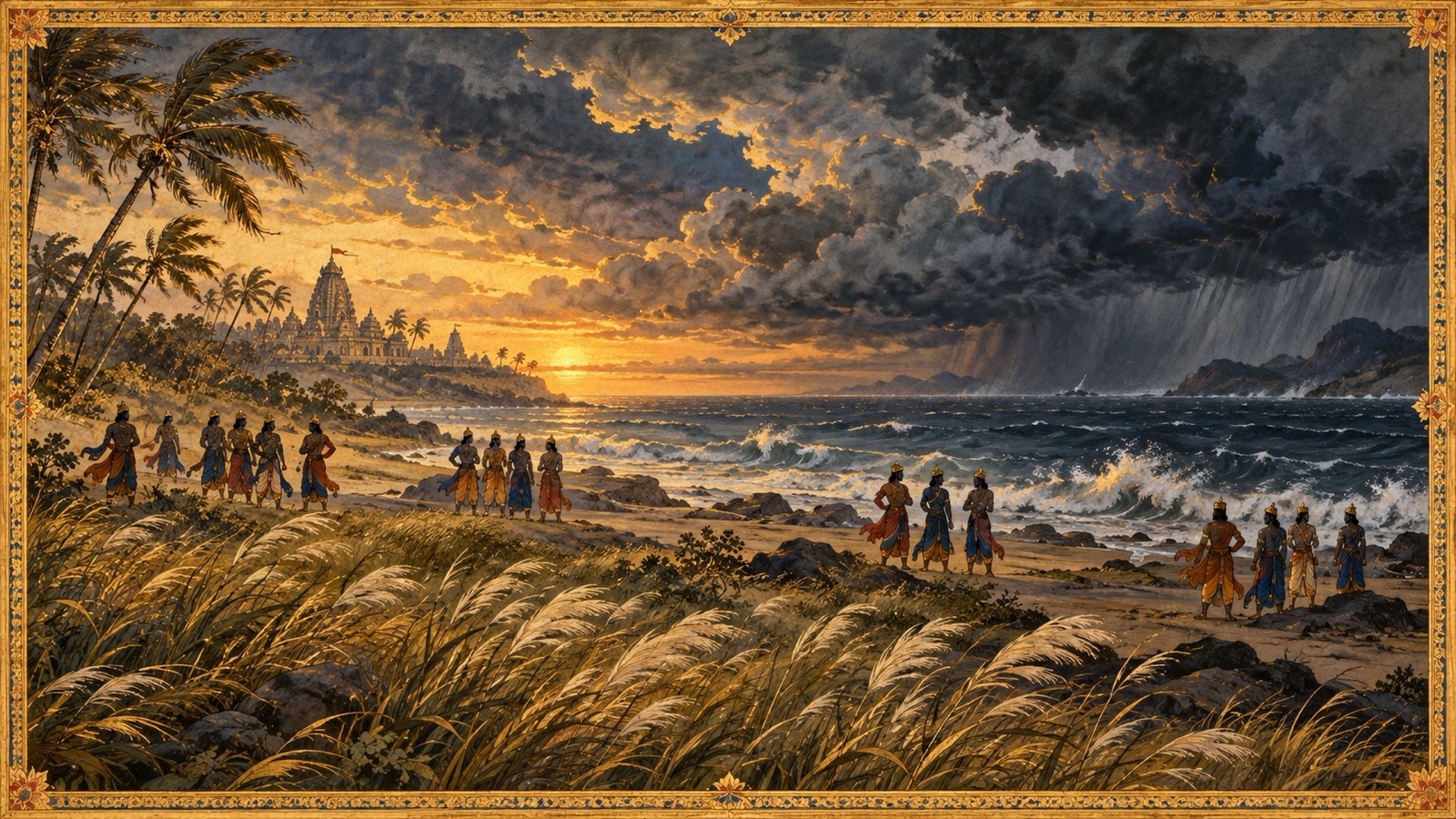
Weapons were soon taken up, and kinsman turned against kinsman in a confusion none could see through — sons against fathers, brothers against brothers, friend against friend, the whole assembly of Dasarhas, Vrishnis, Andhakas, Bhojas and Satvatas caught in the same bewildering storm (verses 14–19).
Eraka Reeds Become Thunderbolts
When their weapons were spent, the Yadus seized the tall grass growing along that shore — grass sprung, long before, from iron filings cast into the sea when the Brahmanas’ curse first took hold. Grasped in anger, that soft grass turned hard as a thunderbolt in their hands.
ता वज्रकल्पा ह्यभवन् परिघा मुष्टिना भृता: । जघ्नुर्द्विषस्तै: कृष्णेन वार्यमाणास्तु तं च ते ॥ २१ ॥
tā vajra-kalpā hy abhavan parighā muṣṭinā bhṛtāḥ jaghnur dviṣas taiḥ kṛṣṇena vāryamāṇās tu taṁ ca te
Meaning: Held fast in their fists, those blades of grass became like iron clubs; with them the warriors struck one another, and even when Krishna sought to restrain them, in their delusion they turned upon Him too. (Canto 11, Chapter 30, verse 21)
Taking Krishna and Balarama for adversaries, the maddened Yadus resolved to strike even Them, and the two Lords, thus provoked, met them with handfuls of that same grass. The fury of the Brahmanas’ curse, working through the Lord’s own bewildering power, overtook the whole clan, as fire kindled by bamboo consumes a forest (verses 22–24).
This was never a tragedy beyond the Lord’s command. He had descended for this very purpose, to lighten the burden of the earth, and the curse now fulfilling itself was the means He had long ago allowed. Seeing His own kinsmen gone, Sri Krishna simply understood that His task on earth was complete (verse 25). What looks, to our eyes, like ruin was the Lord gathering home His own, each according to his destiny — for the Lord is never a victim of events; He is always their quiet author.
Balarama’s Return to the Infinite
Standing at the edge of the sea, Lord Balarama turned within. Absorbed in the yoga of union with the Supreme Spirit, He fixed His self upon His own transcendent Self and quietly relinquished the human form He had worn.
राम: समुद्रवेलायां योगमास्थाय पौरुषम् । तत्याज लोकं मानुष्यं संयोज्यात्मानमात्मनि ॥ २६ ॥
rāmaḥ samudra-velāyāṁ yogam āsthāya pauruṣam tatyāja lokaṁ mānuṣyaṁ saṁyojyātmānam ātmani
Meaning: Standing at the edge of the sea, Balarama took up the yoga of union with the Supreme Person, and, joining His self to His own Self, gave up His human form. (Canto 11, Chapter 30, verse 26)

Krishna Beneath the Pippala Tree
Perceiving that His elder brother had gone, Sri Krishna walked to a pippala tree nearby and sat quietly against its trunk. There He revealed His own resplendent four-armed form, and, like a smokeless flame, dispelled the darkness of every direction by His own effulgence.
बिभ्रच्चतुर्भुजं रूपं भ्राजिष्णु प्रभया स्वया । दिशो वितिमिरा: कुर्वन् विधूम इव पावक: ॥ २८ ॥
bibhrac catur-bhujaṁ rūpaṁ bhrājiṣṇu prabhayā svayā diśo vitimirāḥ kurvan vidhūma iva pāvakaḥ
Meaning: Bearing His resplendent four-armed form, shining with His own radiance, He made every direction free of darkness, like a smokeless fire. (Canto 11, Chapter 30, verse 28)
Dark as a monsoon cloud, robed in gold-bright silk, garlanded and wearing the Kaustubha gem, He sat in deepest peace, left foot upon right thigh, attended by His own eternal weapons in their living forms (verses 29–32).
The Hunter’s Arrow and the Lord’s Mercy
Nearby, a hunter named Jara was at his craft, his arrowhead forged from the one piece of iron left over from the Brahmanas’ fateful pestle — the same iron that, scattered on this shore, had already become the grass that ended the Yadu clan. Seeing in the dim light a foot shaped like a grazing deer’s face, he loosed his arrow, thinking only that he had found his quarry, and pierced it (verse 33).
Drawing near, Jara saw to his horror that he had struck not a deer but the four-armed Lord of all. Trembling, he fell at Krishna’s feet and begged forgiveness, calling himself a sinner and offering even his own life in atonement (verses 34–38).
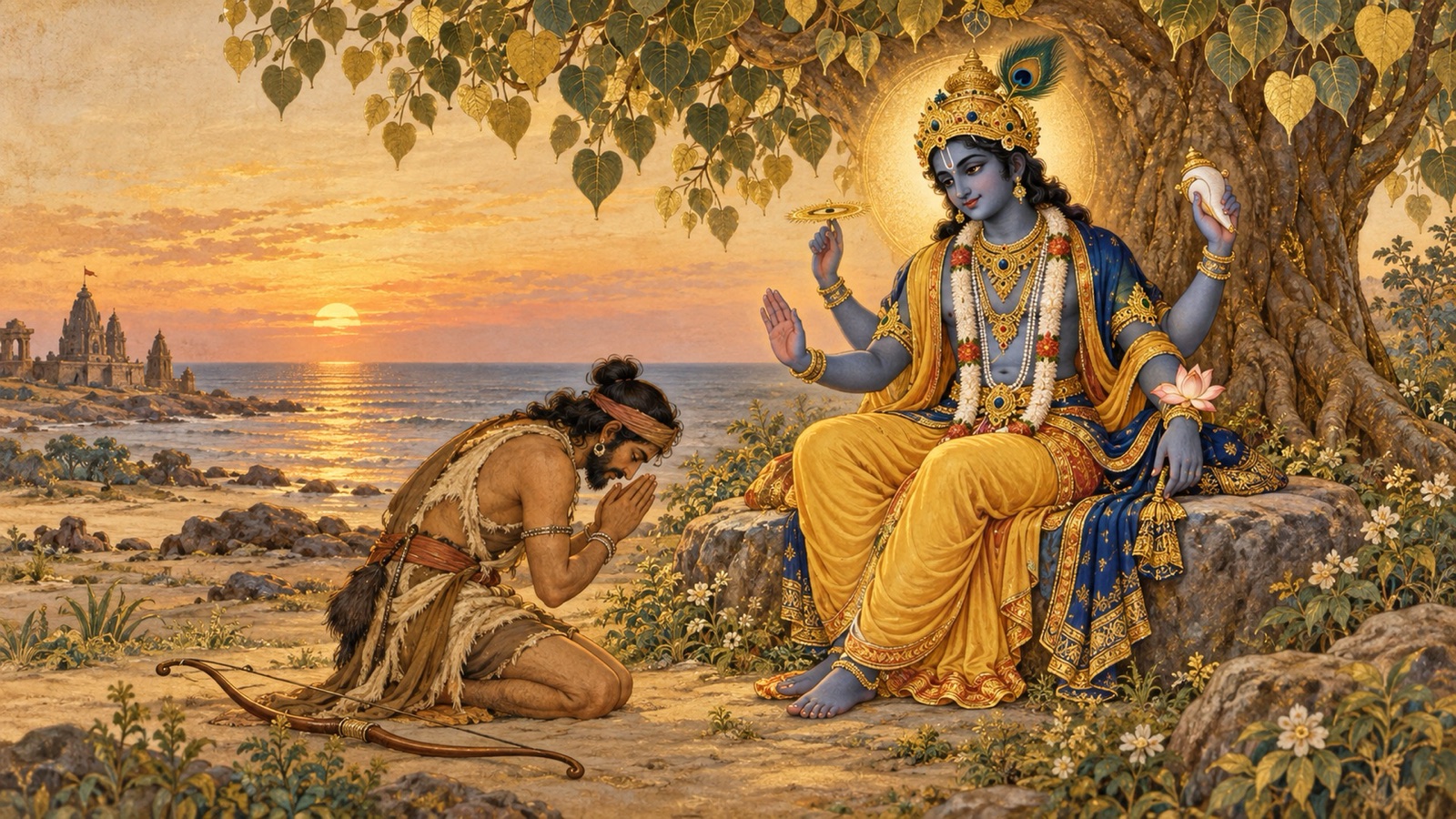
But the Lord’s answer held no anger, only tenderness for a frightened soul who had done nothing but what He Himself had quietly arranged.
श्रीभगवानुवाच मा भैर्जरे त्वमुत्तिष्ठ काम एष कृतो हि मे । याहि त्वं मदनुज्ञात: स्वर्गं सुकृतिनां पदम् ॥ ३९ ॥
śrī-bhagavān uvāca mā bhair jare tvam uttiṣṭha kāma eṣa kṛto hi me yāhi tvaṁ mad-anujñātaḥ svargaṁ su-kṛtināṁ padam
Meaning: The glorious Lord said: “Do not fear, Jara; rise. This very deed was willed by Me alone. Go now, with My own blessing, to heaven, the abode of the righteous.” (Canto 11, Chapter 30, verse 39)
Comforted, Jara circled the Lord in reverence and ascended in a celestial chariot sent for him, carried to heaven by the mercy of the very One he had feared he had wronged (verse 40).
Krishna’s Last Words to Daruka
Far away, Daruka, the Lord’s own charioteer, tracked his Master at last by the fragrance of tulasi on the breeze, found Him seated beneath the tree surrounded by His living weapons, and fell weeping at His feet. “My eyes have known only darkness, O Lord, since I ceased to behold Your feet; I can find no peace, like a traveller lost beneath a moonless sky.” (verses 41–43)
Even as he spoke, the Lord’s own chariot, bearing the emblem of Garuda, rose by itself into the sky, and His transcendent weapons rose and followed it, leaving Daruka standing in wonder (verses 44–45).
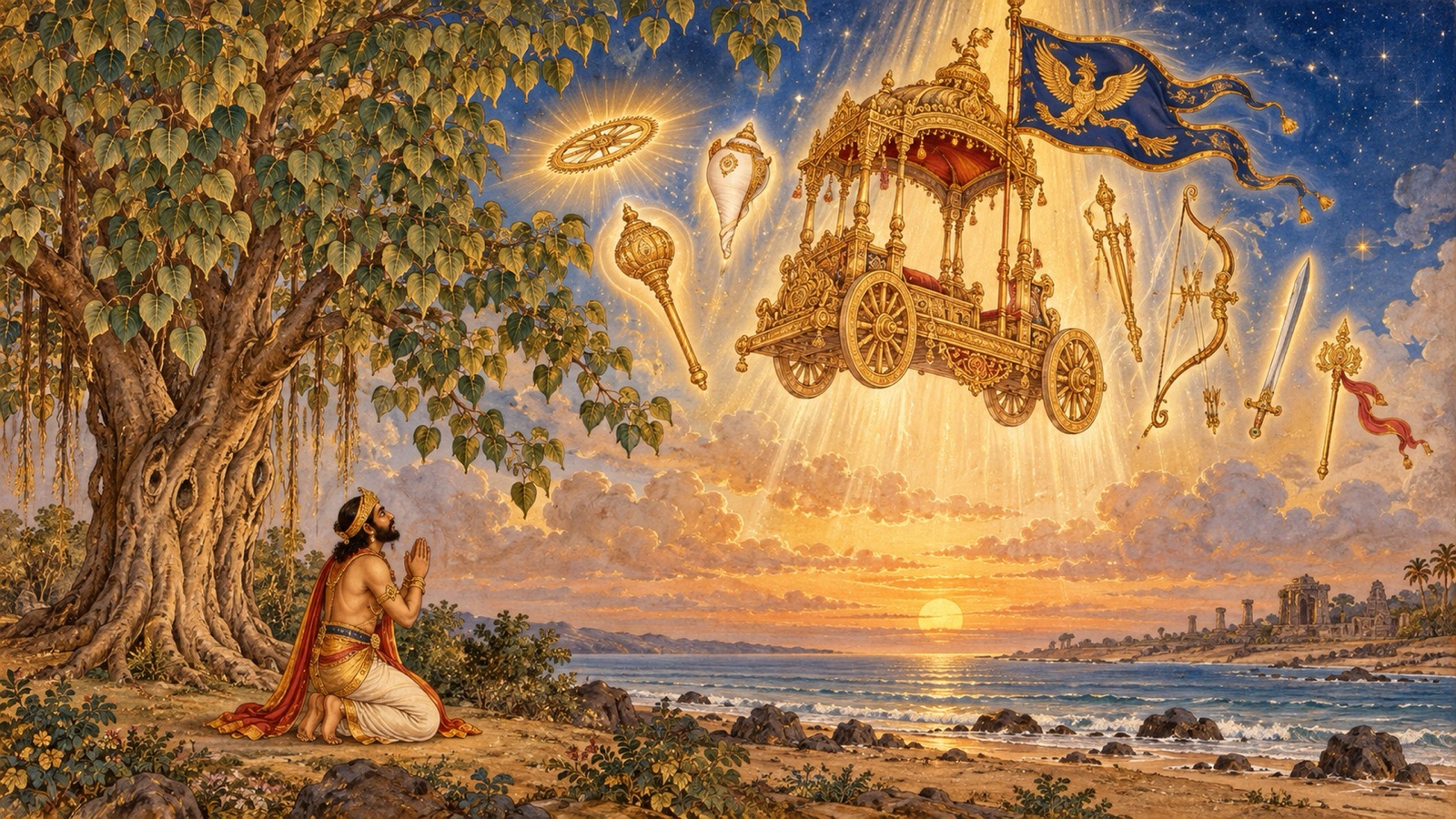
Then Sri Krishna, with perfect calm, gave him the message to carry home: tell the kinsfolk of the mutual destruction, of Balarama’s departure, and of what had now befallen the Lord Himself. None should remain in Dwaraka, for the sea would soon cover the city once forsaken by Him; each household should gather its family and possessions, take Devaki and Vasudeva with them, and, under Arjuna’s protection, journey on to Indraprastha (verses 46–48).
To Daruka himself the Lord then gave one final, personal word.
त्वं तु मद्धर्ममास्थाय ज्ञाननिष्ठ उपेक्षक: । मन्मायारचितामेतां विज्ञायोपशमं व्रज ॥ ४९ ॥
tvaṁ tu mad-dharmam āsthāya jñāna-niṣṭha upekṣakaḥ man-māyā-racitām etāṁ vijñayopaśamaṁ vraja
Meaning: “As for you, remain established in devotion to Me, steady in knowledge, and free from attachment; knowing this whole creation to be fashioned by My own Maya, go in peace.” (Canto 11, Chapter 30, verse 49)
Instructed thus, Daruka walked round the Lord in reverence, bowed to Him again and again, and set out for Dwaraka — his heart heavy, yet carrying the Lord’s own blessing with him to the very end (verse 50).
Principal Teachings of This Chapter
1. Nothing here unfolds outside the Lord’s own will. The Yadus’ end and the Lord’s own disappearance are not misfortune befalling Him but His completing, in perfect freedom, the task for which He had descended (verses 24–25, 39).
2. Even an old curse serves the Lord’s purpose. The iron of a sage’s anger becomes both the Yadus’ end and the arrowhead touching the Lord’s own foot — nothing stands outside dharma’s working, however distant its cause (verses 20–21, 33).
3. Pride and intoxication undo even the most exalted. The Yadus, heroes beloved of the Lord, fell through drink and vanity into a ruin they never intended — a warning against carelessness in the very blessings one has received (verses 12–14).
4. Yoga is the art of returning to one’s true Self. Balarama’s quiet departure, absorbed in union with the Supreme, shows the aim of all spiritual practice: resting the self in the Self, free of the body at will (verse 26).
5. The Lord forgives the one who serves His will unknowingly. Jara’s terror and the Lord’s immediate, tender reassurance are this chapter’s heart — proof that no sincere soul is ever beyond His mercy (verses 34–39).
6. The last word is always devotion, knowledge and peace. To Daruka, the Lord leaves a teaching for every devotee: remain fixed in His path, settled in knowledge, unattached to this fleeting Maya, and attain real peace (verse 49).
A Devotional Reflection
There is nothing frightening in this chapter once the heart settles into it, because nothing stands apart from the Lord. He who once lifted a mountain on His little finger now simply sits beneath a tree and lets a hunter’s arrow find His foot — not struck down, but releasing His own body exactly as He chose. And the moment that ought to feel most terrible, a frightened hunter prostrate before the One he fears he has wronged, becomes the gentlest moment in the canto: Krishna does not pause to grieve for Himself; His first word is comfort for another’s fear. Perhaps this is the deepest truth the Bhagavata offers about the Lord — that even in laying aside His form, His whole attention stays fixed on lifting the soul before Him. If we are tempted to think devotion means begging Him to spare us every hardship, this chapter asks something braver — that we trust His arrangement even when it looks like loss, and that, like Jara, the instant we recognise Him, we simply fall at His feet.
A Daily Devotional Practice
Today, when something unexpected disturbs your peace — a loss, a sudden change, a plan undone — pause before reacting, and remember that the Lord’s hand is present even there, just as it was in the hunter’s arrow. Offer the moment to Him rather than resisting it, and let your heart soften toward whoever seems to have caused it, as Krishna’s own words softened toward Jara. Close your eyes and repeat His holy name: “Om Namo Bhagavate Vasudevaya.” In that small surrender lies the same trust the Lord asks of every soul who loves Him.
Conclusion
In this solemn thirtieth discourse, the Lord brings His earthly pastime to its appointed close. Warned by fearsome portents, He sends the Yadus to Prabhasa, where an old curse awakens through drink and pride and overtakes the clan exactly as destiny required. Balarama returns to His eternal realm in yoga; Krishna, seated in peace beneath a pippala tree, receives Jara’s unknowing arrow with nothing but mercy, blessing him toward heaven. To faithful Daruka He leaves one last instruction — devotion, knowledge, freedom from attachment — before His chariot and weapons rise into the sky. Nothing here is loss: it is the Lord, in perfect love and freedom, gathering His own pastime to its close.
May the divine wisdom of Srimad Bhagavatam awaken pure devotion within our hearts.
Om Namo Bhagavate Vasudevaya.
Jay Shree Madhav.
References and Attribution
- Primary edition: Gita Press, Śrīmad Bhāgavata Mahāpurāṇa (English, complete), Book Eleven, Discourse 30, pages 660–664.
- Series: Srimad Bhagavatam Wisdom · Biswa Sanatan Dharma Seva Trust.
- Presented following the spiritual guidance and recommendation of Pandit Dr. Shri Kashinath Mishra.
This is an original, faithful retelling in the writer’s own words, with brief quoted verses shown in Devanāgarī and transliteration and their meanings given as summaries. It is not a reproduction of any single publisher’s continuous translation or commentary. No affiliation with or endorsement by any publisher is implied.
Jay Shree Madhav