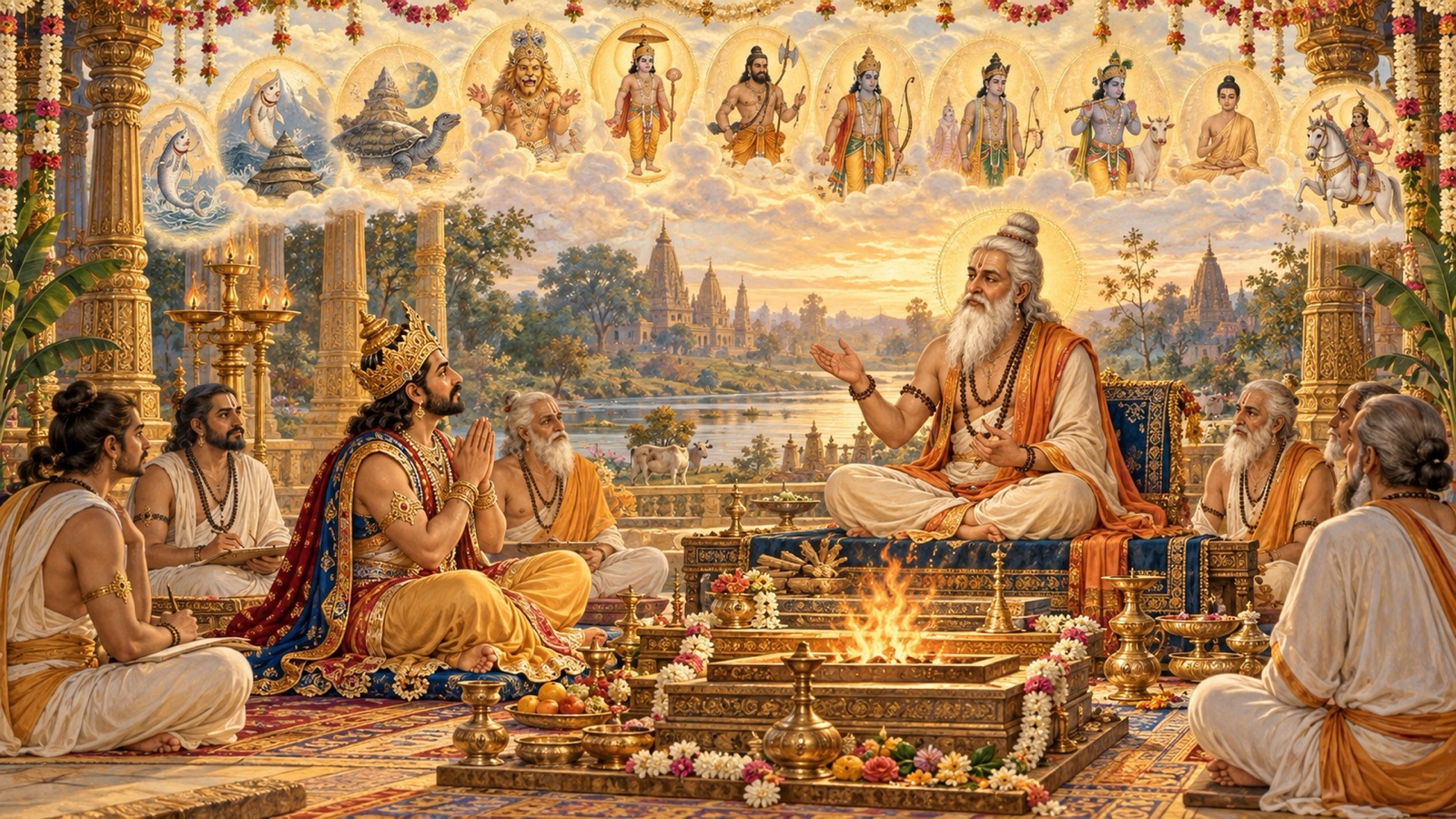
King Nimi asks the sages to recount the wondrous deeds the Lord performs in His many descents into the world. The sage Drumila answers with a sweeping remembrance of the Lord’s incarnations — from the cosmic Person and the great trinity, through Nara and Narayana, to the beloved forms of Rama and Krishna, and the descents yet to come.
Om Namo Bhagavate Vasudevaya.
Om Namo Bhagavate Vasudevaya.
Om Namo Bhagavate Vasudevaya.
Welcome to Srimad Bhagavatam Wisdom, a devotional journey through the sacred histories and teachings of the Srimad Bhagavat Mahapurana. Having heard how the Lord’s illusory energy binds the soul and how loving devotion sets it free, King Nimi now longs to hear of that same Lord’s endless compassion in action — the wondrous deeds He performs, age after age, when He descends into the world. In this fourth discourse the sage Drumila, another of the nine Yogendras, offers a radiant remembrance of the Lord’s incarnations: the descents that create and sustain the worlds, that protect the sages and the earth, that humble pride and rescue the fallen, and that, in the fullness of time, remove the burden of the earth and guard righteousness to the very end of the age.
Chapter Information
- Scripture: Śrīmad Bhāgavata Mahāpurāṇa
- Canto: 11 (Book Eleven)
- Chapter: 4 (Discourse 4)
- Chapter title: Drumila Describes the Lord’s Descents
- Principal speaker: The sage Drumila, answering King Nimi; the whole recalled by Narada to Vasudeva and narrated by Sukadeva Gosvami to King Parikshit
- Principal listener: King Nimi with his assembly; within the frame, Vasudeva and King Parikshit
- Main setting: The sacrificial arena of King Nimi in ancient Ajanabha (Bharatavarsha)
- Central subject: The descents (avataras) of the Supreme Lord and the wondrous deeds He performs in each, from the cosmic creation to the end of the age
- Principal verse range: Canto 11, Chapter 4, verses 1–23
- Primary edition: Gita Press Śrīmad Bhāgavata Mahāpurāṇa
Context from the Previous Chapter
In Chapter 3, four of the nine Yogendras revealed to King Nimi the nature of the Lord’s illusory energy, the shelter of a true teacher, the imperishable Self, and the worship that carries the soul beyond Maya. Delighted, the king now asks the sages to describe the deeds of the very Lord whose devotion they have praised — and the sage Drumila takes up the answer.
King Nimi Asks About the Lord’s Deeds
King Nimi requested the sages to narrate the various deeds that Sri Hari performs in this world through His different incarnations, assumed according to His own free will — the deeds He has done, is doing now, and will perform in time to come (verse 1).
Drumila Speaks — The Uncountable Glories
The sage Drumila began with a word of humility. One who sets out to count the endless qualities of the infinite Lord, he said, is like a child; one might somehow, in the course of time, count the particles of dust upon the earth, but never the excellences of the all-powerful Lord.
यो वा अनन्तस्य गुणाननन्ता- ननुक्रमिष्यन् स तु बालबुद्धिः । रजांसि भूमेर्गणयेत् कथञ्चित् कालेन नैवाखिलशक्तिधाम्नः ॥ २ ॥
yo vā anantasya guṇān anantān anukramiṣyan sa tu bāla-buddhiḥ rajāṁsi bhūmer gaṇayet kathañcit kālena naivākhila-śakti-dhāmnaḥ
Meaning: One who would try to count the endless qualities of the infinite Lord is surely of childish understanding; one may somehow, in time, count the particles of dust on the earth, but never the excellences of the Lord, the abode of all powers. (Canto 11, Chapter 4, verse 2)
The Cosmic Person and the Threefold Lord
When Lord Narayana, the first and foremost Deity, created the universe as His body from the elements He Himself evolved, and entered into it by a part of Himself as its indwelling controller, He became known as the Purusha. The three worlds are His body; through His organs come the organs of all creatures; by Himself He is Consciousness, and His breath is the source of all vitality and activity in the world.
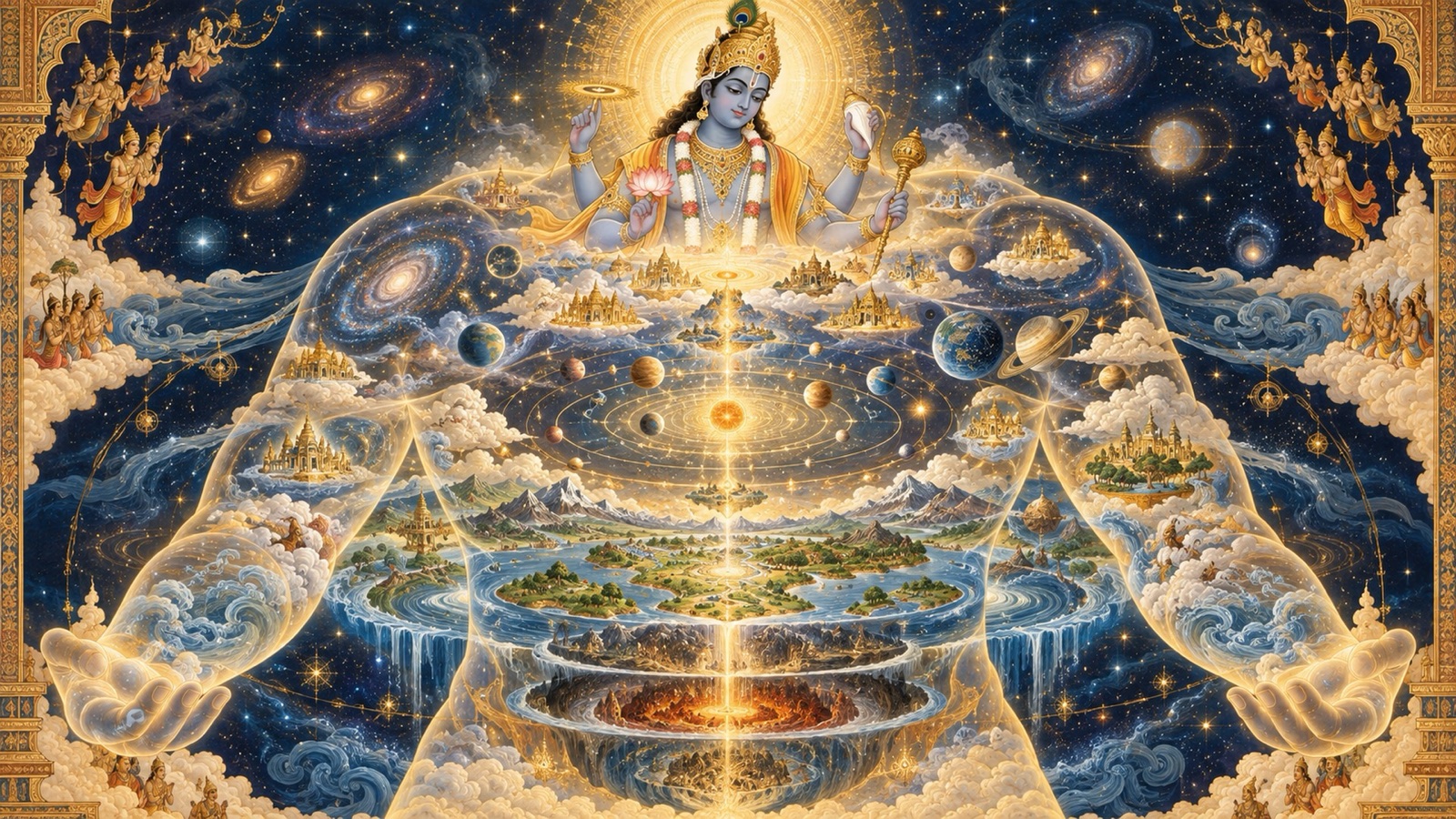
Through the qualities of sattva, rajas and tamas, Drumila continued, the one Lord becomes the author of creation, preservation and destruction. Joined with rajas He appears as Brahma to create; in sattva He appears as Vishnu to sustain the universe, to uphold righteousness among the twice-born, and to bestow the fruit of sacrifices; endowed with tamas He appears as Rudra to bring about dissolution. Through these three proceed the creation, preservation and destruction of all beings in every kalpa (verses 3-5).
Nara and Narayana
The Lord also descended as the twin sages of perfect tranquillity, Nara and Narayana, born of Murti, the daughter of Daksha and wife of Dharma. They both taught and themselves practised the path of action that leads to the knowledge of the Self, and their feet are worshipped by the greatest of sages even to this day.
धर्मस्य दक्षदुहितर्यजनिष्ट मूर्त्यां नारायणो नर ऋषिप्रवरः प्रशान्तः । नैष्कर्म्यलक्षणमुवाच चचार कर्म योऽद्यापि चास्त ऋषिवर्यनिषेविताङ्घ्रिः ॥ ६ ॥
dharmasya dakṣa-duhitary ajaniṣṭa mūrtyāṁ nārāyaṇo nara ṛṣi-pravaraḥ praśāntaḥ naiṣkarmya-lakṣaṇam uvāca cacāra karma yo ‘dyāpi cāsta ṛṣi-varya-niṣevitāṅghriḥ
Meaning: As Narayana and Nara, foremost of sages and perfectly serene, the Lord took birth of Murti, the daughter of Daksha and wife of Dharma; He both taught and practised the action that leads to freedom from action, and to this day He abides, His feet served by the greatest of sages. (Canto 11, Chapter 4, verse 6)
Pride Humbled at Badarikashrama
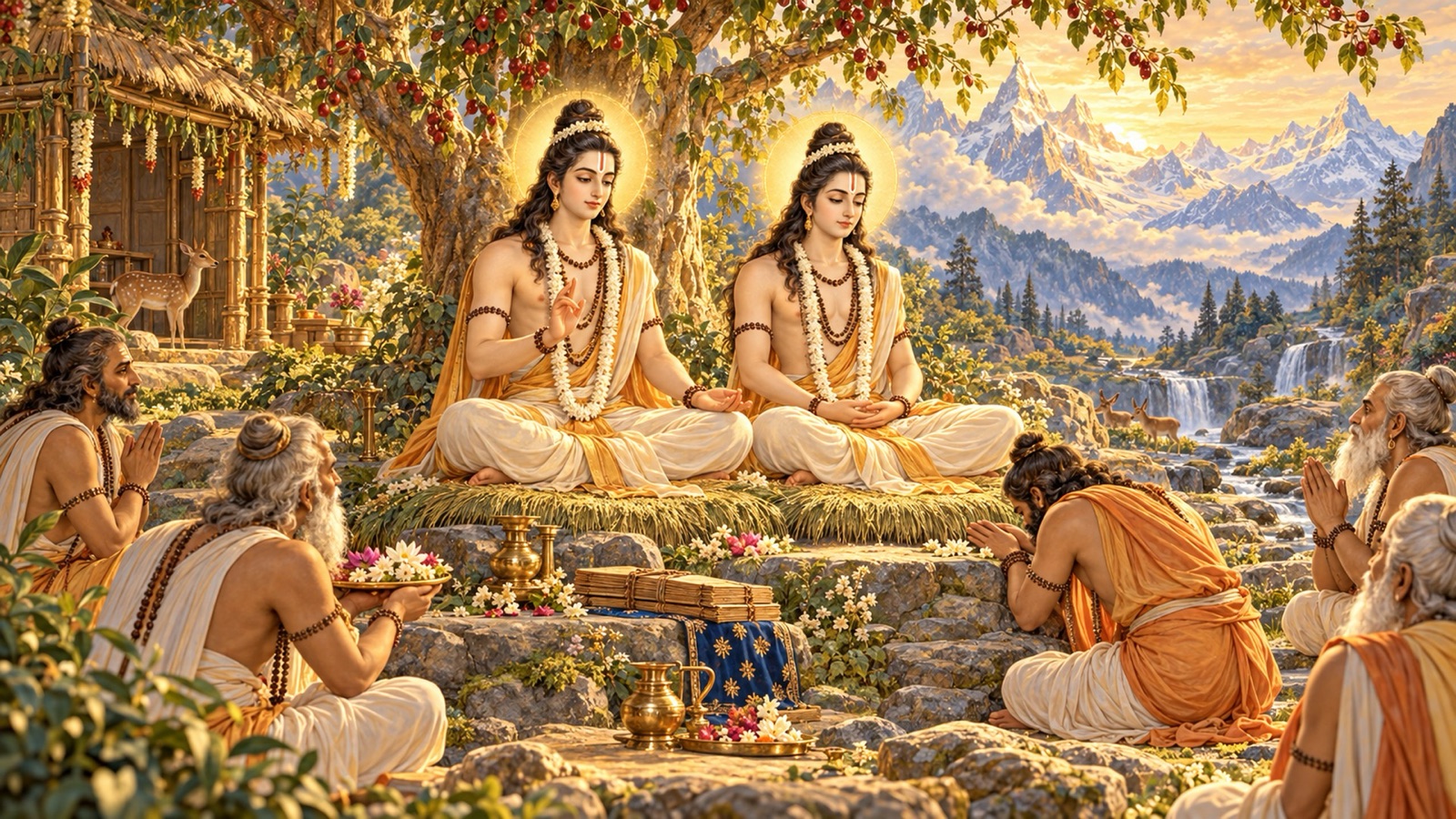
Suspecting that the sage Narayana desired his heavenly domain, Indra sent Kamadeva, the god of love, with his attendants, celestial nymphs, soft breezes and the spring, to Badarikashrama to disturb the sage’s mind. Not knowing His power, they tried to sway Him with the amorous glances of the women. Knowing Indra’s mischief, Narayana laughed without astonishment or pride, and reassured the trembling visitors, bidding them fear nothing and accept His hospitality.
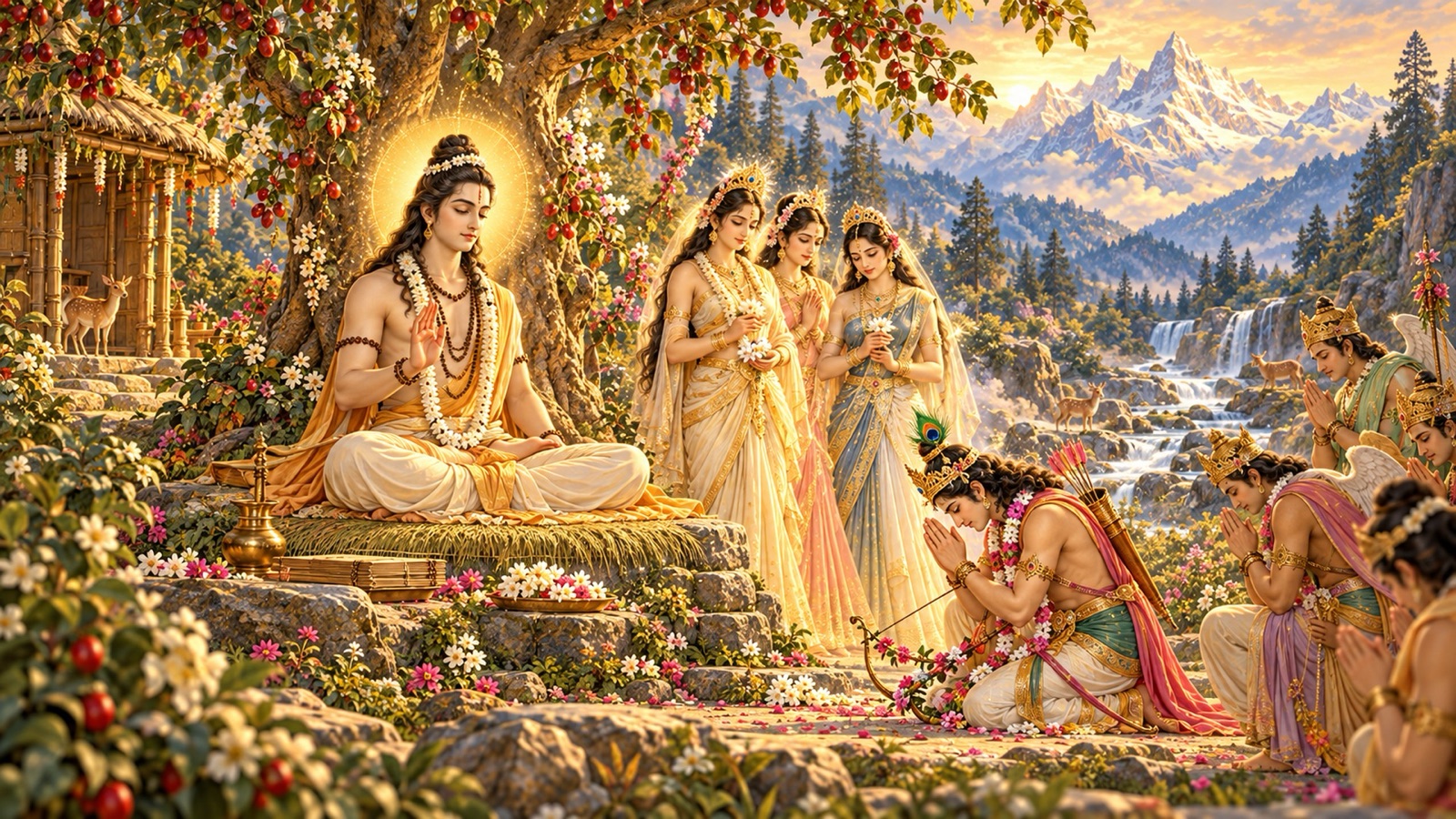
Then, from His own person, the Lord manifested women of wonderful beauty, adorned and radiant, waiting upon Himself; beside their surpassing loveliness, the celestial damsels found their own beauty faint, and the pride of Kamadeva and his retinue was humbled. Narayana graciously invited them to choose one such woman for heaven; they chose Urvashi and returned, bowing to Indra and recounting the Lord’s prowess, at which Indra was astonished and dismayed (verses 7-16).
The Line of the Lord’s Descents
Drumila then recounted a garland of descents. For the good of the worlds the Lord appeared as the divine Swan, as Dattatreya, as the four sages Sanaka, Sanandana, Sanatana and Sanatkumara, and as their own father Rishabha, teaching the knowledge of the Self; as Hayagriva He slew the demon Madhu and recovered the Vedas. As the divine Fish He rescued Manu and the earth at the dissolution; as the Boar He lifted the earth from the ocean and slew the demon; as the Tortoise He upheld Mount Mandara when the ocean was churned, and He rescued the king of elephants from the crocodile. He saved the tiny Valakhilya sages and delivered Indra from sin.
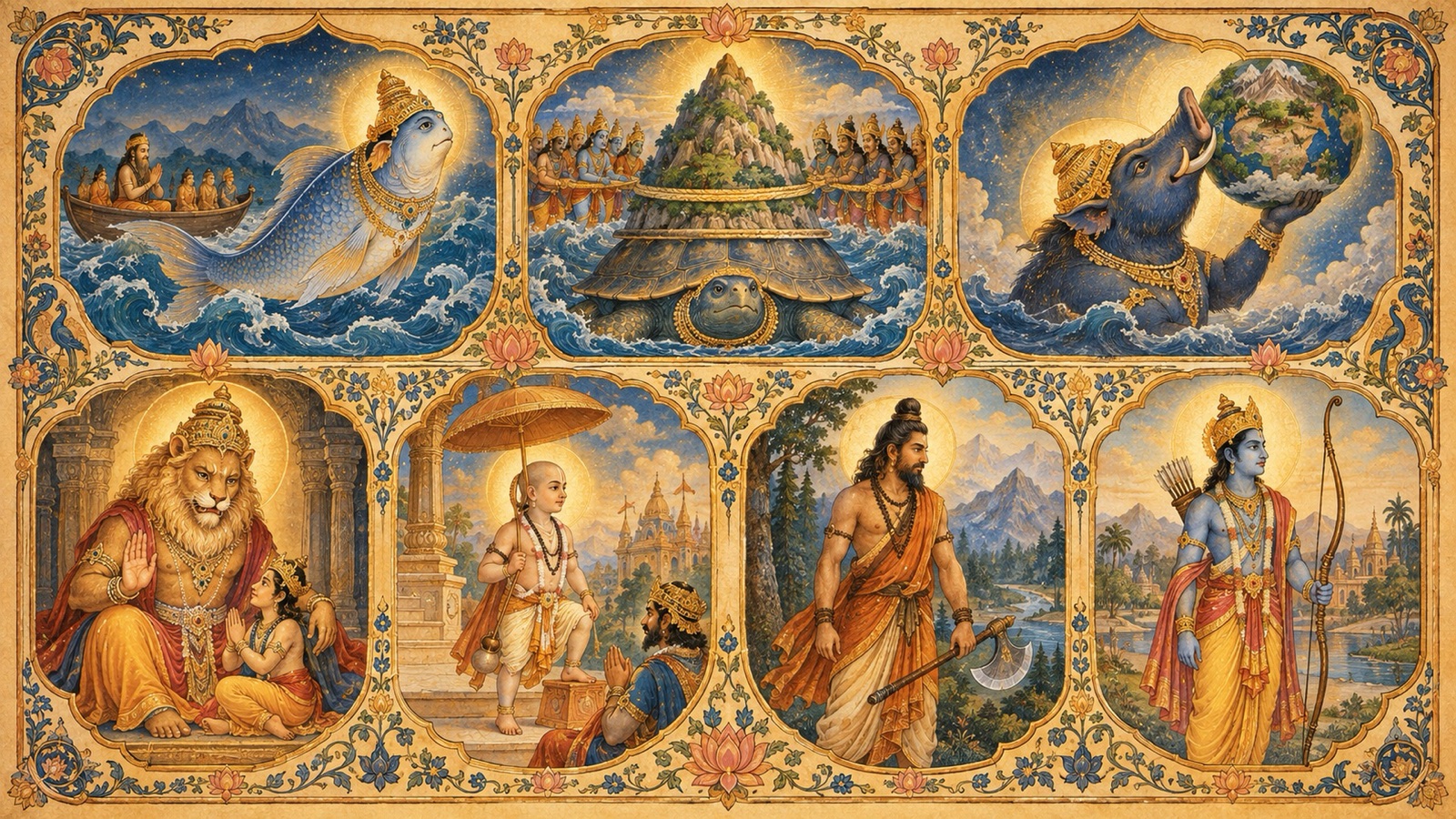
As the Man-Lion, Narasimha, He slew Hiranyakashipu to free His devotees from fear; in the wars of gods and demons He destroyed the demon chiefs; as the Dwarf, Vamana, He obtained the earth from Bali and gave it to the gods. Descending as Parasurama, He rid the earth of unrighteous rulers many times over; and as Sri Rama, the beloved of Sita, He bridged the ocean, destroyed the ten-headed demon and his city of Lanka, and remains ever victorious, His fame destroying the sins of all who hear it (verses 17-21).
The Descent in the Yadu Race, and Beyond
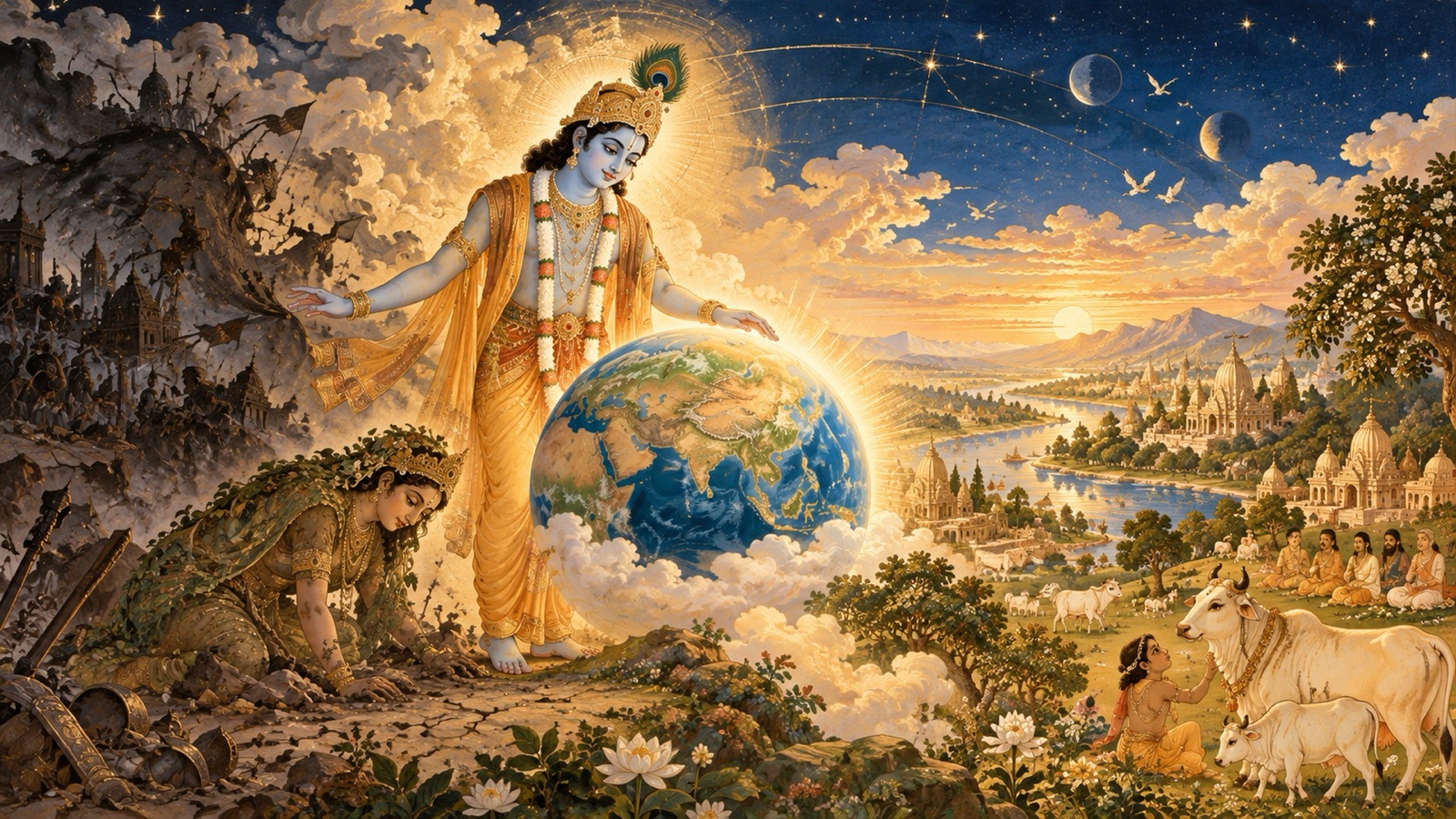
Though birthless, Drumila said, the Lord will appear in the race of Yadu to remove the burden of the earth and perform deeds beyond the power even of the gods; and He will guard righteousness to the very close of the age.
भूमेर्भरावतरणाय यदुष्वजन्मा जातः करिष्यति सुरैरपि दुष्कराणि । वादैर्विमोहयति यज्ञकृतोऽतदर्हान् शूद्रान् कलौ क्षितिभुजो न्यहनिष्यदन्ते ॥ २२ ॥
bhūmer bharāvataraṇāya yaduṣv ajanmā jātaḥ kariṣyati surair api duṣkarāṇi vādair vimohayati yajña-kṛto ‘tad-arhān śūdrān kalau kṣiti-bhujo nyahaniṣyad ante
Meaning: To remove the burden of the earth, the birthless Lord will take birth in the race of Yadu and perform deeds difficult even for the gods; He will bewilder by His teachings those unworthy men who perform sacrifices without qualification, and at the end of the age of Kali He will destroy the unrighteous kings. (Canto 11, Chapter 4, verse 22)
Many such descents and deeds of the Lord of the universe, of immeasurable glory, Drumila concluded, have been recounted by the wise (verse 23).
Principal Teachings of This Chapter
1. The Lord’s glories are infinite. The dust of the earth might sooner be counted than the excellences of the infinite Lord — a reminder that our praise, however heartfelt, only touches the edge of His greatness (verse 2).
2. One Lord, threefold work. Through sattva, rajas and tamas, the same Lord creates as Brahma, sustains as Vishnu and dissolves as Rudra — the whole cosmic order is His single, unbroken work (verses 3-5).
3. The Lord teaches by living the teaching. As Nara and Narayana He does not merely instruct the path beyond action; He Himself practises it, showing that true teaching is embodied (verse 6).
4. Divine serenity humbles all pride. Unmoved by Kamadeva’s assault, the Lord humbles pride not by force but by His own effortless glory, and then shows grace to the humbled (verses 7-16).
5. The descents are acts of compassion. From the Fish to Sri Rama, and on to the descent in the Yadu race, every incarnation rescues, protects and restores righteousness — the Lord enters the world again and again for the good of all beings (verses 17-22).
A Devotional Reflection
There is a particular joy in simply remembering the Lord’s descents, one after another, as Drumila does here. The chapter does not argue or analyse so much as it lovingly recites — and in that recitation something is kindled. We are reminded that the same Lord who is the imperishable Self of the previous chapter, beyond the reach of mind and speech, is also the One who lifts the earth on His shoulders, who upholds a mountain, who rescues an elephant crying out from the water, who reassures trembling visitors and bids them fear nothing. Drumila’s opening confession — that the Lord’s glories can no more be counted than the dust of the earth — is not discouraging but freeing. We are not asked to comprehend the infinite; we are invited only to remember, and to let each remembered deed draw the heart a little closer to the One who performs them all out of love.
A Daily Devotional Practice
Today, take a few quiet minutes to remember one of the Lord’s descents recounted in this chapter — perhaps the Tortoise upholding the mountain, or Sri Rama bridging the ocean, or the Lord’s compassion at Badarikashrama. Hold the scene in your mind with gratitude, and let it remind you that whenever the world needs Him, He returns, age after age, out of sheer compassion for His creatures. As you reflect, chant softly: “Om Namo Bhagavate Vasudevaya.” Let the simple act of remembrance become, as Drumila shows, its own form of worship.
Conclusion
The fourth discourse of Book Eleven is a loving remembrance of the Lord’s descents, offered by the sage Drumila in answer to King Nimi. Beginning with the humble truth that the Lord’s glories can never be fully counted, Drumila traces the one Lord’s threefold work of creation, sustenance and dissolution; His descent as Nara and Narayana, who live the very path they teach; His effortless humbling of pride at Badarikashrama; and the long garland of His incarnations — the Fish, Tortoise, Boar and Man-Lion, the Dwarf, Parasurama and Sri Rama — culminating in His promised descent in the race of Yadu to relieve the earth and guard righteousness to the end of the age. Through every form runs one truth: the Lord enters the world, again and again, out of boundless compassion. As King Nimi’s inquiry continues, the next discourse will turn to the ways in which the Lord is worshipped in the different ages of the world.
May the divine wisdom of Srimad Bhagavatam awaken pure devotion within our hearts.
Om Namo Bhagavate Vasudevaya.
Jay Shree Madhav.
References and Attribution
- Primary edition: Gita Press, Śrīmad Bhāgavata Mahāpurāṇa (English, complete), Book Eleven, Discourse 4, pages 530–533.
- Series: Srimad Bhagavatam Wisdom · Biswa Sanatan Dharma Seva Trust.
- Presented following the spiritual guidance and recommendation of Pandit Dr. Shri Kashinath Mishra.
This is an original, faithful retelling in the writer’s own words, with brief quoted verses shown in Devanāgarī and transliteration and their meanings given as summaries. It is not a reproduction of any single publisher’s continuous translation or commentary. No affiliation with or endorsement by any publisher is implied.
Jay Shree Madhav