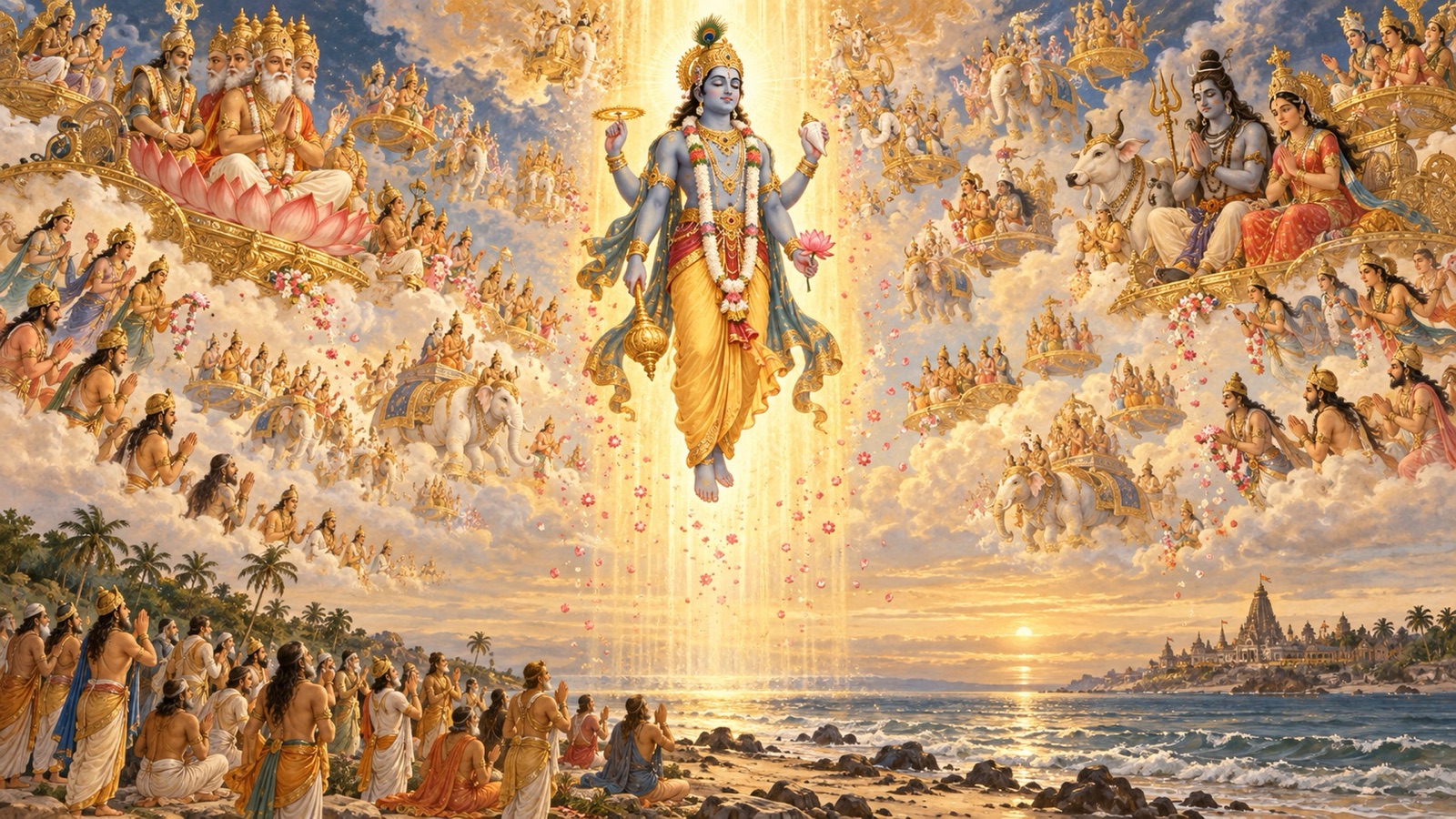
Brahma, Shiva and the gods gather in the sky to witness the Lord’s return to His own eternal abode, as Sri Krishna closes His lotus eyes and withdraws into the light that He is.
Om Namo Bhagavate Vasudevaya.
Om Namo Bhagavate Vasudevaya.
Om Namo Bhagavate Vasudevaya.
Welcome to Srimad Bhagavatam Wisdom, a devotional journey through the sacred histories and teachings of the Srimad Bhagavat Mahapurana. We come now to the most hallowed hour in the Lord’s earthly sojourn — when Sri Krishna, His work complete, lays aside the mortal semblance and returns to His own imperishable realm. Brahma and Shiva come to witness it, and Sukadeva Gosvami carries King Parikshit to the seashore of Prabhasa to behold what no eye can truly follow.
Chapter Information
- Scripture: Śrīmad Bhāgavata Mahāpurāṇa
- Canto: 11 (Book Eleven)
- Chapter: 31 (Discourse 31)
- Chapter title: The Disappearance of Lord Sri Krishna
- Principal speaker: Sukadeva Gosvami, narrating to King Parikshit
- Principal listener: King Parikshit
- Main setting: The seashore at Prabhasa, and the city of Dwaraka
- Central subject: The Lord’s voluntary withdrawal from His earthly form into His own divine realm, and its aftermath among His kinsfolk
- Principal verse range: Canto 11, Chapter 31, verses 1–28
- Primary edition: Gita Press Śrīmad Bhāgavata Mahāpurāṇa
Context from the Previous Chapter
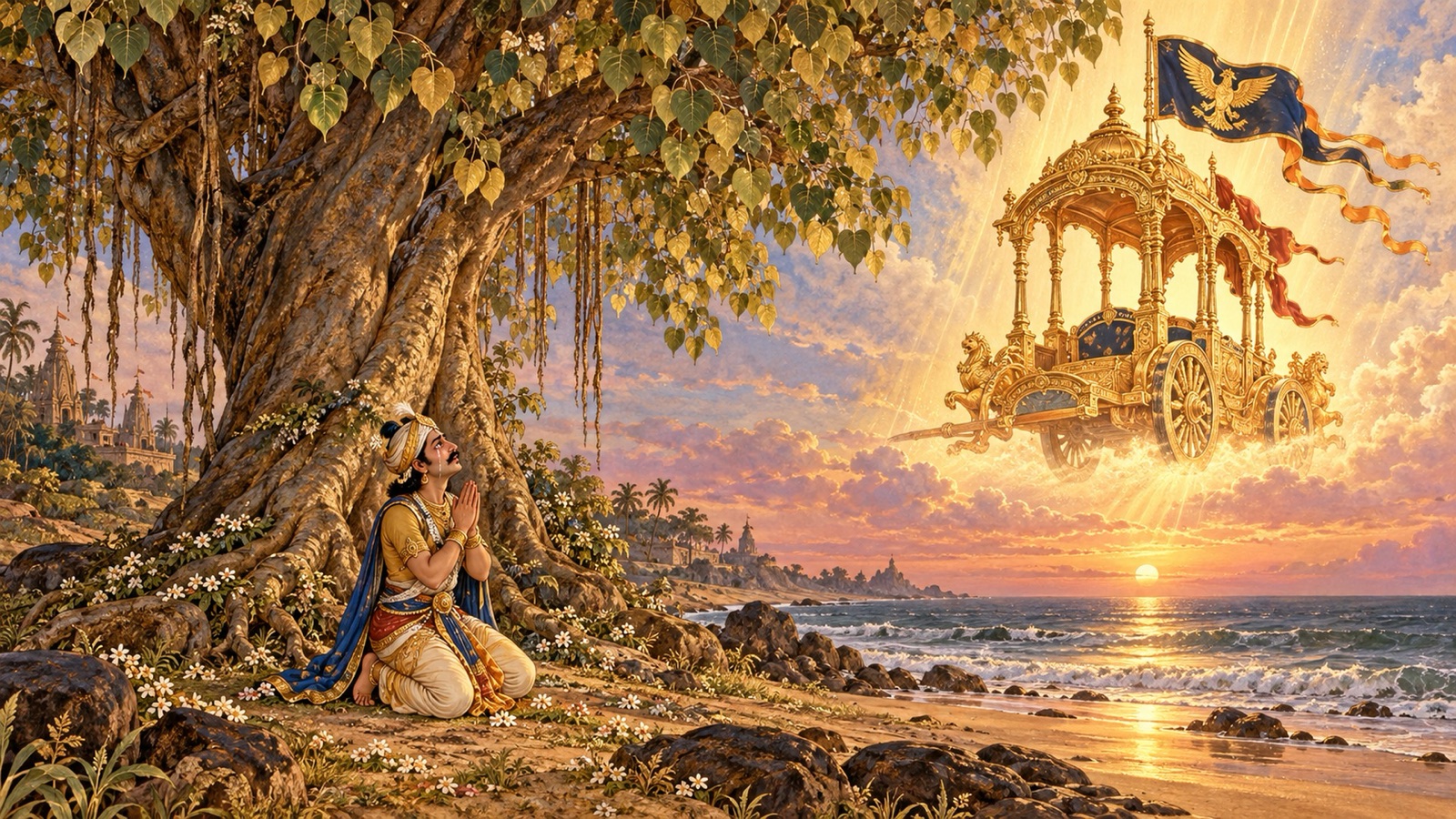
In the previous discourse, the Yadu heroes at Prabhasa, under the Brahmanas’ curse, fell into drunken strife and destroyed one another. Lord Balarama withdrew into the sea by His own yogic power. Krishna sat beneath a peepul tree, where the hunter Jara, mistaking His foot for a deer, pierced it with an arrow; the Lord forgave him, sent him to heaven, and sent Daruka to Dwaraka with word of what had befallen the Yadus.
The Gods Gather to Witness the Lord’s Return
No sooner had Daruka departed than the heavens grew restless. Brahma arrived with Parvati and Lord Shiva; Indra at the head of the gods, the sages, and hosts of celestial beings all converged upon that shore, eager to witness the Lord’s going, singing the deeds and the very birth of Krishna.
श्रीशुक उवाच अथ तत्रागमद् ब्रह्मा भवान्या च समं भव: । महेन्द्रप्रमुखा देवा मुनय: सप्रजेश्वरा: ॥ १ ॥
śrī-śuka uvāca atha tatrāgamad brahmā bhavānyā ca samaṁ bhavaḥ mahendra-pramukhā devā munayaḥ sa-prajeśvarāḥ
Meaning: Sukadeva said: Then Brahma arrived there, and Lord Shiva together with Parvati, and the gods headed by the great Indra, and the sages with the lords of creation. (Canto 11, Chapter 31, verse 1)
Filled with the highest devotion, this radiant assembly rained flowers from a sky crowded with ranks of heavenly cars.
ववृषु: पुष्पवर्षाणि विमानावलिभिर्नभ: । कुर्वन्त: सङ्कुलं राजन् भक्त्या परमया युता: ॥ ४ ॥
vavṛṣuḥ puṣpa-varṣāṇi vimānāvalibhir nabhaḥ kurvantaḥ saṅkulaṁ rājan bhaktyā paramayā yutāḥ
Meaning: Full of the highest devotion, O king, they rained showers of flowers, crowding the sky with their rows of heavenly cars. (Canto 11, Chapter 31, verse 4)
The Lord Withdraws Into His Own Light
Sri Krishna cast His glance upon Brahma, His own grandsire, and upon the assembled gods — manifestations of His own being. Then, fixing His mind on His own divine essence, He gently closed His lotus eyes. He did not burn away His beautiful form, the object of all meditation, but through the concentration of Yoga entered His own eternal abode, undiminished and whole.
लोकाभिरामां स्वतनुं धारणाध्यानमङ्गलम् । योगधारणयाग्नेय्यादग्ध्वा धामाविशत् स्वकम् ॥ ६ ॥
lokābhirāmāṁ sva-tanuṁ dhāraṇā-dhyāna-maṅgalam yoga-dhāraṇayāgneyyā- dagdhvā dhāmāviśat svakam
Meaning: Through the concentration of Yoga joined with the element of fire, He gathered unto Himself His own body — beloved of all the worlds, the object of meditation and auspiciousness — and entered His own eternal abode. (Canto 11, Chapter 31, verse 6)
In that instant the kettledrums of heaven sounded and flowers rained again; and with the Lord’s going, Truth, Piety, Fortitude, Glory and Prosperity departed from the earth, for they had dwelt here only because He dwelt here.
A Mystery Even to the Gods
Even Brahma and the gods could not behold that going; only a few, more fortunate, caught some glimpse of it. The movements of Sri Krishna, Sukadeva said, cannot be traced any more than a flash of lightning once it has vanished into the sky, leaving only the mass of cloud behind.
सौदामन्या यथाकाशे यान्त्या हित्वाभ्रमण्डलम् । गतिर्न लक्ष्यते मर्त्यैस्तथा कृष्णस्य दैवतै: ॥ ९ ॥
saudāmanyā yathākāśe yāntyā hitvābhra-maṇḍalam gatir na lakṣyate martyais tathā kṛṣṇasya daivataiḥ
Meaning: Just as the course of lightning vanishing into the sky, leaving the mass of cloud behind, cannot be traced by mortal eyes, so even the gods cannot trace the going of Sri Krishna. (Canto 11, Chapter 31, verse 9)
Astonished at this wonder, Brahma, Shiva and the rest withdrew, each to his own celestial abode.
Sukadeva’s Teaching — The Lord’s Play of Maya
Here Sukadeva opens the heart of this chapter’s teaching to King Parikshit, so that none will mistake this for an ending. The Lord’s appearance, sojourn and now disappearance among embodied beings are nothing but the enacted play of His own Maya, exactly as an actor plays a part. Of His own will He created this universe, entered it as its indwelling Lord, sported within it, and at last withdrew it into Himself — remaining, through it all, established in His own unchanging glory.
राजन् परस्य तनुभृज्जननाप्ययेहा मायाविडम्बनमवेहि यथा नटस्य । सृष्ट्वात्मनेदमनुविश्य विहृत्य चान्ते संहृत्य चात्ममहिनोपरत: स आस्ते ॥ ११ ॥
rājan parasya tanu-bhṛj-jananāpyayehā māyā-viḍambanam avehi yathā naṭasya sṛṣṭvātmanedam anuviśya vihṛtya cānte saṁhṛtya cātma-mahinoparataḥ sa āste
Meaning: O King, know the birth, activity and disappearance of the Supreme Lord among embodied beings to be, like the acting of a player, nothing but the enacted play of His own Maya. Having created this universe by Himself, entered it, sported within it, and at the end withdrawn it into Himself, He remains established in His own glory. (Canto 11, Chapter 31, verse 11)
This is no helplessness. Was He unable to guard His own body — He who revived His teacher’s son from the realm of Death, who revived Parikshit himself in the womb after Ashvatthama’s weapon had burned him, who conquered even Lord Shiva, and who bodily carried the hunter Jara up to heaven? Though the sole cause of the universe’s birth, continuance and dissolution, possessed of every power, He chose not to keep His visible body here — only to show the sublime unconcern of those established in the Self toward the mortal frame.
तथाप्यशेषस्थितिसम्भवाप्यये- ष्वनन्यहेतुर्यदशेषशक्तिधृक् । नैच्छत् प्रणेतुं वपुरत्र शेषितं मर्त्येन किं स्वस्थगतिं प्रदर्शयन् ॥ १३ ॥
tathāpy aśeṣa-sthiti-sambhavāpyayeṣv ananya-hetur yad aśeṣa-śakti-dhṛk naicchat praṇetuṁ vapur atra śeṣitaṁ martyena kiṁ sva-stha-gatiṁ pradarśayan
Meaning: Though He is the sole cause of the creation, maintenance and dissolution of all things, and possesses every power, He did not choose to preserve His remaining body here by mortal means — showing thereby the unconcern of those established in their own true nature toward the body. (Canto 11, Chapter 31, verse 13)
One who, rising at dawn, devotedly recites this supreme departure of Sri Krishna, Sukadeva adds, attains that same unsurpassed destination.
Daruka’s Grief and the Fall of Dwaraka’s House
Daruka, bereft of his Lord, returned to Dwaraka and fell weeping at the feet of Vasudeva and King Ugrasena. When he told them of the destruction of the Vrishnis, the people were struck with grief and many fainted; beating their heads, they rushed to the place where the slain lay. Finding Krishna and Balarama gone from among the living, Devaki, Rohini and Vasudeva — the parents of the two divine brothers — lost consciousness, and so sharp was their anguish that they gave up their lives upon that very spot.
The Queens Enter the Sacred Fire
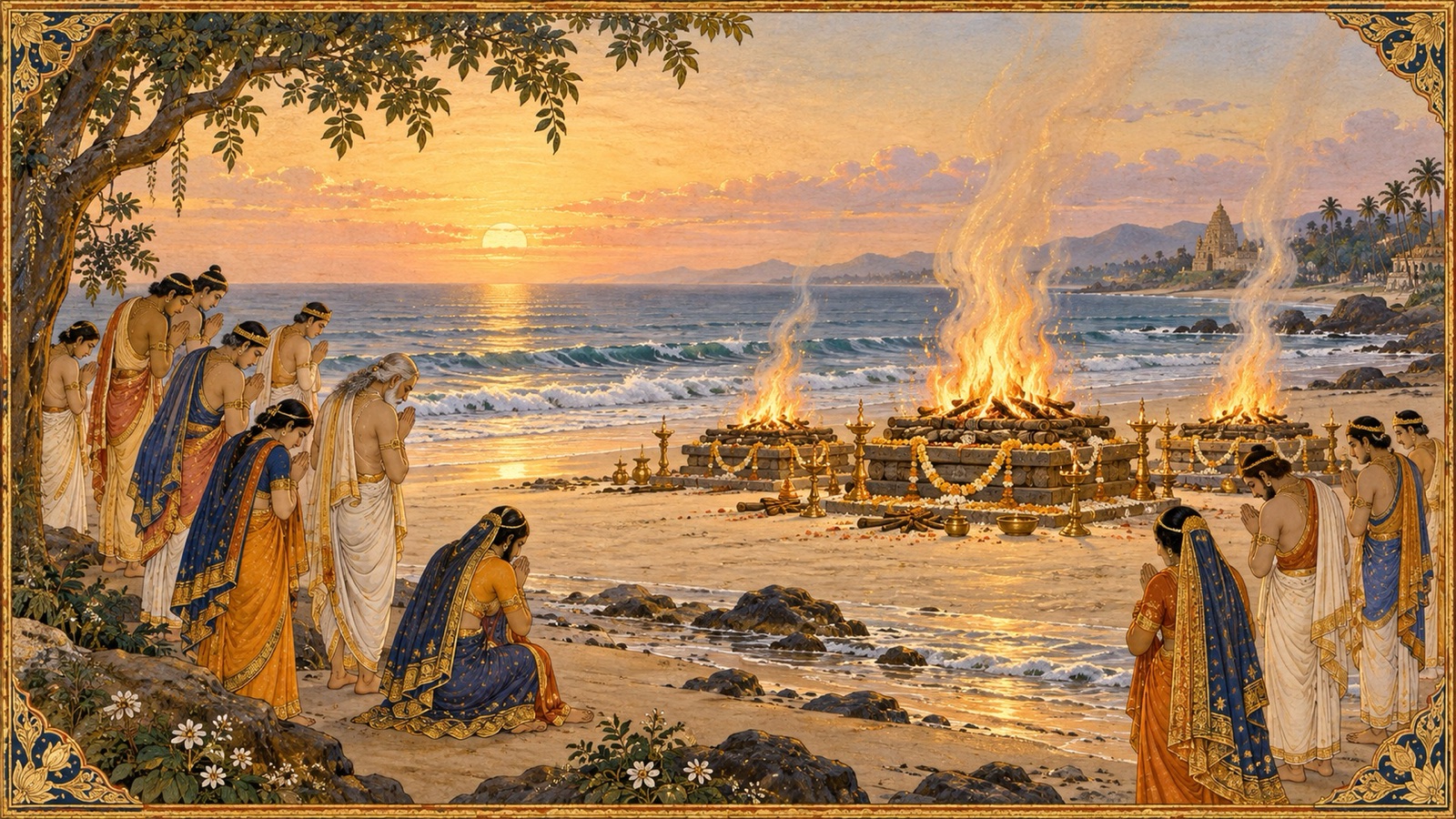
What followed, Sukadeva tells with the deepest tenderness, for grief such as this cannot be hurried past. Rather than remain behind, the women of the Yadu household chose to join their beloved in the sacred fire.
रामपत्न्यश्च तद्देहमुपगुह्याग्निमाविशन् । वसुदेवपत्न्यस्तद्गात्रं प्रद्युम्नादीन् हरे: स्नुषा: । कृष्णपत्न्योऽविशन्नग्निं रुक्मिण्याद्यास्तदात्मिका: ॥ २० ॥
rāma-patnyaś ca tad-deham upaguhyāgnim āviśan vasudeva-patnyas tad-gātraṁ pradyumnādīn hareḥ snuṣāḥ kṛṣṇa-patnyo ‘viśann agniṁ rukmiṇy-ādyās tad-ātmikāḥ
Meaning: The wives of Balarama entered the fire embracing His body; the wives of Vasudeva embraced his body; the daughters-in-law of the Lord embraced Pradyumna and his brothers; and Rukmini and the other queens of Krishna, their minds wholly fixed on Him, entered the fire as one with Him. (Canto 11, Chapter 31, verse 20)
Arjuna’s Sorrow and the Rites for the Fallen
Arjuna, too, could scarcely bear the loss of his dearest companion. For comfort he turned inward, to the sacred words Krishna had once spoken to him on the battlefield — the very teaching of the Bhagavad Gita.
अर्जुन: प्रेयस: सख्यु: कृष्णस्य विरहातुर: । आत्मानं सान्त्वयामास कृष्णगीतै: सदुक्तिभि: ॥ २१ ॥
arjunaḥ preyasaḥ sakhyuḥ kṛṣṇasya virahāturaḥ ātmānaṁ sāntvayām āsa kṛṣṇa-gītaiḥ sad-uktibhiḥ
Meaning: Arjuna, tormented by separation from Krishna, his most beloved friend, comforted his own heart with the true and sacred sayings that Krishna had spoken to him. (Canto 11, Chapter 31, verse 21)
Steadying himself thus, Arjuna had the proper funeral rites duly performed, in order of seniority, for all his kinsmen who had fallen at Prabhasa, for their welfare in the world beyond.
The Sea Reclaims Dwaraka
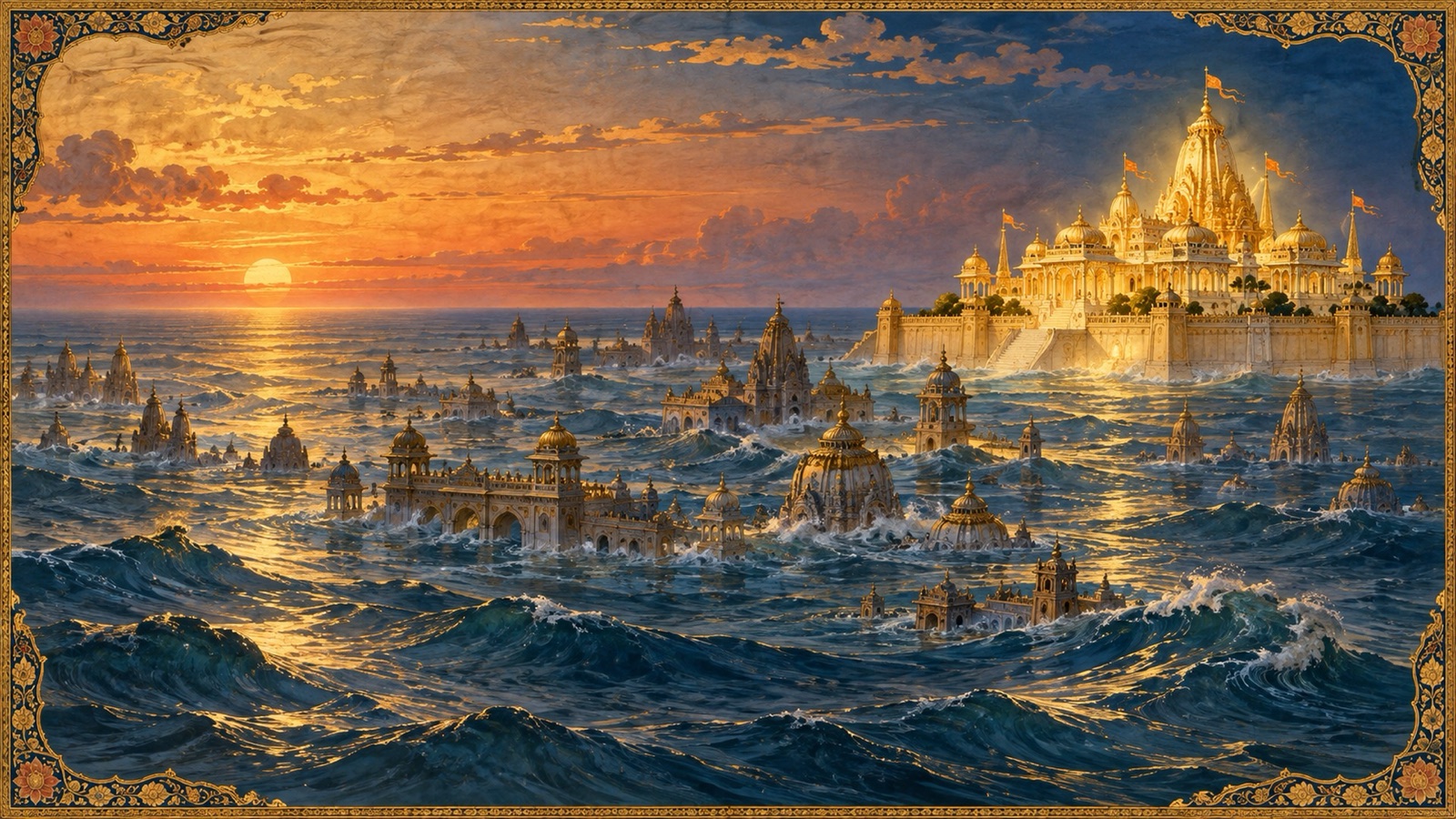
No sooner was Dwaraka forsaken by Sri Krishna than the ocean rose and, in a moment, swallowed the whole city — sparing only the sacred palace of the Lord Himself, the most auspicious of all auspicious places, for there He remains bodily present even now.
द्वारकां हरिणा त्यक्तां समुद्रोऽप्लावयत् क्षणात् । वर्जयित्वा महाराज श्रीमद्भगवदालयम् ॥ २३ ॥
dvārakāṁ hariṇā tyaktāṁ samudro ‘plāvayat kṣaṇāt varjayitvā mahā-rāja śrīmad-bhagavad-ālayam
Meaning: The ocean, O great king, submerged in an instant the city of Dwaraka once it was forsaken by Sri Krishna — sparing only the glorious abode of the Lord. (Canto 11, Chapter 31, verse 23)
Arjuna Leads the Survivors to Indraprastha
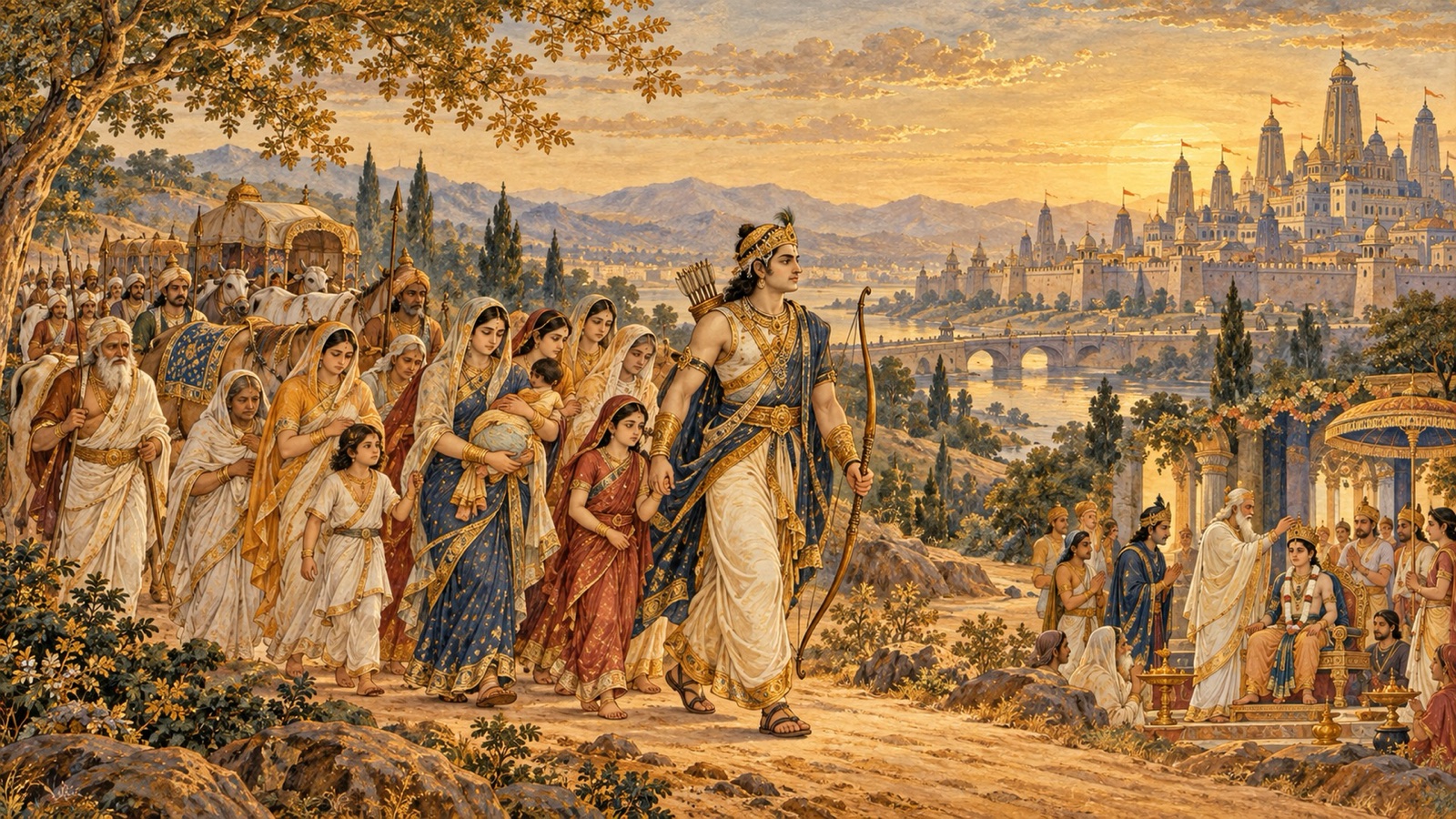
Gathering the women, children and aged who had survived, Arjuna led them to Indraprastha, the ancient Pandava capital, and settled them there, crowning Vajra — the one surviving son of Aniruddha — king over the remnant of the Yadu line. Hearing of this destruction from Arjuna, the Pandavas themselves then set out for the Himalaya on their own final journey, appointing Parikshit as their successor upon the throne of Hastinapura.
The Fruit of Hearing This Sacred Departure
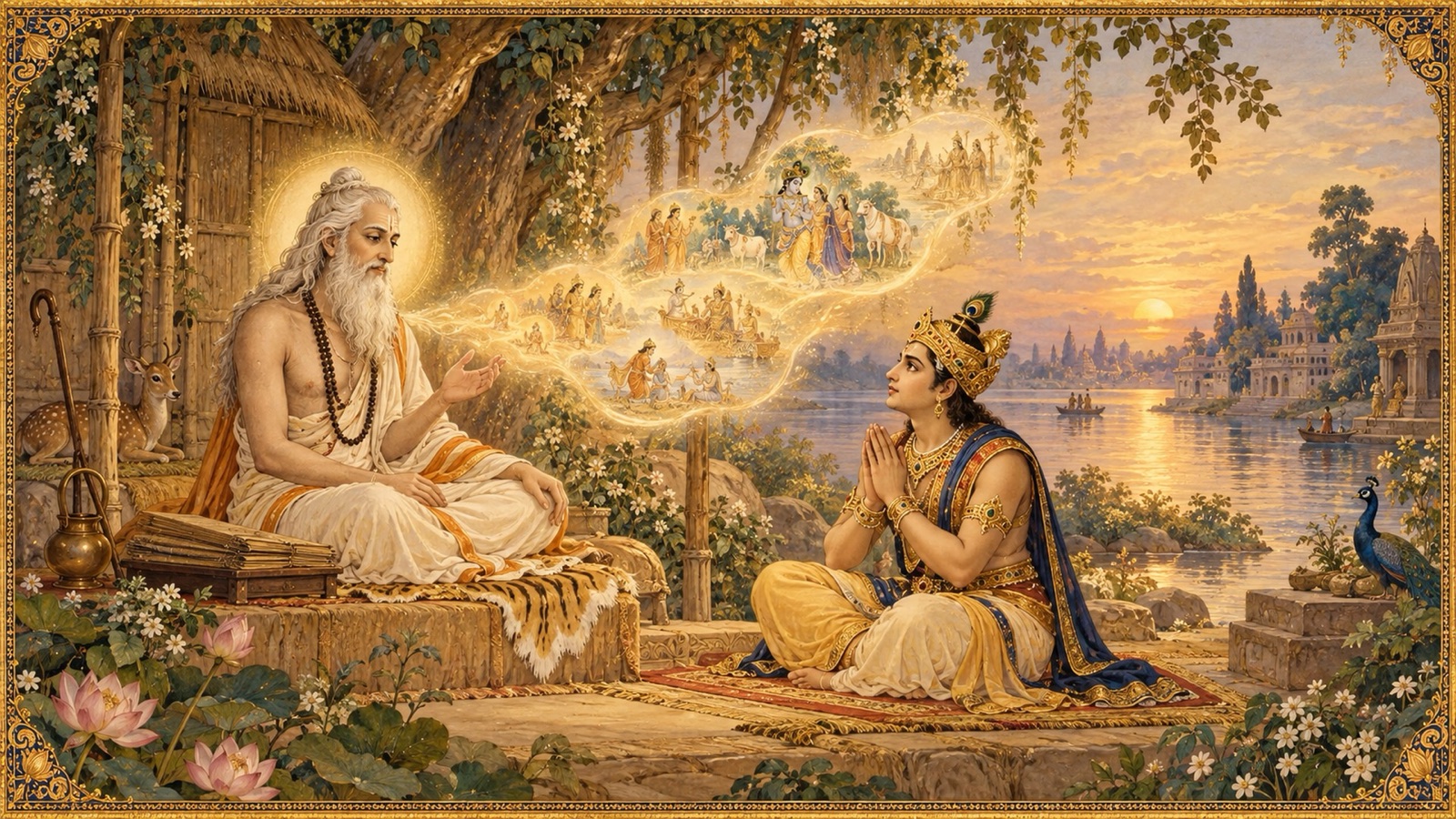
Sukadeva closes with a promise to King Parikshit — and to every listener. Whoever recounts with faith these deeds and this birth of Lord Vishnu, adored of the gods themselves, is freed from the burden of all sin; and whoever recites, here or in any other scripture, these auspicious sports and radiant deeds of the Lord’s charming incarnations, attains thereby the supreme devotion that is the very goal of great souls.
इत्थं हरेर्भगवतो रुचिरावतार- वीर्याणि बालचरितानि च शन्तमानि । अन्यत्र चेह च श्रुतानि गृणन् मनुष्यो भक्तिं परां परमहंसगतौ लभेत ॥ २८ ॥
itthaṁ harer bhagavato rucirāvatāra- vīryāṇi bāla-caritāni ca śantamāni anyatra ceha ca śrutāni gṛṇan manuṣyo bhaktiṁ parāṁ paramahaṁsa-gatau labheta
Meaning: Thus, whoever recites the deeds of the Lord’s charming incarnations and His most auspicious childhood sports, heard here or elsewhere, attains supreme devotion — the very goal of the great liberated souls. (Canto 11, Chapter 31, verse 28)
Principal Teachings of This Chapter
1. The Lord’s disappearance is His own Maya, not an ending. His birth, pastimes and departure among embodied beings are the enacted play of His own Maya, like an actor assuming and laying aside a part — He who creates, enters, sports within and withdraws the universe remains established in His own unchanging glory (verse 11).
2. The Lord’s unconcern for the body reveals the goal of the self-realized. Though the sole cause of all creation, possessed of unlimited power, He chose not to retain His visible form on earth, to show the detachment from the body that belongs to those established in the Self (verse 13).
3. Even the gods cannot trace the Lord’s ways. Brahma and Shiva could not perceive the Lord’s going, which escapes divine sight alike, as a flash of lightning escapes the eye once vanished into the sky (verse 9).
4. Love does not end with the body’s absence. The grief of Devaki, Rohini, Vasudeva, the queens and Arjuna shows true devotion feels the Lord’s departure as an unbearable separation — yet it is Krishna’s own teaching, the Bhagavad Gita, upon which Arjuna leans to steady his heart (verses 20–21).
5. The Lord’s own abode is never touched by loss. Though the sea swallowed all of Dwaraka, it could not swallow the Lord’s own palace, for He remains bodily present there even now — a sign that what belongs to the Lord is beyond time’s reach (verse 23).
6. Hearing and reciting this departure grants the highest devotion. Sukadeva promises that one who recites this departure with devotion, or tells with faith the Lord’s deeds and births, is freed from sin and attains supreme devotion, the goal of the liberated (verses 14, 27–28).
A Devotional Reflection
There is something in this chapter that no other chapter of the Bhagavata quite carries — the hush of an ending that is also, somehow, not an ending at all. We watch Brahma stand amazed, unable to follow where the Lord has gone; we watch mothers and wives give up their own breath rather than live without Him; yet Sukadeva keeps gently reminding Parikshit that none of this touches the Lord at all. He who entered the world as a player simply steps off the stage, as whole and radiant as He ever was. Perhaps this is the chapter’s deepest comfort: grief at separation is real and sacred and need not be denied — Arjuna does not pretend otherwise — yet that grief can itself become the path home, when we lean on the Lord’s own words to steady us.
A Daily Devotional Practice
Today, in the spirit of this chapter’s own promise, rise if you can at dawn and spend a few unhurried minutes remembering Lord Sri Krishna’s return to His own abode — not as sorrow, but as the luminous homecoming it truly was. Let your heart feel both the ache of Daruka, Arjuna and the Yadu household, and the deeper peace Sukadeva offers beneath it: the Lord who enters this world and leaves it is never parted from Himself, and so never truly parted from one who loves Him. Close your eyes, as He closed His own, and softly offer: “Om Namo Bhagavate Vasudevaya.”
Conclusion
In this most sacred of discourses, Brahma, Shiva and the gods gather with flowers and reverence to witness what no eye can fully follow — Lord Sri Krishna withdrawing His own form, whole and undiminished, into His own eternal abode. Sukadeva opens the heart of the teaching: this going, like the Lord’s coming, is His own Maya, the play of One never bound by birth or death, who chose not to keep His body here only to show the self-realized their own unconcern for the mortal frame. Yet the chapter does not hide the human cost — Daruka’s tears, the fainting of Dwaraka, the queens entering the sacred fire, Arjuna steadying his grief upon the Lord’s own words, the sea closing over the city but never over the Lord’s own house. Arjuna leads the survivors to Indraprastha, crowns young Vajra king, and the Pandavas depart for the Himalaya, leaving Parikshit on the throne. Sukadeva leaves us, as he leaves the king, with one promise: to recite this departure with devotion is itself to walk the path toward the Lord it describes.
May the divine wisdom of Srimad Bhagavatam awaken pure devotion within our hearts.
Om Namo Bhagavate Vasudevaya.
Jay Shree Madhav.
References and Attribution
- Primary edition: Gita Press, Śrīmad Bhāgavata Mahāpurāṇa (English, complete), Book Eleven, Discourse 31, pages 664–667.
- Series: Srimad Bhagavatam Wisdom · Biswa Sanatan Dharma Seva Trust.
- Presented following the spiritual guidance and recommendation of Pandit Dr. Shri Kashinath Mishra.
This is an original, faithful retelling in the writer’s own words, with brief quoted verses shown in Devanāgarī and transliteration and their meanings given as summaries. It is not a reproduction of any single publisher’s continuous translation or commentary. No affiliation with or endorsement by any publisher is implied.
Jay Shree Madhav