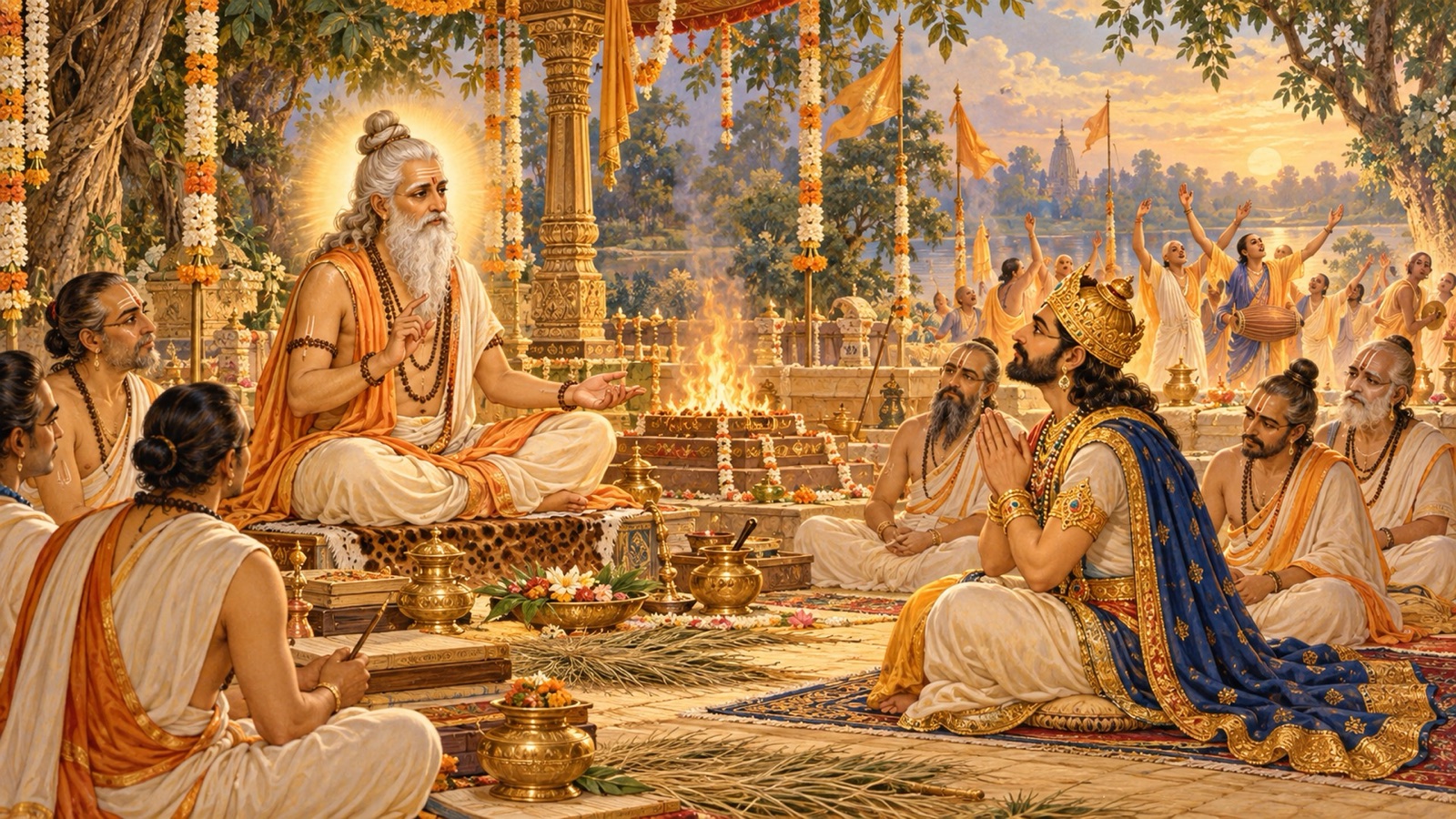
King Nimi asks two final questions — the fate of those who turn away from the Lord, and the forms in which the Lord is worshipped in each age of the world. The sages Chamasa and Karabhajana answer, and their reply rises to a radiant crown: in this age of Kali, the Lord is best adored by the congregational chanting of His holy names.
Om Namo Bhagavate Vasudevaya.
Om Namo Bhagavate Vasudevaya.
Om Namo Bhagavate Vasudevaya.
Welcome to Srimad Bhagavatam Wisdom, a devotional journey through the sacred histories and teachings of the Srimad Bhagavat Mahapurana. Having heard the Lord’s illusory energy, the path beyond it, and the wondrous deeds of His descents, King Nimi now asks the last of his great questions: what becomes of those who neglect the Lord, and by what forms, names and rites is He worshipped in the four ages of the world? The sage Chamasa answers the first with sober compassion; the sage Karabhajana answers the second with a rising joy that crests in exaltation of the sacred name as it is chanted in this present Kali age. With their words the ancient dialogue closes, and Narada gently brings his remembrance back to Vasudeva in Dwaraka.
Chapter Information
- Scripture: Śrīmad Bhāgavata Mahāpurāṇa
- Canto: 11 (Book Eleven)
- Chapter: 5 (Discourse 5)
- Chapter title: Narada Concludes His Teachings to Vasudeva
- Principal speaker: The sages Chamasa and Karabhajana, answering King Nimi; the whole recalled by Narada to Vasudeva and narrated by Sukadeva Gosvami to King Parikshit
- Principal listener: King Nimi with his assembly; within the frame, Vasudeva and King Parikshit
- Main setting: The sacrificial arena of King Nimi in ancient Ajanabha (Bharatavarsha)
- Central subject: The fate of those who neglect the Lord, and the forms, names and modes of the Lord’s worship in the ages of Satya, Treta, Dvapara and Kali — culminating in the glory of chanting the holy name
- Principal verse range: Canto 11, Chapter 5, verses 1–42
- Primary edition: Gita Press Śrīmad Bhāgavata Mahāpurāṇa
Context from the Previous Chapter
In Chapter 4, the sage Drumila recounted to King Nimi the many descents of the Lord and the wondrous deeds He performs in each. Now the king puts his final questions to the assembled sages, and Chamasa and Karabhajana — the last two of the nine Yogendras — complete the great teaching.
King Nimi Asks About Those Who Neglect the Lord
King Nimi asked what would become of those who, their minds and senses uncontrolled and their desires unsatisfied, do not generally worship Lord Sri Hari (verse 1).
Chamasa Speaks — The Peril of Turning Away
The sage Chamasa replied that from the mouth, arms, thighs and feet of the Lord arose the four varnas, together with the asramas or stages of life, divided according to their qualities.
मुखबाहूरुपादेभ्यः पुरुषस्याश्रमैः सह । चत्वारो जज्ञिरे वर्णा गुणैर्विप्रादयः पृथक् ॥ २ ॥
mukha-bāhūru-pādebhyaḥ puruṣasyāśramaiḥ saha catvāro jajñire varṇā guṇair viprādayaḥ pṛthak
Meaning: From the mouth, arms, thighs and feet of the Supreme Person arose the four social orders, together with the stages of life, distinguished separately according to their qualities. (Canto 11, Chapter 5, verse 2)
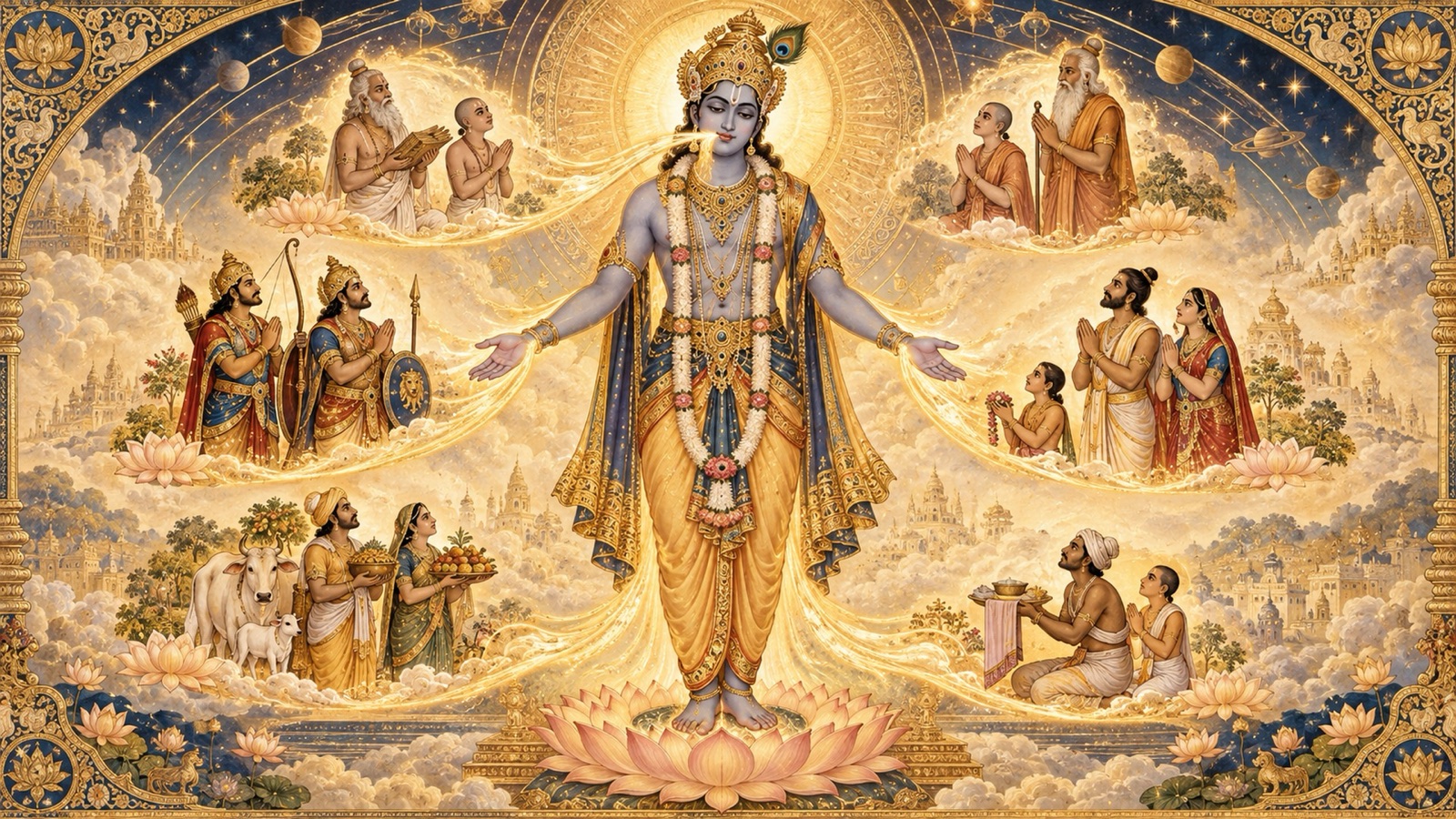
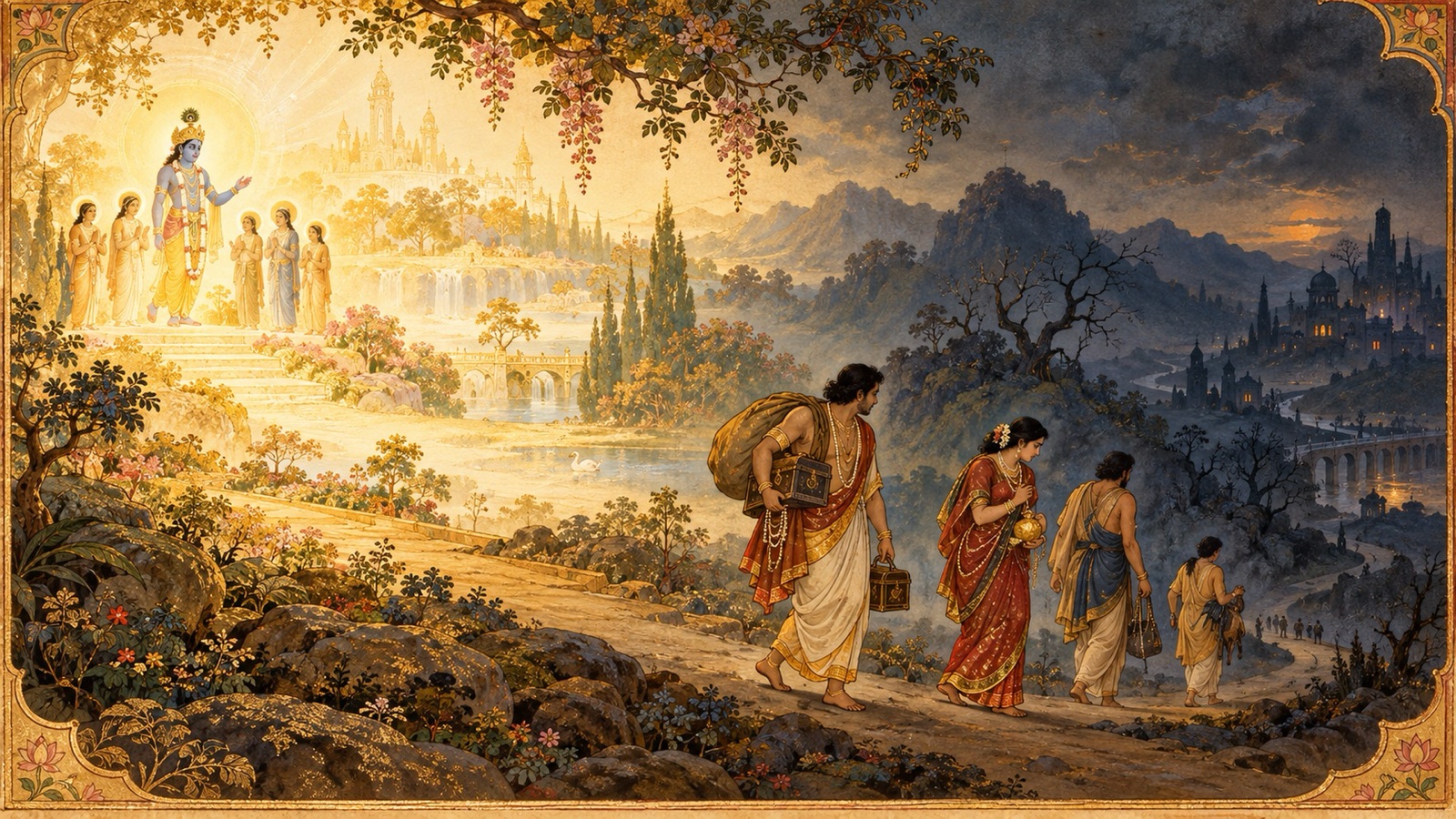
Among these, Chamasa said, those who know the Lord to be their very origin and ruler and yet ignore Him fall from their station. Many, remote from hearing and singing His glories, deserve the compassion of devotees. Even the twice-born, near to the Lord by birth and sacrament, are misled when they read the Vedas only for the fruits of action, missing their deeper meaning; puffed up with learning they never truly gained, dominated by passion and pride, some even scorn the Lord’s devotees and the Lord Himself. Attached to the body and its relations, hating others in whom the same Self dwells, and thereby hating the Lord, such souls fall into darkness; averse to the Lord, they are forced at last to leave behind home, wealth, children and friends and enter a joyless condition (verses 3-18).
King Nimi Asks How the Lord Is Worshipped in Each Age
King Nimi then asked in which ages, and by what forms, colours, names and prescribed rites, the Lord is worshipped by men (verse 19).
Karabhajana Speaks — The Lord in the Four Ages
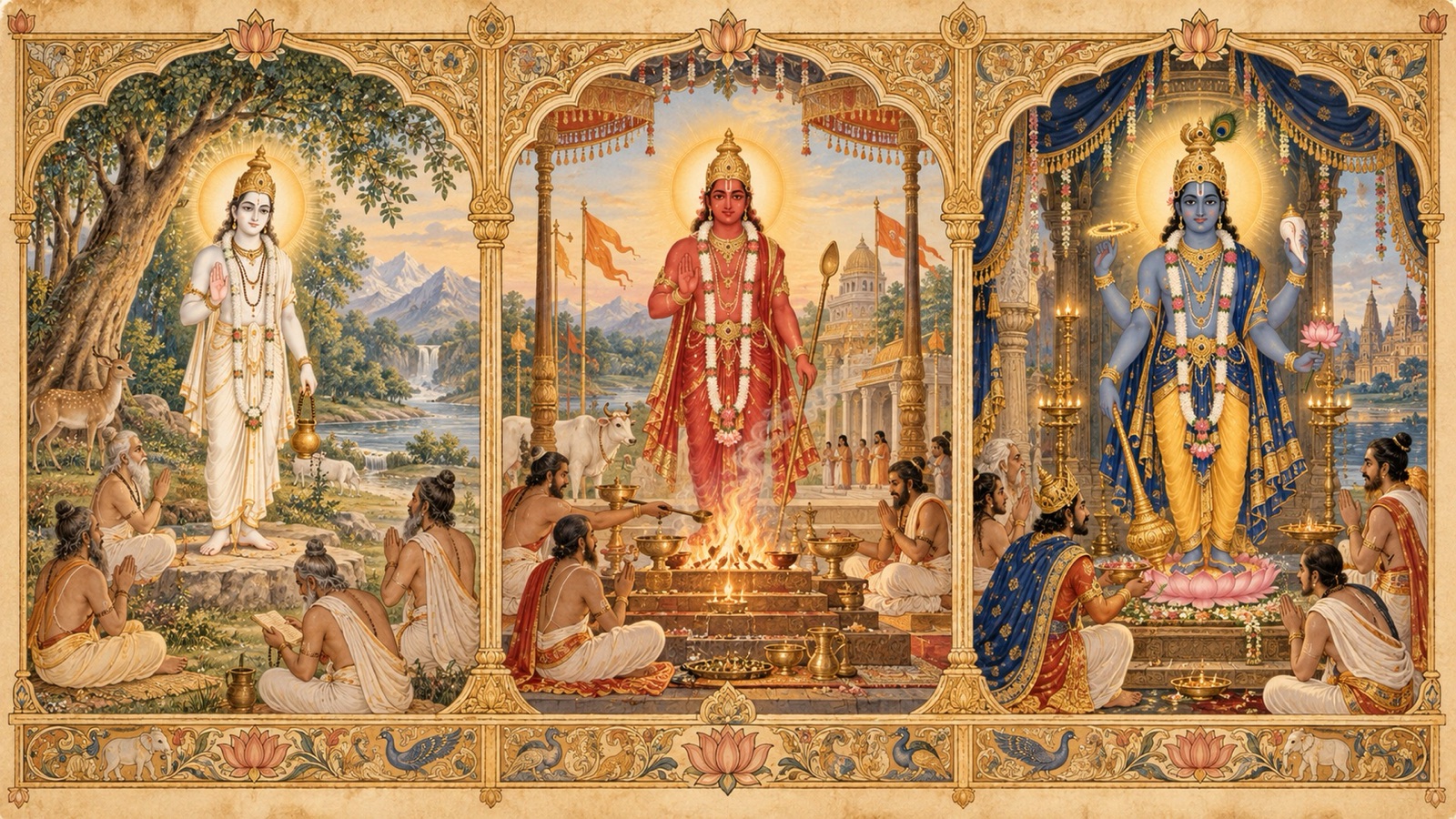
The sage Karabhajana replied that Lord Kesava assumes different colours, names and forms and is worshipped in different ways in the ages of Satya, Treta, Dvapara and Kali. In the Satya age the Lord is of white complexion, four-armed, wearing matted locks and bark, bearing the sacred thread, a rosary, a staff and a water-pot; in that age men, calm and friendly to all, worship Him by contemplation and control of the senses, calling Him by names such as Hamsa, Vaikuntha, Dharma, Yogeshvara and Paramatma. In the Treta age He is of crimson hue, appearing in the form of sacrifice, and is worshipped through the Vedic rites; He is called Vishnu, Yajna, Prishnigarbha and Urukrama. In the Dvapara age He is of a dark-blue complexion, clad in yellow, bearing His conch, discus, mace and lotus and the Kaustubha gem; men worship Him with the regalia of a king, praising Him as Vasudeva, Sankarshana, Pradyumna and Aniruddha (verses 20-31).
The Glory of the Holy Name in the Age of Kali
Then Karabhajana came to our own age. In Kali, he said, wise and thoughtful people worship the Lord — dark in colour yet luminous, perfect in every limb, adorned with ornaments and accompanied by His associates and weapons — chiefly through sacrifices consisting of the chanting and singing of His names.
कृष्णवर्णं त्विषाकृष्णं साङ्गोपाङ्गास्त्रपार्षदम् । यज्ञैः सङ्कीर्तनप्रायैर्यजन्ति हि सुमेधसः ॥ ३२ ॥
kṛṣṇa-varṇaṁ tviṣākṛṣṇaṁ sāṅgopāṅgāstra-pārṣadam yajñaiḥ saṅkīrtana-prāyair yajanti hi su-medhasaḥ
Meaning: In the age of Kali, discerning people worship — by sacrifices consisting mainly of the congregational chanting of His names — the Lord who is dark in hue yet radiant, and who appears with His limbs, associates, weapons and companions. (Canto 11, Chapter 5, verse 32)
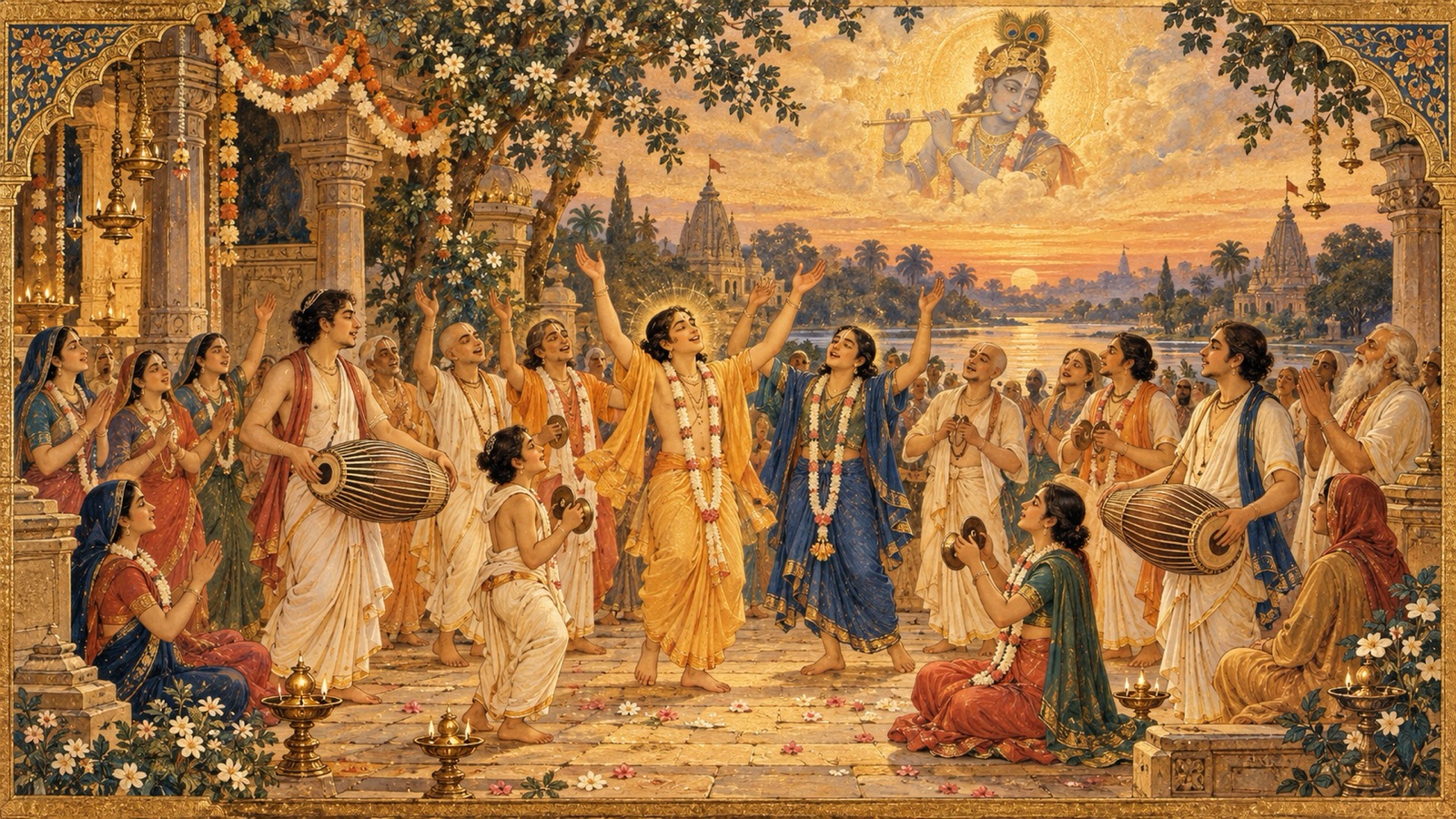
Karabhajana praised this age for its hidden treasure. Discerning souls, who appreciate its true merit and choose the essence of things, actually extol the age of Kali.
कलिं सभाजयन्त्यार्या गुणज्ञाः सारभागिनः । यत्र सङ्कीर्तनेनैव सर्वस्वार्थोऽभिलभ्यते ॥ ३६ ॥
kaliṁ sabhājayanty āryā guṇa-jñāḥ sāra-bhāginaḥ yatra saṅkīrtanenaiva sarva-svārtho ‘bhilabhyate
Meaning: The wise, who recognize its true worth and take the essence of things, extol the age of Kali, for in it every true goal is attained simply by the congregational chanting of the Lord’s names. (Canto 11, Chapter 5, verse 36)
For souls wandering in this world, he continued, there is no higher gain than this.
न ह्यतः परमो लाभो देहिनां भ्राम्यतामिह । यतो विन्देत परमां शान्तिं नश्यति संसृतिः ॥ ३७ ॥
na hy ataḥ paramo lābho dehināṁ bhrāmyatām iha yato vindeta paramāṁ śāntiṁ naśyati saṁsṛtiḥ
Meaning: For embodied souls wandering in this world there is no gain higher than this, by which one attains supreme peace and the cycle of birth and death is brought to an end. (Canto 11, Chapter 5, verse 37)
So great is this treasure, Karabhajana said, that those living in the ages of Satya, Treta and Dvapara long to be born in Kali; and though devotees of Narayana will be found only here and there, they will be many in the southern land watered by sacred rivers such as the Tamraparni, Kritamala and the holy Kaveri, whose waters make people pure-hearted devotees of Lord Vasudeva.
The Freedom of Full Surrender
Finally Karabhajana revealed the fruit of complete refuge in the Lord. One who wholeheartedly takes shelter of the Lord, giving up every other obligation, is no longer a servant or debtor to gods, sages, other beings, relations or forefathers, for by that refuge he fulfils all his duties at once.
देवर्षिभूताप्तनृणां पितॄणां न किङ्करो नायमृणी च राजन् । सर्वात्मना यः शरणं शरण्यं गतो मुकुन्दं परिहृत्य कर्तम् ॥ ४१ ॥
devarṣi-bhūtāpta-nṛṇāṁ pitṝṇāṁ na kiṅkaro nāyam ṛṇī ca rājan sarvātmanā yaḥ śaraṇaṁ śaraṇyaṁ gato mukundaṁ parihṛtya kartam
Meaning: O king, one who, giving up all other duties, wholeheartedly takes shelter of Mukunda, the giver of shelter, is no longer a servant of or debtor to the gods, sages, other beings, kinsmen, fellow men or forefathers. (Canto 11, Chapter 5, verse 41)
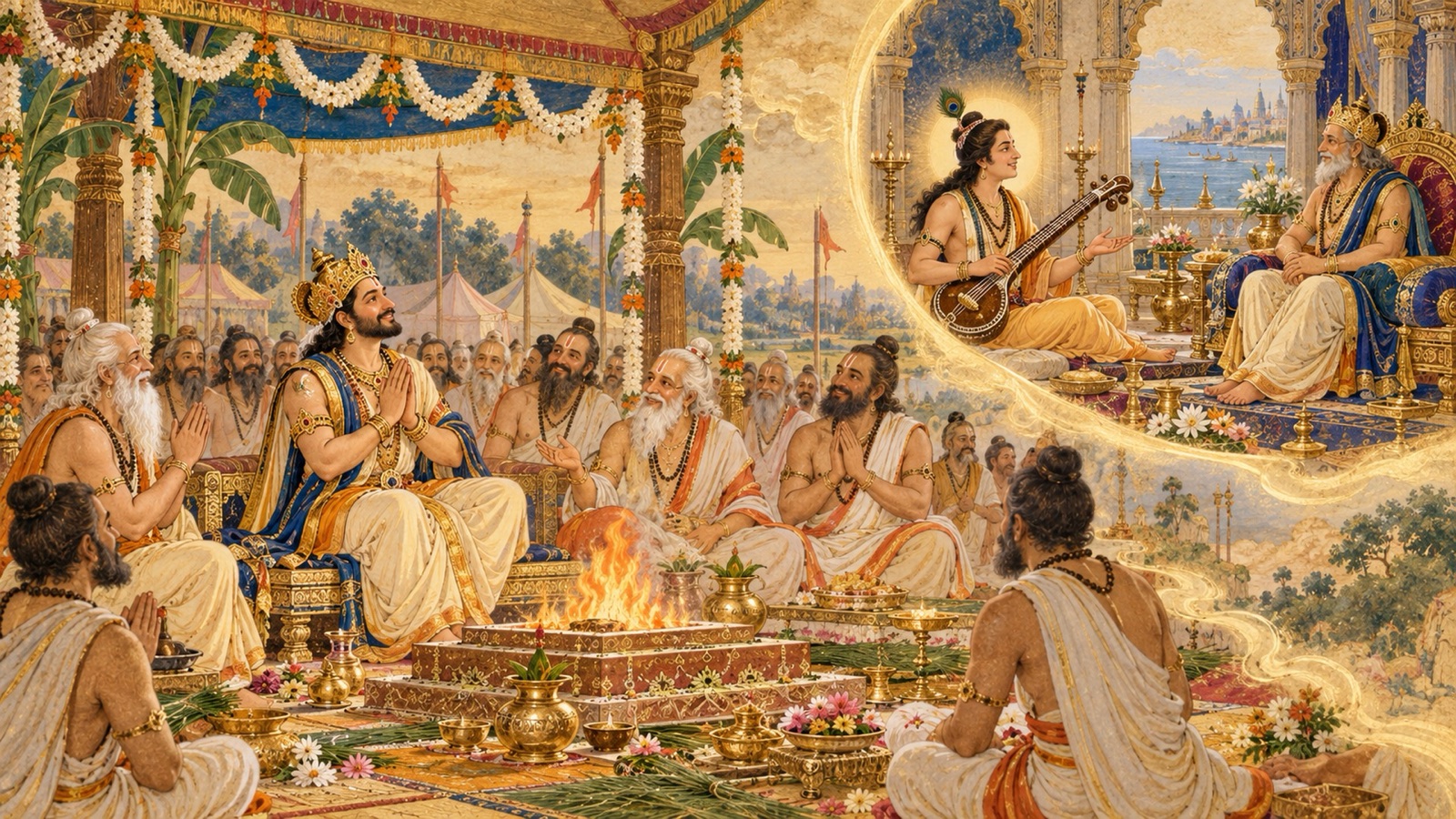
And should such a surrendered devotee, dear to the Lord, ever incur any fault, the Supreme Lord seated in his heart Himself washes it away. Hearing all these courses of conduct so pleasing to the Lord, Narada concluded, King Nimi with his priests and preceptors was filled with delight (verses 41-42).
Principal Teachings of This Chapter
1. To know the Lord and ignore Him is the true loss. Chamasa’s warning falls not on the ignorant but on those who recognize the Lord as their origin and still turn away — the peril lies in neglect, not in incapacity (verses 2-3).
2. Devotees are called to compassion, not contempt. Those far from the Lord’s glories are to be pitied and helped by devotees, never despised — the response to another’s neglect is mercy (verse 4).
3. The Lord meets every age in a fitting form. White in Satya, crimson in Treta, dark-hued in Dvapara, the same Lord adapts His form, name and worship to the capacity of each age (verses 20-31).
4. In Kali, the holy name is the supreme worship. For our own age the Lord is best adored through sankirtana, the congregational chanting of His names — a worship open to all (verse 32).
5. Kali holds a hidden blessing. So powerful is the holy name that the wise extol this very age, and souls of former ages long to be born in it; there is no higher gain for the wandering soul (verses 36-37).
6. Full surrender fulfils every duty. One who wholeheartedly takes shelter of Mukunda is freed of all other debts, and the Lord Himself removes any fault from the heart of His surrendered devotee (verses 41-42).
A Devotional Reflection
This chapter holds within it the great comfort of the whole discourse. Chamasa’s sober words about turning away are not meant to frighten but to awaken; and no sooner is the danger named than Karabhajana opens the door wide for everyone. We might have expected our own difficult age to be the hardest for spiritual life — and in many ways it is. Yet the sages reverse the picture entirely: precisely because Kali is hard, the Lord has made the way easy, placing within our reach the simplest and most joyful of all worship — the singing of His names. What the men of Satya achieved by long contemplation, and those of Treta and Dvapara by elaborate rites, we may attain by opening our hearts and our voices. There is a beautiful humility in this. The holy name asks nothing of us but sincerity; it belongs equally to the learned and the unlettered, the powerful and the poor. And the chapter’s final word is tenderer still: to the one who simply takes shelter, the Lord Himself becomes the keeper of the heart.
A Daily Devotional Practice
Today, in the spirit of Karabhajana’s teaching, take a few minutes for sankirtana — the chanting of the Lord’s holy names. Alone or with family, softly and steadily sing or repeat: “Om Namo Bhagavate Vasudevaya.” Let the names rise without hurry, and let your attention rest gently upon them. In this simple practice you take up the very worship the Bhagavatam commends for our age — the treasure hidden in the age of Kali, by which, the sages promise, supreme peace is attained and the heart is drawn to the feet of Mukunda.
Conclusion
The fifth discourse of Book Eleven brings the great dialogue of King Nimi and the nine Yogendras to its close. The sage Chamasa warns, with grave compassion, of the loss suffered by those who know the Lord yet turn away, calling devotees not to scorn but to mercy. The sage Karabhajana then reveals how the same Lord is worshipped age after age in fitting forms — and crowns his answer with the glory of our own time: in the age of Kali, the Lord is best adored through the congregational chanting of His holy names, a treasure so great that the wise extol this age above the rest. The discourse ends where it must, in complete surrender — the soul that takes shelter of Mukunda is freed of every debt, and the Lord Himself guards its heart. Hearing all this, King Nimi rejoiced, and Narada gently returned his remembrance to Vasudeva. So concludes the teaching of the Yogendras, a shining gateway to the deeper wisdom of the Uddhava Gita that lies ahead.
May the divine wisdom of Srimad Bhagavatam awaken pure devotion within our hearts.
Om Namo Bhagavate Vasudevaya.
Jay Shree Madhav.
References and Attribution
- Primary edition: Gita Press, Śrīmad Bhāgavata Mahāpurāṇa (English, complete), Book Eleven, Discourse 5, pages 533–537.
- Series: Srimad Bhagavatam Wisdom · Biswa Sanatan Dharma Seva Trust.
- Presented following the spiritual guidance and recommendation of Pandit Dr. Shri Kashinath Mishra.
This is an original, faithful retelling in the writer’s own words, with brief quoted verses shown in Devanāgarī and transliteration and their meanings given as summaries. It is not a reproduction of any single publisher’s continuous translation or commentary. No affiliation with or endorsement by any publisher is implied.
Jay Shree Madhav