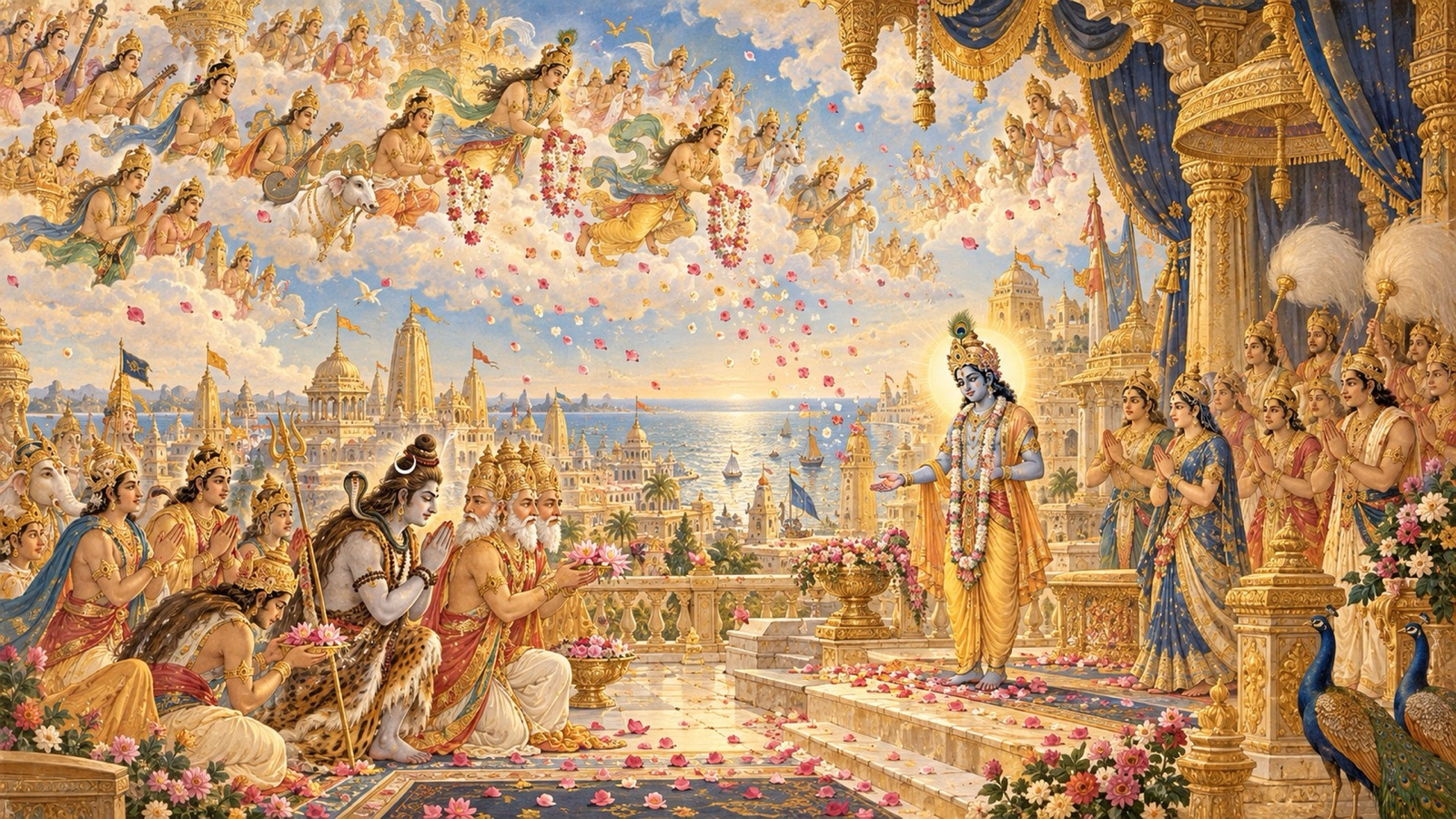
Brahma and Lord Siva lead the celestial host down to the radiant city of Dwaraka, where they shower Sri Krishna with blossoms grown only in heaven and offer Him hymns of adoration — His earthly mission now complete, they come to beg that He return to His own transcendent abode.
Om Namo Bhagavate Vasudevaya.
Om Namo Bhagavate Vasudevaya.
Om Namo Bhagavate Vasudevaya.
Welcome to Srimad Bhagavatam Wisdom, a devotional journey through the sacred histories and teachings of the Srimad Bhagavat Mahapurana. With the teaching of the nine Yogendras concluded and Narada departed from Dwaraka, the sixth discourse of Book Eleven turns to a solemn and tender moment. The gods, led by Brahma and Lord Siva, come with all the hosts of heaven to see Sri Krishna once more, to worship Him with celestial flowers and hymns, and to make a heartfelt request: the burden of the earth has been lifted, and the time has come for the Lord to return to His own abode. Sri Krishna consents, reveals how the Yadu dynasty must be withdrawn, and directs His kinsmen toward the sacred place of Prabhasa. And as the world begins to sense His departure, His beloved servant Uddhava draws near — setting the stage for the great teaching that lies just ahead.
Chapter Information
- Scripture: Śrīmad Bhāgavata Mahāpurāṇa
- Canto: 11 (Book Eleven)
- Chapter: 6 (Discourse 6)
- Chapter title: The Yadu Dynasty Retires to Prabhasa
- Principal speaker: Sukadeva Gosvami, narrating to King Parikshit; within the narrative, the gods, Brahma, Sri Krishna and Uddhava speak in turn
- Principal listener: King Parikshit; within the narrative, Sri Krishna and the assembled elders of the Yadus
- Main setting: The city of Dwaraka, on the eve of the Yadu dynasty’s departure for Prabhasa
- Central subject: The gods’ prayers and entreaty for the Lord’s return to His divine realm, the Lord’s consent and disclosure of the Yadu dynasty’s withdrawal, the journey to Prabhasa, and Uddhava’s approach to the Lord
- Principal verse range: Canto 11, Chapter 6, verses 1–50
- Primary edition: Gita Press Śrīmad Bhāgavata Mahāpurāṇa
Context from the Previous Chapter
In Chapter 5, the sages Chamasa and Karabhajana completed the teaching of the nine Yogendras to King Nimi — the fate of those who neglect the Lord, and the forms in which He is worshipped across the four ages, crowned by the glory of chanting His holy names in the age of Kali. That teaching had been recalled by Narada to Vasudeva. Now, with Narada gone from Dwaraka, the celestials themselves arrive to behold the Lord and to ask that He return home.
The Gods Descend upon Dwaraka
Sukadeva Gosvami resumed his narration. When Narada had finished his discourse and left Dwaraka, Brahma arrived surrounded by his sons — Sanaka and the other sages — together with the gods and the lords of creation, and Lord Siva came accompanied by his hosts. Indra with the Maruts, the Adityas, the Vasus, the Aswins, the Rbhus, the Angiras, the Rudras, the Viswedevas and the Sadhyas, the Gandharvas and Apsaras, the Nagas, Siddhas, Charanas and Guhyakas, the sages and the manes, along with the Vidyadharas and Kinnaras — all came to Dwaraka, eager to see Sri Krishna, whose beauty captivates the mind of the whole world and whose glory, spread through the three worlds, destroys the sins of the universe (verses 1-4).
In that brilliant city, rich with every kind of splendour, they beheld Sri Krishna of wondrous beauty, and their eyes could not be satisfied with looking upon Him. Covering the foremost of the Yadus with flowers that grow only in heaven, they praised the Lord of the universe with hymns woven of charming words and lofty ideas (verses 5-6).
The Prayer of the Gods
Then the gods offered their prayer. With intellect, senses, life-breath, mind and speech, they bowed to the lotus-feet of the Lord — those very feet upon which the devoted meditate within the heart, longing to be freed from the mighty bondage of action.
श्रीदेवा ऊचु: नता: स्म ते नाथ पदारविन्दं बुद्धीन्द्रियप्राणमनोवचोभि: । यच्चिन्त्यतेऽन्तर्हृदि भावयुक्तै- र्मुमुक्षुभि: कर्ममयोरुपाशात् ॥ ७ ॥
śrī-devā ūcuḥ natāḥ sma te nātha padāravindaṁ buddhīndriya-prāṇa-mano-vacobhiḥ yac cintyate ‘ntar hṛdi bhāva-yuktair mumukṣubhiḥ karma-mayoru-pāśāt
Meaning: The gods said: O Lord, with intellect, senses, life-breath, mind and speech we bow to Your lotus-feet — the feet meditated upon within the heart by those full of devotion who seek release from the strong bondage of karma. (Canto 11, Chapter 6, verse 7)
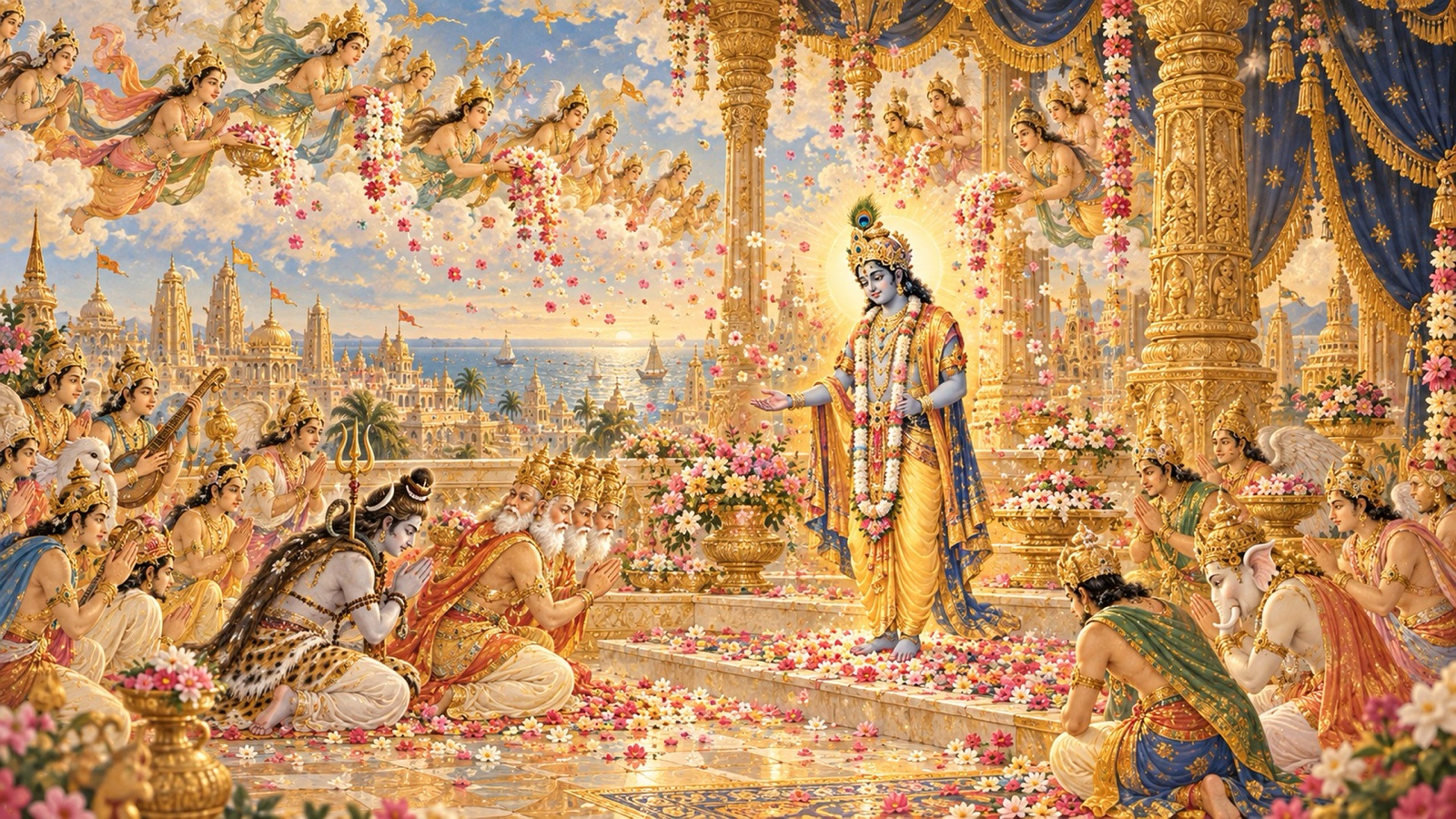
The gods continued their praise at length. The Lord, they said, presides over the three modes born of His own Maya, yet remains ever untouched by the creation, preservation and dissolution He effects, absorbed in the unclouded bliss that is His very nature. The purification of the impure-minded, they observed, is achieved not so much by worship, study, charity, austerity and ritual as it is in the pure-hearted through the mature faith born of constantly hearing His glory. They prayed that His feet might serve as a fire to consume every unholy craving — those feet contemplated by ascetics, worshipped by devotees, meditated upon three times a day by the wise, offered into the sacrificial fire, and sought by yogis striving to see through the veil of Maya. They recalled how, as Vamana, His stride measured the worlds and the Ganga flowed as His banner-streamer; they hailed Him as Purushottama, superior to matter and spirit alike, the Controller of Prakriti and Purusha and the very wheel of Time; and they marvelled that not even His sixteen thousand queens, with all their charms, could disturb His mind. The streams of His glory sung in the Vedas and the sacred rivers that have washed His feet, they declared, are alike able to wash away the sins of the three worlds (verses 8-19).
Brahma’s Petition — The Mission Fulfilled
Having thus extolled and bowed low to Sri Hari, Brahma — standing in the air together with Lord Siva and the other gods — made his petition to Sri Krishna. Long ago, he recalled, the gods had entreated the Lord to remove the burden of the earth, and this He had accomplished exactly as desired. Righteousness had been firmly established among the truthful and the virtuous; descending in the line of Yadu, the Lord had performed deeds of matchless valour, and pious souls in the age of Kali would cross the darkness of ignorance simply by hearing and celebrating those exploits. Then Brahma named the hour that had come.
यदुवंशेऽवतीर्णस्य भवत: पुरुषोत्तम । शरच्छतं व्यतीयाय पञ्चविंशाधिकं प्रभो ॥ २५ ॥
yadu-vaṁśe ‘vatīrṇasya bhavataḥ puruṣottama śarac-chataṁ vyatīyāya pañca-viṁśādhikaṁ prabho
Meaning: O Supreme Person, O Lord, a hundred and twenty-five years have now passed since You descended in the dynasty of Yadu. (Canto 11, Chapter 6, verse 25)
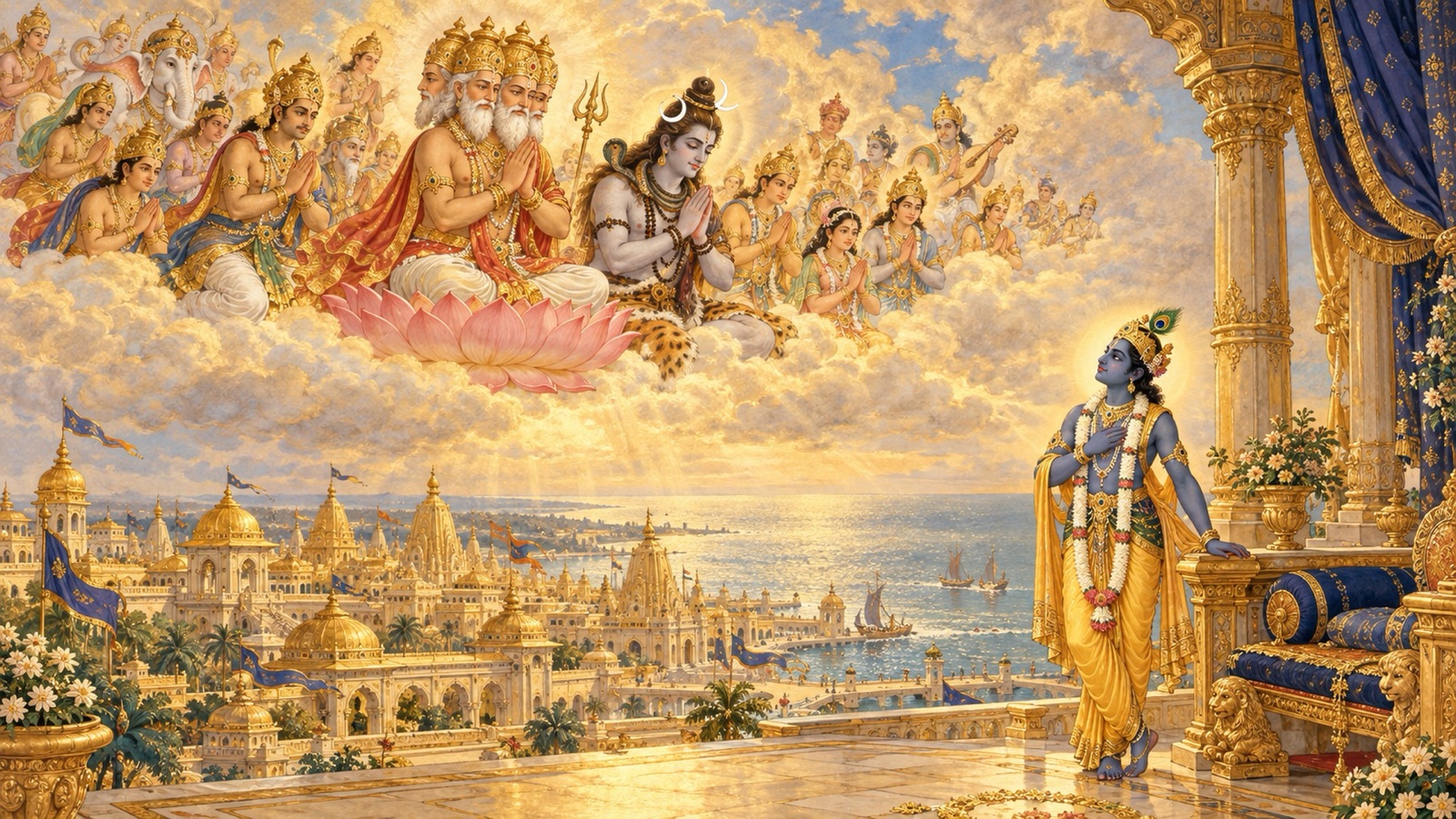
No part of the gods’ purpose now remained unaccomplished, Brahma said, and the Yadu race itself had nearly reached its end through the curse of the brahmanas. Therefore, if it pleased the Lord, let Him now return to His transcendent realm of Vaikuntha and bless His servants, the guardians of the spheres, by visiting their realms and accepting their homage (verses 26-27).
The Lord’s Reply — Withdrawing the Yadu Dynasty
The Supreme Lord replied that what the gods asked had already been decided within Himself.
श्रीभगवानुवाच अवधारितमेतन्मे यदात्थ विबुधेश्वर । कृतं व: कार्यमखिलं भूमेर्भारोऽवतारित: ॥ २८ ॥
śrī-bhagavān uvāca avadhāritam etan me yad āttha vibudheśvara kṛtaṁ vaḥ kāryam akhilaṁ bhūmer bhāro ‘vatāritaḥ
Meaning: The Supreme Lord said: O ruler of the gods, what you ask has already been resolved by Me; the entire purpose of the gods is accomplished and the burden of the earth has been removed. (Canto 11, Chapter 6, verse 28)
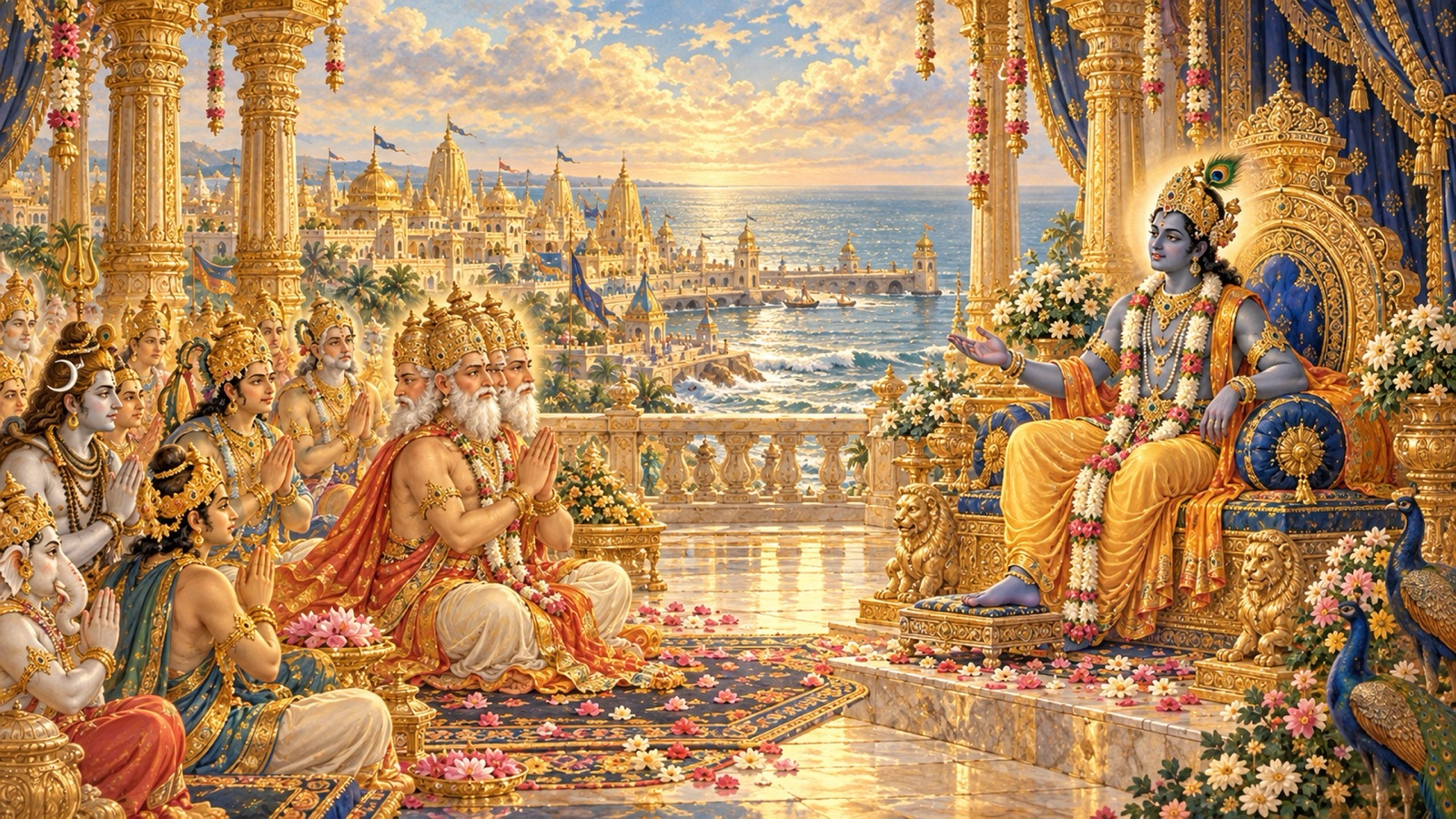
But there was a reason, the Lord explained, why He could not depart at once. The Yadu race, made insolent by its prowess, heroism and fortune and inclined to seize the whole world, had been restrained by Him alone — as the ocean is held in check by its shore. Were He to leave without withdrawing this mighty and overweening dynasty, the whole human race would be overwhelmed by it, like a sea that has broken its bounds. The destruction of the race had already begun through the brahmanas’ curse; once it was complete, He told Brahma, He would ascend to the divine realm. Hearing this, Brahma fell prostrate before the Lord and returned with the host of gods to his own abode (verses 29-32).
The Portents and the Journey to Prabhasa
Presently the Lord noticed grave and terrible portents arising on all sides over the city of Dwaraka, and He spoke to the elders of the Yadus who had assembled there. These exceptional omens, He said, were appearing everywhere, and a curse from the brahmanas, hard to overcome, had fallen upon their race. Then He gave His direction.
न वस्तव्यमिहास्माभिर्जिजीविषुभिरार्यका: । प्रभासं सुमहत्पुण्यं यास्यामोऽद्यैव मा चिरम् ॥ ३५ ॥
na vastavyam ihāsmābhir jijīviṣubhir āryakāḥ prabhāsaṁ su-mahat-puṇyaṁ yāsyāmo ‘dyaiva mā ciram
Meaning: If we wish to live, O honoured elders, we should not remain here any longer; this very day, without delay, let us go to Prabhasa, a place of great sanctity. (Canto 11, Chapter 6, verse 35)
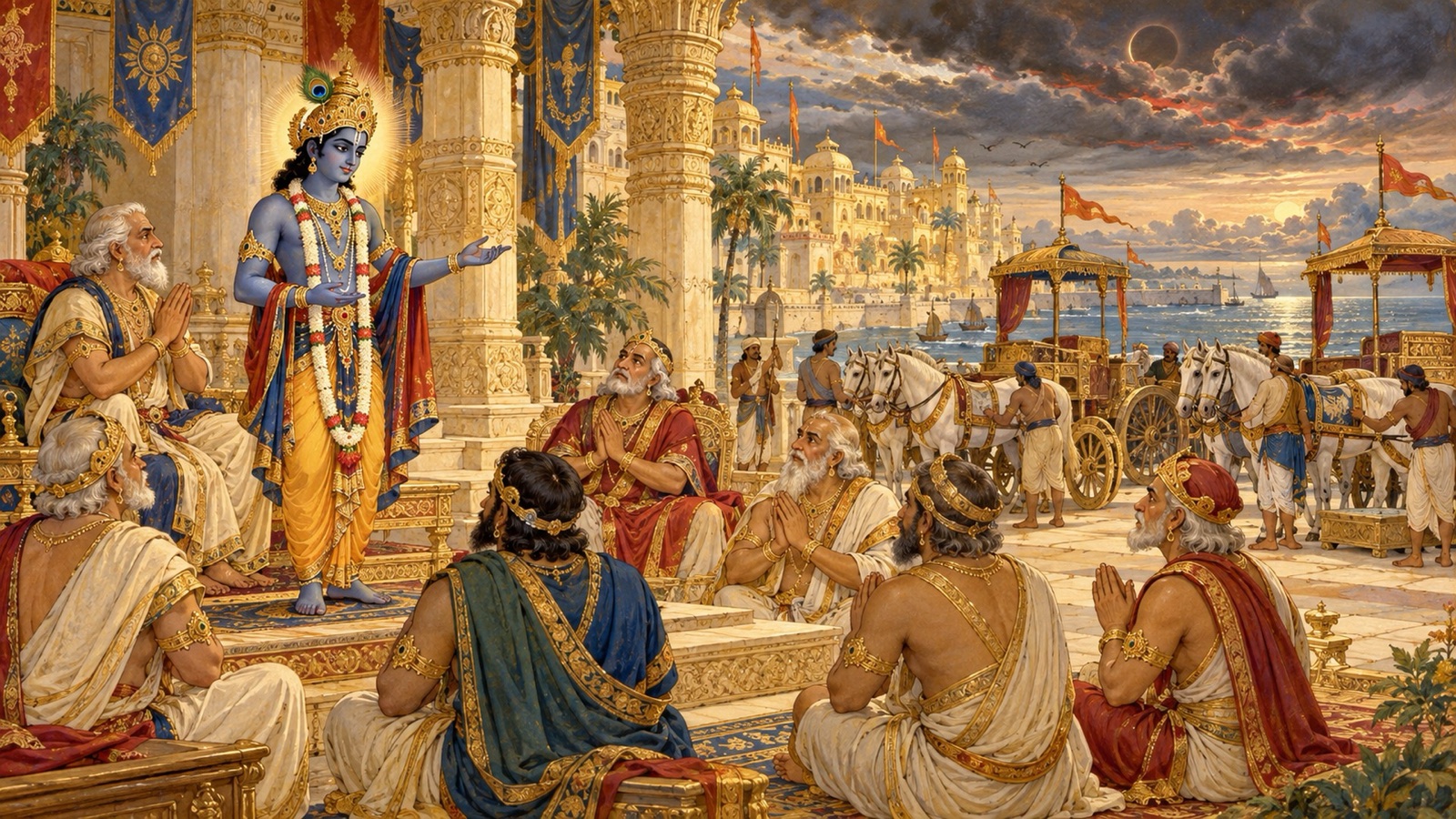
There at Prabhasa, the Lord recalled, the moon-god had once bathed and been freed at once from the wasting sickness laid upon him by Daksa’s curse, recovering the waxing of his digits. Bathing in those sacred waters, gratifying the manes and gods with offerings, feeding worthy brahmanas and bestowing valuable gifts upon them, they too would cross beyond their sins, He said — as people cross the ocean by ship. Thus directed by the Lord, the Yadavas resolved to make the journey to the holy place and began to make ready their chariots (verses 36-39).
Uddhava Approaches the Lord
One among them read the deeper meaning of these events. Uddhava, ever devoted to Sri Krishna, saw the preparations, heard the words the Lord had spoken, and observed the fearful portents — and understood.
तन्निरीक्ष्योद्धवो राजन् श्रुत्वा भगवतोदितम् । दृष्ट्वारिष्टानि घोराणि नित्यं कृष्णमनुव्रत: ॥ ४० ॥ विविक्त उपसङ्गम्य जगतामीश्वरेश्वरम् । प्रणम्य शिरसा पादौ प्राञ्जलिस्तमभाषत ॥ ४१ ॥
tan nirīkṣyoddhavo rājan śrutvā bhagavatoditam dṛṣṭvāriṣṭāni ghorāṇi nityaṁ kṛṣṇam anuvrataḥ vivikta upasaṅgamya jagatām īśvareśvaram praṇamya śirasā pādau prāñjalis tam abhāṣata
Meaning: O king, observing all this, hearing what the Lord had said, and seeing the terrible portents, Uddhava — ever devoted to Krishna — approached the Lord of the lords of the universe in a secluded place, bowed his head to His feet, and with joined palms addressed Him. (Canto 11, Chapter 6, verses 40-41)
Uddhava spoke from the depths of love, addressing the Lord as the sovereign over every celestial power, the master of all mystic discipline, whose very name sanctifies any tongue that utters it — now that the dynasty has been thinned, he said, Your own departure from this world must surely be at hand, for You let the sages’ curse stand though it lay fully within Your power to turn it aside.
श्रीउद्धव उवाच देवदेवेश योगेश पुण्यश्रवणकीर्तन । संहृत्यैतत् कुलं नूनं लोकं सन्त्यक्ष्यते भवान् । विप्रशापं समर्थोऽपि प्रत्यहन्न यदीश्वर: ॥ ४२ ॥
śrī-uddhava uvāca deva-deveśa yogeśa puṇya-śravaṇa-kīrtana saṁhṛtyaitat kulaṁ nūnaṁ lokaṁ santyakṣyate bhavān vipra-śāpaṁ samartho ‘pi pratyahan na yad īśvaraḥ
Meaning: Uddhava said: O Lord of the lords of gods, O Master of yoga, hearing and chanting of whose glories sanctifies the soul — having withdrawn this dynasty, You will surely leave this world, for though able, You did not, O Lord, avert the brahmanas’ curse. (Canto 11, Chapter 6, verse 42)
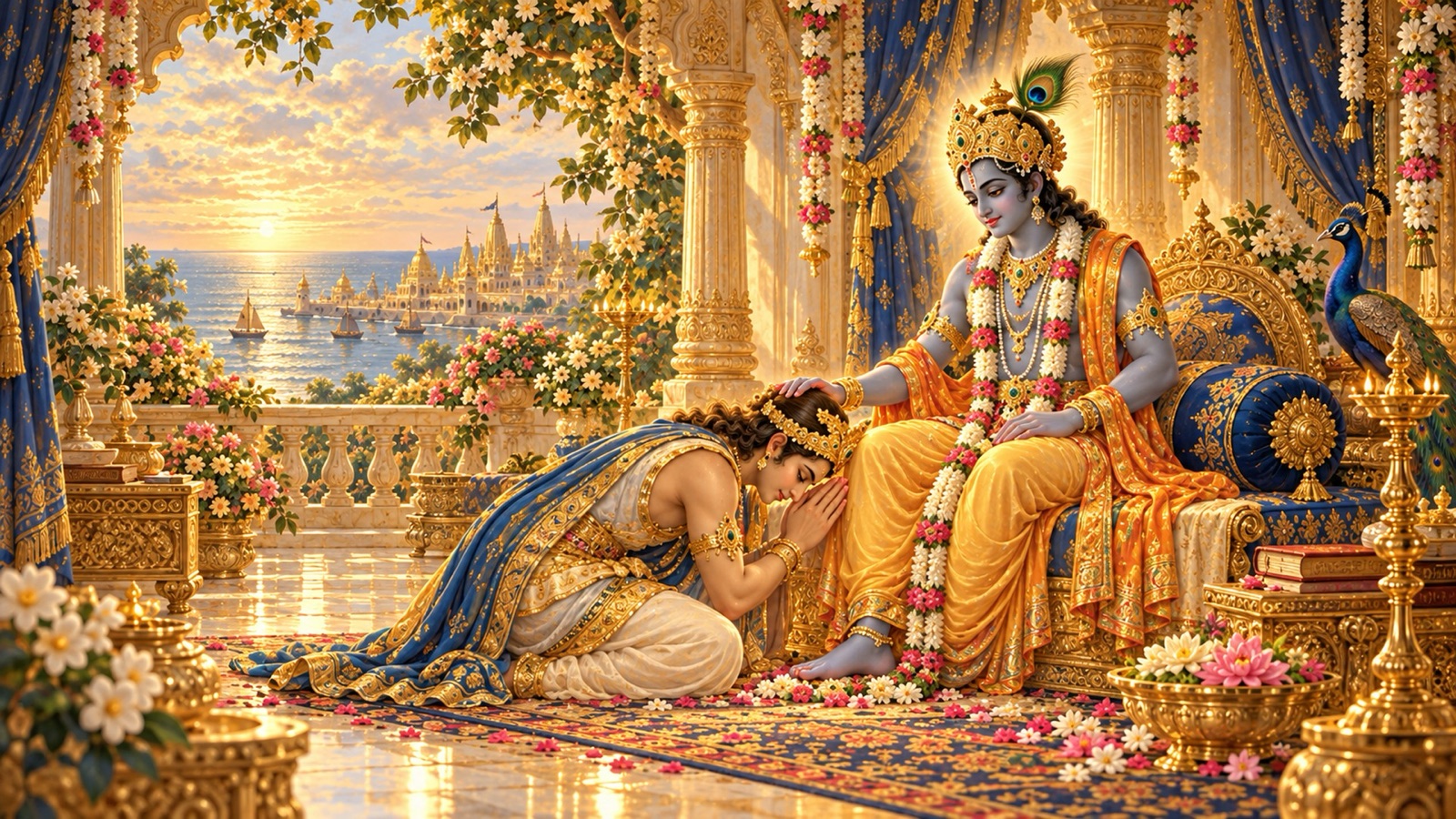
He could not bear, Uddhava said, to abandon the Lord’s lotus-feet even for half a second — and he prayed that the Lord would take him too to His divine realm. Those who have tasted the nectar of hearing the Lord’s pastimes give up every other craving; how then could His servants live without Him, they who had waited on Him as He lay and sat and walked, who had been adorned with the garlands and sandal-paste He had worn and had eaten the remnants of His food? Great sages, free of all passion and impurity, attain the Lord’s supreme state by lifelong penance and celibacy; yet even those who, like themselves, still revolve in the paths of action would cross the darkness of ignorance simply through talking of Him with His devotees — dwelling on His words and deeds, His gait and smiles and glances and jokes, and all that He did in imitation of the ways of human beings (verses 43-49).
Important Verse
Uddhava’s plea did not go unanswered. The chapter closes on the threshold of one of the most treasured teachings in all of Sanskrit scripture.
श्रीशुक उवाच एवं विज्ञापितो राजन् भगवान् देवकीसुत: । एकान्तिनं प्रियं भृत्यमुद्धवं समभाषत ॥ ५० ॥
śrī-śuka uvāca evaṁ vijñāpito rājan bhagavān devakī-sutaḥ ekāntinaṁ priyaṁ bhṛtyam uddhavaṁ samabhāṣata
Meaning: Sukadeva said: Thus entreated, O king, Lord Sri Krishna, the son of Devaki, began to speak to Uddhava — His beloved servant and single-hearted devotee. (Canto 11, Chapter 6, verse 50)
Principal Teachings of This Chapter
1. Every descent of the Lord has its appointed purpose and hour. The gods come to Dwaraka because the burden of the earth is lifted and the work is done; the Lord’s appearance and His return are alike ordered by His own will, not by chance (verses 21-28).
2. The Lord acts for the protection of the world, even in withdrawal. Sri Krishna will not depart until the proud Yadu dynasty is withdrawn, lest an unchecked power overwhelm humanity like a sea that breaks its shore — His very leaving is an act of care (verses 29-31).
3. Faith born of hearing purifies more deeply than ritual alone. The gods declare that the impure heart is cleansed above all by the mature faith that grows from constantly hearing the Lord’s glory (verse 9).
4. The holy places and the holy narrations both wash away sin. The sacred rivers that have touched the Lord’s feet and the streams of His glory sung in the Vedas are alike able to purify the three worlds (verse 19).
5. Love cannot bear separation from the Lord. Uddhava’s prayer is the cry of pure devotion — not fear of Maya, but the anguish of parting from the beloved Lord whose service is life itself (verses 42-46).
6. Remembrance of the Lord is open to all. Even those still bound to the paths of action, Uddhava affirms, may cross the darkness of ignorance simply by speaking of the Lord among His devotees (verses 47-49).
A Devotional Reflection
There is a quiet grandeur in this chapter, and beneath it a tenderness that catches the heart. The whole of heaven gathers to behold one form, and the creator himself stands in the air to say that the work is finished and the hour has come. We might expect such a scene to be only majestic. Yet the Bhagavatam does not let the majesty stand alone. It ends not with the gods and their hymns, but with a single devotee who cannot bear the thought of parting. Uddhava does not ask to be spared hardship or to be granted power; he asks only not to be separated from the feet he loves. In his words we hear the truest measure of devotion — that its deepest fear is not the world’s dangers but distance from the Lord, and its highest hope is simply to remain near Him. And the Lord’s response, held for the chapter to come, reminds us that such love is never turned away. The one who clings to Him in love becomes the very vessel of His parting wisdom.
A Daily Devotional Practice
Today, take the spirit of Uddhava as your guide. Set aside a few unhurried minutes to remember the Lord not out of duty but out of affection — recalling His kindness, His beauty, His nearness. As you do, softly repeat His holy name: “Om Namo Bhagavate Vasudevaya.” Let the remembrance be personal and warm, as of one who does not wish to be apart from the beloved even for a moment. In this simple practice you take up the very devotion the Bhagavatam praises here — the loving remembrance that, the scripture promises, carries the soul across the darkness of ignorance and keeps it ever near the feet of the Lord.
Conclusion
The sixth discourse of Book Eleven stands upon the threshold of the Lord’s departure from the world. The gods, led by Brahma and Lord Siva, descend upon Dwaraka to behold Sri Krishna, to worship Him with heavenly flowers and hymns, and to ask that He now return to His own realm, for the burden of the earth is lifted. The Lord consents, but reveals that the proud Yadu dynasty must first be withdrawn, lest its unchecked strength overwhelm the world; and, seeing dread portents rise over Dwaraka, He directs His kinsmen to the holy place of Prabhasa. Then, in the chapter’s tenderest turn, His devoted servant Uddhava draws near in a lonely place, touches his head to the Lord’s feet, and prays only that he never be parted from Him. To this prayer the Lord turns at last — and the reply He is about to give will unfold into the great teaching known as the Uddhava Gita. So this chapter, solemn and loving at once, opens the door to the deepest wisdom of the Eleventh Canto.
May the divine wisdom of Srimad Bhagavatam awaken pure devotion within our hearts.
Om Namo Bhagavate Vasudevaya.
Jay Shree Madhav.
References and Attribution
- Primary edition: Gita Press, Śrīmad Bhāgavata Mahāpurāṇa (English, complete), Book Eleven, Discourse 6, pages 538–544.
- Series: Srimad Bhagavatam Wisdom · Biswa Sanatan Dharma Seva Trust.
- Presented following the spiritual guidance and recommendation of Pandit Dr. Shri Kashinath Mishra.
This is an original, faithful retelling in the writer’s own words, with brief quoted verses shown in Devanāgarī and transliteration and their meanings given as summaries. It is not a reproduction of any single publisher’s continuous translation or commentary. No affiliation with or endorsement by any publisher is implied.
Jay Shree Madhav