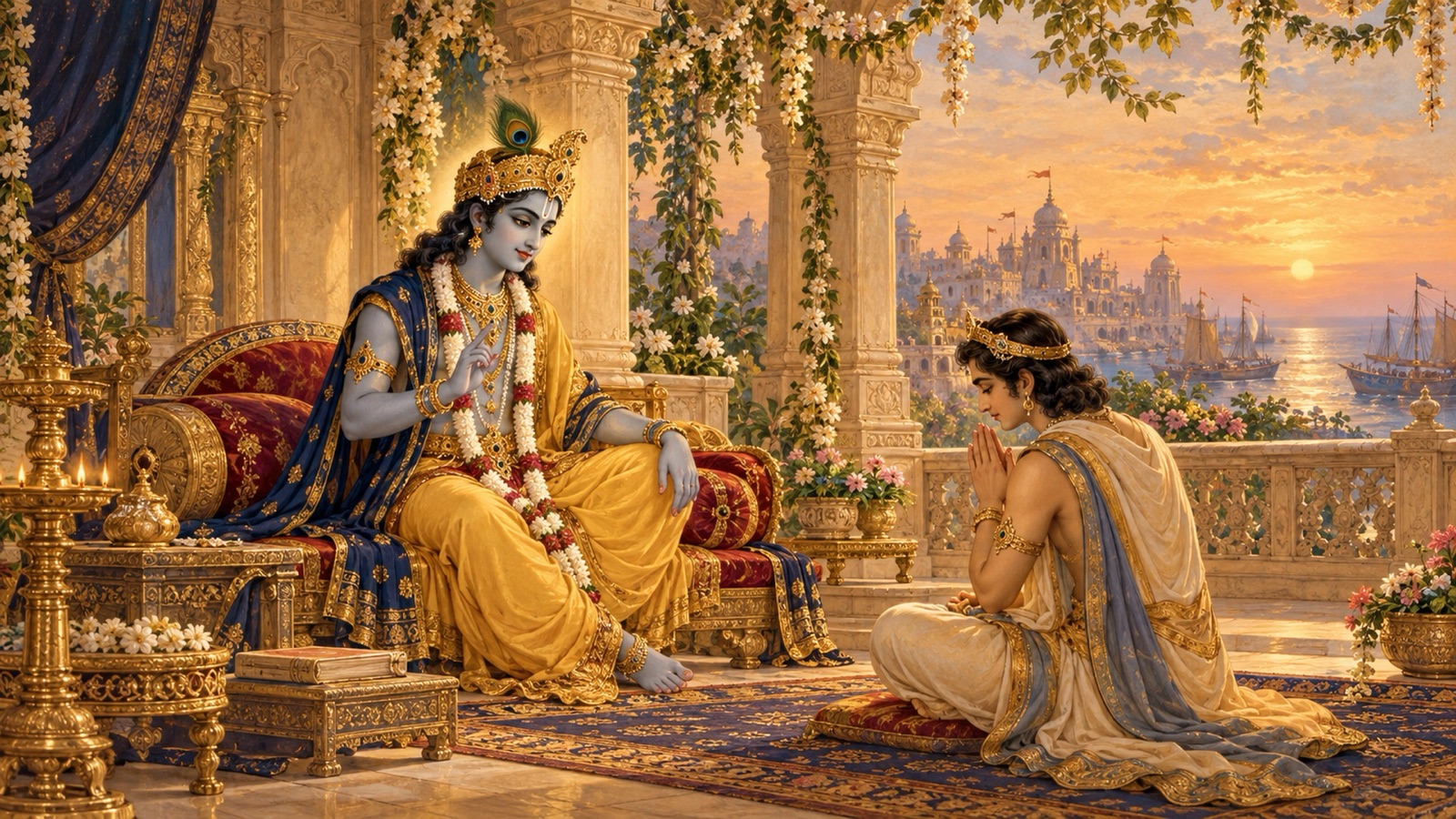
On the eve of His departure from the world, Lord Sri Krishna begins His great instruction to His beloved devotee Uddhava — calling him to renunciation, equal vision and refuge in the Self, and illustrating the path with the ancient legend of a wandering ascetic who found twenty-four teachers in the world around him.
Om Namo Bhagavate Vasudevaya.
Om Namo Bhagavate Vasudevaya.
Om Namo Bhagavate Vasudevaya.
Welcome to Srimad Bhagavatam Wisdom, a devotional journey through the sacred histories and teachings of the Srimad Bhagavat Mahapurana. In the previous chapter, the gods entreated Sri Krishna to return to His realm, the Yadus set out for Prabhasa, and Uddhava drew near, praying never to be parted from the Lord. Now the Lord answers that prayer with the beginning of a profound teaching. He calls Uddhava to leave the world of attachment, to wander the earth with an even mind, and to see all things in the Self and the Self in Him. When Uddhava confesses how difficult such renunciation is and begs for guidance, the Lord relates a beautiful ancient story — the dialogue of King Yadu and a serene wandering ascetic who, free of all worldly ties, had drawn lessons from earth and sky, from beasts and birds, finding a teacher in nearly everything he beheld. This chapter opens the great teaching known as the Uddhava Gita, and gives us the first eight of the ascetic’s twenty-four gurus, from the earth to the dove.
Chapter Information
- Scripture: Śrīmad Bhāgavata Mahāpurāṇa
- Canto: 11 (Book Eleven)
- Chapter: 7 (Discourse 7)
- Chapter title: Lord Krishna Instructs Uddhava
- Principal speaker: Sri Krishna, instructing Uddhava; within the Lord’s narration, the avadhuta Brahmana answering King Yadu; the whole related by Sukadeva Gosvami to King Parikshit
- Principal listener: Uddhava; within the narration, King Yadu; and King Parikshit
- Main setting: Dwaraka, on the eve of the Lord’s departure; within the narration, an ancient meeting of King Yadu and a wandering ascetic
- Central subject: The Lord’s call to renunciation and equal vision, refuge in the Self, and the beginning of the story of the twenty-four gurus — the first eight teachers, from the earth to the dove
- Principal verse range: Canto 11, Chapter 7, verses 1–74
- Primary edition: Gita Press Śrīmad Bhāgavata Mahāpurāṇa
Context from the Previous Chapter
In Chapter 6, the gods came to Dwaraka to praise Sri Krishna and ask that He return to His transcendent realm; the Lord consented, directed the Yadus toward the holy place of Prabhasa, and His devoted servant Uddhava approached Him in seclusion, praying not to be separated from Him. This chapter is the Lord’s loving response — the opening of His last and greatest teaching, spoken to Uddhava on the eve of His departure.
The Lord’s Call to Renunciation
The Lord told Uddhava plainly that when He left the world, the age of Kali would fully arrive and people would grow fond of unrighteous ways; Uddhava should not remain, but should shake off all attachment to kinsmen, fix his mind wholly on the Lord, and wander the earth looking upon all with an equal eye. Whatever is perceived by mind, speech, eyes or ears, the Lord said, is a creation of the mind and therefore fleeting and unreal. A restless mind falls into the illusion of seeing endless diversity, and from that arises the sense of good and evil, and from that the whole tangle of duty and prohibition. Therefore, having controlled mind and senses, Uddhava should see this whole world as projected within the Self, and see his own self as existing in the Supreme Lord. One who becomes a friend to all beings, full of peace, beholding the universe as one with the Lord, never again undergoes suffering (verses 1-12).
Uddhava’s Prayer for Guidance
Hearing this, Uddhava fell prostrate before the Lord and spoke from an honest heart. Such renunciation of sense-pleasure, he said, is well-nigh impossible for those attached to enjoyment, and even more so for those not devoted to the Lord. “I am ignorant,” he confessed, “attached to this body and to children, immersed in the notions of ‘I’ and ‘mine.’ Instruct me, Your servant, that I may attain the renunciation You have taught.” He saw no one, not even among the celestials, who could reveal the truth of the Self as the Lord could; and so, his mind turned away from the world and afflicted with sorrow, he took refuge in the Lord alone — Narayana, the friend of all beings, eternal, infinite and omniscient (verses 13-18).
The Human Body, Dearest of All
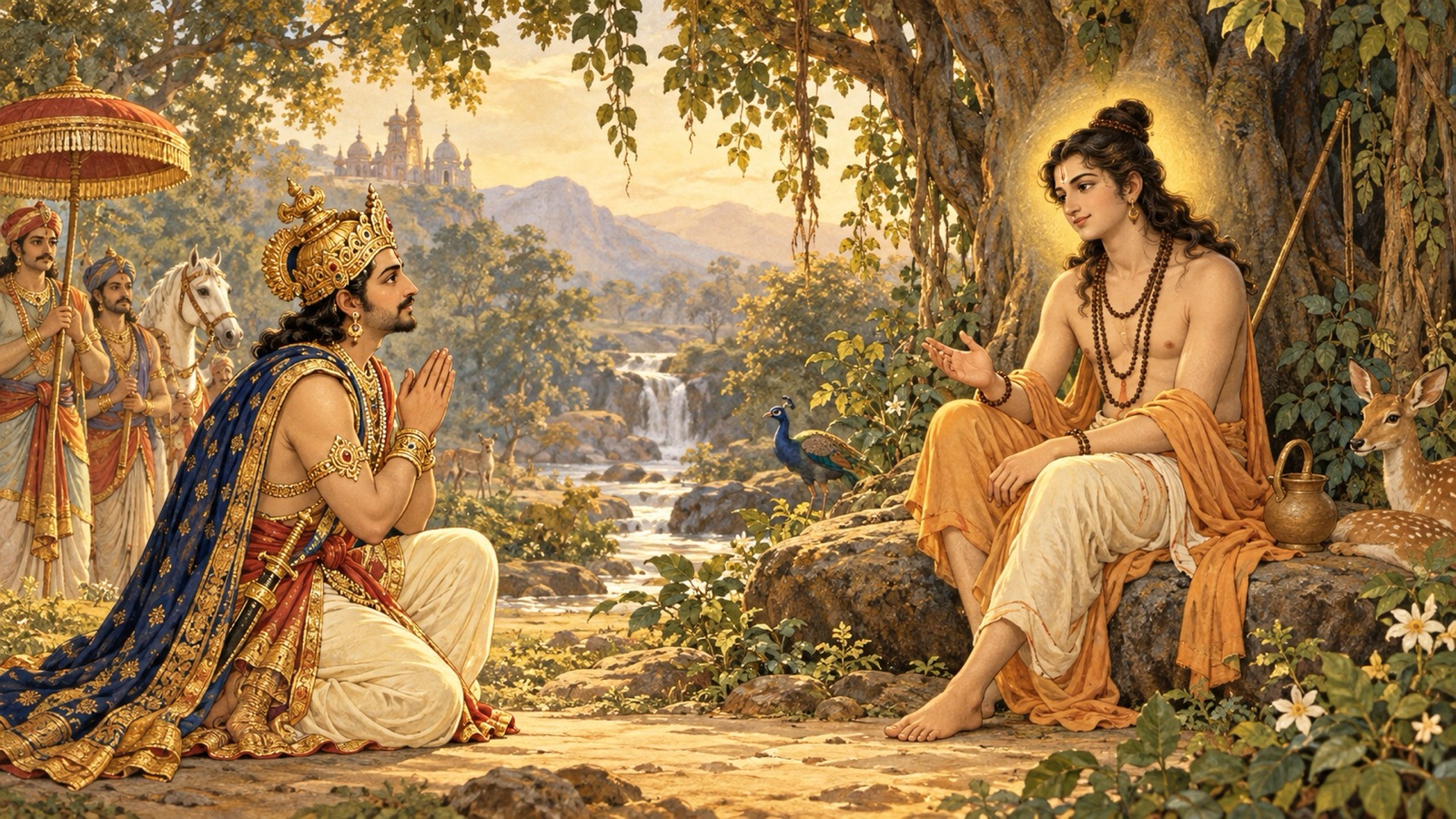
The Lord replied that those who earnestly investigate the true nature of the world can lift themselves by their own effort and free themselves from craving; for the Self is indeed one’s own guide, and man especially, by direct perception and reasoning, can work out his own good. Among the countless forms of living beings, the Lord said, the human body is the dearest to Him, for in it the vigilant discover the Supreme. To illustrate this, He related an ancient legend: a dialogue between the powerful and discerning King Yadu and a young ascetic — an avadhuta of the highest order — who, though full of wisdom, wandered fearlessly with an unclean body, as though carefree (verses 19-25).
King Yadu and the Avadhuta
Seeing the ascetic so learned yet so utterly free, King Yadu, who knew the ways of Dharma, questioned him with reverence. How, though remaining inactive, had he gained such penetrating wisdom? Men generally strive after merit, wealth, pleasure and even self-enquiry only from the wish for long life, renown and fortune — yet this Brahmana, able-bodied, learned and eloquent, did nothing, coveted nothing, and moved among people burning with lust and greed untouched by their fire, like an elephant standing in the cool water of the Ganga. What, Yadu asked, was the source of the joy that abided in his mind? The Brahmana answered graciously.
श्रीब्राह्मण उवाच सन्ति मे गुरवो राजन् बहवो बुद्ध्युपाश्रिता: । यतो बुद्धिमुपादाय मुक्तोऽटामीह तान् शृणु ॥ ३२ ॥
śrī-brāhmaṇa uvāca santi me guravo rājan bahavo buddhy-upāśritāḥ yato buddhim upādāya mukto ‘ṭāmīha tān śṛṇu
Meaning: The Brahmana said: O king, I have many teachers, taken up by my own discernment; having gained wisdom from them, I wander the world free. Hear of them. (Canto 11, Chapter 7, verse 32)
The Twenty-Four Gurus
The Brahmana then named the teachers he had chosen — twenty-four in all, drawn from the elements, the heavens, and the creatures of the world.
पृथिवी वायुराकाशमापोऽग्निश्चन्द्रमा रवि: । कपोतोऽजगर: सिन्धु: पतङ्गो मधुकृद् गज: ॥ ३३ ॥ मधुहाहरिणो मीन: पिङ्गला कुररोऽर्भक: । कुमारी शरकृत् सर्प ऊर्णनाभि: सुपेशकृत् ॥ ३४ ॥ एते मे गुरवो राजन् चतुर्विंशतिराश्रिता: । शिक्षा वृत्तिभिरेतेषामन्वशिक्षमिहात्मन: ॥ ३५ ॥
pṛthivī vāyur ākāśam āpo ‘gniś candramā raviḥ kapoto ‘jagaraḥ sindhuḥ pataṅgo madhukṛd gajaḥ madhu-hā hariṇo mīnaḥ piṅgalā kuraro ‘rbhakaḥ kumārī śara-kṛt sarpa ūrṇanābhiḥ supeśakṛt ete me guravo rājan catur-viṁśatir āśritāḥ śikṣā vṛttibhir eteṣām anvaśikṣam ihātmanaḥ
Meaning: Earth, air, sky, water, fire, the moon and the sun; the dove, the python, the sea, the moth, the honey-bee and the elephant; the honey-gatherer, the deer, the fish, the courtesan Pingala, the osprey and the infant; the maiden, the arrow-maker, the serpent, the spider and the wasp — these twenty-four, O king, I have accepted as my teachers, and from their conduct I have learned all that I needed in this life for my good. (Canto 11, Chapter 7, verses 33-35)
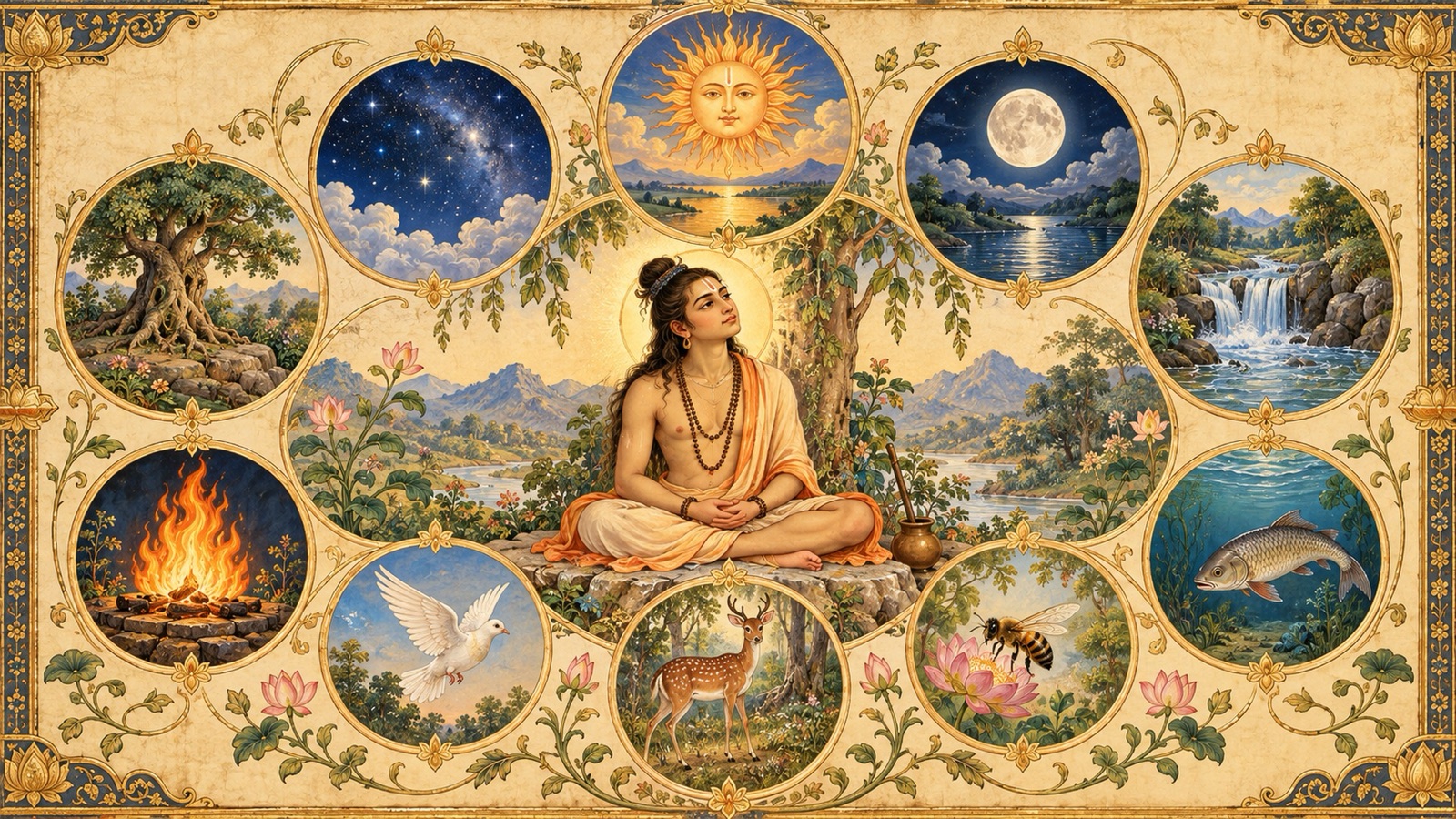
He would tell, he said, what he had learned from each, and how.
Lessons from the Earth, Air and Sky
From the earth the Brahmana learned forbearance — the vow of remaining unshaken even when oppressed by others acting under the sway of destiny, never straying from one’s righteous course.
भूतैराक्रम्यमाणोऽपि धीरो दैववशानुगै: । तद् विद्वान्न चलेन्मार्गादन्वशिक्षं क्षितेर्व्रतम् ॥ ३७ ॥
bhūtair ākramyamāṇo ‘pi dhīro daiva-vaśānugaiḥ tad vidvān na calen mārgād anvaśikṣaṁ kṣiter vratam
Meaning: Though oppressed by beings driven by destiny, the wise and steadfast, understanding this, do not deviate from their path — this vow I learned from the earth. (Canto 11, Chapter 7, verse 37)
From the mountain, a form of the earth, he learned that all one’s actions should serve others and that one’s very birth is meant for the good of others; and from the tree, another form of the earth, complete submission to the will of others. From the air and the life-breath he learned to be satisfied with bare sustenance and never to pamper the senses; and to move among all sorts of sense-objects, like the wind, without becoming attached to their virtues or faults, remaining as untouched by them as the air is by the odours it carries. From the sky he learned that the all-pervading Self, though seeming to dwell in bodies, is in truth free of all limitation and attachment — untouched by the changing world as the sky is untouched by the clouds that drift through it (verses 38-43).
Lessons from Water and Fire
From water the Brahmana learned the qualities of the sage.
स्वच्छ: प्रकृतित: स्निग्धो माधुर्यस्तीर्थभूर्नृणाम् । मुनि: पुनात्यपां मित्रमीक्षोपस्पर्शकीर्तनै: ॥ ४४ ॥
svacchaḥ prakṛtitaḥ snigdho mādhuryas tīrtha-bhūr nṛṇām muniḥ punāty apāṁ mitram īkṣopasparśa-kīrtanaiḥ
Meaning: Clear and pure, gentle by nature, sweet and a very place of pilgrimage for people, the sage — like water — purifies others by his sight, his touch and the utterance of his name. (Canto 11, Chapter 7, verse 44)

From fire he learned another lesson of purity and detachment.
तेजस्वी तपसा दीप्तो दुर्धर्षोदरभाजन: । सर्वभक्ष्योऽपि युक्तात्मा नादत्ते मलमग्निवत् ॥ ४५ ॥
tejasvī tapasā dīpto durdharṣodara-bhājanaḥ sarva-bhakṣyo ‘pi yuktātmā nādatte malam agni-vat
Meaning: Radiant, made brilliant by austerity, formidable, and storing nothing beyond his own belly, the self-controlled sage — like fire — takes on no impurity, though he may consume whatever comes to him. (Canto 11, Chapter 7, verse 45)
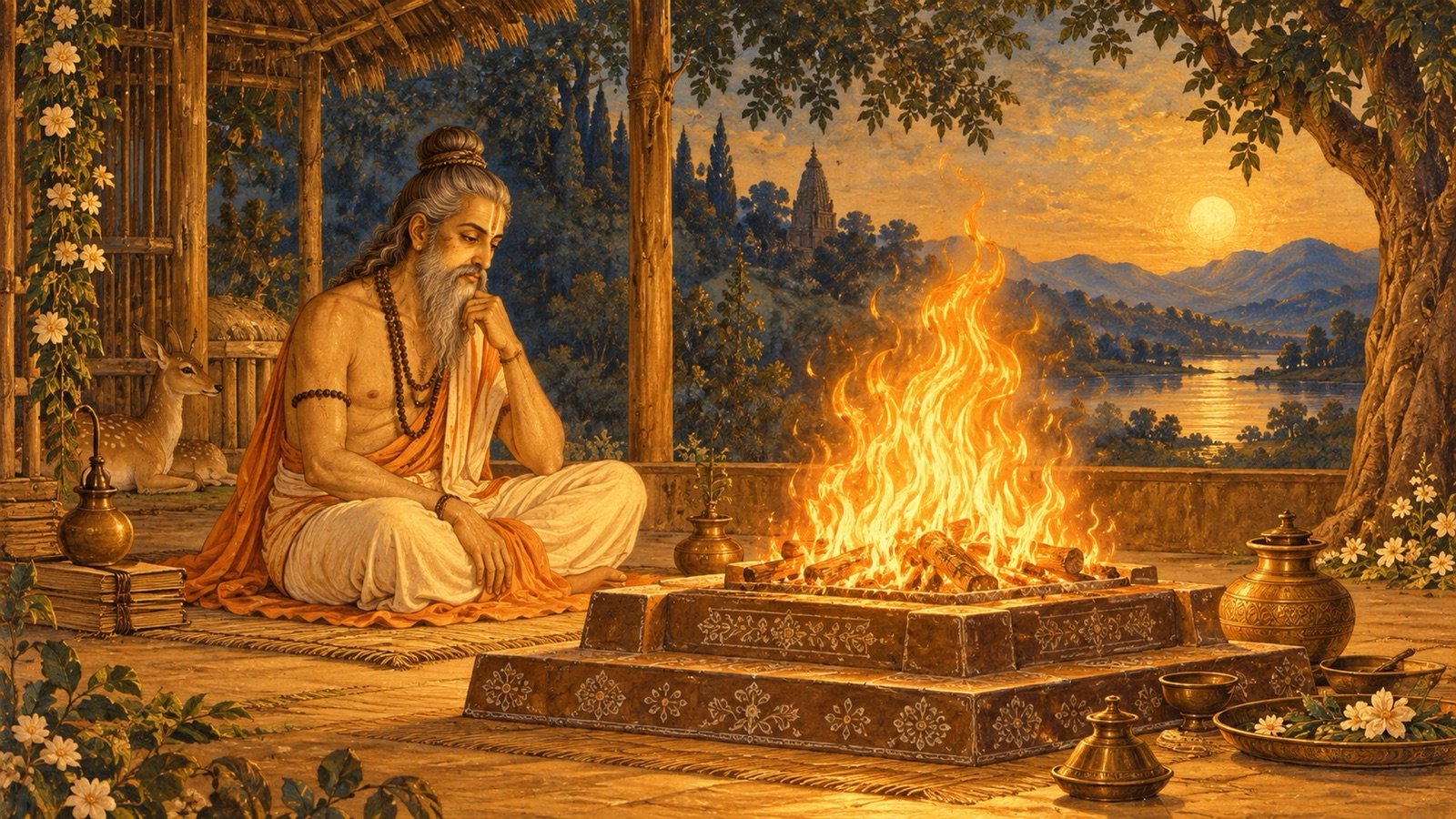
Like fire again, the sage may be hidden at times and visible at others, and burns away the past and future sins of those who make offerings to him. And as fire assumes the shape of the wood in which it burns, so the all-pervading Self, entering bodies noble or lowly formed by its own Maya, appears to take on their forms while remaining ever itself (verses 46-47).
Lessons from the Moon and Sun
From the moon the Brahmana learned that the states of birth, growth and death belong to the body alone and never to the Self — just as the waxing and waning appear only in the moon’s digits and not in the moon itself. And from the sun he learned two things: that the yogi, like the sun drawing up water and releasing it again, may accept the objects of the senses and part with them as the need of the moment requires, without being bound by either act; and that, as the one sun reflected in many vessels of water seems to be many, so the one Self, reflected in many bodies, is mistaken for many by those of gross understanding, though it remains ever one (verses 48-51).
The Dove — the Peril of Attachment
Then the Brahmana came to a longer and more poignant lesson, learned from the dove. Its heart of the matter he stated first.
नातिस्नेह: प्रसङ्गो वा कर्तव्य: क्वापि केनचित् । कुर्वन् विन्देत सन्तापं कपोत इव दीनधी: ॥ ५२ ॥
nāti-snehaḥ prasaṅgo vā kartavyaḥ kvāpi kenacit kurvan vindeta santāpaṁ kapota iva dīna-dhīḥ
Meaning: One should never form excessive fondness or attachment for anyone or anything anywhere; whoever does so meets with grief, wretched in mind, like the dove. (Canto 11, Chapter 7, verse 52)
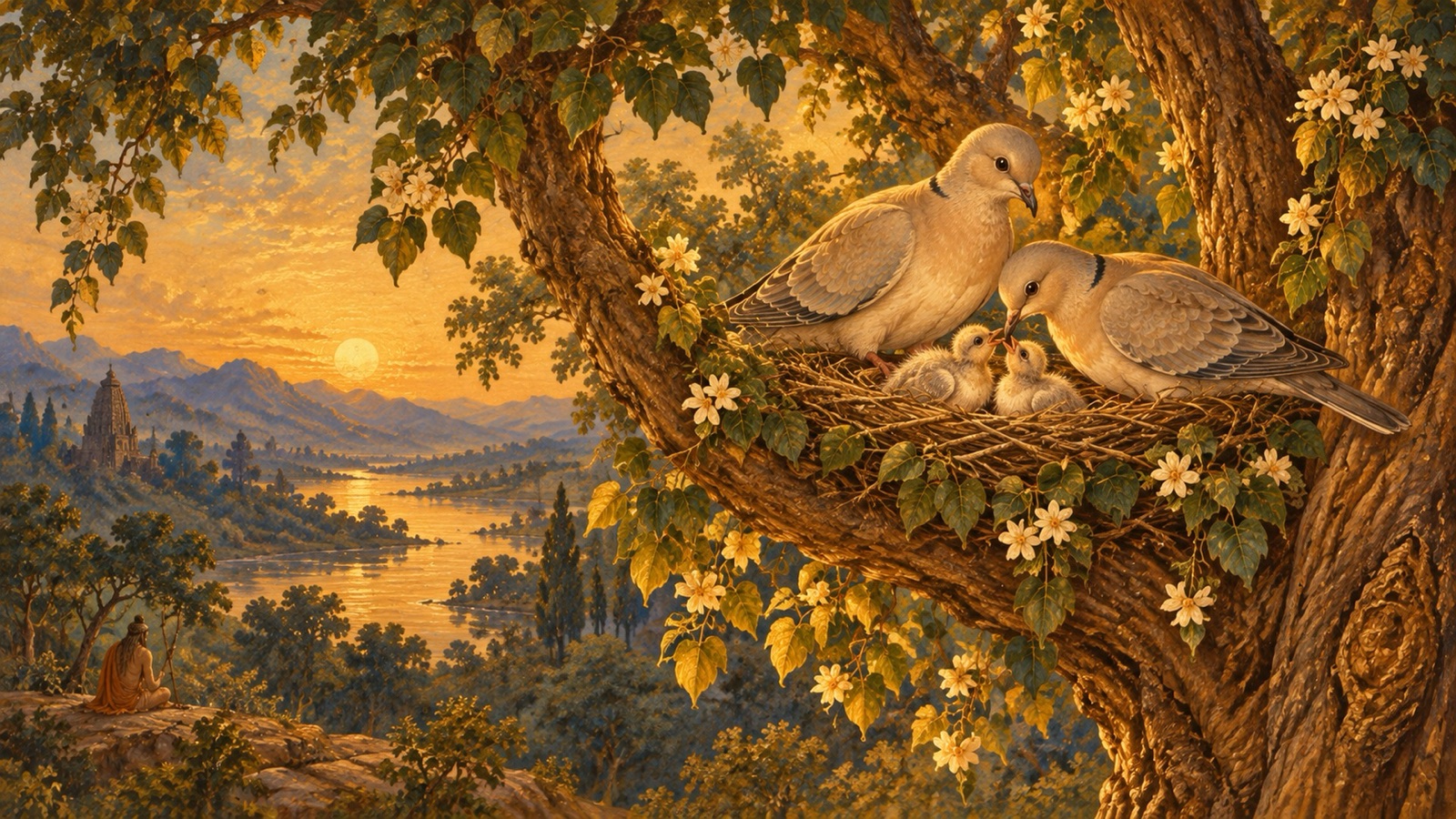
He then told the story. A certain dove had built a nest in a forest tree and lived there for years with its mate. Their hearts bound in love, the pair raised their young with the greatest tenderness, delighting in one another and in their offspring. One day, while the parent birds were away seeking food, a fowler spread his net and captured the young doves. Returning, the mother dove, unable to bear the loss of her chicks, threw herself upon the net and was caught; and the male dove, seeing his mate and children ensnared, lamented that all he had cherished was lost, and in his grief fell into the net of his own accord. Having seized the whole family, the fowler went home content. In this way, the Brahmana concluded, any householder of unquiet mind, attached to the pleasures of sense and revelling in the pairs of opposites, comes to grief along with all those bound to him — and the wise recognize such a one as having fallen from the very height he had attained.
य: प्राप्य मानुषं लोकं मुक्तिद्वारमपावृतम् । गृहेषु खगवत् सक्तस्तमारूढच्युतं विदु: ॥ ७४ ॥
yaḥ prāpya mānuṣaṁ lokaṁ mukti-dvāram apāvṛtam gṛheṣu khaga-vat saktas tam ārūḍha-cyutaṁ viduḥ
Meaning: One who, having attained the human form — an open doorway to liberation — remains attached to home and family like the bird, the wise know to have fallen from the height he had already climbed. (Canto 11, Chapter 7, verse 74)
Principal Teachings of This Chapter
1. Renunciation begins in the mind, not merely in circumstance. The Lord’s first counsel to Uddhava is to withdraw attachment and fix the mind on Him, seeing the perceived world as the mind’s own fleeting projection (verses 6-9).
2. Honest confession of weakness is the doorway to grace. Uddhava does not pretend to strength he lacks; he admits his attachment and takes refuge, and it is this humility that draws forth the Lord’s teaching (verses 15-18).
3. The human birth is precious above all. Of all forms of life, the human body is dearest to the Lord, for in it alone the vigilant can realize Him — a doorway to liberation not to be squandered (verses 22-23, 74).
4. The whole world can be a teacher to the willing eye. The avadhuta found twenty-four gurus in the elements and creatures around him, learning wisdom from all — for one who seeks, every experience instructs (verses 32-36).
5. Be in the world untouched by it. From earth, air, sky, water and fire the sage learns forbearance, contentment, non-attachment, purity and the art of consuming all yet keeping nothing (verses 37-47).
6. Excessive attachment brings sorrow. The tender legend of the dove warns that fond, unquiet clinging to family and pleasure leads to grief — while a steady, detached love keeps the heart free (verses 52-74).
A Devotional Reflection
There is something deeply reassuring in how this great teaching begins. The Lord does not open with a demand for perfection; He opens by drawing out Uddhava’s honesty. And Uddhava, who has just prayed never to be parted from the Lord, now admits how bound he is to body and kin, how far from the detachment he is being asked to embrace. This is the true starting point of the spiritual life — not the pretence of strength, but the humble confession of need. And the Lord’s answer is not a rebuke but a story, and a gentle one: the picture of an ascetic so free that he can learn from a clod of earth, a river, a flame, even a grieving dove. The message is quietly liberating. We need no rare circumstance to grow wise; the whole of creation is already teaching us, if only we will watch with an open and reverent heart. The earth teaches patience, water teaches gentleness, fire teaches purity, and the sorrow of the dove teaches us to love without clinging. To live in the world as the avadhuta did — present to everything, attached to nothing, at peace within — is itself a form of worship.
A Daily Devotional Practice
Today, take up the avadhuta’s way of seeing. Choose one ordinary thing in the world around you — a tree, a flowing stream, the open sky, a small creature — and pause to learn from it as the ascetic did. Let the tree teach you selfless giving, the water gentleness and purity, the sky freedom from attachment. As you reflect, gently repeat the Lord’s holy name: “Om Namo Bhagavate Vasudevaya.” In this simple practice you follow the very teaching of this chapter — turning the whole of creation into a reminder of the Lord, and training the heart, like the wandering sage, to be in the world yet untouched by it.
Conclusion
The seventh discourse of Book Eleven opens the Uddhava Gita, the Lord’s final and most intimate teaching. Sri Krishna calls Uddhava to renounce attachment, to wander with an even mind, and to see the world within the Self and the Self within Him. When Uddhava humbly confesses his weakness and takes refuge, the Lord answers with the ancient legend of King Yadu and a wandering ascetic — a soul so free that he had made teachers of the very elements and creatures of the world. From the earth he learned forbearance; from air, sky, water and fire, contentment, freedom, purity and detachment; from the moon and sun, the changeless nature of the Self; and from the grieving dove, the sorrow that excessive attachment brings. Above all, the chapter reminds us that the human birth is a rare and open door to liberation, not to be lost through clinging. So begins the great teaching of the twenty-four gurus, which the following chapters will complete.
May the divine wisdom of Srimad Bhagavatam awaken pure devotion within our hearts.
Om Namo Bhagavate Vasudevaya.
Jay Shree Madhav.
References and Attribution
- Primary edition: Gita Press, Śrīmad Bhāgavata Mahāpurāṇa (English, complete), Book Eleven, Discourse 7, pages 544–551.
- Series: Srimad Bhagavatam Wisdom · Biswa Sanatan Dharma Seva Trust.
- Presented following the spiritual guidance and recommendation of Pandit Dr. Shri Kashinath Mishra.
This is an original, faithful retelling in the writer’s own words, with brief quoted verses shown in Devanāgarī and transliteration and their meanings given as summaries. It is not a reproduction of any single publisher’s continuous translation or commentary. No affiliation with or endorsement by any publisher is implied.
Jay Shree Madhav