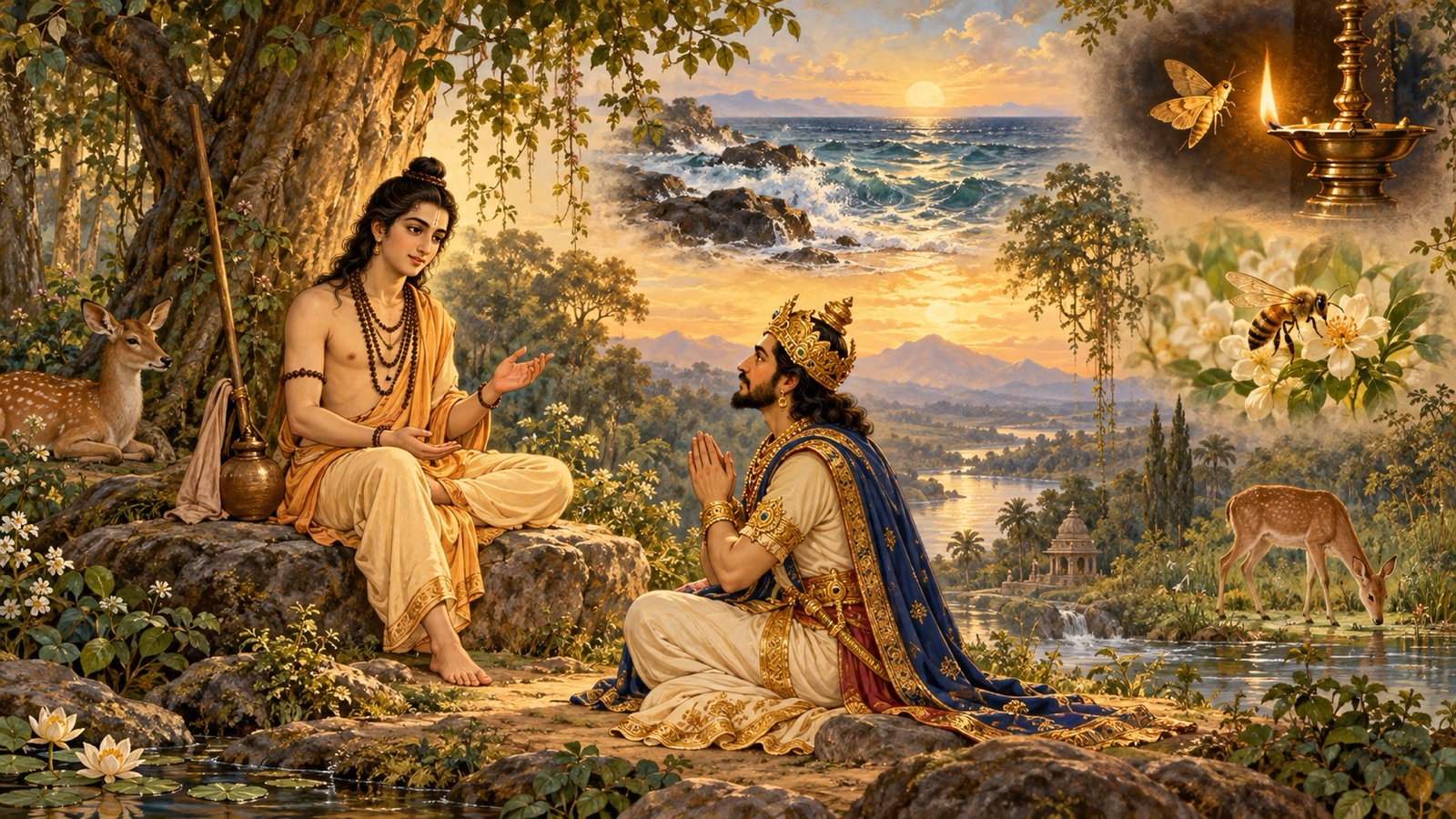
Continuing the great teaching of the twenty-four gurus, the wandering ascetic resumes his account for King Yadu, drawing nine further lessons from the creatures and elements around him, before closing with the moving story of Pingala, a courtesan of Mithila who found peace the moment she gave up hope.
Om Namo Bhagavate Vasudevaya.
Om Namo Bhagavate Vasudevaya.
Om Namo Bhagavate Vasudevaya.
Welcome to Srimad Bhagavatam Wisdom, a devotional journey through the sacred histories and teachings of the Srimad Bhagavat Mahapurana. In the previous chapter, Lord Sri Krishna began the Uddhava Gita by relating the legend of King Yadu and a serene wandering ascetic — an avadhuta who had made teachers of the very elements and creatures of the world. There the ascetic told of the first eight of his twenty-four gurus, from the earth to the dove. Now, in this chapter, he continues, naming nine more teachers and the wisdom he drew from each: contentment from the python, equanimity from the sea, the peril of lust from the moth, moderation and discernment from the bee, danger from the elephant, the folly of hoarding from the honey-gatherer, restraint from the deer, and mastery of the tongue from the fish. The chapter then closes with one of the most beloved stories in the Bhagavata — the awakening of Pingala, a courtesan who, in a single night of disappointment, cast off all hope of the world and found the deepest peace.
Chapter Information
- Scripture: Śrīmad Bhāgavata Mahāpurāṇa
- Canto: 11 (Book Eleven)
- Chapter: 8 (Discourse 8)
- Chapter title: Nine More Gurus and the Story of Pingala
- Principal speaker: The avadhuta Brahmana, answering King Yadu; the whole related by Sri Krishna to Uddhava, and by Sukadeva Gosvami to King Parikshit
- Principal listener: King Yadu; and, in the framing narration, Uddhava and King Parikshit
- Main setting: An ancient meeting of King Yadu and a wandering ascetic, within the Lord’s narration to Uddhava at Dwaraka
- Central subject: The lessons the ascetic learned from nine more of his gurus — the python, sea, moth, bee, elephant, honey-gatherer, deer and fish — and the awakening of Pingala the courtesan
- Principal verse range: Canto 11, Chapter 8, verses 1–44
- Primary edition: Gita Press Śrīmad Bhāgavata Mahāpurāṇa
Context from the Previous Chapter
In Chapter 7, Sri Krishna, on the eve of His departure, called Uddhava to renunciation and equal vision, and illustrated the path with the ancient dialogue of King Yadu and a wandering ascetic. That ascetic named twenty-four teachers he had chosen from the world around him, and described the first eight — the earth, air, sky, water, fire, moon, sun and the dove. This chapter takes up the same discourse where it left off, as the ascetic continues to instruct the reverent king.
The Path of the Discerning Soul
The Brahmana began by reminding King Yadu that the pleasure and pain born of the senses are experienced everywhere — in heaven as surely as in hell — and come of their own accord to every embodied being. Therefore a wise person should not run after them at all.
श्रीब्राह्मण उवाच सुखमैन्द्रियकं राजन् स्वर्गे नरक एव च । देहिनां यद् यथा दु:खं तस्मान्नेच्छेत तद् बुध: ॥ १ ॥
śrī-brāhmaṇa uvāca sukham aindriyakaṁ rājan svarge naraka eva ca dehināṁ yad yathā duḥkhaṁ tasmān neccheta tad-budhaḥ
Meaning: The Brahmana said: O king, the happiness that comes through the senses is met with by embodied beings in heaven and in hell alike, just as their sorrow is; therefore the wise do not hanker after such pleasure. (Canto 11, Chapter 8, verse 1)
The Python and the Sea — Contentment and Equanimity
From the python the ascetic learned contentment. Like that creature, one should eat whatever food comes without effort, be it much or little, sweet or bitter; and if no food comes at all, one should wait patiently, as the python does, resting for many days and trusting that destiny provides. Though strong of body, mind and senses, the sage keeps his body free of restless striving, doing nothing merely for gain.
From the sea he learned equanimity. An ascetic should be quiet and grave, deep and unfathomable like the calm ocean — not overstepping his limits when his desires are fulfilled, nor drying up in despair when they are not.
समृद्धकामोहीनो वा नारायणपरो मुनि: । नोत्सर्पेत न शुष्येत सरिद्भिरिव सागर: ॥ ६ ॥
samṛddha-kāmo hīno vā nārāyaṇa-paro muniḥ notsarpeta na śuṣyeta saridbhir iva sāgaraḥ
Meaning: Whether his desires are amply fulfilled or left unfulfilled, the sage devoted to Narayana neither overflows with elation nor dries up with grief — like the sea, which neither swells when the rivers flow into it nor shrinks when they do not. (Canto 11, Chapter 8, verse 6)

The Moth — the Peril of Lust
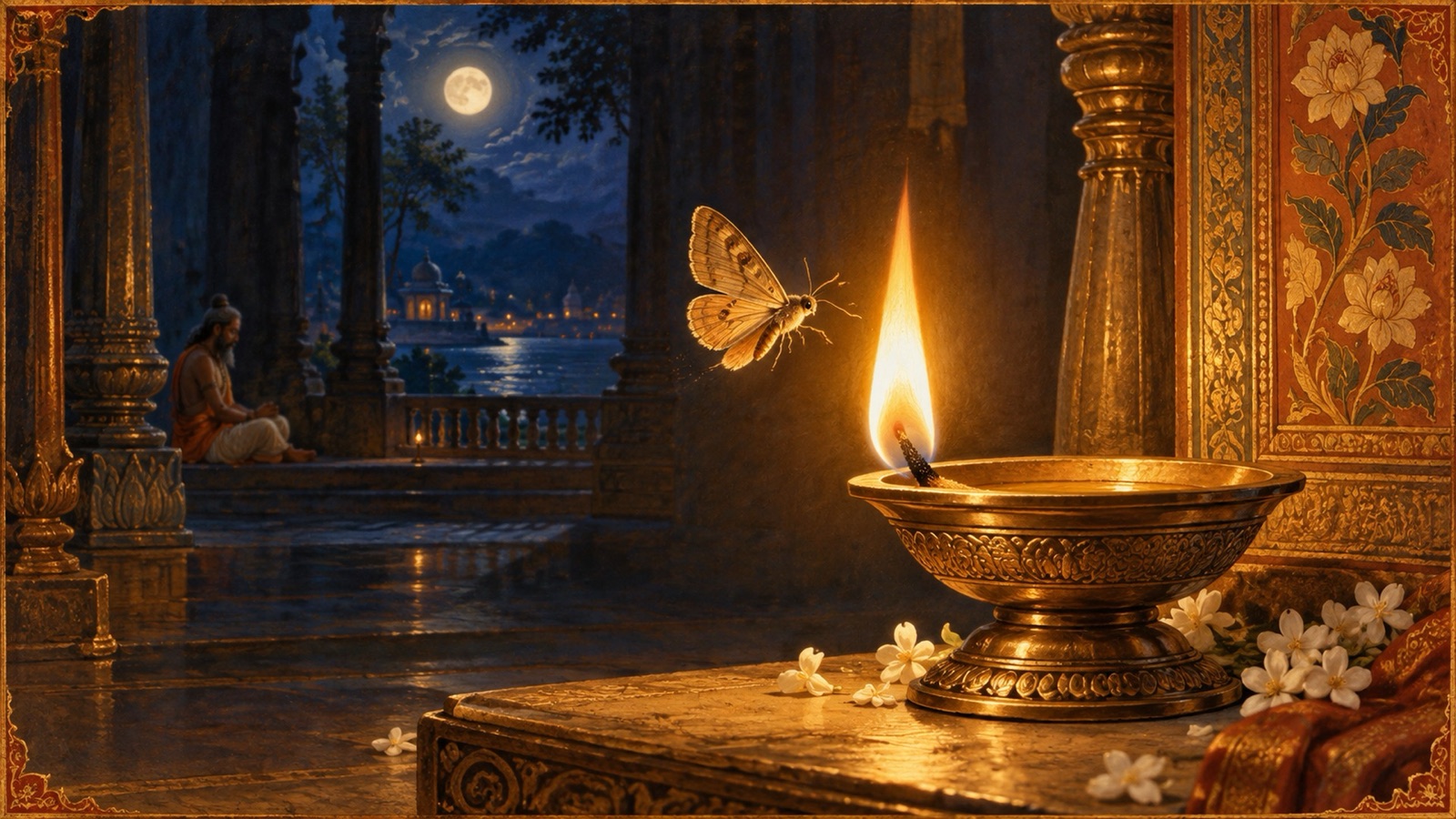
From the moth the ascetic learned the danger of surrendering the senses to allurement. Just as a moth, drawn by the sight of a flame, plunges into the fire and is destroyed, so a man who has not conquered his senses, beholding the enchanting form of a woman — the very Maya of the Lord — is lured by her charms and falls into the blinding darkness of ruin.
दृष्ट्वा स्त्रियं देवमायां तद्भावैरजितेन्द्रिय: । प्रलोभित: पतत्यन्धे तमस्यग्नौ पतङ्गवत् ॥ ७ ॥
dṛṣṭvā striyaṁ deva-māyāṁ tad-bhāvair ajitendriyaḥ pralobhitaḥ pataty andhe tamasy agnau pataṅga-vat
Meaning: Seeing a woman, the very illusory potency of the Lord, the man who has not mastered his senses is captivated by her allurements and, like a moth falling into fire, plunges into blinding darkness. (Canto 11, Chapter 8, verse 7)
The Bee, the Elephant and the Honey-Gatherer
From the bee the ascetic learned two lessons. Like a bee that takes only a little nectar from many flowers without harming them, a mendicant should accept only a small measure of food from many households, giving no one any trouble, barely enough to sustain the body. And like the bee that gathers honey from flowers great and small, a discerning person should draw the essence from all the scriptures, humble or grand.
अणुभ्यश्च महद्भ्यश्च शास्त्रेभ्य: कुशलो नर: । सर्वत: सारमादद्यात् पुष्पेभ्य इव षट्पद: ॥ १० ॥
aṇubhyaś ca mahadbhyaś ca śāstrebhyaḥ kuśalo naraḥ sarvataḥ sāram ādadyāt puṣpebhya iva ṣaṭpadaḥ
Meaning: From scriptures small and great alike, the wise person should gather the essence, as the bee gathers honey from every flower. (Canto 11, Chapter 8, verse 10)
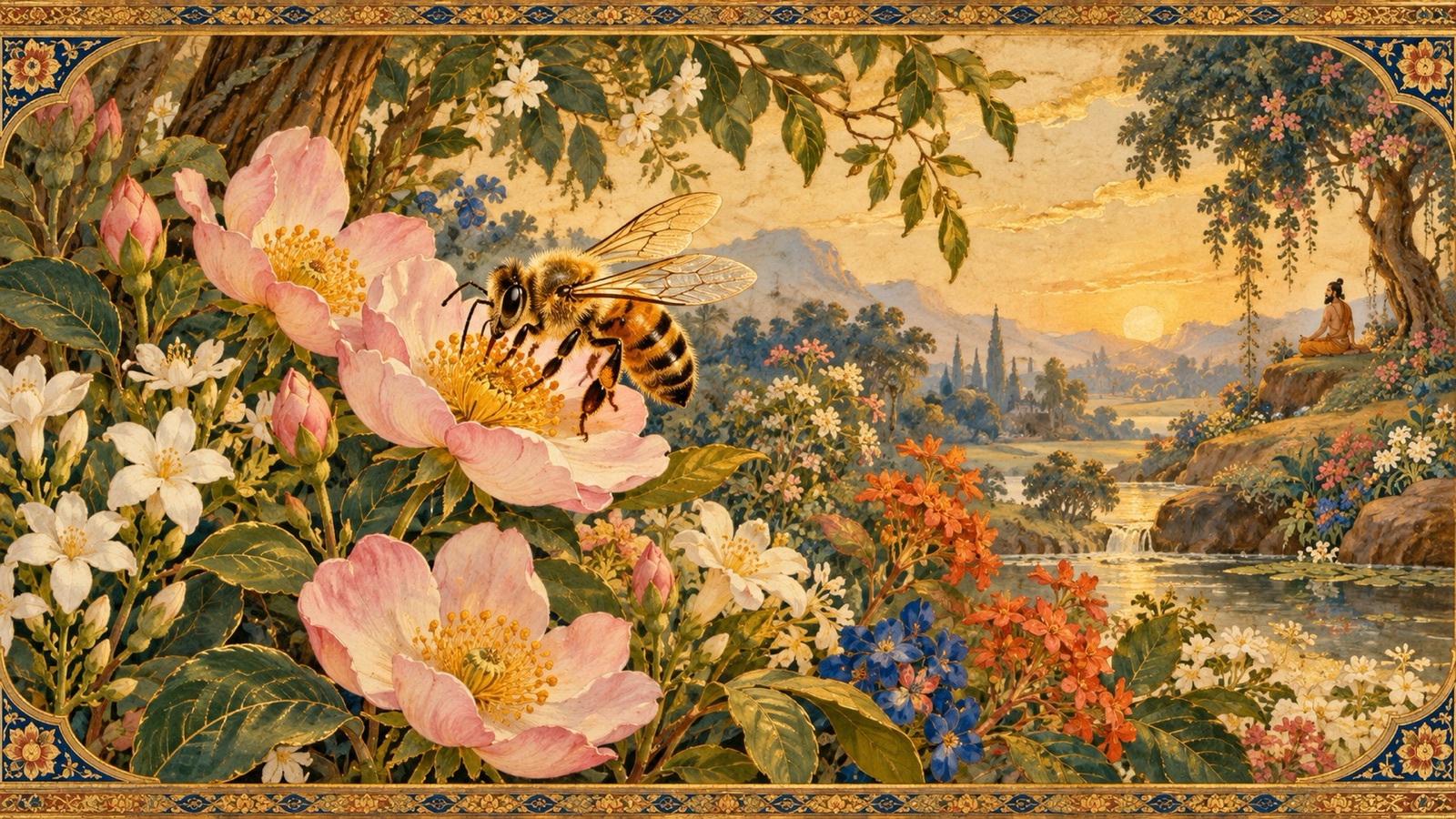
Yet the bee itself gave a further warning: the mendicant must never hoard, storing nothing for the evening or the next day, for one who hoards perishes with his collection like a greedy bee. From the elephant the ascetic learned to shun the snare of lust — as a bull elephant, drawn to a she-elephant, is trapped by hunters and overpowered by stronger tuskers, so a man who chases after women invites his own destruction. And from the honey-gatherer he learned the folly of amassing wealth: the riches a miser hoards with great pains he neither enjoys nor gives away; another comes, like the honey-thief who discovers the hive, and carries it all off.
The Deer and the Fish — Guarding the Senses
From the deer the ascetic learned that one living in solitude should never be lost in worldly music and entertainment, for the deer, entranced by the hunter’s song, is easily snared. From the fish he learned the great danger of the tongue: a creature ruled by its craving for taste is drawn to the baited hook and dies. Of all the senses, the tongue is the hardest to master — even one who fasts finds every other sense subdued while the appetite for taste grows only stronger.
तावज्जितेन्द्रियो न स्याद् विजितान्येन्द्रिय: पुमान् । न जयेद् रसनं यावज्जितं सर्वं जिते रसे ॥ २१ ॥
tāvaj jitendriyo na syād vijitānyendriyaḥ pumān na jayed rasanaṁ yāvaj jitaṁ sarvaṁ jite rase
Meaning: Though a man may have subdued all his other senses, he cannot be called self-controlled so long as he has not conquered the tongue; but when the sense of taste is mastered, all the senses are mastered. (Canto 11, Chapter 8, verse 21)
The Story of Pingala
Then the Brahmana came to a lesson learned not from a creature but from a woman — Pingala, a courtesan who once lived in the city of Videha, or Mithila.
पिङ्गला नाम वेश्यासीद् विदेहनगरे पुरा । तस्या मे शिक्षितं किञ्चिन्निबोध नृपनन्दन ॥ २२ ॥
piṅgalā nāma veśyāsīd videha-nagare purā tasyā me śikṣitaṁ kiñcin nibodha nṛpa-nandana
Meaning: There once lived in the city of Videha a courtesan named Pingala; hear, O delight of kings, something of what I learned from her. (Canto 11, Chapter 8, verse 22)
One night, adorned in her finest, Pingala took her stand at the door of her house, hoping to draw some wealthy lover inside.
सा स्वैरिण्येकदा कान्तं सङ्केत उपनेष्यती । अभूत् काले बहिर्द्वारे बिभ्रती रूपमुत्तमम् ॥ २३ ॥
sā svairiṇy ekadā kāntaṁ saṅketa upaneṣyatī abhūt kāle bahir dvāre bibhratī rūpam uttamam
Meaning: Adorned in her utmost beauty, that woman of loose life took her place one night at her outer door, waiting to lead in a lover by appointment. (Canto 11, Chapter 8, verse 23)

As the passers-by came and went, she took each one for a rich man who might pay for her company; and each one passed on. Again and again she went inside and came out to the door, restless with hope, until it was midnight. Her mouth grew dry, her spirits sank — and then, in her very disappointment, a saving thought arose. Dispassion, the ascetic observed, is like a sword that cuts through the noose of hope; and no one who has not felt this disgust for the world can sever the ties of the body, just as one without discernment cannot give up the sense of “mine.”
Pingala looked at her own folly and was ashamed. How senseless she had been, she thought, to seek her joy from a mean and mortal lover, forsaking the eternal Lord who dwells in the heart and is the true giver of joy and wealth. What satisfaction could ever come from a body that is but a framework of bones wrapped in skin and hair, filled with impurity? Among all the people of Mithila she alone had been the fool.
विदेहानां पुरे ह्यस्मिन्नहमेकैव मूढधी: । यान्यमिच्छन्त्यसत्यस्मादात्मदात् काममच्युतात् ॥ ३४ ॥
videhānāṁ pure hy asminn aham ekaiva mūḍha-dhīḥ yānyam icchanty asaty asmād ātma-dāt kāmam acyutāt
Meaning: In this city of Videha I alone am the fool, who has sought my satisfaction in another — in one who is unreal — turning away from the infallible Lord, who gives His very Self. (Canto 11, Chapter 8, verse 34)
Pingala’s Song of Renunciation
Now her heart turned wholly to the Lord. She resolved to offer herself to Him alone — the true friend, most beloved and the very Self of every embodied being — and to find her delight in Him. Seeing the world devoured by the serpent of Time, she understood at last that the Self is one’s only protector, and that a soul grown weary of every worldly object awakens to this truth. She blessed the disappointment that had freed her: had she never been made miserable, she would never have gained the dispassion that now led her to peace. Casting off every vicious hope, she took refuge in the Lord and lay down to rest, content.
आशा हि परमं दु:खं नैराश्यं परमं सुखम् । यथा सञ्छिद्य कान्ताशां सुखं सुष्वाप पिङ्गला ॥ ४४ ॥
āśā hi paramaṁ duḥkhaṁ nairāśyaṁ paramaṁ sukham yathā sañchidya kāntāśāṁ sukhaṁ suṣvāpa piṅgalā
Meaning: Hope is the greatest misery, and freedom from hope the greatest happiness; for Pingala, having cut off all hope of a lover, slept the sleep of perfect peace. (Canto 11, Chapter 8, verse 44)

Principal Teachings of This Chapter
1. Sense-pleasure comes and goes of its own accord. Since the joys and sorrows of the senses reach every being in every world without being sought, the wise waste no effort chasing them (verse 1).
2. Contentment and equanimity are the marks of the sage. Like the python who takes what comes and the sea that neither swells nor shrinks, the devotee stays steady whether his desires are met or not (verses 2-6).
3. Unmastered desire destroys the soul. The moth in the flame, the elephant in the trap, the deer lost in song and the fish caught by taste all warn that a single ungoverned sense can bring ruin (verses 7-21).
4. Take a little from many, and hoard nothing. Like the bee that gathers nectar without harming the flowers and stores nothing, the seeker draws the essence from all scriptures and lives free of accumulation (verses 9-16).
5. The tongue is the hardest sense to conquer. True self-control is not complete until the craving for taste is subdued; when it is mastered, all the senses are mastered (verses 19-21).
6. When hope of the world dies, peace is born. Pingala’s awakening shows that dispassion is a sword that cuts the noose of longing — and that turning to the Lord is the soul’s true and lasting refuge (verses 22-44).
A Devotional Reflection
Of all the teachers in this chapter, it is Pingala who stays with us. She is no sage, no renunciate — only a worldly woman worn down by a lifetime of chasing what could never satisfy her. And yet her turning point comes not through study or austerity, but through simple, honest disappointment. When at last her hopes collapse, she does not despair; she looks clearly at what she has been doing, and in that clear looking she is set free. There is deep comfort in this for every ordinary heart. We need not be perfect to begin; we need only be honest about the emptiness of what we have been grasping. The very ache of unfulfilled desire, if we let it, can become the sword that cuts the noose. Pingala offers her whole self to the Lord, calls Him her truest friend and her own Self, and lies down to the first peaceful sleep of her life. Her story quietly assures us that no soul is ever too far gone, and that the moment we stop hoping in the world and start resting in Him, misery ends and peace begins.
A Daily Devotional Practice
Today, take Pingala’s turning as your teacher. Bring to mind one hope or craving that has long kept your heart restless — some outcome, possession or approval you have been chasing. For a few quiet minutes, gently set it down, as Pingala set down her hope at the door, and turn instead to the Lord who dwells within as your truest friend. As you release it, softly repeat His holy name: “Om Namo Bhagavate Vasudevaya.” In this small act of letting go, you practise the very lesson of this chapter — that freedom from hope in the world is the doorway to lasting peace in Him.
Conclusion
The eighth discourse of Book Eleven continues the great teaching of the twenty-four gurus. The wandering ascetic tells King Yadu of nine more of his teachers: the python and the sea, who taught him contentment and equanimity; the moth, the elephant, the deer and the fish, who warned him how a single ungoverned sense can destroy; the bee and the honey-gatherer, who taught him to take only a little and to hoard nothing. Above them all stands the story of Pingala, the courtesan of Mithila, whose long night of frustrated hope became the night of her awakening. Cutting off every worldly longing, she took refuge in the Lord and found a peace she had never known. The chapter leaves us with its luminous truth — that hope in the world is the greatest misery, and freedom from it, in the shelter of the Lord, the greatest joy. The remaining gurus, and the close of the ascetic’s discourse, follow in the next chapter.
May the divine wisdom of Srimad Bhagavatam awaken pure devotion within our hearts.
Om Namo Bhagavate Vasudevaya.
Jay Shree Madhav.
References and Attribution
- Primary edition: Gita Press, Śrīmad Bhāgavata Mahāpurāṇa (English, complete), Book Eleven, Discourse 8, pages 552–554.
- Series: Srimad Bhagavatam Wisdom · Biswa Sanatan Dharma Seva Trust.
- Presented following the spiritual guidance and recommendation of Pandit Dr. Shri Kashinath Mishra.
This is an original, faithful retelling in the writer’s own words, with brief quoted verses shown in Devanāgarī and transliteration and their meanings given as summaries. It is not a reproduction of any single publisher’s continuous translation or commentary. No affiliation with or endorsement by any publisher is implied.
Jay Shree Madhav