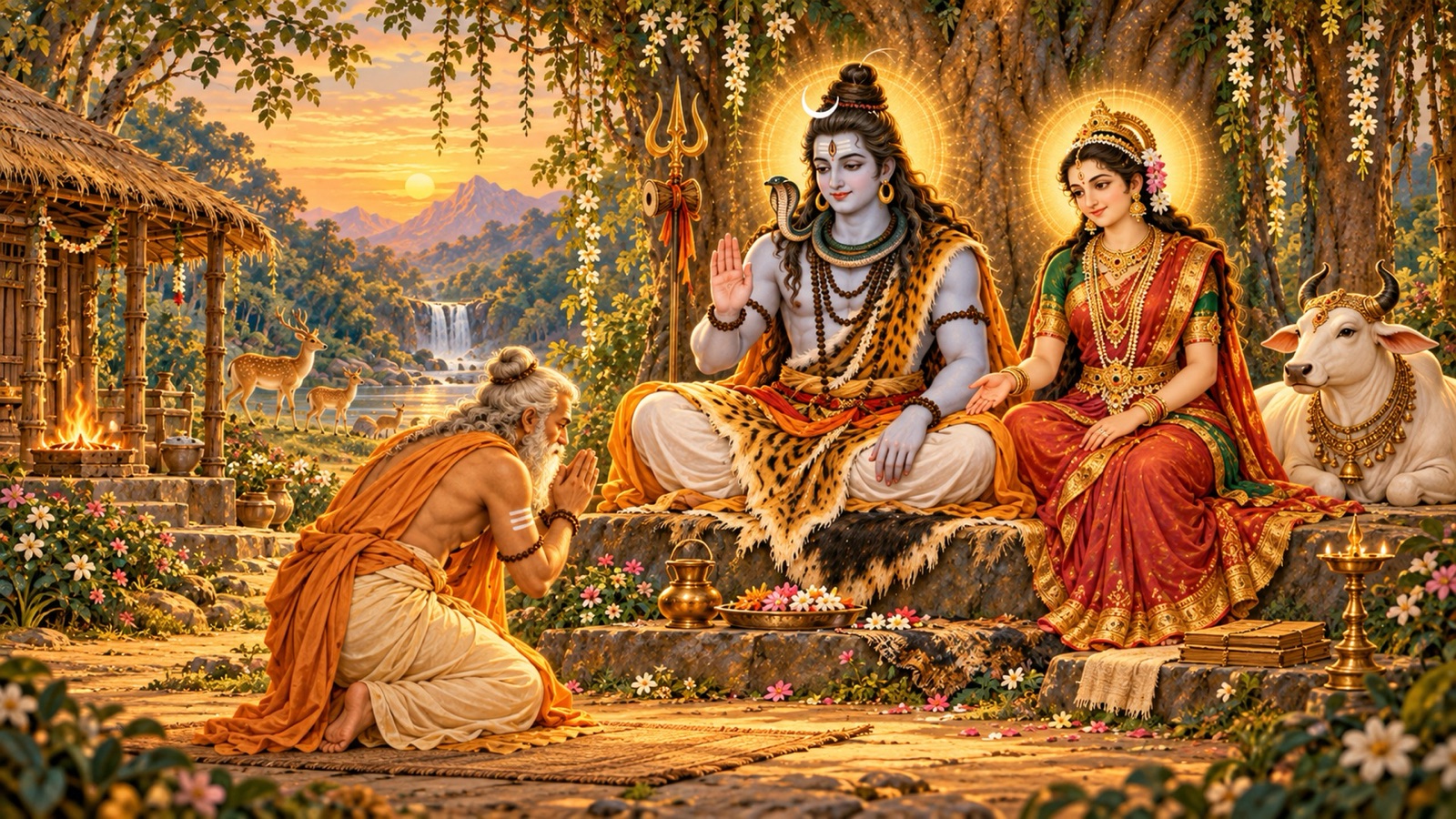
Moved by the sage’s unbroken devotion, Lord Shiva, accompanied by the Goddess Uma, appears in Markandeya’s hermitage and offers him a boon — and the sage asks for nothing but pure, unfailing devotion to the Lord.
Om Namo Bhagavate Vasudevaya.
Om Namo Bhagavate Vasudevaya.
Om Namo Bhagavate Vasudevaya.
Welcome to Srimad Bhagavatam Wisdom, a devotional journey through the sacred histories and teachings of the Srimad Bhagavat Mahapurana. Having been shown the Lord’s inconceivable Maya in the previous chapter, the sage Markandeya once more takes refuge in Sri Hari alone. This tenth chapter tells of a second grace that comes to him — this time from Lord Shiva. Travelling through the skies with the Goddess Uma, Shiva beholds the sage absorbed in deep trance, enters his heart to rouse him, and then, in some of the most beautiful verses in the Bhagavatam, praises the glory of pure-hearted saints and Brahmanas. When invited to name his heart’s desire, the sage seeks nothing the world could offer, choosing instead a single, deathless bond of love directed toward the Lord Himself, toward His beloved servants, and toward Shiva. It is a chapter about the humility of the great, the fellowship of the devotees, and the one gift worth asking for.
Chapter Information
- Scripture: Śrīmad Bhāgavata Mahāpurāṇa
- Canto: 12 (Book Twelve — the final Canto)
- Chapter: 10 (Discourse X)
- Chapter title: Lord Shiva Confers a Boon on Markandeya
- Principal speaker: Suta Gosvami, narrating to the sages of Naimisharanya; within it, the words of Lord Shiva, the Goddess Uma, and Markandeya
- Principal listener: The sages of Naimisharanya, led by Saunaka
- Main setting: Markandeya’s hermitage on the river Pushpabhadra
- Central subject: Lord Shiva’s visit to Markandeya, His praise of saints and Brahmanas, and the boon of unfailing devotion granted to the sage
- Principal verse range: Canto 12, Chapter 10, verses 1–42
- Primary edition: Gita Press Śrīmad Bhāgavata Mahāpurāṇa
Shiva and Uma Behold the Sage
Having realized the glory of the Lord’s Yogamaya, Markandeya sought Sri Hari alone for protection, praying: “I have taken refuge at Your feet, O Hari, under the influence of whose Maya — which wears the false appearance of enlightenment — even the learned fall prey to delusion.” As he sat thus with his mind wholly stilled, Lord Rudra, journeying through the skies on His bull with His Consort Uma and His attendants, saw the sage.
Uma, beholding him, spoke to Shiva: “Look at this Brahmana, O Lord, whose body, senses, and mind have grown still, like a sea whose waters and fishes have become motionless after a storm has passed. Since You are the bestower of the fruit of asceticism, please manifest the reward of his penance.” The Lord replied that this sage would not accept any blessing under any circumstance — not even final liberation — for he has already attained supreme devotion to the immortal Lord. “Even so,” Shiva said, “we shall converse with the saint; for to meet a pious soul is the greatest of all gains.”
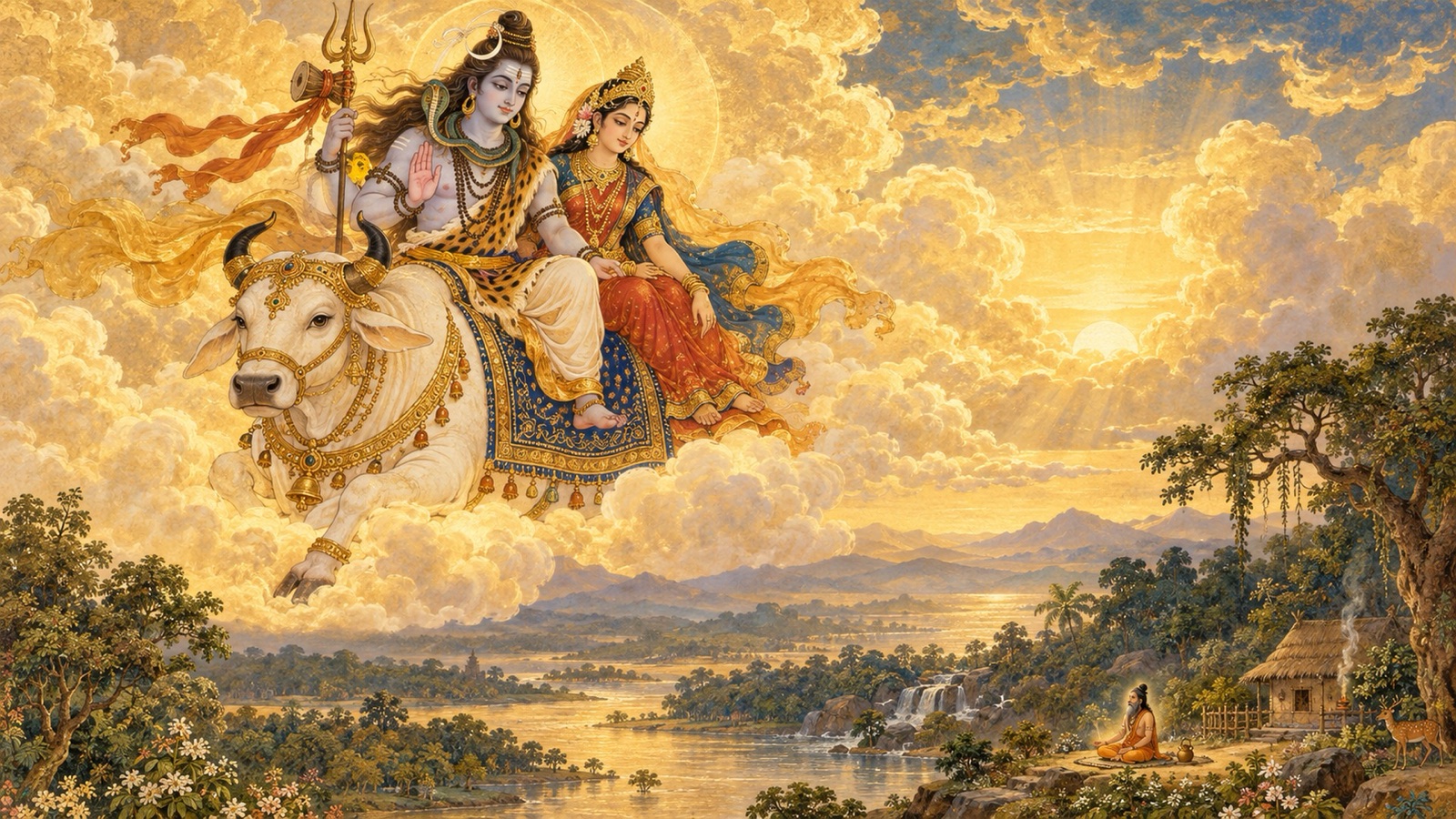
Markandeya, all his mental faculties suspended, was aware neither of his own body nor of the world, and did not perceive even the arrival of the Sovereigns of the universe. Knowing his condition, Shiva entered the cavity of the sage’s heart by His Yogamaya, as air enters an opening. The sage, amazed, suddenly beheld within his heart a flash of Shiva — tall, three-eyed, ten-armed, effulgent as the rising sun, clad in a tiger-skin, bearing rudraksha beads, a small drum, a trident, and other emblems — and, wondering at the vision, woke from his trance. Opening his eyes, he beheld Lord Rudra, the one Preceptor of the three worlds, arrived with Uma and His entourage, and bowed low. He worshipped the Lord and the Goddess with a hearty welcome, seats, water, sandal-paste, garlands, incense, and lamps, and asked what service he could render.
The Glory of the Saints
Highly pleased, Lord Shiva, the foremost of the gods and the resort of the righteous, laughed heartily and spoke to the sage. “Ask of Us a boon of your choice,” He said, “for We three — Brahma, Vishnu, and Myself — are the masters of all who grant boons; our sight can never go in vain, and through us a mortal can attain immortality.” Then Shiva spoke words of extraordinary humility, declaring that the guardians of the spheres, and Brahma, and even Sri Hari Himself, honour and wait upon Brahmanas who are pious, tranquil, free from attachment yet affectionate to all beings, and exclusively devoted — those who perceive no difference between Shiva, Vishnu, and Brahma, nor between themselves and any other living being.
न ह्यम्मयानि तीर्थानि न देवाश्चेतनोज्झिता: । ते पुनन्त्युरुकालेन यूयं दर्शनमात्रत: ॥ २३ ॥
na hy am-mayāni tīrthāni na devāś cetanojjhitāḥ te punanty uru-kālena yūyaṁ darśana-mātrataḥ
Meaning: Sacred places do not consist of holy waters alone, nor do lifeless images alone represent the gods; these purify a person only over a long stretch of time, whereas saints such as you purify by mere sight. (Canto 12, Chapter 10, verse 23)
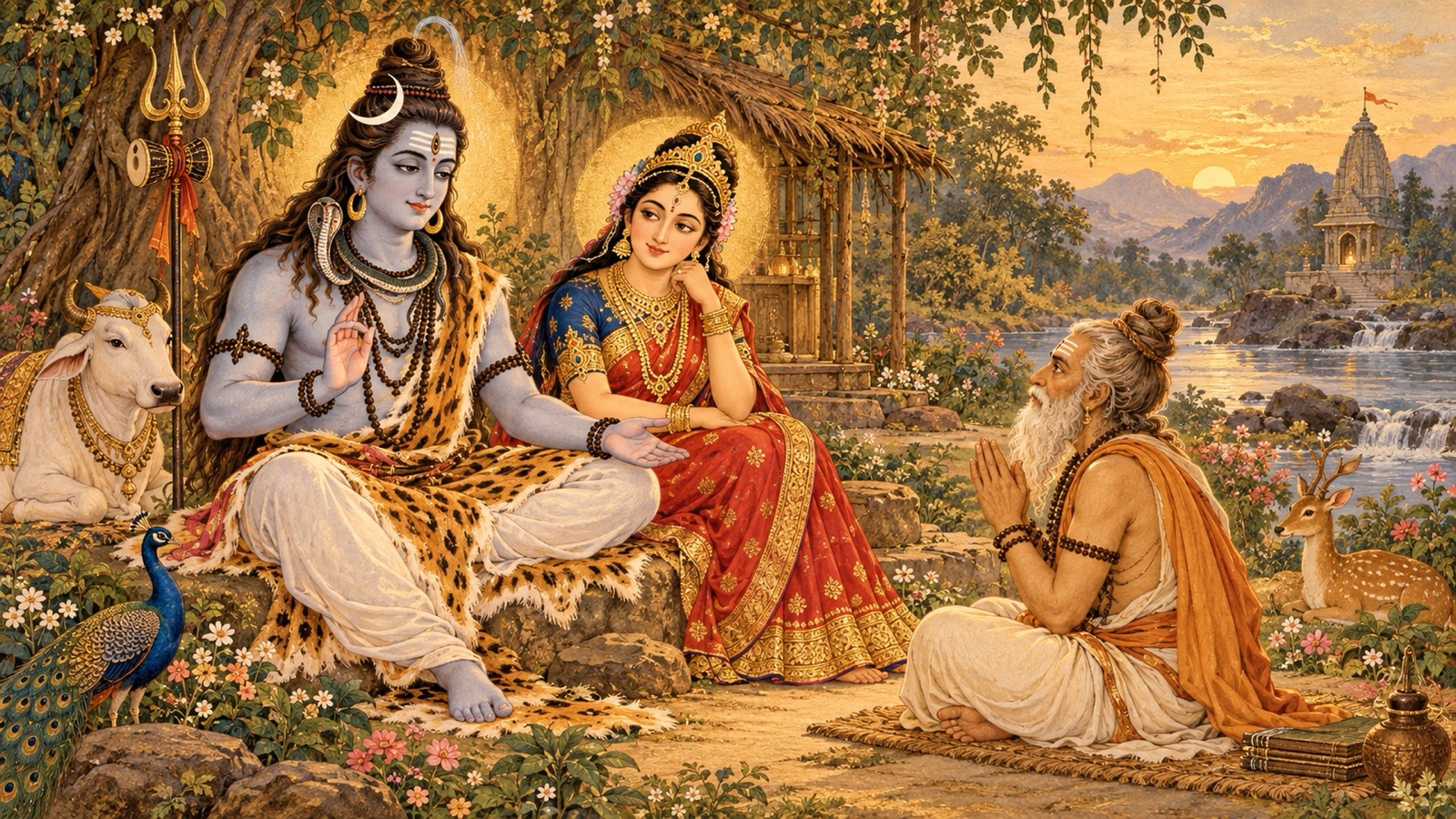
Shiva added that by merely hearing about or seeing such saints, even great sinners and the lowliest are purified — how much more, then, by conversing with them. The sage, drinking in these nectar-like words full of the secret of Dharma, could not feel sated; and, having been tried so long by the Maya of Vishnu, he was now wholly relieved of his afflictions by the grace of Shiva’s speech.
The One Boon Worth Asking
Markandeya then marvelled at the Lord’s pastime — that the very Rulers of the universe should bow to and glorify those who deserve to be commanded by them. Such conduct, he observed, is how great teachers instruct the world in righteousness, and it no more diminishes the Lord’s glory than a magician’s tricks diminish his power. He bowed to the almighty Lord who, having evolved the universe by thought and entered it as the individual soul, appears as the doer through the gunas while remaining their absolute Controller. “What greater boon,” the sage asked, “could I request than Yourself, whose very sight is blessing enough?” And yet, pressed to name a wish, he asked for one thing only.
वरमेकं वृणेऽथापि पूर्णात् कामाभिवर्षणात् । भगवत्यच्युतां भक्तिं तत्परेषु तथा त्वयि ॥ ३४ ॥
varam ekaṁ vṛṇe ’thāpi pūrṇāt kāmābhivarṣaṇāt bhagavaty acyutāṁ bhaktiṁ tat-pareṣu tathā tvayi
Meaning: Yet I do ask one boon of You, who are full in Yourself and yet shower every desired thing — unfailing devotion to the almighty Lord, to those devoted to Him, and likewise to You. (Canto 12, Chapter 10, verse 34)
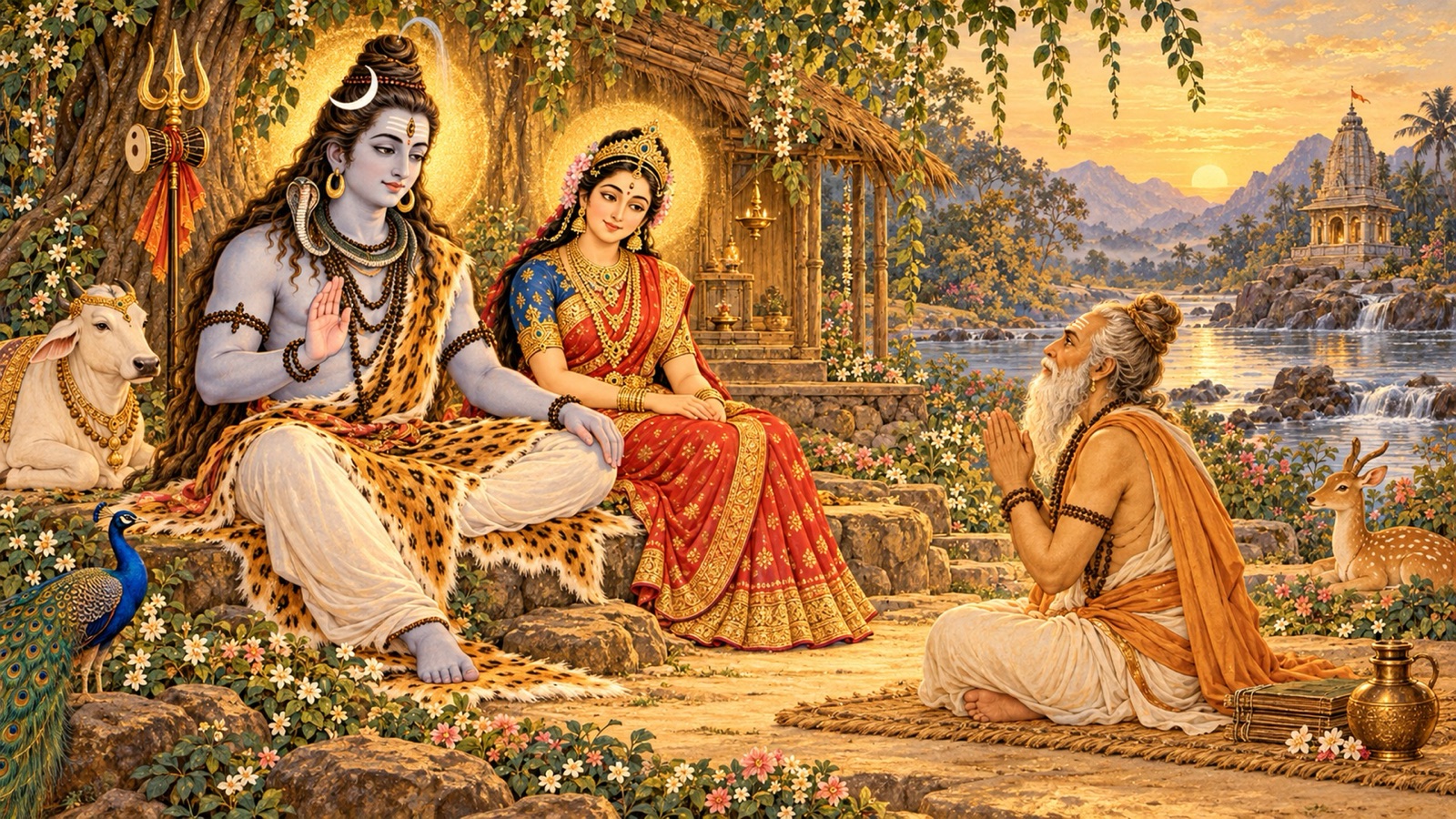
Pleased by the sage’s sweet words, Lord Shiva, supported by His Consort, granted his prayer and more: “Full of devotion as you are to Lord Vishnu, O great sage, let all this desire of yours be fulfilled; let your fame endure until the end of the Kalpa; let religious merit, and freedom from old age and death, be yours; and let knowledge of the past, present, and future, together with Self-realization, dispassion, and the teachership of a Purana, fall to your lot, invested as you are with Brahmanical glory.” Having granted these boons, the three-eyed Lord withdrew, telling Uma of the sage’s deeds and of all that he had experienced. And Markandeya, Suta says, having realized the glory of the great Yoga, still roams the world at will even now, exclusively devoted to Sri Hari. Both he who narrates and he who hears this story, enriched with the glory of Lord Vishnu, are freed from the round of birth and death.
Principal Teachings of This Chapter
1. The greatest souls are the most humble. Even Lord Shiva bows to the pure devotees, teaching that greatness expresses itself as reverence, not as pride (verses 19-22).
2. A saint purifies by mere sight. Holy waters and sacred images sanctify over long ages, but a pure-hearted devotee purifies instantly — such is the power of true devotion (verse 23).
3. The true devotee asks only for devotion. Offered anything, Markandeya asked not for long life or liberation but for unfailing devotion to the Lord, His devotees, and Shiva — the one gift that includes all others (verse 34).
4. Devotion embraces the Lord’s devotees too. Markandeya’s boon deliberately included love for those devoted to the Lord — for true devotion naturally flowers into fellowship and reverence for other devotees (verse 34).
A Devotional Reflection
There is a quiet astonishment running through this chapter: the Lord of destruction, the mightiest of ascetics, arrives not to test the sage but to praise him — and to praise, through him, all pure-hearted devotees. “Sacred places do not consist of holy waters alone,” Shiva says; a living saint sanctifies by a single glance. It is a breathtaking reversal of how we usually measure holiness. We travel to sacred rivers and temples, and rightly so; but the Bhagavatam reminds us that the truest tirtha is a heart wholly given to God, and that such a heart can purify others simply by its presence. And notice what Markandeya does with the boon. He has already conquered death, seen the Lord’s Maya, and beheld Nara-Narayana; he could ask for anything. He asks for more devotion. This is the unmistakable signature of a real devotee: the reward he wants for his love is only the capacity to love more — and to love not the Lord alone, but everyone who loves the Lord. In that small request lies the whole secret of the spiritual life: devotion does not seek to be finished; it seeks to deepen, and to widen into fellowship.
A Daily Devotional Practice
Today, honour the teaching that a saint purifies by mere sight — and that devotion widens into fellowship. Bring to mind one devotee, teacher, or God-loving soul whose life has touched yours, and offer silent gratitude for them, remembering Shiva’s words that such company is the greatest of gains. Then, following Markandeya, make his prayer your own: instead of asking God for something the world can give, ask sincerely for deeper, unfailing devotion — to the Lord, and to all who love Him. Close by chanting “Om Namo Bhagavate Vasudevaya” a fixed number of times, offering your resolve to seek the company of the devotees and to let your love for God quietly grow.
Conclusion
The tenth chapter of the Twelfth Canto shows us grace arriving in the form of Lord Shiva. Journeying with the Goddess Uma, Shiva beholds Markandeya absorbed in trance, rouses him, and — with striking humility — praises the glory of pure-hearted saints, declaring that they purify by a single sight where holy rivers and images take long ages. Offered any boon, the sage asks only for unfailing devotion to the Lord, to His devotees, and to Shiva himself; and Shiva grants him this, together with lasting fame, freedom from old age and death, and the teachership of a Purana. Markandeya, forever devoted to Sri Hari, roams the world still. The chapter leaves us with a luminous standard for our own hearts: to seek the company of the devotees, to honour the God in one another, and to ask, above all, only to love more.
May the divine wisdom of Srimad Bhagavatam awaken pure devotion within our hearts.
Om Namo Bhagavate Vasudevaya.
Jay Shree Madhav.
References and Attribution
- Primary edition: Gita Press, Śrīmad Bhāgavata Mahāpurāṇa (English, complete), Book Twelve, Discourse 10.
- Series: Srimad Bhagavatam Wisdom · Biswa Sanatan Dharma Seva Trust.
- Presented following the spiritual guidance and recommendation of Pandit Dr. Shri Kashinath Mishra.
This is an original, faithful retelling in the writer’s own words, with brief quoted verses shown in Devanāgarī and transliteration and their meanings given as summaries. It is not a reproduction of any single publisher’s continuous translation or commentary. No affiliation with or endorsement by any publisher is implied.
Jay Shree Madhav