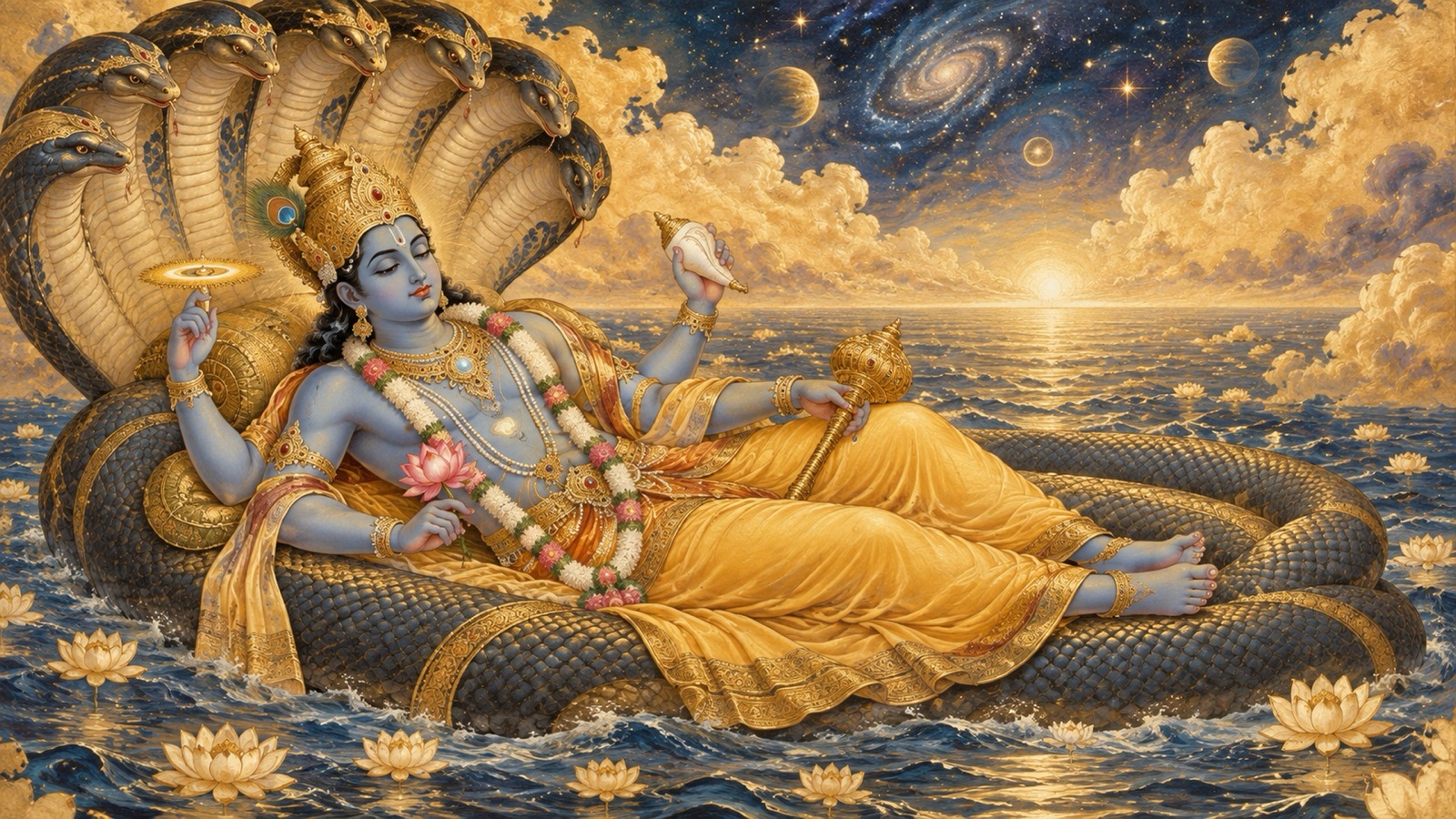
Suta Gosvami unfolds how the wise meditate on Lord Vishnu in worship — every ornament, weapon, and attendant of the Lord revealed as a living principle of the cosmos, so that to contemplate His form is to contemplate all reality gathered into one.
Om Namo Bhagavate Vasudevaya.
Om Namo Bhagavate Vasudevaya.
Om Namo Bhagavate Vasudevaya.
Welcome to Srimad Bhagavatam Wisdom, a devotional journey through the sacred histories and teachings of the Srimad Bhagavat Mahapurana. Having heard the story of the sage Markandeya, the sages of Naimisharanya now turn to a question at the very heart of worship: how do those learned in the Tantras contemplate the Lord’s limbs, His weapons, His ornaments, and His attendants? Suta Gosvami answers with one of the most sublime passages in the whole Bhagavatam. He shows that the Lord’s every emblem is not mere decoration but a living symbol — the conch, the discus, the mace, the gem upon His breast, each standing for a principle of the cosmos itself. From there he unveils the Virat Purusha, the Cosmic Person whose very body is the manifest universe, and finishes by tracing how the solar deity — Sri Hari in another guise — moves through the months with a rotating company of sages, Gandharvas, Apsaras, and other celestial beings. It is a chapter that teaches us to see the whole of creation as the very body and adornment of the Lord.
Chapter Information
- Scripture: Śrīmad Bhāgavata Mahāpurāṇa
- Canto: 12 (Book Twelve — the final Canto)
- Chapter: 11 (Discourse XI)
- Chapter title: Vishnu’s Serene Worship-Form and the Celestial Train Attending Surya
- Principal speaker: Suta Gosvami (Ugrashrava), narrating to the sages of Naimisharanya
- Principal listener: The sages of Naimisharanya, led by Saunaka
- Main setting: The forest hermitage of Naimisharanya
- Central subject: The symbolic meaning of the Lord’s limbs, weapons, ornaments, and attendants; the Cosmic Person; and the glory of the Sun-god with His twelve monthly retinues
- Principal verse range: Canto 12, Chapter 11, verses 1–50
- Primary edition: Gita Press Śrīmad Bhāgavata Mahāpurāṇa
The Question of the Sages
Saunaka, the foremost of the sages, places a searching question before Suta. Knowing him to be well-versed in the meaning of all the scriptures that deal with worship, the sages ask how those proficient in the Tantras meditate, in the course of active worship, upon the limbs, the attendants, the weapons, and the ornaments of Lord Vishnu — the Lord of Sri, who is absolute Consciousness — and of what principles they conceive these to be composed. They ask this, they say, because they are keen to know the path of worship through which a mortal may attain immortality.
श्रीशौनक उवाच अथेममर्थं पृच्छामो भवन्तं बहुवित्तमम् । समस्ततन्त्रराद्धान्ते भवान् भागवत तत्त्ववित् ॥ १ ॥
śrī-śaunaka uvāca athemam arthaṁ pṛcchāmo bhavantaṁ bahu-vittamam samasta-tantra-rāddhānte bhavān bhāgavata tattva-vit
Meaning: Sri Saunaka said: Now we ask you this matter, for you are the foremost among those knowing many subjects; you know the true meaning of the settled conclusions of all the scriptures of worship, O great devotee of the Lord. (Canto 12, Chapter 11, verse 1)
Bowing to his preceptors, Suta agrees to speak of the glorious manifestations of Lord Vishnu — so difficult to comprehend — as they have been discussed by Brahma and other teachers in the light of the Vedas and the Tantras.
The Cosmic Person
Suta begins with the vast. The cosmic egg, he explains, is made up of the nine fundamental principles — Prakriti and eight others — together with the sixteen modifications. Presided over by the Spirit, this cosmic form gives rise to the three worlds. This, Suta says, is the Purusha, the Cosmic form of the Lord, whose very body is the universe.
एतद् वै पौरुषं रूपं भू: पादौ द्यौ: शिरो नभ: । नाभि: सूर्योऽक्षिणी नासे वायु: कर्णौ दिश: प्रभो: ॥ ६ ॥ प्रजापति: प्रजननमपानो मृत्युरीशितु: । तद्बाहवो लोकपाला मनश्चन्द्रो भ्रुवौ यम: ॥ ७ ॥ लज्जोत्तरोऽधरो लोभो दन्ता ज्योत्स्ना स्मयो भ्रम: । रोमाणि भूरुहा भूम्नो मेघा: पुरुषमूर्धजा: ॥ ८ ॥
etad vai pauruṣaṁ rūpaṁ bhūḥ pādau dyauḥ śiro nabhaḥ nābhiḥ sūryo ’kṣiṇī nāse vāyuḥ karṇau diśaḥ prabhoḥ prajāpatiḥ prajananam apāno mṛtyur īśituḥ tad-bāhavo loka-pālā manaś candro bhruvau yamaḥ lajjottaro ’dharo lobho dantā jyotsnā smayo bhramaḥ romāṇi bhūruhā bhūmno meghāḥ puruṣa-mūrdhajāḥ
Meaning: This indeed is the Cosmic form of the Lord: the earth is His feet, heaven His head, the sky His navel, the sun His eyes, the air His nostrils, the quarters His ears; Prajapati His generative organ, Death His anus, the guardians of the spheres His arms, the moon His mind, and Yama His eyebrows; modesty His upper lip and greed His lower, moonlight His teeth and Maya His smile, the trees the hair on His body and the clouds the locks upon the head of the infinite Person. (Canto 12, Chapter 11, verses 6-8)
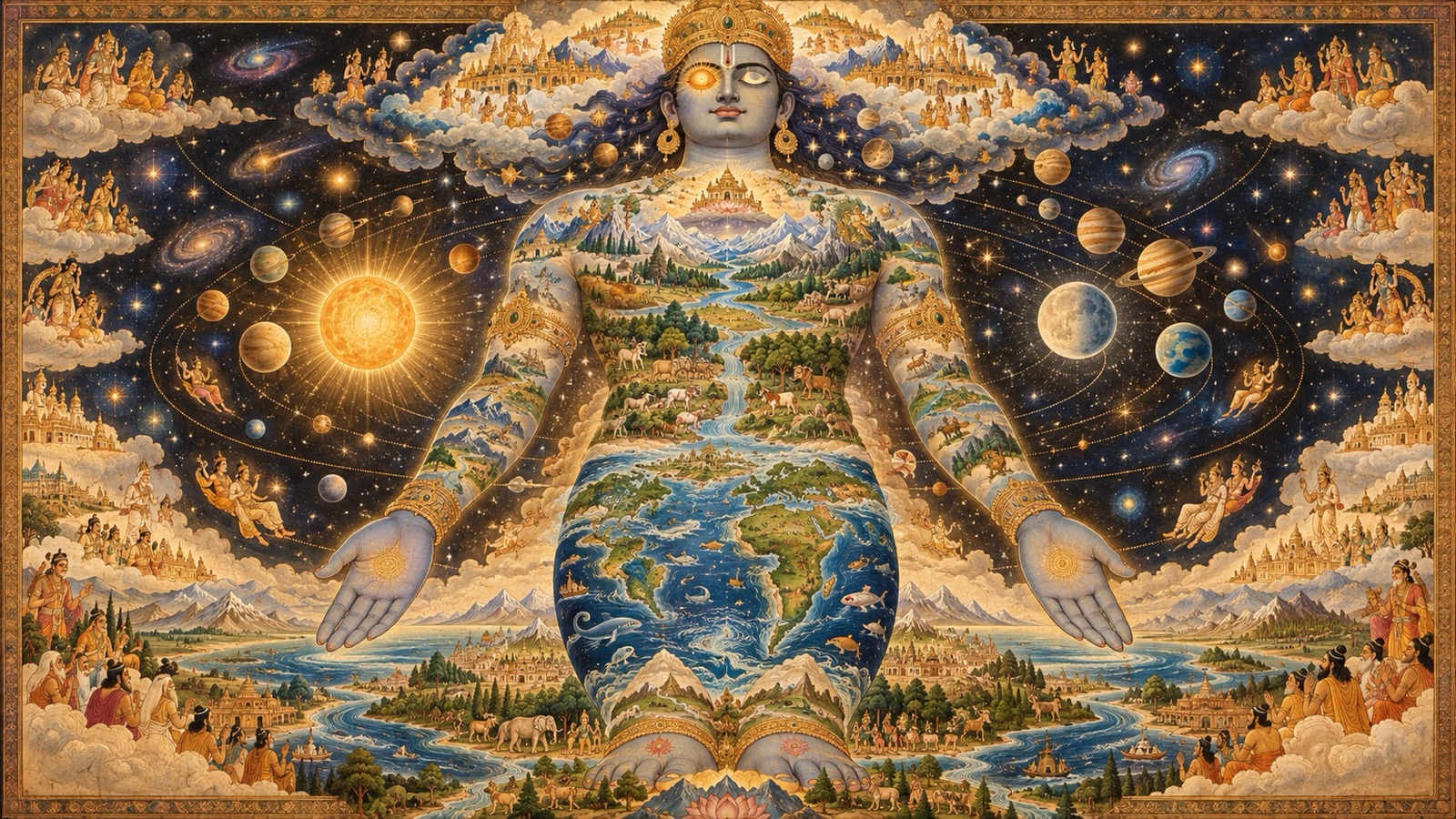
The Cosmic Person, Suta adds, bears the same proportion to the disposition of the spheres as a mortal man does to the disposition of his own limbs.
The Ornaments and Weapons as Living Principles
Suta now turns from the Cosmic body to the meditative form of the Lord worshipped in the heart — and here every emblem becomes a principle of reality. The Kaustubha gem upon the Lord’s breast is the pure consciousness of the individual soul, His own particle; the Srivatsa mark is the diffusive splendour of that consciousness. The Vanamala, His garland of sylvan flowers, is His Maya of the three Gunas; the golden yellow cloth about His waist is the Vedas; and the sacred syllable OM is His triple sacred thread. Sankhya and Yoga are His pair of alligator-shaped earrings, and the realm of Brahma, which grants fearlessness, is His diadem.
His couch, the serpent Sesha, is unmanifest Primordial Matter, upon which He rests; and the lotus spread over it is Sattva, the mode of goodness, adorned with the divine qualities. His weapons, too, are principles: the mace Kaumodaki is the vital force with its strength; the conch Panchajanya is the principle of water; the discus Sudarshana is the principle of fire; the sword clear as the sky is ether; His shield is Tamas; His horn-bow is Kala, the Time-Spirit; and His quiver is Karma. The ten cosmic senses are His arrows, the cosmic mind His chariot, and the subtle elements its exterior; and through the Mudras of His hands He shows His readiness to bless and protect His devotees. The place of worship should be visualized as the orb of the sun; initiation into a Mantra should be contemplated as self-consecration; and the worship of the Lord as the eradication of all one’s sins.
Wielding His six divine attributes — lordship, righteousness, renown, affluence, wisdom, and dispassion, together denoted by the term Bhaga, which justifies His name Bhagavan — He carries a lotus for His pastime, while two of His attendants hold a chowrie and a fan. Over His head He bears His own realm, Vaikuntha, as an umbrella; the threefold Veda serves as His carrier Garuda; His inseparable energy appears as the Goddess Sri; Vishvaksena, the chief of His attendants, embodies the Tantras; and His eight mystic powers, Anima and the rest, stand as the eight gatekeepers, Nanda and the others. The Supreme Person Himself is manifest in the four forms of Vasudeva, Sankarshana, Pradyumna, and Aniruddha, and is contemplated as Vishva, Taijasa, Prajna, and Turiya in relation to the four states of consciousness — waking, dream, deep sleep, and Self-realization.
The Prayer to the Lord
Suta explains that the one Lord, though self-effulgent and perfect in His own bliss, creates, preserves, and destroys the universe by His own Maya under the names of Brahma, Vishnu, and Shiva, while His consciousness remains ever uncircumscribed; and His devotees realize Him as their very self. He then offers a tender prayer to the Lord in His descent as Sri Krishna.
श्रीकृष्ण कृष्णसख वृष्ण्यृषभावनिध्रुग् राजन्यवंशदहनानपवर्गवीर्य । गोविन्द गोपवनिताव्रजभृत्यगीत- तीर्थश्रव: श्रवणमङ्गल पाहि भृत्यान् ॥ २५ ॥
śrī-kṛṣṇa kṛṣṇa-sakha vṛṣṇy-ṛṣabhāvani-dhrug- rājanya-vaṁśa-dahanānapavarga-vīrya govinda gopa-vanitā-vraja-bhṛtya-gīta- tīrtha-śravaḥ śravaṇa-maṅgala pāhi bhṛtyān
Meaning: O Sri Krishna, friend of Arjuna, jewel among the Vrishnis, fire to consume the kings hostile to the earth, whose valour never fails, O Govinda, whose sanctifying glory is sung by the cowherd women and by Your devotees, and whose names are auspicious to hear — protect us, Your servants. (Canto 12, Chapter 11, verse 25)
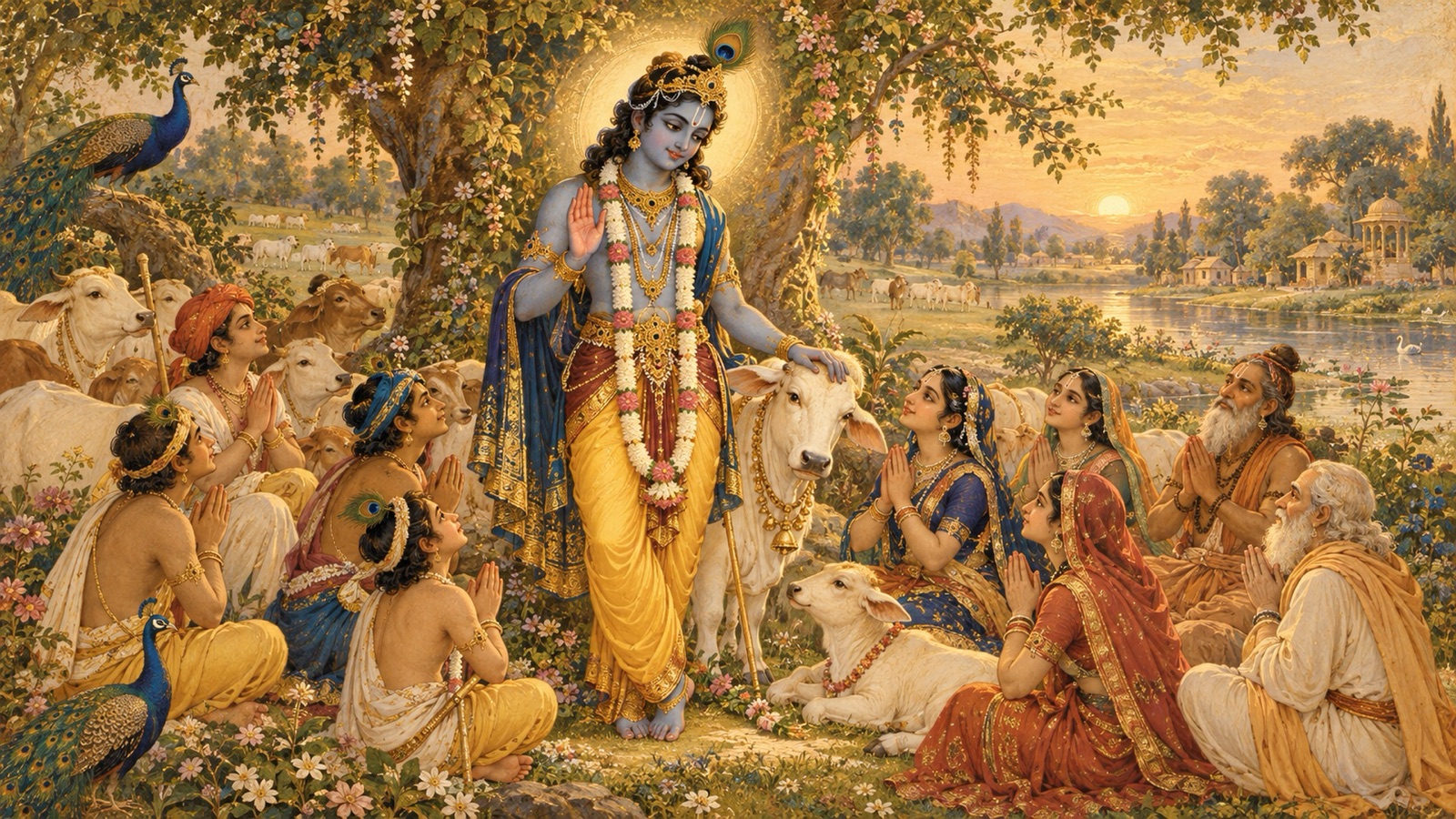
He who rises early, becomes clean, and repeats this description of the Lord with his mind fixed on Him, Suta says, realizes Brahma enshrined within the heart.
The Glory of the Sun-God
Saunaka then asks about another form of the Lord’s glory: the entourage of the Sun-god, which changes month after month, a different group of seven remaining on duty through the year. Suta explains that this visible sun, which keeps the world going, is brought into being by the eternal Maya of Lord Vishnu, the Inner Controller of all. Though one without a second, the Sun-god — who is truly the same as Sri Hari — is spoken of under diverse names, for He is the source of all Vedic rites; and because of His beginningless Maya He is named as time, place, activity, the doer, the instrument, duty, sacred text, material substance, and fruit. Assuming the form of Time, He runs His course through the twelve months from Chaitra onward, with twelve different batches of attendants.
Suta then names, month by month, the twelve groups — each consisting of the Sun-god under a particular name, together with an Apsara, a Rakshasa, a Naga, a Yaksha, a sage, and a Gandharva. Thus Dhata, Kritasthali, Heti, Vasuki, Rathakrit, Pulastya, and Tumburu preside over Chaitra; Aryama and his companions over Vaishakha; and so through all the seasons of the year, each month upheld by its own sacred sevenfold retinue. These groups, Suta says, take away the sins of those who remember them morning and evening.
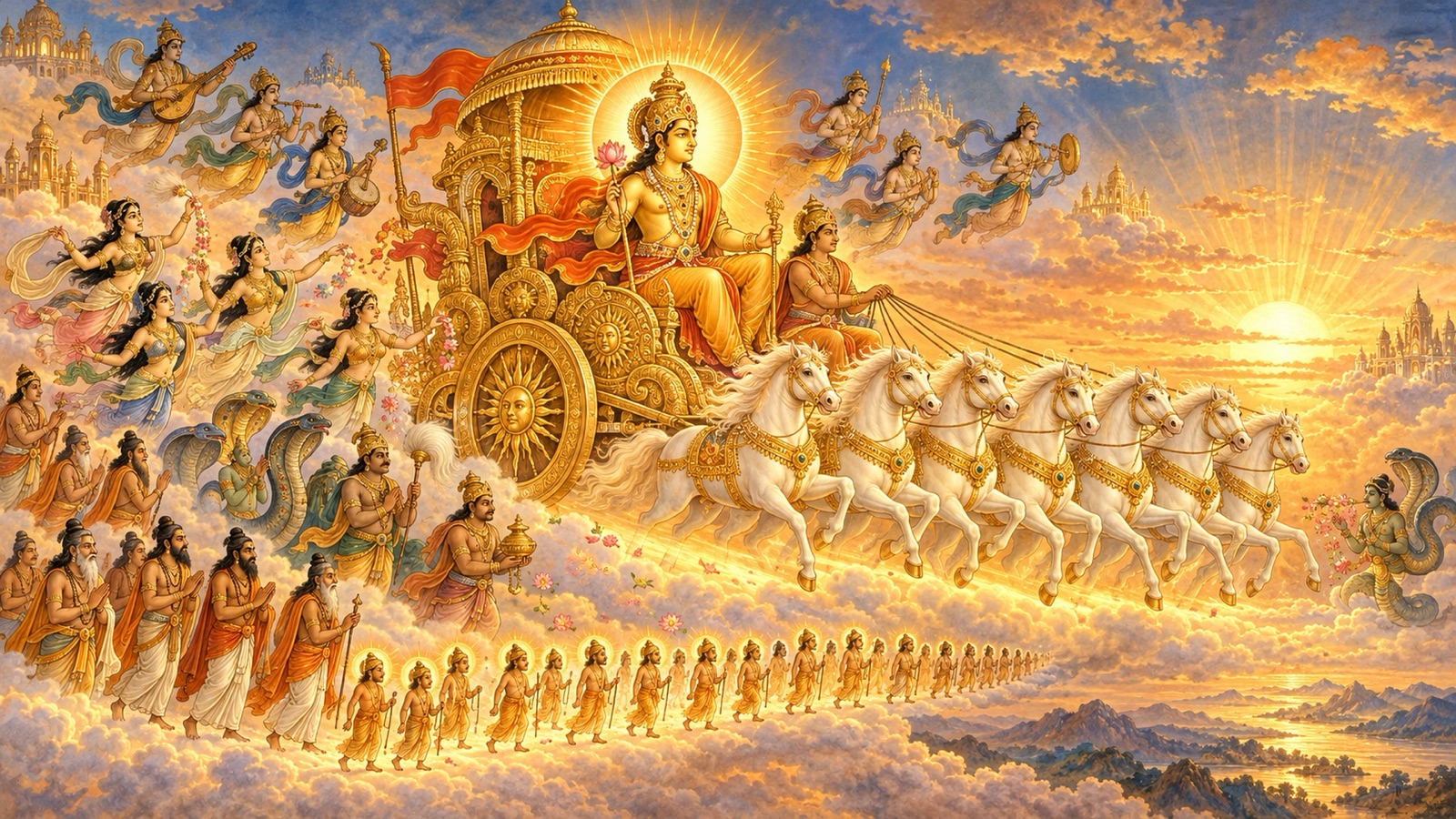
The sages of the entourage extol the Sun-god through the hymns of the Sama, Rig, and Yajur Vedas; the Gandharvas sing His praises while the Apsaras dance before Him; the Nagas hold the parts of His chariot together, the Yakshas make it ready, and the mighty Rakshasas push it from behind. And sixty thousand pure-minded Brahmana sages, the Valakhilyas, walk ahead of the Sun-god, celebrating Him with hymns.
वालखिल्या: सहस्राणि षष्टिर्ब्रह्मर्षयोऽमला: । पुरतोऽभिमुखं यान्ति स्तुवन्ति स्तुतिभिर्विभुम् ॥ ४९ ॥
vālakhilyāḥ sahasrāṇi ṣaṣṭir brahmarṣayo ’malāḥ purato ’bhimukhaṁ yānti stuvanti stutibhir vibhum
Meaning: Sixty thousand pure Brahmana sages, known as the Valakhilyas, walk ahead facing the Lord and extol the all-pervading One with their hymns. (Canto 12, Chapter 11, verse 49)
Principal Teachings of This Chapter
1. The whole universe is the body of the Lord. In the Cosmic Person, earth and heaven, sun and moon, are seen as the very limbs of the infinite Lord — teaching us to behold all creation as sacred and divine (verses 6-8).
2. Every emblem of the Lord is a living truth. The conch, discus, mace, gem, and garland are not ornaments alone but principles of reality; to meditate on His form is to meditate on the whole order of existence (verses 10-16).
3. Worship is the eradication of sin. The chapter reframes worship itself as self-consecration and inner purification — the visualized offering that dissolves one’s sins in the light of the Lord (verse 17).
4. The Sun-god is a form of Sri Hari. The sun that sustains the world, with its ever-changing retinue, is the Lord Himself dividing His power to protect the worlds in every Kalpa — a reminder that the divine upholds creation ceaselessly (verses 29-32, 50).
A Devotional Reflection
This chapter offers a breathtaking way of seeing. We are used to thinking of the Lord’s conch and discus as beautiful symbols, and of the sun as a great natural body. But Suta invites us to look again and find, everywhere, the one Lord. The mace in His hand is the very life-force within us; the gem on His breast is the pure light of our own soul; the earth beneath our feet is His feet, the sky His navel, the trees the hair of His body. Nothing, in this vision, is merely material — all of it is the Lord’s form, His adornment, His living presence. And the sun that rises each morning is not a distant sphere but Sri Hari Himself, dividing His power into twelve to carry the year and protect the worlds, attended by singing Gandharvas and sixty thousand sages of light. To worship in this way is to stop searching for God elsewhere and to recognize Him in the whole fabric of existence — and, above all, in the heart, where the devotee who contemplates His form realizes Brahma enshrined within.
A Daily Devotional Practice
Today, practise the seeing this chapter teaches. As you go about your day, let one ordinary thing — the sunlight through a window, a tree, the breath in your body — remind you that it belongs to the Lord’s own form. When you see the sun, remember Suta’s words that it is a form of Sri Hari upholding the world. And, following the chapter’s counsel, rise clean in the morning and hold in your mind the image of the Lord — His conch, discus, mace, and lotus — praying with the sages, “protect us, Your servants.” Close by chanting “Om Namo Bhagavate Vasudevaya” a fixed number of times, offering your resolve to behold the Lord in all things and, most of all, within your own heart.
Conclusion
The eleventh chapter of the Twelfth Canto lifts our gaze from the sage’s story to the very form of God. Answering the sages’ question about worship, Suta Gosvami reveals the Cosmic Person whose body is the universe, and then unfolds the Lord’s meditative form in which every ornament and weapon is a living principle of reality — the gem His soul, the mace His vital force, the discus His fire, His couch the unmanifest and His umbrella His own eternal realm. He offers a tender prayer to Sri Krishna, protector of His devotees, and closes with the glory of the Sun-god, who is none other than Sri Hari, coursing through the twelve months with His sacred retinues to sustain the worlds in every age. The chapter leaves us with a luminous teaching: that the whole of creation, and the sun that lights it, and the soul within us, are all the form and presence of the one infinite Lord.
May the divine wisdom of Srimad Bhagavatam awaken pure devotion within our hearts.
Om Namo Bhagavate Vasudevaya.
Jay Shree Madhav.
References and Attribution
- Primary edition: Gita Press, Śrīmad Bhāgavata Mahāpurāṇa (English, complete), Book Twelve, Discourse 11.
- Series: Srimad Bhagavatam Wisdom · Biswa Sanatan Dharma Seva Trust.
- Presented following the spiritual guidance and recommendation of Pandit Dr. Shri Kashinath Mishra.
This is an original, faithful retelling in the writer’s own words, with brief quoted verses shown in Devanāgarī and transliteration and their meanings given as summaries. It is not a reproduction of any single publisher’s continuous translation or commentary. No affiliation with or endorsement by any publisher is implied.
Jay Shree Madhav