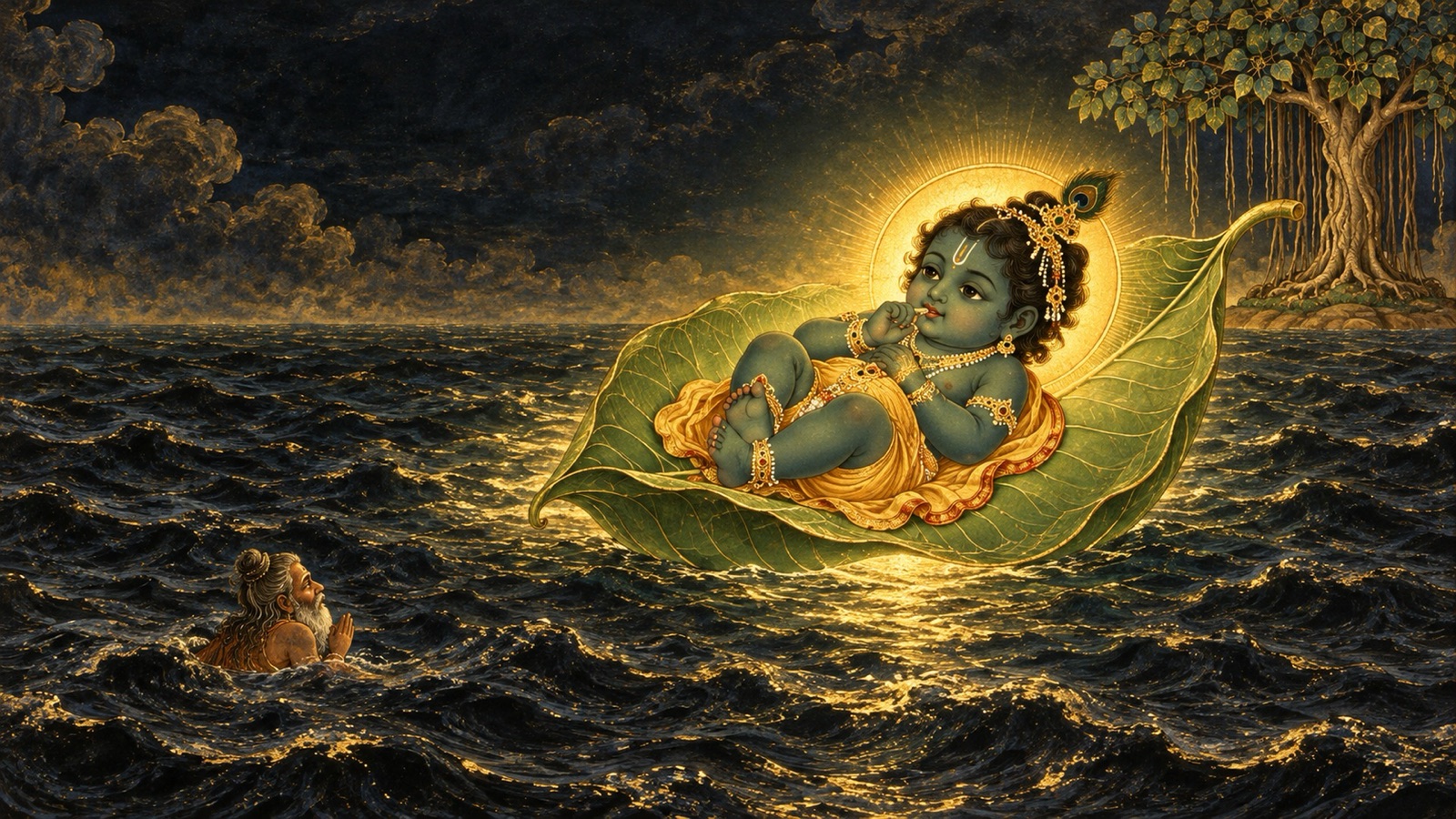
Adrift and alone upon the single ocean of dissolution, the sage Markandeya beholds the Supreme Lord as a radiant infant resting on a banyan leaf — the whole universe held safe within that tiny, luminous form.
Om Namo Bhagavate Vasudevaya.
Om Namo Bhagavate Vasudevaya.
Om Namo Bhagavate Vasudevaya.
Welcome to Srimad Bhagavatam Wisdom, a devotional journey through the sacred histories and teachings of the Srimad Bhagavat Mahapurana. In the previous chapter the Lord appeared before the sage Markandeya as Nara and Narayana, moved by the sage’s long austerity and pure devotion. This ninth chapter tells what Markandeya asked for, and what he was shown. Offered any boon, the sage did not ask for wealth or even liberation; he asked only to behold the Lord’s Maya — the mysterious power by which the one Reality appears as this manifold world. What follows is one of the most extraordinary visions in all of scripture: countless ages adrift and alone upon a shoreless flood, followed by the astonishing encounter with the Lord Himself resting as an infant on a single banyan leaf, His tiny form somehow containing every world within it. It is a chapter that answers Saunaka’s earlier question and shows us, unforgettably, what Maya is and Who holds it.
Chapter Information
- Scripture: Śrīmad Bhāgavata Mahāpurāṇa
- Canto: 12 (Book Twelve — the final Canto)
- Chapter: 9 (Discourse IX)
- Chapter title: Markandeya Witnesses the Lord’s Maya
- Principal speaker: Suta Gosvami, narrating to the sages of Naimisharanya
- Principal listener: The sages of Naimisharanya, led by Saunaka
- Main setting: Markandeya’s hermitage on the river Pushpabhadra; and, within the vision, the single ocean of cosmic dissolution
- Central subject: Markandeya’s request to see the Lord’s Maya, the cosmic deluge, and the vision of the Supreme Lord as an infant on a banyan leaf
- Principal verse range: Canto 12, Chapter 9, verses 1–34
- Primary edition: Gita Press Śrīmad Bhāgavata Mahāpurāṇa
A Boon Beyond the Ordinary
Duly extolled by the talented sage, Lord Narayana, accompanied by Nara, was highly pleased and spoke to that jewel among the Bhrigus. “You have attained perfection,” He said, “through concentration of mind, unceasing devotion to Me, and through austerity, study, and self-control. We are highly pleased with your lifelong vow of celibacy. Receive from Me your coveted boon.”
The sage’s answer is the heart of the chapter. He submits that the Lord’s own exalted nature has already been revealed to him by the very fact of this direct vision — a favour greater than which he can hardly imagine, for even Brahma and the other gods attain only an inward glimpse of the Lord’s lotus feet through long yoga, while here the Lord Himself has come within the range of his senses. And yet, he says, there is one thing he would ask.
अथाप्यम्बुजपत्राक्ष पुण्यश्लोकशिखामणे । द्रक्ष्ये मायां यया लोक: सपालो वेद सद्भिदाम् ॥ ६ ॥
athāpy ambuja-patrākṣa puṇya-śloka-śikhāmaṇe drakṣye māyāṁ yayā lokaḥ sa-pālo veda sad-bhidām
Meaning: Even so, O lotus-eyed Lord, O crest-jewel of the renowned, I would behold that Maya of Yours, under whose influence the world, together with its ruling deities, perceives diversity in the one Reality. (Canto 12, Chapter 9, verse 6)
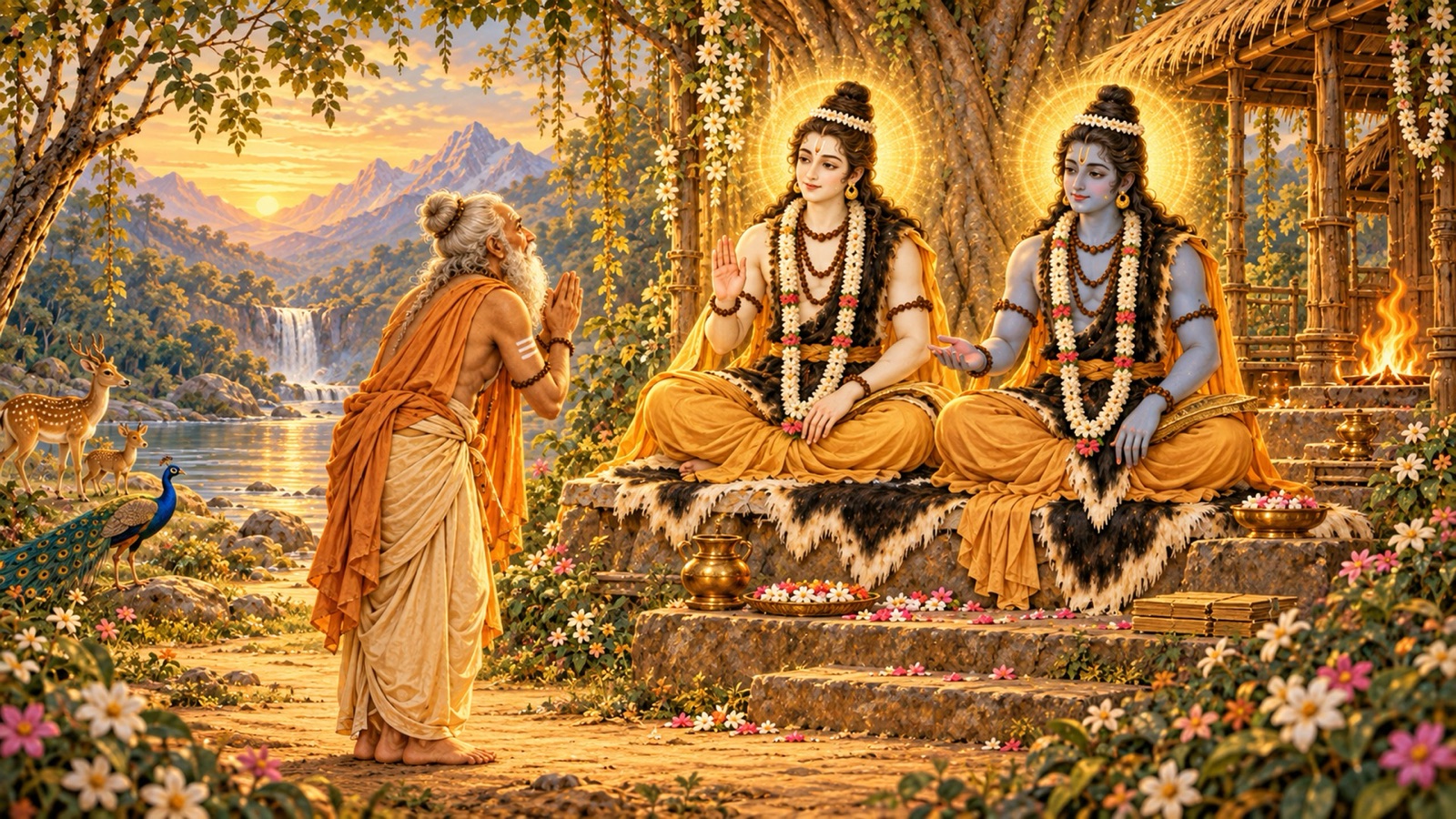
Extolled and worshipped, the Lord replied, “So shall it be!” and, smiling, withdrew to Badarikashrama. Thinking constantly of the promised vision and continuing in his own hermitage, Markandeya beheld Sri Hari in fire, sun, moon, water, earth, air, ether, and his own self — everywhere — and worshipped Him with articles conceived in the mind, at times so overwhelmed with emotion that he forgot the outward worship altogether.
The Deluge
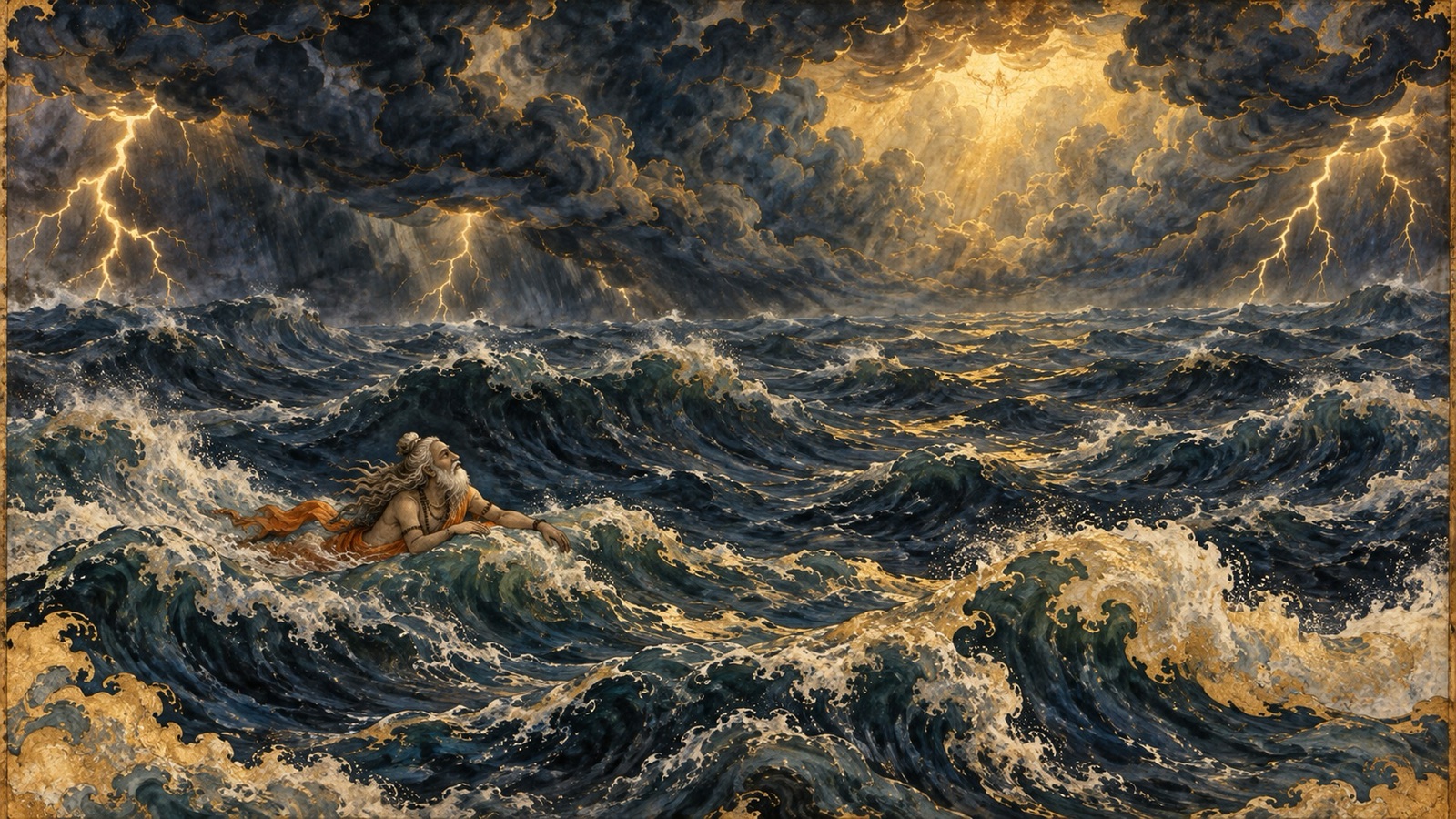
One day at evening, while the sage was worshipping the Lord on the bank of the Pushpabhadra, a furious wind sprang up. Following it came terrifying clouds, flashing with lightning and pouring rain thick as chariot-axles. The oceans of the four quarters appeared with fearful whirlpools and crocodiles and a deafening roar, engulfing the earth on every side. The whole universe — earth, sky, heaven, and the hosts of luminaries — was submerged, and the great sage, the only living being left alive, drifted along like a blind and helpless creature, his matted locks tossing on the waves.
Oppressed by hunger and thirst, assailed by sea-monsters, beaten by storm and wave, enveloped in endless darkness, he could not make out the directions, nor sky, nor earth. Now he fell into grief, now infatuation; now sorrow, now joy; now fear, now the very experience of death. Millions upon millions of years rolled by as he drifted, his judgment clouded by the enchanting potency of Lord Vishnu.
अयुतायुतवर्षाणां सहस्राणि शतानि च । व्यतीयुर्भ्रमतस्तस्मिन् विष्णुमायावृतात्मन: ॥ १९ ॥
ayutāyuta-varṣāṇāṁ sahasrāṇi śatāni ca vyatīyur bhramatas tasmin viṣṇu-māyāvṛtātmanaḥ
Meaning: Countless thousands and hundreds of ten-thousands of years passed by as he drifted there, his very self enveloped by the Maya of Vishnu. (Canto 12, Chapter 9, verse 19)
The Infant on the Banyan Leaf
Rolling about in that deluge, the sage at last beheld, on a rising of earth, a young banyan tree adorned with leaves and fruit. On a branch in the north-east lay a babe within a hollow leaf, swallowing up the darkness by its splendour. Markandeya was amazed at the sight.
महामरकतश्यामं श्रीमद्वदनपङ्कजम् । कम्बुग्रीवं महोरस्कं सुनसं सुन्दरभ्रुवम् ॥ २२ ॥ श्वासैजदलकाभातं कम्बुश्रीकर्णदाडिमम् । विद्रुमाधरभासेषच्छोणायितसुधास्मितम् ॥ २३ ॥ पद्मगर्भारुणापाङ्गं हृद्यहासावलोकनम् । श्वासैजद्वलिसंविग्ननिम्ननाभिदलोदरम् ॥ २४ ॥ चार्वङ्गुलिभ्यां पाणिभ्यामुन्नीय चरणाम्बुजम् । मुखे निधाय विप्रेन्द्रो धयन्तं वीक्ष्य विस्मित: ॥ २५ ॥
mahā-marakata-śyāmaṁ śrīmad-vadana-paṅkajam kambu-grīvaṁ mahoraskaṁ su-nasaṁ sundara-bhruvam śvāsaijad-alakābhātaṁ kambu-śrī-karṇa-dāḍimam vidrumādhara-bhāseṣac- choṇāyita-sudhā-smitam padma-garbhāruṇāpāṅgaṁ hṛdya-hāsāvalokanam śvāsaijad-vali-saṁvigna- nimna-nābhi-dalodaram cārv-aṅgulibhyāṁ pāṇibhyām unnīya caraṇāmbujam mukhe nidhāya viprendro dhayantaṁ vīkṣya vismitaḥ
Meaning: Dark as a great emerald, with a beautiful lotus-like face, a conch-shaped neck and broad chest, shapely nose and lovely brows, locks stirring with its breath, ears like fair conch-shells adorned with pomegranate blossoms, coral lips and a nectar-like rosy smile, eyes reddish as the interior of a lotus and a heart-captivating glance, a deep navel throbbing above the folds of its fig-leaf-shaped belly — the babe lifted its lotus-foot with its charming-fingered hands, placed it in its mouth, and sucked it, as the foremost of Brahmanas gazed on in wonder. (Canto 12, Chapter 9, verses 22-25)
At the sight of the babe the sage’s fatigue vanished; the lotuses of his heart and eyes opened for joy, and he approached, filled with awe, to make inquiries. Then, like a mosquito drawn in with the infant’s breath, Markandeya entered the body of the babe — and there, within, he beheld the entire universe arranged exactly as it had been before the deluge.
तावच्छिशोर्वै श्वसितेन भार्गव: सोऽन्त: शरीरं मशको यथाविशत् । तत्राप्यदो न्यस्तमचष्ट कृत्स्नशो यथा पुरामुह्यदतीव विस्मित: ॥ २७ ॥
tāvac chiśor vai śvasitena bhārgavaḥ so ’ntaḥ śarīraṁ maśako yathāviśat tatrāpy ado nyastam acaṣṭa kṛtsnaśo yathā purāmuhyad atīva vismitaḥ
Meaning: Then, with the infant’s breath, the descendant of Bhrigu entered its body like a mosquito, and there too he beheld the whole universe laid out entirely as before — and, as of old, he was utterly bewildered and amazed. (Canto 12, Chapter 9, verse 27)
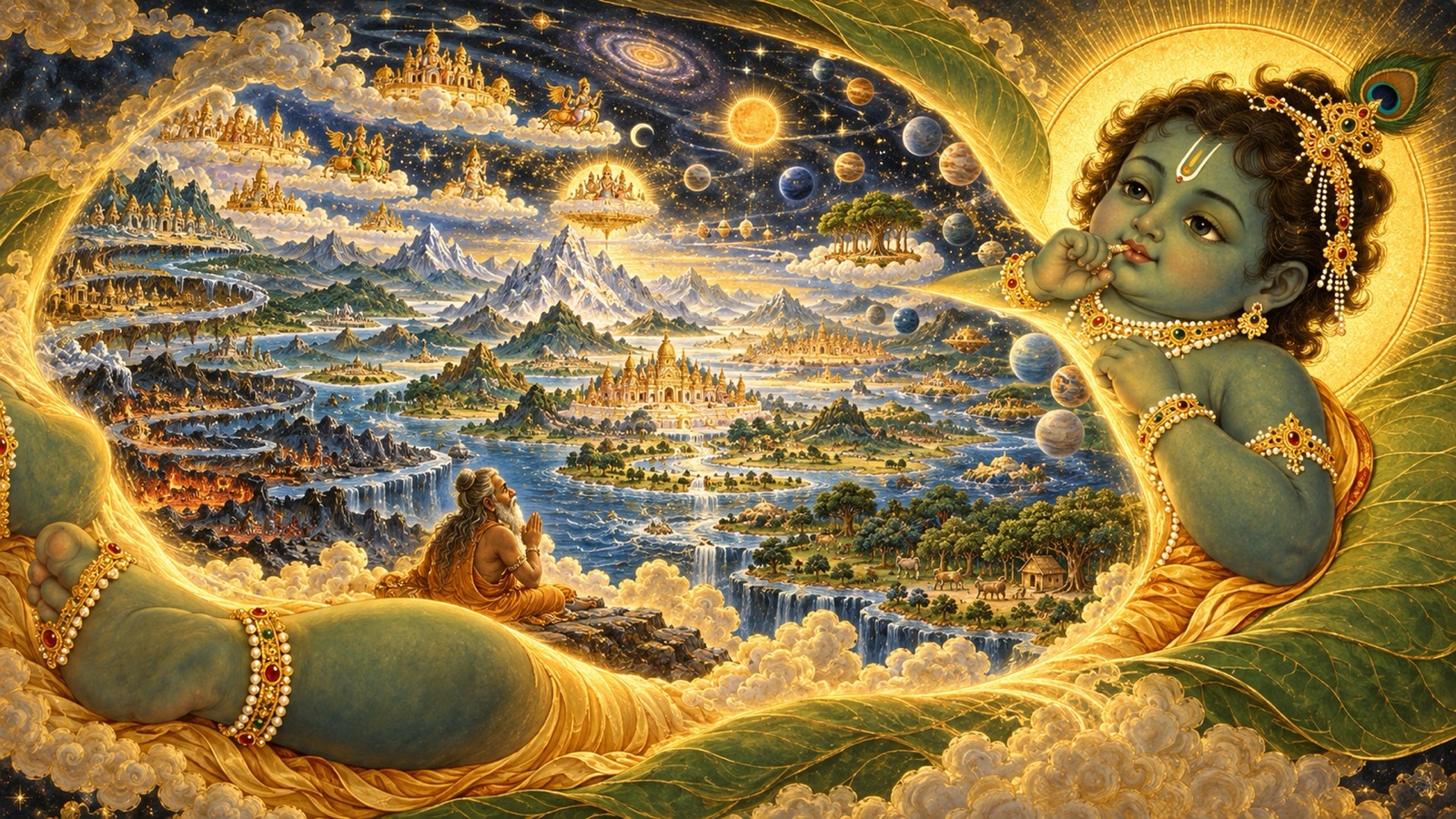
There he saw the sky, heaven and earth, the hosts of stars, the mountains and oceans, the lands and rivers, the gods and demons, the four orders of society and stages of life, the elements and their products, and Time in all its divisions — the whole world as if real. He even saw the Himalaya, the river Pushpabhadra, his own hermitage, and the sages dwelling there. Then, with the infant’s breath, he was cast out again and fell back into the sea of dissolution.
Beholding once more the banyan tree and the babe lying in the leaf — now gazing at him with a sidelong glance and a smile full of the nectar of love — the sage, deeply moved, went to embrace the child, who was none other than Lord Vishnu and had already entered his heart through the door of his eyes. That very moment the babe vanished, and with Him the banyan tree, the deluge-water, and the whole dissolution disappeared in an instant. Markandeya found himself standing in his own hermitage, exactly as before.
Principal Teachings of This Chapter
1. The truest devotee asks for God alone. Offered any boon, Markandeya asked neither for wealth nor even liberation, but only to understand the Lord’s power — because to a heart that has seen the Lord, nothing else is worth requesting (verses 2-6).
2. Maya is not separate from the Lord. The bewildering ocean of dissolution, the endless drifting, the whole apparent world — all of it is the Maya of Vishnu, held within and displayed by Him, never apart from Him (verse 19).
3. The infinite rests within the finite. The entire universe abides within a tiny infant on a leaf. The Lord contains all that is, effortlessly, in the smallest and most tender of forms (verses 22-27).
4. The Lord has already entered the devotee’s heart. Even amid the vision, the babe enters Markandeya through the door of his eyes and takes His seat within — a reminder that the Lord we seek outwardly already dwells within (verses 31-34).
A Devotional Reflection
What Markandeya asked to see is what most of us spend our lives inside without ever recognizing it. He wanted to understand Maya — the strange power that makes the one Reality look like a thousand separate things, that makes us forget who we are and where we truly stand. And the Lord answered not with an explanation but with an experience: ages of terror and loneliness on a shoreless sea, in which even a great sage lost his bearings, wept, feared, and forgot. That is Maya from the inside. But the chapter does not leave us there. In the very midst of the dissolution appears a smiling infant, and within that infant is the whole world, safe and whole. The terror and the tenderness are held by the same hands. Maya frightens only until we see Whose power it is. And then comes the gentlest revelation of all: the babe had already entered Markandeya’s heart through his eyes, and had taken His seat there. The Lord we search for across oceans of experience is nearer than our own breath — He came in the moment we first truly looked.
A Daily Devotional Practice
Today, let Markandeya’s request become your own. Once during the day, pause and gently notice how completely you are immersed in the passing world — its worries, its pleasures, its endless sense of “many things” pulling at you. Then breathe slowly and remember that all of it rests within the Lord, as the whole universe rested within the infant on the leaf; and that the same Lord has already taken His seat within your heart. Rather than asking God for one more thing the world can give, ask instead — as the sage did — only to see Him more clearly. Close by chanting “Om Namo Bhagavate Vasudevaya” a fixed number of times, letting each repetition draw your attention gently inward, toward the One who holds both the world and you.
Conclusion
The ninth chapter of the Twelfth Canto gives us one of the Bhagavatam’s most unforgettable visions. Granted any boon, the sage Markandeya asked only to behold the Lord’s Maya, and the Lord answered by leading him through the whole experience of it: a cosmic deluge in which the sage drifted alone for uncounted ages, and then the sight of the Supreme Person as a radiant infant on a banyan leaf, within whose body the entire universe was held. When the sage reached to embrace the child, the vision dissolved — for the Lord had already entered his heart. This is the answer to Saunaka’s earlier question, and a teaching for us all: the world that overwhelms us is the Lord’s own power, held safely within Him, and the One we seek so far afield is already seated within our own hearts.
May the divine wisdom of Srimad Bhagavatam awaken pure devotion within our hearts.
Om Namo Bhagavate Vasudevaya.
Jay Shree Madhav.
References and Attribution
- Primary edition: Gita Press, Śrīmad Bhāgavata Mahāpurāṇa (English, complete), Book Twelve, Discourse 9.
- Series: Srimad Bhagavatam Wisdom · Biswa Sanatan Dharma Seva Trust.
- Presented following the spiritual guidance and recommendation of Pandit Dr. Shri Kashinath Mishra.
This is an original, faithful retelling in the writer’s own words, with brief quoted verses shown in Devanāgarī and transliteration and their meanings given as summaries. It is not a reproduction of any single publisher’s continuous translation or commentary. No affiliation with or endorsement by any publisher is implied.
Jay Shree Madhav