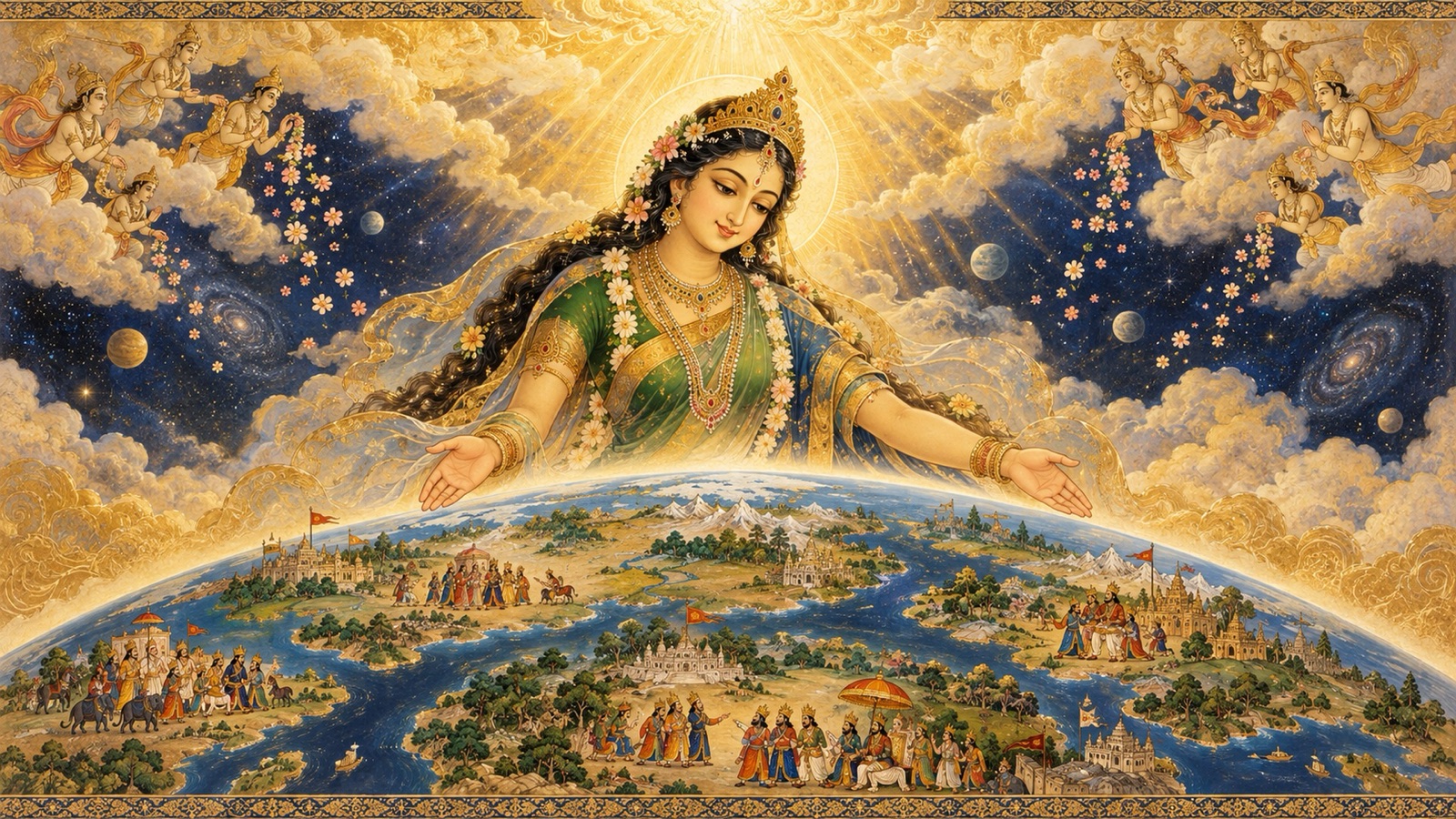
Mother Earth laughs quietly at the kings who scramble to conquer her, knowing they are but playthings of Death — and from this sobering vision Sukadeva Gosvami leads King Parikshit to the one great treasure hidden within the age of Kali: the chanting of the holy Name.
Om Namo Bhagavate Vasudevaya.
Om Namo Bhagavate Vasudevaya.
Om Namo Bhagavate Vasudevaya.
Welcome to Srimad Bhagavatam Wisdom, a devotional journey through the sacred histories and teachings of the Srimad Bhagavat Mahapurana. Having unrolled the long procession of Kali’s dynasties and laid bare the symptoms of the age, Sukadeva Gosvami now lifts King Parikshit’s gaze from the fate of kingdoms to the deeper questions beneath them: what is the worth of all worldly conquest, how does righteousness change from age to age, and how — in the darkest of the four ages — may a soul still be saved? This third chapter of the Twelfth Canto opens with one of the most striking images in all the scripture: Mother Earth herself, quietly laughing at the endless parade of rulers who fight and die to possess her. From that laughter, Sukadeva draws out a teaching on the vanity of ambition, the turning of the Yugas, and the perils of the Kali age — and then, when the picture seems darkest, he reveals the age’s single, priceless mercy: that by merely chanting the names of Sri Krishna, one may cross beyond all bondage. It is a chapter that empties the hands of every earthly craving only to fill them with the Name.
Chapter Information
- Scripture: Śrīmad Bhāgavata Mahāpurāṇa
- Canto: 12 (Book Twelve — the final Canto)
- Chapter: 3 (Discourse III)
- Chapter title: The Bhumi-gita, the Song of the Earth
- Principal speaker: Sri Sukadeva Gosvami, addressing King Parikshit; framed within Suta Gosvami’s narration to the sages of Naimisharanya
- Principal listener: King Parikshit; and the sages of Naimisharanya
- Main setting: The bank of the Ganga, where Parikshit awaits his death, within the forest hermitage of Naimisharanya
- Central subject: The vanity of worldly conquest as sung by Mother Earth, the character and conduct of the four Yugas, the evils of the Kali age, and the supreme remedy of chanting the holy Name of the Lord
- Principal verse range: Canto 12, Chapter 3, verses 1–52
- Primary edition: Gita Press Śrīmad Bhāgavata Mahāpurāṇa
The Laughter of Mother Earth
Sukadeva begins by recalling a curious sight: the whole earth, seeing kings so anxious and impatient to conquer her, laughs at them.
श्रीशुक उवाच दृष्ट्वात्मनि जये व्यग्रान् नृपान् हसति भूरियम् । अहो मा विजिगीषन्ति मृत्यो: क्रीडनका नृपा: ॥ १ ॥
śrī-śuka uvāca dṛṣṭvātmani jaye vyagrān nṛpān hasati bhūr iyam aho mā vijigīṣanti mṛtyoḥ krīḍanakā nṛpāḥ
Meaning: Sri Suka said: Seeing the kings so eager to conquer her, this earth laughs and says: How surprising it is that these kings, mere playthings in the hands of Death, wish to conquer me! (Canto 12, Chapter 3, verse 1)
Fruitless, Mother Earth says, is the ambition of rulers who stake everything on a body as fragile as a bubble of water, even while knowing it must burst. They plot to conquer their senses first, then their enemies, then continent after continent to the very shores of the ocean — and all the while they fail to notice Death standing at their side. What a poor return their conquests bring, when the true reward of subduing the self is liberation, not empire.
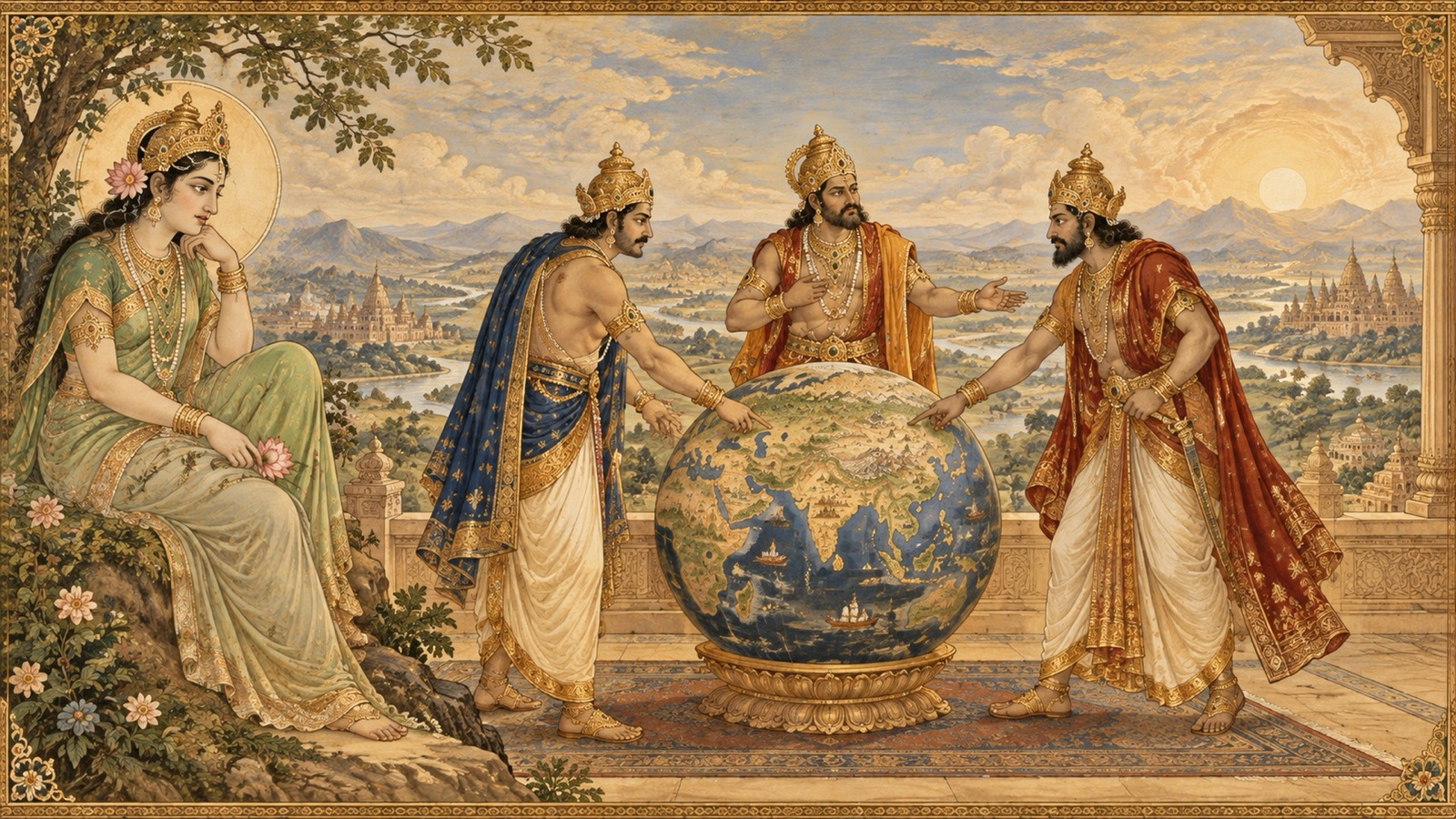
Then Mother Earth speaks the roll-call that silences all pride. Prithu, Pururava, Gadhi, Nahusha, Bharata, Kartavirya Arjuna, Mandhata, Sagara, Rama, Khatvanga, Raghu, Yayati, Bhagiratha, and many more — great emperors who understood everything, were brave and unconquered, and claimed her as their own. Demons too, like Hiranyakashipu, Ravana, and Hiranyaksha, held her in their grip. Yet mortal by nature, every one of them was in the end converted by Death into nothing more than a theme for a story, their designs left unfinished. This, Sukadeva tells Parikshit, is why such tales are told: not to glorify conquest but to reveal how insubstantial worldly enjoyment truly is. Words about empire have no bearing on the highest truth; but the glories of Lord Vishnu, endlessly praised by the righteous, put an end to all evil, and one who longs for pure devotion should hear them every day.
The Turning of the Four Ages
Moved by this vision, Parikshit asks how men living in Kali may shake off the accumulated evils of the age, and begs Sukadeva to explain the nature of the four Yugas, the conduct proper to each, and the workings of Time, the potency of the Lord that directs even the rulers of the universe.
Sukadeva answers with a majestic sweep. In Satya-yuga, Dharma stands firm on all four of its feet — truthfulness, compassion, austerity, and charity — and the people are content, gentle, tranquil, and devoted to Self-realization. In Treta, a quarter of Dharma is lost as its opposites creep in; people turn to ritual and the pursuit of merit, wealth, and enjoyment. In Dwapara, virtue halves again; men grow fond of glory, great sacrifices, and large families. And in Kali, only a quarter of Dharma remains, steadily wearing away, as greed, cruelty, dishonesty, and restlessness take hold.
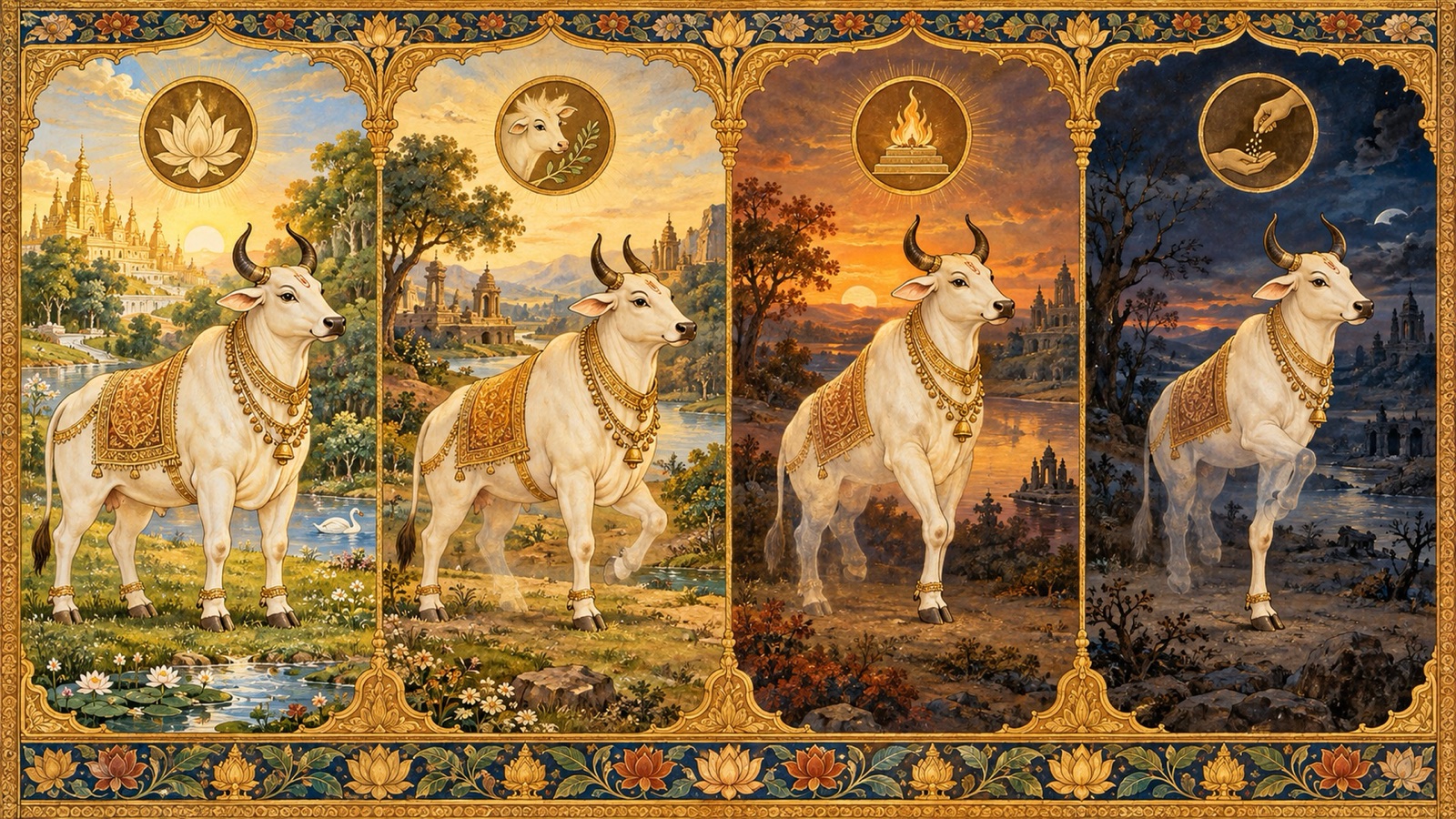
The sage adds a subtle teaching: the three modes of nature — sattva, rajas, and tamas — rise and fall within the human mind by the force of Time, and it is really this inner balance that marks which age is present. Where the mind abounds in goodness and delights in wisdom and austerity, Satya-yuga reigns within; where greed, discontent, and hypocrisy prevail, it is Kali, whatever the outer calendar may say. In this way each of us carries all four ages within, and may choose, moment by moment, which age our heart will inhabit.
The One Great Virtue of the Dark Age
Having painted the age of Kali in unsparing colours, Sukadeva turns, as he loves to do, from diagnosis to cure. However thick the darkness, he says, Lord Sri Hari, once enthroned in the mind, drives away every evil born of the age. Heard, glorified, remembered, and worshipped, the Lord dwells in the heart and burns away the sins of a thousand lives, as fire applied to gold burns away every impurity. And then he speaks the verse that has become the lamp of the whole age.
कलेर्दोषनिधे राजन्नस्ति ह्येको महान् गुण: । कीर्तनादेव कृष्णस्य मुक्तसङ्ग: परं व्रजेत् ॥ ५१ ॥
kaler doṣa-nidhe rājann asti hy eko mahān guṇaḥ kīrtanād eva kṛṣṇasya mukta-saṅgaḥ paraṁ vrajet
Meaning: O king, though the age of Kali is an ocean of faults, it possesses one great virtue: simply by chanting the names and glories of Sri Krishna, one is freed from all bondage and reaches the Supreme. (Canto 12, Chapter 3, verse 51)
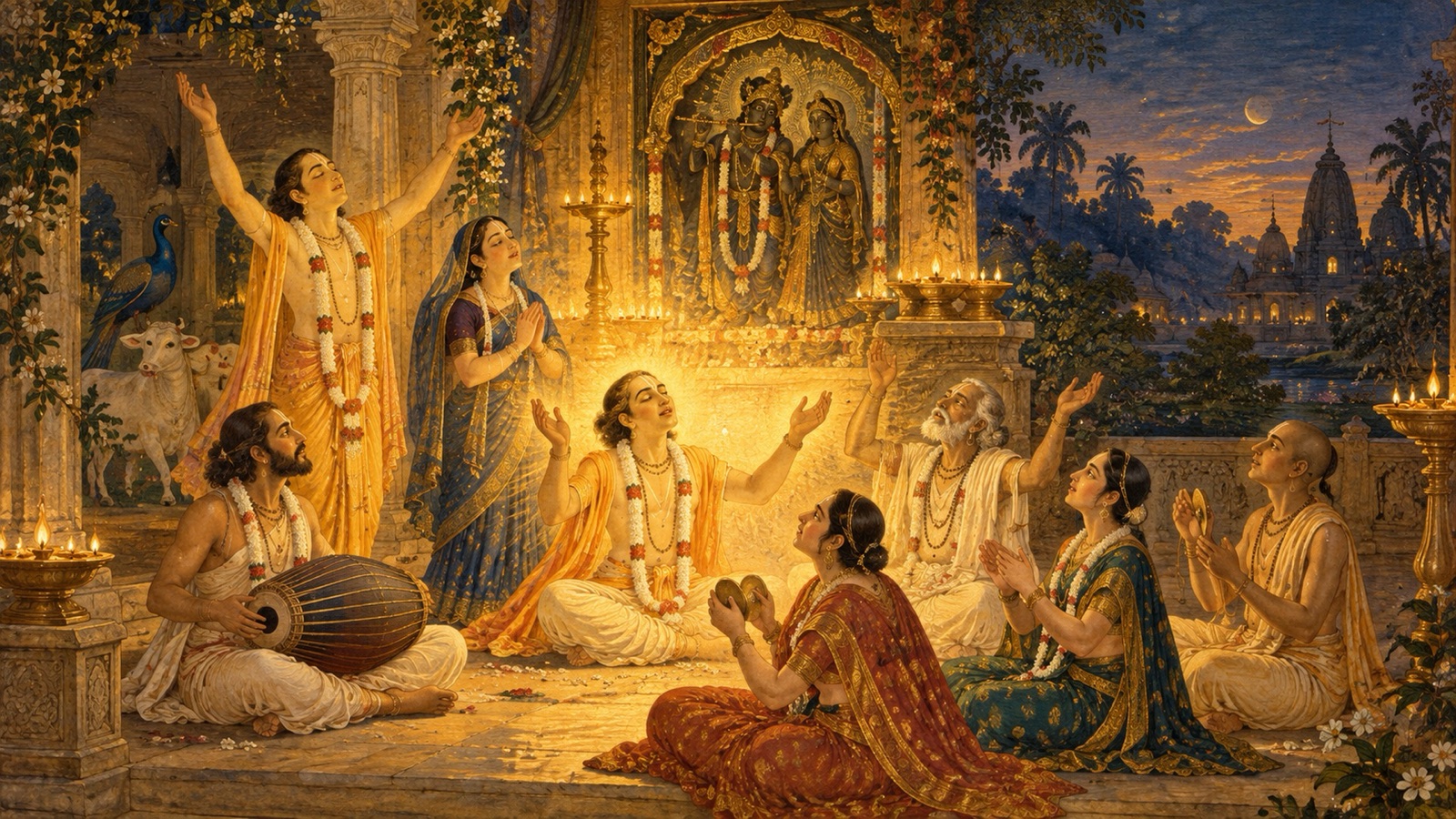
To make the mercy plain, Sukadeva sets the ages side by side. What is won in Satya-yuga through long meditation on Vishnu, in Treta through elaborate sacrifice, and in Dwapara through temple worship, is won in the age of Kali simply by chanting and singing the praises of Sri Hari.
कृते यद्ध्यायतो विष्णुं त्रेतायां यजतो मखै: । द्वापरे परिचर्यायां कलौ तद्धरिकीर्तनात् ॥ ५२ ॥
kṛte yad dhyāyato viṣṇuṁ tretāyāṁ yajato makhaiḥ dvāpare paricaryāyāṁ kalau tad dhari-kīrtanāt
Meaning: Whatever is attained in Satya-yuga by meditating on Vishnu, in Treta by worshipping Him through sacrifice, and in Dwapara by ritual service, is attained in the age of Kali simply by chanting the glories of Sri Hari. (Canto 12, Chapter 3, verse 52)
It is a breathtaking reversal. The very age that strips away strength, memory, and long life — the age in which the elaborate disciplines of earlier times are beyond most human reach — is given the easiest and most powerful of all paths: the Name itself, freely available to every tongue and every heart.
Principal Teachings of This Chapter
1. All worldly conquest is Death’s plaything. Mother Earth’s laughter is not cruelty but compassion: she reminds us that every crown returns to dust, so that we might invest our hearts where nothing can be lost (verses 1-13).
2. The stories of great kings are mirrors, not trophies. Sukadeva tells these histories to teach detachment, not admiration — for even the mightiest were reduced at last to “themes of a story” (verse 14).
3. The age lives within the heart. Since sattva, rajas, and tamas rise and fall within the mind, we may cultivate the inner Satya-yuga of goodness and wisdom even while the outer age of Kali runs its course (verses 26-29).
4. The holy Name is the mercy of the age. The one great virtue of Kali is that liberation, so hard-won in earlier ages, is now available simply through chanting the names of Sri Krishna (verses 51-52).
A Devotional Reflection
There is a tender logic in the order of this chapter. Sukadeva first empties our hands of every false treasure — showing us kings and demons alike swallowed by Death, the very earth laughing gently at our schemes — and only then does he place in those emptied hands the one thing that cannot be taken away. This is the movement of all true devotion: we do not cling to the Name until we have first loosened our grip on everything else. And the mercy he reveals is astonishing in its fairness. The disciplines of the earlier ages demanded leisure, strength, learning, and long life — gifts unevenly given. But the Name asks nothing but love. The poor may chant it as fully as the rich, the unlettered as fully as the learned, the dying as fully as the young. In an age Sukadeva calls an ocean of faults, this is the single bright pearl: that the door to the Supreme has been thrown open to anyone willing simply to call upon the Lord.
A Daily Devotional Practice
Today, take Mother Earth’s gentle laughter to heart. Notice one thing you are anxiously striving to “conquer” — a possession, a position, a small victory over another — and quietly acknowledge that it, too, is Death’s plaything, unable to follow you beyond this life. Then, releasing that grip even a little, turn your tongue to the treasure that endures: chant slowly, with attention, “Om Namo Bhagavate Vasudevaya,” or the names of Sri Krishna, a fixed number of times. In this single act you practise the whole teaching of the chapter — loosening your hold on the fleeting, and taking up the one great virtue of the age.
Conclusion
The third chapter of the Twelfth Canto carries us from the laughter of Mother Earth to the lamp of the holy Name. Sukadeva Gosvami first strips away every illusion of worldly permanence — kings and empires and even mighty demons all dissolving into mere stories under the hand of Death — and then traces the long descent of Dharma through the four ages, until the darkness of Kali stands fully revealed. Yet the chapter’s true purpose is not to frighten but to free: for precisely in the age of greatest weakness, the Lord has hidden His greatest mercy. Where earlier ages required meditation, sacrifice, and elaborate worship, Kali requires only the chanting of Sri Krishna’s names, by which any soul may cross the ocean of birth and death. It is the Bhagavatam’s great democratic gift — the Song of the Earth ending not in lament but in the singing of the Name.
May the divine wisdom of Srimad Bhagavatam awaken pure devotion within our hearts.
Om Namo Bhagavate Vasudevaya.
Jay Shree Madhav.
References and Attribution
- Primary edition: Gita Press, Śrīmad Bhāgavata Mahāpurāṇa (English, complete), Book Twelve, Discourse 3.
- Series: Srimad Bhagavatam Wisdom · Biswa Sanatan Dharma Seva Trust.
- Presented following the spiritual guidance and recommendation of Pandit Dr. Shri Kashinath Mishra.
This is an original, faithful retelling in the writer’s own words, with brief quoted verses shown in Devanāgarī and transliteration and their meanings given as summaries. It is not a reproduction of any single publisher’s continuous translation or commentary. No affiliation with or endorsement by any publisher is implied.
Jay Shree Madhav