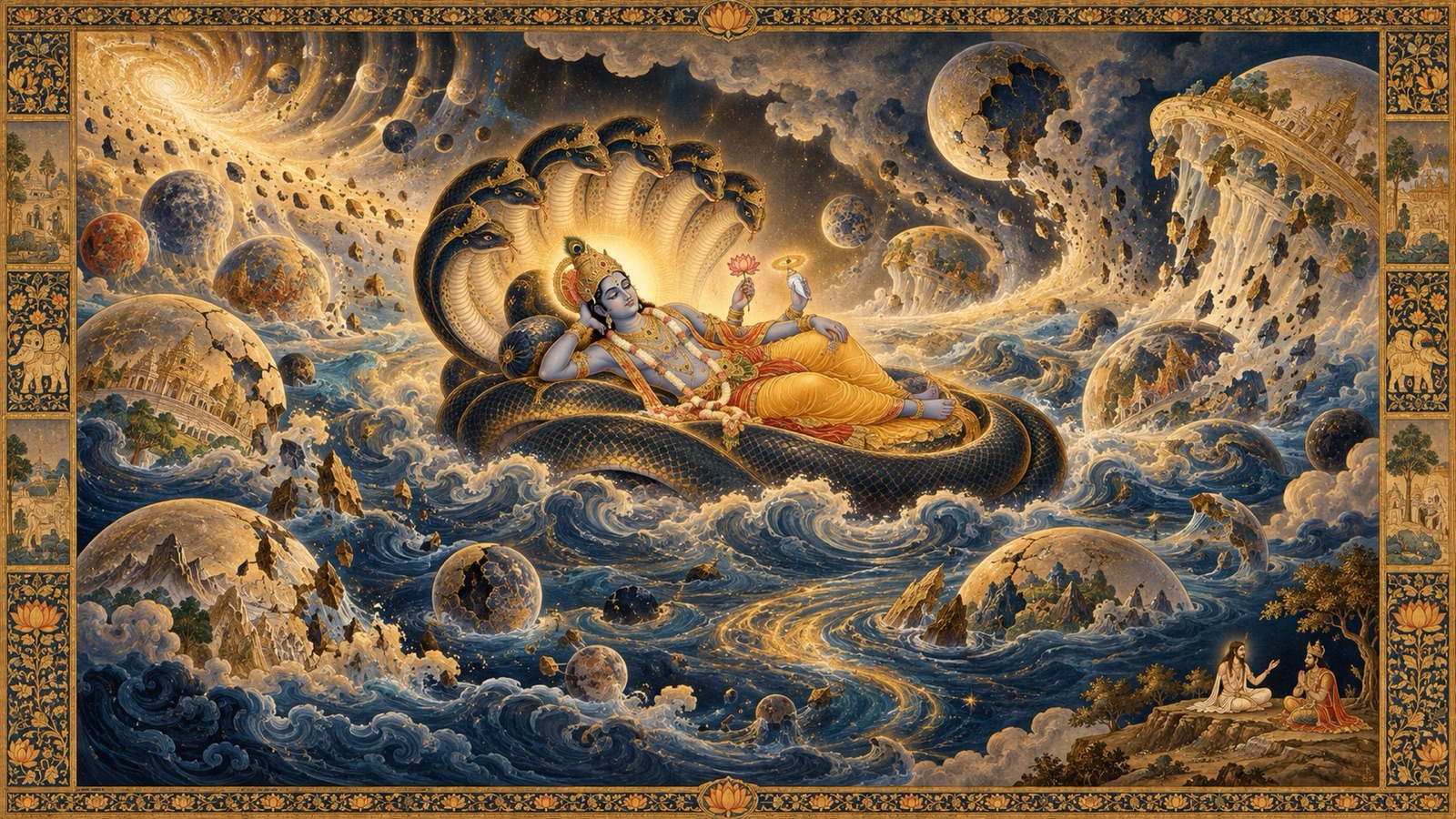
Sukadeva Gosvami unfolds for King Parikshit the four kinds of cosmic dissolution — the constant, the occasional, the elemental, and the everlasting — showing how all that has a beginning must end, and how the one imperishable refuge is the nectar of the Lord’s own story.
Om Namo Bhagavate Vasudevaya.
Om Namo Bhagavate Vasudevaya.
Om Namo Bhagavate Vasudevaya.
Welcome to Srimad Bhagavatam Wisdom, a devotional journey through the sacred histories and teachings of the Srimad Bhagavat Mahapurana. Having revealed the age of Kali and the mercy of the holy Name, Sukadeva Gosvami now lifts King Parikshit’s vision to the very rhythm of creation itself: the great in-breath and out-breath of the cosmos, by which all worlds arise and are withdrawn. This fourth chapter of the Twelfth Canto is the Bhagavatam’s majestic account of pralaya — dissolution — set out in four kinds: the constant wearing-away of every changing thing, the occasional night of Brahma when the three worlds sleep, the elemental dissolution when even the building-blocks of matter return to their source, and the everlasting dissolution of the soul that awakens to its own true nature. It is a chapter that could overwhelm the heart with the sheer scale of impermanence; yet Sukadeva turns it, at the last, into the tenderest of invitations — for against the boundless ocean of birth and death he holds out a single, unfailing vessel: the nectar of the Lord’s own story.
Chapter Information
- Scripture: Śrīmad Bhāgavata Mahāpurāṇa
- Canto: 12 (Book Twelve — the final Canto)
- Chapter: 4 (Discourse IV)
- Chapter title: The Four Kinds of Cosmic Dissolution
- Principal speaker: Sri Sukadeva Gosvami, addressing King Parikshit; framed within Suta Gosvami’s narration to the sages of Naimisharanya
- Principal listener: King Parikshit; and the sages of Naimisharanya
- Main setting: The bank of the Ganga, where Parikshit awaits his death, within the forest hermitage of Naimisharanya
- Central subject: The four kinds of dissolution — Nitya (constant), Naimittika (occasional), Prakrtika (elemental), and Atyantika (everlasting) — and the imperishable refuge of hearing the Lord’s glories
- Principal verse range: Canto 12, Chapter 4, verses 1–43
- Primary edition: Gita Press Śrīmad Bhāgavata Mahāpurāṇa
The Day and Night of Brahma
Sukadeva begins by placing the measure of Time before the king. Having earlier described the divisions of time from the tiniest paramanu to the vast two parardhas of Brahma’s lifespan, he now unfolds the span of a kalpa, one round of creation, and of laya, the period of dissolution. One thousand cycles of the four Yugas, he says, make a single day of Brahma — and within that day fourteen Manus successively hold sway.
चतुर्युगसहस्रं तु ब्रह्मणो दिनमुच्यते । स कल्पो यत्र मनवश्चतुर्दश विशाम्पते ॥ २ ॥
catur-yuga-sahasraṁ tu brahmaṇo dinam ucyate sa kalpo yatra manavaś caturdaśa viśām-pate
Meaning: A thousand cycles of the four Yugas are said to be one day of Brahma; this is called a kalpa, during which fourteen Manus hold sway, O ruler of men. (Canto 12, Chapter 4, verse 2)
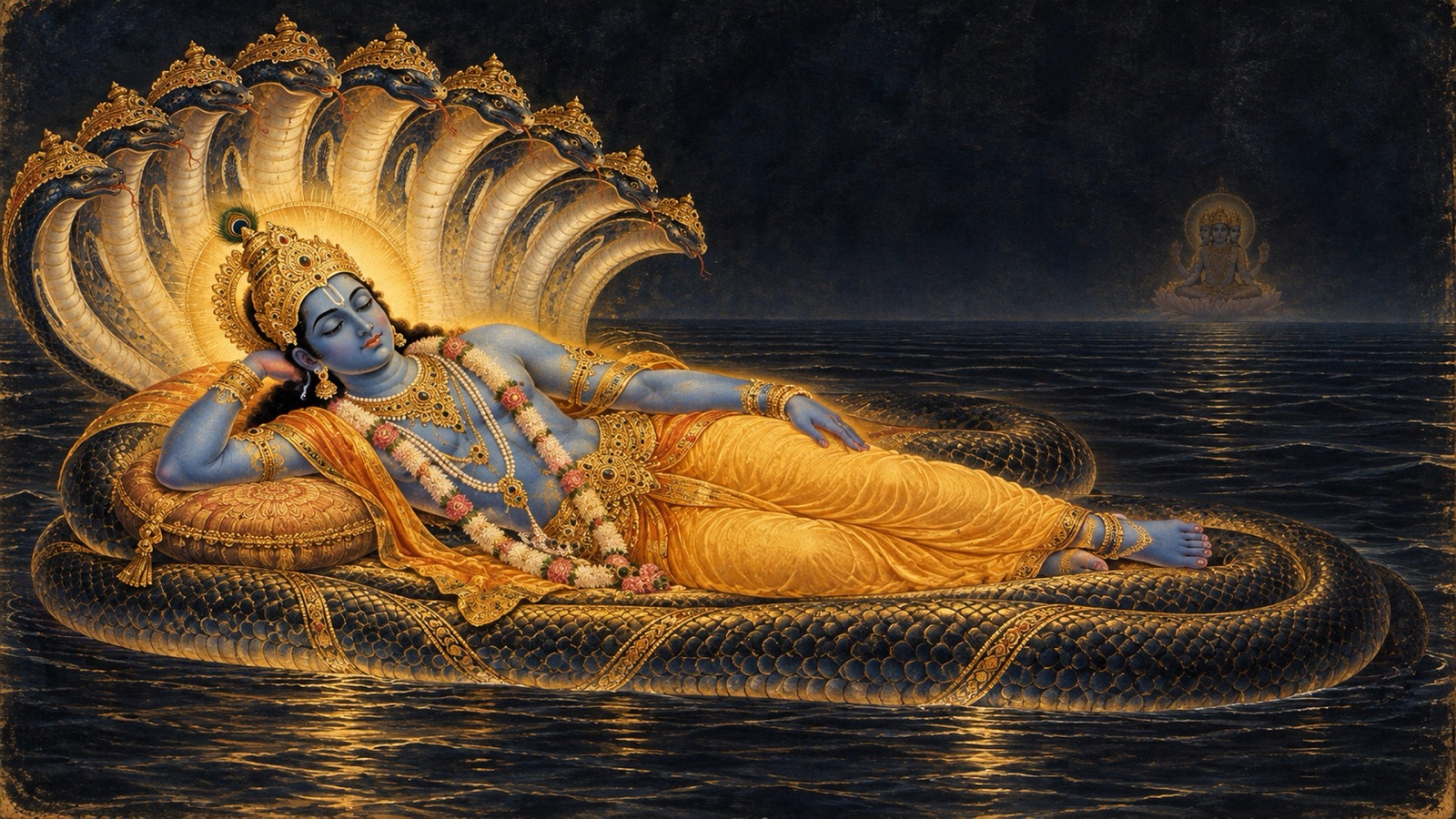
At the close of each such day, Sukadeva explains, comes an equally long night — the Naimittika, or occasional, dissolution. During this night the three worlds are withdrawn; Lord Narayana, maker of the universe, draws all creation into Himself and rests upon His couch of Ananta, the serpent of eternity, while Brahma too sinks into sleep. It is not the end of all things, but their nightly rest within the Lord.
The Elemental Dissolution
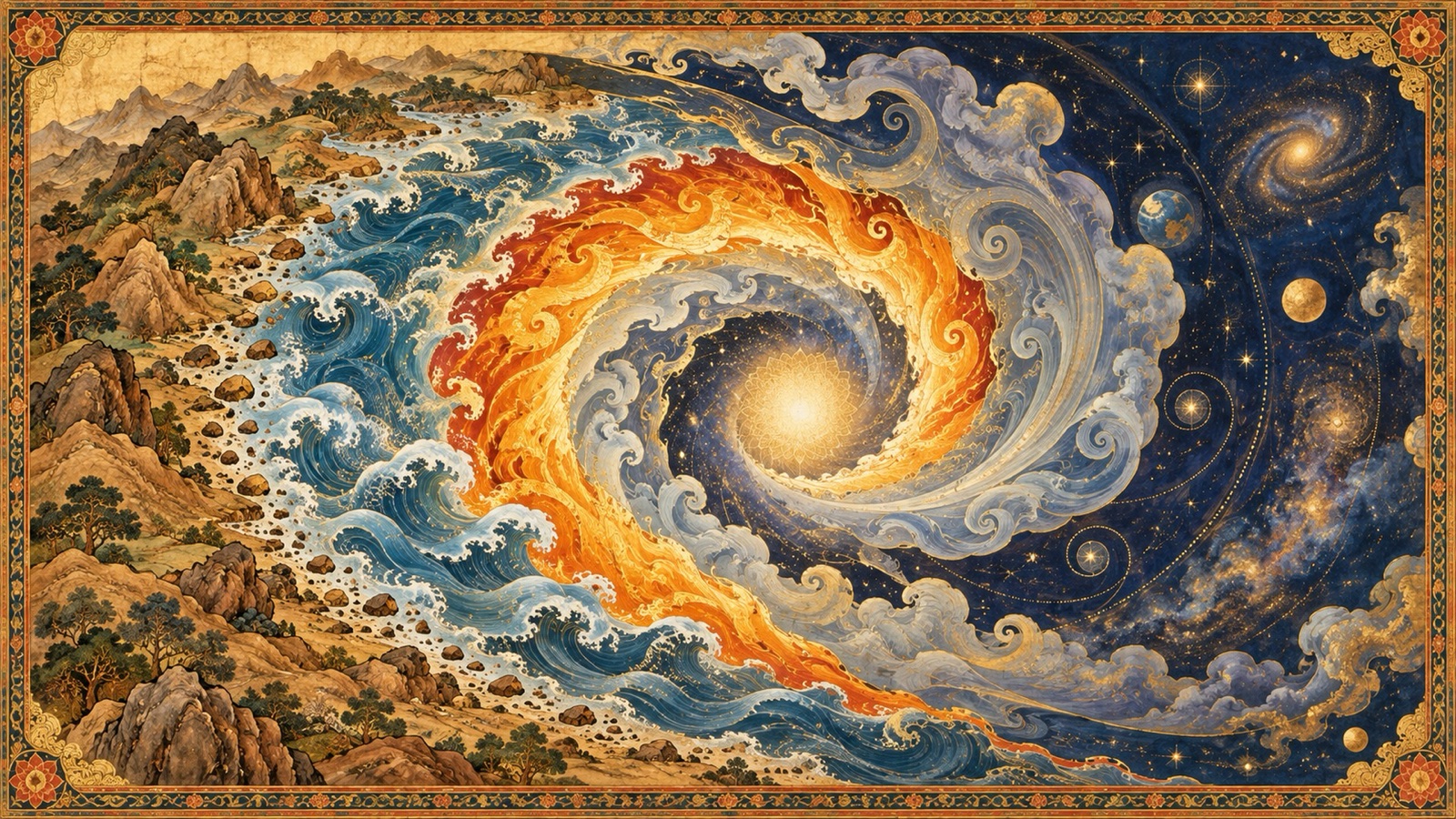
When at last the full lifetime of Brahma — two parardhas — has run its course, a far greater unwinding begins: the Prakrtika, or elemental, dissolution, in which even the fundamental principles of matter return to their unmanifest source. Sukadeva paints it in awesome strokes. For a hundred years no rain falls; the famished earth is stripped of grain, and living beings perish. The sun blazes with terrible brightness, drinking up all the waters of the seas, the earth, and the bodies of creatures. Fire, springing from the mouth of Lord Sankarshana and fanned by the winds, scorches the worlds until the cosmic egg glows like a burnt clod; then hurricane winds rage, and vast many-coloured clouds pour down for a hundred years, until the whole universe is drowned in a single sheet of water.
Then, one by one, the elements surrender their qualities and merge into their causes. Water absorbs the earth’s quality of smell, and earth dissolves; fire absorbs water’s taste, and water dissolves; air absorbs fire’s form, and fire dissolves; ether absorbs air’s touch, and air dissolves; and the cosmic ego absorbs the sound of ether. Ego is drawn into the mahat-tattva, the mahat into the three gunas, and the gunas, impelled by Time, return to perfect equilibrium in unmanifest Prakriti — beginningless, changeless, and undecaying.
The Everlasting Dissolution
Sukadeva now turns from the dissolution of worlds to the dissolution of ignorance itself — the Atyantika, or everlasting, dissolution, which is nothing less than liberation. Whatever has a beginning and an end, he teaches, is unreal, for it has no existence apart from its cause; only pure consciousness, the ground of intellect, senses, and their objects, truly shines. Just as light, the eye, and colour are not separate from fire, so the mind and senses are not separate from Brahma, the one Reality. The world appears and disappears within Brahma as clouds appear and vanish in the sky.
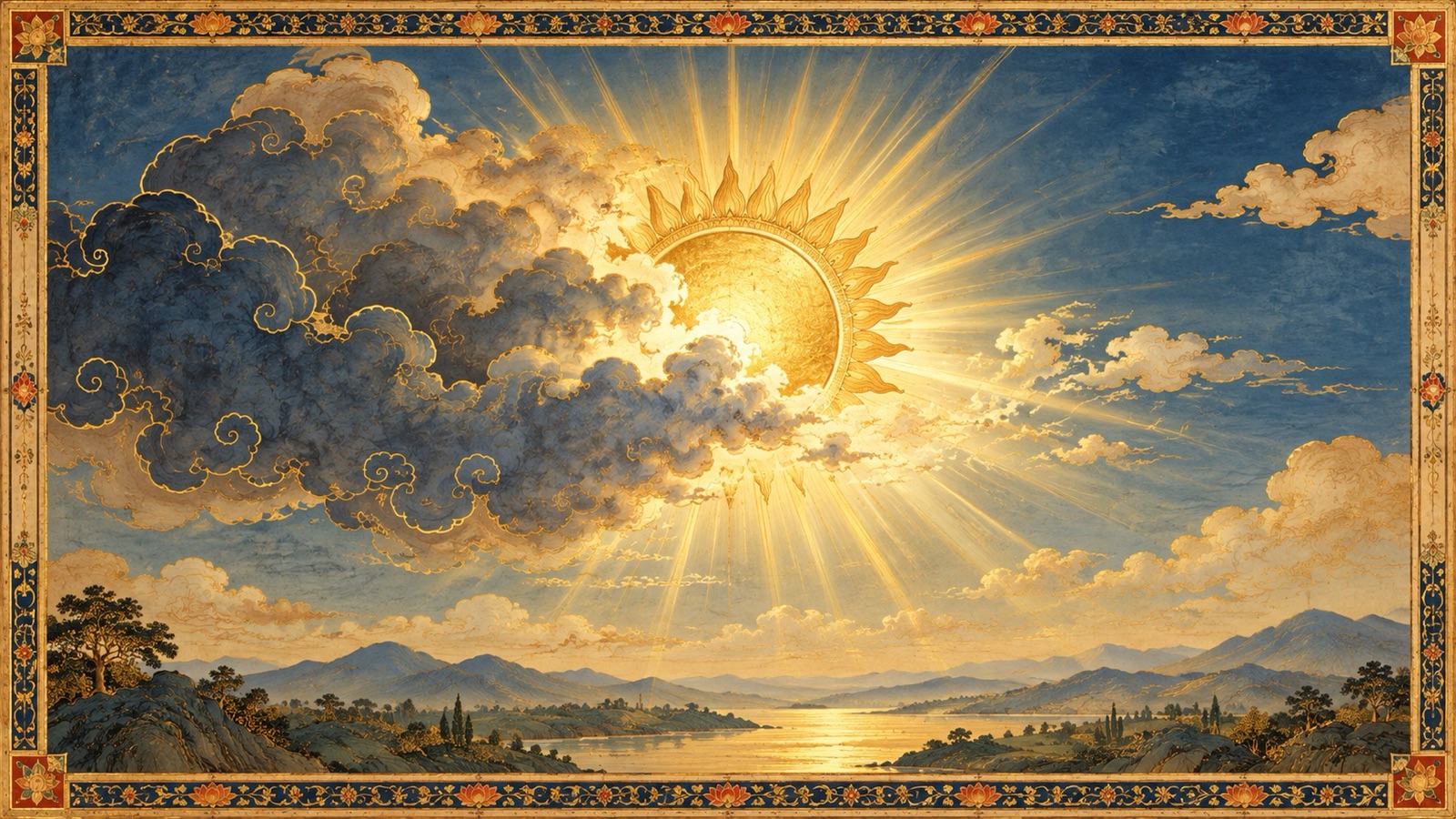
To make it vivid, the sage gives his luminous image of the cloud and the sun. Just as a cloud, though itself born of the sun, hides the sun from the very eye that the sun illumines, so the ego — born of Brahma and lit by Brahma — stands between the soul and the realization of Brahma. And the moment that cloud is scattered by inquiry into the Self, the eye beholds the sun again; the soul knows its oneness with the Supreme. When, with this dagger of discrimination, one severs the false bondage of ego, a product of Maya, and abides in the realized Self, that, Sukadeva says, is called the everlasting dissolution.
यदैवमेतेन विवेकहेतिना मायामयाहङ्करणात्मबन्धनम् । छित्त्वाच्युतात्मानुभवोऽवतिष्ठते तमाहुरात्यन्तिकमङ्ग सम्प्लवम् ॥ ३४ ॥
yadaivam etena viveka-hetinā māyā-mayāhaṅkaraṇātma-bandhanam chittvācyutātmānubhavo ’vatiṣṭhate tam āhur ātyantikam aṅga samplavam
Meaning: When, with this dagger of discrimination, one cuts through the ego-born bondage of the self that is a product of Maya, and abides in the realized experience of the infallible Self, the wise call that the everlasting dissolution, O dear one. (Canto 12, Chapter 4, verse 34)
The Constant Dissolution
Finally Sukadeva names the Nitya, or constant, dissolution — the quietest and most ceaseless of the four. Those who perceive the subtle nature of things, he says, know that the creation and destruction of all beings, from Brahma downward, is going on at every moment. Like the ever-changing flow of a river or the flickering of a lamp’s flame, the body and all created things are worn away instant by instant under the stream of Time, so imperceptibly that we do not notice it, any more than we mark the constant motion of the stars across the sky. Thus the constant, the occasional, the elemental, and the everlasting dissolutions together reveal the whole course of Time.
The One Boat Across the Ocean
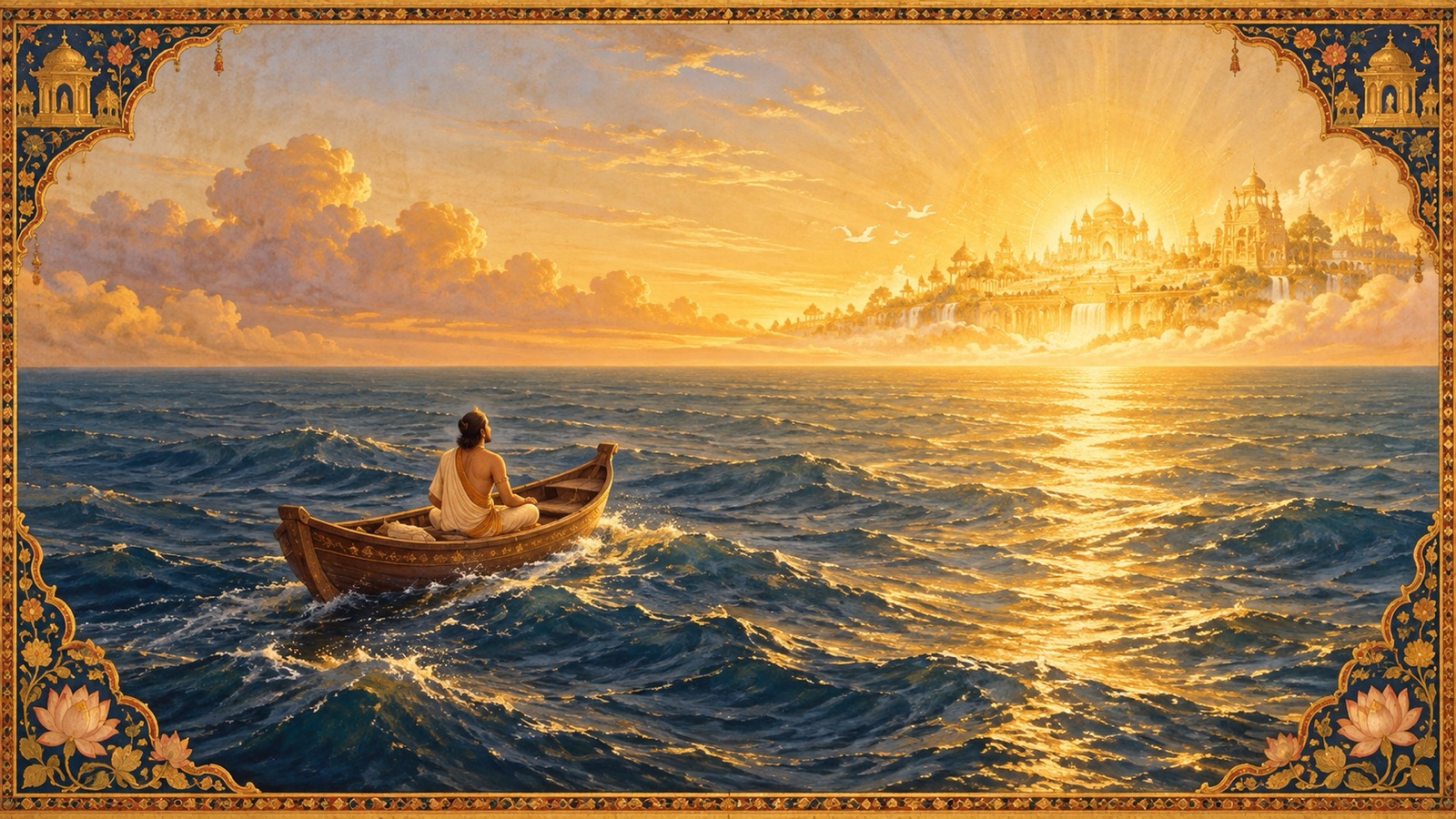
Having led the king through the grandeur of universal dissolution, Sukadeva gathers it all into a single, tender teaching. These, he says, are but a brief telling of the sportive activities of Lord Narayana — the maker of the universe and the abode of all beings — glories so vast that not even Brahma could relate them in full. And for a soul tormented by the wildfire of manifold miseries and longing to cross the well-nigh impassable ocean of birth and death, there is no other boat than the constant relishing of the nectar of the Lord’s stories.
संसारसिन्धुमतिदुस्तरमुत्तितीर्षो- र्नान्य: प्लवो भगवत: पुरुषोत्तमस्य । लीलाकथारसनिषेवणमन्तरेण पुंसो भवेद् विविधदु:खदवार्दितस्य ॥ ४० ॥
saṁsāra-sindhum ati-dustaram uttitīrṣor nānyaḥ plavo bhagavataḥ puruṣottamasya līlā-kathā-rasa-niṣevaṇam antareṇa puṁso bhaved vividha-duḥkha-davārditasya
Meaning: For one scorched by the wildfire of manifold sorrows and seeking to cross the well-nigh impassable ocean of worldly existence, there is no boat other than the loving service of the nectar of the stories of the Lord, the Supreme Person. (Canto 12, Chapter 4, verse 40)
Sukadeva closes by tracing the sacred lineage of this very scripture: the immortal Lord Narayana first taught the Bhagavata to the sage Narada, Narada to Sukadeva’s own father Vedavyasa, and Vedavyasa, full of delight, taught it to Sukadeva himself — a compilation equal in worth to the Vedas. And, he tells Parikshit, the same Suta who sits nearby will one day expound it to the great assembly of sages gathered for the long sacrificial session in the forest of Naimisharanya. In a single verse the whole frame of the Bhagavatam is quietly revealed, binding the dying king’s discourse to the very telling we now hear.
Principal Teachings of This Chapter
1. All that begins must end. Whatever has a beginning and an end is, by its nature, impermanent and ultimately unreal; only the changeless Self endures. To grasp this is to loosen our grip on the fleeting (verses 23-28).
2. Dissolution has four faces. Time works constantly, occasionally, elementally, and finally; the same law that ends a universe wears away a single body moment by moment. Impermanence is not an accident but the very rhythm of creation (verses 35-38).
3. The ego is the cloud before the sun. What hides the Self from us is not distance but our own ego, itself born of Brahma; inquiry scatters it, and the soul beholds its own light (verses 32-34).
4. Hari-katha is the only boat. Amid an ocean of sorrow no philosophy or effort suffices as a vessel; the sure crossing is the loving, constant relishing of the Lord’s glories (verse 40).
A Devotional Reflection
There is a strange comfort hidden in this chapter of endings. Sukadeva shows us suns burning out, oceans drying up, the very elements folding back into their source — a scale of impermanence so vast that our anxieties shrink beside it. Yet he does not leave us in the cold of that vastness. Having emptied the cosmos of every permanence, he places into our hands the one thing the deluge cannot dissolve: the nectar of the Lord’s story. It is a movement we have met before in these discourses — first the loosening, then the gift. To meditate on dissolution is not morbid but freeing: it teaches the heart to stop clinging to what was always slipping away, and to cling instead to what abides. The wise soul, hearing of the fire and the flood, does not despair; it simply climbs into the boat that Sukadeva points to, and begins, even now, to cross.
A Daily Devotional Practice
Today, sit quietly for a few moments and let the truth of this chapter settle in: everything you can see, hold, or fear to lose is already dissolving, grain by grain, under the stream of Time. Rather than letting this frighten you, let it gently release you. Then take up the one imperishable refuge the chapter offers — the nectar of the Lord’s story. Read or recall a single lila of Sri Krishna, or simply chant with attention, “Om Namo Bhagavate Vasudevaya,” a fixed number of times, stepping into that unfailing boat. In this small daily crossing you practise the whole teaching of the chapter — releasing the perishable, and taking hold of the Eternal.
Conclusion
The fourth chapter of the Twelfth Canto is the Bhagavatam’s grand meditation on impermanence — and its quiet turning of impermanence into hope. Sukadeva Gosvami sets before the dying king the four kinds of dissolution: the constant wearing-away of all things, the nightly rest of the worlds within Narayana, the elemental unwinding of matter back to its source, and the everlasting dissolution of ignorance in the light of Self-realization. Beneath the awesome imagery of drying seas and folding elements runs a single, steady teaching: that all which begins must end, so the heart must anchor itself in what has no beginning and no end. And in the chapter’s final verses that anchor is named — the nectar of the Lord’s own story, the one boat across the impassable ocean of birth and death, carried down through Narayana, Narada, and Vyasa to the sages of Naimisharanya, and to us.
May the divine wisdom of Srimad Bhagavatam awaken pure devotion within our hearts.
Om Namo Bhagavate Vasudevaya.
Jay Shree Madhav.
References and Attribution
- Primary edition: Gita Press, Śrīmad Bhāgavata Mahāpurāṇa (English, complete), Book Twelve, Discourse 4.
- Series: Srimad Bhagavatam Wisdom · Biswa Sanatan Dharma Seva Trust.
- Presented following the spiritual guidance and recommendation of Pandit Dr. Shri Kashinath Mishra.
This is an original, faithful retelling in the writer’s own words, with brief quoted verses shown in Devanāgarī and transliteration and their meanings given as summaries. It is not a reproduction of any single publisher’s continuous translation or commentary. No affiliation with or endorsement by any publisher is implied.
Jay Shree Madhav