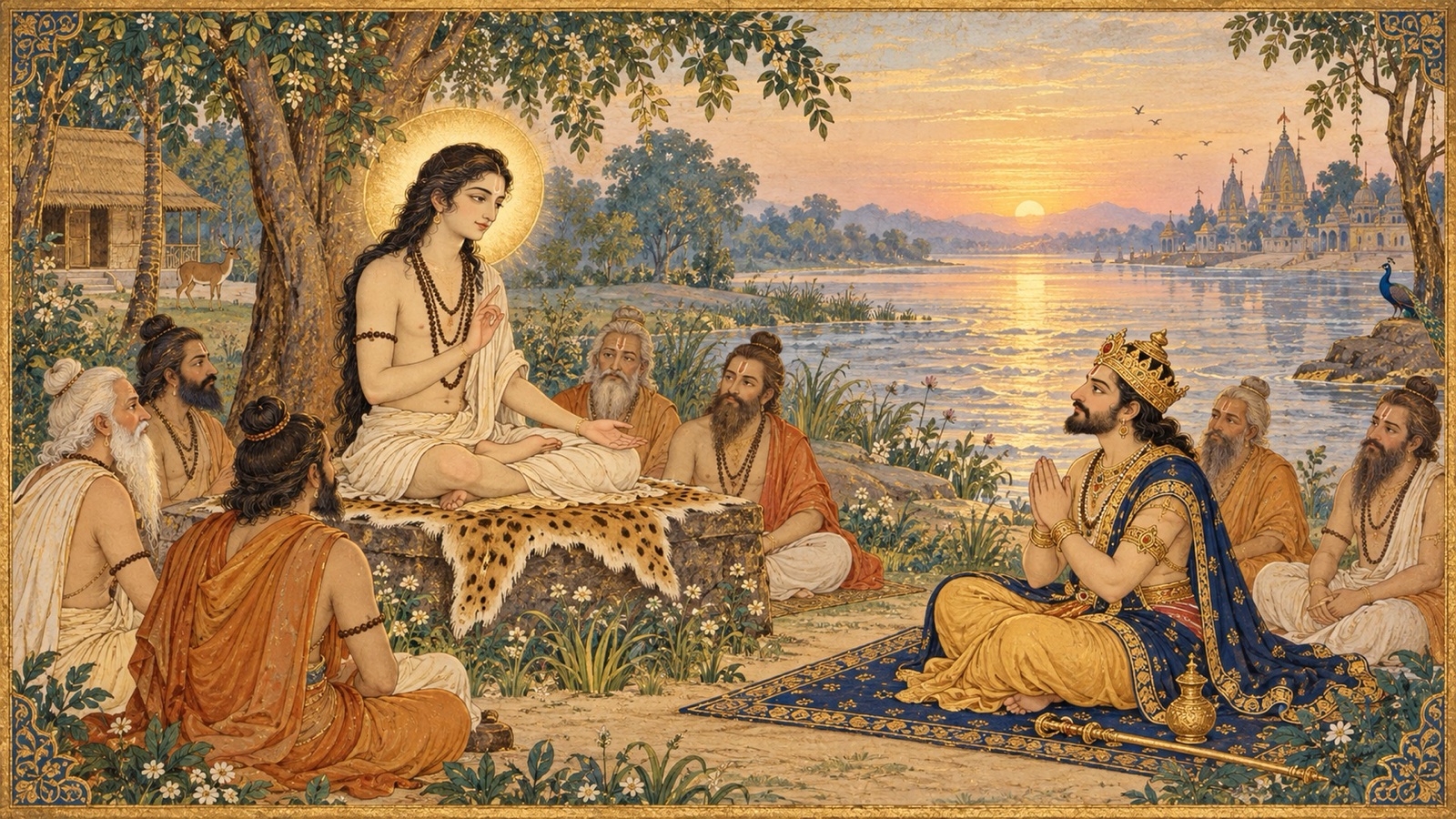
As the hour of death draws near, Sukadeva Gosvami gives King Parikshit his final and most intimate teaching — that the Self is unborn and undying, distinct from the body as fire is distinct from firewood, and that the serpent’s fangs can touch the body but never the soul.
Om Namo Bhagavate Vasudevaya.
Om Namo Bhagavate Vasudevaya.
Om Namo Bhagavate Vasudevaya.
Welcome to Srimad Bhagavatam Wisdom, a devotional journey through the sacred histories and teachings of the Srimad Bhagavat Mahapurana. Having led King Parikshit through the vast rhythm of creation and dissolution, Sukadeva Gosvami now draws close for his last and tenderest counsel. Only seven days remained of the king’s life when this great recitation began; now, with the appointed hour of the serpent Taksaka’s bite almost upon him, the sage speaks not of worlds and ages but of the one thing that truly matters at the moment of death — the deathlessness of the Self. This short fifth chapter of the Twelfth Canto is Sukadeva’s final teaching concerning Brahma, the Absolute. In a handful of luminous verses he lifts the king above every fear, showing him that he was never born and can never die, that the body’s dissolution is only the breaking of a pot that releases the enclosed space back into the boundless sky. It is the calm, clear summit toward which the whole Bhagavatam has been climbing: a soul made fearless before death by the knowledge of its own eternal nature.
Chapter Information
- Scripture: Śrīmad Bhāgavata Mahāpurāṇa
- Canto: 12 (Book Twelve — the final Canto)
- Chapter: 5 (Discourse V)
- Chapter title: Sukadeva’s Final Teaching on the Deathless Self
- Principal speaker: Sri Sukadeva Gosvami, addressing King Parikshit; framed within Suta Gosvami’s narration to the sages of Naimisharanya
- Principal listener: King Parikshit; and the sages of Naimisharanya
- Main setting: The bank of the Ganga, where Parikshit awaits his death, within the forest hermitage of Naimisharanya
- Central subject: The immortality of the Self, the distinction of the soul from the body, the reunion of the liberated soul with Brahma, and freedom from the fear of death
- Principal verse range: Canto 12, Chapter 5, verses 1–13
- Primary edition: Gita Press Śrīmad Bhāgavata Mahāpurāṇa
Give Up the Notion “I Will Die”
Sukadeva opens by recalling the theme that has run through the entire scripture: that in the Bhagavata, again and again, stands celebrated Lord Sri Hari, the Soul of the universe, from whose joy and wrath were born Brahma the creator and Rudra the destroyer. Then he turns directly to the king with a startling command — to abandon the animal-like notion that he is about to die.
त्वं तु राजन् मरिष्येति पशुबुद्धिमिमां जहि । न जात: प्रागभूतोऽद्य देहवत्त्वं न नङ्क्ष्यसि ॥ २ ॥
tvaṁ tu rājan mariṣyeti paśu-buddhim imāṁ jahi na jātaḥ prāg abhūto ’dya deha-vat tvaṁ na naṅkṣyasi
Meaning: But you, O king, give up this brute-like notion, “I shall die.” Unlike the body, which was non-existent before and is born at a certain moment, you were never so born, and therefore you will not perish. (Canto 12, Chapter 5, verse 2)
You were never born as a father, the sage continues, nor will you be reborn as a son or grandson in endless succession, as a tree springs from a seed and a seed again from a tree; for you, the Self, are as distinct from the body as fire is from the firewood it burns. Just as a man in a dream may see his own head cut off — witnessing it, yet remaining the unharmed witness — so one observes the death of the body alone, never of the Self who sees. The Self within, therefore, is truly unborn and undying.
The Pot and the Sky
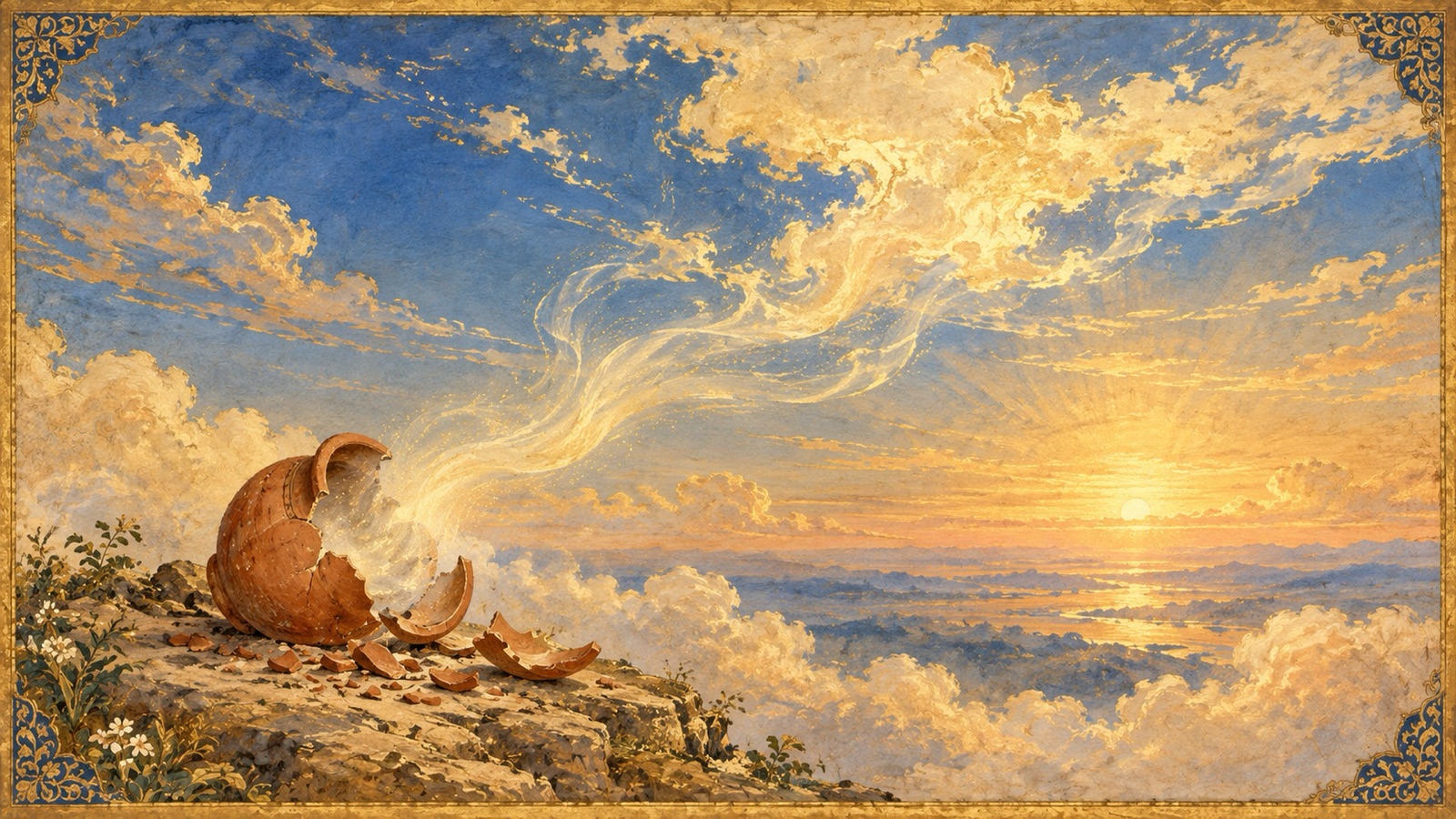
To make this deathlessness vivid, Sukadeva gives one of the most beloved images in all of Vedanta: the earthen pot and the space it encloses. When a pot is broken, the space that seemed shut inside it is simply the same boundless space as before, undiminished and unchanged. So too, when the body at last dissolves, the individual soul is once more one with Brahma.
घटे भिन्ने घटाकाश आकाश: स्याद् यथा पुरा । एवं देहे मृते जीवो ब्रह्म सम्पद्यते पुन: ॥ ५ ॥
ghaṭe bhinne ghaṭākāśa ākāśaḥ syād yathā purā evaṁ dehe mṛte jīvo brahma sampadyate punaḥ
Meaning: As, when a pot is broken, the space within it becomes once more the same open space as before, so, when the body dies, the soul is again united with Brahma. (Canto 12, Chapter 5, verse 5)
Where, then, does bondage come from? The mind alone, Sukadeva explains, fashions bodies, sense-objects, and actions for the soul; it is Maya that creates this mind, and from Maya proceeds the endless transmigration of the Jiva. As a lamp shines only so long as oil, vessel, wick, and fire are joined, so a body appears and ceases through the working of the three modes — sattva, rajas, and tamas — while the wandering from birth to birth is rooted in one single error: mistaking the body for the Self.
The Self, Self-Effulgent Like the Sky
Yet the Self is never touched by this appearing and ceasing. Just as fire does not perish when a lamp goes out, the soul is not destroyed when the body falls. It is self-luminous, beyond both the gross and the subtle body, the support of all, changeless, all-pervading, endless, and beyond compare — like the very sky.
न तत्रात्मा स्वयंज्योतिर्यो व्यक्ताव्यक्तयो: पर: । आकाश इव चाधारो ध्रुवोऽनन्तोपमस्तत: ॥ ८ ॥
na tatrātmā svayaṁ-jyotir yo vyaktāvyaktayoḥ paraḥ ākāśa iva cādhāro dhruvo ’nantopamas tataḥ
Meaning: The Self is self-luminous, beyond the manifest and the unmanifest; it is the support of all, like the sky — constant, endless, and without compare. (Canto 12, Chapter 5, verse 8)

Full of constant thought of Lord Vasudeva, Sukadeva urges the king, investigate in this very way the truth of the Self dwelling within your own body, through your own effort and clear reasoning.
Fearless Before the Serpent
Now the sage speaks to the king’s deepest fear by name. Though a Brahmana’s curse has sent the serpent Taksaka toward him, that serpent will never be able to burn the Self within, even if it should consume the body. Indeed, all the combined agents of death cannot touch the one who has realized that he is the very Death of deaths — the Self that is one with the Lord. Established in that knowledge, Sukadeva tells him, he will pass beyond all fear.
अहं ब्रह्म परं धाम ब्रह्माहं परमं पदम् । एवं समीक्ष्य चात्मानमात्मन्याधाय निष्कले ॥ ११ ॥ दशन्तं तक्षकं पादे लेलिहानं विषाननै: । न द्रक्ष्यसि शरीरं च विश्वं च पृथगात्मन: ॥ १२ ॥
ahaṁ brahma paraṁ dhāma brahmāhaṁ paramaṁ padam evaṁ samīkṣya cātmānam ātmany ādhāya niṣkale daśantaṁ takṣakaṁ pāde lelihānaṁ viṣānanaiḥ na drakṣyasi śarīraṁ ca viśvaṁ ca pṛthag ātmanaḥ
Meaning: “I am Brahma, the supreme abode; Brahma, the highest goal, am I.” Thus beholding the Self and fixing yourself in the undivided Absolute, you will not see the serpent Taksaka biting your foot and licking it with its poison-bearing fangs, nor your body, nor the universe, as anything apart from your own Self. (Canto 12, Chapter 5, verses 11-12)
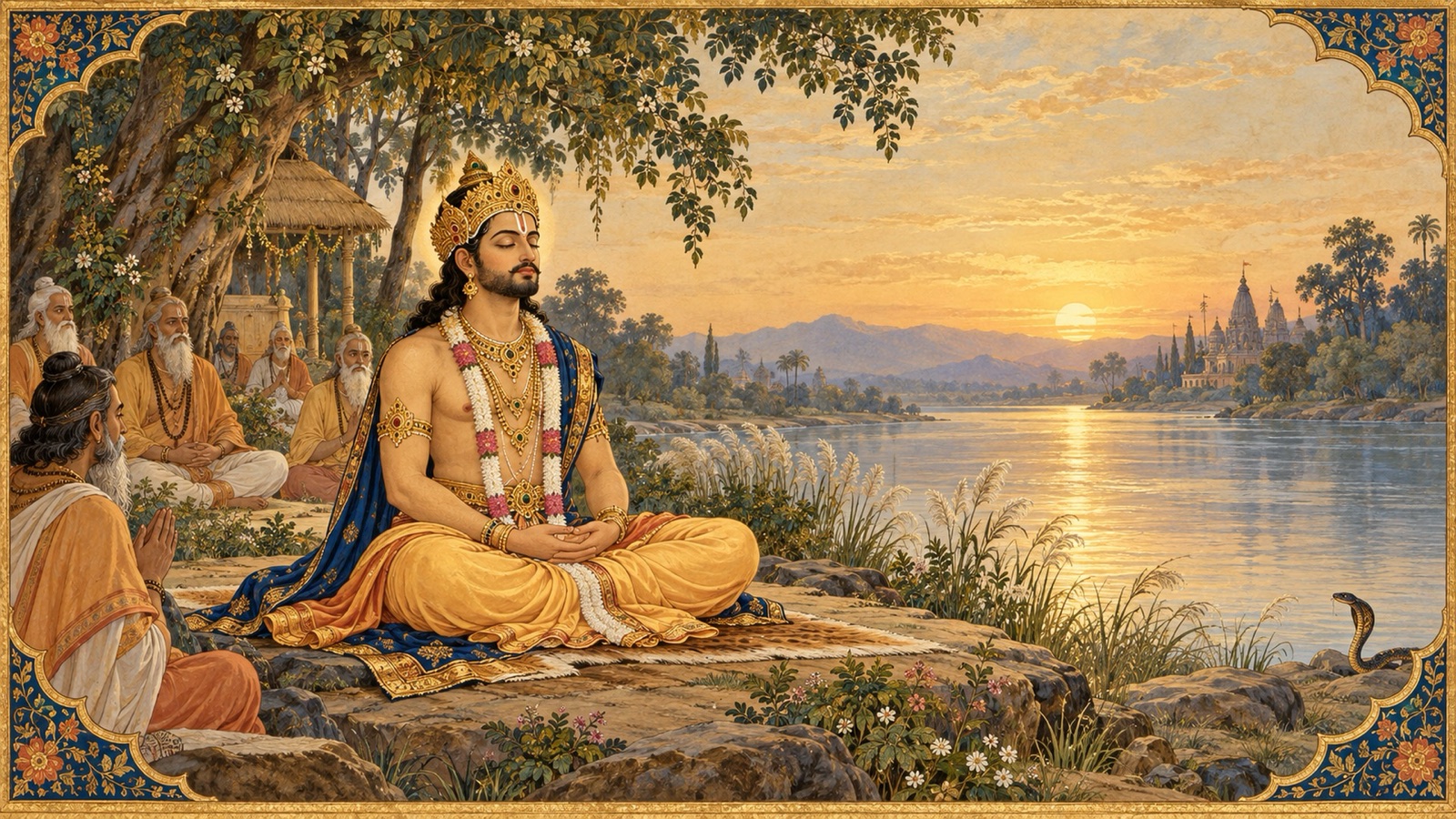
With this, Sukadeva gently closes his instruction: all this, he says, has been narrated in answer to what Parikshit — his very own Self — had asked concerning the pastimes of Lord Hari, the Soul of the universe. “What more,” he asks, “do you desire to hear?” It is the quiet, complete summit of the great dialogue: the teacher has given everything, and the disciple is made ready.
Principal Teachings of This Chapter
1. The Self is unborn and undying. Death belongs to the body alone; the soul, never born, can never perish. To grasp this is to lose the deepest of all fears (verses 2-4).
2. The soul is not the body. As fire differs from firewood and the dreamer from the dream, the witnessing Self is wholly distinct from the body it observes (verses 3-4, 7).
3. Liberation is like a broken pot. At the body’s death the realized soul does not travel anywhere; it is simply revealed to be, and always to have been, one with the boundless Brahma (verse 5).
4. Knowledge of the Self makes us fearless. Fixed in “I am Brahma,” even the poison of Taksaka becomes powerless to disturb the soul that sees nothing as apart from itself (verses 11-12).
A Devotional Reflection
This is the chapter every one of us will one day need. Sukadeva does not comfort the dying king with distractions or postpone the truth; he places death squarely before him and then dissolves its terror with knowledge. What makes the teaching so tender is its timing — spoken not in the abstract calm of a classroom but at the very edge of the serpent’s approach. And notice that the sage does not ask Parikshit to deny the body’s death or pretend the danger away. Taksaka will indeed come; the body will indeed fall. What changes is the king’s identification: he learns to stand as the witnessing, deathless Self, for whom the body’s end is no more than a broken pot returning its space to the sky. For the devotee, this is not cold philosophy but the fruit of a life absorbed in Vasudeva — for it is “full of constant thought of Lord Vasudeva” that the sage tells him to inquire. Love of the Lord and knowledge of the Self here become one, and out of that union is born a fearlessness no death can shake.
A Daily Devotional Practice
Today, sit quietly and gently loosen your grip on the thought “I am this body.” Recall Sukadeva’s image: you are the space, not the pot; the witness, not the passing scene. Bring to mind that the same Self within you is untouched by every fear the body carries. Then, holding the Lord in your heart as Parikshit was taught to do, chant slowly and with attention, “Om Namo Bhagavate Vasudevaya,” a fixed number of times, letting each repetition settle you deeper into the deathless Self that is never apart from Him. In this small practice you rehearse, in peace, the very freedom the chapter offers at the hour of death.
Conclusion
The fifth chapter of the Twelfth Canto is Sukadeva Gosvami’s final and most personal gift to King Parikshit — the knowledge that carries a soul fearlessly through death. In a few radiant verses the sage shows that the Self was never born and can never die, that it is distinct from the body as fire from firewood, and that its release at death is simply the breaking of a pot that frees the enclosed space into the boundless sky. Even the serpent Taksaka, bearing a Brahmana’s curse, can touch only the body, never the deathless soul fixed in the knowledge “I am Brahma.” Spoken at the very brink of the appointed hour, and rooted in constant remembrance of Lord Vasudeva, this teaching is the calm summit of the whole Bhagavatam: love and knowledge joined, and a heart made ready to meet death without a trace of fear.
May the divine wisdom of Srimad Bhagavatam awaken pure devotion within our hearts.
Om Namo Bhagavate Vasudevaya.
Jay Shree Madhav.
References and Attribution
- Primary edition: Gita Press, Śrīmad Bhāgavata Mahāpurāṇa (English, complete), Book Twelve, Discourse 5.
- Series: Srimad Bhagavatam Wisdom · Biswa Sanatan Dharma Seva Trust.
- Presented following the spiritual guidance and recommendation of Pandit Dr. Shri Kashinath Mishra.
This is an original, faithful retelling in the writer’s own words, with brief quoted verses shown in Devanāgarī and transliteration and their meanings given as summaries. It is not a reproduction of any single publisher’s continuous translation or commentary. No affiliation with or endorsement by any publisher is implied.
Jay Shree Madhav