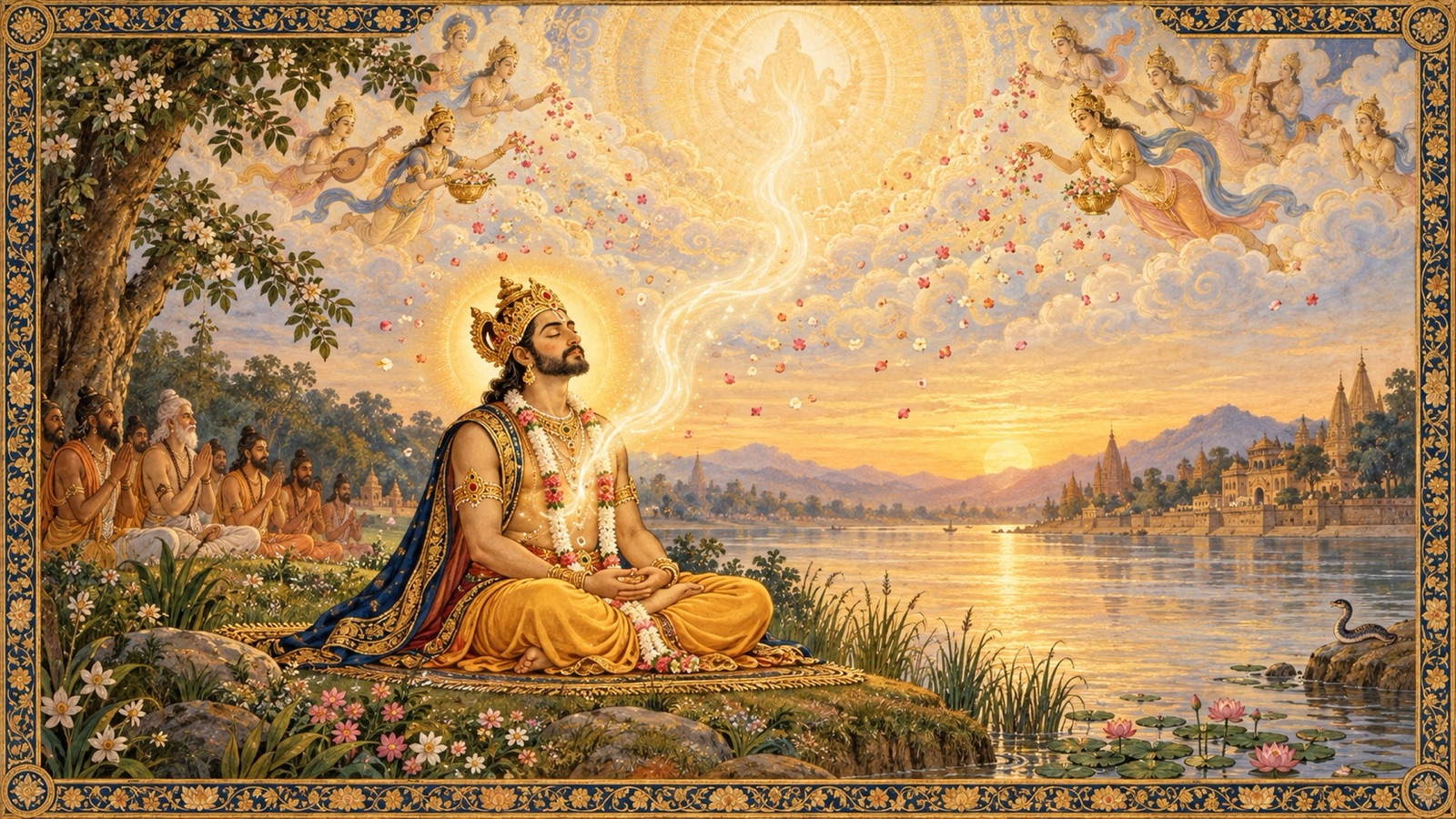
Fearless and free, King Parikshit merges his soul in Brahman even as the serpent’s poison consumes his body; his son Janamejaya’s grief gives way to wisdom, and Suta turns to tell how the one eternal Veda was divided into its many branches.
Om Namo Bhagavate Vasudevaya.
Om Namo Bhagavate Vasudevaya.
Om Namo Bhagavate Vasudevaya.
Welcome to Srimad Bhagavatam Wisdom, a devotional journey through the sacred histories and teachings of the Srimad Bhagavat Mahapurana. In this sixth chapter of the Twelfth Canto the great story that opened the Bhagavatam reaches its serene close: King Parikshit, having heard the whole scripture in seven days, lays down his body without a trace of fear, absorbed in the Absolute. Yet the chapter does not end with his passing. It moves through his son Janamejaya’s fierce grief and the snake-sacrifice it provokes, through the wise counsel of Brihaspati that stills that grief, and into a meditation on the inconceivable Maya of Lord Vishnu. Then, answering a question from the sage Saunaka, Suta Gosvami turns to a new and sacred theme — how the one primeval sound OM, arising in the heart of Brahma, unfolded into the Vedas, and how the sage Vedavyasa divided that one boundless knowledge into the many branches by which it has been preserved. It is a chapter of endings and continuities: one soul returns to its source, and the eternal word passes safely on.
Chapter Information
- Scripture: Śrīmad Bhāgavata Mahāpurāṇa
- Canto: 12 (Book Twelve — the final Canto)
- Chapter: 6 (Discourse VI)
- Chapter title: King Parikshit’s Liberation and the Fourfold Transmission of Vedic Knowledge
- Principal speaker: Suta Gosvami, narrating to the sages of Naimisharanya; within it, the final words of King Parikshit and the counsel of Brihaspati
- Principal listener: The sages of Naimisharanya, led by Saunaka
- Main setting: The forest hermitage of Naimisharanya; and, within the narration, the bank of the Ganga where Parikshit passes away
- Central subject: The fearless passing of King Parikshit, Janamejaya’s snake-sacrifice and Brihaspati’s counsel, the Maya of Lord Vishnu, and the origin of OM and the division of the Vedas
- Principal verse range: Canto 12, Chapter 6, verses 1–80
- Primary edition: Gita Press Śrīmad Bhāgavata Mahāpurāṇa
A Fearless Farewell
Having heard Sukadeva’s final teaching, King Parikshit bows at the sage’s feet with joined palms and speaks words of perfect fulfilment. He has been shown Sri Hari, who has no beginning or end, and the means of attaining Him; his purpose, he says, stands accomplished. He no longer fears the serpent Taksaka or any other agent of death, for he has now entered the fearless, all-blissful state of oneness with Brahma.
भगवंस्तक्षकादिभ्यो मृत्युभ्यो न बिभेम्यहम् । प्रविष्टो ब्रह्म निर्वाणमभयं दर्शितं त्वया ॥ ५ ॥
bhagavaṁs takṣakādibhyo mṛtyubhyo na bibhemy aham praviṣṭo brahma nirvāṇam abhayaṁ darśitaṁ tvayā
Meaning: O lord, I no longer fear Taksaka or any other cause of death, for I have entered that fearless, blissful Brahman which you have shown me. (Canto 12, Chapter 6, verse 5)
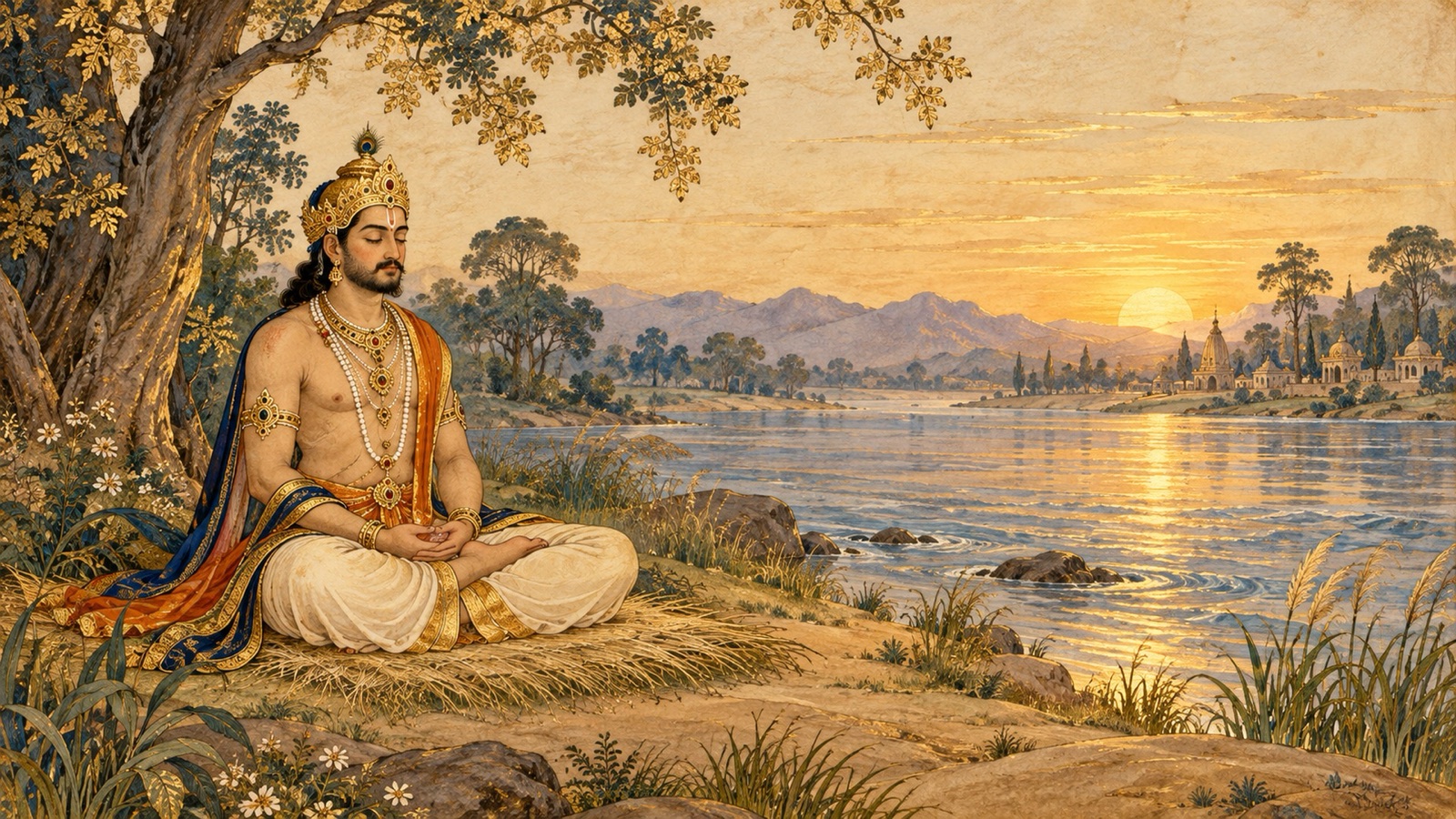
Asking the sage’s leave, Parikshit resolves to control his senses and speech and, fixing his craving-free mind on Lord Vishnu, to give up the body. His ignorance, seed and all, has been burned away by knowledge and realization. Thus honoured and worshipped, Sukadeva takes his leave and departs with the other ascetics. Then the royal sage, uniting his mind with the Self by force of reason, sits upon blades of kusha grass on the bank of the Ganga, facing north, and — free of all doubt, one with Brahman, beyond attachment — contemplates the Supreme, still as the trunk of a tree.
The Serpent and the Ashes
Meanwhile Taksaka, sent by the angry Brahmana boy’s curse, races toward the king. On the way he meets a Brahmana named Kashyapa, learned in counteracting poison; the serpent bribes him with wealth and sends him back, then, taking the disguise of a Brahmana, approaches and bites the king. By the fire of the serpent’s poison the body of the royal sage — already merged in Brahman — is instantly reduced to ashes before the eyes of all. A terrible outcry rises across earth and heaven; gods and demons and men are struck with wonder; celestial drums sound of their own accord, Gandharvas and Apsaras sing, and the gods rain down flowers. So passes King Parikshit — not as a victim of death, but as a liberated soul whose body’s end could not touch the deathless Self.
Janamejaya’s Sacrifice and the Counsel of Brihaspati
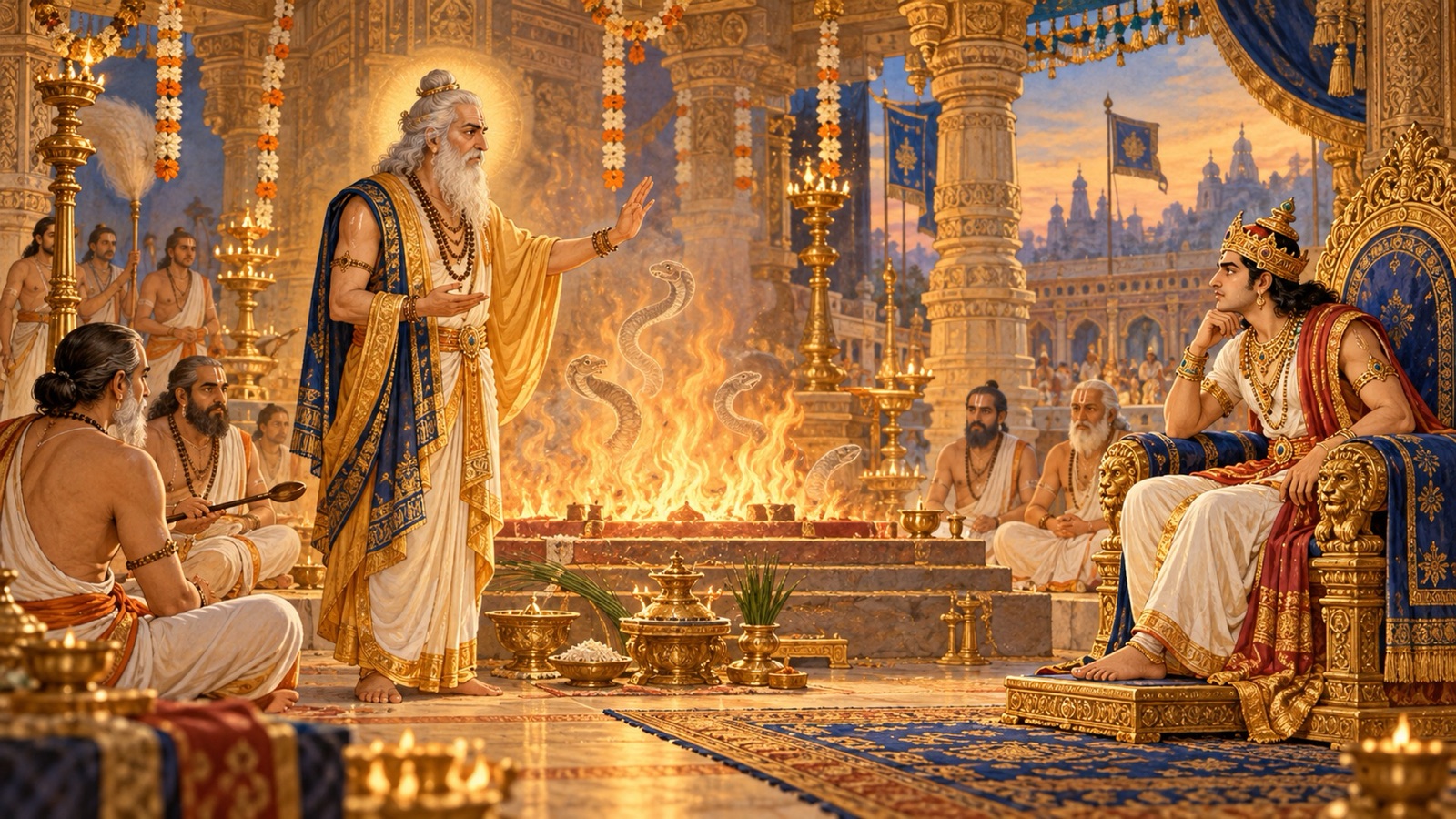
When Janamejaya, Parikshit’s son, hears that his father has been consumed by Taksaka, he is seized by grief and rage. With Brahmana priests he begins a great snake-sacrifice, offering serpents by the manner prescribed into the sacrificial fire. Terrified to see the snakes burning, Taksaka flees to Indra for protection, and Indra shelters him. When the king asks why the vilest of serpents is not falling, the priests explain; and the intelligent Janamejaya answers that Taksaka should then be summoned together with Indra himself. At the Brahmanas’ powerful invocation, Indra is shaken from his abode, car and all.
Then Brihaspati, preceptor of the gods, intervenes with words that turn grief into wisdom. Taksaka, he says, cannot be killed, for he has drunk of nectar and is deathless. And more deeply: the life and death of every being, and its fate in the next world, are determined by its own deeds alone; none can bring another joy or sorrow apart from that one’s own karma.
सर्पचौराग्निविद्युद्भ्य: क्षुत्तृड्व्याध्यादिभिर्नृप । पञ्चत्वमृच्छते जन्तुर्भुङ्क्त आरब्धकर्म तत् ॥ २६ ॥
sarpa-caurāgni-vidyudbhyaḥ kṣut-tṛd-vyādhy-ādibhir nṛpa pañcatvam ṛcchate jantur bhuṅkta ārabdha-karma tat
Meaning: Whether through a serpent, a thief, fire, or lightning, or through hunger, thirst, and disease, O king, when a creature meets its death it is only reaping the fruit of the karma that has begun to bear. (Canto 12, Chapter 6, verse 26)
Let this sacrifice, driven by a malevolent purpose, be stopped, Brihaspati urges, for the serpents burnt in it were innocent. Respecting the sage’s counsel, Janamejaya says “Amen,” desists from the snake-sacrifice, and honours Brihaspati.
The Maya of the Lord
Suta pauses here to reflect on the mystery beneath the whole episode. Such, he says, is the inconceivable Maya of Lord Vishnu, under whose sway living beings — themselves particles of the Lord — fall foul of one another, driven by the passions born of the three modes. Yet this same Maya cannot stand boldly before God when the Self is truly inquired into; in relation to the Lord there is no karma, no reward, no ego, no opposition. Renouncing the waves of “I” and “mine,” the sage should revel in the Self alone. Those alone attain the supreme state of Vishnu who are free of false identification with body and home; one should bear even harsh words, disrespect no one, and enter into hostility with none for the sake of this perishable body. Then Suta offers his own salutation, revealing how he received this very scripture.
नमो भगवते तस्मै कृष्णायाकुण्ठमेधसे । यत्पादाम्बुरुहध्यानात् संहितामध्यगामिमाम् ॥ ३५ ॥
namo bhagavate tasmai kṛṣṇāyākuṇṭha-medhase yat-pādāmburuha-dhyānāt saṁhitām adhyagām imām
Meaning: Salutations to that Lord Sri Krishna of unfailing wisdom, by meditation upon whose lotus feet I learned this great compilation. (Canto 12, Chapter 6, verse 35)
The Birth of OM and the One Veda
Now the sage Saunaka asks a new question: into how many schools were the Vedas divided by Paila and the other great teachers, the disciples of Vedavyasa? Suta answers by tracing the Veda back to its very source. From the cavity of the heart of Brahma, his mind stilled in meditation, there arose a subtle sound — the unstruck inner sound that yogis perceive by closing the ears and focusing the mind, by which they cleanse the impurities of the mind and attain liberation. From that sound emerged the threefold syllable OM, self-manifest and self-luminous, the very emblem of the Supreme Spirit, Brahman.
ततोऽभूत्त्रिवृदोंकारो योऽव्यक्तप्रभव: स्वराट् । यत्तल्लिङ्गं भगवतो ब्रह्मण: परमात्मन: ॥ ३९ ॥
tato ’bhūt tri-vṛd oṁkāro yo ’vyakta-prabhavaḥ sva-rāṭ yat tal liṅgaṁ bhagavato brahmaṇaḥ paramātmanaḥ
Meaning: From that sound arose the threefold syllable OM, unmanifest in origin and self-luminous, which is the emblem of the Supreme Lord, Brahman, the Supreme Self. (Canto 12, Chapter 6, verse 39)
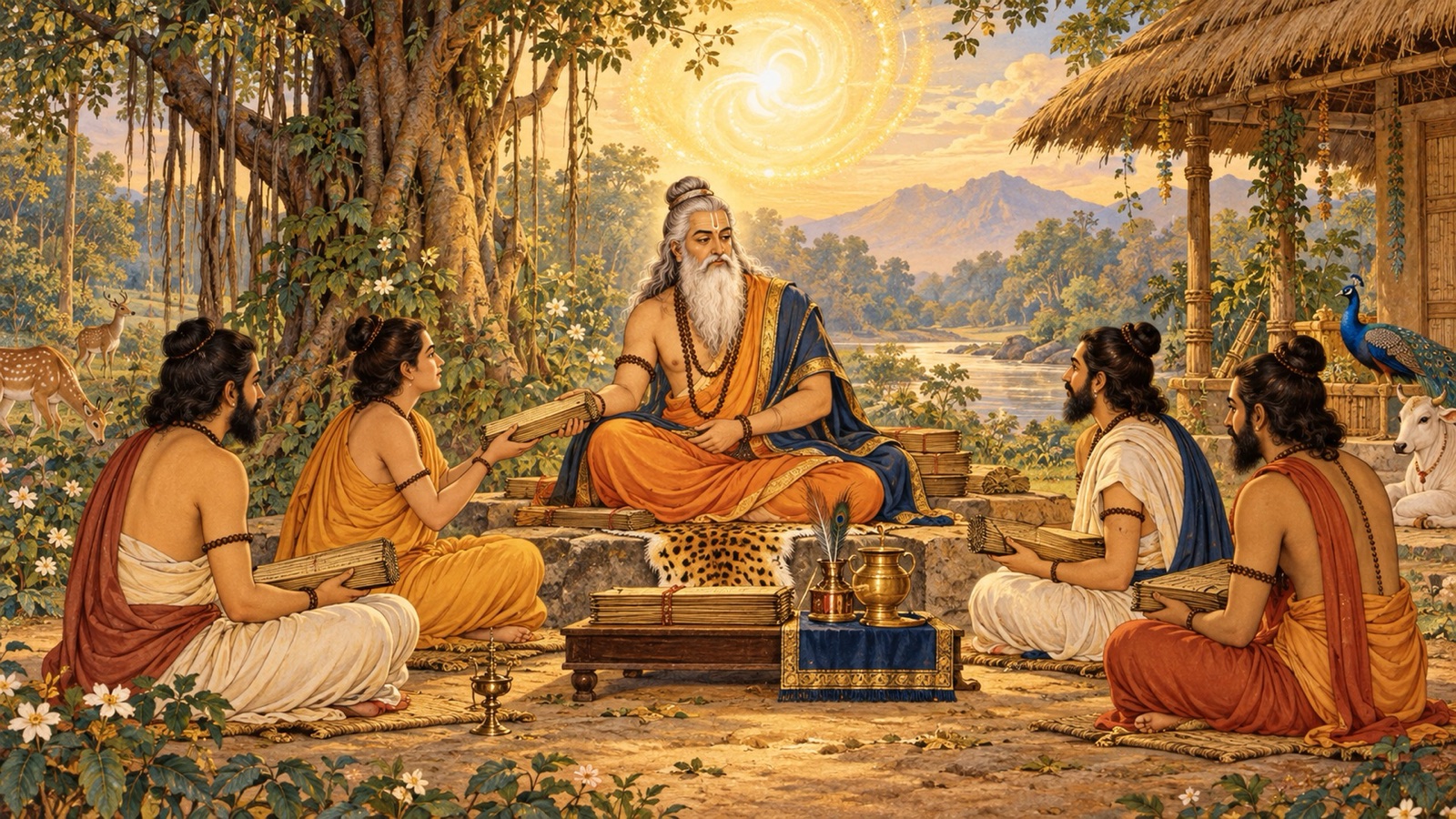
From OM the whole body of Vedic sound expanded, and the compassionate Vedavyasa, seeing the people of the age grown short-lived and weak of memory, divided the single vast Veda into four, that it might be preserved and understood. He entrusted the Rig hymns to his disciple Paila, the Yajur formulas to Vaisampayana, the Sama chants to Jaimini, and the Atharva mantras to Sumantu; and each of these, in turn, divided his portion among his own pupils, branch upon branch, until the one knowledge was safely carried in many hands.
Yajnavalkya and the Sun-God
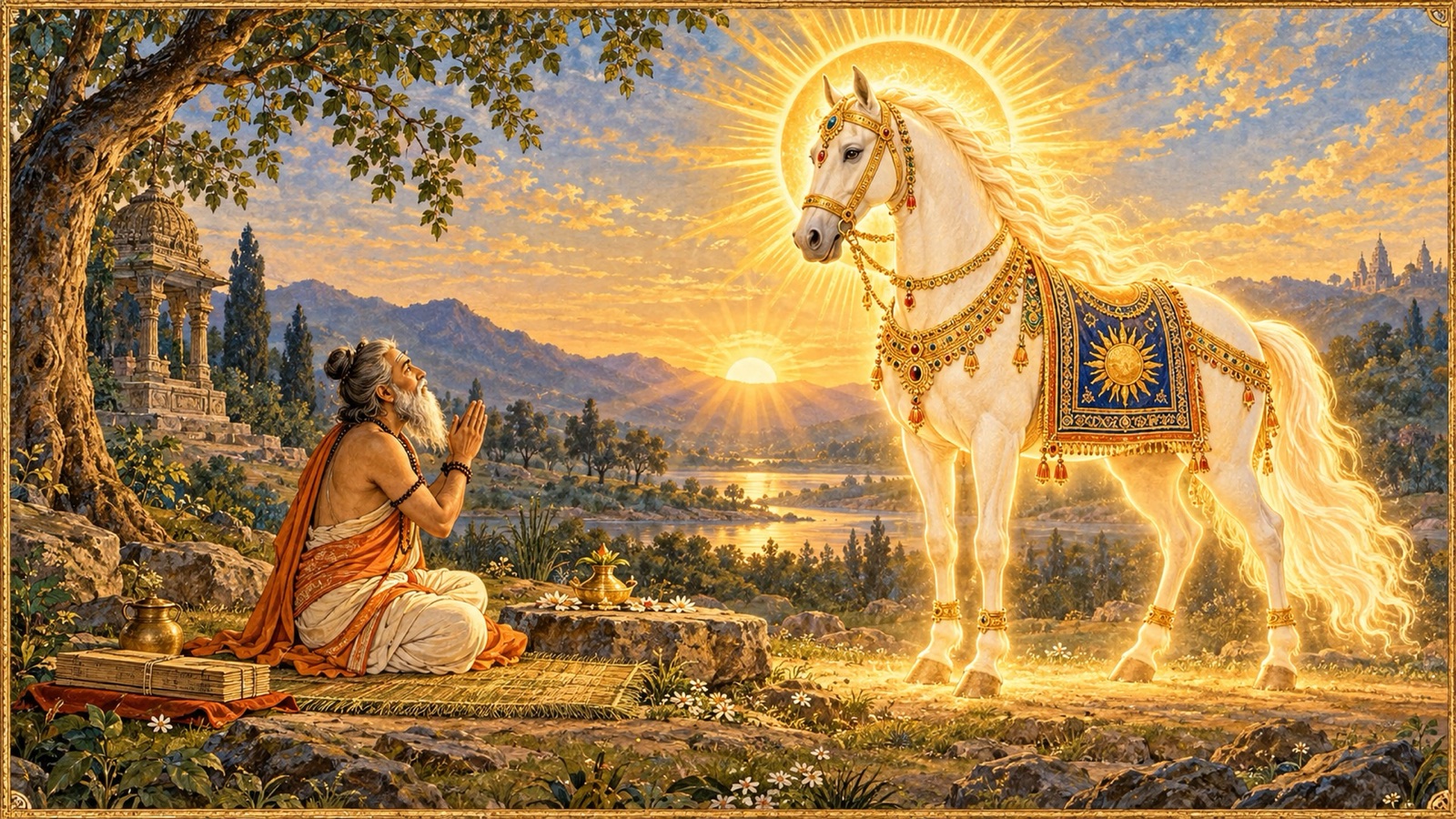
Among these lineages Suta tells one striking story. A disciple of Vaisampayana named Yajnavalkya, after a falling-out with his preceptor, gave back the portion of the Yajurveda he had learned and resolved to obtain Srutis known to no one before. Devoutly he worshipped the Sun-god, master of the Vedas, with a magnificent hymn — a hymn that unfolds the very meaning of the sacred Gayatri, praising the Lord who dwells as the Soul within all beings and revolves outside as the wheel of Time, who rouses the world from the darkness of ignorance and turns it thrice daily to the worship of the Supreme. Propitiated, the Sun-god assumed the form of a horse and taught Yajnavalkya the hitherto-unknown portions of the Yajurveda, from which he compiled the fifteen branches known as the Vajasaneyi. The Sama and Atharva lineages, too, branched out through many devoted sages, so that the entire Veda was preserved for the good of the world.
Principal Teachings of This Chapter
1. A life well-heard makes a fearless death. Having heard the Bhagavatam and realized the Self, Parikshit meets the serpent without fear; the body’s end cannot touch the soul established in Brahman (verses 5-13).
2. Every being reaps its own karma. Brihaspati’s counsel frees Janamejaya from vengeance: no serpent, thief, or fire is the true cause of death — each creature receives only the fruit of its own deeds (verses 24-27).
3. Peace comes from renouncing “I” and “mine.” The supreme state of Vishnu is reached by those free of false identification with body and home, who bear harsh words and hold hostility toward none (verses 32-34).
4. The eternal word is carefully preserved. From OM arising in Brahma’s heart, Vedavyasa divided the one Veda into branches out of compassion for a weak-memoried age — a reminder that sacred knowledge is a trust to be guarded and passed on (verses 37-53).
A Devotional Reflection
This chapter joins two things we might not expect to find together: a death and a library. Parikshit’s passing shows us the fruit of the whole Bhagavatam ripening in a single soul — a man who, having truly heard, can lay down his body as easily as setting down a burden. And then, almost in the same breath, Suta turns to tell how the Veda itself was preserved, branch by branch, in the hands of faithful disciples. The connection is quietly beautiful. What allowed Parikshit to die without fear was knowledge — and knowledge survives only because someone took the trouble to carry it forward. Every time we hear a verse, chant OM, or pass a teaching to another, we stand within that same long lineage that Suta describes, from Brahma’s heart to Vyasa’s pen to the sages of Naimisharanya, and onward to us. Brihaspati’s teaching completes the picture: since each of us reaps only our own karma, there is no enemy to blame and no vengeance to pursue — only the Self to know, and the word to keep.
A Daily Devotional Practice
Today, honour the two gifts of this chapter — a fearless heart and a preserved word. Sit quietly and chant the sacred syllable “Om” a few times slowly, remembering that it arose in the heart of Brahma as the very emblem of the Supreme. Then recall Parikshit’s fearlessness, and gently release one small grievance you are holding against another, remembering Brihaspati’s teaching that every being reaps only its own karma. Finally, chant “Om Namo Bhagavate Vasudevaya,” offering your gratitude to the long line of sages through whom this wisdom has reached you. In this small practice you receive the chapter’s whole inheritance: freedom from fear, freedom from blame, and reverence for the eternal word.
Conclusion
The sixth chapter of the Twelfth Canto brings the Bhagavatam’s opening story to its luminous close and opens a new one. King Parikshit, his purpose fulfilled and his fear dissolved, merges his soul in Brahman even as Taksaka’s poison turns his body to ashes, while the heavens rain flowers upon a liberated soul. His son Janamejaya’s grief kindles a snake-sacrifice, but the wisdom of Brihaspati — that every being reaps only its own karma — quiets it, and Suta reflects on the inconceivable Maya of the Lord. Then, from the sacred sound OM arising in the heart of Brahma, the one eternal Veda unfolds, and Vedavyasa divides it into its branches, entrusting each to a worthy disciple. Death and continuity meet here as one truth: the soul returns to its source, and the sacred word is carried safely on, from Brahma’s heart to the sages of Naimisharanya, and to us who hear it still.
May the divine wisdom of Srimad Bhagavatam awaken pure devotion within our hearts.
Om Namo Bhagavate Vasudevaya.
Jay Shree Madhav.
References and Attribution
- Primary edition: Gita Press, Śrīmad Bhāgavata Mahāpurāṇa (English, complete), Book Twelve, Discourse 6.
- Series: Srimad Bhagavatam Wisdom · Biswa Sanatan Dharma Seva Trust.
- Presented following the spiritual guidance and recommendation of Pandit Dr. Shri Kashinath Mishra.
This is an original, faithful retelling in the writer’s own words, with brief quoted verses shown in Devanāgarī and transliteration and their meanings given as summaries. It is not a reproduction of any single publisher’s continuous translation or commentary. No affiliation with or endorsement by any publisher is implied.
Jay Shree Madhav