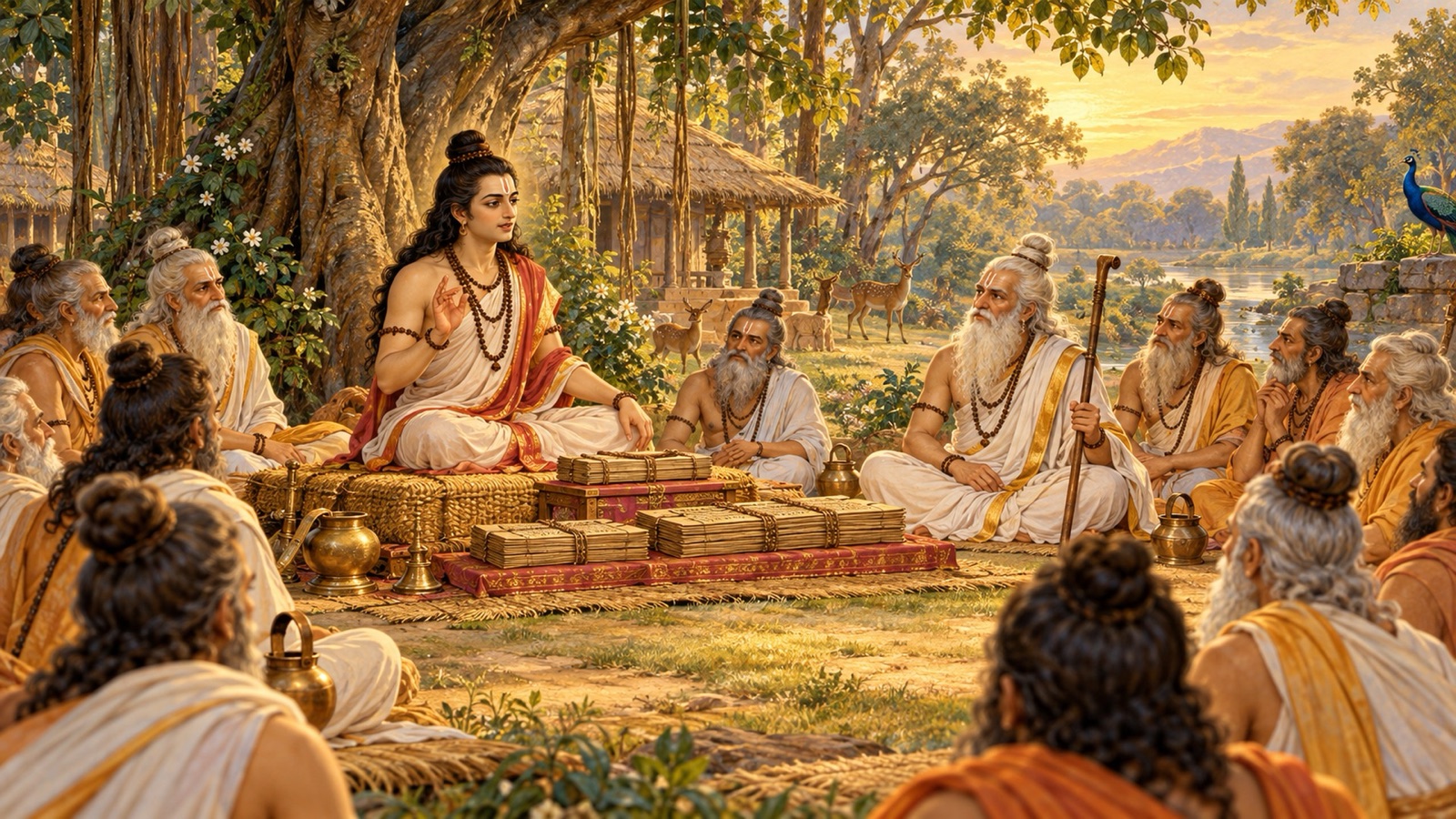
Suta Gosvami continues the lineage of sacred learning: who received the Atharva mantras from teacher to student, which seers kept the Puranic tradition intact across generations, and the defining criteria that separate genuine scripture from mere story — criteria the Bhagavatam itself fulfills most completely.
Om Namo Bhagavate Vasudevaya.
Om Namo Bhagavate Vasudevaya.
Om Namo Bhagavate Vasudevaya.
Welcome to Srimad Bhagavatam Wisdom, a devotional journey through the sacred histories and teachings of the Srimad Bhagavat Mahapurana. Having told how Vedavyasa divided the one Veda into its four great bodies, Suta Gosvami now completes that account with the branches of the Atharva Veda, and then turns to the sacred literature that stands beside the Vedas — the Puranas. This seventh chapter of the Twelfth Canto may look, at first glance, like a catalogue of names; but within it lies a quietly profound teaching about how divine knowledge is preserved and what makes a scripture truly a Purana. Suta names the sages through whom the Atharva mantras and the Puranic collections were carried down, and then lists the ten distinguishing marks by which the wise recognize a genuine Purana. He closes by naming all eighteen of the great Puranas — among them the Bhagavata itself. It is a chapter that shows us the living chain of tradition, and the careful pattern by which the deepest truths were shaped so that every age might receive them.
Chapter Information
- Scripture: Śrīmad Bhāgavata Mahāpurāṇa
- Canto: 12 (Book Twelve — the final Canto)
- Chapter: 7 (Discourse VII)
- Chapter title: Transmission of the Atharva Lineage and the Defining Signs of Scripture
- Principal speaker: Suta Gosvami (Ugrashrava), narrating to the sages of Naimisharanya
- Principal listener: The sages of Naimisharanya, led by Saunaka
- Main setting: The forest hermitage of Naimisharanya
- Central subject: The branches of the Atharva Veda, the sages who preserved the Puranas, the ten characteristics of a Purana, and the names of the eighteen Puranas
- Principal verse range: Canto 12, Chapter 7, verses 1–25
- Primary edition: Gita Press Śrīmad Bhāgavata Mahāpurāṇa
The Branches of the Atharva Veda
Suta resumes his account of how the Veda was carried down. Sumantu, master of the Atharva Veda, taught his collection to his pupil Kabandha, who divided it and taught it to Pathya and Vedadarsha. From Vedadarsha it passed to Shauklayani, Brahmabali, Modosha, and Pippalayani; from Pathya to Kumuda, Shunaka, and Jajali. Through Babhru, Saindhavayana, Savarnya, and others — and through such teachers as Nakshatrakalpa, Shanti, Kashyapa, and Angirasa — the mantras of the Atharva Veda were preserved, branch upon branch. In this patient succession of names lies a beautiful truth: the eternal word survived not by accident but through the devotion of countless sages, each receiving a portion and faithfully handing it on.
The Sages Who Preserved the Puranas
Suta then turns to the Puranas, the sacred histories that stand beside the Vedas. Six great teachers, he says, preserved the Puranas: Trayyaruni, Kashyapa, Savarni, Akritavrana, Vaisampayana, and Harita. Each learned one collection from the mouth of Suta’s own father, Romaharshana, the pupil of Vedavyasa; and Suta himself — Ugrashrava — together with Kashyapa, Savarni, and Akritavrana, learned the original collections from Romaharshana. It is a personal moment in the narration: the very speaker seated before the sages of Naimisharanya is himself a living link in the chain he describes, one who received the Puranas directly from his father, who received them from Vyasa.
The Ten Marks of a Purana
Now Suta unfolds the heart of the chapter: what makes a text a true Purana. Those learned in the Puranas, he says, recognize ten distinguishing features, though some teachers count five, dividing the Puranas into greater and lesser according to whether they treat ten topics or five.
सर्गोऽस्याथ विसर्गश्च वृत्तिरक्षान्तराणि च । वंशो वंशानुचरितं संस्था हेतुरपाश्रय: ॥ ९ ॥ दशभिर्लक्षणैर्युक्तं पुराणं तद्विदो विदु: । केचित् पञ्चविधं ब्रह्मन् महदल्पव्यवस्थया ॥ १० ॥
sargo ’syātha visargaś ca vṛtti-rakṣāntarāṇi ca vaṁśo vaṁśānucaritaṁ saṁsthā hetur apāśrayaḥ daśabhir lakṣaṇair yuktaṁ purāṇaṁ tad-vido viduḥ kecit pañca-vidhaṁ brahman mahad-alpa-vyavasthayā
Meaning: Sarga (creation), Visarga (secondary creation), Vritti (sustenance), Raksha (protection), the Manvantaras, Vamsa (dynasties), Vamsanucarita (their deeds), Samstha (dissolution), Hetu (the cause), and Apashraya (the ultimate shelter) — those who know the Puranas recognize a Purana by these ten marks, though some, O Brahmana, count five, distinguishing the greater from the lesser. (Canto 12, Chapter 7, verses 9-10)
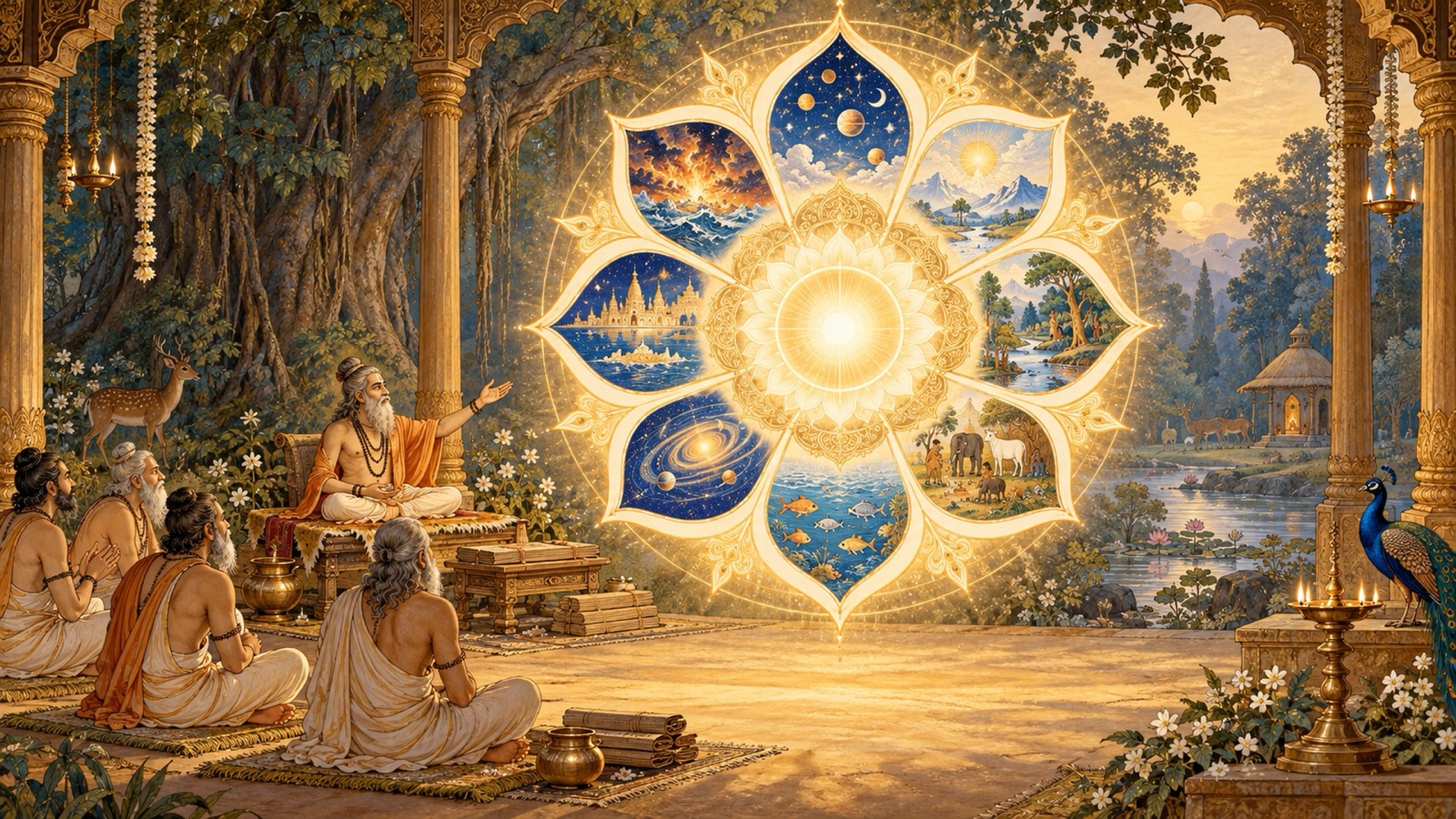
Suta then explains each mark in turn. Sarga is the primary creation — the evolution of cosmic intelligence, ego, the subtle elements, the senses, and their objects from unmanifest Prakriti. Visarga is the secondary creation of mobile and immobile beings, unfolding seed from seed under the latencies of past karma. Vritti is the means of sustenance by which living beings are maintained. Raksha is the protection of the world through the descents of the Lord in every age.
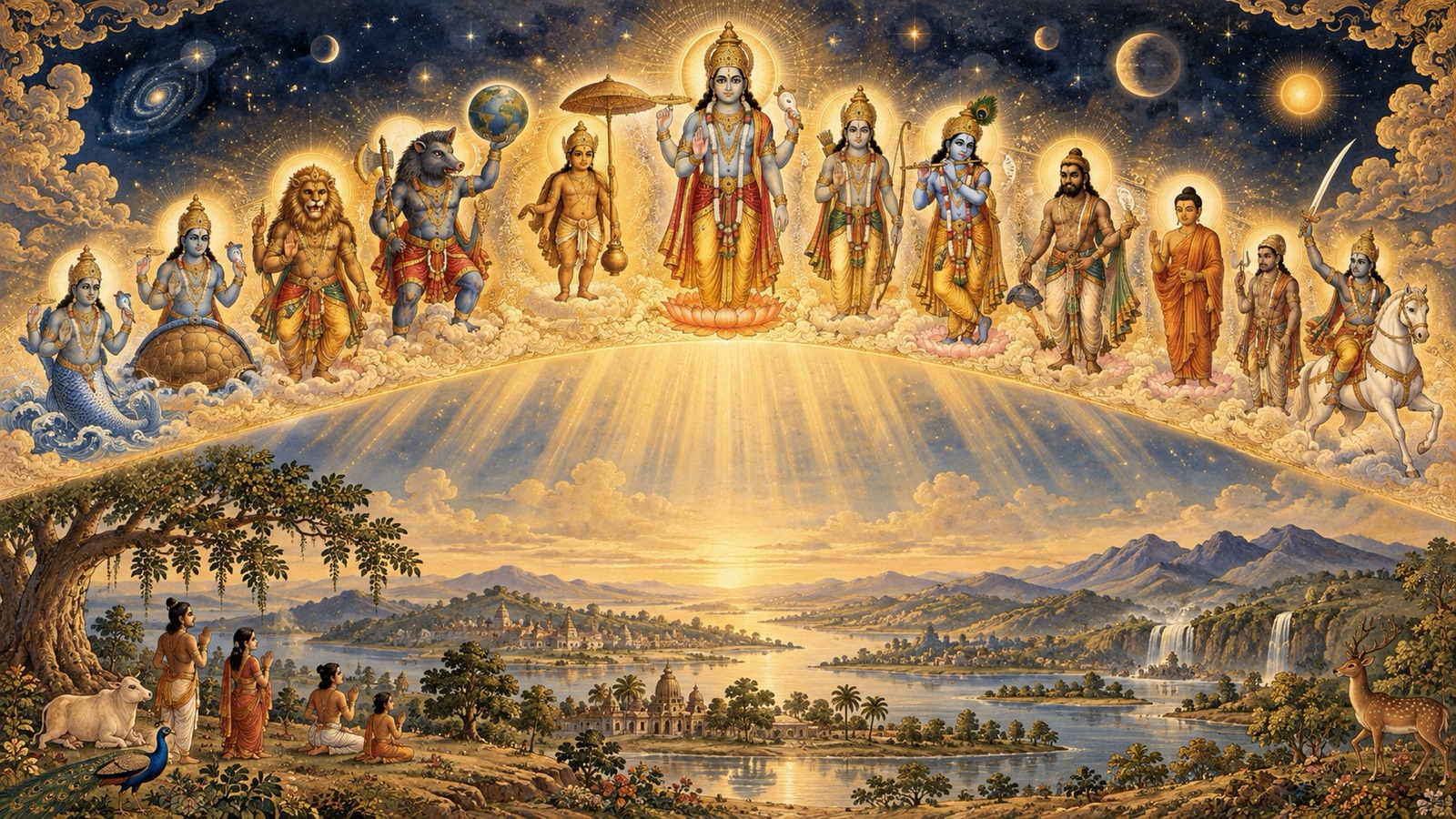
रक्षाच्युतावतारेहा विश्वस्यानु युगे युगे । तिर्यङ्मर्त्यर्षिदेवेषु हन्यन्ते यैस्त्रयीद्विष: ॥ १४ ॥
rakṣācyutāvatārehā viśvasyānu yuge yuge tiryaṅ-martyarṣi-deveṣu hanyante yais trayī-dviṣaḥ
Meaning: Raksha is the protecting activity of the descents of the infallible Lord, who appears age after age among animals, human beings, sages, and gods, and by whom the enemies of the Vedas are destroyed. (Canto 12, Chapter 7, verse 14)
The remaining marks follow. The Manvantaras are the great periods presided over by a Manu, the gods, the Manu’s sons, Indra, the seven Rishis, and a partial descent of the Lord. Vamsa is the line of kings across past, present, and future, and Vamsanucarita the connected account of their deeds. Samstha is the fourfold dissolution — occasional, elemental, constant, and final. Hetu, the cause of creation, is the individual soul, the doer of actions prompted by ignorance. And Apashraya — the deepest of the ten — is Brahman, the Absolute, which pervades every state a soul passes through, from the womb to death, and yet remains ever distinct as their witness and ground. When the mind grows still, whether of its own accord or through concentration, one realizes this Self, transcends the three states of consciousness, and withdraws from worldly striving.
The Eighteen Puranas
Having given the marks, Suta names the great Puranas themselves — eighteen in all, distinguished by these very characteristics.
ब्राह्मं पाद्मं वैष्णवं च शैवं लैङ्गं सगारुडं । नारदीयं भागवतमाग्नेयं स्कान्दसंज्ञितम् ॥ २३ ॥ भविष्यं ब्रह्मवैवर्तं मार्कण्डेयं सवामनम् । वाराहं मात्स्यं कौर्मं च ब्रह्माण्डाख्यमिति त्रिषट् ॥ २४ ॥
brāhmaṁ pādmaṁ vaiṣṇavaṁ ca śaivaṁ laiṅgaṁ sa-gāruḍaṁ nāradīyaṁ bhāgavatam āgneyaṁ skānda-saṁjñitam bhaviṣyaṁ brahma-vaivartaṁ mārkaṇḍeyaṁ sa-vāmanam vārāhaṁ mātsyaṁ kaurmaṁ ca brahmāṇḍākhyam iti tri-ṣaṭ
Meaning: The eighteen Puranas are the Brahma, Padma, Vishnu, Shiva, Linga, Garuda, Narada, Bhagavata, Agni, Skanda, Bhavishya, Brahmavaivarta, Markandeya, Vamana, Varaha, Matsya, Kurma, and Brahmanda. (Canto 12, Chapter 7, verses 23-24)

Thus, Suta says, has been narrated how Vedavyasa, together with his pupils and their pupils in turn, divided and preserved the Vedas and the Puranas, so that the sacred knowledge might endure for the good of the world.
Principal Teachings of This Chapter
1. Sacred knowledge lives through devotion. The long lineages of the Atharva Veda and the Puranas show that the eternal word survives only because faithful souls receive it and hand it on. We are heirs of their care (verses 1-7).
2. A true Purana has ten marks. Creation, sustenance, protection, dissolution, the dynasties, and above all the ultimate shelter, Brahman — these ten features shape a Purana so that it carries both the story of the world and the way beyond it (verses 9-10).
3. The Lord protects in every age. Raksha, the fourth mark, is the Lord’s own descent age after age to guard the righteous — a reminder that divine protection is woven into the very structure of sacred history (verse 14).
4. All roads lead to the ultimate shelter. Apashraya, the tenth mark, is Brahman underlying every state of the soul; a Purana is not mere history but a map pointing to the Self that is our final refuge (verses 19-21).
A Devotional Reflection
It would be easy to pass over a chapter of lineages and definitions as merely technical. But look again, and something tender appears. Every name Suta recites is a person who loved this knowledge enough to carry it — who memorized a portion of the Veda or a Purana and gave it faithfully to a student, so that centuries later it could reach us. When we read the Bhagavatam today, we are the far end of that chain of devotion. And the ten marks reveal how wisely the sages shaped these scriptures: a Purana does not only tell how the world was made, sustained, and dissolved; it always circles back to Apashraya, the ultimate shelter, Brahman — so that no matter which story we enter, we are quietly led toward the Self. The Bhagavata, standing here among the eighteen, is the supreme fulfilment of this pattern, for in it every one of the ten marks is turned, again and again, toward pure devotion to the Lord. To hold this book, then, is to hold the distilled love of a thousand sages.
A Daily Devotional Practice
Today, pause to feel your place in the long chain of devotion this chapter describes. Before you read or hear a verse of scripture, silently thank the unbroken line of sages — from Vedavyasa to Suta to your own teachers — through whom this wisdom has reached you. Then read even a single passage of the Bhagavatam slowly, remembering that its every story is meant to lead you to Apashraya, the ultimate shelter. Close by chanting “Om Namo Bhagavate Vasudevaya” a fixed number of times, offering your gratitude for the sacred word and your resolve to keep it alive in your own heart. In this you become, in your own small way, one more faithful link in the chain.
Conclusion
The seventh chapter of the Twelfth Canto completes the story of how the eternal knowledge was preserved and passed on. Suta Gosvami traces the branches of the Atharva Veda through its many disciples, names the six sages who carried the Puranas — a lineage in which he himself stands — and unfolds the ten marks by which a true Purana is known: from the creation of the universe to Brahman, the ultimate shelter beneath all things. He closes by naming the eighteen great Puranas, among them the Bhagavata itself. Beneath its lists and definitions, the chapter carries a quiet and moving message: that the deepest truths reach us only through the devotion of those who cherished and preserved them, and that every genuine Purana, however vast its subject, is finally a path homeward to the Self.
May the divine wisdom of Srimad Bhagavatam awaken pure devotion within our hearts.
Om Namo Bhagavate Vasudevaya.
Jay Shree Madhav.
References and Attribution
- Primary edition: Gita Press, Śrīmad Bhāgavata Mahāpurāṇa (English, complete), Book Twelve, Discourse 7.
- Series: Srimad Bhagavatam Wisdom · Biswa Sanatan Dharma Seva Trust.
- Presented following the spiritual guidance and recommendation of Pandit Dr. Shri Kashinath Mishra.
This is an original, faithful retelling in the writer’s own words, with brief quoted verses shown in Devanāgarī and transliteration and their meanings given as summaries. It is not a reproduction of any single publisher’s continuous translation or commentary. No affiliation with or endorsement by any publisher is implied.
Jay Shree Madhav