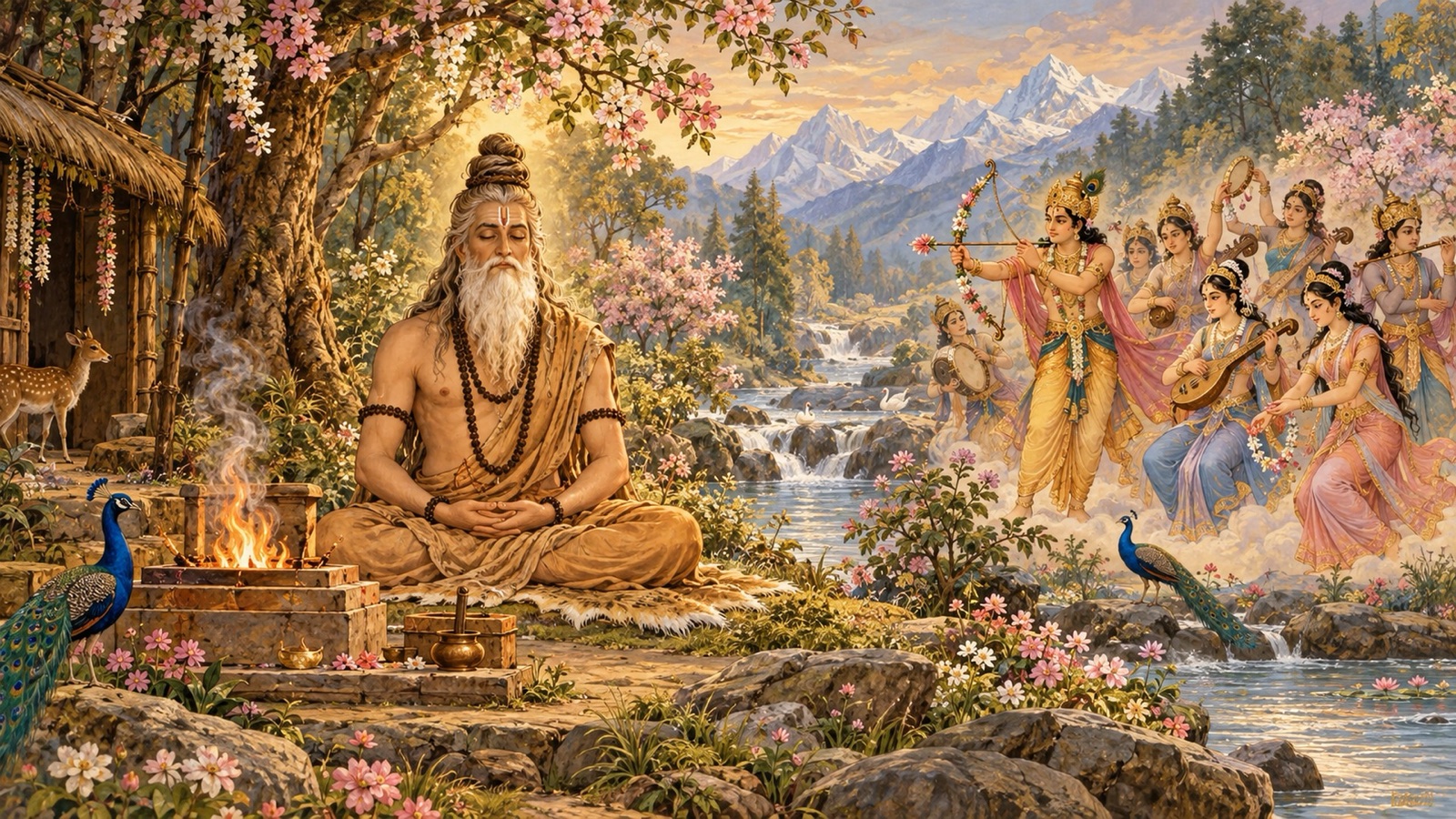
The long-lived sage Markandeya sits unmoved in deep austerity while the god of love, the seasons, and the celestial dancers strive in vain to disturb him — until the Lord Himself appears as Nara and Narayana to bless His devotee.
Om Namo Bhagavate Vasudevaya.
Om Namo Bhagavate Vasudevaya.
Om Namo Bhagavate Vasudevaya.
Welcome to Srimad Bhagavatam Wisdom, a devotional journey through the sacred histories and teachings of the Srimad Bhagavat Mahapurana. Having completed his account of how the Vedas and Puranas were preserved, Suta Gosvami now answers a heartfelt question from the sage Saunaka about one of the most celebrated of all seers — Markandeya, who is spoken of as living even through the dissolution of the world. This eighth chapter opens the beautiful story of that sage: decades spent in unbroken discipline and scriptural study, a destiny that outlasted death itself, Indra’s elaborate but futile campaign to shake his resolve using heavenly allurements, and finally the Lord’s own merciful descent in the dual form of Nara and Narayana. The chapter closes with Markandeya’s tender prayer of refuge — a prayer that will lead, in the chapters to come, to a vision of the Lord’s own inconceivable Maya.
Chapter Information
- Scripture: Śrīmad Bhāgavata Mahāpurāṇa
- Canto: 12 (Book Twelve — the final Canto)
- Chapter: 8 (Discourse VIII)
- Chapter title: The Austerity of Markandeya and His Prayer to Nara-Narayana
- Principal speaker: Suta Gosvami, narrating to the sages of Naimisharanya; within it, the prayer of Markandeya
- Principal listener: The sages of Naimisharanya, led by Saunaka
- Main setting: The forest hermitage of Naimisharanya; and, within the narration, Markandeya’s hermitage on the river Pushpabhadra in the northern Himalayas
- Central subject: Saunaka’s question about the long-lived Markandeya, the sage’s austerity and conquest of death, Indra’s failed test through Kamadeva, and the appearance of Nara-Narayana
- Principal verse range: Canto 12, Chapter 8, verses 1–49
- Primary edition: Gita Press Śrīmad Bhāgavata Mahāpurāṇa
Saunaka’s Question
Saunaka, the foremost of the sages, addresses Suta with affection and reverence: “O Suta, O jewel among speakers, may you live long! You alone can show the way to those wandering in the endless darkness of worldly existence.” He then places his doubt before Suta. People speak of Markandeya, the son of Mrikandu, as a seer of immense age, one who remained alive even at the end of a day of Brahma, when the whole universe was swallowed up in dissolution. Yet, Saunaka observes, this Markandeya was born in the present Kalpa and in Saunaka’s own line, and no universal dissolution has taken place within it. It is further said that, drifting alone upon a single sheet of cosmic water, he beheld the Supreme Person lying as a wondrous infant upon a banyan leaf. “This is a great matter of doubt to us,” Saunaka says; “resolve it, O great Yogi, honoured as you are even for your knowledge of the Puranas.”
The Austerity that Conquered Death
Suta replies that this very inquiry is meant to dispel a widespread misapprehension, and that answering it will require telling the sanctifying story of Sri Narayana. He then unfolds Markandeya’s life. Having received the sacred thread from his father and studied the Vedas in the righteous way, Markandeya became rich in asceticism and knowledge. Observing lifelong celibacy, free from passions, he wore matted locks, the bark of trees, and a girdle of munja grass, and carried a staff, a water-pot, a black-buck skin, and a rosary of rudraksha beads. Morning and evening he worshipped Sri Hari through the sacred fire, the sun, his preceptor, and the Brahmanas, and by contemplating the Lord within himself.
प्राप्तद्विजातिसंस्कारो मार्कण्डेय: पितु: क्रमात् । छन्दांस्यधीत्य धर्मेण तप:स्वाध्यायसंयुत: ॥ ७ ॥ बृहद्व्रतधर: शान्तो जटिलो वल्कलाम्बर: । बिभ्रत् कमण्डलुं दण्डमुपवीतं समेखलम् ॥ ८ ॥ कृष्णाजिनं साक्षसूत्रं कुशांश्च नियमर्द्धये । अग्न्यर्कगुरुविप्रात्मस्वर्चयन् सन्ध्ययोर्हरिम् ॥ ९ ॥ सायं प्रात: स गुरवे भैक्ष्यमाहृत्य वाग्यत: । बुभुजे गुर्वनुज्ञात: सकृन्नो चेदुपोषित: ॥ १० ॥ एवं तप:स्वाध्यायपरो वर्षाणामयुतायुतम् । आराधयन् हृषीकेशं जिग्ये मृत्युं सुदुर्जयम् ॥ ११ ॥
prāpta-dvijāti-saṁskāro mārkaṇḍeyaḥ pituḥ kramāt chandāṁsy adhītya dharmeṇa tapaḥ-svādhyāya-saṁyutaḥ bṛhad-vrata-dharaḥ śānto jaṭilo valkalāmbaraḥ bibhrat kamaṇḍaluṁ daṇḍam upavītaṁ sa-mekhalam kṛṣṇājinaṁ sākṣa-sūtraṁ kuśāṁś ca niyamarddhaye agny-arka-guru-viprātmasv arcayan sandhyayor harim sāyaṁ prātaḥ sa gurave bhaikṣyam āhṛtya vāg-yataḥ bubhuje gurv-anujñātaḥ sakṛn no ced upoṣitaḥ evaṁ tapaḥ-svādhyāya-paro varṣāṇām ayutāyutam ārādhayan hṛṣīkeśaṁ jigye mṛtyuṁ su-durjayam
Meaning: Having in due course received the rites of the twice-born from his father, Markandeya studied the Vedas righteously and grew rich in austerity and study. Observing the great vow of celibacy, tranquil, wearing matted locks and bark garments, bearing a water-pot, staff, sacred thread and girdle, a black-buck skin, a rosary and kusha grass for the perfection of his vows, he worshipped Sri Hari at dawn and dusk through the fire, the sun, the preceptor, the Brahmanas, and the Self. Bringing alms morning and evening for his teacher, he ate only when permitted, and otherwise fasted; and thus, devoted to austerity and study, worshipping the Lord of the senses for ten thousand times ten thousand years, he conquered death, which is most difficult to conquer. (Canto 12, Chapter 8, verses 7-11)
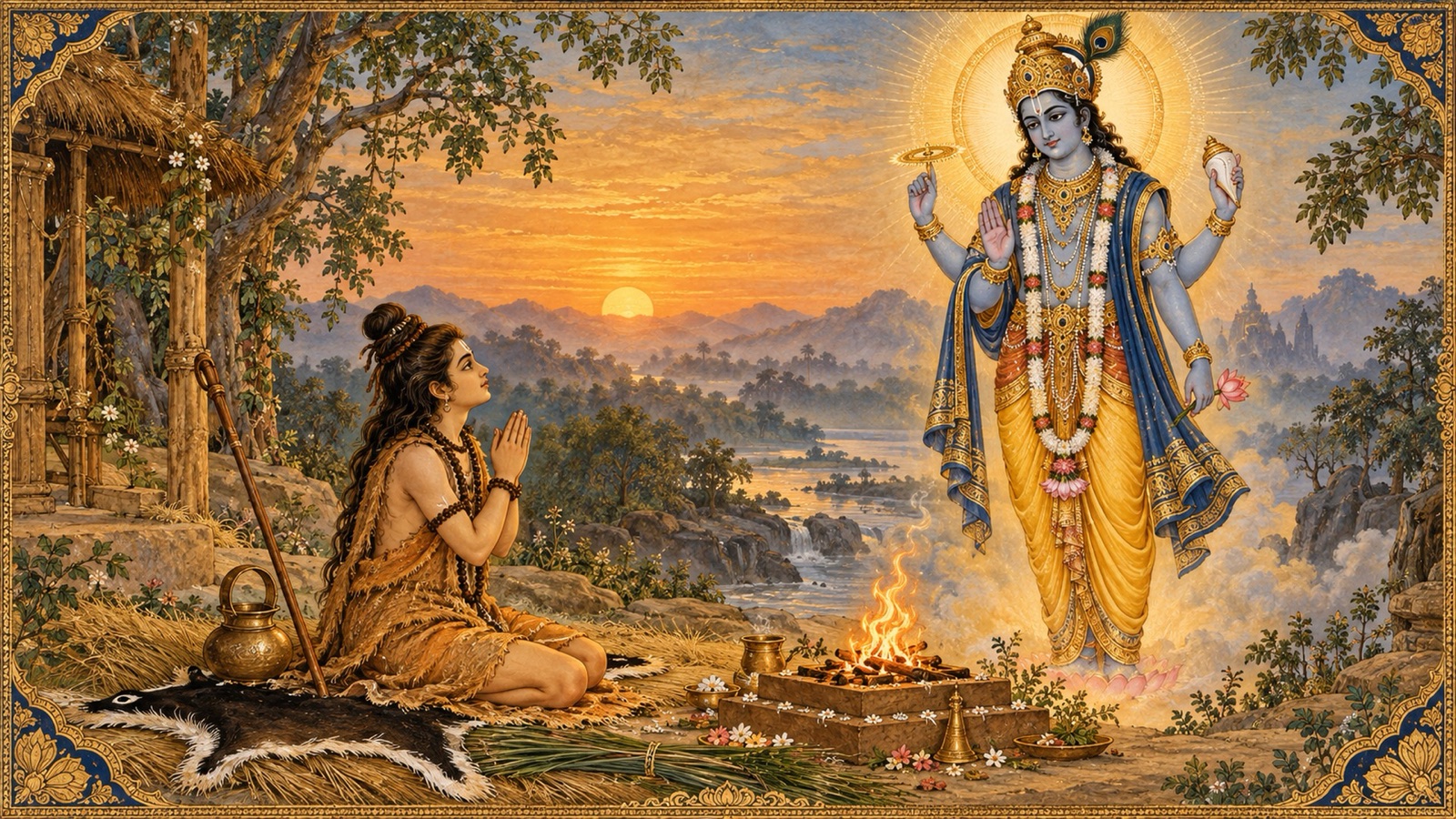
Brahma, Lord Shiva, Bhrigu, Daksha, and the other sons of Brahma — and men, gods, and manes alike — were struck with wonder at this extraordinary achievement. Absorbed in meditation on Sri Hari, with every inner hindrance destroyed, the sage passed through a period covering six Manvantaras in unbroken contemplation.
Indra’s Test through the God of Love
Coming to know of this, and alarmed at the magnitude of the sage’s askesis, Indra grew fearful for his throne and resolved to interrupt the penance. He dispatched to the sage’s hermitage the Gandharvas and Apsaras, Kamadeva the god of love, the deity of the vernal season, the fragrant south wind, and even Greed and Pride. They came to Markandeya’s beautiful hermitage on the northern slopes of the Himalayas, where the river Pushpabhadra flows past the rock named Chitra — a hallowed place adorned with sacred trees and pools, humming with intoxicated bees and joyous with the songs of cuckoos and the dance of peacocks.
Spring appeared with its moonlit evenings and blossoming creepers; the god of love came with bow and arrows, leading troops of celestial musicians and dancers. They found the sage seated near his sacred fire with closed eyes, formidable as fire in human form. The damsels danced and the singers sang; Kamadeva set his five-tipped arrow to his bow; and the Apsara Punjikasthali sported before him until the breeze carried away her garment. But taking the sage as already won, Kamadeva loosed his shaft — and, like the effort of an unlucky man, all his striving proved utterly futile against the sage. Scorched by Markandeya’s glory, they withdrew like children who flee after rousing a serpent. Though so assailed, the great sage did not fall prey to egotism — which, Suta notes, is no matter for wonder in the case of exalted souls.
The Appearance of Nara and Narayana
To shower His grace upon the sage who was thus absorbed through austerity, study, and self-control, Lord Sri Hari appeared before him in the twin forms of the divine sages Nara and Narayana.
तस्यैवं युञ्जतश्चित्तं तप:स्वाध्यायसंयमै: । अनुग्रहायाविरासीन्नरनारायणो हरि: ॥ ३२ ॥
tasyaivaṁ yuñjataś cittaṁ tapaḥ-svādhyāya-saṁyamaiḥ anugrahāyāvirāsīn nara-nārāyaṇo hariḥ
Meaning: As Markandeya thus absorbed his mind through austerity, study, and self-control, Lord Hari, to bestow His grace, appeared before him in the form of Nara and Narayana. (Canto 12, Chapter 8, verse 32)
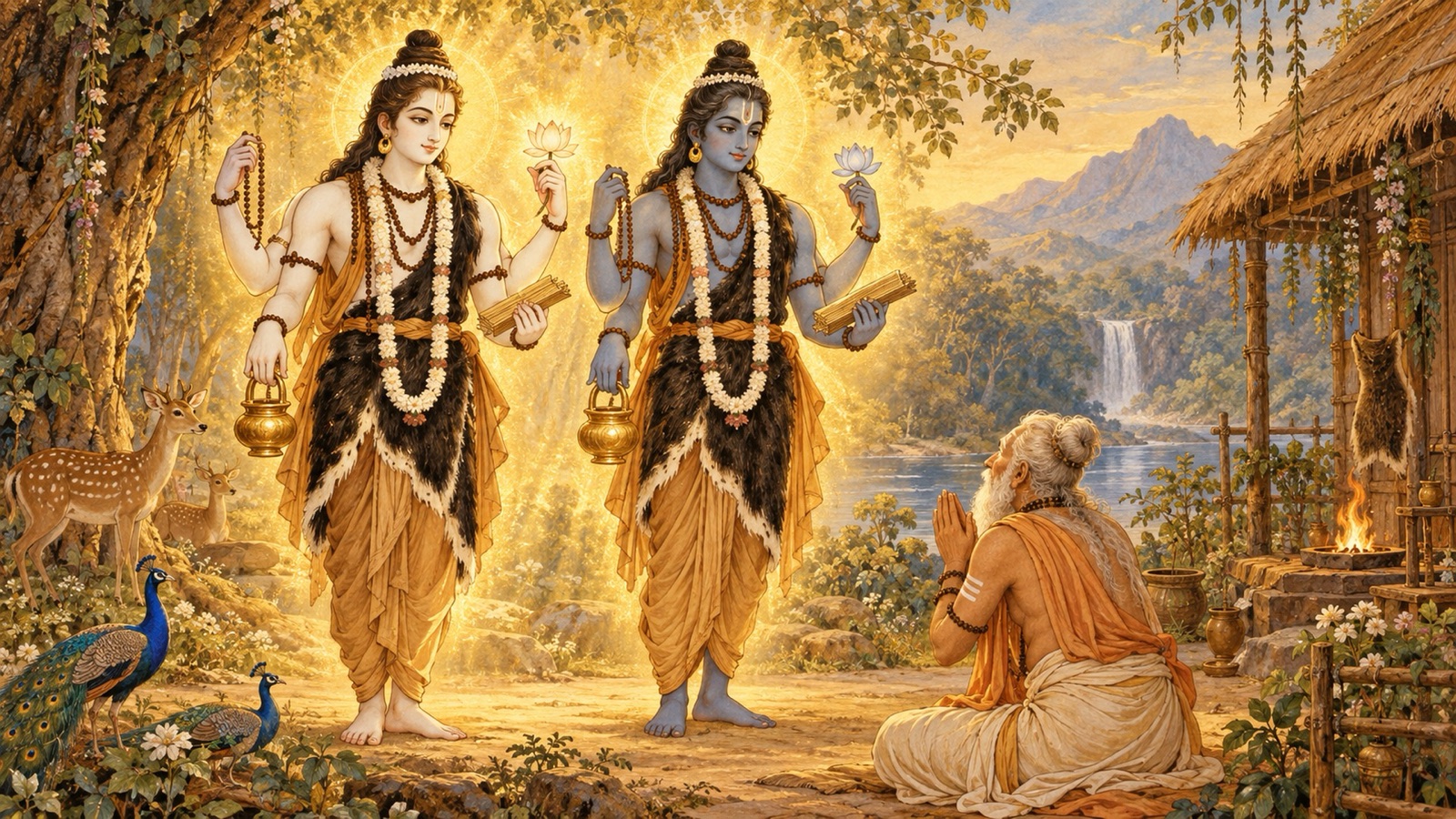
The two Lords, adored even by the chief of the gods, were fair and dark-complexioned, with eyes like fresh lotuses, four arms each, clad in black-buck skin and bark, wearing rings of kusha grass and the threefold sacred thread, and carrying a water-pot, staff, and the ascetic’s grass. Tall, golden as lightning, they looked like two embodiments of austerity itself. Markandeya rose, fell flat like a log in reverence, and, his body thrilling with joy, hair standing on end and eyes brimming with tears, could scarcely look upon them. With joined palms he greeted them, offered them a seat, washed their feet, and worshipped them with sandal-paste, incense, and garlands.
Markandeya’s Prayer of Refuge
Bowing at their feet, Markandeya prayed. How, he asks, can he possibly extol the Lord, by whose impulse alone the vital air, speech, mind, and senses of every being — even of Brahma and Shiva — function, and who yet behaves as the true friend of the soul of those who worship Him? These twin forms of Nara and Narayana, he says, are revealed for the well-being and liberation of the three worlds. He declares that impurities of action, the three gunas, and Time itself can never contaminate one who takes refuge at the Lord’s feet — those very feet that the wisest sages extol, worship, and meditate upon. And he confesses that he knows no other safe retreat.
नान्यं तवाङ्घ्र्युपनयादपवर्गमूर्ते: क्षेमं जनस्य परितोभिय ईश विद्म: । ब्रह्मा बिभेत्यलमतो द्विपरार्धधिष्ण्य: कालस्य ते किमुत तत्कृतभौतिकानाम् ॥ ४३ ॥
nānyaṁ tavāṅghry-upanayād apavarga-mūrteḥ kṣemaṁ janasya parito-bhiya īśa vidmaḥ brahmā bibhety alam ato dvi-parārdha-dhiṣṇyaḥ kālasya te kim uta tat-kṛta-bhautikānām
Meaning: O Lord, embodiment of liberation, for people beset with fear on every side we know no safe refuge other than being brought to Your feet; for even Brahma, whose reign lasts two parardhas, greatly fears Your Time-Spirit — what, then, of the created beings he has made? (Canto 12, Chapter 8, verse 43)
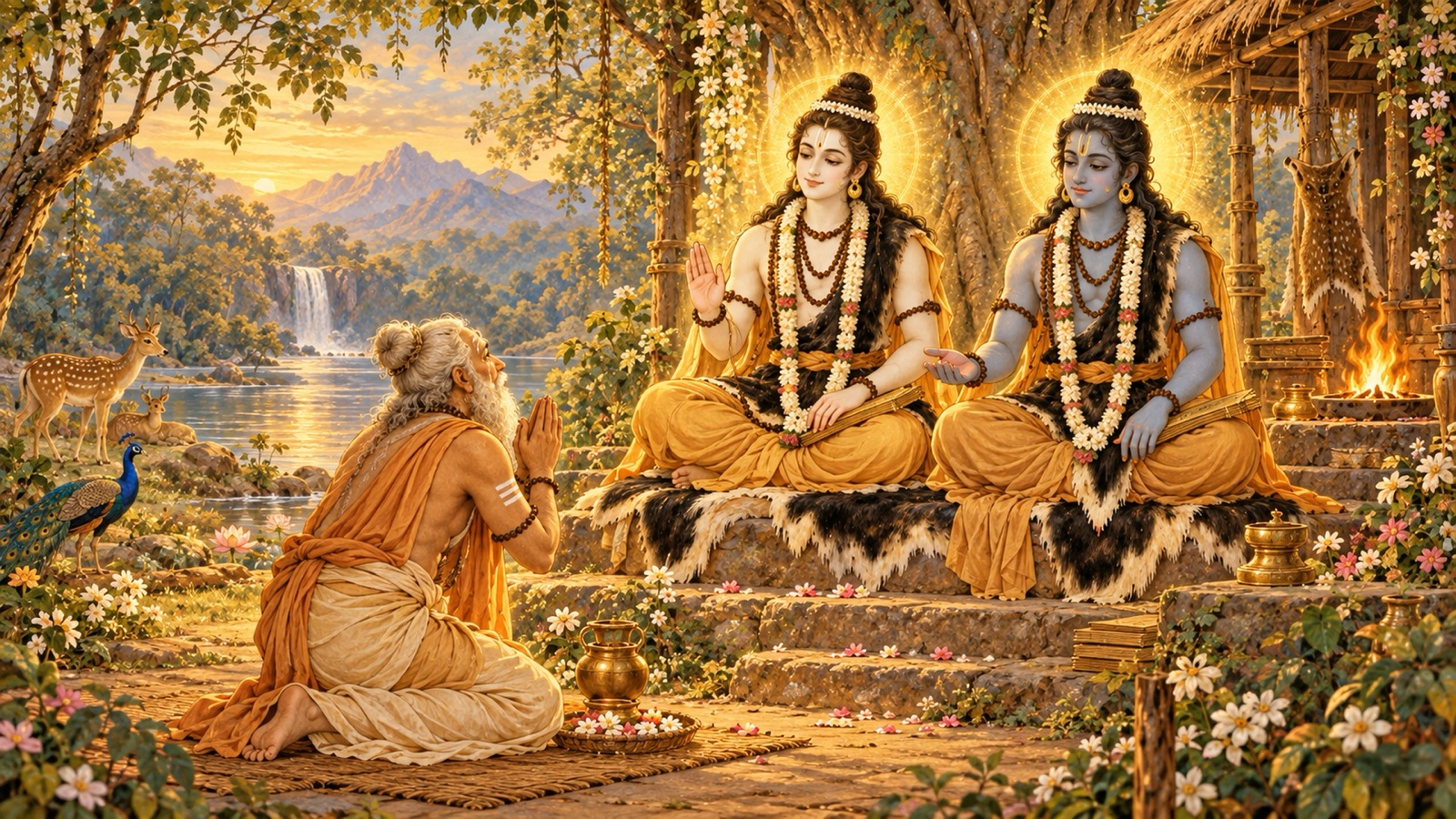
Turning away from all attachment to the body and its concerns, Markandeya takes refuge at the feet of the Supreme. He observes that although the Lord wields the three gunas — sattva, rajas, and tamas — for His cosmic pastimes, it is His sattvika form, so dear to His devotees, that leads to everlasting peace. He therefore bows again and again to the Lord who appears as Nara and Narayana, the Inner Controller and Preceptor of the universe, whose true nature is glimpsed only through the Veda He Himself reveals.
Principal Teachings of This Chapter
1. Austerity aimed at the Lord conquers even death. Markandeya’s victory over death came not from mere endurance but from unbroken devotion to Sri Hari through fire, sun, teacher, and Self (verses 7-11).
2. Temptation cannot touch a soul anchored in God. The god of love and all his enchantments failed against a sage absorbed in the Lord — and, remarkably, the sage did not even fall into pride at his own steadfastness (verses 16-30).
3. The Lord reveals Himself to grace His devotee. Nara and Narayana appear not because Markandeya demanded a boon, but as an act of pure grace toward one absorbed in Him (verse 32).
4. There is no other refuge from fear. Even Brahma fears the Time-Spirit; the only shelter for beings beset with fear on all sides is the Lord’s feet (verse 43).
A Devotional Reflection
There is something deeply reassuring in Markandeya’s story. Here is a soul who did not conquer death by clever means or by escaping the world, but simply by loving God so completely, and for so long, that death lost its grip on him. And when the great test came — not of hardship, but of pleasure, in the form of the god of love and his dazzling company — it was his absorption in the Lord, not any grim self-suppression, that carried him through untouched. Most moving of all is what did not happen afterward: he did not congratulate himself. The Bhagavatam gently notes that great souls simply do not fall into that trap. And then comes the tender reversal of the whole chapter: the Lord, unasked, appears — because the natural response of the Divine to a heart wholly turned toward Him is to draw near. Markandeya’s prayer teaches us where true safety lies. Not in health, wealth, or even long life, but in being “brought to Your feet.” When even Brahma trembles before Time, the small soul that has taken shelter in the Lord has nothing left to fear.
A Daily Devotional Practice
Today, take one small teaching from Markandeya into your day. At dawn or at dusk — the sacred junctions the sage honoured — pause for a few quiet minutes and offer a simple worship of the Lord: light a lamp or a stick of incense, or simply fold your hands, and remember Sri Hari present in the light of the sun, in your teachers, and within your own heart. Then, recalling that even Brahma fears Time while the devotee at the Lord’s feet does not, gently place one worry you are carrying at those feet and leave it there. Close by chanting “Om Namo Bhagavate Vasudevaya” a fixed number of times. In this small daily turning toward God lies the same seed that, in Markandeya, grew into a devotion that death itself could not overcome.
Conclusion
The eighth chapter of the Twelfth Canto opens the luminous story of the sage Markandeya. In answer to Saunaka’s question about the seer said to live through the dissolution of the world, Suta tells how Markandeya, through lifelong celibacy, study, and worship of Sri Hari, conquered death itself; how Indra’s attempt to break his penance through the god of love and his celestial retinue failed utterly against a soul absorbed in God; and how the Lord, out of pure grace, appeared before him as Nara and Narayana. The chapter closes with the sage’s prayer of refuge — the recognition that when even Brahma fears the Time-Spirit, the only true shelter is at the Lord’s feet. It is a story that quietly redraws our idea of strength: the strongest soul is not the one who resists the most, but the one who has most completely taken refuge in God.
May the divine wisdom of Srimad Bhagavatam awaken pure devotion within our hearts.
Om Namo Bhagavate Vasudevaya.
Jay Shree Madhav.
References and Attribution
- Primary edition: Gita Press, Śrīmad Bhāgavata Mahāpurāṇa (English, complete), Book Twelve, Discourse 8.
- Series: Srimad Bhagavatam Wisdom · Biswa Sanatan Dharma Seva Trust.
- Presented following the spiritual guidance and recommendation of Pandit Dr. Shri Kashinath Mishra.
This is an original, faithful retelling in the writer’s own words, with brief quoted verses shown in Devanāgarī and transliteration and their meanings given as summaries. It is not a reproduction of any single publisher’s continuous translation or commentary. No affiliation with or endorsement by any publisher is implied.
Jay Shree Madhav