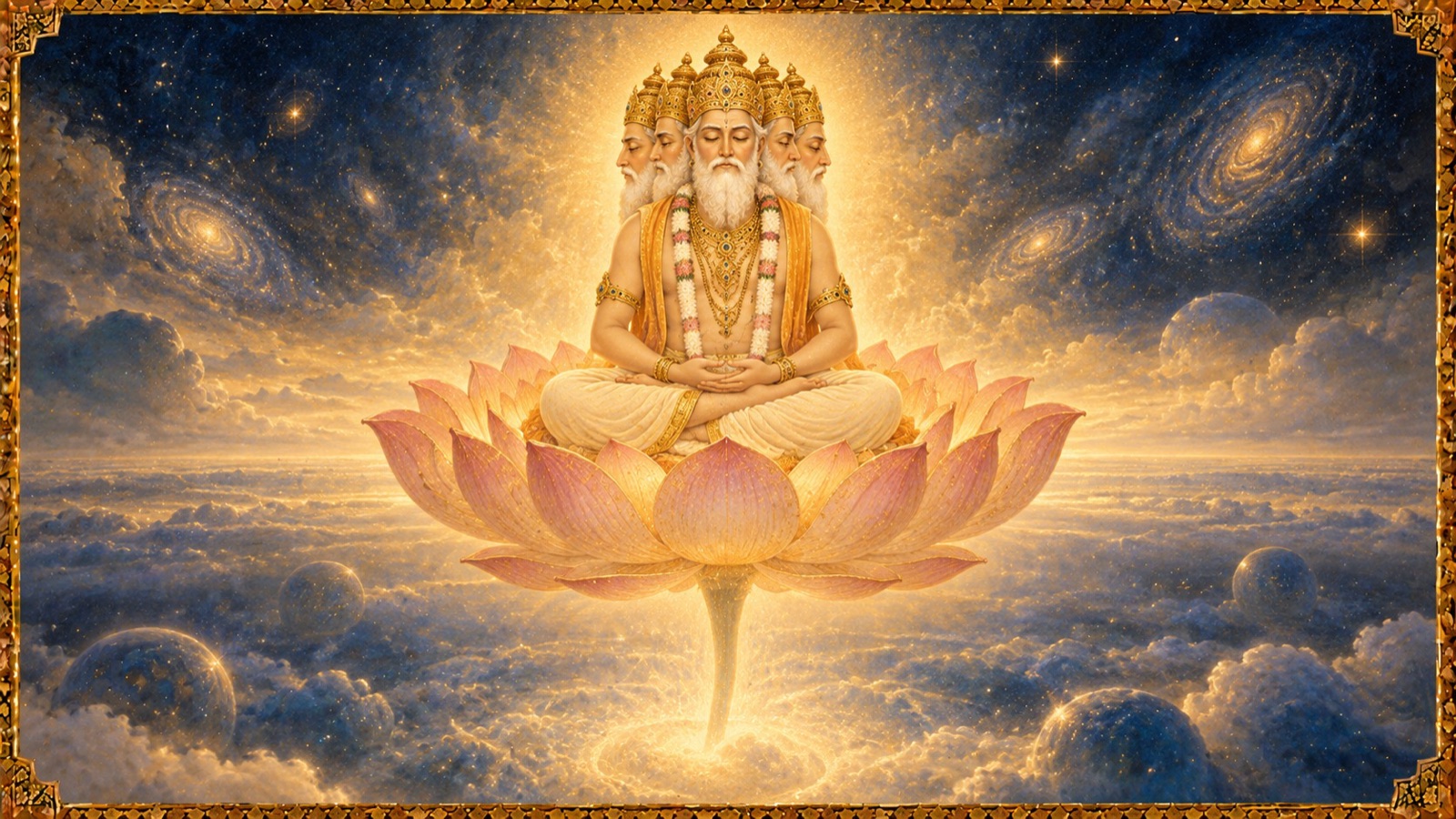
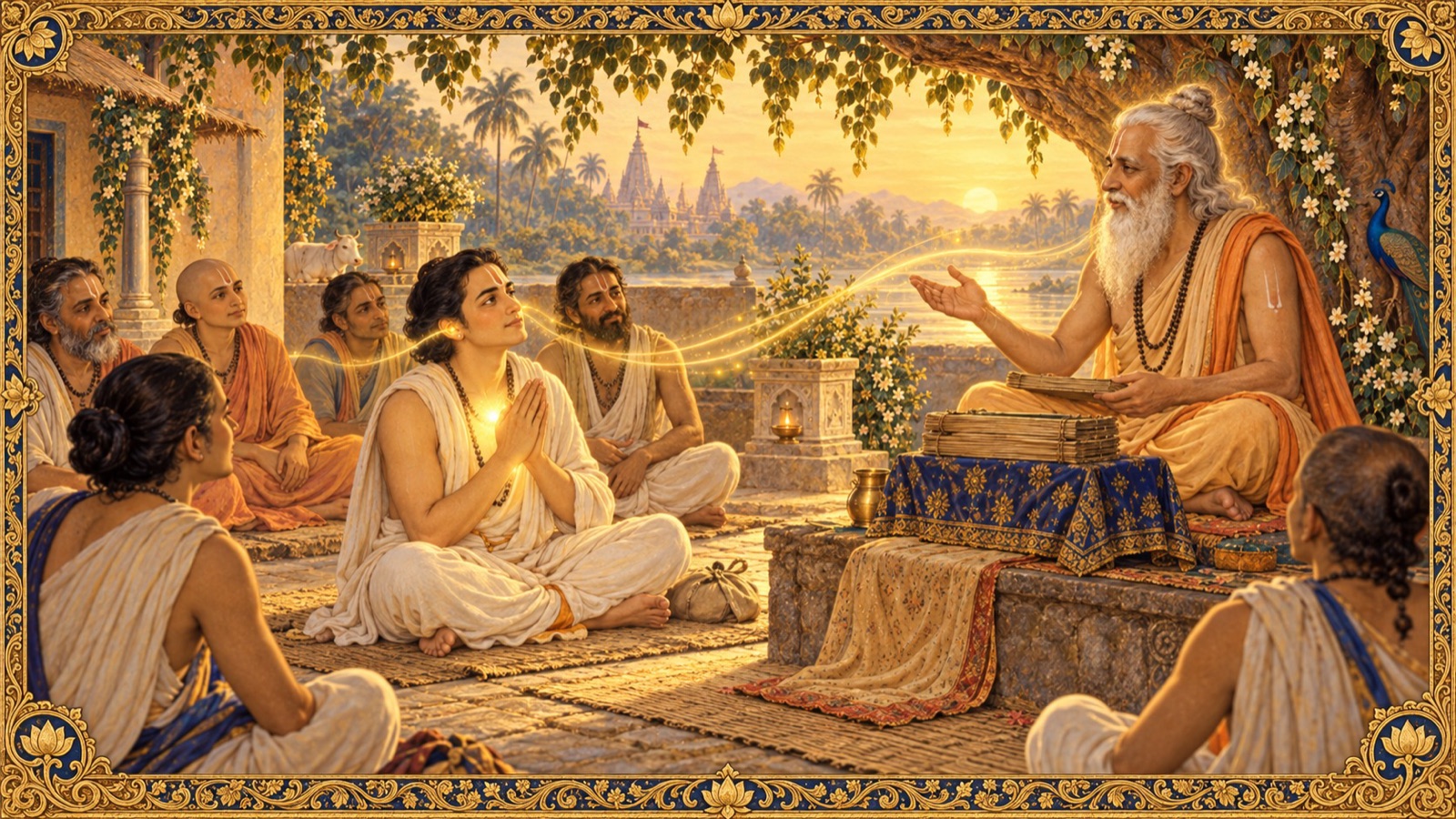
Lord Brahma, seated in deep meditation on the Lord’s cosmic form, regains the forgotten knowledge of creation at the dawn of a new cosmic cycle.
Om Namo Bhagavate Vasudevaya.
Om Namo Bhagavate Vasudevaya.
Om Namo Bhagavate Vasudevaya.
Welcome to Srimad Bhagavatam Wisdom, a devotional journey through the sacred histories and teachings of the Srimad Bhagavat Mahapurana. Sukadeva Goswami’s discourse to the dying King Parikshit continues without pause. Having described, in the previous chapter, the Lord’s grossest cosmic form, Sukadeva now turns inward. He first shows how Lord Brahma, the very architect of the universe, once regained his forgotten knowledge of creation through this same concentration. He then teaches a gentler, more intimate object of meditation: the Lord’s four-armed personal form, no bigger than a thumb, seated within the heart. From there the chapter moves into the mechanics of dying consciously — how the Yogi withdraws the life-air through the body’s subtle centres — and closes with the two paths open to a liberated soul: gradual ascent through the higher worlds, or direct, immediate absorption into the Lord Himself.
Chapter Information
- Scripture: Śrīmad Bhāgavata Mahāpurāṇa
- Canto: 2 (Book Two)
- Chapter: 2 (Discourse 2)
- Chapter title: How the Lord’s gross and subtle forms are held in meditation, and the two kinds of Mukti (Liberation) — Kramamukti, gradual Liberation, and Sadyomukti, immediate Liberation
- Principal speaker: Sri Suka (Sukadeva Gosvami), continuing his uninterrupted discourse
- Principal listener: King Parikshit, and through him the sages of Naimisharanya
- Main setting: the bank of the Ganga, where Parikshit sits fasting in his final days
- Central subject: Brahma’s example of regained memory through meditation; the Lord’s personal four-armed form as an object of concentration; the yogic technique of consciously leaving the body; and the two eternal paths of liberation, Kramamukti and Sadyomukti
- Principal verse range: Canto 2, Chapter 2, verses 1–37
- Primary edition: Gita Press Śrīmad Bhāgavata Mahāpurāṇa
Continuing Without a Pause
Unlike the previous chapter, which closed with Parikshit asking precisely how and upon what object concentration should be held, this chapter carries no question from the king at all. Sukadeva simply continues speaking, verse after verse, as though the momentum of his own teaching carries him forward. Having just finished describing the Virat Purusha — the universe as the Lord’s gross cosmic body — he now offers proof that this very method of concentration works, even for the greatest being in creation.
Brahma’s Forgotten Knowledge, Restored
Sukadeva opens with a striking example. At the dawn of a new cosmic cycle, Lord Brahma, the self-born architect of the universe, found that his memory of how to create had been lost during the universal dissolution that preceded him. Through exactly this kind of concentration, Brahma regained his lost knowledge and, with unfailing vision restored, rebuilt creation precisely as it had existed before. The lesson is deliberate: if concentration on the Lord could restore the forgotten art of creating a universe to Brahma himself, it can certainly restore an ordinary soul’s forgotten relationship with the Divine.
From there Sukadeva cautions against the Vedas’ own alluring promises. Their descriptions of heavenly rewards, he says, direct the mind toward names and realms that ultimately yield no lasting happiness — the soul wanders through them as though dreaming, always expecting a satisfaction it never quite finds. His remedy is radical simplicity: connect with worldly objects only to the extent needed to maintain the body, and never strain after what destiny has not already placed within reach.
The Freedom of Needing Almost Nothing
What follows is one of the most vivid, quietly radical passages in the early Bhagavatam — rhetorical questions that strip away, one by one, the comforts most people consider necessities. When the earth itself is there to lie upon, what use is a bed? When nature has given a person arms, why seek a pillow? When the palms of the hands can hold anything needed, what use are dishes and cups? When the four directions and the bark of a tree can cover the body, why crave silken robes?
Sukadeva pushes further: are there no discarded rags on the road? Do the trees, which exist only to give to others, ever refuse their fruit? Have the rivers run dry for one who is thirsty, or the mountain caves been sealed against a seeker of shelter? And, above all, does Sri Hari ever deny protection to one who turns to Him? If none of this is true, why should the wise go begging at the doors of the wealthy, blind with the pride of their possessions? Having settled his heart on this determination, a person should adore the eternal Lord residing within as the beloved Self — for through this worship alone the seed of repeated birth and death, sown by ignorance, ceases to sprout again. Who but a beast, Sukadeva asks, could witness others suffering the fruits of their own past deeds in this hellish river of worldly life and still choose sense-pleasure over remembrance of the Supreme?
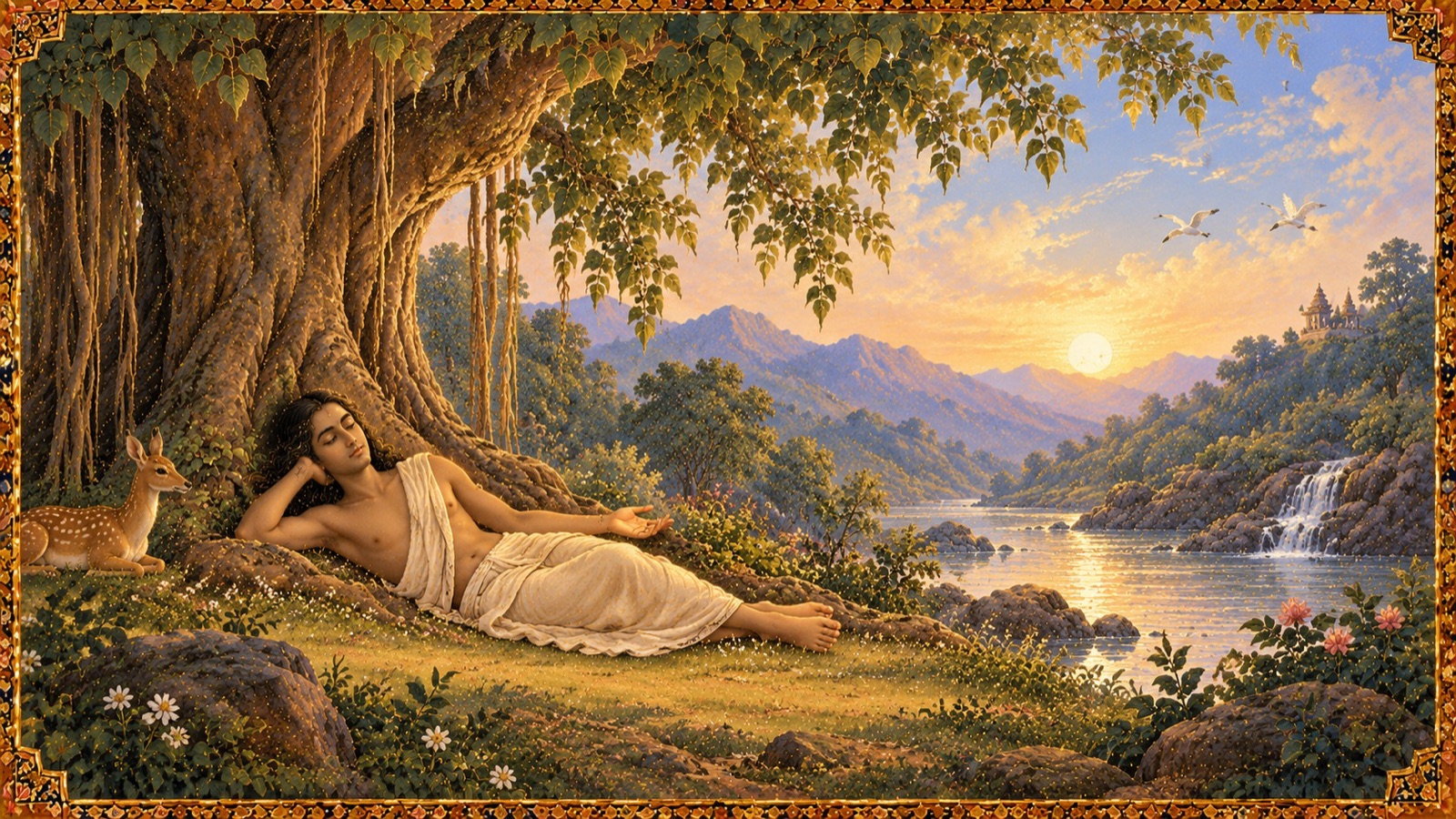
Meditating on the Lord’s Personal Form in the Heart
Having established the mind’s freedom from unnecessary want, Sukadeva now offers a gentler and more intimate object of meditation than the vast cosmic body described in Chapter One. Some seekers, he says, fix their mind on the Lord as He resides within the space of their own heart — a form no larger than a thumb, with four arms, holding a lotus, a discus, a conch, and a mace.
केचित् स्वदेहान्तर्हृदयावकाशे प्रादेशमात्रं पुरुषं वसन्तम् । चतुर्भुजं कञ्जरथाङ्गशङ्ख- गदाधरं धारणया स्मरन्ति ॥ ८ ॥
kecit sva-dehāntar-hṛdayāvakāśe prādeśa-mātraṁ puruṣaṁ vasantam catur-bhujaṁ kañja-rathāṅga-śaṅkha- gadā-dharaṁ dhāraṇayā smaranti
Meaning: Some, through concentration, remember the Lord dwelling within the cavity of their own heart in a form the size of a thumb, four-armed, bearing a lotus, a discus, a conch, and a mace. (Canto 2, Chapter 2, verse 8)
Sukadeva describes this form with evident tenderness: a cheerful countenance, eyes like fully bloomed lotuses, a garment yellow as the filaments of the Kadamba flower, gold armlets set with brilliant jewels, a crown, and radiant earrings. His lotus-soft feet are installed by masters of Yoga at the very centre of their heart’s blossomed lotus. A golden streak above His left breast marks the presence of Goddess Lakshmi; the Kaustubha gem hangs from His neck; a garland of unfading forest flowers covers His chest, and jewelled rings, anklets and bracelets complete the picture, His countenance forever lit by a smile framed in dark, curling hair. Through the play of His brows and the warmth of His glances, He pours out His grace upon the devotee who gazes on this form until the mind settles firmly into meditation.
The method is patient and systematic: visualize each limb of the Lord in turn, moving upward from the feet to the smiling face, letting the mind grow steadier as the reasoning grows clearer, and only moving on once one limb becomes vividly present. Until devotion fixes the mind on this all-witnessing Lord, the seeker should, after each day’s devotions, continue concentrating also on the grosser cosmic form described in the previous chapter — the personal and cosmic forms serving as two rungs of the same ladder.
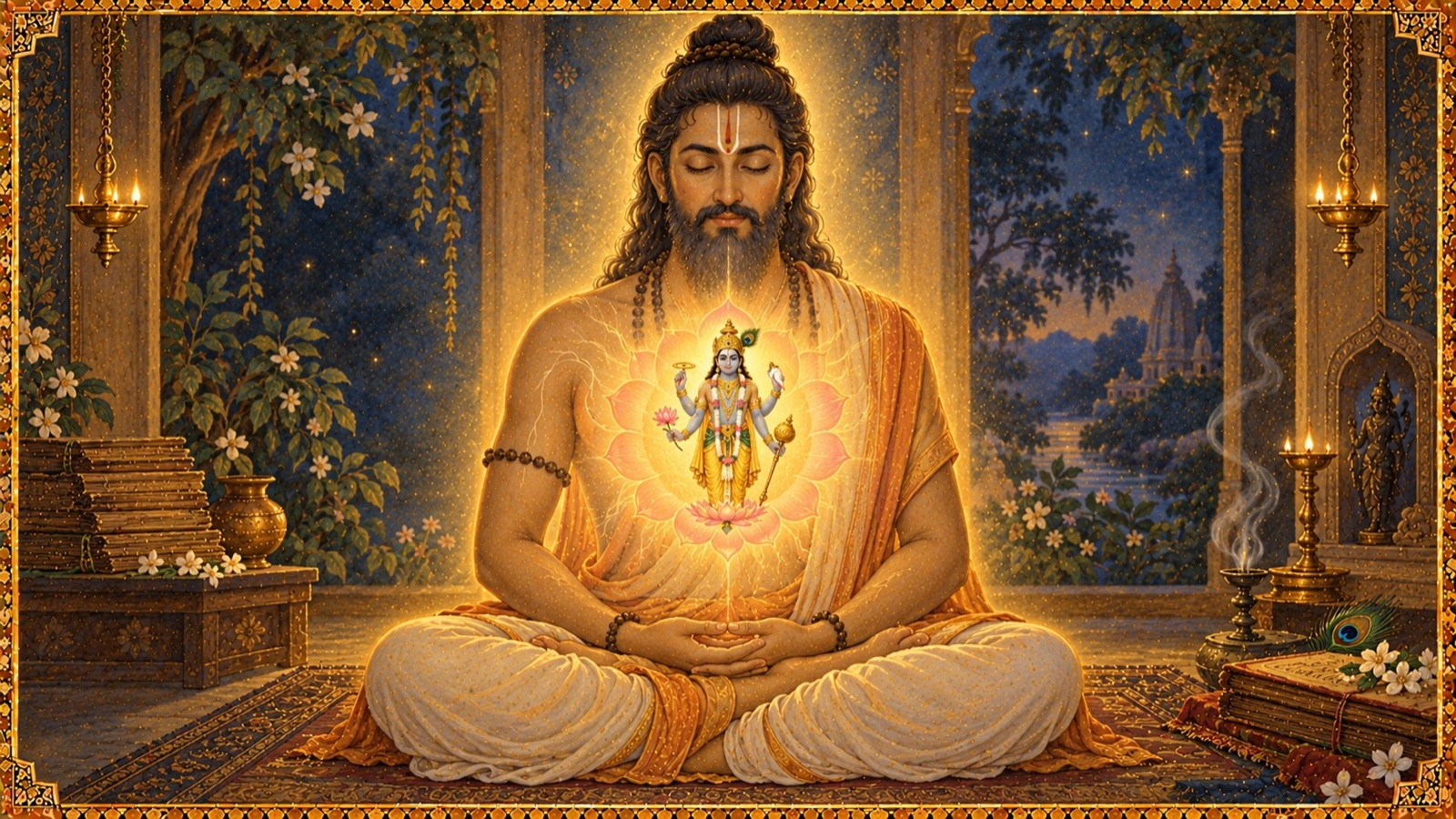
How to Leave the Body: The Yogic Technique
The chapter now turns to something startlingly practical: precise instructions for consciously leaving the body at death. When that moment approaches, the striver should not let the mind grow anxious about time or place. Seated in a steady, easy posture, breath controlled and senses reined in by the mind, the practitioner lets pure reason dissolve the intellect into the Kshetrajna — the conscious principle within the body — and then dissolves the Kshetrajna itself into the absolute Self, merging finally into the Supreme Spirit, all activity set aside. In that absorbed state, even Time, the ruler of the gods, has no power; there is no longer Sattva, Rajas, or Tamas, no ego, no cosmic intelligence — only the Yogi’s heart embracing, moment by moment, the one adorable form of Lord Vishnu that the scriptures unanimously declare to be His supreme essence.
For the Yogi whose craving for sense-pleasure has been thoroughly stilled, Sukadeva then describes the mechanics of dropping the body itself: squatting with the heel pressed against the anus, drawing the life-air upward through six mystical centres. From the navel’s Manipuraka circle it rises into the heart’s Anahata; from there, riding the Udana air, it is carried to the Vishuddhi circle above the chest and pushed to the root of the palate. With the body’s seven openings sealed shut, the life-air is drawn from the palate to the point between the eyebrows, the Ajna chakra. There the Yogi with no wish to ascend to higher worlds may pause with his gaze fixed on his goal; but if he intends union with God, he raises the air into the Sahasrara at the crown of the head and, breaking it open, abandons body and senses altogether.
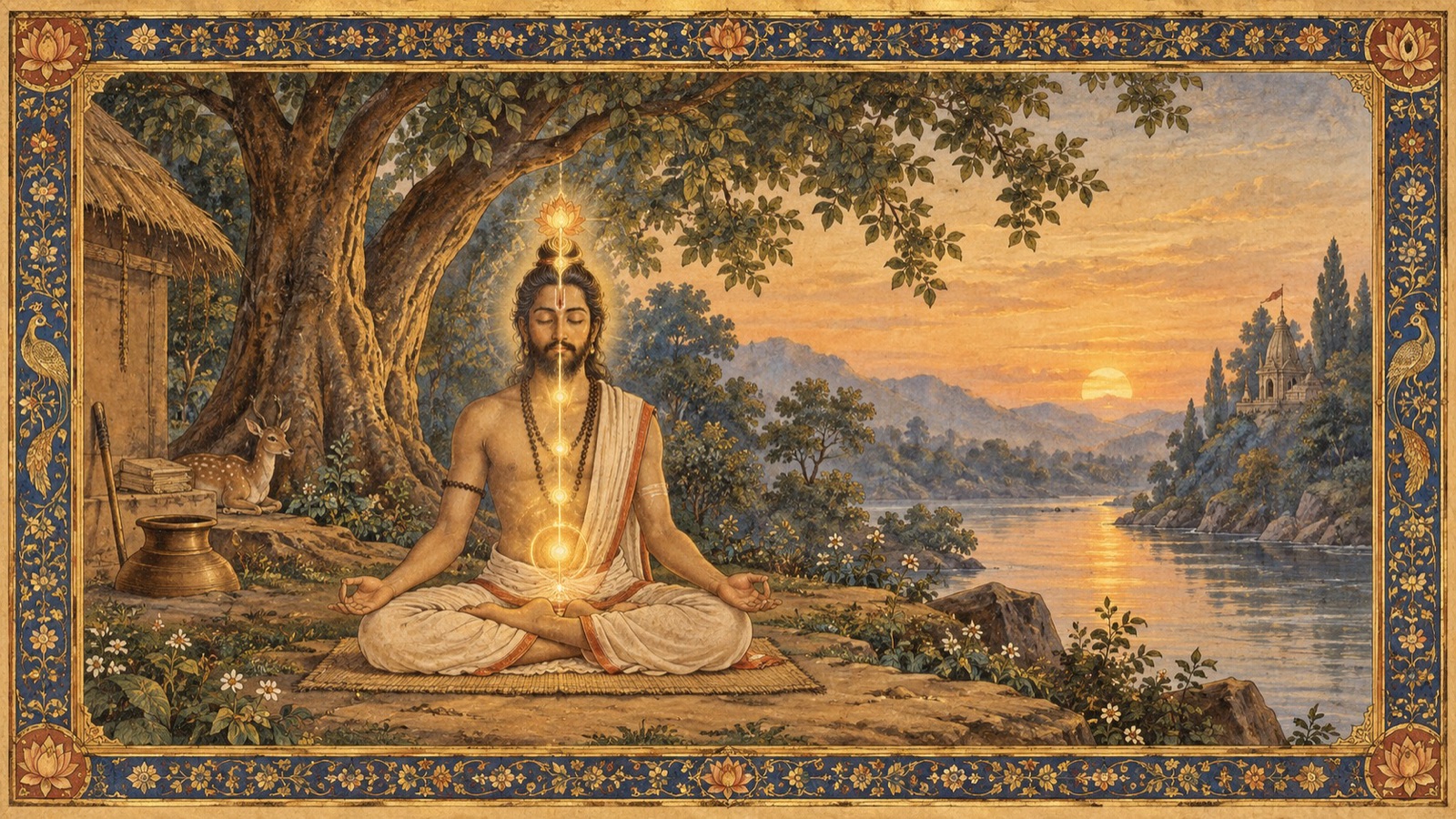
The Two Paths: Kramamukti and Sadyomukti
Sukadeva now describes the Yogi who, rather than seeking immediate union, wishes first to visit Brahma’s abode, Brahmaloka, having acquired the eight supernatural powers and desiring the company of the Siddhas who move freely through the air. Such a Yogi departs the body along the luminous Sushumna channel, rising first to the abode of Vaishvanara, the fire-god, then higher to the stellar sphere shaped like a dolphin and presided over by Lord Vishnu. Passing beyond even that — a sphere Sukadeva compares to the navel of the universe’s great wheel — the Yogi ascends in a subtle, purified body to Maharloka, home of gods who live for an entire Kalpa, a single day of Brahma.
When that Kalpa ends and the Yogi sees the world below consumed by the fire issuing from Lord Ananta’s mouth, he rises still higher, to Brahmaloka itself, a realm of the foremost Siddhas in their aerial cars, enduring for the full span of Brahma’s own life. There is no grief, old age, or death in that sphere; the only sorrow felt there is compassion for souls on earth who, lacking this knowledge, remain trapped in endless cycles of birth and death.
At the ultimate dissolution, even this Yogi’s subtle body unites first with the earth, then passes in sequence through the sheaths of water, fire, air, and ether — the five elements returning, through each sense, to their subtle origin. From there the Yogi enters the ego itself, dissolving the elements into the Tamasika ego, the senses into the Rajasika, the mind into the Sattvika, and returns through the same unwinding process to the Mahat-tattva, cosmic intelligence, and finally into Prakriti, where the three Gunas merge back into their source. When Prakriti in turn dissolves into God, the all-blissful Yogi merges with that tranquil Divine — and, Sukadeva tells Parikshit plainly, never returns again to this world of matter.
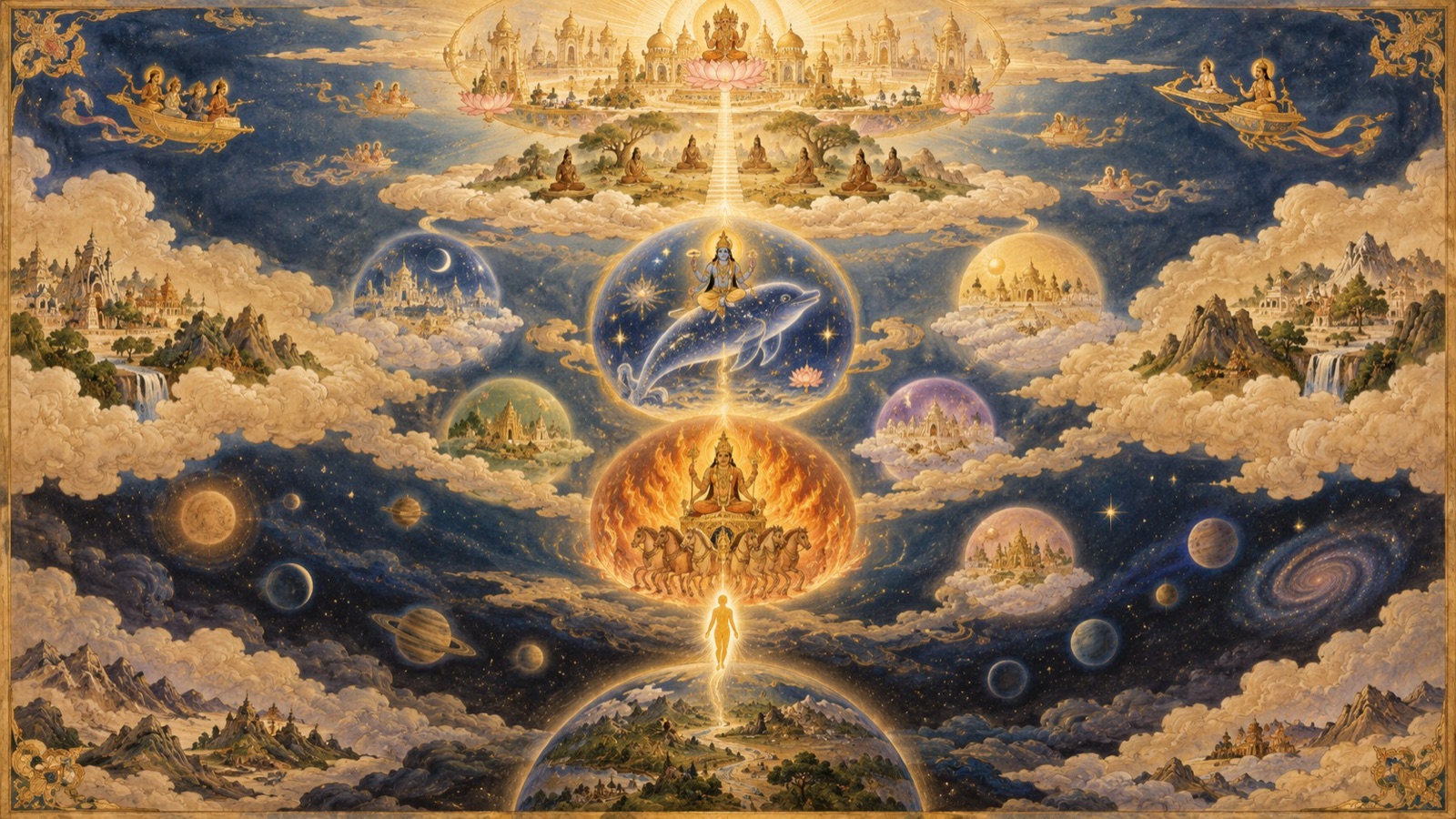
These two paths, Sukadeva concludes, are the two eternal paths taught by the Vedas, revealed by Lord Vasudeva Himself to Brahma when Brahma worshipped and questioned Him at the dawn of creation. Yet he does not leave the matter suspended between two equal options.
न ह्यतोऽन्य: शिव: पन्था विशत: संसृताविह । वासुदेवे भगवति भक्तियोगो यतो भवेत् ॥ ३३ ॥
na hy ato ‘nyaḥ śivaḥ panthā viśataḥ saṁsṛtāv iha vāsudeve bhagavati bhakti-yogo yato bhavet
Meaning: For a soul caught in this whirlpool of birth and death, no path is as auspicious as loving devotion turned toward Lord Vasudeva. (Canto 2, Chapter 2, verse 33)
This is the very conclusion Brahma himself reached after studying the Vedas three times over: that exclusive devotion to Sri Krishna is the highest virtue attainable.
Hear, Recite, Remember
The chapter’s final verses return to the theme with which Sukadeva began his whole discourse back in Chapter One: the supreme value of hearing about the Lord. Lord Sri Hari alone, he declares, abides within every being, animate and inanimate, as their very Self; the intellect and every other faculty we possess exist only as evidence pointing back toward Him, the one all-witnessing seer. Therefore, under all circumstances and with one’s whole being, a person should always listen to, recite, and dwell upon the Lord alone.
पिबन्ति ये भगवत आत्मन: सतां कथामृतं श्रवणपुटेषु सम्भृतम् । पुनन्ति ते विषयविदूषिताशयं व्रजन्ति तच्चरणसरोरुहान्तिकम् ॥ ३७ ॥
pibanti ye bhagavata ātmanaḥ satāṁ kathāmṛtaṁ śravaṇa-puṭeṣu sambhṛtam punanti te viṣaya-vidūṣitāśayaṁ vrajanti tac-caraṇa-saroruhāntikam
Meaning: Those who drink, through the cups of their ears, the nectar-like stories of the Lord and Soul of the universe, poured out by holy men, purify their hearts, contaminated as they are by sense-enjoyment, and attain proximity to His lotus feet. (Canto 2, Chapter 2, verse 37)
With this verse the chapter closes. “Thus ends the second discourse,” reads the colophon, “entitled ‘A Description of the Lord’s Divine Form,’ in Book Two of the great and glorious Bhagavata-Purana, otherwise known as the Paramahamsa-Samhita.”
Principal Teachings of This Chapter
1. Concentration truly restores what is lost. Brahma himself, forgetting the art of creation, regained it entirely through meditation on the Lord — proof that this path genuinely works (verses 1–2).
2. Real security needs almost nothing. The earth, the trees, the rivers, and the mountain caves already offer whatever the body requires; needless accumulation only invites needless labour (verses 3–7).
3. The Lord can be approached intimately, not only cosmically. Where Chapter One taught meditation on the vast universal form, this chapter offers the tender four-armed form seated the size of a thumb within one’s own heart (verses 8–14).
4. Dying consciously is a learnable discipline. Sukadeva lays out the precise stages — posture, breath, the raising of the life-air through the body’s six centres — by which a Yogi may leave the body with full awareness (verses 15–21).
5. Two paths lead beyond transmigration, but devotion is the surest. Kramamukti ascends gradually through Maharloka and Brahmaloka to final merging; yet Sukadeva insists that for a soul in samsara’s whirlpool, devotion to Vasudeva alone is the blessed path (verses 22–34).
6. Hearing the Lord’s stories purifies the heart. The chapter ends exactly where the whole discourse began — with the simple, accessible practice of listening to and reciting the Lord’s glories (verses 35–37).
A Devotional Reflection
There is a quiet symmetry in how this chapter unfolds. It begins with Brahma, the mightiest of created beings, and ends with an ordinary listener simply drinking in a story through the ear. In between, Sukadeva shows that the same discipline that let Brahma rebuild the universe can be practised by anyone willing to sit still, breathe evenly, and let the mind settle — first on the Lord’s grand cosmic body, then on His intimate form resting within the heart. The elaborate description of chakras and subtle ascents can feel technical, yet its purpose is simple: even death need not be a moment of confusion, but can become the most conscious act of a lifetime, if the mind has already learned where to rest. And should the technical path feel too distant, Sukadeva leaves the door wide open at the very end — hearing, reciting, and remembering the Lord’s stories is enough to begin purifying a heart clouded by sense-pleasure.
A Daily Devotional Practice
Set aside a few quiet minutes today. Sit comfortably, let your breath settle, and bring to mind the small, tender image Sukadeva describes — the Lord dwelling within the space of your own heart, no bigger than a thumb, His countenance gentle and smiling. You need nothing more than this to begin. Softly repeat the holy name, “Om Namo Bhagavate Vasudevaya,” and let that quiet inward gaze be your offering for the day, exactly as this chapter teaches: hearing, reciting, and remembering Him.
Conclusion
The second chapter of the Second Canto carries Sukadeva’s discourse forward from the vastness of the cosmic form into the intimacy of the heart and the precision of a dying soul’s final moments. Brahma’s own example proves that concentration truly restores what forgetfulness has taken away. A life stripped of needless want becomes free to rest in the Lord residing within. The technique of consciously leaving the body shows that death, too, can be approached with discipline rather than dread. And when Sukadeva sets the grand path of gradual liberation beside the simplest path of all — devotion to Vasudeva — he leaves no doubt which one he recommends. The chapter that began with the mightiest being in creation closes with the gentlest instruction: simply hear, recite, and remember, and let that remembrance purify the heart.
May the divine wisdom of Srimad Bhagavatam awaken pure devotion within our hearts.
Om Namo Bhagavate Vasudevaya.
Jay Shree Madhav.
References and Attribution
- Primary edition: Gita Press, Śrīmad Bhāgavata Mahāpurāṇa (English, complete), Book Two, Discourse 2, pages 89–95.
- Series: Srimad Bhagavatam Wisdom · Biswa Sanatan Dharma Seva Trust.
- Presented following the spiritual guidance and recommendation of Pandit Dr. Shri Kashinath Mishra.
This is an original, faithful retelling in the writer’s own words, with brief quoted verses shown in Devanāgarī and transliteration and their meanings given as summaries. It is not a reproduction of any single publisher’s continuous translation or commentary. No affiliation with or endorsement by any publisher is implied.
Jay Shree Madhav